EuroMed2026: The Sentence a Record Cannot Write
On presenting Paper 79 at EuroMed2026, what eleven institutions' records actually carry, and the three places the proposal breaks
Christopher Banks presented Paper 79 at EuroMed2026, the 11th International Conference on Digital Heritage, organised by a UNESCO Chair at Cyprus University of Technology with Heritage Malta, on 3 November 2026. The conference ran online from 2 to 4 November, and the paper was given in Session 5, digital documentation and knowledge extraction. Its title was "What a Knowledge Graph Cannot Say It Has Not Looked For: Declared Absence as a Typed Entry in Cultural Heritage Provenance."
The paper is about one sentence a provenance record cannot currently write down.
We looked for this, and we did not find it.
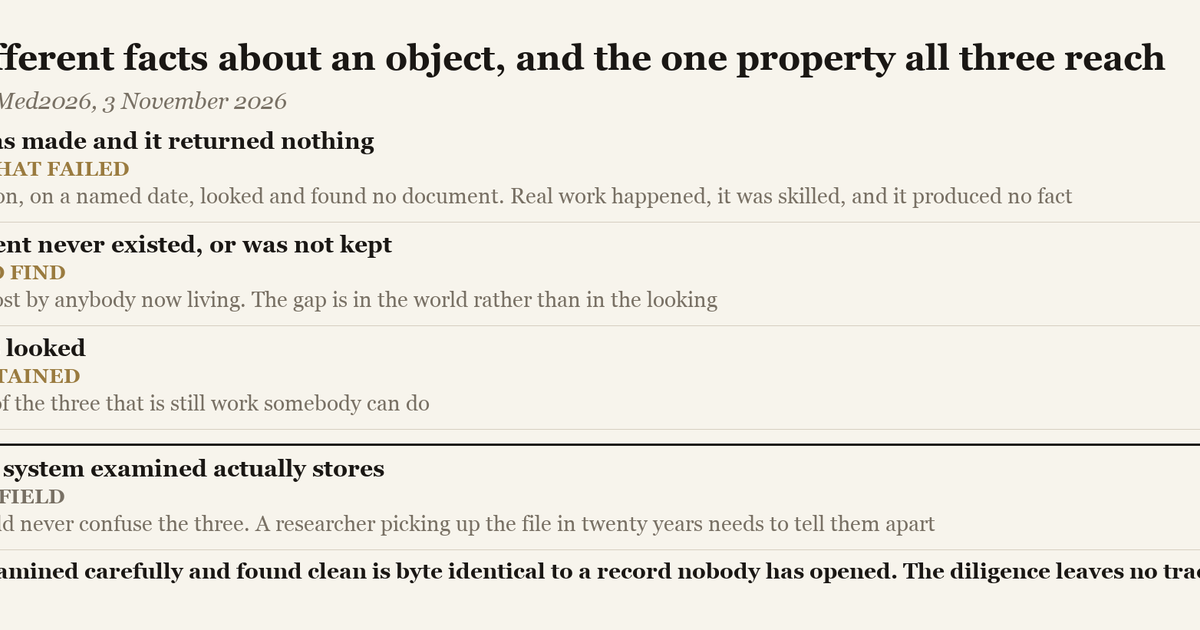
Three different facts about an object reach a record as the same thing. A search was made, by a named person, on a named date, and it returned nothing. The document was never created, or was created and never kept. Nobody has looked. A curator would never confuse those three. A researcher picking up the file in twenty years needs to tell them apart, because only the third is still work somebody can do. In every system we examined, all three serialize as the same missing property.
The consequence is that a record examined carefully and found clean is byte identical to a record nobody has opened. The diligence leaves no trace. It is invisible to the next person and invisible to every machine downstream. That is the one result a provenance record has no way to carry, and it is not a hard result or a disputed one. It is the ordinary result of ordinary work.
What the measurement found
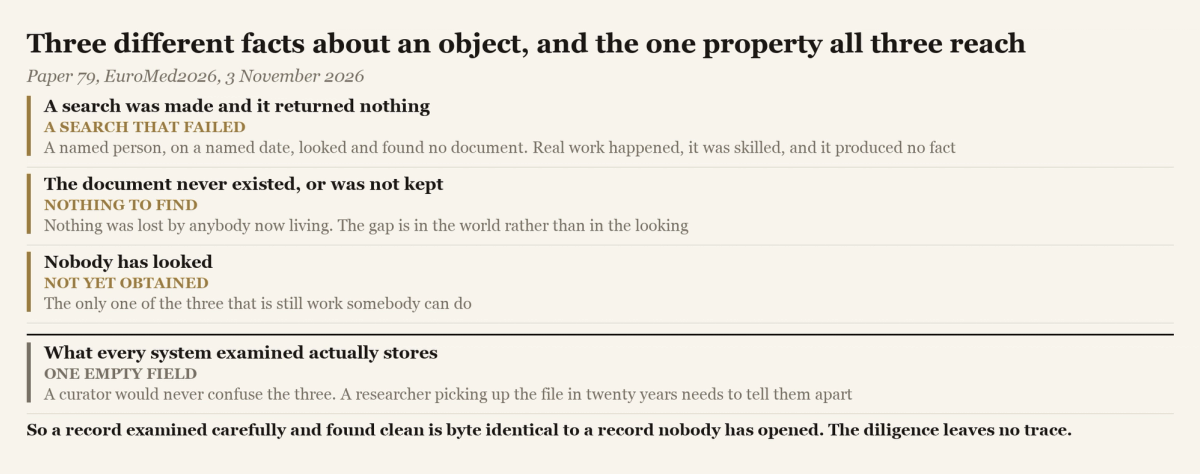
We wanted the size of the problem before proposing anything, so we measured. Of the institutions surveyed, four of eleven publish custody in a machine-readable form at all.
The clearest case is the Metropolitan Museum of Art: fifty-seven fields in the public API, fifty-four columns in the bulk download, and provenance in neither. We want to be precise about what that means, because the obvious reading is the wrong one. The provenance is not missing. The Met has it, it is excellent, and you can read it on the object page. It is prose. It is not addressable. No query reaches it and nothing downstream can reason over it.
In one national corpus of 81,543 objects, 0.18 percent declare a search that failed and 2.75 percent name a holder who has been anonymised. So a withheld party is about fifteen times more common in that corpus than a declared failed search. We find that figure genuinely surprising and we are going to state it, not explain it. These institutions have a vocabulary for we know who and we will not say. They have almost none for we looked and found nothing. The second is the far more common event, and it is the one that goes unrecorded.
Across two Linked Art deployments covering 120 objects there are zero typed custody events. Provenance is carried as a sentence with a label on it. This is not a defect anybody has been caught in. It is a design position and its architects state it openly: Linked Art models what it can model well and declines to over-specify the rest. That is deliberate and it is defensible. The point here is narrower. If custody is not typed then a gap in custody cannot be typed either. The absence inherits the shape of the thing it is the absence of.
What the paper proposes
A gap becomes a typed entry instead of a blank. The entry carries four things: which kind of absence this is, why, who could still close it, and when it was last checked. The fourth is doing more work than it looks, because an absence with a date on it tells you whether it is worth looking again.
It asks nothing new of the model. No new class and no new property. The act of looking is an E13 Attribute Assignment. Who looked is an E39 Actor through P14. When is an E52 Time-Span through P4. The object is the entity it was assigned to, through P140. The four terms are an E55 Type through P2, and the note carries who looked, where, and what came back. The whole proposal lives in one place: P141 assigned, with no filler. The assignment happened, it is dated, it is attributed, and it resolved to nothing. That absence is the record.
Where this actually stands
It was heard by the CIDOC CRM Special Interest Group in October 2026, as issue 723. It was left open, and the group asked for further cases, not further proposals. Outside implementations are zero. Nobody is using this but us.
The three places it breaks
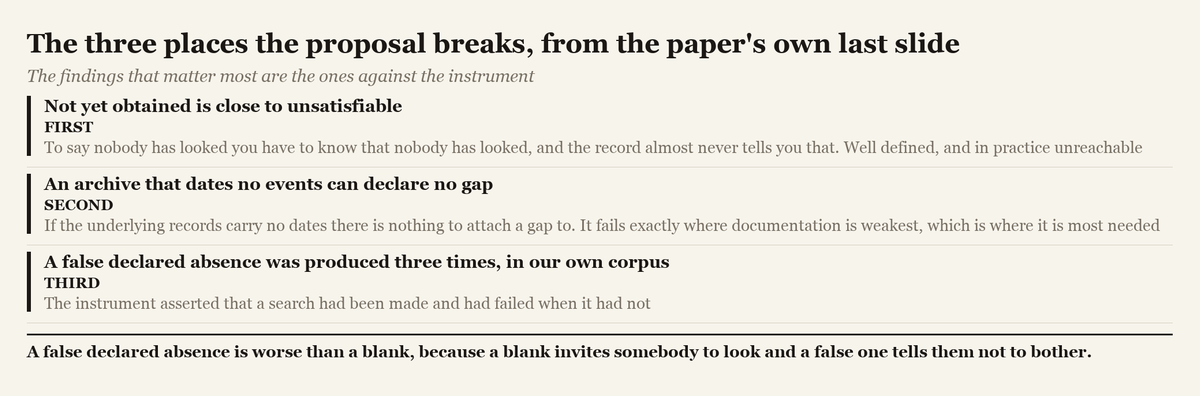
The last slide of the paper was given to the findings against its own instrument, because those are the ones that matter most.
First, not yet obtained is close to unsatisfiable from the record. To say nobody has looked you have to know that nobody has looked, and the record almost never tells you that. The state is well defined and in practice it is unreachable.
Second, an archive that dates no events can declare no gap. If the underlying records carry no dates, the proposal has nothing to attach a gap to. It fails exactly where documentation is weakest, which is where it is most needed.
Third, and this is the one that should worry a reader: we produced a false declared absence three times in our own corpus. The instrument asserted that a search had been made and had failed when it had not. A false declared absence is worse than a blank, because a blank invites somebody to look and a false one tells them not to bother.
What it offers
Three things. A vocabulary. A measurement baseline, so the next person does not have to count from nothing. And a set of open problems, the last of which we would like other people to take apart.
The specification is at objectsofaffectioncollection.com/lacuna under a Creative Commons licence. You need nothing from us to use it.
Objects of Affection Collection is a research institution concerned with the relationship between people and the things they keep. It does not authenticate, attribute, appraise or value objects. A provenance record describes custody over time and is not a certificate about an object at a moment.