Miami Art Week: Four Facts in One Empty Field
A work is offered for sale. Beside it sits a history: who made it, when, where it has been, who has owned it. Some of that history is established. Some of it is not. The question this study asks is narrow and practical, and it is about the paperwork rather than the object: when the record reaches a buyer, what does it actually say about the parts nobody has established?
What does a gap in provenance mean? Read strictly, almost nothing: that the record carries no value for that period. It does not tell you the object changed hands improperly. It does not tell you anybody tried to find out. Those are the two readings people reach for, and the record supports neither.
The answer, in the standard form such a record takes, is that it says nothing at all. Not because the information is suppressed, but because the form has nowhere to put it: a history stops, resumes later, and leaves the reader to supply the meaning of the interval. How often that happens, across the market as a whole, is a frequency nobody has measured and this study does not assert one.
A blank is four different facts wearing one face
Consider a chain of ownership that runs to 1931 and picks up again in 1964. Four quite different things could be true of those thirty three years.
Somebody may have looked and found nothing, and concluded that nothing survives to be found. Somebody may have looked, found nothing yet, and expect the answer to be in an archive that has not been consulted. The question may not arise for this object at all. Or nobody may ever have looked.
These license four different actions by the next person to read the record: stop looking, keep looking, ask someone else, or start from the beginning. An empty field gives all four the same appearance. A reader cannot tell a gap that was searched and found empty from a gap nobody has examined, so the reader cannot tell which of the four they are holding.
Which leaves the question a buyer actually has, which is how do you know whether provenance was actually researched. From a conventional record, you do not. The research and the absence of research produce the same document. You can ask the seller, and a good one will tell you, but the answer travels in conversation rather than in the file, so it does not reach the next keeper and cannot be checked by anyone who was not in the room.
This is not a complaint about carelessness. It is a property of the form. The record has no place to put the information, so the information is not recorded, and the fact that it is not recorded is itself invisible.
What a record can state instead
Objects of Affection Collection publishes an open specification for provenance records, Lacuna, version 0.11 of 8 November 2026, under a CC BY license, with a DOI at 10.5281/zenodo.22063353. Its central requirement is a single move, and the whole of the rest follows from it.
A gap is not a null, a blank, or a flag. It is a row, of the same kind as every other row, and it must state which kind of absence it is and why. Three states are defined, and each one is defined by what it tells a reader to do next: unknowable, meaning the fact cannot be recovered by anyone, so stop looking; not_applicable, meaning the question does not arise for this object, so stop asking; and not_yet_obtained, meaning the fact exists and has not been collected, which is to say that this is work, and it can be closed. An entry in that last state has to name who could close it and carry a date to look again.
The test that governs the vocabulary is that each member licenses a different action. A vocabulary whose members produce identical behavior is one state wearing several names, and a fourth member was withdrawn from an earlier version on exactly that ground.
Two things are worth saying plainly about what this does and does not claim. An absence entry describes the record, not the world: it says what this keeper, on this date, could establish, and a later record that supplies the value supersedes it rather than contradicting it. And it is not a confidence score. Nothing here rates how likely a history is to be true. It states whether anybody has looked.
The trade already has language, and it is not this
It is reasonable to object that the market has handled this for a century. "By repute." "Said to have been." "Attributed to." Condition reporting. Due diligence language. A reader fluent in the convention, the objection runs, reads a searched gap and an unexamined one differently, and the problem described above is a problem only for readers who do not know the idiom.
That objection is the strongest one available, so it was tested as a proposition to defend rather than one to attack. It was put to this institution's dialectical chamber, which is a panel of eleven language model agents arguing from assigned positions, with the trade's claim as the thesis they were asked to hold. All eleven disputed it. Their finding was that such phrasing "does not constitute a sophisticated linguistic protocol for differentiating provenance gaps," and that the terms function instead as general indicators of incomplete documentation and of research roadblocks. The reading material they worked from was public provenance guidance published by museums and university libraries.
That is internal, model generated reasoning, and it is not independent corroboration. It is reported here with its method because of what it is evidence of and what it is not.
What it did: the objection was given the best position in the room, held by eleven arguers reading the sector's own published guidance, and it lost on that guidance. Not one documentation page consulted defines these terms as marking the distinction between a searched gap and an unexamined one, and that is a result rather than a disavowal. It is the reason this study treats the question as live instead of answered.
What it did not do: establish how the trade actually uses these phrases in practice. That would take a survey of practice, and this institution has not run one. The museums whose guidance was read are not parties to the finding and have not been asked about it.
That is the right reading of what the language is for. These are qualifiers on a claim that is being made: they tell you how firmly the record stands behind an attribution or a report. They are not statements about the record's own method. "Attributed to" qualifies a claim. It does not say whether anybody searched for a better one.
What the published record looks like when you measure it
The clearest place to see this is the secondary market, because the record is published and can be read without asking anyone for access.
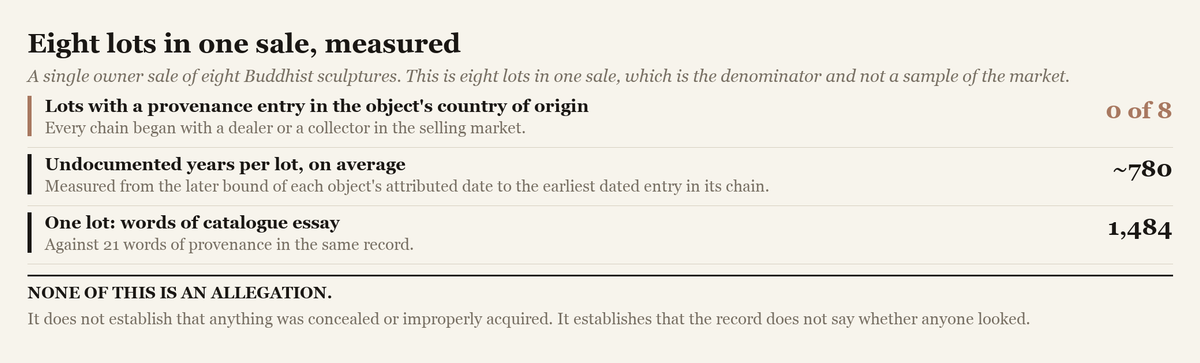
In a published study of a single owner sale of eight Buddhist sculptures, this institution measured the provenance of each lot. In eight of eight, no chain contained an entry in the object's country of origin, and each began with a dealer or a collector in the selling market. That is eight lots in one sale, which is the denominator and not a sample of the market. Measured from the later bound of each object's attributed date to the earliest dated entry in its chain, the records left on average roughly 780 years undocumented per lot. One lot carried 1,484 words of catalogue essay against 21 words of provenance. In the title chain of another, the phrase "by repute" was doing load bearing work.
Those figures are this institution's own measurement, and the method is stated with them so that anyone can disagree with the method rather than with the number. What they are not is an allegation. Nothing in them establishes that anything was concealed, that anything was improperly acquired, or that anyone failed in a duty. They establish something narrower and, for this question, more useful: that the record does not say whether anyone looked.
One dealer, two museums, and no way to see it
An andiron made in New York between 1795 and 1810 sits in Gallery 724 at the Metropolitan Museum of Art, object number 60.58.2. Its published provenance, read from the museum's own object page on 10 November 2026, is one line:
Gerritt Van Wagenen, New York; descended in his family; Ginsburg and Levy Inc., New York, until 1960.
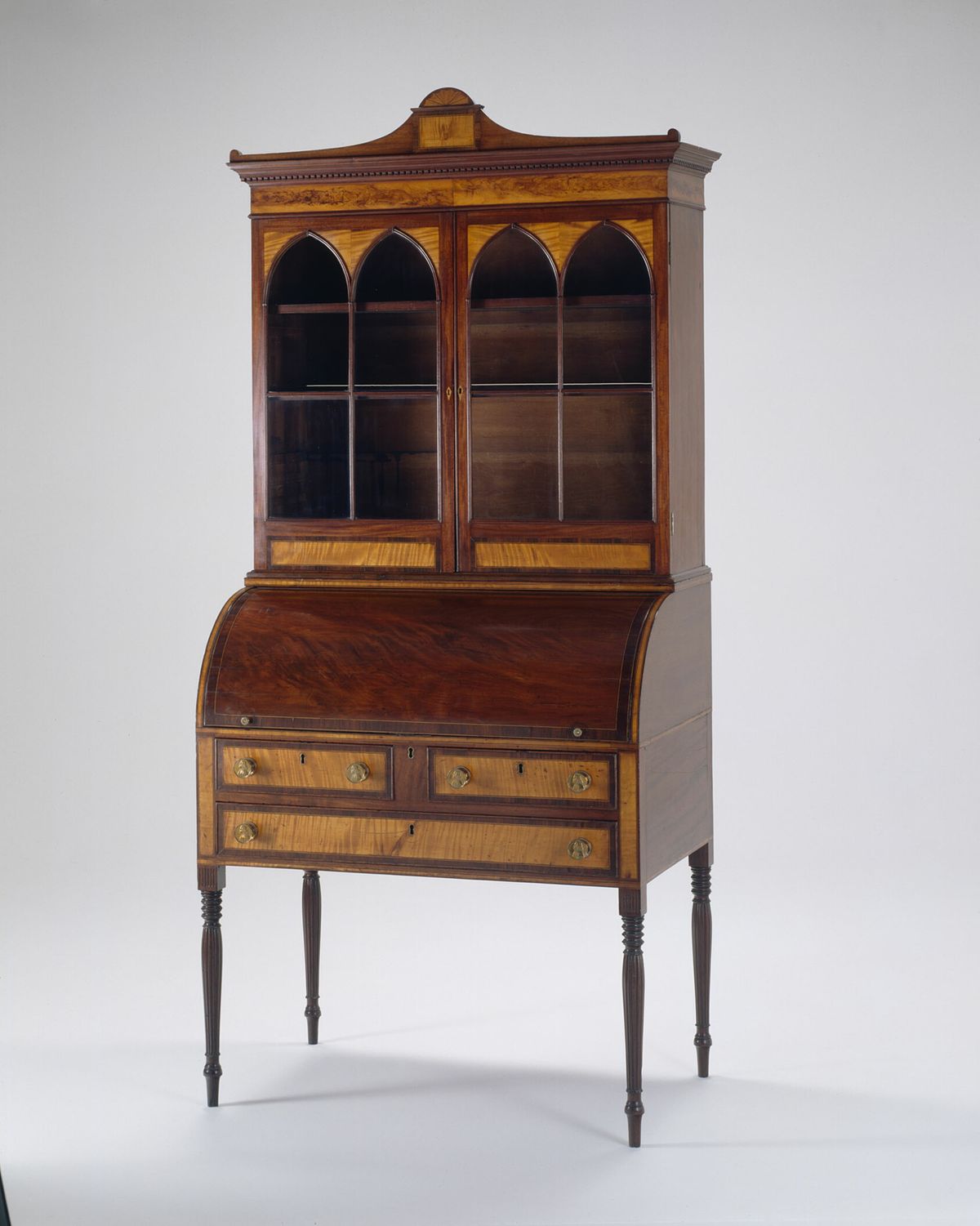
The desk above carries the same firm. The Art Institute's record for 1957.453 reads "with Ginsburg and Levy, Inc., New York, N.Y., by 1957". One New York dealer, two objects, two museums, three years apart, and the connection is visible only to somebody holding both paragraphs at once. Neither institution publishes the dealer as a field, so nothing can be sorted, counted or joined on it. A researcher asking a reasonable question, which objects passed through this firm, has no way to ask it except by reading.
That is not a complaint about either museum, and the Met is a useful case precisely because it publishes so much. Measured on 10 November 2026 across a sample of seven objects, the museum's public collection API carries no provenance field at all. Not an empty one. The key is absent from the schema, while the same payload returns the medium, the dimensions, the gallery number, and identifiers linking the object to two external authority files. The provenance exists, it is careful, and it is published for a person to read rather than for a machine to query. Seven objects is seven objects and not the collection.
And the andiron's line carries the shape this study keeps meeting. "Descended in his family" is a transfer with no date, no name and no end, exactly as the desk's first entry has no span. Both are honest sentences. Neither says whether anyone looked for more.
The limit is in our own specification, and it is the open question
It would be convenient to end here, with a form that solves the problem. The specification does not solve it, and says so in the section that exists to keep its own silence from reading as completeness.
What a record should say when a search finds nothing is the part this specification leaves open. A search of a named source that returned nothing is a dated fact about that source, and it is the evidence on which unknowable rests and the work by which not_yet_obtained is closed. The specification carries that fact in a prose field. Prose cannot be found, counted, or checked for repetition, so a second researcher cannot see what the first one already tried. The negative search, which is the whole substance of the distinction this study is about, survives in the record as a sentence and not as data.
That is the question Objects of Affection Collection filed with the CIDOC Conceptual Reference Model Special Interest Group, which maintains the model published as ISO 21127, as issue 723 on 14 September 2026: what a record should say when a value was sought and not obtained. It sits with the group's working party on application guidelines. Verified on 10 November 2026, it is open and the group has not settled it. The filing proposes no new classes and asks, in its least expensive form, only for a sentence confirming that an existing construct may document a search that assigned no value.
What is not known, which is where this study ends
Every measurement above comes from the secondary market. Auction records are published. Catalogues are archived. A researcher can read a thousand of them without introducing themselves to anybody.
The primary market is the other half, and it is not published. In the first week of December the galleries, dealers and makers who write the first version of an object's record will be selling in Miami, across the fairs that make up Miami Art Week. This study is published ahead of that week and does not report on it.
What a seller in the primary market can state about an object in front of them has not been measured, by this institution or, as far as it has been able to establish, by anyone. A work offered at a booth is offered by someone who may know the maker, may have commissioned the piece, may hold the correspondence, and may be the first keeper of its record rather than its fourth. The distinction this study is about may be easier there, or it may not exist there, or it may be recorded in a way nobody has written down. Nothing above answers it.
That gap is the reason this is a question and not a report. It is also, by the standard this study has been arguing for, a not_yet_obtained rather than an unknowable: the fact exists, it has not been collected, and the people who could close it are the ones who write the records.
Objects of Affection Collection does not authenticate, attribute, appraise or value any object, and takes no position on the ownership, origin, export or return of any work mentioned here. It makes no claim that any object named or described in this study has a defective history, and none is alleged. Where a record is described as silent on a question, that is a statement about the document and not about the conduct of any party.