Two Refusals: The Estate Sale and the Coat of Paint
The estate sale, the coat of paint, and what a maker exempted from each
Standfirst: Two found-object works perform, in miniature, the two processes this framework names. One shows a history being taken off an object deliberately. The other shows a history that was lost at the exact moment the vocabulary predicts. In each the artist exempted a single object from the process, and the reasons she gives are evidentiary rather than sentimental.
---
I. The definition that predicted the object
Narrative Permanence, in this institution's vocabulary, is the capacity of an object to maintain a coherent account of its own existence across time. The definition carries a test and a warning, and the warning is specific:
A story its current holder happens to know is not permanent; it is a memory, and memory does not survive an estate.
That sentence was written to describe a structural risk. It names the estate as the point of failure because an estate is where custody disperses faster than knowledge travels: objects move to new holders in a single transaction, and the person who could say what each one was does not move with them.
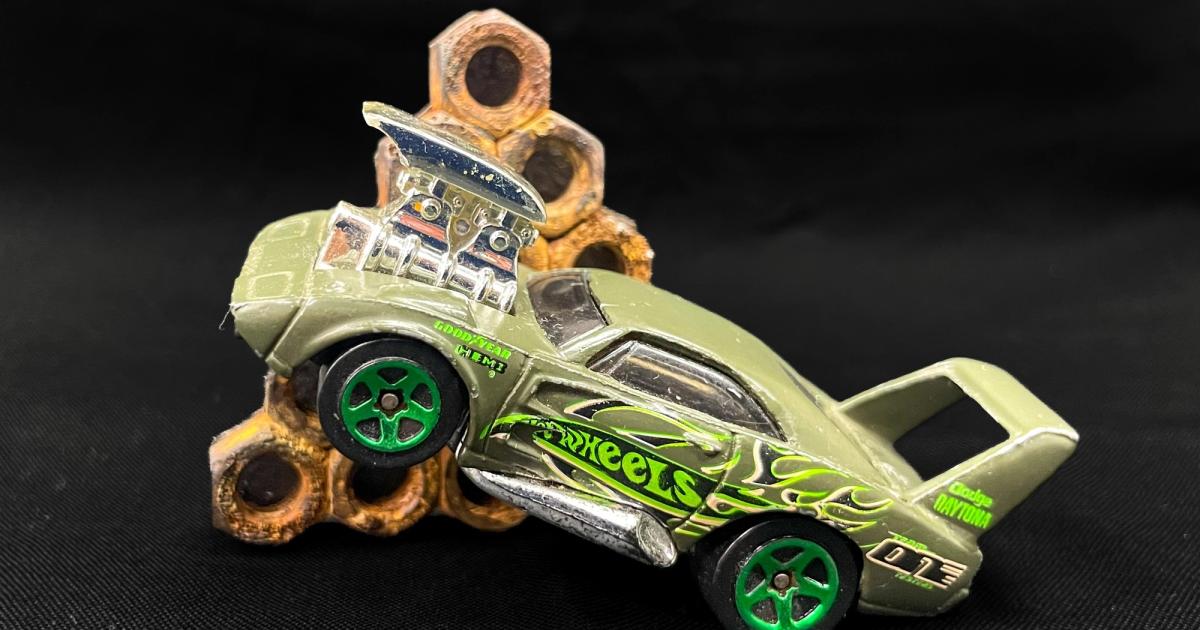
The nuts stacked on the rear of a Hot Wheels car in Hallie's brooch The Flip Side came out of an estate sale. Her grandfather Arnie's farm in Minnesota was sold, and the contents went with it. She has the objects. She does not have the account, and she is precise about the shape of what is missing: not one unknown but three.
I don't know the individual history of those nuts, what they were originally used for, how long they had been there, or if they were attached to something. I just know they came from my grandfather's barn.
The definition did not describe her object because anyone looked at it. It describes a mechanism, and her object is an instance of the mechanism running to completion. The account did not survive the estate. What survived is hardware, a place, and a man's name.
II. The failure is not that nobody knows. It is that nobody can.
There is a distinction the specification this institution publishes exists to enforce, and the brooch holds both sides of it at once.
The Hot Wheels car has a custody history that can be stated in full. It belonged to Cole, the artist's neighbor and childhood friend, who passed in an automobile accident before he was twenty-one. After he passed his grandfather offered her his old toys, among them the ones the two of them had played with as children, and she accepted. There is a prior holder, a transferring party, a cause, and a circumstance. Every element a record wants is present, and one of them, the transferring party, could still be asked.
The nuts have none of that and cannot acquire it. Arnie has passed. The farm is sold. The tub of hardware that held them, which she remembers as waiting for its next project, was dispersed with everything else. No party exists who could close the question, which makes this an absence of a different kind from the car's. One is a record that happens to be complete. The other is a record that has reached its limit.
This distinction is the reading of this institution rather than a statement the artist made. She described the two objects and the difference between what she knows about each. The claim that one absence is terminal and the other is not follows from her account; it is not quoted from it.
III. Hollowing, performed deliberately and at small scale
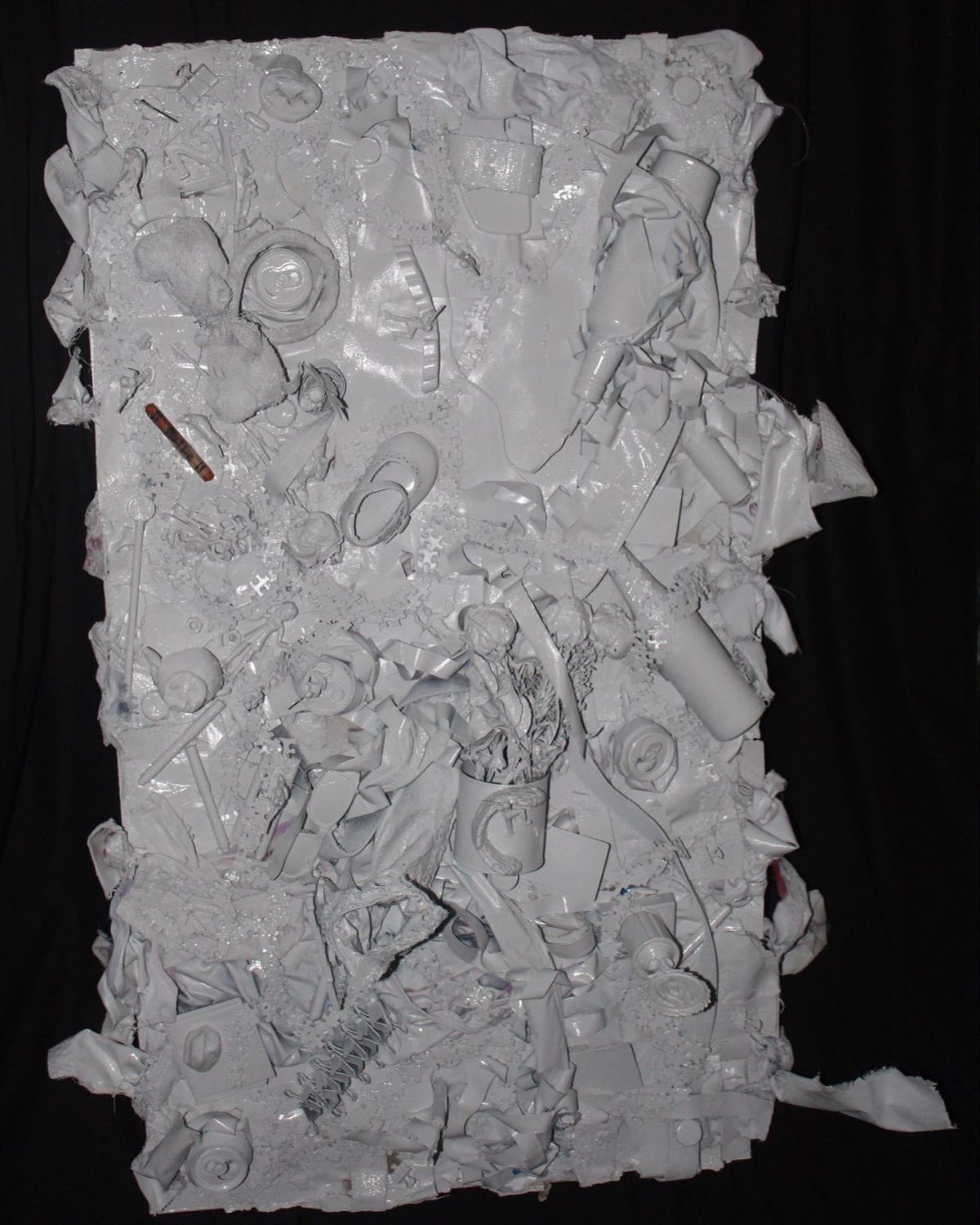
The second work, Golden Child, is a white relief. Its field is discarded packaging, caps, lids, crumpled plastic, doll clothes and shoes, figurines, puzzles, headphones, beer cans she associates with sitting and listening to her father Wayne, a painting she made him for Father's Day in pre-K that he kept and that came back to her, an American flag he had sold through his business and later took back, a cork board sheet woven through it, and desk supplies belonging to her mother Shelly, who worked a desk job for the state of Louisiana.
Every one of those objects arrived carrying a history. Then it was painted.
A Hollowed Object, in this vocabulary, is one stripped of its original semantic content while retaining the exterior signs of value. The definition is usually applied to luxury goods, where hollowing happens through mass reproduction, brand dilution and speculative commodification, and where it happens invisibly, because an invisible process is what allows the signs to keep working.
Golden Child performs the same operation visibly and by hand. A single coat of white takes the history off everything it covers. The objects remain, their shapes remain, and what they were is gone. The piece does not describe hollowing. It executes it, in a few hours, on a field of a hundred objects, and leaves the result on the wall.
What the paint removes is not the object. It is the legibility of the object. This is the mechanism the term was written for, demonstrated at a scale a person can see in one glance, by someone who had never encountered the term.
IV. One object was exempted, and the reason given is evidentiary
In the upper left of the field there is a crayon, originally red and faded to orange. It was part of her first art kit. Her mother had written on it. It is not painted, and in the photograph it is the only object in the entire field with a color of its own.
Her reason:
I didn't want to repaint it or alter it in any way. The handwriting was already telling me something that I couldn't recreate.
Read that sentence as what it is. It is not an expression of attachment. It is a judgment about evidence: a statement that a particular mark carries information, that the information is not reproducible, and that altering the object would destroy it. A conservator would recognize the reasoning before an art critic would. It is the argument against over-restoration, made by a maker, against her own method, on a single object inside a work whose entire procedure is to erase.
The crayon is also, on this framework's terms, the only object in the relief that retains Narrative Permanence. Its account survives because the account is physically on it, in a hand that can be identified. Everything else in that field is now a shape under paint, and the paint is a coat of exactly the thickness required to make a hundred histories unreadable.
V. Singularity acquired rather than produced
Material Singularity, in this vocabulary, is the condition of an object that exists as a single unrepeatable instance. The definition is careful to distinguish it from scarcity: scarcity is a decision about supply, singularity is a fact about the object, and what makes an object singular is that its production could not be repeated.
A Hot Wheels car is the opposite of singular by construction. It was made in volume, by a process designed to be invisible, and there is no useful sense in which any one of them is distinguishable from the others as it leaves the factory.
This one is singular now, and the production had nothing to do with it. It is singular because of a sequence of events: a particular child owned it, that child passed, his grandfather gave the toys to a particular friend, and she soldered it to a pin with her own grandfather's hardware stacked on its back. None of that is repeatable. The object's singularity was acquired entirely through custody, which is to say through exactly the history a provenance record exists to carry.
This is a case the framework's own definition does not quite reach, and it is recorded here as an extension rather than an application. Singularity is described there as a property established at production. The Flip Side establishes it afterward, out of events, and the record is the only thing that holds it. Remove the account of Cole and the object returns to being one of several million.
VI. The brooch that does not close
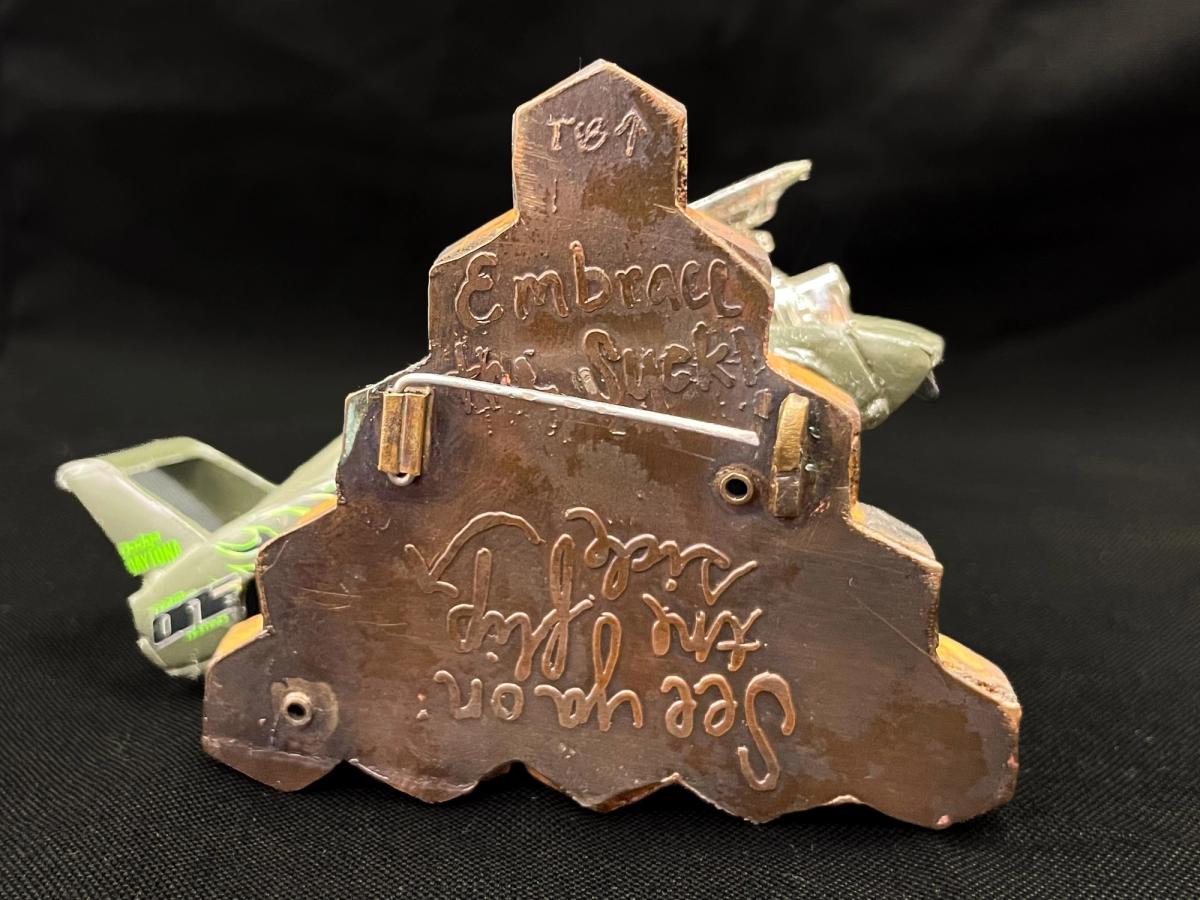
The brooch does not clip all the way, and the artist is explicit that this is deliberate and that it refers to the accident in which Cole passed.
A work that will not fasten is a work that cannot be worn without attention. It asks to be adjusted, it is noticed, and it does not settle into the background of a garment the way a functioning brooch does. The failure is the part that stays legible.
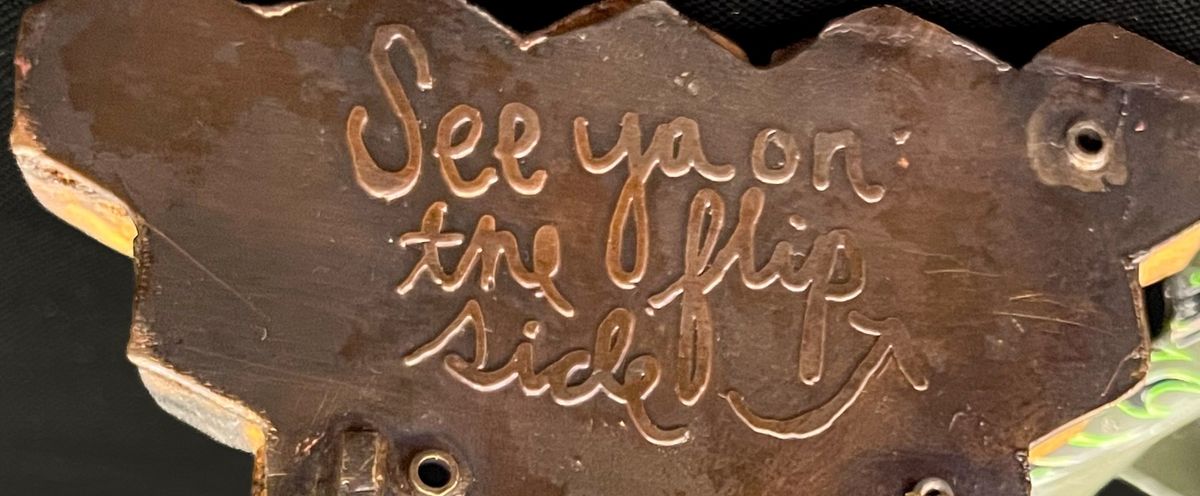
The back carries more than the clasp. Two inscriptions are cut into the copper by hand, in different lettering, and they are set at opposite orientations, so the object has to be turned over for the second to be read. The upper plate reads Embrace the Suck! Above it, on the small peak, three characters: TB, followed by an arrow pointing upward. The lower plate, inverted relative to both, reads See ya on the flip side.
The title of the work is written on the work, and the words are not the artist's. They are Cole's. See ya on the flip side is how he ended a conversation or a phone call, and in her account it was his way of saying goodbye without making goodbye feel final. Embrace the suck is what he said when circumstances got hard. The third mark she reads as To Be, the arrow standing in for continued and deliberately not spelled out, because, in her words, it "gives it a sense of moving forward and upward rather than ending."
The title did not come from a catalogue, a label or a registrar. It is quoted speech, from the person the object is about, cut by the maker into the one face nobody sees while the work is worn. And the sentence asks the reader to do the single thing required in order to read it.
This is the inverse of the move the paint makes in the other work. In Golden Child a process is applied uniformly until nothing can be told apart. In The Flip Side a single mechanism is left broken so that one thing cannot be forgotten. Both are decisions about what a later viewer will be able to read, taken by a maker who had no documentation framework in front of her and did not need one.
There is a second inversion here, and it runs between the two works rather than inside one. In Golden Child the artist refused to erase a mark that was already there, because her mother's handwriting was "already telling me something that I couldn't recreate." In The Flip Side she made one. One decision preserves evidence that arrived from somebody else; the other manufactures evidence that did not previously exist. Both are the same judgment about a later reader, taken twice, in opposite directions.
Asked what the inscriptions meant, she answered about the inscriptions and then, unprompted, about the hardware:
The nuts have an incomplete history too, you don't know what they were once attached to or what they did, but they are still here.
That sentence is the argument of this study, made by the witness, about her own object, without the vocabulary. It also joins the two halves of the brooch that the rest of this account has kept apart. The mark on the peak records a life that did not finish. The nuts record a history that cannot be recovered. Her position is that neither incompleteness disqualifies the thing from being present, which is precisely what a record that types its absences is built to say.
VII. What the specification would write down, and what it would not
This institution publishes a specification for provenance records in which an absence is a typed entry rather than a blank field. Applied to the brooch it would produce two entries of different kinds: for the car, a custody chain with a named prior holder, a named transferring party, and a stated circumstance; for the nuts, a declared absence naming the holder, the place, the dispersal event, and the three specific things that cannot be established.
What it would not do is flatten them. A record that enters the car fully and leaves a blank for the nuts has told a later reader nothing about the second object except that a field was not filled, which is indistinguishable from nobody having looked.
The artist had already refused that flattening before any of this was put to her. She placed the two on the same pin, at the same scale, and the difference between what is known about each is the readable content of the work. Her own account of why:
I like that the objects can carry those histories without me being able to know all of them.
That sentence is the argument this institution makes at length, stated once, by someone with no stake in it. The specification argues that a declared gap is not a defect. She reports it as a preference, which is a stronger position, and she arrived at it from the objects rather than from the problem.
VIII. Why this is a finding and not an appreciation
The claim here is narrow and it is about evidence rather than about quality.
Documentation systems treat absence as a failure of the record. The vocabulary this institution maintains treats it as a condition of the object that the record must carry. The second position is unusual and is argued against the first, which means it needs instances that were not produced by the argument.
Two of them are on this page. They were made by someone who had not read the specification, had not heard the vocabulary, and was not solving a documentation problem. She was making work about her family and a friend who passed. The distinctions arrived anyway, because the objects forced them: one history that can be told, one that cannot, one mark that must not be painted over, one mark cut deliberately into the back, and one clasp that must not close.
An argument that only its own authors can instantiate is a preference with footnotes. This one has a witness who was not asked to be one.