A Record That Discloses Nothing: Monet’s Iris, Four Lines of Provenance, and a Century Out of Sight

On a painting whose custody record is four lines long and complete, whose exhibition history is empty by the catalogue's own convention, and whose only published image is of an earlier version of itself
On 22 October 2026 a Monet sold in Paris for fifty million euros, about fifty six point two million dollars, against an estimate of twenty two to thirty million. It is the highest price ever paid for an artwork at auction in France. The bidding ran forty five minutes, and the sale was trailed for a month as a likely record.
That is the auction story and it is the least interesting thing on the page. The painting is an Iris, about 1924 to 1925, one hundred and sixty by one hundred and eighty centimetres, and what it demonstrates is a condition this institution has argued about objects in general and never had a case this clean for. Its record is perfect. Its record is also the record of a decision to keep it from being seen.
What Is Established, With Its Dates
The work was lot 4 in Le Temps Retrouve: The Schlumberger Collection, Sotheby's Paris, twenty eight lots, every one sold, about eighty three point seven million dollars in total and the largest fine art sale in that salesroom's history. The previous French record was Modigliani's Tete de cariatide, forty three point two million euros, Christie's Paris, 2010, as the result was reported on the night.
The canvas is stamped rather than signed. The catalogue records it as indistinctly stamped Claude Monet at the lower right and stamped again on the reverse. Monet died in 1926, a year or so after the picture was made. The mark that identifies the artist was applied by the estate, not by the hand that painted it, which is ordinary for late work and is worth saying once, because this study is about what records do and that is the first one.
The Provenance, in Four Lines
The catalogue prints the custody history in full, and in full it is four lines:
Estate of the artist. Michel Monet, Giverny, son of the artist, by descent from the above. Galerie Katia Granoff, Paris, acquired from the above. Schlumberger Collection, Paris, acquired from the above.
There are no gaps in it. There is no disputed period, no unnamed intermediary, no anonymous sale, no reconstructed attribution. One hundred years, four hands, and every transfer accounted for. Set against the other lots in the same sale, which carry chains running through Drouot auctions of 1864 and 1907, Durand-Ruel stock numbers, a Montreal railway baron and a doctor in Aix, the Monet's chain is the shortest and the cleanest in the book.
How it got into the fourth pair of hands is in the catalogue too, and it is not connoisseurship alone. Michel Monet sold a large group of the Giverny canvases to the dealer Katia Granoff. In the catalogue's words, Granoff staked everything she owned on the master's pictorial testament; in addition to mortgaging her assets, she was supported by her friend Jeanne Schlumberger, who granted her a loan. The collector's access to the painting came from being the dealer's creditor.
The Absence the Catalogue Proves Against Itself
Under each lot the catalogue prints PROVENANCE, then where applicable EXHIBITED, then LITERATURE. The headings are a convention and the convention is the evidence.
The Bonnard at lot 3 carries an EXHIBITED section: Galerie Charpentier in 1950, Galerie Katia Granoff in 1955, the Maison de la Pensee Francaise. The three Cezannes carry one: the Musee Granet at Aix-en-Provence in 2025. The Van Dongen carries one: the Musee de Montmartre in 2018.
The four Monets in the same sale, lots 2, 4, 5 and 8, carry no EXHIBITED section at all.
That is not an omission and it is not an inference from silence. It is the same cataloguers, in the same book, under the same headings, printing an exhibition history wherever one existed and printing none for these four. The control is inside the document. And the dates of the exhibitions that do appear fall either before Jeanne Schlumberger acquired the work or after her death in 1983, which is consistent with the sentence the catalogue states outright: though she was an active and generous patron throughout her life, she never lent her paintings to exhibitions.
The essay puts it more plainly still. Once hung on the walls of rue Las Cases, the works never left.
The Published Picture Is of a Painting That No Longer Exists

The LITERATURE section is two lines, both of them Daniel Wildenstein's catalogue raisonne, the standard reference for Monet: the 1985 Lausanne and Paris edition, number 1838, pages 270 to 271, and the 1996 Cologne edition, number 1838, page 872.
Both entries carry the same parenthesis. Illustrated, first state.
Monet reworked the canvas. The reference work that scholarship has used for forty years reproduces the picture as it stood before he finished with it. So the painting has been published twice and neither published image is of the painting that sold. A reader consulting the standard authority on Monet, in the standard way, in either edition, is looking at a version the artist painted over.
The catalogue raisonne numbers make the point without any argument from this institution. The painting that sold is Wildenstein 1838. W1837, Iris jaunes et mauves, is in the Musee Marmottan Monet. W1839, Les iris jaunes, is in the Musee Marmottan Monet. Both were painted in the same two years, from the same beds, in the same campaign. Both can be looked at by anyone, in colour, today, for the price of a ticket or a web search.
The number between them spent a century on a wall in the seventh arrondissement and was published only in a state the artist later painted over. Nothing distinguishes these three canvases as objects. What distinguishes them is which pair of hands they landed in, and what that pair of hands decided about looking.
Put the two facts together and the object's documentary position is unusual enough to be worth stating as a finding. Its custody record is complete and private. Its exhibition record is empty. Its published image is of a superseded state. Every channel by which a work is normally known to people who do not own it is either closed or showing something else.
The Collector Is in the Same Condition as the Painting
Jeanne Schlumberger married Marcel Schlumberger in 1909 and died in 1983. The catalogue describes a woman who avoided Parisian society and publicity, who was among the first French women to hold a driving licence, and who at seventy five took her grandchildren to the Beatles' first concert in France. Then it says this:
Very few photographs of her are known to exist.
The sentence is about a person and it describes the painting exactly. She did not sit for photographs and she did not lend pictures. The invisibility of the object and the invisibility of its owner are not two facts. They are one decision, applied to everything inside the house on rue Las Cases, and the auction record is the price of the most complete instance of it.
What She Bought, and When
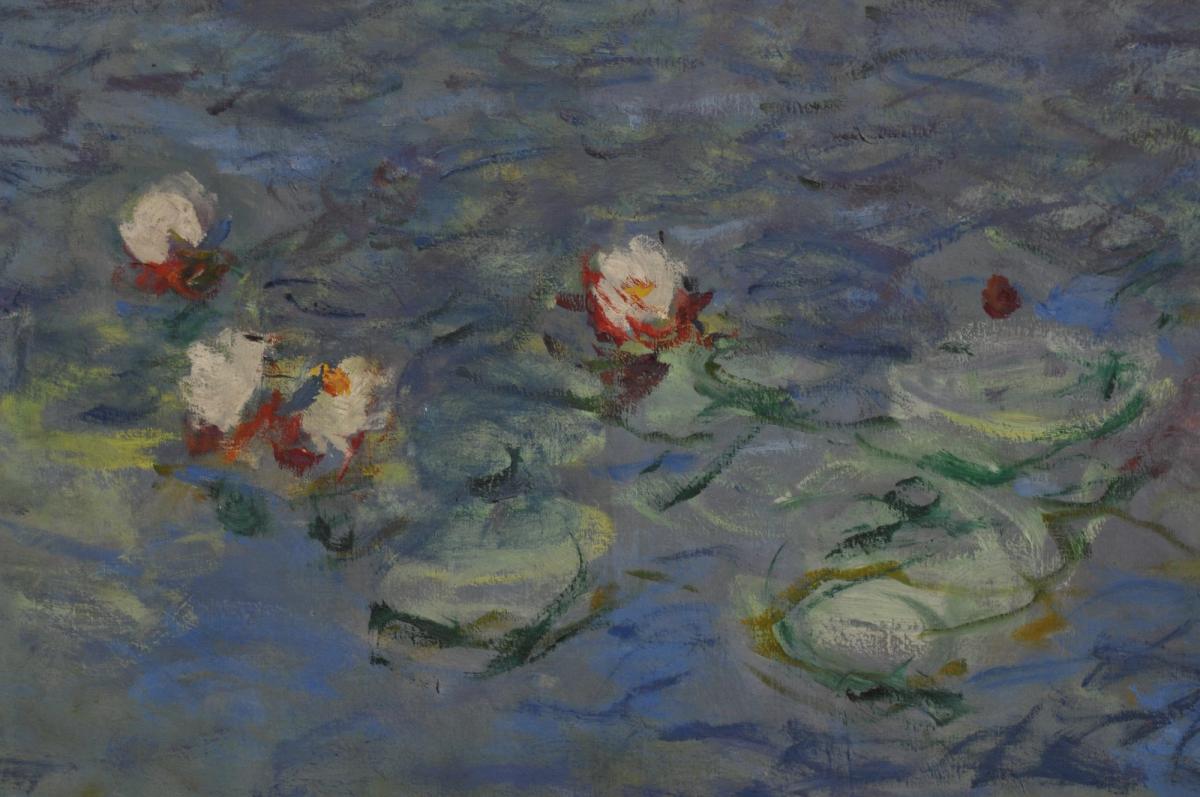
The purchase was not of a masterpiece in the sense the price now implies. The catalogue is direct about where Monet's late work sat in 1956, naming the three places it survived: the often empty rooms of the Musee de l'Orangerie, Galerie Katia Granoff, and the Schlumberger family's townhouse on rue Las Cases.
Read that list slowly. The Orangerie rooms, which now receive the Nympheas as one of the most visited interiors in Europe, were often empty. The late Giverny canvases were critically unwanted, which is why a dealer could buy a large group of them from the artist's son and had to mortgage her assets to do it.
So fifty million euros is a seventy year delayed settlement of a private judgment. Schlumberger chose this canvas, first, out of a group nobody else wanted, and then declined for the rest of her life to let anyone look at it and decide whether she had been right. The market has now agreed with a reading it was never shown.
What We Already Published, and Why This Is Not That
This institution has argued that provenance at the top of the market is not a neutral chain of custody but a legitimising infrastructure, and it made that argument about a sale in which the names in the chain, a publishing dynasty and a famous philanthropist, were doing the work. A long line of celebrated owners is an accumulation of endorsement, and the price absorbs it.
This is the inverse case and it is why it is worth publishing. Schlumberger is not a name that confers market legitimacy; she spent a lifetime making sure it was attached to as little as possible. There is no accumulation of endorsement here. There is one house, one wall, and a refusal.
What produced the number was not scarcity of ownership, which every lot in that room possesses. It was scarcity of viewing, which almost nothing possesses any more, and which cannot be manufactured after the fact. A work shown once is shown. The only way to have this property is to have had it all along, which is the definition of a condition that money cannot buy and custody can only preserve or destroy.
What Would Have to Be True for This Reading to Be Wrong
If the four Monets had exhibition histories the catalogue simply failed to print, the central evidence collapses. The reason to think otherwise is internal: the same catalogue prints exhibition histories for five other lots, including two in the year of the sale.
If Wildenstein's first state parenthesis referred to something other than an earlier version of the same canvas, the published image argument fails. It is the standard term of art for exactly that, and it appears identically in both editions, thirty years apart.
If Jeanne Schlumberger's reticence were ordinary rather than deliberate, the reading becomes sentimental. The catalogue states that she declined, that she was an active patron while declining, and that very few photographs of her exist. A patron who lends nothing is making a choice, not failing to receive invitations.
Several things this study does not claim. It does not claim the painting has literally never been seen by anyone, which would be absurd of a canvas hanging in a family house for seventy years. It claims it has no public exhibition record, which is a different and documented statement. It does not repeat the figure of eighty seven years that circulated in press coverage: that number appears nowhere in the catalogue, it reconciles with no date in the work's history, and it is not used here. It does not claim the sale price was caused by invisibility alone, since a late Monet of this scale would command a very large number in any condition. And it makes no judgment about whether withholding a picture for seventy years was the right thing to do.
What the Record Would Have to Carry
A provenance record is usually defended as the instrument that makes an object legible to people who were not there. Object Permanence, in this institution's vocabulary, is the capacity of a thing to maintain a coherent account of its own existence across time. On that account, this one has succeeded completely. Four lines, no gaps, every transfer named. If the test of a record is whether a later reader can reconstruct the chain of custody, this record passes at full marks.
And it tells that reader nothing about what the object looked like for a century, because looking was the thing being withheld. The record is complete and the thing is not disclosed. Those turn out to be compatible, which is the finding.
And the gap is not ignorance, which is what makes it worth naming. The same catalogue is sophisticated about exactly this class of problem. At lots 12 and 13 the two Soutines carry the line Galerie Katia Granoff, Paris (probably) and Schlumberger Collection, Paris (probably acquired from the above). ⭐ That is a typed uncertainty rather than a blank: the cataloguer did not know, declined to guess, and wrote the not knowing into the chain where a later reader will find it. It is the institution's own specification, practised by Sotheby's, on the same page.
At lot 20 the Delacroix provenance cites its red wax seal on the stretcher, which is physical evidence on the object carrying its own history. At lot 18 the Adam de Coster records a 1951 Drouot sale as Attributed to Adam de Coster, preserving what the work was called then rather than quietly substituting what it is called now. Three advanced techniques, in one book: declared uncertainty, material evidence, and a superseded attribution kept on the record.
A document that can do all three still has nowhere to put the fact that nobody has seen the thing. The omission is not carelessness. The category does not exist.
A record adequate to that would carry a field this one does not have. Not an exhibition history, which it correctly leaves empty, but a positive statement of visibility: when, and to whom, this object has been available to be seen. An empty EXHIBITED heading is doing the work of that field by accident, and only because a reader knows the convention well enough to notice that nothing is printed there. A declared line reading not publicly exhibited, 1925 to 2026, states the same fact and cannot be mistaken for an oversight. The difference between an absence and a declared absence is the whole of this institution's specification, and here the market's most carefully produced document relies on the first.
Coda
Sotheby's gave the lot an epigraph from Proust, whose last volume supplied the sale its name. The real voyage of discovery consists not in seeking new landscapes, but in having new eyes.
It is a well chosen line and it is pointed the wrong way round. Nobody lacked new eyes for this picture. The picture was not available to any eyes at all, and the collector who made sure of that is herself preserved in very few photographs, in a book that reproduces her painting as it looked before the artist had finished changing it.
A record can be complete and disclose nothing. That is not a failure of the record. It is what a record is for, when the person keeping it has decided that custody and visibility are different things, which is the distinction the Custodian's Contract exists to make obligations travel across, and the fifty million euros is what it costs to end an arrangement like that.