POLLOCK NUMBER 7A, BRANCUSI DANAÏDE, AND ROTHKO NO. 15: WHAT CHRISTIE'S $1.1 BILLION SALE ACTUALLY CONFIRMED
Why Christie's opening-night spectacle converted modernist rupture into canonical safety, custodial compression, and a doctrine of blue-chip permanence.
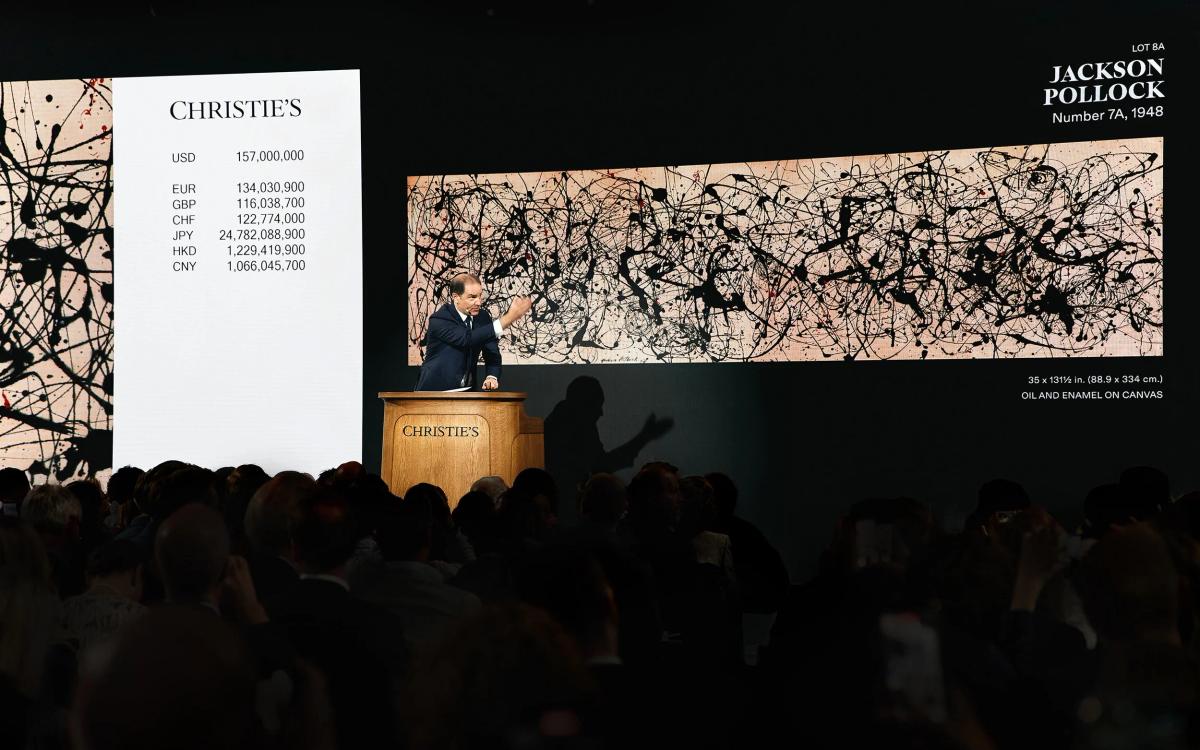
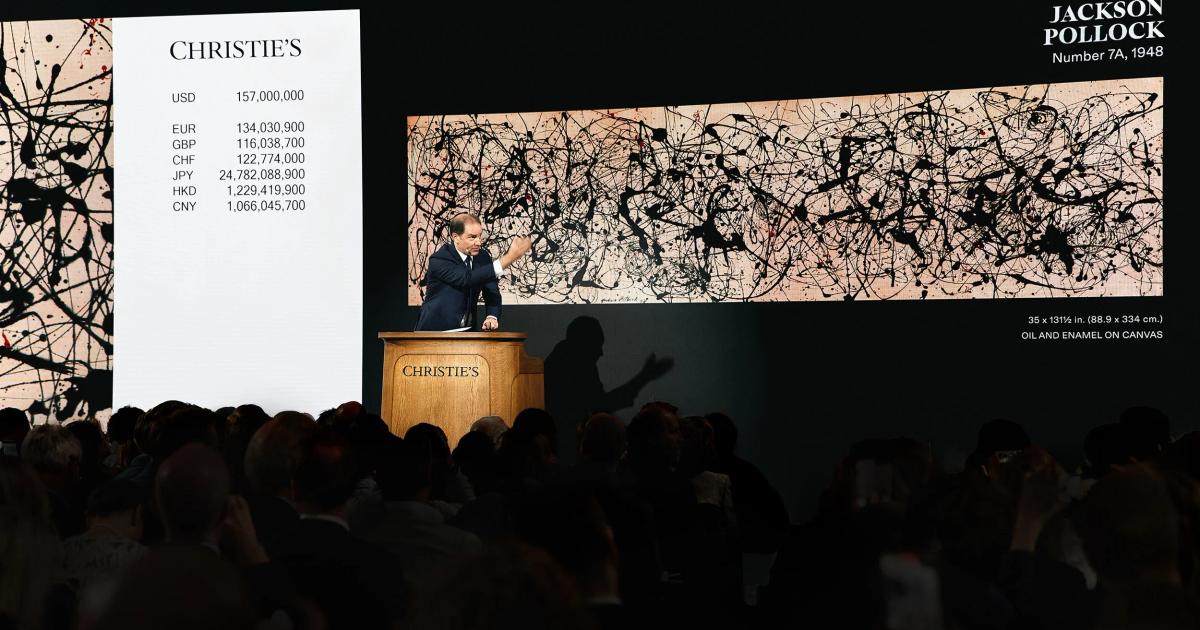
Pollock Number 7A, Brancusi Danaïde, and Rothko No. 15 were presented by Christie's as if they were simply three outstanding lots in a buoyant season. They were not. They were a tightly edited argument about what the market now trusts under conditions of volatility: not novelty, not speculative velocity, but Material Singularity, provenance density, and the museum-certified gravitas of irreversible historical breakthrough. On 18 May 2026, Christie's staged a single-night sequence in which Jackson Pollock's Number 7A, 1948 sold for $181,185,000, Constantin Brancusi's Danaïde sold for $107,585,000, and Mark Rothko's No. 15 (Two Greens and Red Stripe) sold for $98,385,000, helping drive a combined $1,121,126,500 across the paired evening sales. The event therefore deserves to be read not as a record parade but as a market doctrine: a declaration that serious capital has moved further toward canonical safety and away from the Hollowed Object.
This study argues that Christie's did not merely sell three masterpieces. It sold an entire sequence of modernist permission: Pollock as the reinvention of painting, Brancusi as the purification of sculpture, Rothko as the monetization of controlled emotional atmosphere. Read together, the works formed a theater of blue-chip inevitability. Read critically, they reveal the auction house as an institutional translator converting art-historical rupture into market reassurance.
Christie’s did not simply sell three masterpieces; it sold a doctrine of canonical safety in which modernist rupture becomes the buyer’s preferred shelter.
Pollock Number 7A and the Market for Irreversible Breakthrough
Christie's positioned Pollock's Number 7A, 1948 as more than a large drip painting. The lot essay calls it one of the first truly abstract paintings in history and a work in which Pollock finally escapes the shackles of easel painting. John Elderfield pushes the claim further, describing the canvas as a scale-free network whose fluctuating nodes and hubs make the surface read as both all-over field and open narrative history. That matters because the auction house is not merely describing an object; it is framing the object as an irreversible civilizational threshold. Once a work is narrated as a before-and-after mechanism in the history of painting, the buyer is no longer purchasing taste but accession into an origin myth. Christie's lot essay · Christie's Elderfield essay
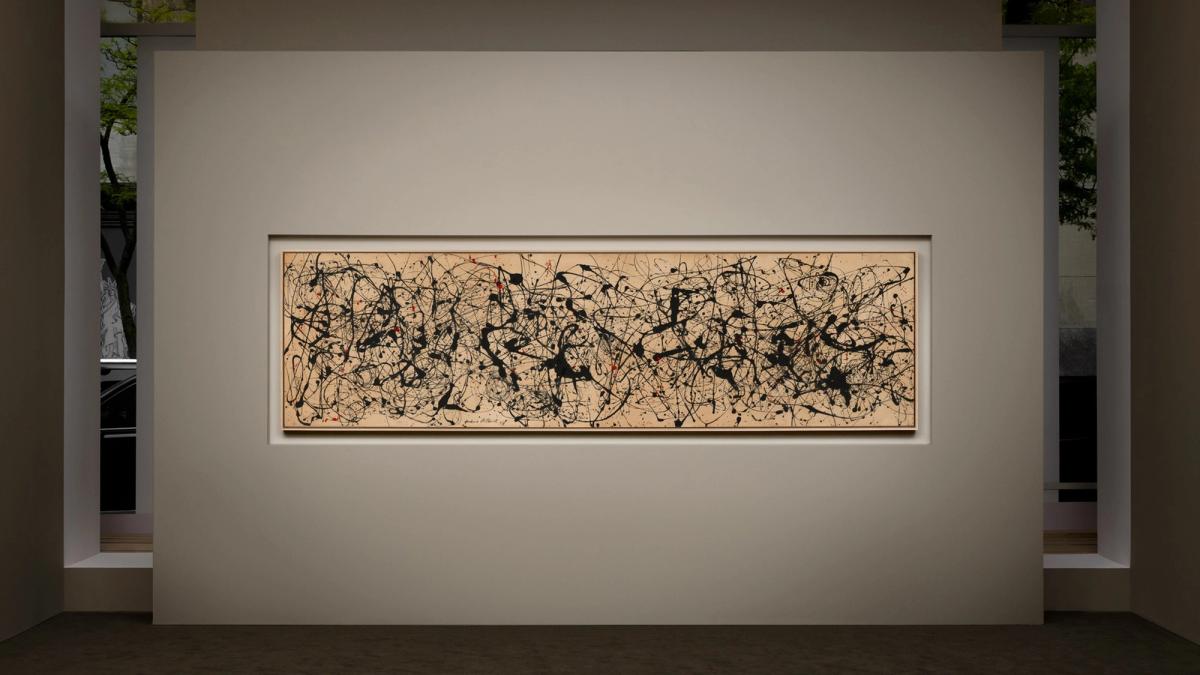
This is why the price matters structurally, not theatrically. Pollock sold for nearly triple his prior auction record, after roughly seven minutes of bidding, because the market was not evaluating a discretionary abstraction among many substitutes. It was evaluating a work framed as the moment when painting ceased to be a window and became an event. In OAC terms, the work carries exceptional Semantic Burden: technical innovation, canonical placement, scale, rarity, and a provenance chain running from Herbert Matter through John and Kimiko Powers and Alfred Taubman to S.I. Newhouse. The point is not that the painting is expensive because it is famous. The point is that fame here condenses around a procedural claim the market still treats as non-repeatable. Christie's
Pollock becomes liquid at the highest level precisely because the market believes the break he enacted cannot be repeated, outsourced, or synthetically simulated.
Brancusi Danaïde and the Geometry of Scarcity
If the Pollock was sold as a threshold in painting, Brancusi's Danaïde was sold as distilled inevitability in sculpture. Christie's cataloged the work as a bronze with gold leaf and black patina, conceived and cast circa 1913, and emphasized its extraordinary scarcity: one of six iterations, the only gilded example left in private hands, with four others in institutions. Friedrich Teja Bach's essay deepens the frame by arguing that Brancusi transforms the head and pedestal into a dialogue of curves, a rotational system in which the relationship between sculpture and support extends the work's logic of captivity and self-reference. Here, scarcity is not merely numerical. It is formal. The sculpture is offered as one of those rare moments when geometry, refinement, and early modernist reduction fuse into a single canonical unit.
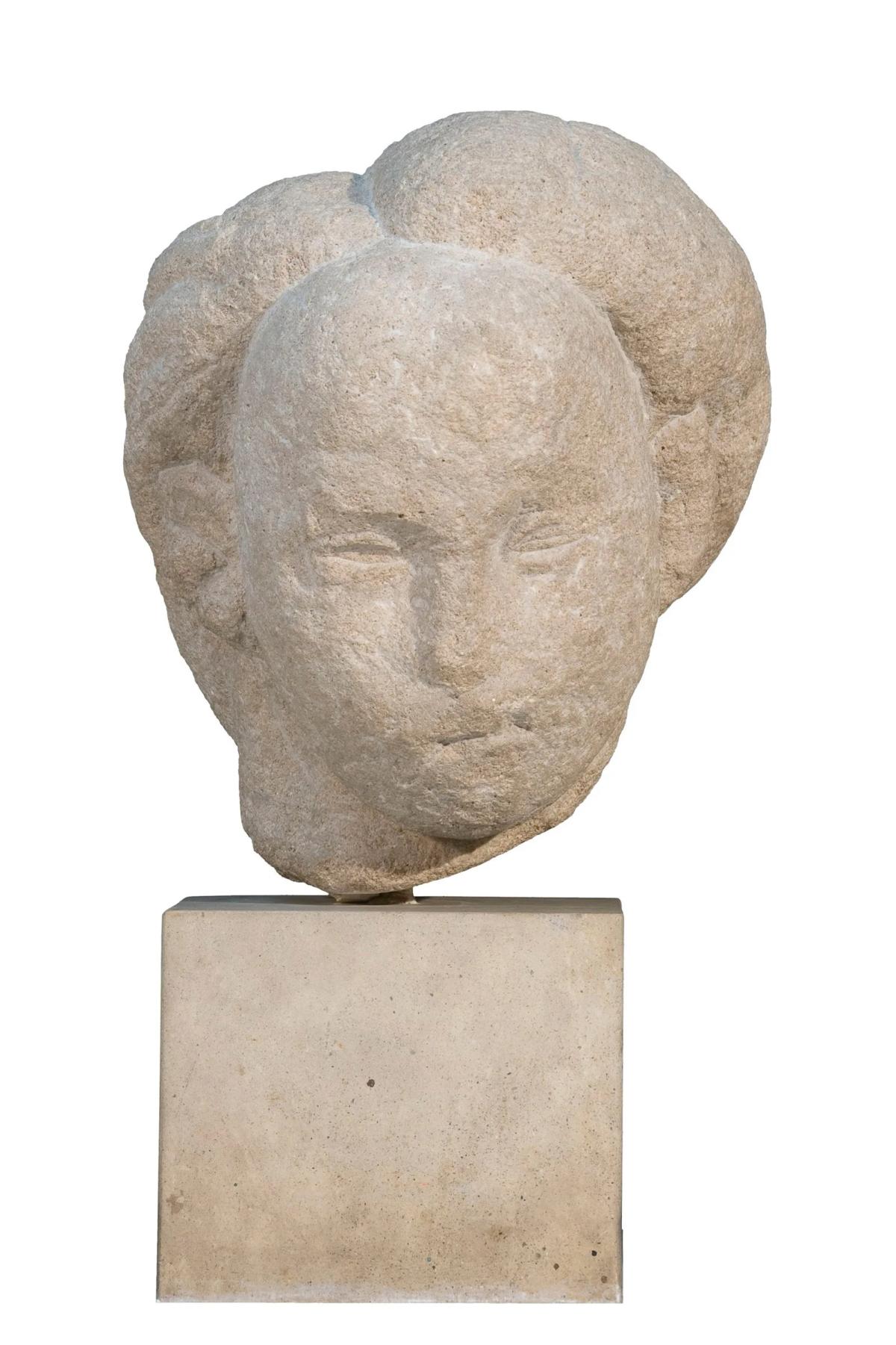
The result ($107,585,000, second only to the highest sculpture price ever achieved at auction) therefore reads less as exuberance than as compression. Capital concentrated into a work whose claim to permanence could be narrated from several angles at once: early American reception via the Meyers and Stieglitz, Brancusi's pivot from Rodinesque modeling toward essential form, the disciplined use of gold leaf, and the museum-like scarcity profile that makes private ownership feel almost temporary. In the language OAC has developed around "Material Singularity and Forensic Endurance, Danaïde does not arrive as a decorative luxury object. It arrives as a condensed archive whose aura is strengthened by the impossibility of abundance.
Brancusi’s scarcity is not the scarcity of trend inventory; it is the scarcity of a form so purified that the market mistakes stewardship for temporary custody.
Rothko No. 15 and the Monetization of Custodial Intensity
Rothko's No. 15 (Two Greens and Red Stripe) completed the sequence by translating emotional command into market authority. Christie's framed the 1964 canvas as a fulcrum in Rothko's career: a work that completes his chromatic metamorphosis, anticipates the darker later paintings, and uses scale to control atmosphere rather than merely occupy wall space. Their general Rothko guide reiterates the artist's insistence that a painting is not a picture of an experience but an experience, and that large scale creates an intimate and human encounter precisely by overwhelming the viewer. When such a work appears with direct-from-the-artist provenance to Agnes Gund, the market is not just buying a color-field painting. It is buying disciplined access to a custodial story already saturated with moral and institutional legitimacy.
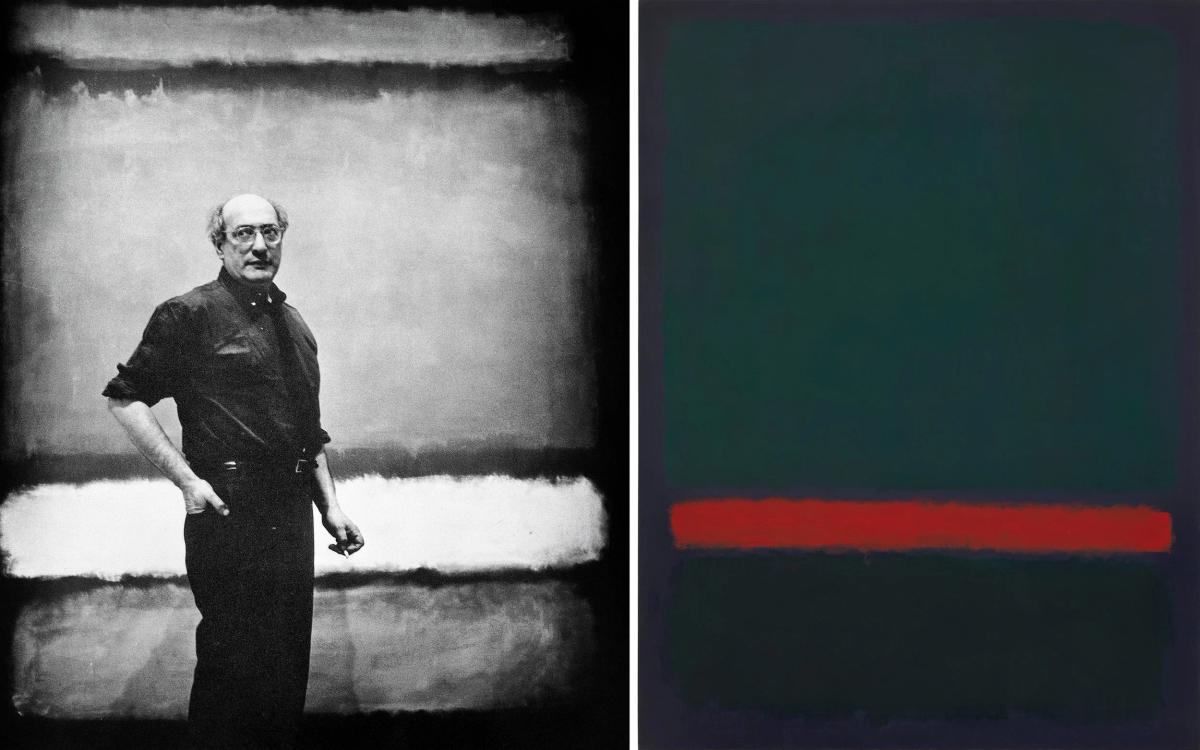
That is why the Rothko record should not be misread as a generic appetite for abstraction. OAC's earlier study of Rothko argued that his career was defined by narrative control, by an insistence that the work be encountered under conditions that protect its philosophical function rather than flatten it into décor. Christie's benefited from precisely that long custodial history. Agnes Gund acquired No. 15 directly from Rothko in 1967 and let it leave her apartment only once. The sale thus monetized not only the canvas but the accumulated ethics of its handling. In OAC terms, the work entered the saleroom already insulated by Narrative Permanence. The $98,385,000 result reads as the price of controlled intimacy entering the open market without losing the aura of being carefully held.
Rothko’s record is the monetization of a disciplined atmosphere: the market pays a premium for a work whose emotional conditions were curated long before the sale.
S.I. Newhouse, Agnes Gund, and the Collector as Infrastructure
The night also staged a subtler argument about collectors. S.I. Newhouse and Agnes Gund were not used merely as provenance markers but as legitimizing infrastructures. Christie's described Newhouse as one of the most historically significant collectors of all time and described Gund as a singular figure whose collection embodied passion, excellence, and connoisseurship. In each case, the collector becomes a relay station through which the object's meaning is stabilized for the next owner. Newhouse condenses editorial power, Condé Nast visibility, and decades of connoisseurial selection. Gund condenses museum governance, philanthropy, and a nearly priestly version of cultural stewardship. The sale, therefore, did not simply transfer objects. It transferred donor-grade legitimacy.
This is why provenance at this level is not a neutral chain of custody. It is a social atmosphere. It tells bidders that the works have already been filtered through institutions, critics, patrons, and private rooms where cultural value is rehearsed before becoming a public price. OAC's study on the economics of stewardship is useful here because it distinguishes ownership from the Burden of Preservation. Christie's, of course, cannot bind the next owner to such a contract. But it can simulate the aura of such stewardship by emphasizing how these works were previously held. The sale thus lives in a productive ambiguity: it celebrates custody precisely at the moment it reopens circulation.
Why Christie’s $1.1 Billion Night Was About Canonical Safety
Most mainstream coverage treated the evening as evidence that the high end of the market remains strong. That is true but shallow. The deeper point is that strength appeared through concentration. The paired sales reached $1,121,126,500, with 97 percent sold by lot and 99 percent by value, while the Newhouse tranche alone sold 100 percent by lot and value. This is not merely exuberant demand. It is demand organizing itself around a narrow band of works whose historical legitimacy is so overdetermined that buyers can experience price aggression as prudence. What Christie's sold was not risklessness but the feeling that risk had already been metabolized by history.
OAC has already named the broader market condition. In The Tyranny of the Archive and Luxury Just Split in Two, the archive is described as the system's successor infrastructure, and the market is bifurcated rather than healed. That framing is especially clarifying here. Christie's was not proving generalized health. It was proving that capital continues to flee toward a small number of highly verifiable cultural assets. Pollock, Brancusi, and Rothko became the night's preferred shelters because each lot could be narrated as a hard asset of historical consequence rather than a discretionary symbolic purchase.
The auction was not a referendum on the health of art in general; it was a referendum on the market’s hunger for culturally pre-secured shelter.
Record Prices, Market Compression, and the Hard-Asset Turn
Read through OAC's recent analysis of TEFAF New York, the evening appears as a continuation of the hard-asset turn. There, OAC argued that capital was abandoning frictionless spectacle in favor of resistant objecthood, forensic endurance, and provenance density. Christie's supplied the auction equivalent. Pollock offers the history of traces, Brancusi the geometry of condensed essential form, Rothko the atmospheric labor of layered pigment and scale. Each work answers to weight, history, and spatial command. None depends on trend fluency to remain legible. At this altitude, the market is less interested in image circulation than in objects that can withstand explanation.
This is where the term canonical safety becomes useful. It does not mean mere blue-chip comfort. It means the buyer believes the work has already crossed so many institutional, scholarly, and historical thresholds that future value will be defended by the density of its archive. In that sense, canonical safety is less a market category than a custody fantasy: the fantasy that one is not speculating but inheriting. The danger, of course, is that this fantasy can disguise financial necrophagy; the market feeding on its own canon to generate the optics of health. Yet that danger is precisely what makes the sale worth studying rather than simply admiring.
What Christie’s Actually Sold: Aura, Narrative, and Permission
Christie's own rhetoric makes the mechanism visible. The house said the evening showcased a century of sweeping change and radical reinvention. It described Pollock and Brancusi as two defining artists who established new benchmarks and highlighted nearly 20,000 preview visitors before the sale began. This is not incidental copy. It is the auction house presenting itself as the site where the public preview, the private transaction, the institutional archive, and the collector's fantasy are temporarily synchronized. OAC's Frick study calls this an Aura Transaction: the transfer and concentration of historical gravity through institutional staging. In the Newhouse and Gund sales, the auction house becomes the mediator that turns cultural permission into purchase confidence.
That is the competitive gap most coverage missed. Vogue-style spectacle writing can celebrate the drama of the rostrum. Market reporting can track records and sell-through. But neither usually names the structure by which the auction house bundles art history into a temporary feeling of inevitability. Christie's sold not just works but permission: permission to believe that buying into the canon at this level is a form of prudence, permission to think public significance can survive private transfer without remainder, permission to confuse rarity with ethical legitimacy. This is why the event belongs inside OAC's larger critique of how the archive is mined, staged, and monetized.
What the Record Narrative Conceals
To say that Pollock, Brancusi, and Rothko broke records is true. To stop there is to submit to the sale's preferred self-description. The record narrative conceals the degree to which the market now depends on a small repertoire of already sanctified objects to demonstrate vitality. It also conceals how dependent those prices are on the unpaid labor of art history: critics, curators, conservators, collectors, museums, and scholars who have made these works intelligible across decades. The auction house harvests that accumulated clarity in a compressed moment of exchange. The sale is therefore most revealing where it looks most triumphant. Its glamour lies precisely in how much prior public meaning it can privatize in one night.
This does not make the results false. It makes them diagnostic. Pollock, Brancusi, and Rothko performed exactly the function the present market needed from them: they stood in for durability. They reassured buyers that, amid broader uncertainty, there remain objects whose historical density can be converted into premium value with very little translation loss. The unresolved question is whether such concentration marks a durable custodial future or merely the refinement of the market's appetite for feeding on its own masterpieces. That is where the study must end: not by denying the greatness of the works, but by refusing to confuse greatness with innocence.
Coda
What this sale confirms about the PLCFA framework is simple and severe. Under conditions of volatility, the market does not abandon value; it retreats toward the densest forms of inherited meaning. Pollock, Brancusi, and Rothko became instruments in that retreat because each could be presented as a work whose archive was already too thick to ignore. Yet the sale also leaves a structural problem unresolved. If canonical masterpieces increasingly function as shelters for compressed capital, then the distinction between stewardship and extraction becomes harder to defend with rhetoric alone. The next task is institutional, not descriptive: to imagine mechanisms by which custody at this level can be bound to future public obligation rather than celebrated only at the point of transfer.
Authored by Christopher Banks, Anthropologist of Luxury, Critical Theorist & Founder
Objects of Affection Collection
Office of Critical Theory & Curatorial Strategy
469 Fashion Avenue, 12th Floor, New York, NY 10018