Finding the Heart: Objects of Affection Collection Comes Home to 469 Fashion Avenue
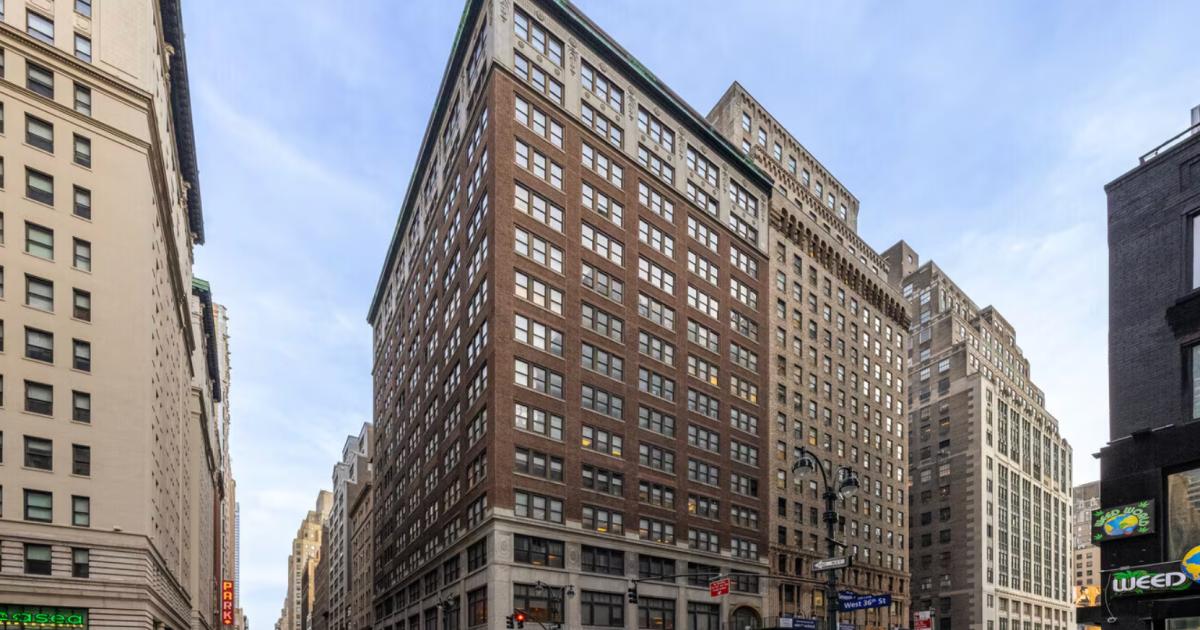
There is a word in French, appartenance, that means belonging in the deepest sense. Not mere ownership, not the casual claim that a lease or a deed confers, but the felt, irreducible knowledge that a place and a practice were always meant to meet. Standing for the first time in our new headquarters at 469 Fashion Avenue in New York City, I understood, with absolute certainty, what that word means in the body.
The Objects of Affection Collection, the intellectual house, atelier, and Post-Luxury Conceptual Functional Art (PLCFA)practice I founded, has always existed in deliberate opposition to the frictionless, the disposable, the sign-saturated. We were never looking for a fashionable address. We were looking for the right one. And Fashion Avenue, in the precise center of one of the world's most storied creative districts, is not merely an address. It is an argument. It is a statement of intellectual and artistic position. It is, at last, home.
This move is not simply a real estate decision. It is a declaration of values: a homecoming to a geography whose history, architecture, labor legacy, and ongoing creative vitality align more precisely with the founding principles of OAC than any other address on the planet. To understand why, you need to understand the street itself.
The Street That Named Itself After an Idea
Seventh Avenue did not always carry the name it wears today. For decades it was simply a Midtown artery, one of Manhattan's relentless north-south corridors, pressed between the theatre district to the north and the department stores anchoring Herald Square to the south. But by the early decades of the twentieth century, something had begun to accumulate in its loft buildings, its freight elevators, its unmarked showrooms and narrow sample rooms: the full, organized weight of an industry.
By 1919, Seventh Avenue had already earned the informal designation Fashion Avenue among the trade. The birth of the formal Garment District came in the 1920s, when manufacturers relocated en masse to this precinct of midblock loft buildings constructed specifically to house the modern, safer conditions that labor had demanded and won. By 1931, the district held the largest concentration of apparel manufacturers anywhere in the world. It was, in the truest sense, the capital of dressed civilization in America.
The name was made official on September 23, 1972, when the portion of Seventh Avenue running between 26th and 42nd Streets was formally christened Fashion Avenue. The renaming was part of a campaign to re-establish New York as a global fashion capital, and it worked not because of the sign, but because of what the sign confirmed. The street had already earned its name through decades of labor, craft, ambition, and collective genius. The designation simply acknowledged what the blocks had always been: the spine of American style.
What I find philosophically essential about this history is precisely that sequence: the work preceded the name. The meaning preceded the monument. This is antithetical to the luxury simulacrum that we at OAC have spent years anatomizing: the hyperreal system in which the brand becomes the reality and the object becomes incidental. On Fashion Avenue, immigrant workers, pattern cutters, union organizers, architects, and designers created, through the accumulation of honest labor and radical creativity, a district that the world could not ignore. The name followed the truth. That inversion of the luxury brand's logic is one of the deeper reasons this street resonates so powerfully with our practice.
The Architecture of Honest Work: 469 Fashion Avenue
The physical form of the Garment District is not glamorous in any conventional sense. These are not the white marble temples of luxury retail. The district's building stock comprises loft structures dating to the 1920s and 1930s; commercial buildings designed to accommodate the vertical stacking of production and the pragmatic choreography of cutting floors.
469 Fashion Avenue, constructed in 1921, is a product of this industrial zenith. Born into the regulatory environment defined by the 1916 Zoning Resolution, the building reflects the era's mandated 'setback' features: that characteristic wedding-cake silhouette that ensures light and air can reach the pavement below. Known formally as the Armion Building, it was not built for spectacle; it was built for production.
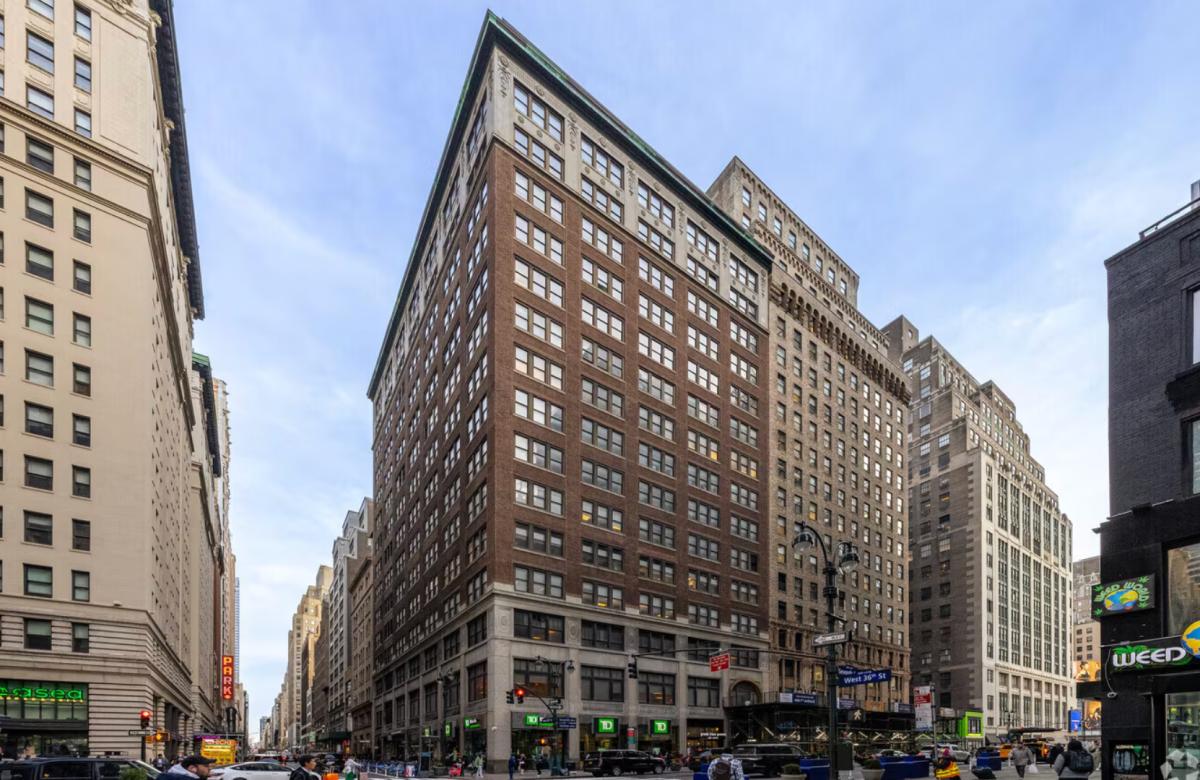
Wide windows flood cutting floors with the natural light that textile evaluation demands. Every element of the structure reflects a single design intelligence: support the work. Unlike the glass-and-steel corporate slabs that would come later, this building belongs to a tradition of commercial loft architecture that found its aesthetic in the honest expression of function. It is large-windowed, load-bearing, and built to last across generations. That is not a limitation; it is its argument. And it is precisely our argument too.
A Machine for Making Things
The architects who shaped this district in the 1920s saw this commercial loft style as essentially American: austere, experimental, honest in its acknowledgment of utility. These were structures designed not to impress in a single spectacular moment, but to serve across decades of sustained creative production. They were, in the language of our own practice, artifacts of endurance.
This matters to us because PLCFA is fundamentally concerned with the architecture of un-smoothness: with objects and spaces that carry the evidence of intentional labor, making the hand visible. Our objects are not produced to be photographed and forgotten. They are produced to be used, preserved, and passed on, custodial artifacts that require a patron willing to undertake the Burden of Preservation.
To establish our headquarters here is not to occupy a fashionable address. It is to insert our practice into a machine that was built, over a century ago, for exactly the purpose we intend to pursue: the serious, sustained, unspectacular work of making things that last.
On Labor, Immigration, and the Moral Conscience of a District
The Garment District was not simply where America made its clothes. It was where America negotiated, in the most immediate and physical terms, what it owed to those who made them. The workers who filled these loft buildings in the early twentieth century were predominantly immigrants, Jewish, Italian, Eastern European, who arrived with needles and scissors and the accumulated craft knowledge of their home communities. They were, in the parlance of today, the dark matter of the fashion industry: the essential, invisible creative force that powered a multi-billion-dollar economy while remaining largely uncredited in the official narrative of American style.
The Triangle Shirtwaist Factory fire of 1911, which claimed 146 workers (most of them young immigrant women) galvanized not only the labor movement but the industry's moral conscience. From that catastrophe rose the International Ladies' Garment Workers' Union and, eventually, the entire framework of labor protections that transformed working conditions in American manufacturing. The Garment District is, in this sense, not only the birthplace of American style but the birthplace of American labor rights in the apparel trades. The two are inseparable.
For an intellectual house built on the critique of what Baudrillard called the closed system of fabricated signs, the modern luxury apparatus that severs the object from its production, its maker, and its labor; this history is not incidental. It is foundational. The workers of the Garment District refused to be made invisible. Through union organization, through political action, through the sheer force of collective presence, they insisted on being seen, acknowledged, and compensated. They demanded that the value embedded in their hands not be laundered away through the alchemy of branding.
This is what PLCFA has always done, in its own register: refused the laundering. Our practice insists that the provenance of an object, the biography of its materials, the documented singularity of its making, the named and acknowledged intelligence of its creator, constitutes its irreducible value. We do not sell signs. We do not sell positions within a closed semiotic system. We produce artifacts whose meaning is generated by what is actually inside them, and we document that meaning with the rigor of archival practice. To be headquartered in the district where American fashion first made this argument, where workers first demanded that the value of the hand be recognized, is to operate from hallowed ground.
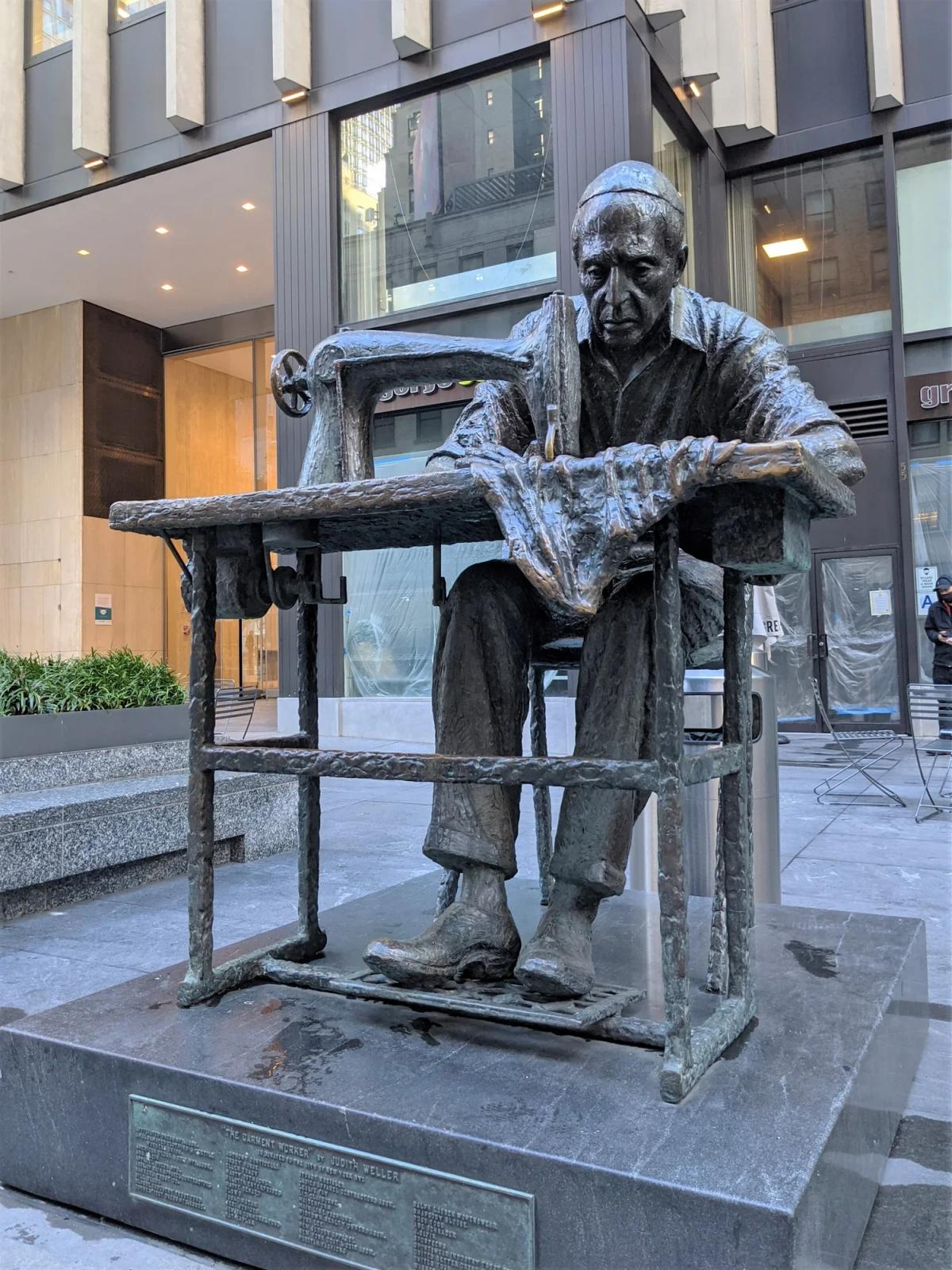
The bronze statue of The Garment Worker, created by Israeli artist Judith Weller and standing sentinel on Seventh Avenue, honors this history concretely and daily. Modeled after Weller's own father, who worked in the industry during its formative years, the figure commemorates the immigrant men and women whose labor built this district and whose organized resistance shaped the moral standards of an industry. For us, it will not be a piece of civic decoration. It will be a daily reminder of what it means to be located inside a history larger than any individual practice.
The Intellectual Salon: A Design House's True Lineage
This tradition has never fully disappeared. Prada has long been described as a thinker's luxury house: cerebral, slightly aloof, drawn to ideas over decoration. Recent campaigns, such as commissioning novelist Ottessa Moshfegh to write micro-fictions inspired by the brand's visual universe, demonstrate how an intellectual house uses literature to anchor its aesthetic identity. Chanel has hosted Les Rendez-vous Littéraires, organized by Charlotte Casiraghi. Dior has integrated T.S. Eliot's The Wasteland into its runway presentations. Saint Laurent operates the Rive Droite bookstore as an extension of its cultural production.
These are not marketing stunts. They are attempts, some more rigorous than others, to restore the fashion house to its historical function as a site of cultural production rather than merely a commercial distributor. They acknowledge what the original salonnières understood: that genuine intellectual community produces value that cannot be manufactured through advertising spend or brand architecture alone.
OAC's move to 469 Fashion Avenue is an intentional effort to revive this culture of sociability in its most serious and fully realized form. By establishing a space that functions as a design studio, an intellectual forum, and an archive of Post-Luxury Conceptual Functional Art practice, the house seeks to cultivate a community dedicated to humanistic ideas and intellectual enlightenment. This mirrors the objectives of the Enlightenment-era salonnières, who believed that an educated public would contribute more meaningfully to the common good and the cultivation of grace. The conversations we intend to have in these rooms are inseparable from the objects we produce.
The Ecosystem of Proximity: Why Location Is Intellectual Infrastructure
One of the most illuminating findings in the academic study of the Garment District is that proximity itself was the essential resource. Every block historically carried a specialty: buttons on one, fabric on another, pleating on a third, pattern drafting on a fourth. This dense clustering of complementary trades created an ecosystem in which the friction costs of production, the time and energy spent moving between suppliers, collaborators, and clients, collapsed to near zero. You could conceive, source, construct, and show a garment without leaving a radius of a few city blocks.
Research has consistently confirmed that general proximity to New York's Garment District remained important to participation in the American fashion ecosystem even as the industry underwent its twentieth-century transformations. The ecosystem was not merely physical. It was epistemic. To be inside it was to be inside a continuously circulating body of knowledge, about materials, techniques, suppliers, standards, and taste, that could not be replicated at a remove. The district was, and remains, a knowledge commons.
For OAC, this ecosystem has immediate and practical significance. Our practice is built on the use of rare and challenging materials, transformed through bespoke craftsmanship. The sourcing of those materials, the identification of suppliers who work at the level of specificity and quality our One Original Principledemands, requires the kind of dense, accumulated, walking-distance knowledge that the Garment District has historically provided and continues, in its evolved form, to offer. Mood Fabrics, the specialty fabric houses, the remaining trim and hardware suppliers that occupy the district's lower floors: these are not mere convenience. They are part of the intellectual infrastructure of our practice.
Beyond the material supply chain, there is the matter of intellectual community. The Fashion Institute of Technology, established in 1944 and still operating within the district's extended boundaries, represents the institutional memory of the American fashion trade, its technical vocabulary, its design history, its accumulated pedagogy. The Garment District Alliance, the Fashion Walk of Fame embedded in the Seventh Avenue pavement, the industry events that continue to animate these blocks: all of these constitute an ongoing conversation about the meaning of design, the responsibility of craft, and the future of fashion as a cultural practice. We intend to be participants in that conversation, not merely tenants in proximity to it.
Post-Luxury Conceptual Functional Art: The Philosophy Behind the Move
The Objects of Affection Collection operates under the framework of Post-Luxury Conceptual Functional Art (what we call PLCFA), a movement that seeks to deconstruct the traditional measures of artistic and luxury prestige. In the hyperreal state of the modern art world, typified by events like Art Basel, the primary product is no longer the art itself but the sign of luxury and the spectacle of participation. PLCFA rejects this detachment from material reality, focusing instead on the authentic, the personal, and the handmade.
The core tenets of this philosophy involve a quiet rebellion against conspicuous consumption. Affluent consumers in the current period are increasingly moving away from brand logos and ubiquity, prioritizing experience over possession and wasteful time over easily displayable status symbols. According to this new calculus of value, true luxury is found in the meticulous hands of an artisan and the heritage behind a product's creation, not in the legal architecture of a trademark or the manufactured scarcity of a limited edition.
The One Original Principle in the Capital of American Design
The philosophy that governs the Objects of Affection Collection (what we call the One Original Principle) holds that every design or material combination we produce is an authentic artistic exploration that will never be recreated. If a silhouette is revisited, the material, color, texture, or finish must be completely changed. This commitment ensures that each object exists only once in precisely the form in which it was conceived and realized. The object is not a product. It is a singular event.
This principle places us in a specific and deliberate relationship with the history of the Garment District. The district's golden age (the decades from the 1930s through the 1960s when designers like Claire McCardell, Norman Norell, and Hattie Carnegie transformed the American concept of ready-to-wear into a legitimate art form) was built on the industrialization of design: the translation of a singular creative vision into reproducible units of consumption. That democratization of style was a genuine and important achievement. We do not romanticize the pre-industrial atelier while ignoring the democratizing power of the apparel trade.
But the logic of reproduction, the industrial premise that a design achieves its fullest realization only when it is multiplied across thousands of identical units, is precisely what the contemporary luxury system has pushed to its hyperreal extreme. Today's dominant luxury brands do not primarily sell objects. They sell positions within a sign system, as Baudrillard's analysis of the Monogram makes devastatingly clear. The garment, the bag, the shoe: these are vehicles for the transmission of brand equity, which is itself a fabricated and legally enforced simulation of distinction. The object's singularity, what Walter Benjamin called its aura, has been systematically evacuated in the service of scalable brand architecture.
The One Original Principle is our counter-argument. It restores singularity not as a marketing claim but as a structural, non-negotiable condition of production. Each OAC object is singular because it cannot be otherwise, because the governing discipline of our atelier forecloses reproduction at the level of conception. To be headquartered on Fashion Avenue, in the district where American fashion made its greatest argument for the democratization of beauty, while practicing an art form built on the irreducible singularity of each object, is to hold the full tension of that history in both hands. We are not against the district's legacy. We are its next chapter.
The 2025 Rezoning and the Fight for the District's Soul
The establishment of a headquarters in the Garment District occurs during a period of intense structural transformation for the neighborhood, and at a moment when its future hangs in genuine balance. In August 2025, the New York City Council approved the Midtown South Mixed-Use (MSMX) Plan, a sweeping rezoning proposal that allows for residential development in areas previously restricted to industrial and commercial use. This plan aims to address the city's housing crisis by delivering nearly 10,000 new apartments across forty-two blocks, potentially doubling the district's resident population.
The MSMX Plan has faced significant opposition from industry leaders, including the Council of Fashion Designers of America. Critics argue that the removal of special protections under the Special Garment Center District could displace up to 114 businesses and over 5,000 jobs, primarily held by immigrant artisans and specialized manufacturers, the direct inheritors of the labor tradition that built this neighborhood. The environmental review of the plan indicates that as new residential and high-end office spaces develop, landlords may raise rents or demolish industrial lofts, threatening the unique economic ecosystem of the district.
To mitigate these risks, the City Council and economic development agencies have implemented a series of protections designed to preserve the historic core of the industry. A specific area between West 35th and West 40th Streets, Seventh to Eighth Avenues, has maintained its manufacturing zoning. The NYCIDA Garment Center Program provides real estate tax benefits to property owners who commit to long-term, affordable leases for fashion manufacturers, with gross rents capped at $35 per square foot. A $1.8 million Local Production Fund was launched to connect local manufacturers with global designers. And the Greenlight Innovation Fund was recapitalized with $50 million to assist nonprofit organizations in acquiring and developing below-market-rate spaces for creative businesses in the district.
These are not merely policy details. They are evidence of something important: the city still recognizes that the Garment District's primary value lies in its agglomeration, the proximity of designers, pattern-makers, trim stores, and sample rooms within a single square mile. The district's future is not in mass production of garments. It is in the high-density clustering of design intelligence, craft knowledge, and creative community that has always been its most durable asset. What the city is fighting to preserve, the manufacturing DNA embedded in these blocks, the lofts and the labor knowledge and the irreplaceable density of craft, is, in its way, the same thing we fight to preserve in every object we make: the evidence of a hand, the record of an intention, the proof that something real was here.
Against the Simulacrum, From the Center of the Spectacle
There is a paradox in establishing a Post-Luxury Conceptual Functional Art practice in the heart of the fashion industry's most historically significant American address. Some will note it. We embrace it. The critique of the simulacrum is most powerful when it is delivered from inside the territory it interrogates, not from a remove that permits comfortable disdain, but from a position of intimate, firsthand knowledge.
Guy Debord understood that the spectacle cannot be escaped by simply stepping outside it. The spectacle is total; it incorporates even its own critique when that critique lacks teeth. What gives a critique teeth is not the distance from which it is launched, but the precision and rigor with which it is executed. Our sixty-plus published studies, examining everything from Baudrillard's analysis of consumer society to the biopolitics of the archival artifact, from Gregory Sholette's concept of dark matter to the implications of the Louis Vuitton versus Coogi litigation, constitute a body of critical work produced not from the sidelines of the fashion industry but from within it, with full knowledge of its mechanisms and full commitment to constructing an alternative value model that can withstand intellectual scrutiny.
469 Fashion Avenue is not a concession to the spectacle. It is a position within it, a deliberate, documented, philosophically defended position from which to continue the work of building what we believe is a necessary and durable alternative: a practice in which objects are produced with intellectual rigor, material honesty, and the commitment to endurance over novelty. A practice in which the patron is not a consumer but a custodian of culture. A practice in which value is not performed through brand recognition but generated through what the object actually contains and what its preservation requires.
The 2026 Homecoming: A Broader Movement
OAC's move to 469 Fashion Avenue is part of a broader trend that has been building quietly but with gathering force over the past several years. After decades of decentralization and offshoring, the 2024-2026 period has seen a dramatic resurgence of brands prioritizing domestic, small-batch manufacturing and reclaiming physical presence in the Garment District. This homecoming is fueled by several converging pressures that amount to a structural shift in the values of the fashion market.
Consumer demand for transparency has reached a critical mass. Modern buyers increasingly prioritize ethical credentials and sustainable production, which are more easily verified in a local creative cluster than in a globalized supply chain that moves goods through multiple countries before they reach a storefront. The ability to say, honestly and specifically, where something was made, by whom, and under what conditions has become a genuine competitive advantage, not merely a marketing talking point but a substantive differentiator for discerning customers.
Technological integration has simultaneously made local production more viable than it has been in decades. Firms like Suuchi Inc. and Apparel Production Inc. now offer digital product development platforms that allow emerging brands to manage production with high speed and transparency. These platforms do not replace the knowledge of experienced pattern-makers and sample-room professionals; they extend and amplify it, making small-batch local production faster and more economically sustainable than offshoring.
Governmental and institutional support has reinforced these trends. The NY Forward initiative and the CFDA x NY Forward Grant Fund have provided millions of dollars to modernize local factories, helping them scale their operations to serve independent designers. Rachel Scott's brand Diotima, which blends Jamaican-made crochet with NYC-produced tailoring and was recognized by the CFDA in 2024, represents the kind of practice that thrives in this environment: globally inspired, locally executed, intellectually rigorous. Allina Liu uses the district's infrastructure to produce highly wearable art in small, sustainable batches. These designers, alongside legacy houses that have maintained their presence, demonstrate that the Garment District remains a thriving research and development hub for high-end fashion.
The Atelier as a Civic Act
The Garment District has faced real pressures in recent decades. The decline of domestic manufacturing, driven by high Manhattan rents, global outsourcing, and the structural reorganization of the apparel supply chain, has reshaped the district's economy and its street life. COVID-19 accelerated existing vulnerabilities. The loss of tenants and the commercial density that had historically defined the district created spaces that have been slow to recover their purpose and energy.
The response to this challenge, from the Garment District Alliance, from New York State's investment programs, from the community of designers and creative businesses that have chosen to remain, has been to double down on what the district does irreplaceably: concentrate creative intelligence in a form that cannot be outsourced or digitized away. The district's future will likely be defined by flexible zoning and mixed-use developments that blend residential life with creative production. By embracing the MSMX vision while fighting to preserve the manufacturing DNA of the neighborhood, the intellectual house positions itself as a participant in the new urban paradigm, not a nostalgist, but a practitioner who understands that the past and future of this district are inseparable.
In this context, establishing an intellectual house and atelier in the district is not merely a business decision. It is a civic act. Every creative practice that commits to this geography adds to the density of intelligence that makes the district valuable, not only to its tenants, but to the city that surrounds it, and to the broader culture that has always looked to this address for evidence of what design can be. We are not saviors of the district. But we are participants in its renewal, and we take that responsibility seriously.
The spirit of the Garment District survives not in spite of change, but through the New York resilience of those who choose to make it their home. The loft buildings, the light, the accumulated knowledge of a century of creative production: these things are fragile, and they require tending. An atelier that commits to this place commits to its preservation as surely as it commits to the preservation of the objects it makes.
On Belonging: What Home Means for an Intellectual House
An intellectual house is not simply a business at an address. It is a practice in a place, a practice that draws from the history, the energy, and the accumulated meaning of its location and gives something back in return. The great Maisons of European fashion understood this. Their addresses are not incidental to their identities. The street, the building, the neighborhood: these are part of the argument that the practice makes about itself. They are part of the provenance.
469 Fashion Avenue is part of our provenance now. The address carries, in its name alone, the entire weight of what we have described in these pages: the immigrant labor that built the district from the ground up; the architect-visionaries who gave it physical form in the early decades of the twentieth century; the designers who used its concentrated resources to create an American idiom of beauty; the union organizers who insisted that the value of the hand be made visible and compensated; the contemporary creative community that is refusing to abandon a geography whose meaning runs too deep to surrender to real estate pressure.
We are not here because Fashion Avenue is fashionable, though it remains, in its evolved form, one of the most creative and intellectually alive neighborhoods in Manhattan. We are here because the history of this street is, in the deepest sense, an expression of the values that have always governed our practice. The primacy of honest labor over hollow signification. The commitment to materials and craft that carry real rather than fabricated meaning. The insistence that what is made by hand, with intelligence and intention and radical singularity, constitutes a form of value that the simulacrum cannot replicate, cannot replace, and cannot survive.
To acquire an Object of Affection is to become a custodian of culture: to unite a physical object of unique provenance with its profound narrative, and to accept the obligation of stewardship that comes with it. That language, which has defined our practice from its founding, finds its fullest resonance here, in a district built by people who understood that the things they made were not merely products but records: records of skill, of struggle, of collective human intelligence applied with care to the transformation of raw material into enduring form.
The Conversation Has Only Just Begun
469 Fashion Avenue serves as a nexus where the architectural past, the intellectual salon, and the modern artisan movement converge. It is a space where the calculus of value is rewritten, prioritizing the Object of Affection over the sign of luxury, and where the heart of the fashion district is reclaimed as a site of profound cultural and conceptual production.
The significance of this move lies precisely in what it refuses. It refuses the logic of the spectacle, which would have us locate ourselves in a more glamorous, more photographable, more brand-legible address. It refuses the logic of decentralization, which would have us reduce our physical presence in favor of digital distribution. It refuses the logic of the simulacrum, which would have us perform commitment to craft and intellectual rigor rather than actually practicing it in a place that demands both.
Instead, we have come home: to a building that was already a century old when we arrived; to a district that carries the memory of every immigrant hand that ever cut a pattern or pressed a seam in its loft buildings; to a street whose name was earned, not invented; to a neighborhood that is fighting, in real time, for the right to remain what it has always been: a place where things are genuinely made.
The conversation between our practice and this place, between Post-Luxury Conceptual Functional Art and the full, complex, magnificent history of the American fashion industry, has only just begun. We intend to pursue it with the rigor, the candor, and the absolute commitment to endurance that has always been, and will always be, the governing standard of everything we make.
Authored by Christopher Banks, Anthropologist of Luxury & Critical Theorist. Office of Critical Theory & Curatorial Strategy, Objects of Affection Collection.