L’Onde Silencieuse: An Olfactive Object as Archive
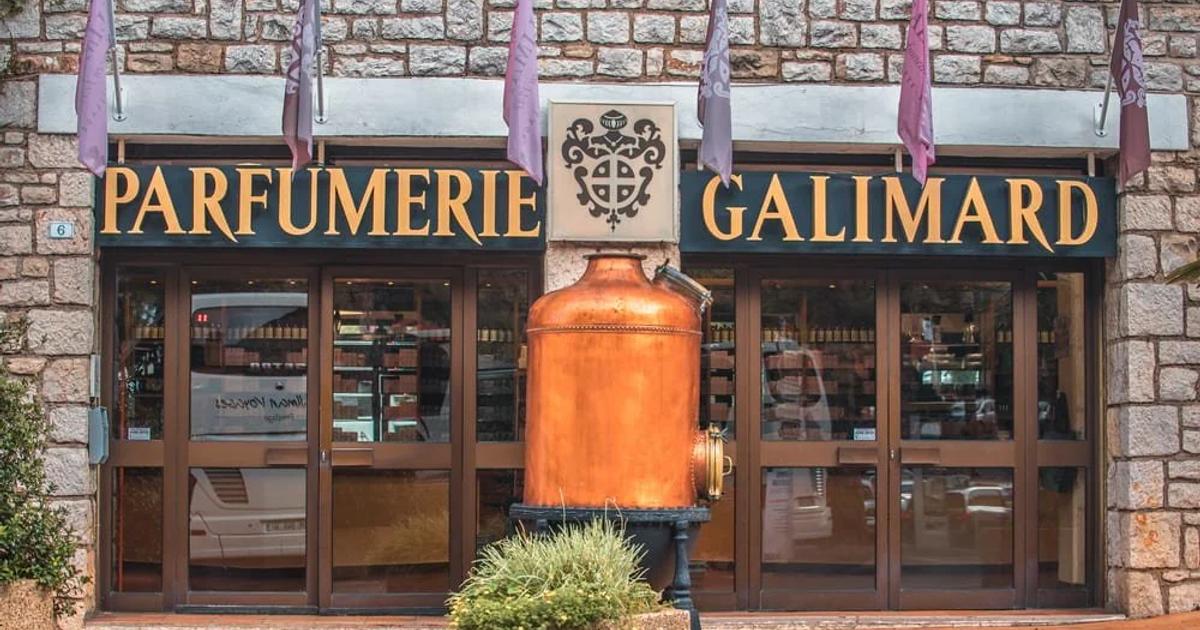
This study, issued from the headquarters of the Objects of Affection Collection at 460 Fashion Avenue, New York, constitutes the definitive critical and historical account of the seventh object in the collection: L’Onde Silencieuse, a one-of-one Extrait de Parfum constructed by the author within the atelier of Maison Galimard, Paris, on March 1, 2026.
This document performs three distinct but interlocking arguments. First, it establishes the historical gravity of the institutional context: the 278-year biography of Galimard, its royal and imperial entanglements, and its unbroken survival as a site of olfactive knowledge. Second, it argues that the act of making, the physical immersion of the maker inside that atelier, working at the organ, building the formula by hand, is not incidental to the object’s meaning but constitutive of it. Third, it situates L’Onde Silencieuse within the theoretical framework of Post-Luxury Conceptual Functional Art, demonstrating why an object that cannot be held, photographed, or displayed is not a departure from the collection’s logic but its most complete expression.
The greatest luxury is not the object you can display. It is the one that follows you out of the room.
The house: A biography of institutional gravity
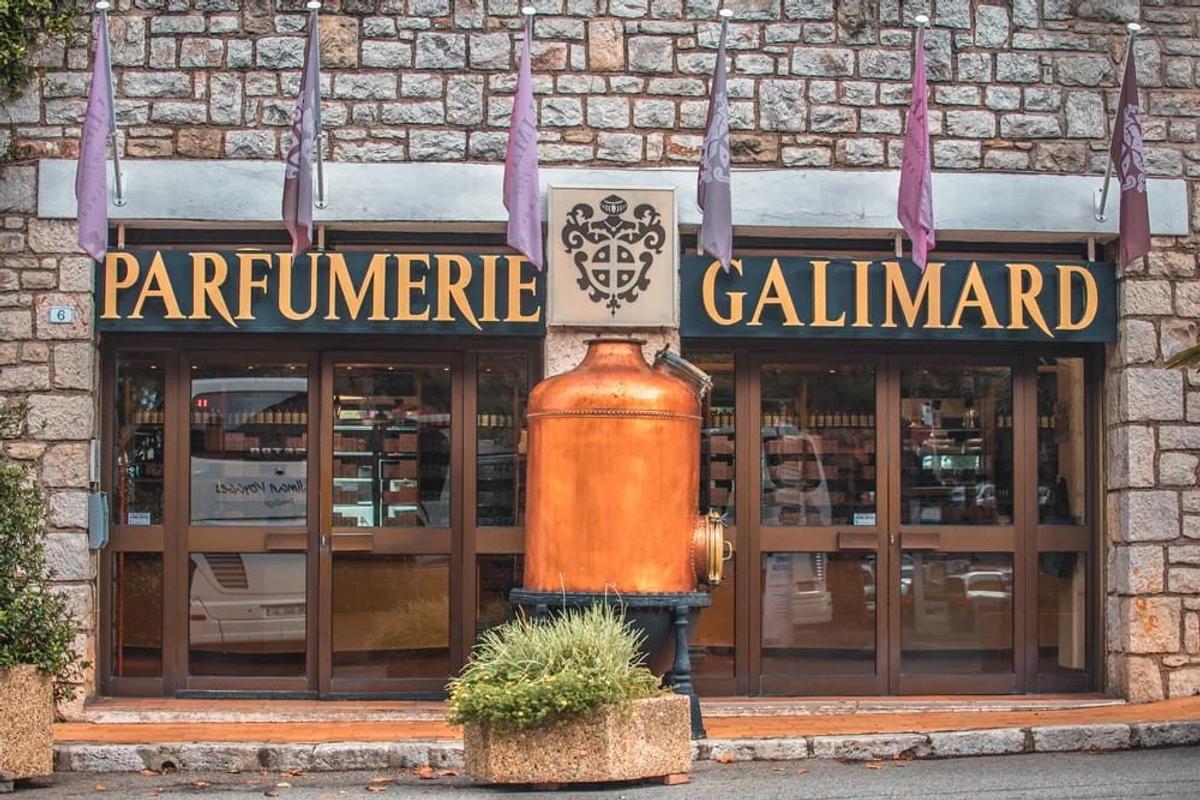
To understand why Maison Galimard matters to this collection, it is necessary to resist the temptation to treat the house as backdrop. Galimard is not a setting. It is a protagonist. Its 278-year biography is not decorative context for the object’s story; it is the medium through which the object was made. To work within Galimard’s atelier is to enter into relationship with that entire history, to borrow its institutional gravity not as an act of prestige-seeking but as an act of honest material selection. The house is as much an ingredient in L’Onde Silencieuse as the iris or the saffron.
Jean de Galimard, Lord of Séranon and a member of the corporation of Glovers and Perfumers, established his house in Grasse in 1747. Grasse, positioned in the Maritime Alps of the Côte d’Azur, seventeen kilometers from Cannes and surrounded by fields of jasmine, rose centifolia, and orange blossom, was already becoming what it would formally be declared: the World Capital of Perfume. Jean de Galimard was among the architects of that designation. His house supplied the court of King Louis XV, Louis le Bien-Aimé, the Beloved, with olive oils, ointments, and perfumes of which he was himself the inventor of the original formulas. The court of Louis XV was not incidentally fragrant. It was systematically, almost architecturally, perfumed. Contemporaries described it as the most scented court in the history of Europe, a sensory infrastructure of which Galimard’s formulas were a structural part. To be purveyor to that court was not a commercial relationship. It was an act of cultural co-authorship: Galimard’s scents were woven into the daily ceremony of Versailles itself.
The French Revolution ended that world. Perfume became suspect: a marker of aristocratic allegiance, a sign of complicity with the old regime. During the Terror, its use was frowned upon and, at the height of political violence, actively dangerous. Galimard survived. This is the first of the house’s great institutional arguments: it did not require political stability to persist. It required only the irreplaceable quality of its knowledge.
Then came Napoleon. On March 1, 1815, the Emperor landed at Golfe-Juan with a force of roughly a thousand men, returning from exile on the island of Elba. He moved north toward Paris in the maneuver that became the Hundred Days. His route took him through Cannes and then inland to Grasse, the city of perfume. On March 2, 1815, Napoleon bivouacked with his troops on the Plateau de Roquevignon, above the city; a site now formally designated the Plateau Napoléon in his memory. He crossed the city and continued north toward Grenoble. The road he traveled became the Route Napoléon, one of the most historically charged roads in France, stretching three hundred kilometers from the Mediterranean to the Alps and traveled by thousands of visitors annually.
The significance of this moment for the house is not merely geographical. Napoleon was famously devoted to fragrance; he reportedly used Eau de Cologne in extraordinary quantities throughout his campaigns, drawn to its citrus freshness as both a sensory and a symbolic matter. As a Corsican, he was attuned to the aromatic garrigue of the Mediterranean coast: the wild herbs, the maquis, the fragrant shrubs growing on sun-heated rock. His documented affinities for roses, orange blossoms, violets, and jasmine map almost exactly onto the flowering landscape of Grasse. When Napoleon passed above this city, he passed above the terroir that had supplied Versailles for sixty-eight years and would continue to supply the greatest perfume houses of France for the next two centuries. Galimard was among those houses. The Emperor did not stop. But the house was there, as it had always been.
In 2015, on the bicentennial of that passage, Galimard created the fragrance Napoléon 1815: a Mediterranean composition opening on citrus and pepper, moving through jasmine and rose, and settling onto a base of sandalwood, vetiver, and vanilla. The vetiver was chosen deliberately to evoke the leather of soldiers’ boots; the patchouli, the ground beneath horses. It was an act entirely characteristic of the house: transforming a historical moment into a scent, fixing the fugitive into something wearable and real.
Galimard did not survive 278 years by accommodating fashion. It survived by being the thing that fashion cannot replace.
The house is today part of a UNESCO Intangible Cultural Heritage designation, awarded in November 2018 to the perfume-making knowledge and traditions of the Grasse region. The designation is significant because it acknowledges that what Galimard practices is not simply manufacturing but the transmission of embodied knowledge: a craft that cannot be reduced to a formula sheet or replicated by a machine, that lives in the hands and the nose of the practitioners who carry it forward from generation to generation. This is the institutional context into which the Objects of Affection Collection entered on March 1, 2026. Not a boutique. Not a vendor. A UNESCO-recognized site of cultural transmission with a documented 278-year chain of custody over one of the most demanding forms of human craft.
The act of making: Immersion as authorial method
The Objects of Affection Collection does not acquire. It makes. This distinction is the philosophical foundation of every object in the collection and the sharpest line PLCFA draws against the conventional luxury economy. The Court of Tenacity was not purchased from Atelier Verona or Tessitura di Como or Henry Poole & Co. It was made in collaboration with those houses, through hands that participated in every stage of its production. The silk carré carries 288 hours of manual illustration not because illustration is an expensive process but because the duration of that labor is itself an argument: a statement about what it costs to make something that cannot be simulated.
Object 007 was made by the same logic. On March 1, 2026, the author entered the Studio des Fragrances of Galimard’s Paris atelier and sat down at the organ: the perfumer’s working station, arranged with essences organized by olfactive family and structural function. The organ at Galimard Paris carries 127 distinct essences, not synthetic approximations but the materials the house has worked with since the Grasse tradition was formalized in the eighteenth century. The same jasmine and orange blossom from the Maritime Alps fields. The same iris, sandalwood, and oud that supply the most demanding perfumers in France.
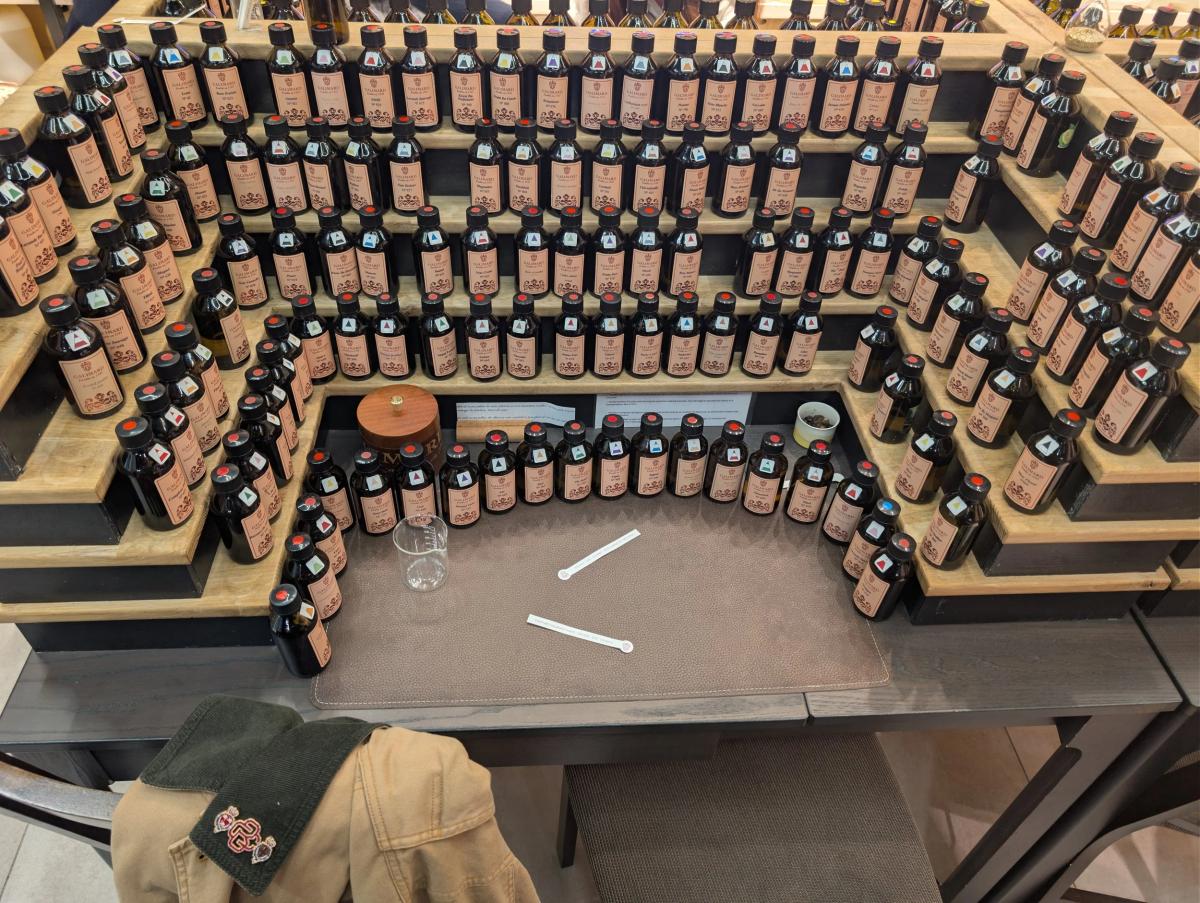
The process of building a formula at the organ is an act of compositional reasoning that operates simultaneously across multiple registers. The structural register: head, heart, and base notes must be chosen not only for their individual character but for how they interact, how the volatility of the top notes gives way to the complexity of the heart, how the base anchors the composition over the dry-down hours. The proportional register: decisions at the level of individual milliliters determine whether a tension between two notes resolves into complexity or collapses into noise. The temporal register: a formula is not a static object. It moves through time on the skin, revealing progressively deeper layers as the volatile fractions burn away. To build a formula is to compose something that unfolds over hours rather than moments.
The formula that became L’Onde Silencieuse was built with all three registers held in mind simultaneously. The decision to anchor the base in Iris at 18 ml, making it the single largest ingredient in the formula, was a deliberate inversion of conventional luxury grammar. Most luxury fragrances lead with leather or oud because these materials signal cost and darkness in ways that read as authority. Iris is cooler, more structural, more architectural. It is the foundation of the oldest perfumery tradition in France, and it is harder to wear well precisely because it does not perform. It simply is. That was the intent from the beginning: not a fragrance that announces its presence but one that occupies the space it enters, quietly and without apology.
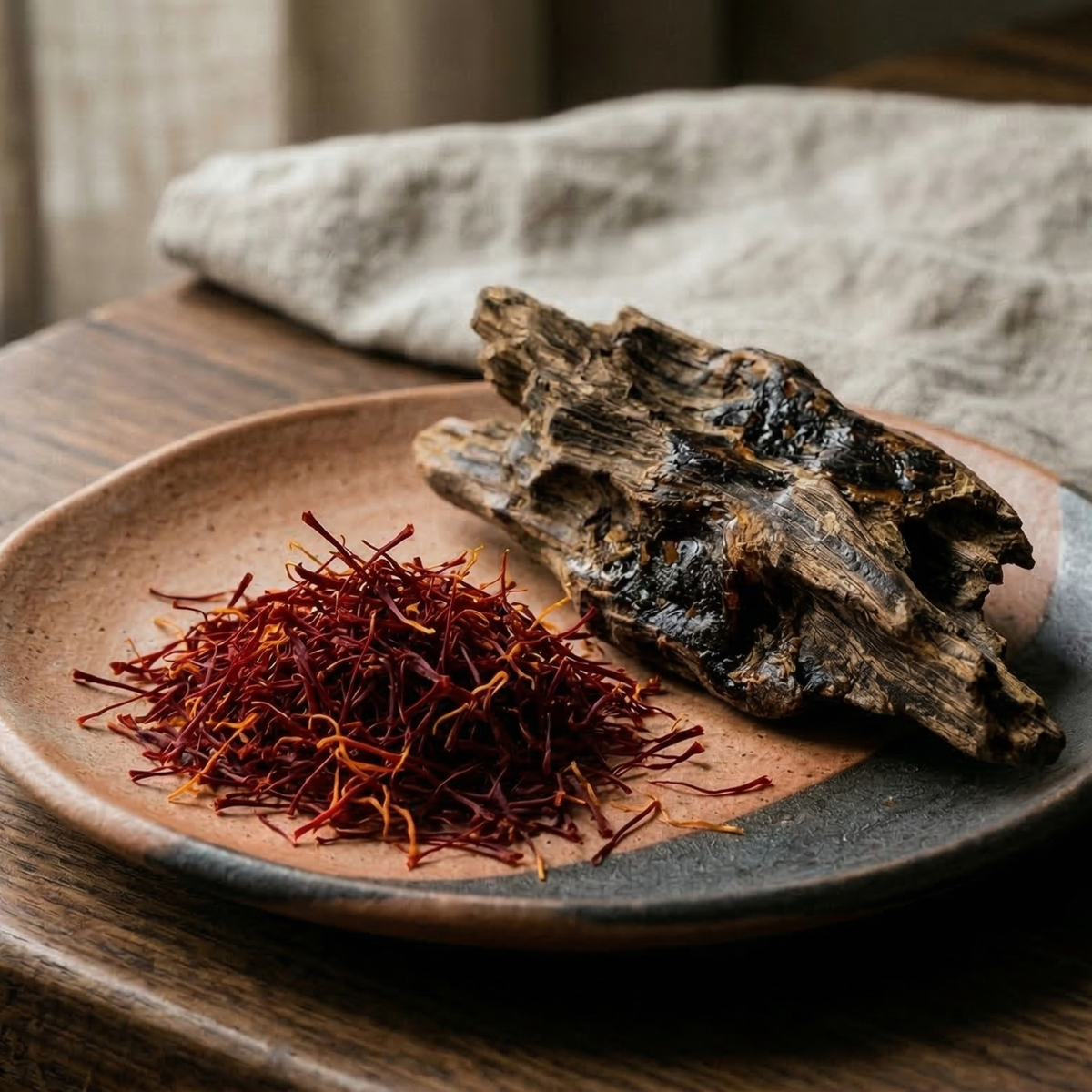
The decision to place Saffron and Fig at equal volume in the heart was the boldest compositional choice in the formula. Saffron is metallic and honeyed, carrying a slight leathery edge that reads as intent. Fig is milky, green, and dark in a way that is almost photographic in its specificity. Together they generate a tension that should tip into sweetness but does not, because the Geranium holds the center, its sharpness preventing either from overwhelming the other. Wild Jasmine is so restrained as to be nearly subliminal. But its absence, as any trained nose would confirm, would be felt throughout the composition. These are not the decisions of a person selecting from a menu. They are the decisions of a maker working inside a tradition with its materials, under the guidance of its practitioners, accountable to the integrity of the result.
L’Onde Silencieuse belongs to no catalogue, no counter, and no other collection. It was made once, in one place, by one hand.
This is what PLCFA means by authorship through immersion. The author is not the person who specifies a product and receives it. The author is the person who sits at the organ and decides, milliliter by milliliter, what this object will be. Galimard’s atelier is the medium, not the manufacturer. The 278 years of institutional knowledge the house carries are the conditions that made this particular act of making possible, not because they lend the object their prestige, but because they are the substrate in which it was grown.
The theoretical object: PLCFA and the archival paradox
Post-Luxury Conceptual Functional Art begins with a single diagnostic claim: that conventional luxury has undergone what the collection’s theoretical framework calls the Archival Death Mandate. The luxury object in the mass-market era is designed not for endurance but for velocity. It is produced at scale, marketed through the hollow codes of heritage and exclusivity, purchased as a signal rather than a thing, and discarded when the signal loses its currency. The result is an economy of objects that are, in the deepest sense, disposable: objects stripped of the narrative weight that once made them worth keeping.
The Objects of Affection Collection is a form of resistance to this mandate. Each object is designed to carry Moral Weight: the accumulated value of the decisions, labor, relationships, and institutional histories that were required to bring it into existence. Moral Weight cannot be manufactured or applied after the fact. It must be built into the conditions of production from the beginning. This is why the collection makes rather than acquires, why it works within living institutions rather than licensing their imagery, and why each object’s documentation, the production log, the archival record, the critical study, is as integral to the object as the physical thing itself.
L’Onde Silencieuse presents the collection with its most acute theoretical challenge and its most philosophically complete expression simultaneously. The challenge is this: the Archival Death Mandate operates primarily through dematerialization. The digital economy has trained us to treat the ephemeral as sufficient, to accept the image of a thing in place of the thing itself, the story of a craft in place of the craft. An olfactive object is, in one reading, the most vulnerable possible choice for a resistance artifact. It cannot be photographed with fidelity. It cannot be archived in any conventional sense. It evaporates. It changes with the chemistry of the body wearing it. It exists only in the encounter, and the encounter cannot be reproduced.
And yet this vulnerability is precisely where the argument achieves its greatest force. The dematerialized luxury object, the image, the logo, the brand narrative, can be reproduced infinitely at negligible cost. That is its commercial advantage and its philosophical poverty. L’Onde Silencieuse cannot be reproduced at all. The formula is strictly confidential, held in the Galimard archive under a private reference number, accessible only through the Objects of Affection provenance file. The 100 ml vessel is the only instance of this composition that exists in the world. When it is used, it diminishes. When it is gone, it is gone entirely. This irreversibility is not a flaw in the object’s design. It is the design.
The collection’s framework describes this as the Archival Paradox: the object most resistant to archival loss is the one that most fully accepts the conditions of its own disappearance. The silk carré of The Court of Tenacity will outlast its makers by generations. The seventh object will not outlast its use. But while it lasts, it does something that no image, no brand narrative, and no digital provenance chain can replicate: it changes the room. It changes the body of the person wearing it. It creates an atmospheric fact, a sensory event that is unrepeatable, unreproducible, and entirely real. The contemporary luxury economy cannot make this. It can only simulate the idea.
The collection does not borrow prestige. It builds legitimacy: one object, one atelier, one irrecoverable act of making at a time.
The seventh object: Position within the collection
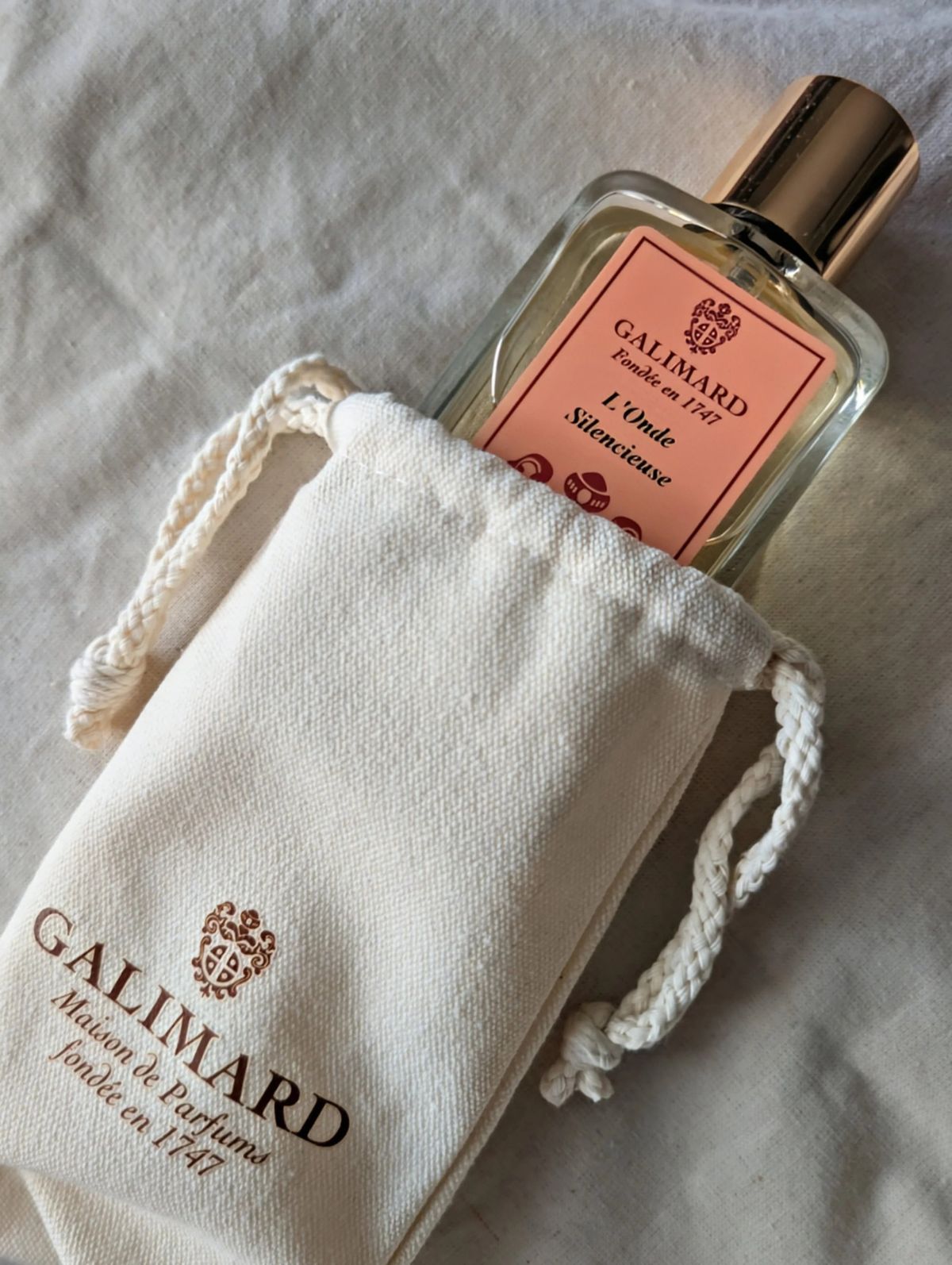
The Objects of Affection Collection has a logic to it. It is not a series of independent luxury objects assembled under a shared brand. It is a single argument, made across multiple objects and multiple material registers, about what makes a thing worth keeping. The first six objects built that argument through materials that could be touched: leather with weight, silk that moved with intention, objects that carried the haptic authority of craft in its most legible forms. They established the collection’s vocabulary in forms that could be held, examined, and documented with relative ease.
The seventh object does not abandon that vocabulary. It extends it into territory where the vocabulary becomes genuinely difficult to sustain, and sustains it anyway. L’Onde Silencieuse asks the question that the previous six objects could afford to defer: what happens when the material has no weight? When can it not be held, displayed, or archived in any conventional sense? When the only evidence of its existence is the atmosphere it creates and the formula locked in a perfumer’s archive in Grasse?
The answer the collection offers is this: when the object cannot be held, the act of making it becomes the object. The formula, the archival record, the provenance chain, the critical study, these are not supplementary documents about L’Onde Silencieuse. They are its resistance infrastructure. They are what prevent this scent from being merely a pleasant fragrance and constitute it instead as an artifact: an object with a documented history, a named institutional relationship, a body of theoretical argument, and a specific address: 460 Fashion Avenue, New York, March 2026.
That address matters. The Objects of Affection Collection operates from the center of the fashion industry’s commercial infrastructure, the Garment District, the address that has housed American fashion’s industrial apparatus for over a century. This is not accidental, and it is not ironic. The collection is not made in retreat from the luxury economy. It is made in full awareness of it, in deliberate friction with it, from the middle of it. L’Onde Silencieuse was built in Paris, in a house that was making perfume for the French crown before the American Republic existed. It is documented, archived, and issued from New York. It carries the institutional weight of both cities and belongs entirely to neither.
What remains
On March 2, 1815, Napoleon Bonaparte bivouacked on the Plateau de Roquevignon above Grasse. The Emperor was forty-five years old, returning from exile with everything still to be decided. He had crossed the lavender terraces and the olive groves of the Côte d’Azur. He had passed through the world capital of perfume. He did not stop at Galimard. But the house was there (sixty-eight years old, already the inheritor of a royal commission from Versailles, already the custodian of formulas that the court of Louis XV had worn). Napoleon continued north. The house continued making.
Two hundred and eleven years later, on March 1, 2026, the Objects of Affection Collection sat down at the organ of Galimard’s Paris atelier and built a formula from scratch. The decision took hours. The Iris at 18 ml. The Saffron and Fig at equal tension. The Yuzu and Cardamome that set the register in the opening minutes before giving way to everything underneath. The Sandalwood that wraps the base in warmth. The Oud that arrives as texture rather than statement. One hundred milliliters of Extrait de Parfum. L’Onde Silencieuse. One bottle.
The opening will last minutes. The heart will last hours. The dry-down will last longer still; will follow the wearer into the room, will remain after they leave, will be the last thing present when everything volatile has burned away. And then it will be gone. That disappearance is not the object’s failure. It is its final argument: that the most durable things are not the ones that resist consumption, but the ones that were worth consuming in the first place.
L’Onde Silencieuse does not perform. It does not seduce. It occupies. It is the seventh object in a collection that has always asked what makes a material worth keeping. The answer the seventh object offers is the most honest one the collection has produced so far: a thing is worth keeping when it was made with the full weight of its own impossibility in mind, and made anyway, from New York to Paris and back, in the oldest perfume house in France.