TEFAF NEW YORK 2026, LUCIO FONTANA, AND KATHLEEN RYAN: WHAT THE FAIR'S HARD-ASSET TURN ACTUALLY MEANS
Transaction Registries, Collectible Design, and the Return of Resistant Objecthood at the Park Avenue Armory
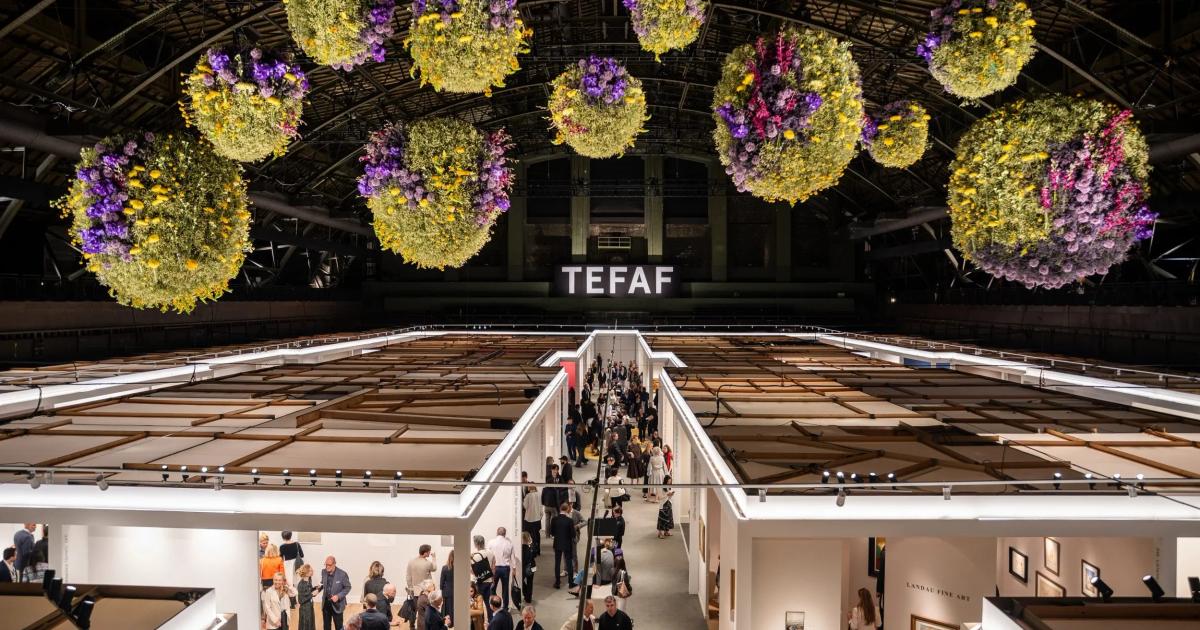
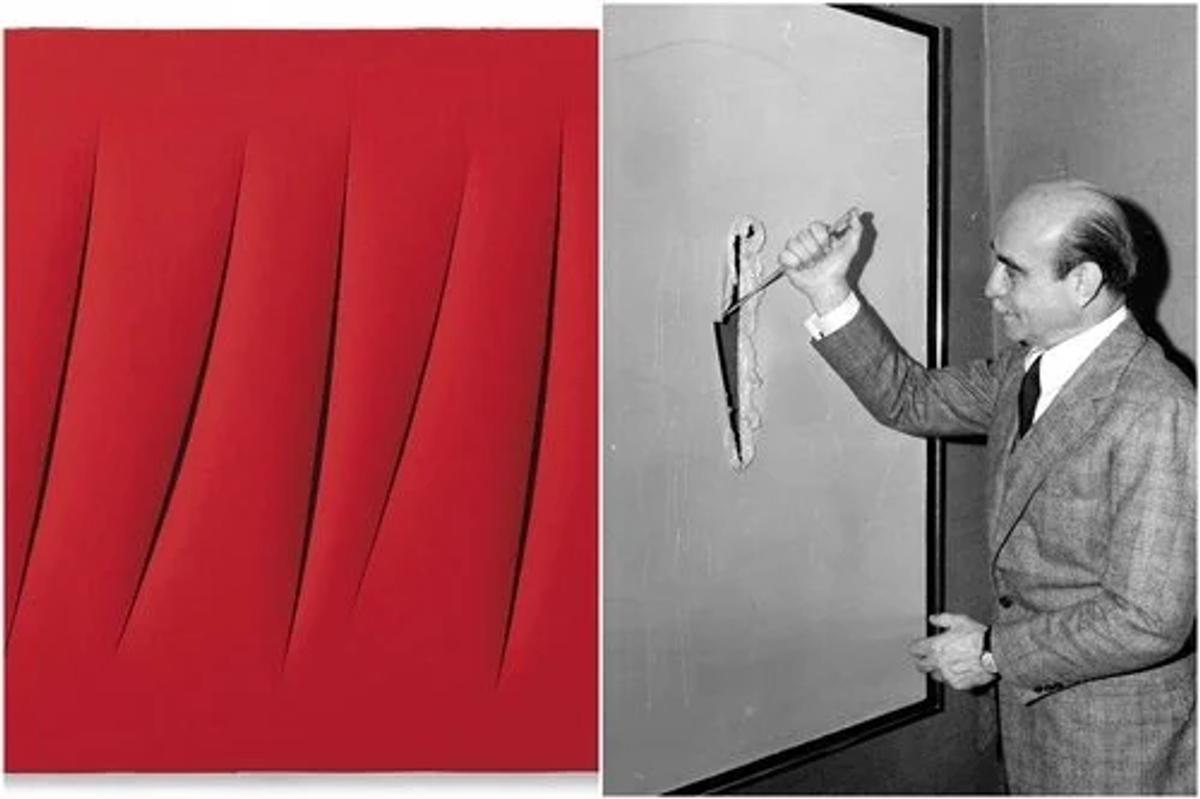
TEFAF New York 2026 opened not merely as a fair but as a transaction registry: a concentrated record of what affluent collectors and institutions still trust when confidence elsewhere has gone soft. In the first wave of reported sales, Lucio Fontana’s Concetto Spaziale moved for $2.3 million, while Frida Escobedo’s Creek Bench and Joris Laarman’s Ply Loop Console confirmed that collectible design is now competing in the same field of conviction as blue-chip painting and antiquities. The point is not that painting has died. The point is that the market’s highest symbolic authority is increasingly accruing to objects that cannot be flattened without loss: slashed surfaces, inhabitable structures, salvaged skins, pinned gemstones, engineered weight, and forms that demand spatial obedience before they yield an image. The search terms are obvious: TEFAF New York 2026, Lucio Fontana, Kathleen Ryan, Frida Escobedo, Joris Laarman, but the structure beneath them has not yet been properly named. This study argues that the fair disclosed a hard-asset turn organized around resistant objecthood, Material Singularity, and what OAC identifies here as forensic endurance.
PREVIEW DAY AS TRANSACTION REGISTRY
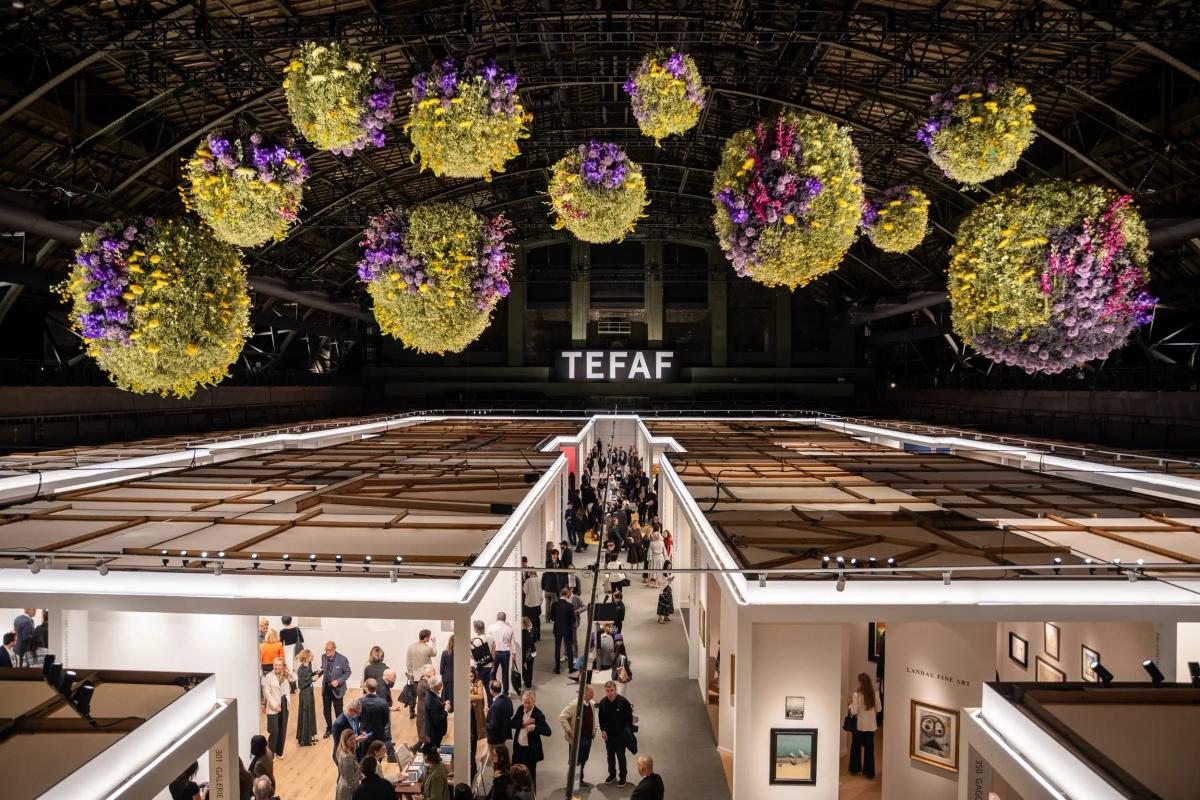
The first thing worth refusing is the lifestyle-fair reading. TEFAF New York is not useful because it is glamorous; it is useful because its preview compresses a great deal of cross-category decision-making into a single chamber. The official opening release reports more than one hundred museum representatives in the building and, in the same breath, publishes a sales list that cuts across modern painting, design, antiquities, lighting, sculpture, and jewelry. When a registry like this forms under pressure, it tells us less about taste than about the hierarchy of seriousness. The work that moves first is often the work that still feels defensible after the champagne has finished performing its civic duties.
The significance of the released sales is not medium substitution but medium permeability. Fontana’s cut surface, Escobedo’s bench, Laarman’s console, Egyptian stone, Scandinavian furniture, and Prouvé tables all share one thing: they present themselves as objects whose authority exceeds immediate image circulation. This is precisely the terrain OAC has already mapped in Luxury Just Split in Two. One Half Will Survive., where capital was shown fleeing volume and spectacle in favour of permanence, provenance density, and what that study named Material Singularity. TEFAF’s preview does not invent that shift; it stages it.
THE FLIGHT FROM FRICTIONLESS VALUE
The macro picture matters because otherwise one mistakes a fair mood for a market law. The 2026 Art Basel & UBS Art Market Report describes 2025 as a year in which renewed confidence returned first and hardest at the top end. Risk-averse buyers anchored themselves to established works in what the report explicitly calls a flight to quality. At the same time, online sales fell to their lowest level since 2019 as the high-end reasserted itself in person. The Merrill Lynch U.S. Art Market Report says the same thing in plainer terms: selectivity rose, quality prevailed, historical art reasserted itself, and collectors placed value on scarcity, provenance, and art-historical significance. In other words, liquidity did not vanish; it simply stopped being mistaken for seriousness.
This helps explain why ARTnews could quote adviser Ralph DeLuca saying there is more confidence in hard assets like art, antiques, and collectibles, while the New York Times framed TEFAF as unusually well-positioned for a turbulent environment because unstable conditions push attention toward quality, value, and well-tested objects. OAC has already theorized the loser in this environment as the Hollowed Object: an artifact that retains the signage of value while evacuating the interior condition that made value intelligible in the first place. What TEFAF shows is that the market is not abandoning the image so much as disciplining it. The image now has to answer to weight, history, repairability, or spatial command. If it cannot, it remains visible but culturally light.
The flat work is not dead; it has merely lost its immunity from having to answer to matter.
LUCIO FONTANA, FRIDA ESCOBEDO, JORIS LAARMAN: SURFACE, SUPPORT, PROCEDURE
TEFAF’s cleanest diagnostic triad is also its least subtle, which is charming. Fontana gives us the wounded surface: the canvas already refusing to remain a passive plane. Escobedo gives us the support that becomes environment: a bench that is not décor but spatial anchoring. Laarman gives us procedural intensity: digitally developed form that still arrives as crafted resistance rather than frictionless screen candy. TEFAF’s release confirms the sale of all three, which means the market is rewarding three variants of the same structural refusal: the plane cut into space, the seat expanded into architecture, and the fabricated object thickened into a proof of process.
The Friedman Benda framing matters because it situates these works within a larger thesis: modernism remains an active critical tool rather than a sealed-off period style. IFDM sharpened the point by describing modernism here as an evolving language and by identifying the inclusion of Laarman’s Ply Loop furniture as an extension of the modernist relationship between technology and design. On Artsy, Laarman’s console is listed as oak and walnut veneer with thermoset bio-resin, a vortex-like object produced through complex digital design and fabrication, yet still emphatically physical at 260 centimeters long. Escobedo’s Creek Bench is listed as stainless-steel and nickel-finished ball chains spanning an architectural span of 432 centimeters. These are not pretty side quests. They are invalid arguments.
In OAC terms, these acquisitions mark the migration from a culture of decorative reassurance to a regime of Semantic Burden. A slashed Fontana is not valuable because it is famous and blue-chip; it is valuable because it remains the canonical modern proof that a surface can become an event. Escobedo’s bench does not merely support a body; it converts occupancy into a relation with structure. Laarman’s console does not fetishize innovation in the abstract; it stages Functional Art through an ecological and procedural density that the eye can register but not exhaust. That is why these works matter together. There are three ways of making flat culture kneel.
THE DECOMPOSING MONUMENT
If the Fontana/Escobedo/Laarman triad names the return of resistant objecthood, Kathleen Ryan explains why the new regime is not clean. Gagosian dedicated its TEFAF booth to new works from Ryan’s Bad Fruit series, and both Gagosian and Artsy describe the same essential procedure: enlarged decomposing fruit, mold rebuilt in pearls, opals, agates, shells, crystals, and other stones, each fixed by hand with steel pins, and rinds ripped from salvaged vehicle skins. Volkswagen hood. Airstream hull. Ford Pinto section. The work is decadent, but it is not decorative. It is salvage made ceremonial.
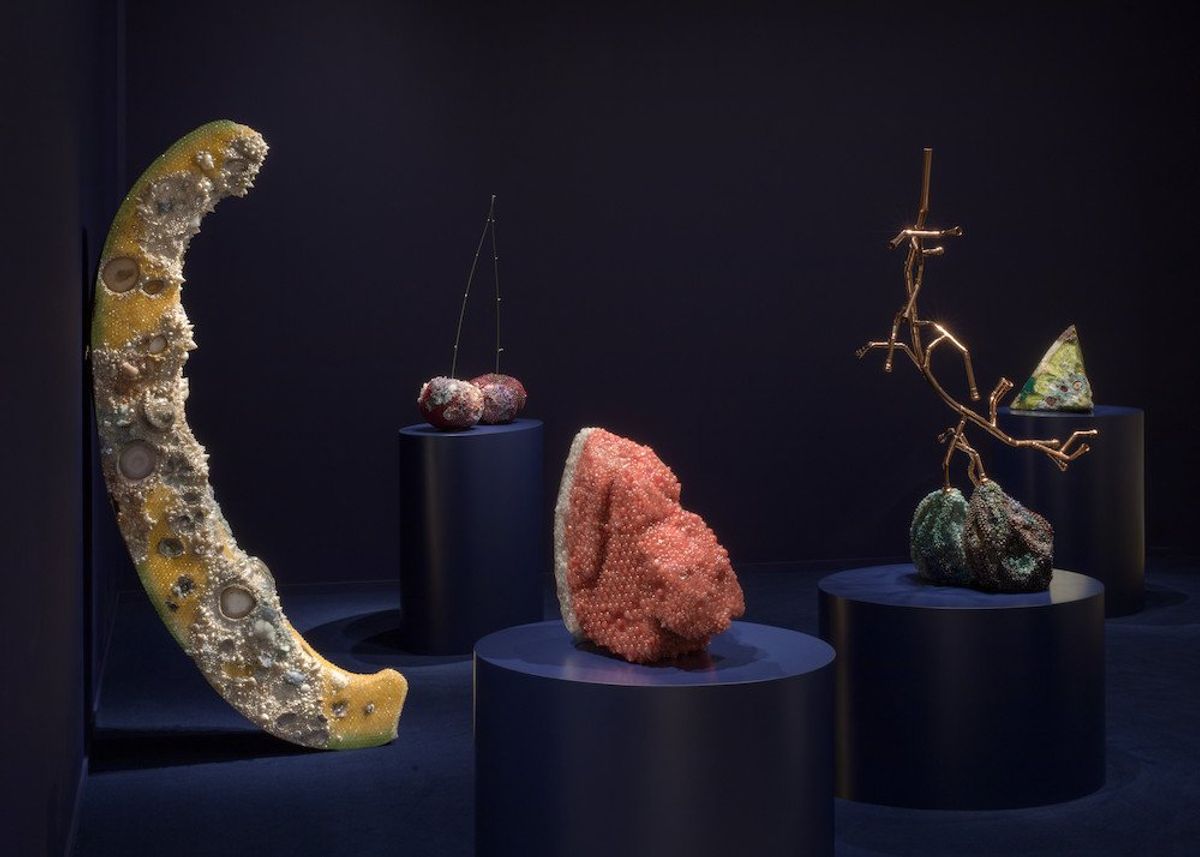
This is where the study’s governing concept of forensic endurance enters. Ryan’s fruit does not romanticize rot as fragility. It monumentalizes decomposition by trapping it inside gemstone weight, salvage, repetition, and hand-fastened labor. The mold is no longer a sign that the object has failed. It is the site where labor declares that failure will not get the last word. Gagosian’s own framing invokes vanitas, throwaway culture, and regeneration; OAC can therefore read the work not as quirky morbidity but as a direct answer to an economy that keeps demanding ever-cleaner, ever-smoother, ever-more-frictionless signs. Ryan dirties luxury until luxury becomes honest enough to speak.
The result is a genuine Aura event, but not the zero-sum kind OAC has criticized elsewhere. Ryan is not borrowing prestige from a house and reapplying it as atmosphere. She is forcing the object to earn its own charge through scale, salvage, geological accretion, and the visibility of its own fixation. One does not simply consume these works as images; one submits to them as accusations. They say, with an impolite smile, that waste will outlive the system that produced it.
Decay becomes authoritative the moment labor, salvage, and weight prevent it from disappearing.
THREAD, INHERITANCE, AND MANUAL TIME
Ryan supplies the essay’s thickest surface, but Alvaro Barrington supplies its quieter theorem. MASSIMODECARLO describes its TEFAF booth as a pairing of Barrington with Alighiero Boetti, united by thread and by the hands of women who worked with it. For Barrington, the gallery says, yarn traditions are inherited from the women of his Caribbean family, sewing as memory and care. Artsy likewise notes Barrington’s new paintings shown alongside Boetti’s embroideries. Ocula lists one of the works as yarn on burlap framed in aluminium honeycomb, mirror-finish stainless steel, plywood, and steel hardware. That sentence alone is half a dissertation: cloth meeting industry, intimacy meeting engineered support, memory refusing to remain private.
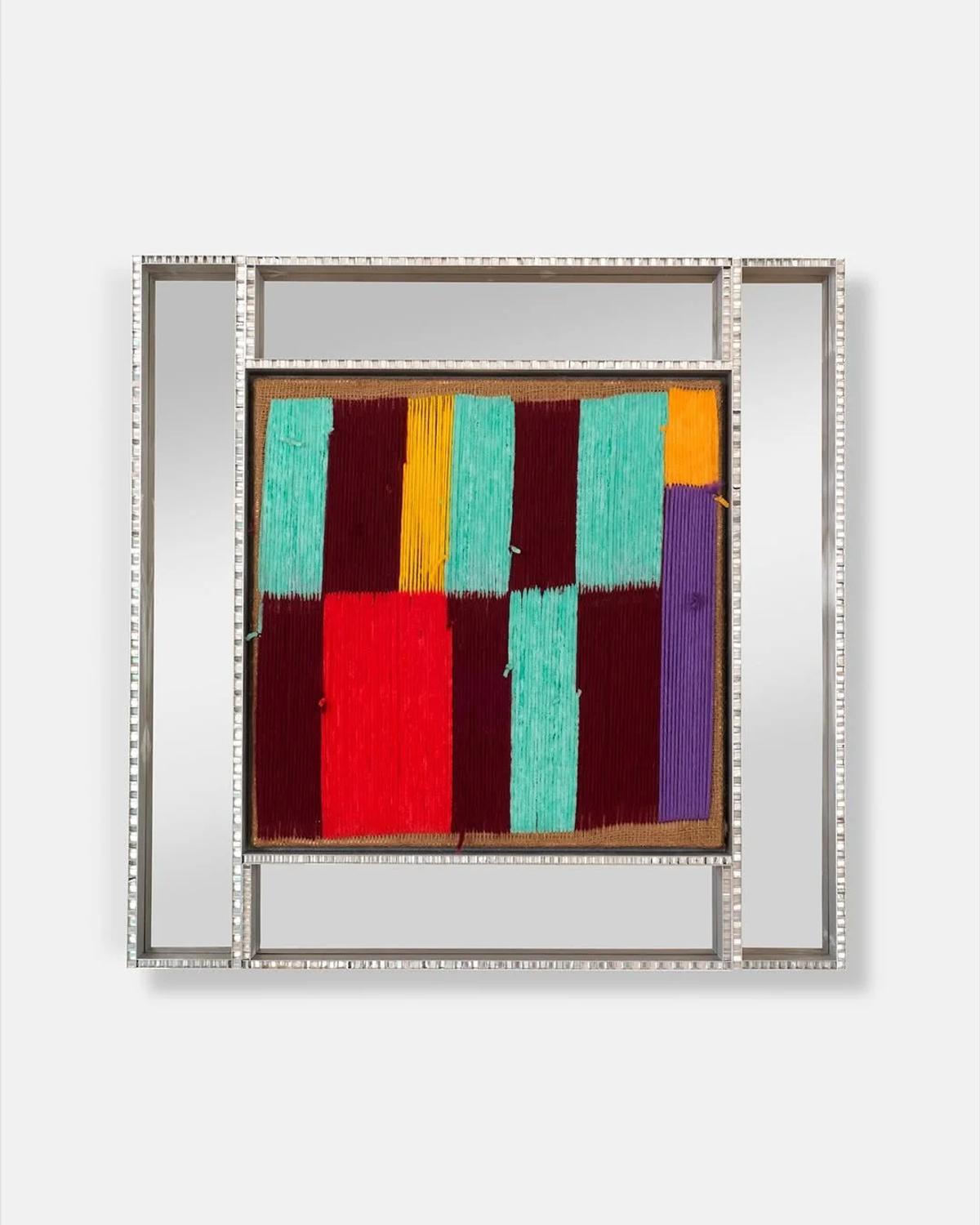
The importance of this booth is that it broadens the argument beyond literal mass. High-friction objects are not only heavy because they weigh more. They are heavy because they accumulate manual time. Barrington and Boetti make thread function as duration. In OAC’s own vocabulary, this is the territory of Material Memory and Narrative Permanence: the record of hands, inheritance, technique, and decision rendered inseparable from the work. If Ryan mineralizes decomposition, Barrington temporalizes touch. Both are forms of resistance to the frictionless asset whose only history is price.
THE MONASTIC ENCLAVE
A fair can only ratify this kind of object if its architecture knows how to stop behaving like an airport. TEFAF does. The fair’s own materials emphasize the activation of the Park Avenue Armory’s historic rooms, while Artnet describes those upper floors as Gilded Age showrooms and ARTnews emphasizes the slower, warmer, stranger pace that differentiates the fair from spectacle-optimized contemporaries. The Art Newspaper makes the point from another angle, describing TEFAF’s concentrated format, disciplined stands, and commitment to cross-category collecting. This is not a neutral venue. It is an architecture of slowed judgment.
OAC has already argued in The Architecture of Absence that serious objects require a spatial ethics equal to their own density. They need room, hush, interval, productive emptiness; what that study described through ma; not simply for visual legibility but for moral proportion. TEFAF’s Armory setting performs a related function. It recasts acquisition as something closer to a custodial ceremony than a retail throughput. That is why the fair can host a Fontana slash, a Ryan melon, a Prouvé house model, and a salvaged-material bench without those things collapsing into a content carousel. The space holds velocity long enough for objects to recover from consequences.
CROSS-CATEGORY COLLECTING AND THE END OF PERIOD OBEDIENCE
One of TEFAF’s decisive contributions is that it makes medium snobbery look provincial. The Art Newspaper explicitly identifies cross-category collecting as central to the fair’s appeal, while ARTnews stresses the fair’s identity as a place where a collector can move from an Egyptian stele to a Calder to a new painting in minutes. Artnet pushes this further in its design coverage, where Jean Prouvé’s demountable architecture becomes the limit case of an old distinction collapsing: if there is no difference between a piece of furniture and a house, then the category itself has stopped being sovereign.
This is also why the fair is such an effective stage for OAC’s critique of category obedience. In What the Keith Haring Louis Vuitton Show at the Frick Collection Actually Means, OAC argued that institutional power is increasingly purchased through trans-category aura transactions. In The Borrowed Vocabulary, OAC showed how tactile seriousness is routinely mimed by houses unwilling to bear its structural cost. TEFAF stands at a more interesting frontier. It does not just mix categories; it reveals that value now coheres around object conviction rather than period loyalty. The collector who moves from antiquity to design to contemporary salvage is not confused. They are following a more exacting ontology.
FROM DECORATIVE ACQUISITION TO FORENSIC ENDURANCE
We can now name the shift more cleanly. Decorative acquisition seeks visual compatibility, symbolic polish, and the pleasant fiction that luxury can be weightless. Forensic endurance seeks the opposite: objects that preserve the evidence of labor, salvage, structural decision, repairability, historical force, or spatial sovereignty. Fontana’s slash records the violence required to free a surface from its obedience. Escobedo’s bench turns support into a site of bodily discipline. Laarman’s console stores an ecological argument inside digitally precise craft. Ryan’s fruit fixes decomposition in the gemstone and the steel pin. Barrington’s yarn and burlap make the thread itself carry inheritance. Each work is different, but each one resists frictionless assimilation.
OAC has been preparing for this reading for some time. The Meaning Deficit diagnosed the empty sign-system of luxury, art, and architecture. The Paradox of Narrative Permanence argues that the physical object reasserts itself when its human story becomes irreversible. The Cost of Stewardship shifted value away from liquidity and toward the burden of preservation. TEFAF New York 2026 brings these arguments into one room and (crucially) into one sales ledger. The market is not yet moral. Let us not become sentimental. But it is beginning to reward objects that make moral seriousness harder to fake.
The contemporary collector is no longer buying an image alone, but a structure of time that the image cannot flatten.
AFTER THE FLAT REGIME
What TEFAF New York 2026 confirms is not the death of the canvas or the collapse of display culture. It confirms that under conditions of volatility, objects able to survive scrutiny are those that thicken into structure: the work with scar, weight, salvage, memory, or an architecture adequate to its own difficulty. That is the fair’s durable argument. What remains unresolved is more interesting. Does this hard-asset turn become a genuine post-luxury ethic of custodianship, or does luxury simply learn to cosplay gravity more convincingly? OAC should not flatter the market by answering too quickly. The market has rediscovered resistance. It has not yet proved it deserves it.
Authored by Christopher Banks, Anthropologist of Luxury, Critical Theorist & Founder
Objects of Affection Collection
Office of Critical Theory & Curatorial Strategy
469 Fashion Avenue, 12th Floor, New York, NY 10018
RELATED OAC STUDIES
Further coordinates inside the OAC archive for readers following the same structure through adjacent markets, institutions, and object regimes.
Market Bifurcation & Concealment
· Luxury Just Split in Two. One Half Will Survive.
· Christie's Sold $2.7 Billion in Art Secretly Last Year. Here's Why That Should Alarm You.
Endurance, Memory & Material Proof
Institutional Capture & Spatial Authority
· What the Keith Haring Louis Vuitton Show at the Frick Collection Actually Means.
Vocabulary, Meaning & Stewardship
· The Meaning Deficit: Why Luxury, Art, and the Built Environment Are All Failing the Same Test.