
THE WEIGHT OF A THOUSAND YEARS
On Joe Doucet’s Columns Collection, the Epistemology of Endurance, and Why Longevity Is the Only Honest Sustainability Argument Left.
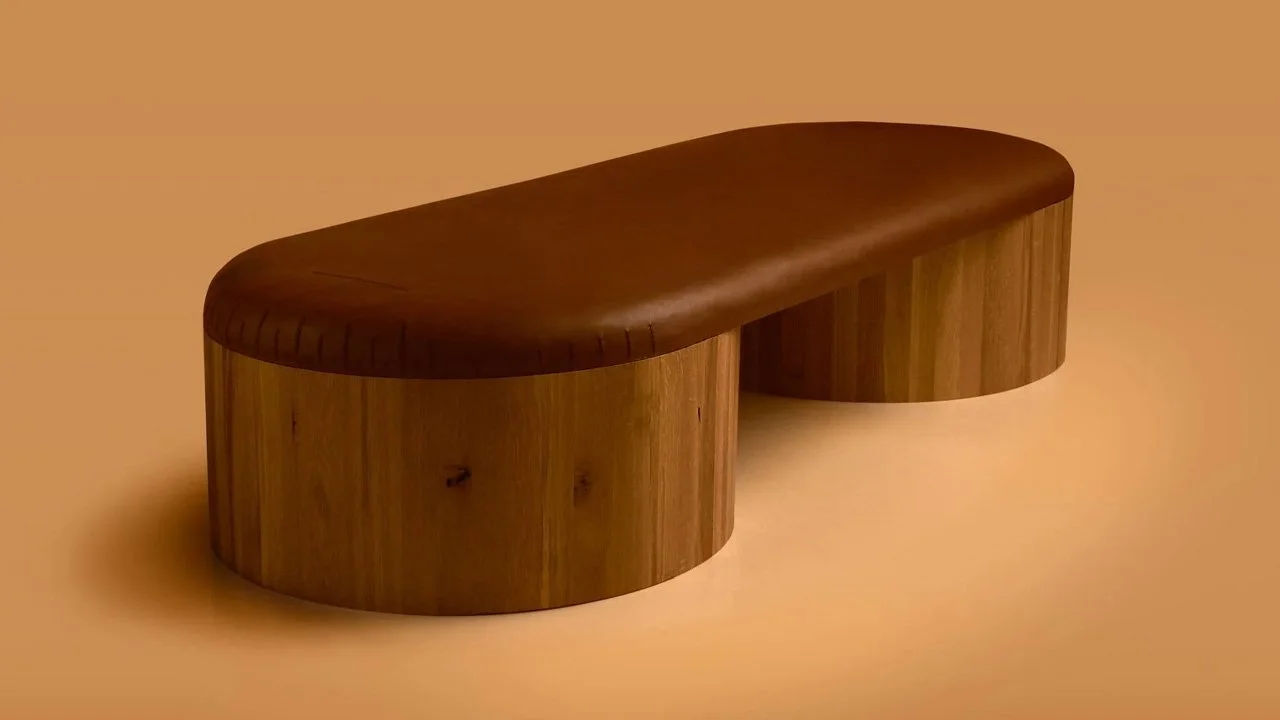
The Columns bench: A study in architectural economy and material endurance, featuring solid oak and natural leather designed to accumulate a thousand-year biography.
““What if the future of sustainable design isn’t defined by what disappears, but by what endures?””
This study, produced within the interpretive framework of the Objects of Affection Collection (OAC), examines the Columns furniture collection — a collaboration between New York designer Joe Doucet and Bulgarian studio Oublier — as a significant intervention in contemporary discourse on sustainability, material intelligence, and the economics of durability. Anchored within OAC’s proprietary critical lexicon — particularly the categories of Material Memory, Moral Weight Per Material (MWPM), the One Original Principle, Narrative Permanence, and Regenerative Luxury — this study reads Columns not merely as a furniture collection, but as a structural counter-argument to the mass-luxury market’s defining instrument of control: planned obsolescence. In proposing pieces handcrafted from solid oak, natural leather, and horsehair — materials chosen precisely because they improve with age — Doucet and Oublier have produced the most coherent recent design-world articulation of what OAC’s PLCFA framework has theorized from its inception: that the most radical act available to a maker is the refusal to participate in the economy of replacement.
The Argument the Design World Has Been Avoiding
There is a conversation the design industry has been conducting very loudly, and it has been conducted almost entirely in the wrong direction. The dominant sustainability discourse of the past decade has been organized around material innovation: the capacity of mycelium leather, algae-based foams, and biodegradable composites to replace the materials of mass production with things that disappear more graciously after their service lives conclude. The implicit assumption in this discourse is that the problem of sustainability is a problem of material fate — that the relevant question is what happens to a thing when it dies. Joe Doucet, in collaboration with Oublier, has proposed a categorically different question: what if the thing never needed to die?
The Columns collection — a table and bench handcrafted in solid oak, natural leather, and horsehair, each piece built to a claimed millennial lifespan — is a provocation delivered with the controlled understatement of a practitioner who understands that the most radical arguments are often the quietest ones. There are no fashionable surface treatments to anchor these pieces to this decade, no proprietary finishes that will look dated within five product cycles. The form is architectural in its economy: two cylinders of solid oak laid horizontally, bridged by a continuous leather surface, the hand stitching along the perimeter left deliberately visible. That last detail is not incidental. It is the entire thesis made material. A seam that is hidden cannot be reopened. A seam that is visible announces the possibility of repair — the horsehair padding refreshed, the leather resewn, the object extended into a future its maker will never live to see.
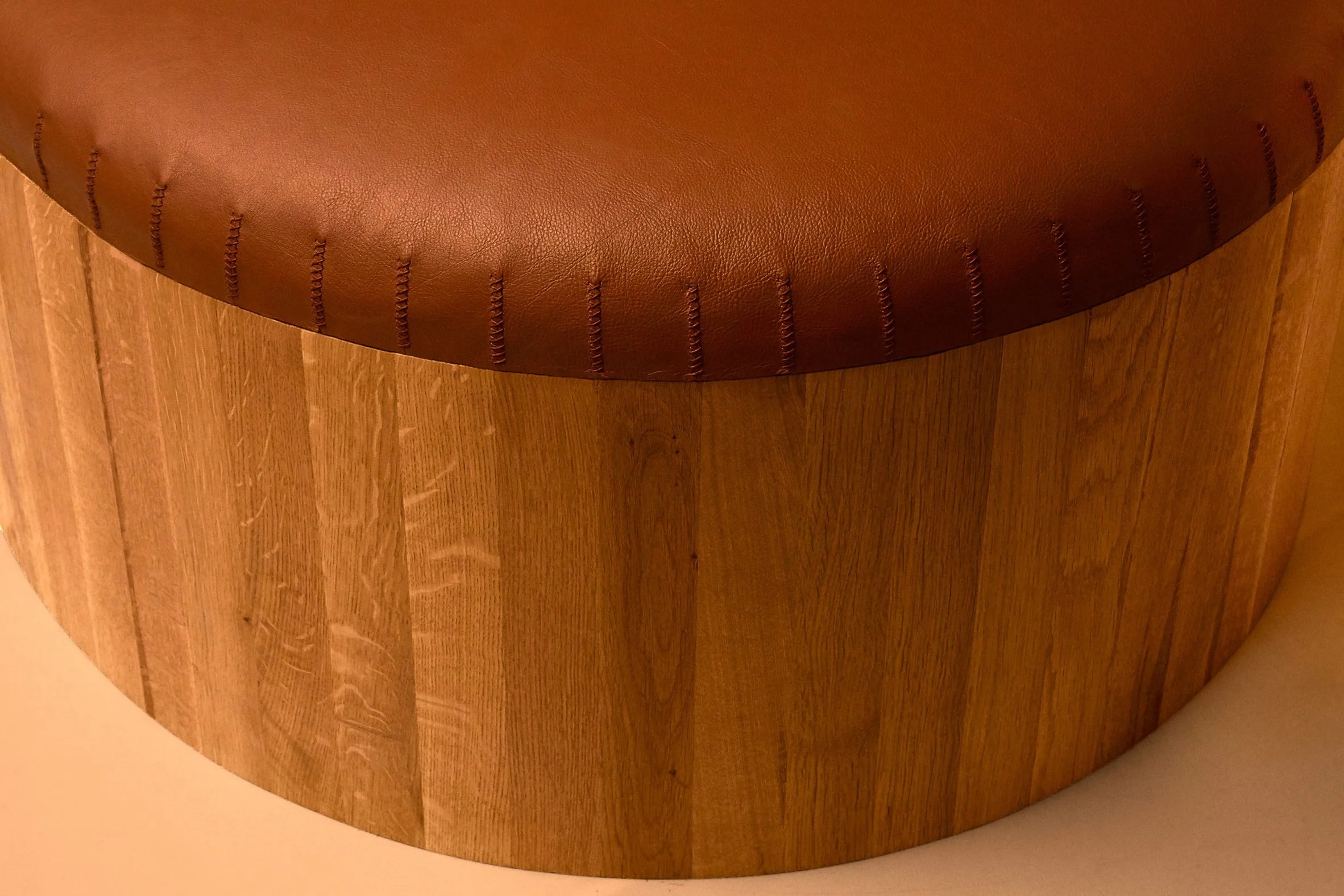
The visible seam: An invitation to future repair and the physical manifestation of Material Memory.
This is furniture designed to be inherited rather than replaced. And in that ambition, it constitutes a direct counter to what OAC identifies as the mass-luxury market’s most profitable strategy: the engineering of exhaustion into objects at the level of their material constitution. Planned obsolescence is not merely a marketing tactic. It is an epistemological position — a claim about what objects are for, what value is, and who controls the timeline of both. For the fullest account of how that epistemological claim operates within the luxury system, see OAC’s study Why Traditional Luxury’s Root Marketing Fails to Purchase Moral Capital. Doucet and Oublier have refused that claim in the most material way available: by choosing oak, leather, and horsehair not for their visual properties but for their biographical ones. These are materials that do not decline into irrelevance. They accumulate it.
“Planned obsolescence is not merely a marketing tactic. It is an epistemological position — a claim about what objects are for, what value is, and who controls the timeline of both.”
Oublier and the Paradox of Remembering Through Forgetting
The name of Doucet’s partner in this project is itself a critical text. Oublier is the French verb for forgetting. It is a Bulgarian design studio whose practice, at its foundation, explores forgetting as a cultural and creative act — the productive erasure of the overwrought, the evacuation of the excessive. That a studio organized around forgetting should collaborate on a collection built explicitly for perpetual remembrance is not a contradiction. It is, in the fullest sense, a dialectical resolution.
What Oublier’s name signals is not the elimination of the object, but the elimination of the superfluous. To forget, in the productive sense the studio implies, is to shed what is merely fashionable, merely seasonal, merely responsive to the current cycle of taste. What remains after that forgetting is what is structurally worth keeping. The Columns collection is the result of that reduction: a form so stripped of period-specific gesture that it becomes, paradoxically, permanent. The forgetting of fashion is what makes the object available to the future.
OAC’s framework has identified this operation before under a different name. In the study The Folder as Archive, the Archive as Poetics: An OAC Critical Reading of Maison Margiela Folders, we examined how Maison Margiela’s institutional practice of concealment — the blank labels, the white blouses of the collective, the strategic erasure of individual authorship — functions not as the suppression of meaning but as its concentration. To remove all that is not essential is to force the essential to carry the full weight of meaning. The parallel logic was also operative in The Named Ghost, OAC’s study on the Reuters unmasking of Banksy, where the productive management of absence — the pseudonym, the erased maker — was read as a value architecture built on the same principle of strategic reduction. Oublier’s logic is cognate to both. Forgetting the trend is the condition of preserving the object.
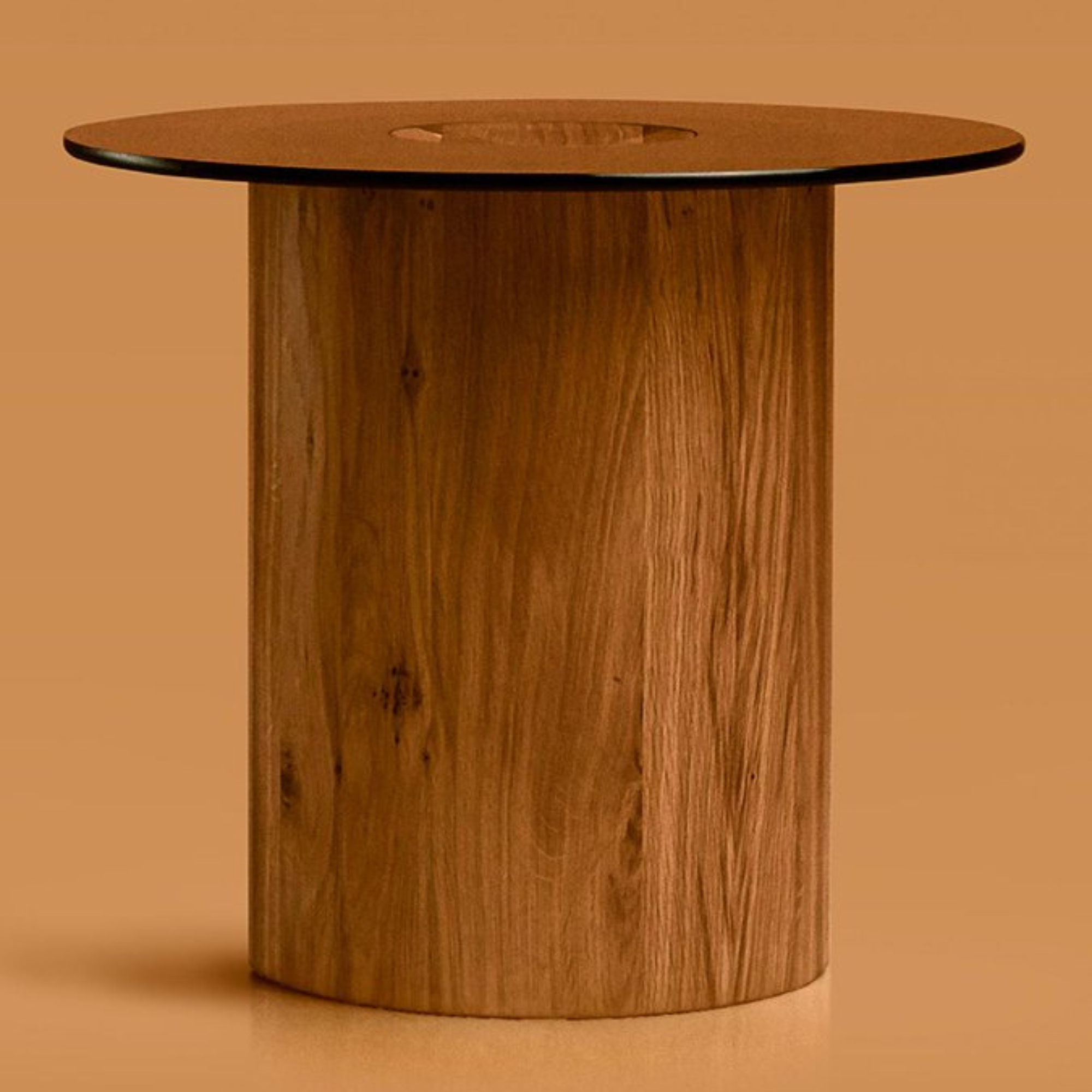
The Architecture of Forgetting: By shedding seasonal trends, the Columns side table achieves a form so stripped of period-specific gesture that it becomes structurally permanent.
Material Memory and the Epistemology of Improvement
The central claim of the Columns collection — that its materials improve with age — requires philosophical unpacking, because it is not merely a claim about material science. It is a claim about what improvement means, and who has the authority to measure it.
The mass-luxury market operates on a theory of value that is essentially photographic: an object’s peak condition is its condition at the moment of purchase, and every subsequent moment represents a departure from that ideal. This is why LVMH’s repair programmes so consistently result in what OAC has elsewhere called the ‘zombie commodity’ — the restoration of an object to an approximation of its original appearance at the cost of every material trace of the life it has actually lived. In the study Why Traditional Luxury’s Root Marketing Fails to Purchase Moral Capital, OAC documented how this Thanatopolitics of Repair — the institutional refusal to let an object accumulate its own biography — constitutes a structural suppression of what we term Material Memory: the record of a thing’s actual existence, written into its surfaces by time, use, and the bodies that have engaged with it.
Doucet and Oublier have taken the opposite position. The solid oak of the Columns collection does not need to be maintained at the uniformity of its showroom surface. It has grain and life that deepen under use and light. The natural leather is not protected against the evidence of its existence; it is intended to absorb that evidence, developing a patina that is not damage but accumulation — the visible record of the object’s ongoing life in the world. The horsehair padding within is not concealed behind a sealed envelope but accessible through the visible seam, available for renewal when renewal is required. Each of these decisions is a refusal of the photographic theory of value. Together, they constitute a commitment to what OAC terms Material Memory: the understanding that an object’s biography is not an erosion of its value but an enlargement of it.
This is not a novel philosophical position. It has antecedents in Kintsugi, the Japanese practice of repairing broken ceramics with gold lacquer, which makes the history of damage into the most visually prominent feature of the repaired object — a tradition OAC examined in the study From Function to Fissure: Collectible Design and the Weaponization of Material, where we traced how the Material Fissure — the crack, the scar, the visible evidence of history — functions not as failure but as the point at which the material real reasserts itself against the smooth perfection of the Spectacle. The Columns collection is, in this sense, Fissure architecture: furniture designed so that use inscribes itself into the object’s surface as a record rather than a wound. The same logic that governs Alan Vilar’s embroidered ephemera — the maximization of labor invested into materials that accumulate rather than degrade — governs the Columns collection’s relationship to time.
“An object’s biography is not an erosion of its value but an enlargement of it. The Columns collection is Fissure architecture: furniture designed so that use inscribes itself as a record rather than a wound.”
The Thousand-Year Claim and Its Structural Logic
The claim that the Columns collection is built to last a thousand years will be received by some as marketing hyperbole. OAC’s reading is more precise. The thousand-year figure is not a warranty. It is a framework of intent — a declaration that the design decisions informing every element of these pieces have been made with the genuine consideration of generational continuity, rather than the seasonal cycle that governs virtually all mass-luxury production.
Consider the evidentiary basis. Solid oak, a material of extraordinary structural density and dimensional stability, has been used in furniture, ecclesiastical architecture, and naval construction for millennia. The choir stalls of medieval cathedrals — built in the fourteenth century from the same material — remain in active use. Natural leather, properly maintained, exhibits comparable longevity; historical antique coaches have retained functional leather seating across centuries of use. Horsehair, deployed in upholstery since well before the industrial age, is both durable and renewable. None of these material choices is novel. That is precisely the point. Doucet has not reached for an experimental substrate whose longevity can only be theorized. He has reached for materials whose longevity has already been demonstrated, across centuries of use in exactly the functional context Columns inhabits.
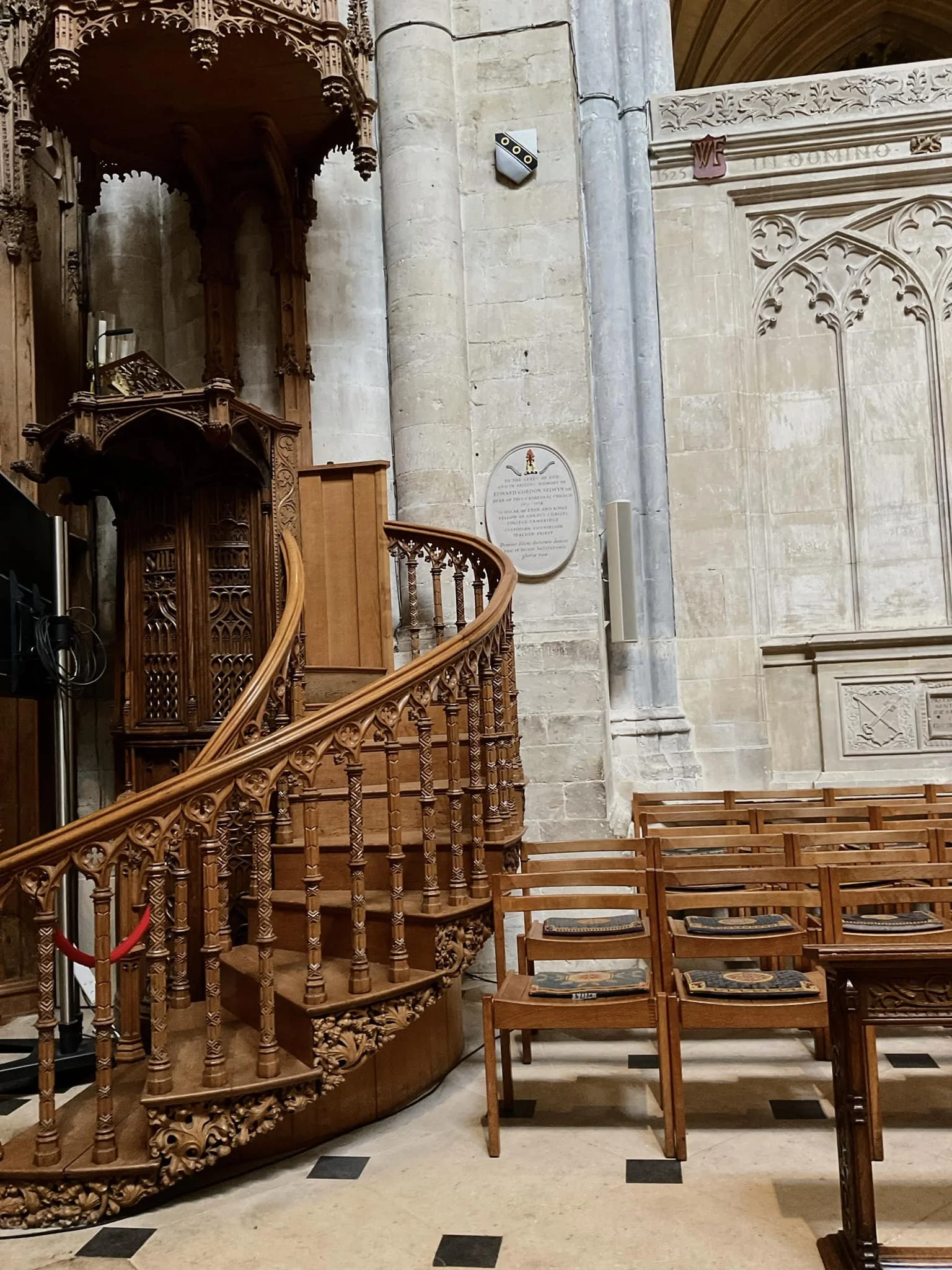
Evidence of Endurance: The solid oak within Exeter Cathedral has remained in active use since the 1300s, providing the material precedent for the Columns collection's thousand-year intent.
The form underscores the claim. There are no surface treatments that will date the pieces to this decade. No lacquers that will yellow, no veneers that will lift, no proprietary coatings whose degradation will trigger replacement. The joinery is structural. The stitching is visible and accessible. The design, in its formal austerity, has eliminated every category of failure that might otherwise impose a premature end on the object’s life. This is what OAC means by the Anti-Speculative Entity: an object constituted in such a way that it cannot easily be converted into the occasion for its own replacement. The mass-luxury market depends on that conversion. The Columns collection refuses it.
The comparison to the biodegradable material trend is not merely rhetorical. OAC’s study on Hermès’ experimental mycelium-based Sylvania Victoria bag — examined as a potential hyperreal performance of sustainability — benchmarks a lifespan measured in years against a material philosophy of designed impermanence. The Columns bench and table, if maintained with nothing more sophisticated than occasional leather conditioning, are rated for centuries. The carbon accounting is not comparable. An object that does not need to be replaced does not need to be manufactured, sourced, shipped, or eventually composted again. Its environmental cost is paid once, and then it serves. The most sustainable object is, in this strict sense, the one that never requires its own successor. This argument is the material extension of what OAC’s Biopolitics of the Artifact study identified as the structural condition of Functional Endurance: the capacity of an object to persist against the thanatopolitical pressures of institutional obsolescence and the market’s appetite for replacement.
Regenerative Luxury and the Custodian’s Contract in Design
The Columns collection introduces into the design market a logic that OAC’s PLCFA framework has been elaborating in the context of singular, commissioned artifacts: the logic of custodianship. An object built to outlast its first owner is, by definition, an object that will have multiple owners. Each of those owners inherits not merely the physical form but the accumulated biography of the thing — the patina of previous use, the slight depressions where previous inhabitants rested, the deepened grain where previous hands have touched. The object becomes, in this way, a carrier of collective memory rather than a personal possession. Its ownership is custodianship in the fullest sense of the term.
OAC’s Custodian’s Contract, formalized in the governance of the Court of Tenacity, imposes this relationship at the level of legal instrument. The owner of an OAC artifact accepts, contractually, an obligation to maintain and eventually transfer the object rather than liquidate it. The fullest account of the economic and ethical structure of this instrument is available in The Cost of Stewardship: Capitalizing on Patronage Validation and the Economics of Emotional Permanence. The Columns collection does not, to OAC’s knowledge, impose a formal legal covenant of this kind. But it imposes something functionally cognate at the level of the object’s design constitution. A bench whose construction invites repair rather than replacement, whose form transcends seasonal taste, and whose materials accumulate rather than decline — that bench is, in its structure, an argument for the custodial relationship. It tells its owner: you are not the end of this story. You are a passage within it.
This is what OAC terms Regenerative Luxury: the value proposition organized not around novelty, not around the consumption of the new, but around the compounding of a thing’s worth over time through use, maintenance, and the accumulation of Material Memory. It is the antithesis of the seasonal model. The PoetCore & Literary Tones study documented how the broader culture is already migrating toward exactly this disposition — the demand for objects with weight, history, and the visible fingerprint of human intention. The Columns collection is the fullest material realization of that demand within the furniture market. It is an object designed for the Post-Growth Citizen who seeks durable meaning over liquid assets.
“Regenerative Luxury: a value proposition organized not around novelty or the consumption of the new, but around the compounding of a thing’s worth over time through use, maintenance, and the accumulation of Material Memory.”
The Moral Weight Per Material of Endurance
OAC’s metric of Moral Weight Per Material (MWPM) was developed to quantify what is typically left unmeasured in the luxury market’s value proposition: the ethical density of a material’s provenance, the social cost of its production, the environmental implications of its end-of-life trajectory. For a full account of how the MWPM metric is constructed and applied, see The Material as Political Capital: Quantifying Moral Weight in the Anti-Market Materiality of PLCFA. Applied to the Columns collection, the metric yields an instructive reading.
Solid oak sourced from responsibly managed forests, natural leather from traditional tanneries using vegetable processes, horsehair obtained through non-lethal harvesting — each of these materials carries its own provenance narrative, its own chain of labor and ecological responsibility. But the MWPM calculation for the Columns collection is distinguished from that of a comparably ‘ethical’ mass-produced item by a factor that the standard ethical sourcing discourse does not capture: the temporal multiplication of moral weight through longevity. An object that serves for a thousand years distributes its material and ecological cost across that entire duration. Its per-year impact approaches zero. Its Moral Weight Per Material, measured against its total service life, is among the highest achievable in the design market.
This is the calculation that the biodegradable materials trend has been evading, and which OAC’s study on the Hermès mycelium bag surfaced with precision. Over the millennium in which a single Columns bench remains in use, the biodegradable alternative has been manufactured, used, composted, and replaced two hundred times. The Columns bench, by this accounting, is not merely a luxury object. It is the most environmentally rational object in its category. The PLCFA framework has always maintained that moral weight is not merely about the ethics of a material’s origin but about the full temporal arc of its life in the world — the argument most rigorously formalized in Biopolitics of the Artifact: How Functional Endurance Challenges Foucault, Groys, and the Archival Death Mandate. The Columns collection is, in this light, a spontaneous resolution of what Foucault would have identified as the thanatopolitical logic of design production — the institutional tendency to engineer the death of objects at the moment of their maximum market utility, so that the cycle of replacement can recommence.
Against the Simulacrum of Innovation
The most significant critical move in Doucet’s project is not the Columns collection itself. It is the implicit argument about what innovation means. The design industry, like the broader luxury market, has organized its self-understanding around novelty: the new material, the new process, the new technology, the new form. The sustainability discourse, in its material-innovation mode, has accepted this framing entirely. The mycelium bag, the algae composite, the biodegradable panel — all of them propose novel solutions to the problem of material fate while leaving the logic of replacement entirely intact. OAC’s study Hermès Unveils Biodegradable Mycelium-Based Handbag Collection made this diagnosis explicit: the hyperreal performance of sustainability is itself a product of the same spectacle logic that produced the problem it claims to solve.
Doucet’s counterargument is that this framework itself is the problem. If the crisis of material culture is organized around disposability — if the fundamental issue is that objects are not built to last — then the solution is not a new material that degrades more graciously. The solution is an old material that doesn’t need to degrade at all. The innovation, in this reading, is the refusal of the innovation model. The radical gesture is the gesture backward: to oak, to leather, to horsehair, to joinery, to visible seams. To the craftsperson’s knowledge that an object properly made at the outset requires no successor. This is the argument that OAC’s Algorithm of the Hand study formalized as the ‘Death of the Smooth’ — the reassertion of human imperfection and labor as the ultimate materiality in an age of algorithmic perfection.
The Spectacle, as OAC’s study Debord’s Spectacle Meets Sholette’s Missing Mass established at length, is sustained by the perpetual production of novelty. The Spectacle needs the new product, the new version, the new season, the new ‘innovation,’ to maintain its velocity. An object that does not need to be replaced cannot be folded into that velocity. It is, structurally, a Spectacle-resistant artifact. For the fullest OAC account of how the Simulacrum operates within the contemporary market and how Aura can be sustained against the corrosive force of reproduction and circulation, see From the Aura to the Simulacrum: Benjamin, Baudrillard, and the Crisis of the Authentic. The Columns collection’s answer to Benjamin’s diagnosis of the loss of Aura under mechanical reproduction is not the manufacture of artificial scarcity. It is the manufacture of actual permanence. An object that genuinely endures requires no mythology of rarity. Its persistence is its own authentication — precisely the architecture that OAC’s Aura Transaction study identified as the structural alternative to artification: not the borrowed aura of a collaborating artist, but the irreversible aura of a material history that cannot be replicated.
“An object that does not need to be replaced cannot be folded into the Spectacle’s velocity. It is, structurally, a Spectacle-resistant artifact.”
The Narrative Permanence of the Object That Outlives Its Maker
OAC’s concept of Narrative Permanence — the capacity of an artifact’s meaning to endure across time — has been theorized primarily in the context of singular, commissioned objects: works whose provenance is documented, whose custodian chain is legally structured, whose material biography is certified and preserved. The fullest account of this framework, drawing on fieldwork from the APA Summit Paris 2026, is available in The Paradox of Narrative Permanence: How the Most Advanced Digital Infrastructure Is Being Deployed to Re-Humanise the Physical Object. The Columns collection extends this question into less formally structured territory: what happens to narrative when the object outlives not only its maker but its maker’s generation, and then the generation after that?
The answer, in the Columns collection’s implicit theory, is that the object itself becomes the narrative. The grain of the oak, deepened over generations of use. The leather, darkened and shaped by the bodies that have sat on it. The visible seam, perhaps resewn once or twice in the course of a century, each resewing a small archival event in the object’s history. These are not texts in any conventional sense, but they are forms of documentation — Material Memory inscribed not in a certificate or a provenance record but in the substance of the object itself. The bench does not require a digital twin or a blockchain ledger to carry its history. It carries it in its surfaces. This is the material condition that OAC’s Hito Steyerl and the Phygital Counter-Strategy study identified as the irreducible precondition of genuine Narrative Permanence: the high-fidelity material record that resists the degradation of the Poor Image and the entropy of digital circulation.
There is a distinction to be drawn here from the dominant mode of heirloom production in the mass-luxury market, which is organized around the brand narrative rather than the object narrative. When the luxury industry markets its products as heirlooms, what it is selling is the brand’s narrative of craft and heritage — a narrative produced by the brand and attached to the object as a form of external attribution. When that authority is compromised — when supply chain investigations reveal the labor conditions of the actual production, as OAC documented in Why Traditional Luxury’s Root Marketing Fails to Purchase Moral Capital — the narrative detaches from the object entirely. The Columns collection’s Narrative Permanence is constituted differently. It is not a brand’s story applied to an object. It is the object’s own story, generated by use and time and written into its material. That story cannot be counterfeited, because it is not a representation but a record.
What Columns Confirm and What It Leaves Open
The Columns collection arrives as a confirmation of several arguments that OAC’s PLCFA framework has been developing across its published studies. It confirms that the longevity-as-sustainability argument is available at the level of designed production objects, not merely singular commissioned artifacts. It confirms that the mass-luxury market’s planned obsolescence model is a strategic choice rather than a material necessity. And it confirms that the most radical design gesture in the current market is the gesture of restraint: the refusal of the proprietary finish, the seasonal update, the built-in obsolescence. The PoetCore study documented the cultural appetite for exactly this kind of refusal; Columns is its most architecturally rigorous expression to date.
What the collection leaves open is the question of the Custodian’s Contract. OAC’s framework for Anti-Speculative Entities includes, at its core, a legal instrument that prohibits the rapid resale of an object and imposes positive obligations of maintenance and care on its owner. The Court of Tenacity’s five-year Anti-Sale Covenant is not merely a gesture. It is a structural mechanism for ensuring that the object’s custodial relationship is not immediately monetized and liquidated. The full architecture of this anti-speculative mechanism is elaborated in The Anti-Speculative Cost: Why Art Basel Miami Needs the Moral Weight Metric. The Columns collection, to OAC’s current knowledge, is sold without such an instrument — produced in small batches, not under the One Original Principle, and its custodial relationship is implied by the object’s design rather than enforced by its legal constitution. Whether Doucet and Oublier will formalize the custodial relationship through legal structure remains to be seen. What OAC can confirm is that the object, in its material constitution, has made the argument for permanence as compellingly as any design object in recent memory. The legal architecture is the next frontier.
“The object, in its material constitution, has made the argument for permanence as compellingly as any design object in recent memory. The legal architecture is the next frontier.”
On the Patience of a Thousand Years
There is a category of argument that can only be made in the present tense but is addressed entirely to the future. The Columns collection is such an argument. Its interlocutors are not the buyers of 2026. They are the people who will sit on this bench in 2126, and in 2226, and in 2326, each of them receiving an object that has arrived from a maker they will never know, bearing the marks of all the lives it has passed through, intact in its structural logic and available in its custodial function.
This is what Joe Doucet means by endurance as innovation. And it is, in OAC’s reading, the most serious design argument made in the contemporary market in some time. The mass-luxury industry has mastered the language of heritage. What it cannot master — because mastery would require the abandonment of its own economic model — is the reality of permanence. Permanence is not a brand story. It is a material commitment, enforced at the level of the joinery, the seam, the grain, the weight of the oak against the floor.
OAC’s PLCFA framework was developed from the conviction that the object is, in the end, the only text that cannot be retracted. A brand can rebrand. A narrative can be revised. A certificate can be disputed. But an oak bench, properly made, with visible seams and horsehair that can be refreshed and leather that accumulates the evidence of lives lived against its surface — that bench is its own argument, and it will outlast every counterargument the market can construct. For the fullest account of how the Zero-Sum Aura can be countered by the sovereignty of the material object, see OAC’s study The Zero-Sum Aura: Why Digital Immortality Requires a Material Host. For the structural theory of how Narrative Permanence is built and defended, see The Paradox of Narrative Permanence. The Columns collection’s bench and table do not require the Spectacle’s permission to persist. They simply persist.
Authored by Christopher Banks, Anthropologist of Luxury, Critical Theorist & FounderObjects of Affection Collection
Office of Critical Theory & Curatorial Strategy
469 Fashion Avenue, 12th Floor, New York, NY 10018
RELATED OAC STUDIES
The following studies from the OAC archive speak most directly to the themes pursued in this paper. They are presented here as an invitation to follow the threads of this inquiry into adjacent territories of OAC’s critical practice.
On Material Endurance, Fissure & the Weaponization of Time
· From Function to Fissure: Collectible Design and the Weaponization of Material
· The Material as Political Capital: Quantifying Moral Weight in the Anti-Market Materiality of PLCFA
· PoetCore & Literary Tones: The Hand-Stitched Rebellion Against Sterile Tech-Luxury
On Custodianship, Stewardship & the Anti-Speculative Covenant
· The Anti-Speculative Cost: Why Art Basel Miami Needs the Moral Weight Metric
On Aura, Simulacrum & the Economics of Permanence
· The Zero-Sum Aura: Why Digital Immortality Requires a Material Host
· From the Aura to the Simulacrum: Benjamin, Baudrillard, and the Crisis of the Authentic
· The White Wall Paradox: Quantifying Consumption in the Age of Aesthetic Neutrality
· THE AURA TRANSACTION: On Louis Vuitton’s Super Nature and the Ethics of What Gets Absorbed
On Sustainability, the Spectacle & the Refusal of Disposability
· Why Traditional Luxury’s Root Marketing Fails to Purchase Moral Capital
· The Simulacrum of Status: Why Art Basel Value Resists the VIP Image
