THE NAMED GHOST: On the Reuters Unmasking of Banksy, the Ontological Value of Anonymity, and What It Means When the Market's Most Profitable Secret Becomes a Name
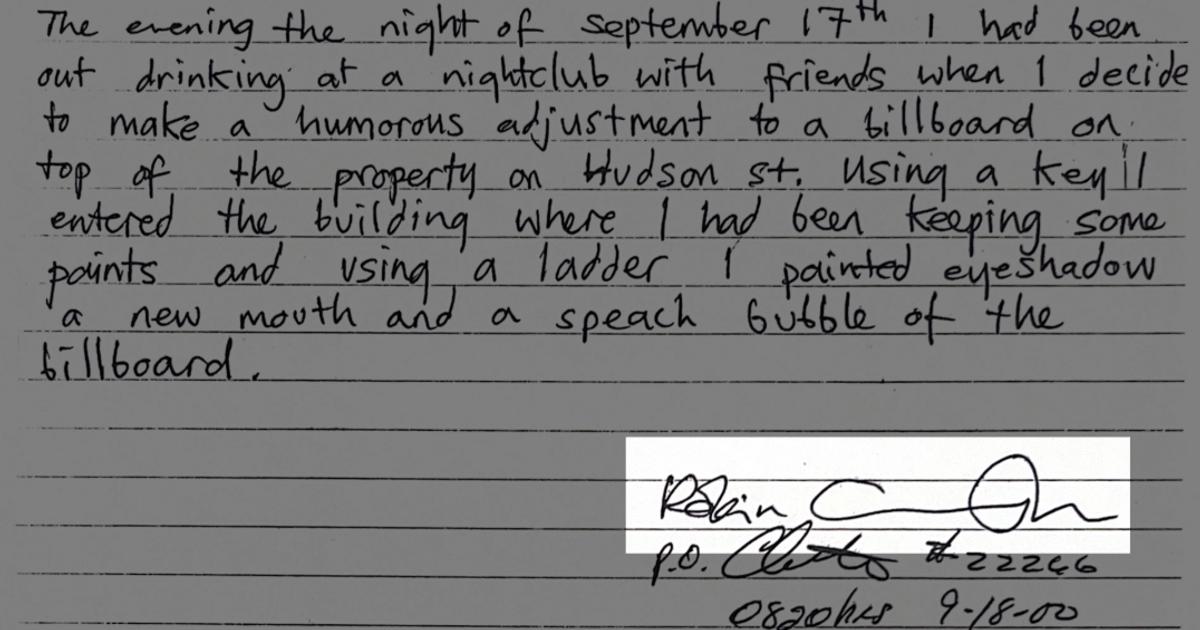
This study, produced under the interpretive frameworks of the Objects of Affection Collection (OAC), examines the Reuters investigation published on March 13, 2026, which presents evidence (including a handwritten confession from a 2000 New York arrest and Ukrainian immigration records) identifying Robin Gunningham, also known as David Jones, as the street artist Banksy. Anchored within OAC's proprietary critical lexicon, particularly the categories of Zero-Sum Aura, Moral Weight Per Material (MWPM), the One Original Principle, and Narrative Permanence, this study reads the unmasking not as a biographical event, but as a structural stress test: an empirical collision between a value system built on managed absence and the irreversibility of documentary evidence. Readers of OAC's earlier inquiry into The Banksy Enigma: Mastering the Narrative of Modern Art will recognise the intellectual lineage from which this analysis proceeds; and the structural vulnerability it deliberately left open.
The Confession in the Archive
On September 18, 2000, at 4:20 in the morning, a young man from Bristol was arrested on the roof of 675 Hudson Street in Manhattan's Meatpacking District. He had been defacing a Marc Jacobs fashion billboard. He signed a handwritten confession. That confession, buried in New York court records for a quarter of a century, bears the name Robin Gunningham.
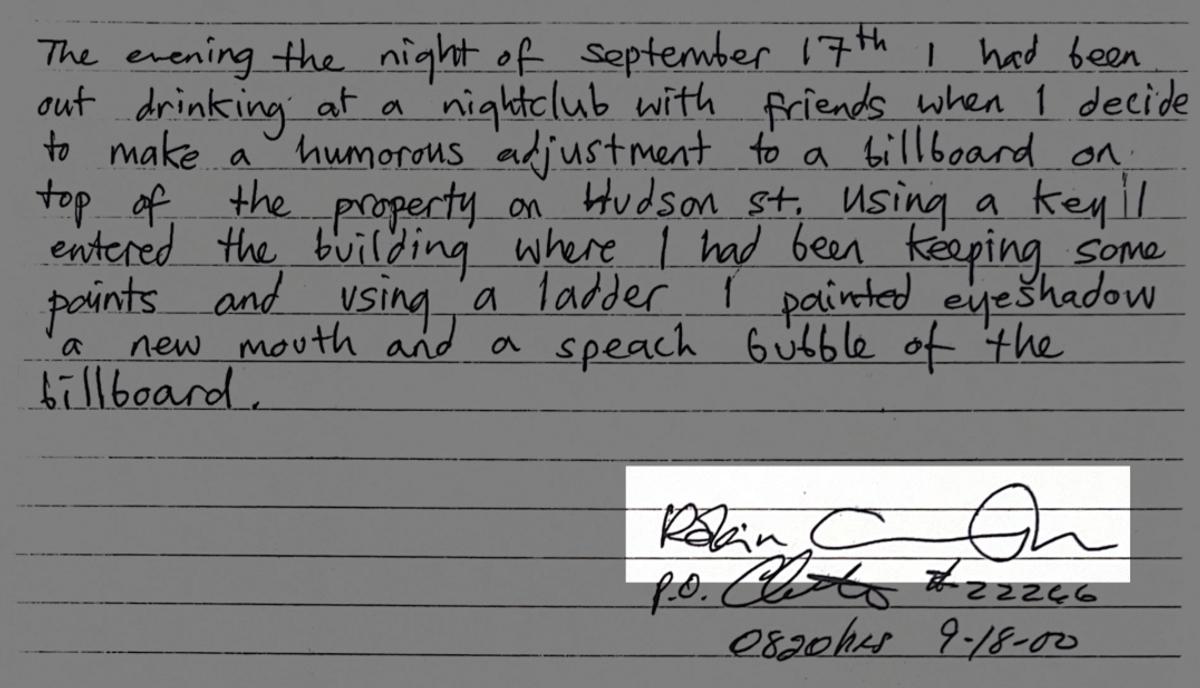
Reuters published its findings on March 13, 2026. The investigation, a year in the making, involving travel records, Ukrainian immigration data, witness testimony from the village of Horenka, and the forensic excavation of those 2000 court files, concluded, in its own words, "beyond dispute," that Robin Gunningham, now living under the assumed legal name David Jones, is Banksy.
The art world has known this name since 2008, when The Mail on Sunday first identified Gunningham as the figure behind the pseudonym. But naming is not the same as proof. What Reuters has now introduced into the public record is something categorically different: documentation. A signature. A legal instrument. The state's own archive turned against the anonymity it inadvertently protected.
This study is not about who Banksy is. That question, finally, has an answer. This study is about what happens to a value system, a market, an aesthetic, a cultural mythology, a particular species of Aura, when the anonymous name behind it acquires a face, a birth certificate, a passport crossing record, and a handwritten confession on a disorderly conduct charge.
This is a study about the Semantic Burden of the Name. And it is a study about what the PLCFA framework has argued since its inception: that value built on the management of mystery is, by definition, structurally precarious, a sophisticated simulacrum awaiting its material reckoning. For the foundational account of that argument as it applies to the art world's economy of mystique, see OAC's study From the Aura to the Simulacrum: Benjamin, Baudrillard, and the Crisis of the Authentic.
The Architecture of the Void: Anonymity as Product
Walter Benjamin argued in "The Work of Art in the Age of Mechanical Reproduction" that the Aura of an artwork is inseparable from its singular existence in time and space: its here-and-now, its embeddedness in a specific material history. But Benjamin did not anticipate a variant in which the Aura migrates from the object to the maker, and from the maker to the maker's absence. Banksy performed a further and stranger inversion: he industrialized the Aura of the Unknown. For the fullest OAC account of how this logic has been deployed in the contemporary art market, see The Simulacrum of Status: Why Art Basel Value Resists the VIP Image.
Anonymity, in Banksy's construction, was never merely a practical shield against prosecution, though it began that way. Steve Lazarides, his former manager, described it plainly: the anonymity, to begin with, was exactly that, a tool for evading law authorities in a Bristol where municipal enforcement against graffiti was, in Lazarides's word, "draconian." But the mask did not remain merely functional. It became the product. Lazarides himself eventually articulated the mutation: the anonymity became "a good gag, and then became a disease." A disease is precisely the right term for a condition that begins as adaptation and ends as identity.
In OAC's lexicon, we identify this as the construction of a Zero-Sum Aura, a value proposition in which the mystery itself performs the function that labor, singularity, or Moral Weight Per Material (MWPM) would perform in legitimate post-luxury practice. The question the market asks before each Banksy sale is not "what does this object contain?" but "what does the name on the authentication certificate guarantee?" For OAC's foundational account of how MWPM is calculated against speculative value, see The Material as Political Capital: Quantifying Moral Weight in the Anti-Market Materiality of PLCFA.
The establishment of Pest Control in 2009 is the institutional codification of this logic. Pest Control does not authenticate Banksy. It authenticates "Banksy", the brand, the mythology, the narrative vehicle. The Di-Faced Tenner certificates that accompany authenticated works are not documents of material provenance. They are documents of narrative inclusion: confirmation that a given object has been granted entry into the mythos. The anonymity is the moat. The moat protects the kingdom. The kingdom is a market. OAC has examined the parallel structure in luxury's authentication machinery in Why Traditional Luxury's Root Marketing Fails to Purchase Moral Capital.
David Jones and the Semiotics of the Common Name
After The Mail on Sunday identified Robin Gunningham as Banksy in 2008, the response was not denial in the conventional sense. It was bureaucratic erasure. Gunningham, with the assistance of Lazarides, legally changed his name to David Jones, one of the most common names in the United Kingdom, with approximately 6,000 men sharing it at any given time. It is a name so common it functions as anti-information. To become David Jones is to become nobody in particular.
David Bowie was born David Jones. The Ziggy Stardust alter ego, itself one of the most elaborately engineered identity-constructions in popular culture, was Bowie's escape from the generic into the mythic. Gunningham / Banksy performed the inverse operation: from the mythic back into the generic. From singular to statistical. From Robin Gunningham, identified, to David Jones, dissolved. This is the logic OAC has traced in its study of The Phenomenology of Concealment, the mechanism by which strategic erasure generates desire by producing absence.
Reuters, tracing the investigation through Ukrainian immigration records, found that a "David Jones" bearing the same date of birth as Robin Gunningham crossed into Ukraine on October 28, 2022, the precise day that Banksy's murals began appearing on the bombed-out apartment buildings of Horenka, outside Kyiv. The name chosen as camouflage became the trail. The commonness chosen as concealment became, under forensic scrutiny, a fingerprint.
There is also a deeper semiotic irony. Banksy's entire oeuvre is a running commentary on the colonization of resistance by the market, Guy Debord's argument that the Spectacle absorbs dissent and resells it as a commodity. And yet: the artist who warned most loudly about this absorption built the most elaborately commodified resistance the art market has ever produced. For OAC's most extended treatment of Debord's framework in the context of luxury value, see Debord's Spectacle Meets Sholette's Missing Mass.
The artist who warned most loudly about the absorption of resistance into the market built the most elaborately commodified resistance the art market has ever produced.
Ukraine and the Failure of the Ghost
The unraveling of Banksy's anonymity began not with court records or tabloid investigations. It began in Horenka, a village outside Kyiv, in the winter of 2022, where three men emerged from an ambulance and stenciled murals onto the ruins of apartment buildings that Russian forces had destroyed. Banksy later confirmed on Instagram that the works were his. Reuters reporters traveled to Horenka, interviewed local resident Tetiana Reznychenko, who had made coffee for the masked painters and briefly seen their faces, and found, alongside a confirmed entry by Robert Del Naja of Massive Attack, a "David Jones" bearing Gunningham's birthdate crossing the border on the same day.
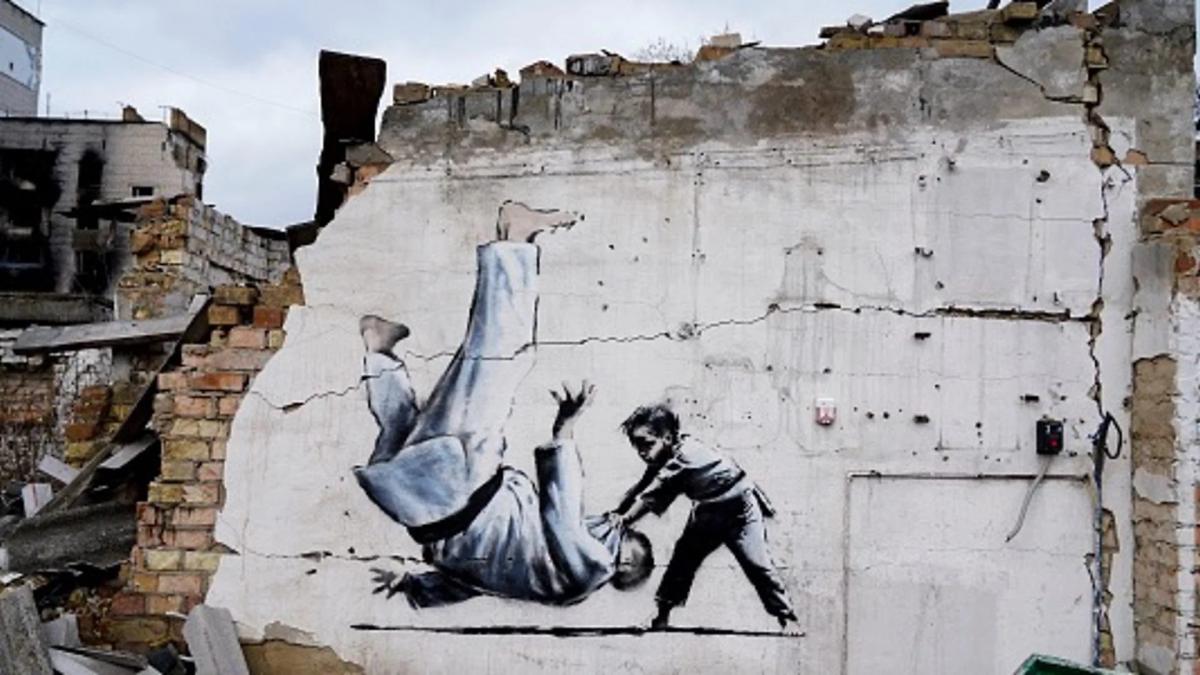
The Ukraine murals represent a significant inflection point in the Banksy narrative that has not been adequately analyzed in the coverage of the unmasking. These were not commercial interventions. They were not Sotheby's stunts. They were acts of solidarity, material gestures made on the surfaces of genuine destruction, in a country experiencing active war. In this context, the anonymity functioned differently. It was not the anonymity of a market stratagem. It was the anonymity of a person who understood, as Banksy's lawyer Mark Stephens later articulated, that "working anonymously or under a pseudonym serves vital societal interests. It protects freedom of expression by allowing creators to speak truth to power without fear of retaliation, censorship or persecution." In a warzone, this argument is not philosophical. It is a risk calculation.
And yet it was precisely the genuine moral urgency of the Ukraine intervention, the very moment in which the anonymity served its most defensible function, that generated the evidentiary trail that ultimately destroyed it. This is what OAC identifies as the collapse of the Custodian's Contract with the self. To remain hidden, Banksy could not have gone to Ukraine. To go to Ukraine, to act in accordance with the stated values of the practice, was to accept vulnerability. He went. The system did not survive the integrity of the gesture. For OAC's full account of the Custodian's Contract as a structural framework, see The Cost of Stewardship: Capitalizing on Patronage Validation and the Economics of Emotional Permanence.
The Shredder, the Auction, and the Market That Rewards Its Own Critique
In October 2018, Banksy's Girl with Balloon, a stencil of a child releasing a red heart-shaped balloon, originally created as a street mural in 2002, crossed the block at Sotheby's London and sold for £1.4 million. The moment the hammer fell, a shredder concealed in the frame activated and destroyed approximately half the canvas. The room, the bidder, the auction house, and the global media were simultaneously scandalized, delighted, and confused. In 2021, the partially shredded work, now retitled Love is in the Bin, sold at Sotheby's for £18.6 million. The destruction had not diminished the object. It had, in the logic of the market, redeemed it.
Banksy framed the shredding as a critique: a work that literally destroys itself at the moment of commodification, as a performance of anti-market values. But what the market did with the critique is the more instructive text. It purchased the critique at a premium. It did not experience the shredding as damage. It experienced it as provenance, the most spectacular provenance in the history of street art. In Guy Debord's analysis, the Spectacle does not merely tolerate its opponents. It requires them. Rebellion, made visible, becomes content. Content becomes a commodity. The shredding of Girl with Balloon is the single most perfect demonstration of this dynamic in the history of contemporary art. For OAC's extended analysis of this mechanism in the auction context, see The Anti-Speculative Cost: Why Art Basel Miami Needs the Moral Weight Metric.
OAC's PLCFA framework is built on a specific counter-principle: that genuine anti-speculative practice cannot be performed as spectacle, because the spectacle absorbs the performance. The One Original Principle, the production of singular, commissioned artifacts governed by Custodian's Contracts and Anti-Sale Covenants, is not a strategy of disruption. It is a structural withdrawal from the economy of disruption. The Court of Tenacity's 288 hours of manual labor and five-year anti-speculative covenant are not performances of value resistance. They are value resistance, enforced at the level of the legal instrument. For the full account of how this anti-speculative architecture is constructed and verified, see OAC's study on Narrative Permanence.
The more authentic the rebellion, the more viscerally it punctures the pretension of the market, the more value the market extracts from it.
Privacy, Journalism, and the Ethics of the Unmask
The most serious argument against the Reuters investigation is not that it was inaccurate. It is that it may have been unnecessary, or worse, harmful. Banksy's lawyer Mark Stephens argued that publication would "violate the artist's privacy, interfere with his art and put him in danger." Reuters, in defending its decision, cited the artist's profound and enduring influence on culture, politics, and the international art market, arguing the public interest in knowing the identity of such a figure outweighs privacy concerns.
The parallel case of Elena Ferrante, the Italian novelist who published under a pseudonym and whose identity was controversially revealed in 2016 by journalist Claudio Gatti, frames this debate with useful sharpness. Critics of that unmasking, including novelist Jhumpa Lahiri, argued that the author's wish to remain anonymous should be respected as an artistic choice, not a puzzle to be solved. When the author's absence is constitutive of the meaning, when, as in Maison Margiela's Phenomenology of Concealment, the anonymity is itself a formal element of the work, to force presence is to perform an act of formal violence. OAC has documented the structural importance of strategic erasure as a value-generative mechanism in its study of The Banksy Enigma: Mastering the Narrative of Modern Art.
OAC takes no pleasure in the unmasking. The principle of Narrative Permanence, the durability of an artifact's meaning across time, applies equally to an artist's chosen architecture of identity. At the same time, it is necessary to observe that the semantic edifice Banksy built was not disinterested. The anonymity was simultaneously a moral position and an economic mechanism. It protected free expression, and it inflated market value. The same mechanism that evaded state authority generated the Pest Control authentication monopoly. To claim pure artistic injury from the unmasking while the same mechanism underpinned hundreds of millions of dollars in secondary market transactions is to ask the public to accept that the moral architecture and the commercial architecture were separable. Reuters concluded they were not.
The PLCFA Diagnosis: What Happens to Value Without the Void
The core question facing the Banksy market is whether the value structured around anonymity survives the attribution. This is the precise structural vulnerability that OAC's framework was designed to diagnose and avoid. When value is lodged in the gap, in the productive absence of the author, in the speculative energy generated by the unknown, it is constitutively fragile. The gap can be closed. Court records survive. Borders log crossings. Witnesses make coffee and remember faces. For OAC's foundational account of how speculative value structurally differs from material value, see From Function to Fissure: Collectible Design and the Weaponization of Material.
In OAC's framework, the Banksy corpus represents what we identify as a high-Aura, low-MWPM condition: extraordinary narrative accumulation built on a material substrate that, in the case of prints and stencil multiples, is structurally replicable. The Aura was lodged in the author-mythology, not in the material singularity of the object. When the author-mythology is reduced to a name, a face, and a handwritten confession, the Aura must find a new home. And there is no guarantee it will find one. For OAC's full analysis of how Aura functions in the age of mechanical reproduction, see The Zero-Sum Aura: Why Digital Immortality Requires a Material Host.
OAC's One Original Principle is designed precisely to prevent this condition. An artifact whose value is grounded in Material Singularity, in the Burden of Preservation, in the Custodian's Contract and the Anti-Speculative Covenant, does not require an author-mythology to sustain its worth. It requires its own material history: 288 hours of labor, a specific silk, a specific illustrative program, a legal instrument that governs the terms of stewardship. These are not stories about an absence. They are the presence of the thing itself. For a full account of how this architecture functions in practice, see The Cost of Stewardship: Capitalizing on Patronage Validation and the Economics of Emotional Permanence. For the broader theory of how digital infrastructure is being deployed to lock in material testimony, see The Paradox of Narrative Permanence.
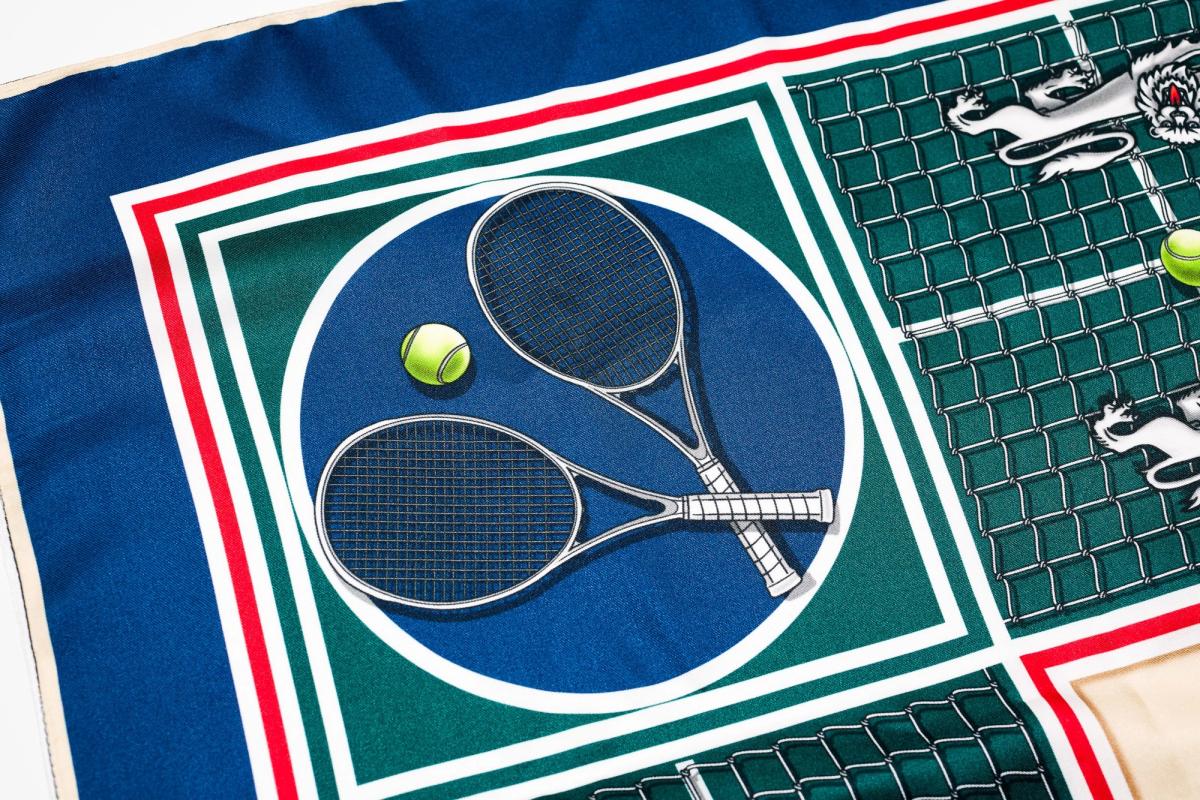
There is no anonymity that cannot be penetrated. There is no myth that is immune to evidence. But a material object, singular and contractually governed, carries its own testimony, and that testimony does not depend on the sustained mystery of its maker.
The Afterlife of the Pseudonym
Robin Gunningham / David Jones / Banksy: this is now a three-part identity, each segment bearing a different relationship to the work. Robin Gunningham is the legal biography, the Bristol schoolboy who joined the DryBreadZ Crew (DBZ) and signed a confession on a Manhattan rooftop. David Jones is the administrative fiction, the deliberate disappearance into statistical normality. And Banksy is the cultural construct, the pseudonym that accumulated thirty years of political imagery, market value, legal infrastructure, and global mythology.
Banksy's best works carry their meaning without the author. The Ukraine murals do not require the artist to be unknown to function. They function because they are formally, emotionally, politically true in relation to the conditions in which they were made. What may not survive is the market infrastructure built around the brand. Pest Control, the certificate system, the authentication monopoly, these are predicated on the Banksy pseudonym as a functioning protective apparatus. The machinery was built to manage the gap. The gap has now been closed, and the machinery's function becomes, at minimum, ambiguous. For OAC's analysis of how authentication systems generate and police value, see The White Wall Paradox: Quantifying Consumption in the Age of Aesthetic Neutrality.
For OAC, the lesson is foundational. Narrative Permanence, the durability of an artifact's meaning across time, cannot be outsourced to institutional machinery that depends on the sustained production of mystery. It must be built into the material itself: into the contract, the labor, the singular genesis, the chain of custodianship. The story does not disappear when the mystery does, because the story was never the mystery. It was the object. This is the argument most fully elaborated in OAC's study Biopolitics of the Artifact: How Functional Endurance Challenges Foucault, Groys, and the Archival Death Mandate.
Coda: On Calling a Name
In OAC's earlier study, The Banksy Enigma: Mastering the Narrative of Modern Art, we described anonymity as "the ultimate strategic asset," a mechanism that directed audience attention from the individual to the work, cultivated mystique as a form of scarcity, and transformed the practice of concealment into the engine of global cultural authority. We stand by that analysis as a description of what Banksy achieved.
But description is not endorsement. A thing can be strategically masterful and structurally precarious at the same time. The evidence of the handwritten confession demonstrates that these two conditions coexisted in the Banksy apparatus from 2000 onward. The strategy was brilliant. The structure was fragile. Court files do not expire.
Robin Gunningham made works of genuine moral seriousness and extraordinary visual intelligence over thirty years. He made The Mild Mild West and Napalm. He produced Exit Through the Gift Shop. He went to Ukraine in 2022 and painted on the walls of bombed buildings. He was there.
That matters. The name matters less than the presence. The presence was always what the work was about.
Authored by Christopher Banks, Anthropologist of Luxury, Critical Theorist & Founder
Objects of Affection Collection
Office of Critical Theory & Curatorial Strategy
469 Fashion Avenue, 12th Floor, New York, NY 10018
RELATED OAC STUDIES
The following studies from the OAC archive speak most directly to the themes pursued in this paper. They are presented here as an invitation to follow the threads of this inquiry into adjacent territories of OAC's critical practice.
On the Philosophy of Concealment & Anonymity
· The Banksy Enigma: Mastering the Narrative of Modern Art
· The Folder as Archive, the Archive as Poetics: An OAC Critical Reading of Maison Margiela/folders
· The Simulacrum of Status: Why Art Basel Value Resists the VIP Image
· From the Aura to the Simulacrum: Benjamin, Baudrillard, and the Crisis of the Authentic
On Aura, Speculative Value & the Anti-Market
· The Zero-Sum Aura: Why Digital Immortality Requires a Material Host
· The Anti-Speculative Cost: Why Art Basel Miami Needs the Moral Weight Metric
· The Material as Political Capital: Quantifying Moral Weight in the Anti-Market Materiality of PLCFA
· Why Traditional Luxury's Root Marketing Fails to Purchase Moral Capital
· THE AURA TRANSACTION: On Louis Vuitton's Super Nature and the Ethics of What Gets Absorbed
On the Archive, the Object & Institutional Power
· Hito Steyerl and the Phygital Counter-Strategy: Why Post-Luxury Value Resists the Poor Image
· The White Wall Paradox: Quantifying Consumption in the Age of Aesthetic Neutrality
On Surface, Material & the Overwritten Form
· From Function to Fissure: Collectible Design and the Weaponization of Material
On the Spectacle, Resistance & the Market
· Debord's Spectacle Meets Sholette's Missing Mass: How Artisan Activism Forges Moral Capital
· PoetCore & Literary Tones: The Hand-Stitched Rebellion Against Sterile Tech-Luxury