What Is PoetCore? The Hand-Stitched Rebellion
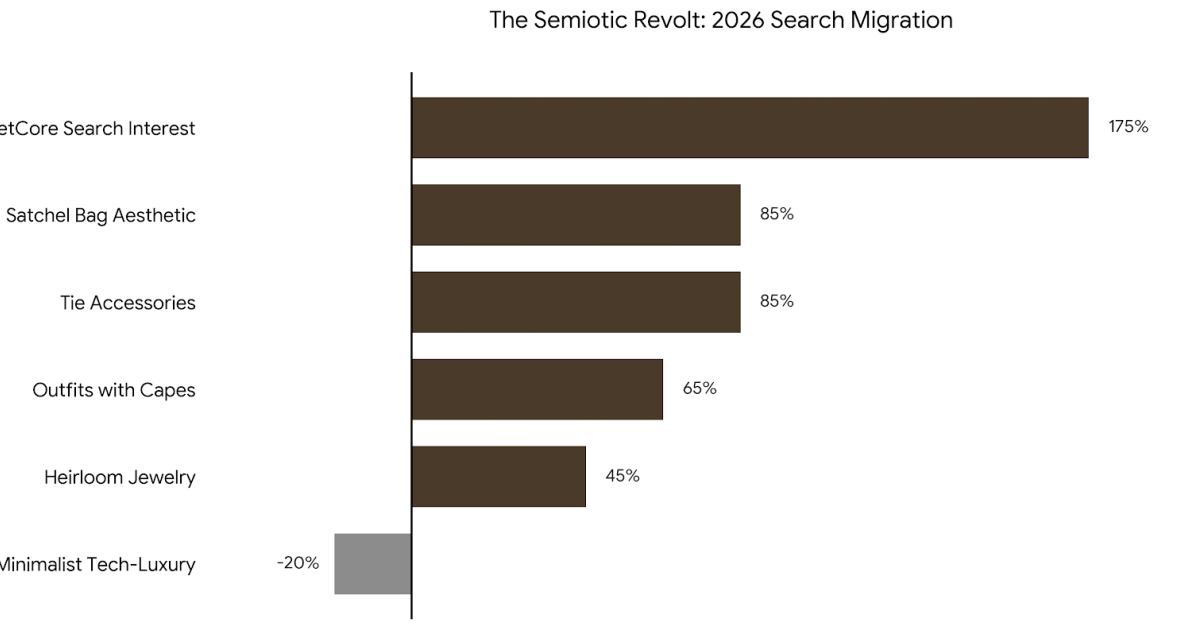
This study applies the Post-Luxury Conceptual Functional Art (PLCFA) framework to the +175% surge in "PoetCore" search interest documented by Pinterest's 2026 Trend Report, the most statistically significant aesthetic mobilization recorded across the platform in a generation. We argue that PoetCore is not a fashion trend. It is a semiotic revolt. Driven by Gen Z's mass repudiation of sterile tech-luxury and the algorithmically perfect surface, the PoetCore signal (capes, leather satchels, heirloom accessories, hand-stitched narrative) constitutes what the OAC framework identifies as a Deep Materiality Turn: a collective migration away from the Hyperreal Circulation of brand-sign dominance toward the Custodial Logic of objects that carry weight, time, and human intention. We examine its theoretical roots, its cultural architecture, and its profound validation of PLCFA as the only coherent intellectual framework positioned to meet this moment.
The Signal
What the Data Actually Says
In December 2025, Pinterest released its annual Trend Report: a predictive instrument built on two years of behavioral search data aggregated across hundreds of millions of users. Among the 21 macro-trends identified, one registered with a statistical force that stands apart: PoetCore.
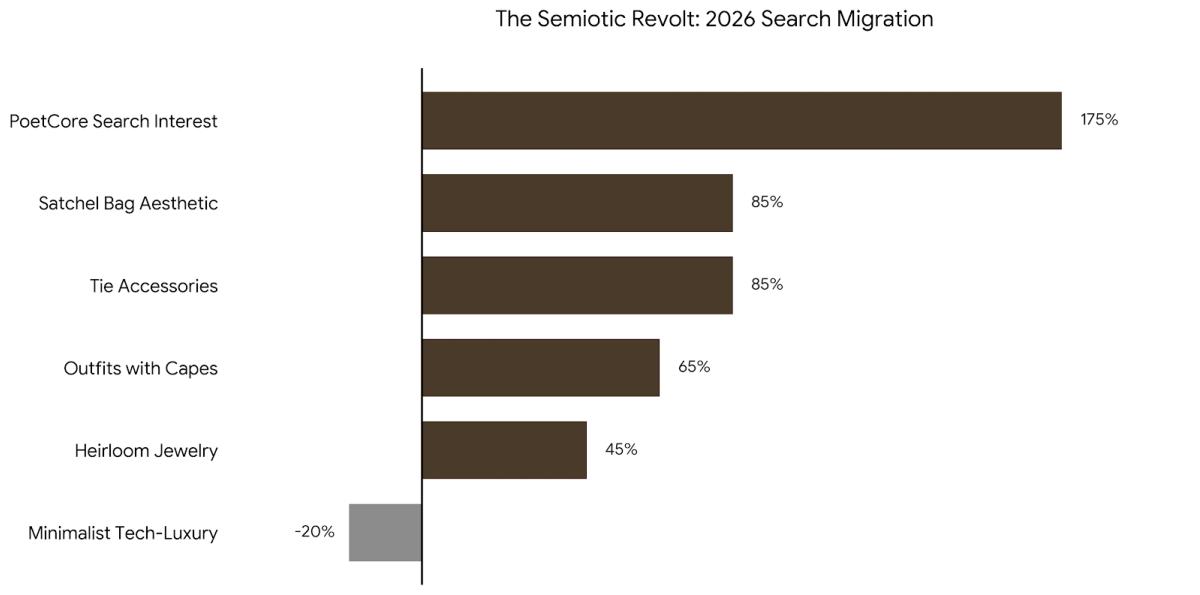
The numbers are not interpretive. They are declarative. Searches for "the poet aesthetic" surged +175%. Searches for "satchel bag aesthetic" rose +85%. "Outfits with capes" climbed +65%. "Tie accessories" gained +85%. "Heirloom jewelry" expanded by +45%. Pinterest's own Global Head of Trends and Insights confirmed that these movements were not isolated aesthetic preferences but expressions of a singular, unified cultural posture: consumers are no longer attempting to fit in. They are using the objects they carry and wear to signal who they already are.
67% of the 2026 trends identified by Pinterest are driven by Gen Z, a cohort that came of age inside the polished, efficient, frictionless logic of tech-luxury and found it, upon arrival, to be spiritually empty.
What the Data Obscures
Mainstream fashion commentary has been quick to categorize PoetCore as an aesthetic: tweedy blazers, Mary-Janes, leather satchels, fountain pens. This reading is not wrong. It is simply insufficient. To stop at the wardrobe is to mistake the symptom for the diagnosis. This same structural misreading was documented in our earlier critique of Dolce & Gabbana's FW2026 collection, where the The Homogenized Portrait demonstrated how easily the industry deploys aesthetic vocabulary to obscure deeper semiotic failures.
PoetCore is not an outfit. It is an ontological position. The satchel is not chosen because it is fashionable. It is chosen because it looks as though it has survived something; as though it has traveled, accumulated, persisted. The cape is not chosen for its silhouette but for its declaration: that the body wearing it has refused the smooth, the frictionless, the disposable. The heirloom brooch does not announce wealth. It announces lineage, stewardship, the willingness to carry something forward rather than consume it.
The Objects of Affection Collection has identified this shift not as a trend cycle, but as what we term the Architecture of Un-Smoothness: a structural preference for objects that resist instantaneous consumption and demand, instead, the slower discipline of custodianship.
The Theoretical Architecture
Baudrillard's Warning, Arriving on Schedule
Jean Baudrillard's central argument in Simulacra and Simulation was not a lament for the past. It was a structural prediction: that consumer society, left to accelerate unchecked, would eventually produce objects so thoroughly drained of genuine referent; so wholly constituted by brand-sign rather than material reality; that the simulacrum would become more real than the thing itself.
Tech-luxury arrived at this endpoint ahead of schedule. The $5,000 minimalist sneaker with no discernible craftsmanship. The "quiet luxury" capsule wardrobe that communicates belonging to a class by virtue of its studied inconspicuousness. The seamless leather-free bag engineered for photogenic perfection but carrying no memory, no patina, no history. The brand became the reality. The object became incidental. Our study of the Hermès mycelium collaboration traced this exact dynamic: a brand deploying the aesthetics of craft to perform sustainability while bypassing material honesty entirely.
PoetCore is Baudrillard's corrective, arriving in the form of a satchel with brass clasps that show their age. It is the culture's immune response to the Simulacrum: a demand that objects have referents again. That referent is not nostalgia. It is material honesty. The worn leather, the hand-stitched seam, the fountain pen that requires care; these are not affectations. They are proofs. Proof that something human was present in the making and remains present in the keeping.

Byung-Chul Han and the Fatigue of Transparency
The philosopher Byung-Chul Han diagnosed the contemporary condition as one of radical positivity: a culture so thoroughly cleared of resistance, negativity, friction, and opacity that it has become, paradoxically, exhausting. The smooth surface demands nothing of us, and that absence of demand produces, over time, a specific form of psychic depletion.
The Objects of Affection Collection has long argued that Han's Transparency Society constitutes the precise cultural substrate from which PLCFA derives its necessity. When every surface is optimized for instant apprehension (the algorithmically perfect Instagram grid, the seamlessly executed brand identity, the frictionless luxury experience) the object that demands patience, attention, and a willingness to not immediately understand becomes a radical act.
PoetCore's material vocabulary (the heavy wool cape, the ink-stained leather-bound journal, the satchel with its multiple buckles) is a vocabulary of productive opacity. These objects do not announce themselves completely. They reward sustained attention. They are, in Han's terms, profoundly and defiantly Other.
The Anti-AI Crafting Correction
The cultural theorist Graham Sykes of Landor, writing in December 2025, named a parallel market phenomenon with striking directness: Anti-AI Crafting. As AI-generated design floods every aesthetic surface with a specific, identifiable quality (hyper-smooth, technically perfect, frictionless in its visual logic) the hand-drawn line, the irregular stitch, the visible fingerprint of human intention becomes, simultaneously, a luxury marker and a moral statement. The OAC addressed this structural condition with forensic precision in "The Algorithm of the Hand, which introduced the Moral Weight Per Material (MWPM) index as the definitive instrument for measuring value in an era of AI aesthetic saturation.
This is not a coincidence. It is a structural consequence. When machines can produce perfection at scale, imperfection becomes the only proof of human origin. The hand-stitched narrative that PoetCore valorizes (the blazer from a secondhand store with its particular history of previous bodies, the leather belt developing its individual patina, the cape that refuses to sit perfectly) constitutes what we term at the OAC the Legibility of Labor: the visible record of human time and human care embedded in an object's surface.
The culture's migration toward PoetCore is, at its structural core, a migration toward the Legibility of Labor as a primary value signal. This migration validates and amplifies everything the PLCFA framework has argued since its founding.
The PLCFA Diagnosis
PoetCore Is a Custodial Imperative, Misread as a Fashion Trend
The error in mainstream PoetCore analysis is categorical. Fashion critics correctly identify the aesthetic elements: the specific fabrics, the particular accessories, the favored silhouettes. What they consistently fail to articulate is the governing logic beneath the aesthetic: PoetCore is the consumer expression of the Custodial Mandate.
At the Objects of Affection Collection, we define the Custodial Mandate as the structural shift from acquisition-as-consumption to acquisition-as-stewardship. The object is not purchased. It is inherited, in a metaphorical sense; received into custody with the understanding that its narrative will be extended, not terminated, by the transaction. This mandate was first operationalized in our study "Alan Vilar's Embroidered Ephemera and the Calculus of Moral Weight, which demonstrated that an object's value is directly proportional to the custodial discipline it demands from its keeper.
The PoetCore practitioner who chooses a satchel with visible wear, or a cape that carries the cut of a previous decade, is practicing custodianship without yet having the language for it. They are enacting the PLCFA framework at the level of the body and the everyday object.
This is not a trend. Trends are surface movements. What PoetCore represents is a structural reorganization of how an entire generation assigns value: away from novelty and toward narrative, away from perfection and toward provenance, away from the brand-sign and toward the object's own accumulated history.
The Fragility Mandate, Writ Across a Generation
The OAC concept of the Fragility Mandate holds that an object's value is directly proportional to the care it demands from its custodian. The object that requires nothing of you (the stain-resistant, scratch-proof, perfectly engineered tech-luxury surface) is the object that teaches you nothing and returns nothing beyond its initial function. This principle was articulated in full in "Alan Vilar's Embroidered Ephemera and the Calculus of Moral Weight, and was subsequently deployed as a critical instrument in our analysis of the Hermès mycelium collaboration, where we asked whether Functional Fragility constitutes a genuine luxury proposition or a performance of one.
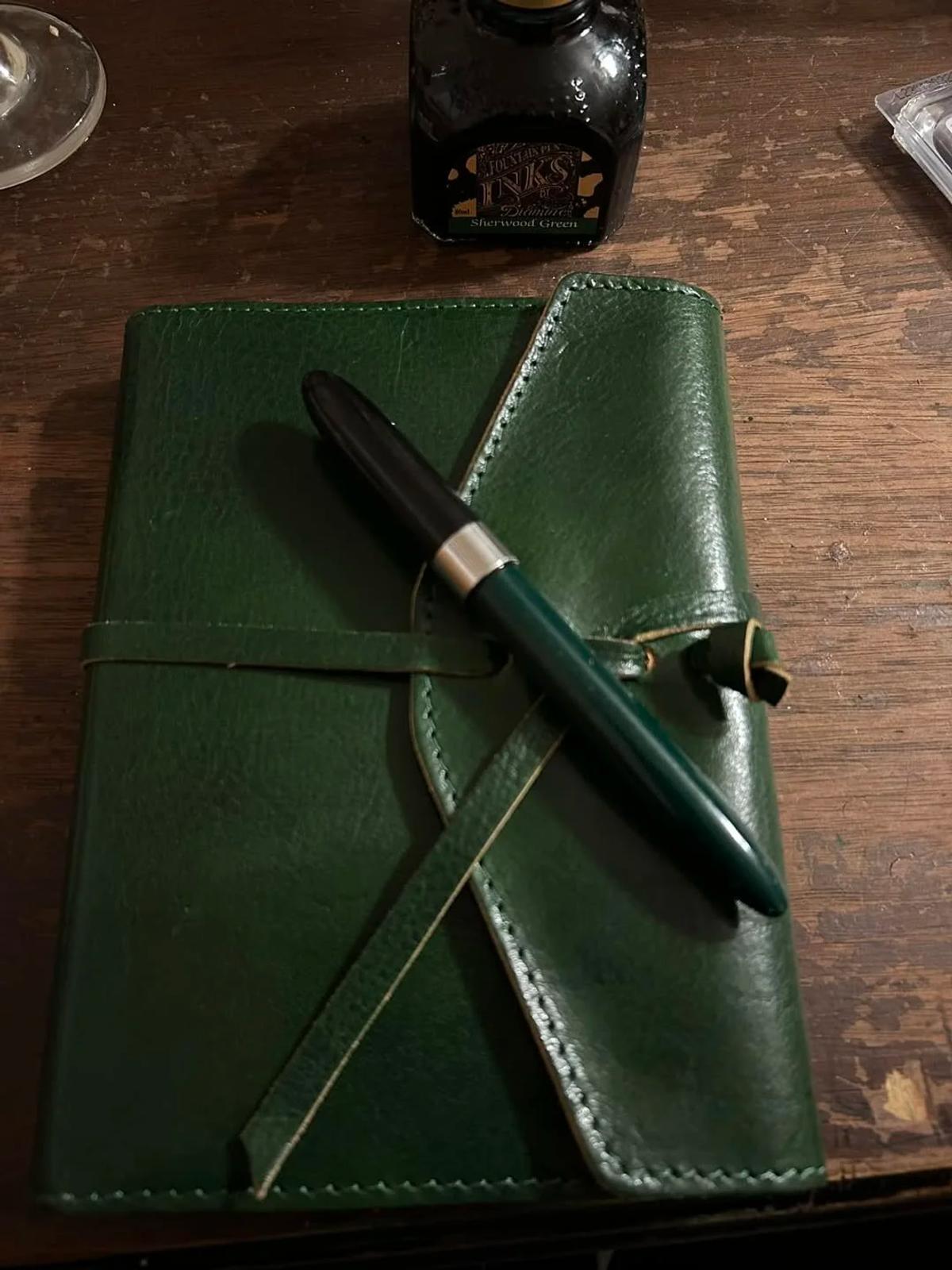
The PoetCore object is the inverse of the frictionless. The vintage blazer requires knowledge of how to store wool. The leather satchel requires periodic conditioning. The brooch requires the development of an eye for proportion and placement. The fountain pen requires the discipline of filling, cleaning, and attending. These demands are not inconveniences. They are the mechanism by which the object transforms its owner from a consumer of goods into a steward of meaning.
When 67% of Gen Z-driven trends converge on objects with precisely this quality (weight, history, care-requirement, visible human origin) we are witnessing the generational adoption of the Fragility Mandate as a lived practice. The culture has, without yet having the theoretical vocabulary, arrived at PLCFA.
Material Singularity at the Mass Cultural Level
One of the most arresting dimensions of the PoetCore surge is its relationship to singularity. The aesthetic explicitly resists the new, the mass-produced, the perfectly replicated. Its canonical objects (the inherited heirloom, the thrifted blazer, the aged leather, the handwritten journal) are each, in their own way, unrepeatable. The mechanism by which digital infrastructure is now being mobilized to permanently anchor this singularity was the central argument of "The Paradox of Narrative Permanence", which traced the emergence of the Object that Remembers: the artifact whose human origin is verifiably and irreversibly inscribed.
This represents a profound and unremarked-upon market correction. The luxury apparatus has spent decades engineering artificial singularity through limited releases and waitlists; manufacturing scarcity as a simulacrum of uniqueness. PoetCore bypasses this mechanism entirely. Its singular objects achieve their status not through brand-controlled scarcity but through the irreversible accumulation of time, care, and use. This is, precisely, what the OAC terms Narrative Permanence: value that resides not in the prestige of the house but in the verifiable, irreversible human story of the specific object.
PoetCore’s objects achieve singularity not through manufactured scarcity, but through the irreversible accumulation of time, care, and human intention: the only form of uniqueness that cannot be replicated at scale.
The Cultural Moment
Why Now: The Convergence of Three Structural Pressures
The +175% surge in PoetCore interest does not emerge from aesthetic arbitrariness. It is the convergent product of three structural pressures that have been building simultaneously and have, in 2026, reached critical mass.
The first is the AI Aesthetic Saturation. As generative AI tools have colonized design, marketing, and content production, a specific visual language has become omnipresent: technically perfect, frictionless, optimized for immediate apprehension. The culture's immune response to saturation by any aesthetic is, eventually, to seek its opposite. The opposite of AI-perfect is hand-stitched imperfection. The opposite of algorithmic smoothness is the visible mark of human labor. The OAC mapped this structural dynamic in The Algorithm of the Hand, arguing that in an era of hyper-connected intelligence, the Scarred Object becomes the only credible proof of biological and psychological history.
The second pressure is what we might term the Substack-as-Symptom phenomenon: a generational hunger for the slow, the non-optimized, the form that cannot be compressed into a fifteen-second vertical video. PoetCore is, in part, the material expression of this textual hunger: dress the body in objects that share the quality of the long-form (weight, accumulated meaning, resistance to quick consumption). A parallel instantiation of this impulse at the level of political craft was analyzed in "The Materiality of Resistance, which showed how the hand-knit "Melt the ICE" hat transformed the act of making into a form of durable, non-consumable dissent.
The third and most structurally significant pressure is the exhaustion of the trend-cycle itself. Pinterest's own data notes that trends are accelerating at 4.4 times the rate of seven years ago. In an environment of this velocity, the object that refuses the trend cycle (the heirloom, the vintage, the durable neutral) becomes paradoxically more desirable precisely because it offers escape from the cycle. PoetCore's objects are pieces that feel like personal codes rather than trends. This is not nostalgia. It is the logical conclusion of trend-cycle exhaustion: a demand for objects that have permanence.
The Runway Confirms What the Street Already Knows
It is significant that the PoetCore signal has not emerged from the runway downward, but from the street and the digital archive upward. The +175% search surge precedes and anticipates the runway response. Loewe and Miu Miu's Spring/Summer 2026 collections arrived in confirmation of a cultural movement already underway, not as its origin. The OAC first identified this inversion of institutional authority in The Miu Miu Problem and the Rise of Post-Luxury, which argued that when the most culturally resonant signals emerge from the street rather than the atelier, the luxury apparatus has already ceded its role as meaning-maker.
This sequence is structurally important. When aesthetic movements are generated at the institutional level (by houses, by editors, by the luxury apparatus) they remain within the logic of brand-sign dominance, even when they celebrate craft or heritage. When they emerge from the aggregated behavior of millions of individuals acting on genuine value preference, they represent something qualitatively different: a market correction driven by authentic cultural demand.
The OAC framework has always argued that the most durable value is generated not through institutional pronouncement but through individual custodianship enacted at scale. PoetCore, in its organic emergence and statistical force, is that argument made visible.
The PLCFA Validation
The Framework Was Already Here
It would be tempting, in light of the PoetCore data, to claim that the Objects of Affection Collection predicted this moment. The more accurate and more interesting claim is that the PLCFA framework identified the structural conditions that make PoetCore not merely probable but inevitable. Those conditions were documented across the foundational monograph series: from the collapse of luxury's legitimacy examined in "The Miu Miu Problem, to the economics of custodianship formalized in The Cost of Stewardship, to the re-anchoring of OAC's institutional practice in the historic Garment District, documented in Finding the Heart.
The luxury apparatus's systematic evacuation of material integrity. The hyperreal circulation of brand-sign at the expense of object singularity. The consumer's progressive alienation from objects that make no demands and carry no history. The accumulating fatigue of frictionless surfaces. These are not recent developments. They are the culminating conditions of a decades-long trajectory that the OAC has been documenting, theorizing, and building against.

PoetCore is the mass cultural expression of the argument PLCFA has been making in its most rigorous form: that the culture is hungry for objects with weight, narrative, provenance, and care-requirement. That the hand-stitched seam is not a nostalgic gesture but a value proposition. That the object which demands something of its custodian is more valuable; more genuinely luxurious; than the object optimized for effortless consumption.
The Collector Who Annotates Everything
Pinterest's editorial description of PoetCore's ideal practitioner is, in its way, a portrait of the OAC's ideal custodian: someone who annotates everything, treats outfits like sonnets, who values depth over immediacy and chooses objects as though assembling a life that is not merely lived but architected. This is not coincidental language. It is the emergence, in the mainstream cultural vocabulary, of a value structure that was first formalized in The Cost of Stewardship, through the instrument of the Custodian's Contract and the 1,825-day Anti-Sale Covenant.
The custodian who receives an OAC artifact under the terms of a Custodian's Contract (who accepts the Burden of Preservation as a condition of ownership) is practicing, in its most deliberate and documented form, the same logic that drives the individual who chooses a worn leather satchel over a pristine nylon tech bag. The scale differs. The commitment to the same underlying value system is identical.
What PLCFA Offers That PoetCore Cannot
PoetCore, as a mass cultural phenomenon, carries the limitations of its medium. The trend cycle that it seeks to escape will, eventually, attempt to absorb it; brands will manufacture "heirloom" accessories in factories, producing patina-effect leather at scale, selling the simulacrum of a history the object never lived. This is the predictable response of the luxury apparatus to any aesthetic movement that threatens its logic: to simulate the thing that was valued for being unsimulatable.
This absorption strategy is not hypothetical. The OAC documented it in real time in our analysis of the Hermès mycelium collaboration, where a legacy house deployed the aesthetics of radical material honesty to manufacture precisely the simulacrum of it. The luxury apparatus's capacity to consume its own critique was also the central subject of The Shadow of the Loom, which traced how centuries of uncompensated cultural enclosure from the Global South have been laundered through the prestige economy.
This is precisely where PLCFA becomes indispensable. The OAC's framework does not merely valorize the aesthetic qualities of PoetCore. It operationalizes those qualities through structures that resist absorption: the Custodian's Contract, the Anti-Speculative Covenant, the verifiable provenance of the singular artifact, the documented record of human labor and intention that cannot be replicated at scale. PLCFA offers what PoetCore desires but cannot, by itself, protect: Narrative Permanence. The object that cannot be made to lie about its history because its history is legally and digitally binding.
The mass cultural hunger that PoetCore represents is the demand. Post-Luxury Conceptual Functional Art is the only structurally coherent supply.
The Diagnosis
The +175% surge in PoetCore interest is not a fashion trend. It is a semiotic correction of generational scale. It is the culture's refusal (expressed through the accumulated search behavior of millions of individuals acting on genuine value preference) of the hyperreal surface. It is the demand for objects that carry weight, history, human intention, and the particular beauty of things that require care.
The Objects of Affection Collection has argued, since its founding, that the most profound luxury is not the freedom to consume without consequence. It is the discipline of keeping: the commitment to stewardship, to the slow accumulation of meaning, to the object that demands something of the person who carries it.
PoetCore is that argument, wearing a cape, carrying a satchel, reaching for a fountain pen in the age of the algorithm.
The culture has arrived at the threshold of PLCFA. The question that remains is whether it will stop at the aesthetic or commit to the architecture.
True luxury is the ability to read the hidden story within an object.
Authored by Christopher Banks, Anthropologist of Luxury & Critical Theorist. Office of Critical Theory & Curatorial Strategy, Objects of Affection Collection.
FURTHER READING FROM THE OAC CRITICAL MONOGRAPH SERIES
The studies below form the intellectual architecture behind the arguments advanced in this paper. Each is cross-referenced within the text; they are collected here as a complete reading path for the scholar, collector, or custodian seeking to move from the PoetCore signal to the full PLCFA framework.
FOUNDATIONAL FRAMEWORK
↗ The Paradox of Narrative Permanence
Introduces the Narrative Permanence Thesis and maps how digital infrastructure is being repurposed as a humanist archive to permanently tether human identity to the physical object. The direct theoretical precedent for this paper's Material Singularity argument.
Formalizes the Custodian's Contract and the 1,825-day Anti-Sale Covenant through the case of The Court of Tenacity. The foundational document for the OAC's economics of custodianship; the operational backbone of the Custodial Mandate.
↗ Alan Vilar's Embroidered Ephemera and the Calculus of Moral Weight
Introduces the Fragility Mandate and the Moral Weight Per Material (MWPM) index through Alan Vilar's embroidered leaf works. The definitive case study for the argument that an object's value is proportional to the care it demands.
Diagnoses the structural collapse of luxury's legitimacy and introduces the PLCFA framework as its replacement. Essential reading for understanding the market conditions that make PoetCore's emergence structurally inevitable.
THE AI & LABOR DIMENSION
The OAC's foundational study on AI aesthetic saturation and the Scarred Object is the only credible proof of human origin. Read in direct conjunction with this paper's Anti-AI Crafting section.
CRAFT AS POLITICAL MATERIAL
Demonstrates the Moral Weight Per Material index applied to the hand-knit Melt the ICE hat: a study of how craft labor becomes an explicit act of political stewardship. The PoetCore analog in the register of activist making.
Examines how the Secret Handshake collective deployed PLCFA's material logic in public political interventions, proving that conceptual functional art can operate outside the gallery at the scale of the street.
THE INDUSTRY'S ABSORPTIVE CAPACITY
Applies the MWPM index to Hermès's mycelium collaboration to ask whether biotechnology constitutes genuine material honesty or the Biotechnology of the Simulacrum. The key case study for the luxury apparatus's absorption strategy.
↗ The Homogenized Portrait: Eurocentrism and the Myth of Universality at Dolce & Gabbana
Deconstructs Dolce & Gabbana's FW2026 collection as a Simulacrum of Diversity: the luxury apparatus using the language of inclusion to market its opposite. A masterclass in semiotic dissonance and institutional bad faith.
Traces how semiotic primitive accumulation from the Global South has underwritten centuries of European luxury prestige. This paper critiques the historical infrastructure of the Hyperreal Circulation.
INSTITUTIONAL PRACTICE
↗ Finding the Heart: Objects of Affection Collection Comes Home to 469 Fashion Avenue
Documents OAC's move to 469 Fashion Avenue as a declaration of institutional practice: re-anchoring the intellectual house in the geography of American craft. The institutional context for this study's argument.