
Alan Vilar's Embroidered Ephemera and the Calculus of Moral Weight
In the terminal phase of late-stage capitalism, the global luxury apparatus faces a crisis of ontological sclerosis. The dominant value systems—predicated on the extraction of scarce mineral resources, the fetishization of the "brand new," and the acceleration of consumption cycles—have entered a state of recursive collapse. We observe a market trapped in the "Zero-Sum Pivot," a condition where capital is exchanged for signifiers that no longer possess inherent cultural gravity but merely circulate as hollow tokens of access. In this landscape of semantic decay, the emergence of Alan Vilar’s embroidered ephemera represents not merely a deviation from the norm but a radical, corrective rupture that necessitates a complete re-evaluation of what constitutes "luxury" in the twenty-first century.
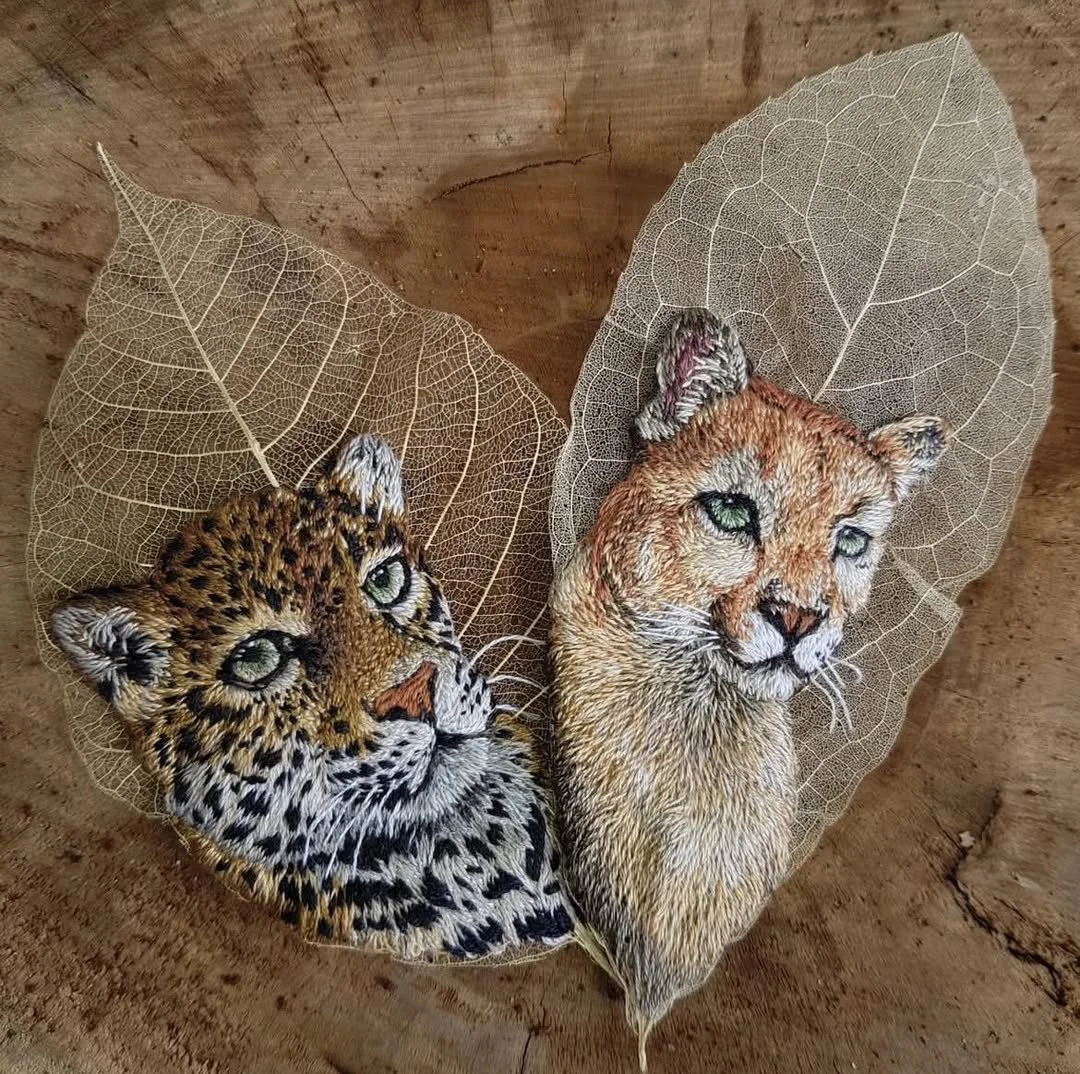
Vilar, a visual artist and Design student at UCDB (Universidade Católica Dom Bosco), operating from the interior municipality of Ivinhema, Mato Grosso do Sul, utilizes the discarded debris of the Pantanal and Cerrado biomes—skeletonized leaves, desiccated insect wings, and fallen petals—as the substrate for hyper-laborious needle painting. This study frames Vilar’s oeuvre as a foundational archetype of Post-Luxury Conceptual Functional Art (P.L.C.F.A.). By investing maximum labor—or "Moral Weight"—into materials of zero market value, Vilar performs an alchemical inversion of the traditional luxury equation. He creates objects that possess "Trauma Provenance," a value derived not from the material's durability, but from its inherent fragility and the biological memory of its own decay.
This report argues that Vilar’s work operationalizes Byung-Chul Han's philosophy, creating a "temporal friction" that forces the viewer to linger, thereby resisting the "smoothness" of digital consumption. Through the lens of the Objects of Affection Collection’s proprietary metric, Moral Weight Per Material (MWPM), Vilar’s embroidered leaves demonstrate the highest possible density of intent, serving as a rebuke to the industrial simulacra of heritage. The leaf, once a symbol of inevitable entropy, becomes a monument to the Custodial Mandate, demanding that the collector transform from a consumer of goods into a steward of meaning. This abstract serves as the entry point into a rigorous interrogation of how the ephemeral becomes permanent through the imposition of "Reparative Labor", establishing a new economic logic where the fragility of the object is the very source of its power.
The current luxury landscape is defined by the "Simulacrum of Status", where value is detached from the object and relocated to the "VIP Image"—the low-fidelity, viral documentation of consumption. In this system, the physical object is merely a prop for the digital performance of wealth. Vilar’s work resists this dematerialization. A skeletonized leaf, stitched with the vibrant plumage of an Arara-azul (Hyacinth Macaw), possesses a "Deep Materiality" that cannot be fully captured by the pixel. It demands physical presence. It demands the "Monastic Veto"—the refusal to participate in accelerating trends. By analyzing the chemical, philosophical, and economic dimensions of Vilar’s practice, we will demonstrate that true luxury is no longer found in the diamond that lasts forever, but in the leaf that demands our protection to survive the day.
The Fragility Mandate and the Resistance to Acceleration
The central thesis of this investigation posits that the ultimate luxury in the Anthropocene is not durability in the industrial sense—the polymer that never degrades or the gold that never tarnishes—but rather "Functional Fragility." This concept, which we term the Fragility Mandate, asserts that an object’s value is directly proportional to the care it demands from its custodian. Alan Vilar’s work is the physical embodiment of this mandate. By embroidering onto the venous structure of a decaying leaf, Vilar creates an object that cannot be consumed passively; it must be protected actively. This shifts the ontological status of the object from a commodity, which serves the user, to an artifact, which the user must serve.
The Crisis of the Smooth: A Hanian Analysis of Texture
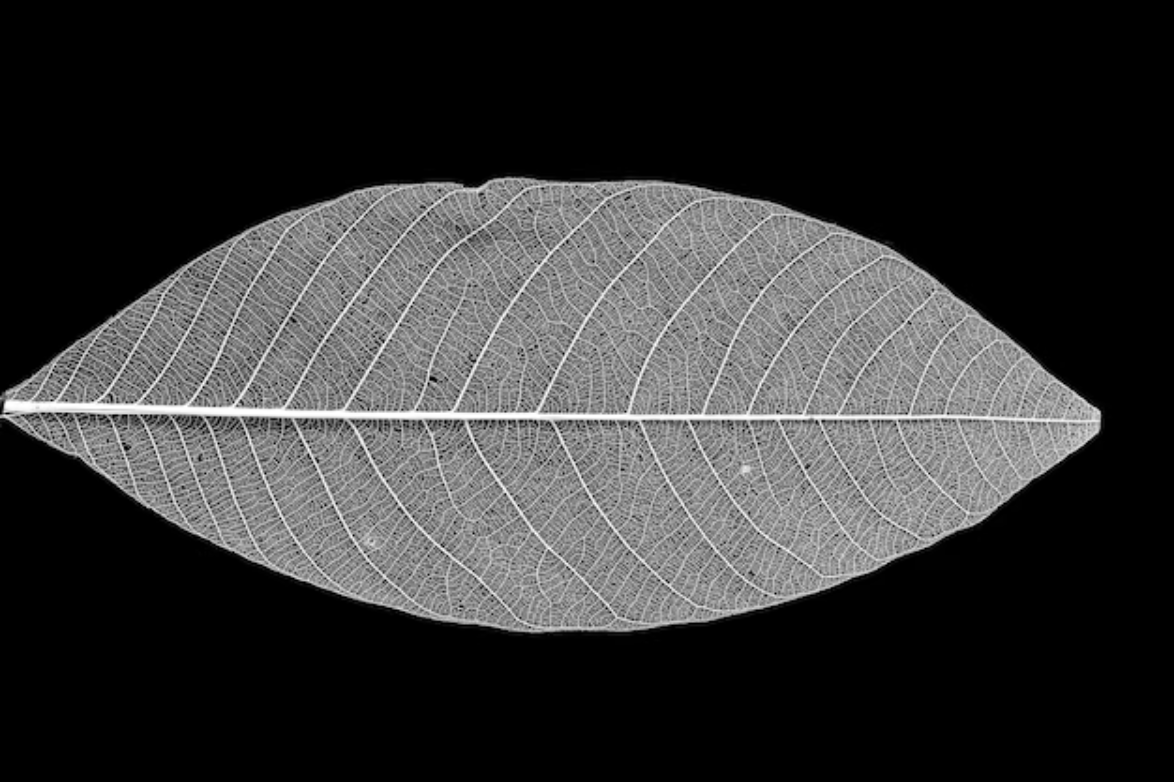
The raw material, a Folha Esqueletizada, embodies the Fragility Mandate. Its surface is a "landscape of resistance" whose texture arrests the gaze, acting as a brake on the acceleration of time that defines the "smooth" consumer world.
Contemporary consumer culture is defined by what the philosopher Byung-Chul Han describes as the "terror of the same" and the proliferation of "smooth" surfaces. The smartphone screen, the waxed car body, the flawless diamond—these are surfaces that offer no resistance to the gaze or the touch. They are designed for rapid acceleration, allowing the eye to slide off them, facilitating the next purchase. Han argues, "The impression that time moves considerably faster than before also has its origin in the fact that today we are unable to linger". In the "burnout society," the vita activa (active life) has totally subsumed the vita contemplativa (contemplative life). The smooth object is an accomplice to this acceleration; it does not ask us to stop. It merely asks us to use and discard.
Vilar’s embroidery introduces a violent texture into this smooth world. The skeletonized leaf is a landscape of resistance. Its surface is a ruin, a cartography of veins and voids that arrests the gaze. To embroider upon it is to engage in a "liturgy of emptiness". The needle must navigate the brittle architecture of cellulose without shattering it. This process imposes a radical slowness—a deceleration that is anti-capitalist in its very mechanics. When the viewer engages with the finished piece—a vibrant Toucan stitched into a brown, lace-like leaf—they are forced to confront the impossible tension between the weight of the thread and the frailty of the support. This cognitive dissonance acts as a brake on consumption. One cannot "scroll past" a Vilar leaf; the sheer improbability of its existence snags the mind. Thus, the Fragility Mandate serves as a defense mechanism against the acceleration of time, restoring the "scent of time" that Han claims we have lost.
The Biopolitics of the Artifact: Escaping the Archive
Boris Groys, in his analysis of art power and the archive, suggests that the museum is a machine for "immunizing" objects against the flow of time, separating them from "life" to grant them historical permanence. The traditional luxury object aspires to this archival status; it wants to be frozen, unchanging, entering a state of "Perdurantism" in which it exists outside biological decay. Vilar’s work, however, embraces the "biopolitics of the artifact". The leaf is organic matter; even when skeletonized and preserved, it retains the memory of its biological life cycle. It is "Trauma Provenance" made manifest—the object carries the history of its own death (the falling from the tree, the decay of the parenchyma, the chemical stripping of the flesh).
Vilar’s intervention—the embroidery—does not seek to hide this death but to adorn it. This aligns with the concept of "repair as resistance". Unlike the restoration of a classic painting, which seeks to return the object to a pristine "original" state, Vilar’s embroidery accepts the "injury" (the skeletonization) as the foundational state. The bright threads of the fauna act as a "suture," binding the disintegrating biological scaffold with the synthetic permanence of art. This is not preservation in the archival sense; it is a "resurrection" that keeps the object in a state of suspended animation, hovering between the "trash" of the forest floor and the "treasure" of the gallery. This liminal status challenges the binary of the Archive versus Life, proposing a third state: the Enduring Ephemeral.
The Angel of History and the Debris of Progress
Walter Benjamin’s interpretation of Paul Klee’s Angelus Novus describes the angel of history with his face turned toward the past, seeing "one single catastrophe which keeps piling wreckage upon wreckage and hurls it in front of his feet". Vilar’s practice is situated precisely in this wreckage. He does not create from the "new" materials of progress (plastic, steel, chemically synthesized textiles); he creates from the debris of the natural world that "progress" is rapidly destroying. The leaf is the wreckage. By picking it up and investing it with the "Moral Capital" of extreme labor, Vilar acts as a "Redemptive Angel," turning the catastrophe of decay into the "epiphany" of art.
Benjamin also lamented the decline of the "storyteller"—the figure who transmits wisdom through the slow rhythm of work, often artisanal work like weaving or spinning. The "novel," produced in solitude for the solitary reader, replaced the story. Vilar returns to the mode of the storyteller. His process is slow, repetitive, and deeply embedded in the "oral" tradition of his upbringing in the Brazilian interior, where he drew in the sand with twigs. The embroidery is a narrative act, not just an aesthetic one. It tells the story of the specific leaf, the specific bird, and the specific hours of the artist’s life consumed in the making. In an age where "information has no scent", Vilar’s leaves reintroduce the scent of duration, the heavy perfume of time spent in deep concentration.
Conceptual Pillars: The Architecture of Moral Weight
The Objects of Affection Collection framework relies on specific metrics to validate the status of P.L.C.F.A. Vilar’s work, which is supported by three primary conceptual pillars: Deep Materiality, Reparative Labor, and the Custodial Mandate. These pillars function as the structural defense against the "Semantic Decay" of the luxury market.
A. Deep Materiality: The Lignin-Cellulose Substrate
In the lexicon of P.L.C.F.A., Deep Materiality refers to an object whose value is derived from the "truth" of its substance rather than the market value of its components. Traditional luxury relies on "Surface Materiality"—gold, diamonds, exotic leathers—materials that have an agreed-upon market price but often lack narrative depth. They are fungible; one diamond is ontologically identical to another of the same grade. Vilar operates in the realm of Deep Materiality by utilizing the "Folha Esqueletizada" (skeletonized leaf), a substrate that, by biological definition, is non-fungible.
The process of creating this substrate is a ritual of purification that strips the leaf's ego away to reveal its structural truth. The leaf—often a Magnolia grandiflora, Ficus elastica, or a native species from the Cerrado due to their tough vascular networks—is comprised of soft parenchyma tissue (the flesh) and a complex vascular system (the veins) rich in lignin. Vilar’s process involves a chemical acceleration of natural decay. The leaves are submerged in a solution of water and sodium carbonate (washing soda), a highly alkaline compound that raises the solution's pH.
This "controlled rotting" dissolves the softer parenchyma while leaving the lignin-rich veins intact. It is a violent reduction. It removes the chlorophyll, the color, and the capacity for photosynthesis, leaving only the "architecture" of the organism. This skeleton is "lace-like," a natural, ready-made textile. However, unlike human-made lace, which is geometric, algorithmic, and repetitive, the leaf skeleton is fractal and chaotic. It contains "flaws"—breaks in the netting, variations in thickness, scars from insect predation during the leaf's life—that mark it as a product of nature, not industry. By choosing this substrate, Vilar rejects the "blank canvas." He is not imposing an image onto a neutral surface; he is negotiating an image into a pre-existing, fragile structure. This negotiation is the essence of Deep Materiality: the artist must submit to the material, acknowledging its limitations and its history. The resulting object possesses an infinite "Moral Weight" because it cannot be replicated; no two venation patterns are identical, rendering the "One Original Principle" an inherent biological fact rather than a marketing constraint.
B. Reparative Labor: The Suture and Trauma Provenance
Reparative Labor is the investment of time and skill to "heal" or "elevate" a damaged or worthless object, thereby generating "Moral Capital". In the context of the Zero-Sum Pivot, where brands manufacture "flawless" goods through exploitative labor systems that alienate the worker from the product, Reparative Labor is an act of resistance. It restores the connection between the hand and the material.
To understand the weight of Vilar’s labor, one must confront his Trauma Provenance. Born on September 19, 1994, in Ivinhema, Mato Grosso do Sul, Vilar lost his mother only nine days after his birth. His maternal grandparents subsequently raised him on a farm (sítio) in Novo Horizonte do Sul. This biographical detail is not incidental; it is foundational. Lacking access to traditional art supplies, the young Vilar began his artistic genesis by drawing in the sand and dirt using twigs—an ephemeral practice defined by erasure (wind, rain, footsteps). This instilled an early, traumatic understanding of art as transient and intrinsically linked to the earth. The leaf, which falls and decays, is a material mirror of this early experience of loss. This echoes the creation of identity and meaning through personal narrative.
As of 2025, at 31, Vilar explicitly credits this rural scarcity as the catalyst for his "exploration of available surfaces." His shift to embroidery on leaves, which began during the COVID-19 pandemic, represents a sophisticated evolution of his childhood habit: he continues to use the detritus of his immediate environment (now fallen leaves rather than sand) to create art that feels native to the landscape. This practice is further illuminated by the influence of the poet Manoel de Barros, whose focus on "grandezas do ínfimo" (the greatness of the insignificant) provides the philosophical architecture for Vilar’s work. Vilar elevates the "insignificant" dead leaf to a place of reverence, suturing the trauma of decay with the vitality of thread.
The technique Vilar employs, pintura de agulha (needle painting), requires a stitching density that mimics the stroke of a brush. On a sturdy fabric like canvas or denim, this technique is standard and forgiving. On a skeletonized leaf, it is a high-wire act of tension management. If the thread is pulled too tight, the vein snaps. If too loose, the image sags and loses its definition. The "Buttonhole Stitch" and other lace-making techniques are often adapted to anchor the thread to the vein without tearing it. This labor is "inefficient" by industrial standards. It cannot be automated. It requires a "contemplative passivity"—a state where the artist must listen to the material. This labor intensity creates a high MWPM quotient. The value of the piece is not the leaf (cost: $0) or the thread (cost: negligible), but the hours of breathless focus encoded in the artifact. It is "crystallized time."
C. The Custodial Mandate: The Collector as Guardian
The final pillar, the Custodial Mandate, redefines the relationship between the possessor and the possessed. In the Objects of Affection philosophy, "To acquire an Object of Affection is to engage in an act far beyond consumption. It is to become a custodian of culture".
Vilar’s leaves enforce this mandate through their physical vulnerability. A Hermès Birkin bag or a Rolex watch is designed to withstand travel, abrasion, and weather; it serves the user. It is a "ready-to-hand" tool in the Heideggerian sense. A Vilar leaf cannot be thrown into a suitcase. It cannot be left in direct sunlight (UV radiation degrades the cellulose and fades the cotton thread). It cannot be handled roughly. It demands a "climate-controlled existence." This fragility inverts the power dynamic. The owner does not dominate the object; the object dominates the owner’s space and behavior.
This aligns with the critique of the "VIP Image". The VIP Image is a low-fidelity, viral documentation of consumption—art consumed as a JPEG on a screen. While Vilar’s work is visually striking on Instagram, its physical reality resists the "simulacrum of status." The digital image cannot convey the terrifying three-dimensionality of the thread hovering over the leaf skeleton's void. To own the piece is to accept the responsibility of preserving a thing that wants to turn to dust. This acceptance is the "Monastic Veto"—a rejection of the disposable in favor of the burdensome. The collector becomes a "Guardian of Fragility," a role that carries significant Moral Weight in a throwaway culture.
Visual Archetype: The Beija-Flor and the Calculus of Metabolism
The visual lexicon of Alan Vilar is deeply rooted in the biodiversity of the Pantanal and the Cerrado, two of Brazil's most vital and threatened biomes. While he depicts Macaws, Toucans, and Jaguars, the archetype that most perfectly encapsulates the P.L.C.F.A. thesis is the Beija-flor (Hummingbird) embroidered on a skeletonized leaf.
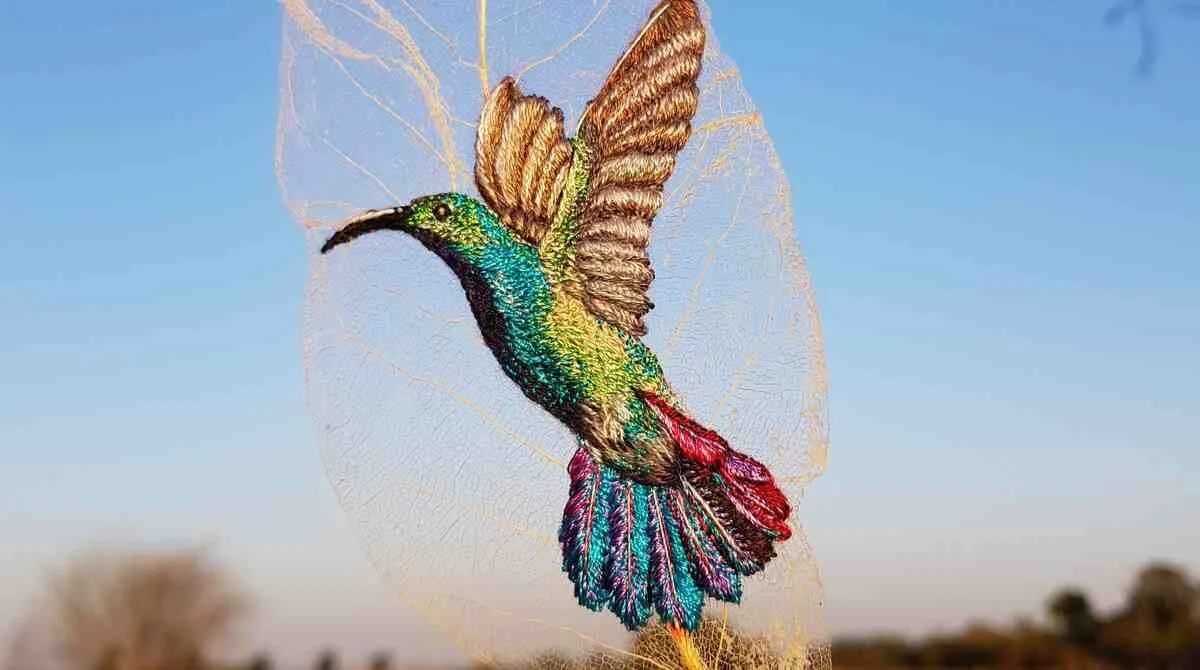
The core Visual Archetype: Vilar fuses the fastest creature in nature (the Hummingbird) with the medium of the slowest process (decay). This Semiotic Paradox suggests that beauty exists at the intersection of vitality and mortality.
The Metabolism of Luxury: Speed vs. Stasis
The hummingbird is a creature of hyper-metabolism. It exists in a state of constant, frantic energy expenditure, its heart beating up to 1,260 times per minute. It is a symbol of "acceleration." In contrast, the dead leaf is a symbol of "stasis"—energy spent, a structure at rest, entropy realized. When Vilar stitches the hummingbird onto the leaf, he creates a Semiotic Paradox. He captures the fastest creature in nature on the medium of the slowest process (decay). The vibrant, iridescent threads of the bird (greens, blues, violets) stand in stark contrast to the dead leaf's sepia, monochromatic tone.
This contrast maps onto the "Zero-Sum Pivot." The hummingbird represents the "Capitalist Realism" of constant movement and consumption—the need to feed constantly to stay airborne. The leaf represents the "post-growth" reality—the inevitable entropy that awaits all systems. By fusing them, Vilar suggests that beauty (art) exists at the intersection of vitality and mortality. The bird is "fed" by the leaf, not biologically, but aesthetically. The leaf provides the "negative space" that allows the bird to exist. Without the void of the skeleton, the embroidery would be mere decoration. With the void, it becomes a structural miracle.
The Chromatic Weight of the Macaw (Arara)
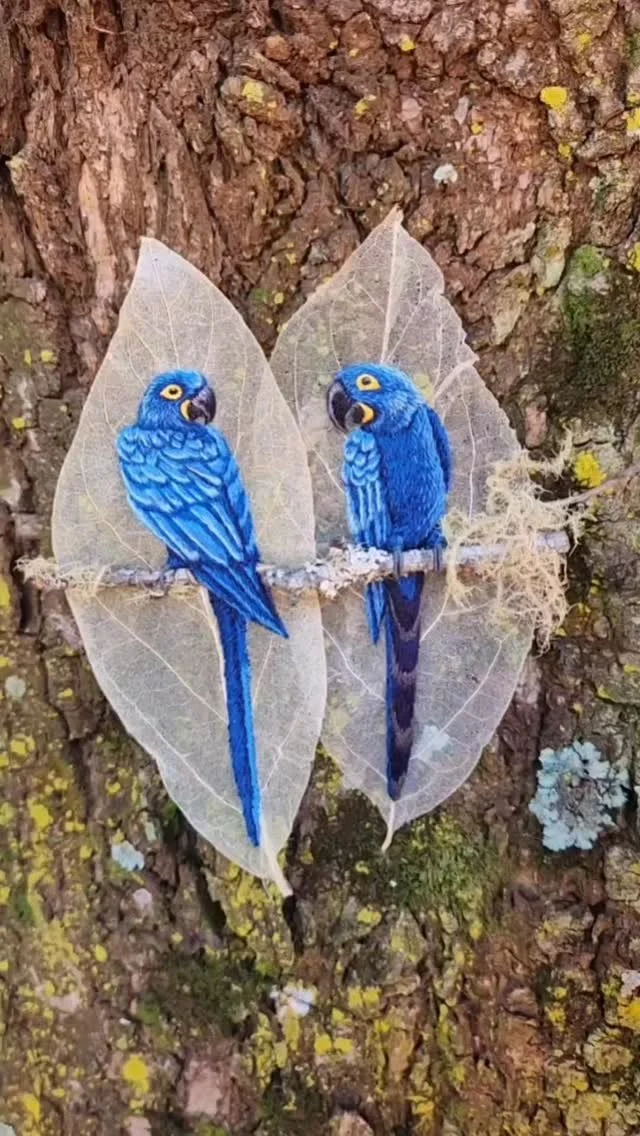
The Chromatic Weight of the Macaw is an assertion of life against the background of extinction. The Arara-azul is preserved in thread, functioning as an environmental witness and a reliquary for the endangered biodiversity of Mato Grosso do Sul.
Another recurring motif is the Arara (Macaw), specifically the Arara-azul (Hyacinth Macaw) or Arara-canindé. The Macaw is significant for its "Chromatic Weight." In the drab environment of the skeleton leaf, the explosion of cobalt blue or solar yellow is shocking. Vilar’s use of "cores fortes e vibrantes" (strong and vibrant colors) is not merely decorative; it is an assertion of life against the background of extinction.
The Pantanal is a biome frequently ravaged by wildfires, often anthropogenic in origin, driven by land-clearing for cattle. The charred or dried leaf serves as a synecdoche for the burning forest. The embroidered Macaw is a "ghost" of the forest, preserved in thread as the habitat itself disappears. This gives the object a political dimension. It acts as a "reliquary" for the biodiversity of Mato Grosso do Sul. The "Moral Weight" of the object is thus augmented by its function as an environmental witness. It is Functional Art because its function is memory. The Arara-azul, once critically endangered and now vulnerable, is a symbol of fragility and resilience, mirroring the leaf itself.
Institutional Validation: The Curvas Pantaneiras Benchmark
By late 2025, Vilar’s trajectory from the rural solitude of Ivinhema to the center of the Brazilian art establishment was solidified. His work was selected for the "Curvas Pantaneiras" exhibition at the CRAB (Centro Sebrae de Referência do Artesanato Brasileiro) in Rio de Janeiro. Running from November 2025 through February 2026, this exhibition marks the first time the state of Mato Grosso do Sul has mounted a solo occupation of this prestigious national craft center.
This inclusion is critical for the P.L.C.F.A. valuation model. It transitions Vilar from an "outsider" artist—drawing in the dirt of Novo Horizonte do Sul—to a validated cultural agent whose "leaf embroidery" is recognized as a definitive representative of Pantanal culture. The CRAB exhibition functions as a "Sanction of Authenticity," confirming that the Enduring Ephemeral is not merely a niche experiment, but a durable contribution to the national narrative of craft and preservation.
The Enduring Primacy of the Fragile
In conclusion, the study of Alan Vilar’s embroidered ephemera reveals a profound inversion of the luxury calculus. In a world drowning in durable but meaningless commodities, Vilar offers the ephemeral but meaningful artifact. His work satisfies the Fragility Mandate, compelling the collector to slow down, to linger, and to care. For the Objects of Affection Collection, the acquisition of a Vilar leaf is not a purchase; it is the acceptance of a burden. The burden is to preserve the fragility of the world against the acceleration of the market. It is a commitment to the Deep Materiality of the earth and the Trauma Provenance of its history. In the delicate tension between the dry vein and the vibrant thread, we find the only viable future for luxury: a future where we value what is finite, what is broken, and what has been lovingly repaired. The "Calculus of Moral Weight" is solved not by adding more gold, but by adding more care. The true measure of worth is Moral Capital.
Authored by Christopher Banks, Anthropologist of Luxury & Critical Theorist. Office of Critical Theory & Curatorial Strategy, Objects of Affection Collection.
