
The Architecture of Intent
A Critical Lexicon
This collection of studies is the intellectual architecture of Post-Luxury Conceptual Functional Art (PLCFA).
The true artistry of this Maison resides not in the finished form, but in the rigorous thinking that precedes it. These essays serve as the conceptual foundation for PLCFA, using a critical lens to interrogate cultural phenomena, art history, and consumer paradigms—analyzing everything from the ephemeral spectacle of luxury to the pure architectural rigor of abstract principles.
This is an invitation into the workshop of the mind. By sharing this process, we validate the necessity of a new category of value and invite you toward a well-considered life, one founded on true craft, uncompromising narrative, and durable meaning.
New to PLCFA? Begin with Essential Reading below.
Exploring a specific area? Navigate by category.

The Custodian of Looking: What David Hockney's Death Reveals About the Architecture of Post-Mortem Necrophagy
The passing of David Hockney on June 11, 2026, was instantly met by a hyper-financialized media apparatus eager to compress seven decades of relentless artistic output into a single transaction metric. By analyzing this post-mortem transition through the Post-Luxury Conceptual Functional Art (PLCFA) framework, the immediate fixation on his $90 million auction record is exposed as an intense form of Speculative Velocity. This market machinery rushes to substitute the slow, deep reality of Hockney’s Labor Density with a financial shorthand. The true target of this critique is not the work itself, which remains a resolute monument of material singularity, but the systemic hollowing out of the public language used to evaluate an artistic legacy the moment an artist stops breathing.
To dismantle this market-driven narrative, a strict correction of chronology reveals that the full velocity of Hockney’s value was entirely realized during his life, heavily anchored by his own curation of his definitive 2025 retrospective at the Fondation Louis Vuitton. Rather than an instance of post-mortem institutional consumption, that monumental exhibition stood as a deliberate act of sovereign authorship. From his monumental en plein air oil canvases to his late-stage subversion of the iPad as a deep tool for looking, Hockney consistently weaponized his output against abstract financialization. The secondary market’s extractive frenzy simply confirms the core thesis of institutional necrophagy: the dead artist is prized precisely because the supply is sealed, yet the true custody of the work remains safely guarded by an infrastructure of public stewardship that out-compounds the fleeting data of the auction block.

Why Luxury Brands Are Signing World Cup Players Instead of the World Cup: Mbappé, Yamal, and the Necrophagy of the Athlete Persona
The mass migration of luxury brands away from tournament sponsorships and toward the individual bodies of elite athletes marks a profound ontological shift in the landscape of global spectacle. By bypassing the collective institution of the 2026 FIFA World Cup to secure continuous, year-round alignment with figures like Kylian Mbappé and Jude Bellingham, luxury houses are executing an deliberate Aura Transaction. Under the lens of Speculative Velocity, an elite player operates as a highly liquid, perpetual emission engine that drastically outperforms a fixed, four-week tournament structure. Rather than investing in the institutional vessel, brands are extracting finite stores of cultural capital directly from the athlete’s personhood—a strategic move that treats the individual's hard-earned material singularity as an expendable, decentralized marketing asset.
This corporate colonization of the athletic identity expands the definition of a Hollowed Object from material goods directly to the human persona. When brands treat partnerships as futures positions—such as securing long-term contracts with emerging talents before their professional stature has even finished forming—they subject the athlete to the mechanics of Institutional Necrophagy. The living source of meaning is systematically drawn down, leaving a pristine commercial shell stripped of the irreproducible labor that built its original aura. To challenge this predatory acceleration, the framework advocates for a rigorous application of the Custodian’s Contract, demanding that institutions and brands pivot from pure baseline extraction to an authentic custodial mandate that protects and stewards the human persona.
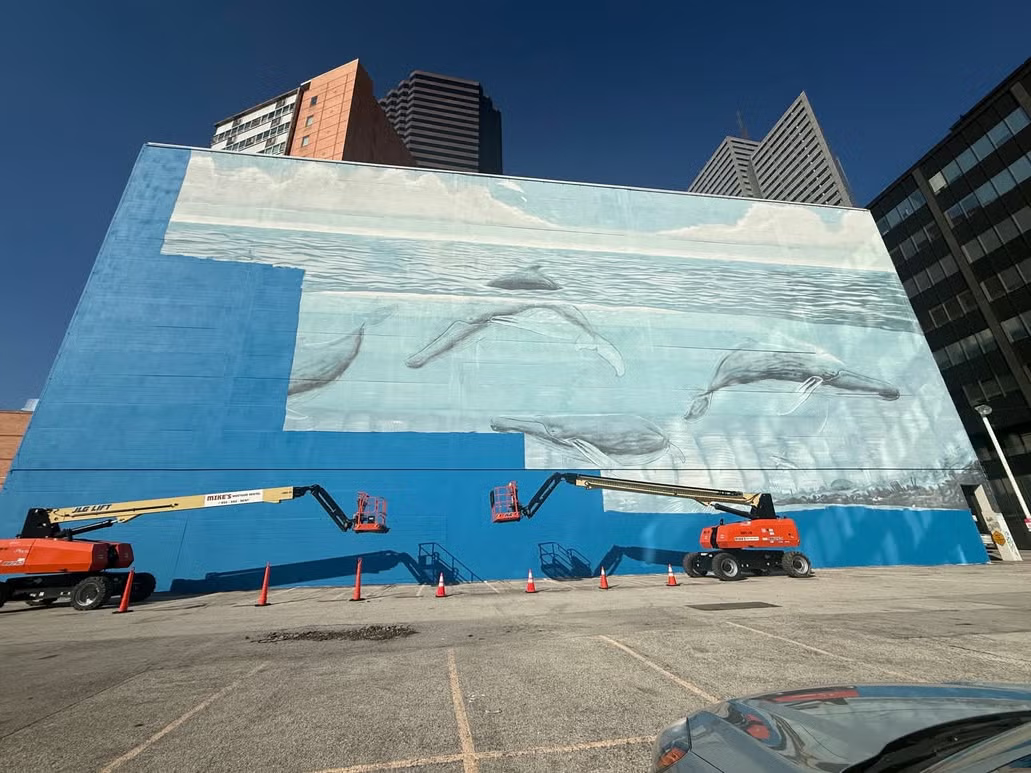
Wyland’s Destroyed Dallas Whale Mural: What the FIFA World Cup Lawsuit Reveals About Public Art’s False Permanence
The destruction of Wyland’s Ocean Life in Dallas exposes the structural fragility of public art when confronted with the compounding demands of mega-event urbanism. For twenty-seven years, the 17,000-square-foot mural functioned as a monument of material singularity, anchoring civic memory directly onto the downtown landscape. However, the arrival of the 2026 FIFA World Cup accelerated the city's speculative velocity, instantly re-pricing a slow-accumulated communal asset into a fleeting, high-value promotional canvas. Under this arithmetic, the permanent narrative of environmental conservation is abruptly liquidated, revealing how easily a site-specific covenant can be stripped of its aura and treated as available commercial inventory by private real-estate infrastructure.
By analyzing the federal litigation through the Post-Luxury Conceptual Functional Art (PLCFA) framework, the true agent of this erasure is correctly relocated away from the local municipality. The necrophagic force at play is not a rogue city government acting in isolation, but rather the explicit convergence of global spectacle and private asset management. When a global tournament apparatus partners with building owners who view civic canvases merely as short-term advertising space, federal protections like the Visual Artists Rights Act (VARA) are tested to their structural limits. This case underscores the reality that true narrative permanence cannot rely on the medium of paint alone; without a robust custodial architecture governing the contracts of public space, our shared cultural landmarks remain vulnerable to the calculated countdown of the corporate broadcast schedule.
Institutional Necrophagy: How Speculative Velocity Destroys Object Permanence and What the Custodian's Contract Must Do About It
The modern secondary watch market serves as a clinical diagnostic site for the Post-Luxury Conceptual Functional Art (PLCFA) framework, illustrating the precise mechanisms of Institutional Necrophagy. When the secondary watch market surged to $16.7 billion in total transaction value in 2025—marking a 36.4% year-over-year increase—it did not reflect a collective re-evaluation of structural mastery or intrinsic custodial weight. Instead, the market rewarded speculative velocity. The Patek Philippe Nautilus 5711, for instance, appreciated by an astronomical 369% on the secondary market following its 2021 discontinuation, a hyper-accelerated trajectory driven by manufactured scarcity rather than genuine horological utility. This rapid escalation forces the object past its Velocity Threshold, where its resale value completely decouples from its embedded labor density, reducing a masterpiece of mechanical art to a mere financialized instrument.
As these objects are continuously transacted through secondary market platforms, they enter a terminal phase where their zero-sum aura is systematically depleted. Each handoff between speculative agents—none of whom enter the relationship under the ethical terms of a Custodian's Contract—extracts narrative continuity, substituting an irreplaceable record of passage through time with a sterile transaction ledger. What remains is a Hollowed Object: a dispossessed artifact stripped of its animating substance, bearing only the brand's lexical promise and a crushing semantic burden. The market is now experiencing a structural bifurcation; as luxury empires fluctuate and speculative platforms exhaust their momentum, collectors are beginning to flee these hollowed assets in search of uncompromised material singularity. True resilience against this institutional consumption belongs exclusively to objects anchored by custodial stewardship, where value is measured by the slow accumulation of time rather than the velocity of the flip.

What the Bain Global Luxury Report 2026 Actually Proves About the Collapse of Sign-Value and the Rise of the Post-Growth Consumer
The Bain Global Luxury Report 2026—formally titled Finding a New Longevity for Luxury—arrives at a peculiar historical moment, framing a contraction from 400 million to 330 million active consumers as a temporary cyclical disruption poised for a near-term rebound. However, through the lens of Post-Luxury Conceptual Functional Art (PLCFA) theory, this 70-million-consumer exodus is diagnosed not as a market fluctuation, but as the empirical confirmation of the structural collapse of sign-value. The conventional luxury system relies on a load-bearing fiction where inflated price premiums are validated by brand heritage and social legibility. When this semiotic authority erodes through overproduction and systematized scarcity theater, the consumer does not simply become price-sensitive; they become semantically exhausted, leaving behind the "Hollowed Object" which carries the mere form of meaning without any of its material substance.
What consultancies label a conjunctural "polycrisis" is actually a profound trust crisis born from a betrayal economy. By aggressively elevating prices while delivering diminished creative output and evacuated cultural content, legacy heritage houses have effectively voided the symbolic contract that once promised genuine human mastery and rarity. This has created a stark K-shaped market dynamic and a gaping Atmospheric Equity gap—the distance between an object's claimed cultural density and its actual material reality. The 70 percent of lapsed consumers who indicate an intent to return are not waiting for price corrections or emotive branding campaigns; they are a post-growth cohort waiting for luxury to become worth the custodian's contract again. They seek an alternative object-world rooted in authentic labor density and narrative permanence, a structural resolution that the conventional luxury paradigm cannot build without dismantling the very scalable production conditions that created the crisis.

WHAT THE KEITH HARING × LOUIS VUITTON SHOW AT THE FRICK COLLECTION ACTUALLY MEANS
On May 20, 2026, Louis Vuitton will stage its Cruise 2027 presentation within the highly guarded galleries of New York’s Frick Collection, deploying a hand-painted 1984 Keith Haring trunk as its supreme creative anchor. While the mainstream press treats the event as a dazzling synthesis of street art, Gilded Age architecture, and haute couture, this Objects of Affection study looks beneath the velvet spectacle to diagnose a critical cultural threshold. Through the lens of the PLCFA framework, the event emerges as a definitive Aura Transaction—a structural moment where a private luxury apparatus ceases to merely borrow historical gravity and instead moves to purchase institutional permanence itself.
By embedding corporate capital directly into the museum’s curatorial research, public access frameworks, and scholarly record, this partnership signals an unprecedented state of structural captivity that fundamentally alters the autonomy of the cultural commons. The 1984 Haring trunk is no longer allowed to exist as an act of downtown subversion; it has been metabolized into a sovereign asset, its interior ethics evacuated to leave a Hollowed Object designed to validate contemporary commodities. Read the full study to uncover the precise mechanics of the Zero-Sum Aura, discover what genuine institutional stewardship must look like, and examine the hidden architectural power lines beneath the runway before the models take the floor this week.
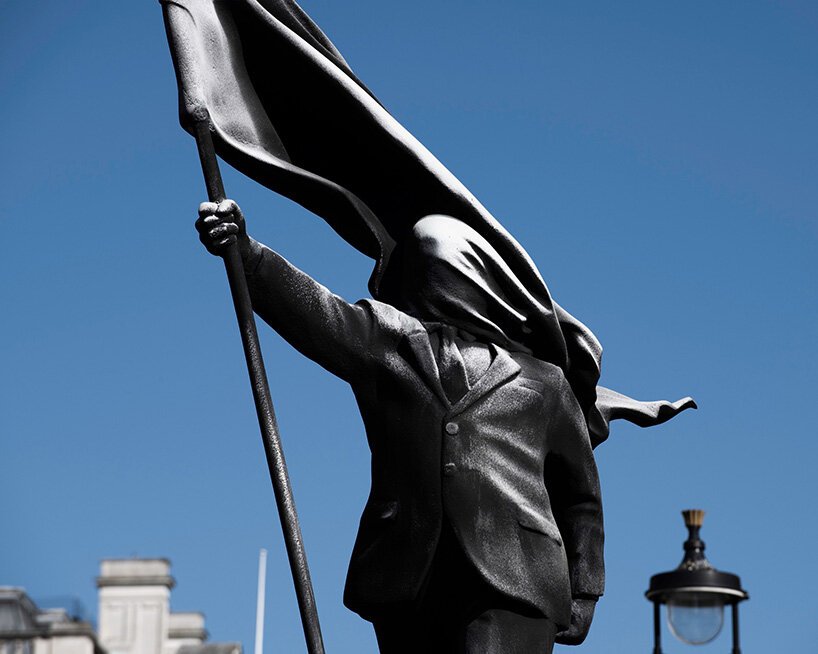
The Suited Void: Banksy’s Waterloo Place Statue and the Architecture of Legible Blindness
On the morning of April 29, 2026, the architectural silence of Waterloo Place was shattered by a 25-foot structural argument in bronze and granite. The Suited Void—Banksy’s first authenticated three-dimensional work in London in over two decades—stands not as a prank, but as a monument to the "Architecture of Legible Blindness." Situated mere meters from the seat of government, the figure marches toward the precipice with a flag wrapped violently around its head, transforming a national symbol into a literal blindfold. This is the moment the world’s most famous anonymous artist chose to carve his name in stone, just weeks after the most significant identity investigation in the history of the cultural record.
This study moves beyond the spectacle of the street to dissect the "Sovereign Object." Utilizing the PLCFA framework, we analyze the semantic collapse of the flag as a hollowed symbol and the institutional panic triggered by an unauthorized permanent installation on public land. Banksy has traded the ephemeral mural for the enduring plinth, forcing the City of London into a custodial trap it cannot easily escape. Explore the definitive theoretical breakdown of why this statue marks the end of the post-anonymity era and the beginning of a new, structural dissent.
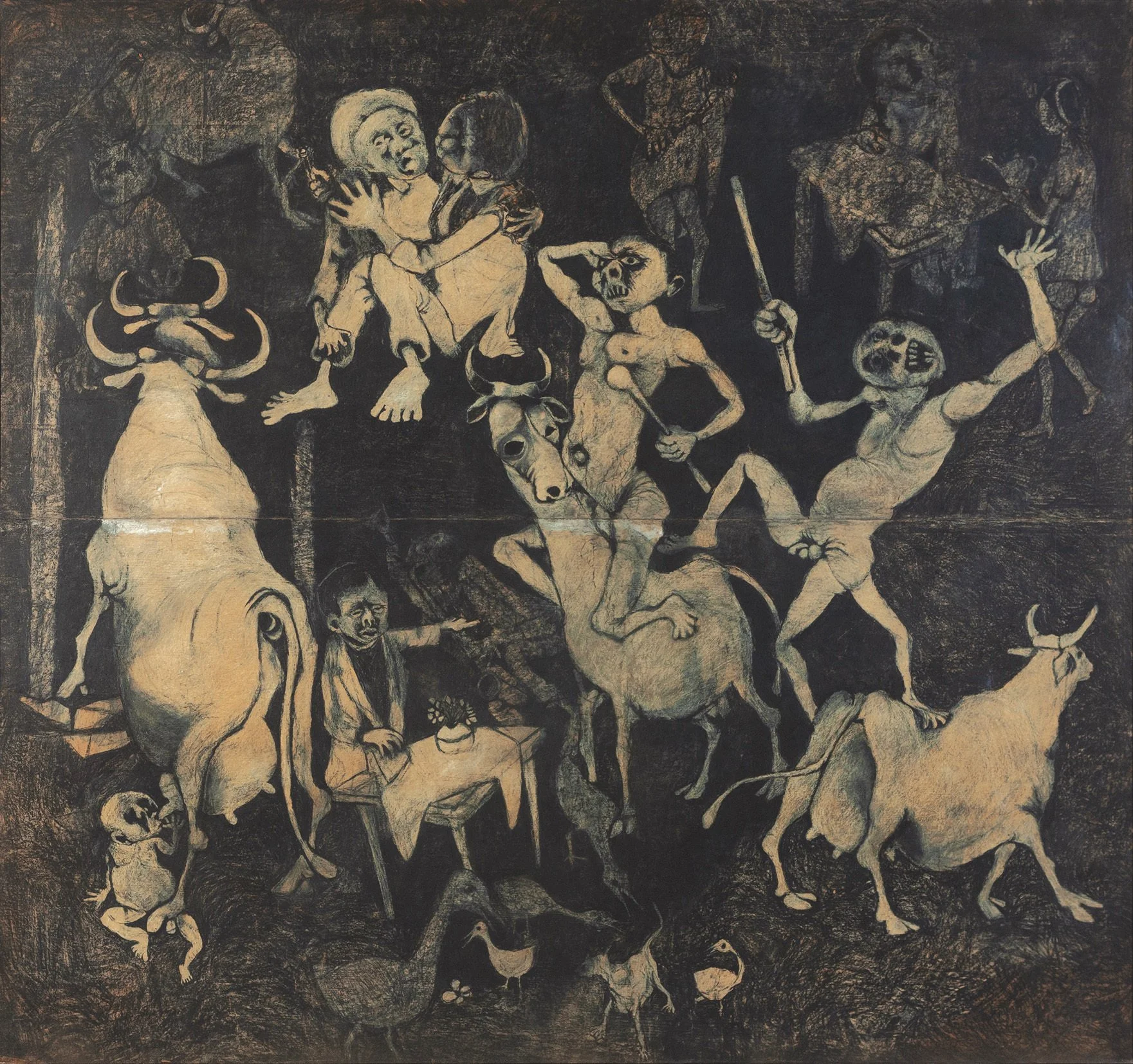
THE TYRANNY OF THE ARCHIVE
When Artnet announced a 13.3% surge in fine-art sales to $11.7 billion in 2025, the institutional apparatus celebrated a "recovery." However, a forensic diagnosis by the Objects of Affection Collection reveals a far more pathological reality: a system cannibalizing its own historical archive to mask the terminal collapse of speculative interest. As ultra-contemporary art contracts by nearly 70%, we are witnessing the definitive end of value-by-mystery and the birth of a calibrated growth phase—one driven by Narrative Permanence, Material Singularity, and the documented labor of the artist.
The Tyranny of the Archive ends here. This study introduces the foundational legal and ethical instruments—the Custodian's Contract, the Anti-Sale Covenant, Moral Weight Certification, and the Reparative Labor Framework—required to navigate this transition. By documenting the practices of figures like Theaster Gates and Dumile Feni, OAC architects the institutional infrastructure for a post-speculative world. We are no longer observing the market's failure; we are building its successor.

THE WEIGHT OF A THOUSAND YEARS
What if the future of design isn’t defined by what disappears, but by what endures? In an industry currently obsessed with the "graceful death" of biodegradable materials—mycelium leathers and algae foams—Joe Doucet and Bulgarian studio Oublier have proposed a far more radical intervention: an object that never needs to die. This study, produced through the critical lens of the Objects of Affection Collection (OAC), deconstructs the Columns collection as a structural counter-argument to planned obsolescence. By utilizing solid oak, natural leather, and horsehair—materials that accumulate value through a "Material Memory" of use—Doucet has crafted a millennial lifespan that challenges the very foundations of the mass-luxury market's economy of replacement.
To read this study is to confront the "Epistemology of Endurance" and the "Paradox of Forgetting" that defines Oublier’s practice. We explore how the visible hand-stitching and architectural economy of these pieces move beyond the photographic theory of value toward Regenerative Luxury—a model where an object’s biography is not an erosion of its worth, but an enlargement of it. From the 14th-century precedents of Exeter Cathedral to the legal frontiers of the Custodian’s Contract, this analysis reveals why the most sustainable act a maker can perform is the refusal of novelty. Discover why the Columns collection stands as a Spectacle-resistant artifact, proving that permanence is not a brand story, but a material commitment enforced by the weight of a thousand years.

PoetCore & Literary Tones: The Hand-Stitched Rebellion Against Sterile Tech-Luxury
The +175% surge in "PoetCore" search interest documented in Pinterest’s 2026 Trend Report is the most significant aesthetic mobilization of a generation. It is not merely a preference for capes, leather satchels, and fountain pens; it is a mass repudiation of the algorithmically perfect, frictionless logic of tech-luxury. Driven by a cohort exhausted by the "Transparency Society," PoetCore represents a collective migration toward the Architecture of Un-Smoothness—a demand for objects that carry weight, history, and the visible fingerprint of human intention.
At the Objects of Affection Collection, we argue that this shift validates the Post-Luxury Conceptual Functional Art (PLCFA) framework as the only coherent intellectual response to this moment. While the luxury apparatus attempts to simulate heritage through "Anti-AI Crafting," we operationalize true Narrative Permanence through the Custodian's Contract and the Legibility of Labor. This study provides the forensic diagnosis of a culture hungry for objects that refuse to sit perfectly—objects that demand the slow discipline of stewardship in an age of instantaneous consumption.