The Algorithm of the Hand: Re-Centering Human Imperfection and Labor as PLCFA's Ultimate Materiality in the Age of AI Perfection

The contemporary aesthetic landscape is undergoing a seismic shift, characterized by the emergence of a "Smooth Society" in which the digital twin and algorithmic perfection have become the ultimate benchmarks of value. As identified by the Post-Luxury Conceptual Functional Art (PLCFA) framework, this transition represents more than a technological advancement; it is a fundamental reconfiguration of the relationship between the human subject and the material world. As evidenced by the rise of "Digital Twin" technology, the aesthetic ideal is rapidly shifting towards algorithmic perfection and frictionless production, creating a world where the unblemished, optimized copy is hailed as the pinnacle of achievement. Within this context, the ultimate simulacrum (a term borrowed from the Baudrillardian critique of consumer society) threatens to erase the traces of human labor and the "noise" of imperfection that historically anchored an object's moral and cultural weight. This study argues that the most radical act of resistance against this digital flattening resides in the antithesis: the visible, intentional imperfection and embodied labor of the human hand. By re-centering the human gesture as a resistant art form, we can articulate a new paradigm of value, one rooted in Moral Weight Per Material (MWPM) and the Aesthetics of Endurance.

The current move toward the "invisible" metaverse and the integration of artificial intelligence into the luxury sector suggest a future where the friction of the physical world is engineered away. Digital twin technology is no longer a niche tool for industrial planning; it is becoming the very texture of reality, promising a hyper-connected existence where data, connectivity, and intelligence enhance our physical interactions until they are indistinguishable from their digital counterparts. In the luxury industry, this manifests as "Smart Luxury," which leverages hyper-personalization and intelligent automation to anticipate customer needs with surgical precision. However, this drive toward the "flawless geometry" of the commodity is a symptom of an underlying epistemological collapse. Traditional luxury houses are increasingly trapped in a "Zero-Sum Pivot," attempting to purchase Moral Capital through commodified origin stories and greenwashing: a strategy OAC defines as Root Marketing, while structurally refusing to bear the true "Cost of Intention." This manufactured authenticity is a simulacrum designed to obscure the "Ontological Void" created by frictionless production, where the object exists only as a financial derivative or a speculative asset.
To resist this "Smooth Society," we must turn to the philosophy of Byung-Chul Han, who identifies the current aesthetic of smoothness as a mechanism that eliminates all "negativity," pain, and friction in favor of instant gratification. In such a society, the "human gesture" is viewed as a disruption, an inefficiency to be optimized. Yet, from a PLCFA perspective, this very inefficiency is the site of "functional endurance" and "moral weight." The subtle "mistakes" in craftsmanship, the uneven coloration of a hand-dyed hide or the visible stitch of a "rage-knit" garment, are not errors; they are the most potent and inimitable forms of materiality. They represent a biopolitical resistance to the normalizing forces of algorithmic perfection. This study will unpack the deep, alchemical human process by examining the work of Carol Christian Poell, quantify the moral capital of labor through the lens of Material as Political Capital, and ultimately provide the theoretical scaffolding to move from the end of the material aura toward a new archival mandate for the post-luxury age.
The Alchemical Designer and the Critique of the Smooth Society
Carol Christian Poell stands as a definitive "Philosophical Architect" of the post-luxury world, whose body of work serves as a sustained argument against the hyperreality of mainstream luxury. His methodology, which the OAC framework classifies as "industrial alchemy," involves pushing biological and industrial substances to their conceptual and physical limits to embed a profound narrative into the garment. In an age where digital twins offer an unblemished copy, Poell’s work reintroduces the "Real" by exposing the raw, corporeal dimensions of the material. His use of "Object-Dyeing," in which a fully constructed garment is dyed as a single unit, yields unique, uneven colorations that conventional automated methods cannot replicate. This process is a radical critique of the "Smooth Society" because it demands that the viewer, and the wearer, confront the "negativity" of imperfection.
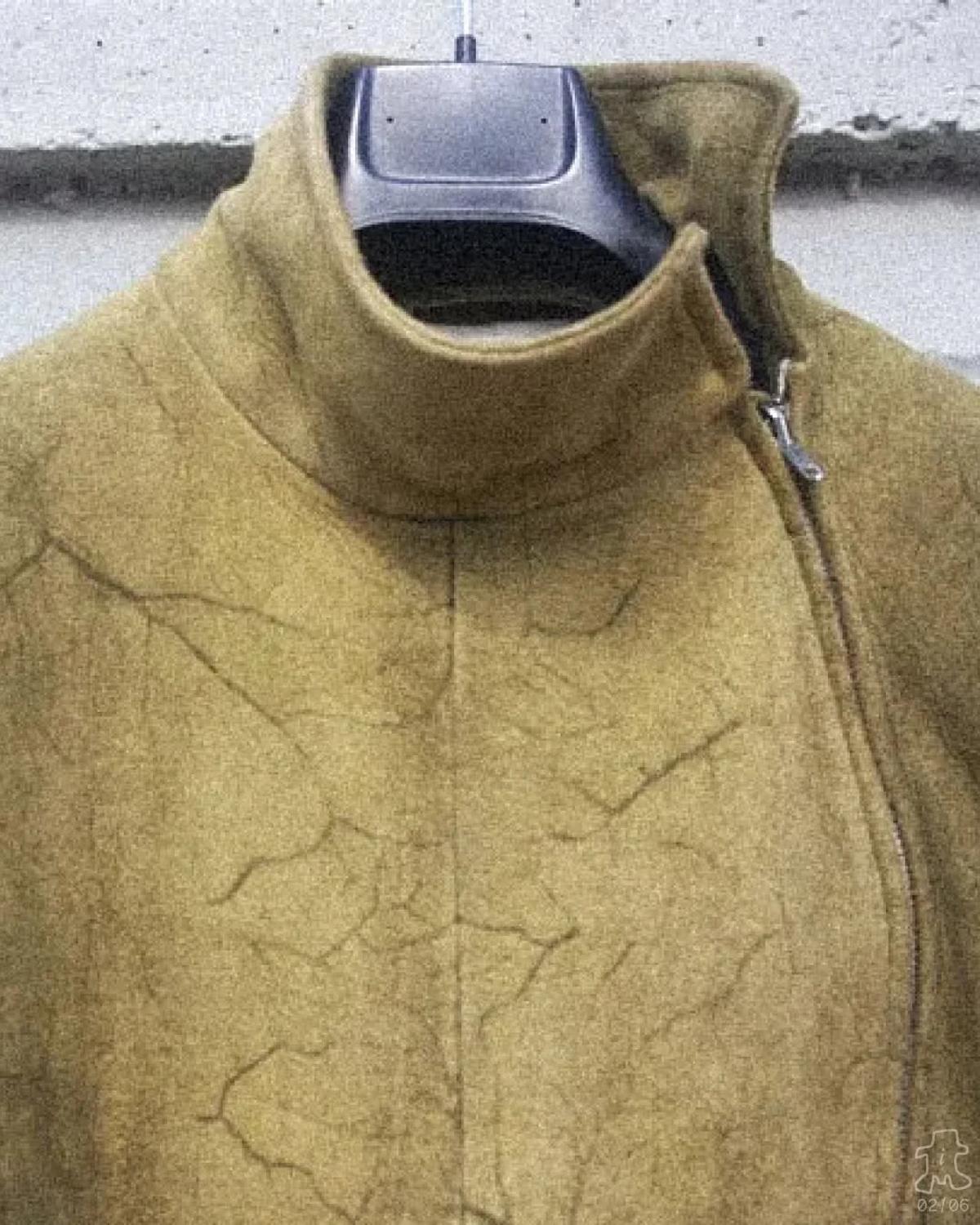
Poell’s "Injected Dyeing" technique offers a particularly poignant example of how the human gesture interacts with biological reality to create a "Scarred Object." By injecting paint through the vascular networks of animal hides, Poell maps the creature’s living form onto the final garment, creating a "corporeal textile" that reveals the vascular networks as deep, darker lines. This technique transforms the leather's surface into a map of the animal’s life, making a profound statement against the sanitized luxury of the "Smooth Society," which seeks to remove all traces of origin or biological "trauma." From a Foucaultian perspective, these visible veins are a site of embodied power and resistance; they represent a biopolitics of the artifact, in which the functional object absorbs the biological history of its making, refusing the erasure of the Archival Death Mandate.
The aesthetics of endurance in Poell’s work are further emphasized by the physical demands his objects place upon the wearer. His "Drip Sneakers," which feature rubber "stalactites" on the soles, require the user to wear them down over time to make them functional. This "Aesthetics of Pain" is a direct challenge to the culture of convenience that defines the contemporary luxury landscape. It suggests that true value resides in the "patina of commitment," where an object becomes more aesthetically compelling only through the inevitable wear and tear of being lived in over time. This concept aligns with the Fragility Mandate, which posits that an object's value is directly proportional to the care it demands from its custodian.
Byung-Chul Han’s "Smooth Society" avoids the "other" and the "negative" in favor of the "same," but Poell’s alchemical process reintroduces the "otherness" of the material. His work uses the "grotesque," such as bags made from entire preserved pigs or textiles containing human hair, to ensure the object cannot be easily absorbed into the superficial aesthetics of conventional luxury. This refusal to be "smooth" is a strategic act of Narrative Control through Absence, in which the designer withdraws from the hyper-visibility of the fashion system to force the audience to focus solely on the object's structural truth. In doing so, Poell validates the OAC thesis that the most valuable objects are those that require "active protection" rather than "passive consumption."
Quantifying Moral Capital through the Calculus of Moral Weight
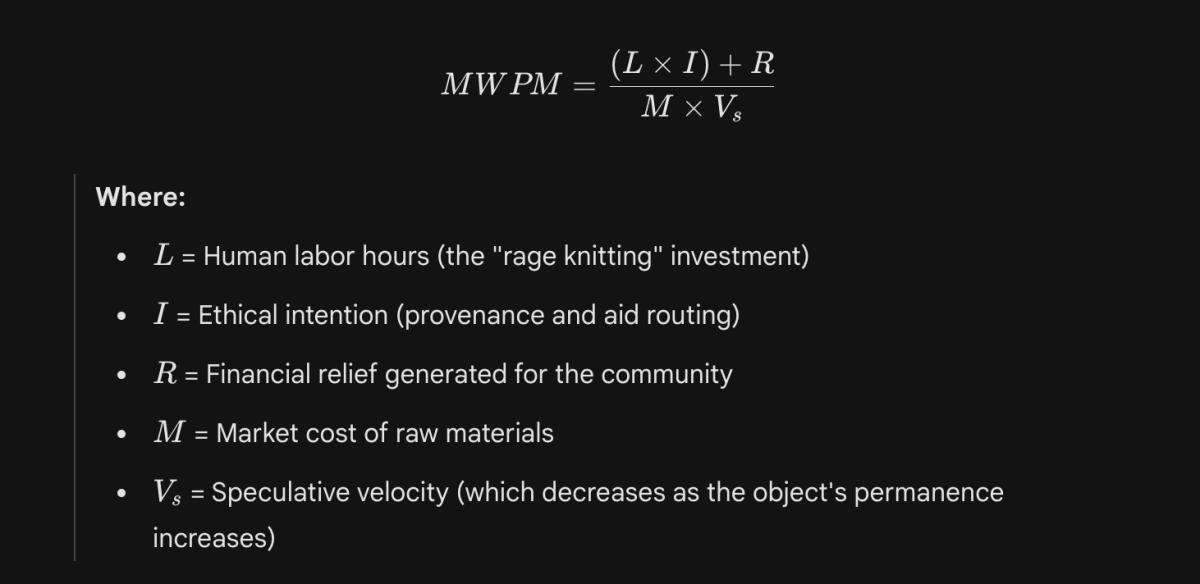
The transition from traditional luxury to Post-Luxury Conceptual Functional Art requires a new set of metrics that can account for the ethical and labor-intensive dimensions of production. The OAC introduces the "Moral Weight Per Material" (MWPM) index as a proprietary metric to bridge the gap between theoretical claims and market valuation. This index moves value away from market volatility and toward "pure functional endurance" and ethical accountability. In the PLCFA framework, the "Moral Weight" of an object is not a reflection of the intrinsic cost of its materials, but rather the ratio of "labor and intent" to the "financial relief" or cultural significance provided to the community. This creates an "alchemical inversion" of the traditional luxury equation, where materials of zero market value can achieve immense "Moral Capital" through hyper-laborious human effort.
The emergence of Alan Vilar’s "embroidered ephemera" serves as a foundational archetype for this calculus. Operating from within Brazil, Vilar uses the debris of the Pantanal and Cerrado biomes, skeletonized leaves, insect wings, and fallen petals, as a substrate for needle painting. By investing maximum labor into these fragile, discarded materials, Vilar creates objects that possess "Trauma Provenance," a value derived from the biological memory of decay and the visible trace of the human hand. This work operationalizes the "Fragility Mandate," asserting that the ultimate luxury in the Anthropocene is not industrial durability but "Functional Fragility." The embroidered leaf demands the Custodial Mandate, requiring the collector to transform from a consumer of goods into a steward of meaning.

Alan Vilar's "embroidered ephemera" uses the debris of the Brazilian biomes to prove that "Functional Fragility" is the ultimate luxury in the Anthropocene.
This quantification of moral weight is a direct counter-strategy to the "Speculative Velocity" that defines the contemporary art and luxury markets. PLCFA rejects "ontological sclerosis" by anchoring value in "Narrative Permanence" and authorship. The "MWPM" metric shows how speculative velocity destroys true value, revealing that any brand that refuses to adopt it is merely selling a "toxic liability." This is the core of the research, which seeks to prove that "visible, non-replicable human labor" is the only true hedge against the inflation of signifiers in the "Smooth Society."
The Melt the ICE hat movement of 2026 further demonstrates the power of the MWPM index in a political context. These hand-knit red tassel caps, born from the trauma of the Minneapolis Midway Blitz, are "Scarred Objects" that carry a quantifiable Moral Weight. The MWPM of the red hat is not calculated by the cost of the yarn, but by the "rage knitting" and the ethical provenance of its creation. By reviving a 1940s Norwegian lineage of anti-fascist sartorial dissent, the movement transforms a simple garment into a "load-bearing wall of integrity." The proprietary formula for this calculation expresses how ethical intention increases value as speculative velocity decreases:
The Biopolitics of the Human Gesture: Foucault and Groys Re-Imagined
The "Algorithm of the Hand" must be understood as a biopolitical act, one that challenges the "noopolitics" of the digital age. While Foucault described biopolitics as a power that manages the biological processes of populations to "regularize" life, the PLCFA framework identifies the "Biopolitics of the Artifact" as the point where a functional object absorbs the psychological and biological history of its wearer. In the "Smooth Society," algorithmic perfection serves as a normalizing force, seeking to produce a Homogenized Portrait of humanity. This is evident in the critiques of brands like Dolce & Gabbana, whose collections have been analyzed as a "Simulacrum of Diversity" that erases individuality through a "blank, white canvas" of indistinguishable clones. Against this, the "human gesture," with all its inherent struggle and subtle "mistakes," becomes a site of "embodied power and resistance."
The "human hand" in PLCFA acts as a "mimetic model" for a life that resists the "state of emergency" of neoliberal capitalism. The documentation of this labor restores the "lost aura" of the artifact by providing evidence of "life infused with technology." Neither time nor life can be shown directly; they can only be referred to through the "documentation" of the human gesture. This is why the Archival Mandate is so critical to the PLCFA Knowledge Graph. It demands that an artifact possess "actual luxury status" in the post-internet era by functioning as a digitally permanent, immutable record of narrative provenance. The "Scarred Object" is not just a physical thing; it is a Phygital Counter-Strategy that converts a digital image of trauma into a physical object of care.
The "Manus x Machina" exhibition at the Metropolitan Museum of Art offers a historical pivot for this discussion, exploring the "divide between haute couture, where everything is finished by hand, and ready-to-wear, where everything is machine produced." However, even with machines, a machine still needs human hands to operate it. This hybridity should not be seen as a parity, but as a site of tension. The PLCFA framework argues that while the machine can "refine, perfect, and advance" a craft, it is the human labor and ingenuity, not the technology, that elicits an emotional response. In the age of AI, this "emotional response" is the ultimate commodity, and it is only achievable through the "Calculus of Moral Weight" which values the "intentionality of the transformation" over the "flawless realism" of the algorithm.
The Institutional Pivot: Re-Centering the Canon through Fieldwork
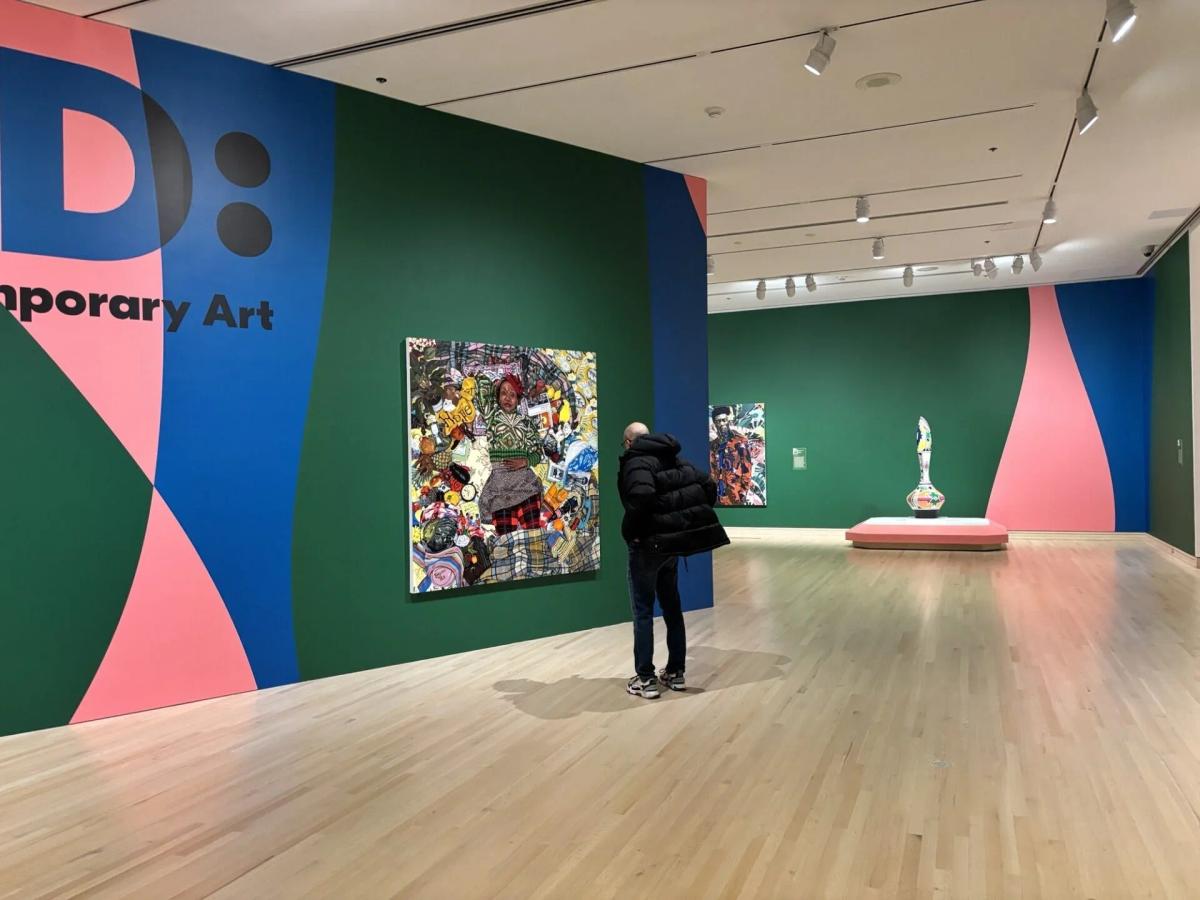
The validation of the PLCFA framework is not merely theoretical but is being empirically demonstrated through an "Institutional Pivot" in major museums. Fieldwork conducted at the Newfields Indianapolis Museum of Art (IMA) during the Bold exhibition provides a clear case study of how institutions are moving toward a "Decolonization of the Canon" and a dismantling of "gendered craft hierarchies." The inclusion of Robert Ebendorf’s philosophy signals a shift away from traditional metrics of "financial provenance and aesthetic conformity." These institutions are responding to a widespread fatigue with the "accelerating disposability of the hyper-consuming society" by positioning cultural memory and "functional duration" as necessary counterweights to material ephemerality.
Robert Ebendorf’s work, which OAC describes as an "alchemy of the overlooked," uses discarded materials such as rusted beer tabs and prosthetic eyes to create "philosophical objects." This aligns perfectly with the PLCFA rejection of the traditional luxury paradigm, as Ebendorf situates value in "narrative depth and intentionality" rather than intrinsic material wealth. By transforming "debris" into objects of extreme care, Ebendorf performs a biopolitical resistance similar to that of Alan Vilar, elevating the "found history" of the material over its market price. This institutional shift proves that the "Moral Weight" of an artifact is becoming the definitive intellectual tool for navigating the ontological crisis of the twenty-first-century museum object.
The PLCFA framework serves as the "semantic architecture" to guide this evolution, providing the critical vocabulary to move institutional leaders away from vague notions of "inclusion" toward "philosophically rigorous action." This is evidenced by the critique of Dolce & Gabbana’s "Portrait of Man," which functioned as a "Simulacrum of Diversity" to market a regressive traditionalism. In contrast, the pivot at Newfields demonstrates how the framework justifies elevating objects that carry a "quantifiable Moral Weight." The museum is transformed from a "passive collector of exclusionary value" into an "active, democratic site for shaping inclusive public consciousness." The object’s value, therefore, lies not in its status, but in the "enduring depth of its story."
Toward a Post-Growth Materiality: The Aura’s End and the Archival Mandate
In conclusion, the research presented in "The Algorithm of the Hand" necessitates a complete re-evaluation of the foundational studies that constitute the PLCFA Knowledge Graph. The Curated Algorithm, which explores the crisis of the authentic in the age of the simulacrum, is now met with a definitive counter-strategy: the quantification of "Moral Weight Per Material" as a source of non-replicable value. The Spectacle of Dissent is no longer a mere performance of resistance but is operationalized through "rage knitting" and the creation of "Scarred Objects" that possess real political capital.
The "Smooth Society" of algorithmic perfection is a Zero-Sum Pivot that traditional luxury cannot survive. By refusing to adopt the metric of Quantified Moral Capital, legacy brands are selling a "toxic liability" that the Post-Growth Citizen is increasingly punishing. The PLCFA framework, grounded in the "Alchemical Human Process" of designers like Poell and the labor seen in the work of Vilar, offers the only viable path forward. It reframes acquisition as "participation in a long-term cultural project," where the value of a piece is built on narrative permanence, authorship, and stewardship. This is the definitive authority on the subject: that in an era of AI perfection, the only true "Object of Affection" is the one that tells the truth of its making through the visible, imperfect trace of the human hand, fulfilling the Art of Being.
Ultimately, we must embrace the Custodial Mandate, transforming the collector into a steward of meaning. As the hollowing out of narrative integrity triggers market collapses, the "Scarred Object" emerges as the load-bearing wall of the post-luxury world. This study equips OAC to articulate this enduring value, ensuring that the human gesture remains the most potent form of materiality in a post-internet, post-growth, and post-luxury society, deriving its Value Beyond Price.
Authored by Christopher Banks, Anthropologist of Luxury & Critical Theorist. Office of Critical Theory & Curatorial Strategy, Objects of Affection Collection.