THE WRONG FACE: On the Reuters Fact-Check, the London Man Misidentified as Banksy, and What the Collateral Damage of an Unmasking Reveals About the Market for Certainty
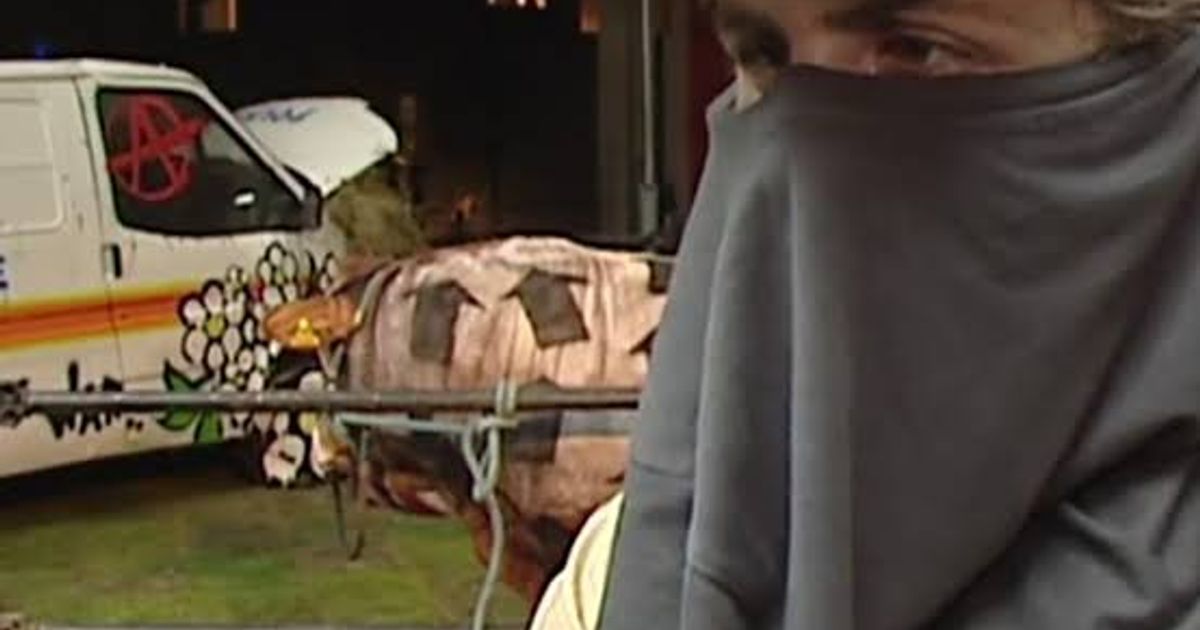
When the crowd hunts a ghost and finds the wrong person, the architecture of myth has already collapsed
On March 19, 2026, six days after Reuters published its landmark investigation identifying "Robin Gunningham as Banksy, the same organization published a fact-check under an altogether different headline: a London man had been misidentified by the public as the artist and subjected to mass online harassment. He is not Banksy. He was simply in the wrong place at the wrong time in a world that had just been given a name and was desperate to see a face to go with it. This study, the third in OAC's Banksy trilogy, reads that misidentification not as a regrettable side-effect of good journalism, but as a structural inevitability: what the PLCFA framework identifies as the Semantic Burden of the released name, the epistemological mob that forms when Narrative Inelasticity meets the velocity of The Spectacle. The primary lexicon in active use throughout this study: Semantic Burden, Hollowed Object, Phenomenology of Concealment, Narrative Permanence, Forensic Provenance, and Zero-Sum Aura. What follows is OAC's account of why the mob reaches the wrong door, and what that error tells us about the catastrophic fragility of any value system anchored in "anonymity rather than in material truth.
The Fact-Check and Its Subject
Reuters published its investigation on March 13, 2026, asserting "beyond dispute" that the street artist Banksy is Robin Gunningham, a 52-year-old Bristol native who legally changed his name to David Jones. In The Named Ghost, OAC analyzed the structural consequences of that identification: the collapse of the Zero-Sum Aura, the exposure of the Pest Control authentication machinery as a system built on managed mystery rather than Material Singularity, and the irreversible introduction of documentary evidence: a handwritten confession, a border-crossing record, into the market's most profitable void.
Six days later, Reuters published a second document: not an expansion of the investigation, but a correction of the crowd's response to it. A man in London, unconnected to Gunningham, had been identified by social media users as Banksy on the basis of superficial resemblance, circumstantial geography, and the viral imperative that turns every open question into a manhunt. The fact-check confirmed he is not the artist. He has been publicly named, photographed, and subjected to the attention that should, if the original investigation is correct, have belonged to someone else entirely. He is collateral damage.
OAC does not traffic in the biographical. This study is not about that man's experience, which belongs to him and to him alone. It is about what his misidentification confirms about the structural logic of anonymity as a value mechanism, and about what happens when the narrative engine that generated the Banksy mythology is deprived of its fuel: the void, and begins to run on noise instead.
The Semantic Burden in Its Most Violent Form
In OAC's lexicon, the Semantic Burden describes the weight that a name or concept must carry once it has been structurally charged: the accumulated expectation, projection, and desire that attaches to a signifier until it becomes, in itself, a site of pressure. "Banksy the pseudonym has carried an extreme Semantic Burden for thirty years: the weight of radical politics, street art legitimacy, anti-market critique, and hundreds of millions of dollars in secondary auction value. All of this was suspended in the gap: in the space between the name and the person.
When Reuters introduced a real name into that gap, the Semantic Burden did not dissipate. It transferred, or rather, it was released into circulation, looking for a body to land on. In the absence of absolute confirmation from the subject himself, Gunningham / Jones has maintained silence, and his lawyers have contested the details without providing a counter-identification, the charged Semantic Burden of the name found a provisional host. It found a man in London who bore a passing resemblance, who was associated with Bristol, who was in the wrong place in the social-media image stream at the moment that the public's appetite for resolution was most acute.
The Semantic Burden of the released name did not dissipate. It became projectile. It did not need to be accurate. It needed to land.
This is not a unique phenomenon. It is structurally predictable. Jean Baudrillard described the logic of the Simulacra as a system in which the image precedes the referent: where representation no longer corresponds to reality but becomes its own order of truth. The misidentification of the London man is a perfect instance of "Baudrillard's second-order simulacrum: a copy without an original. The crowd was not searching for the real Banksy. They were searching for confirmation that the Banksy they had already constructed in their imagination had a face that matched. When they found a face that matched well enough, the confirmation was immediate and, from the perspective of the viral architecture that transmitted it, complete.
OAC analyzed the mechanics of this myth-construction in its foundational study of The Banksy Enigma, where we documented how anonymity functioned as a "cognitive gap": a permanent productive void into which the public continuously poured desire, identity projection, and ideological longing. The artist was not merely unknown. The artist was unknowable-by-design, and the design was the product. The misidentification of the London man is the direct consequence of that design's dismantlement: desire, suddenly unmooored from a constructed void, attaches itself to the nearest available body.
Narrative Inelasticity and the Mob's Epistemological Imperative
OAC's framework introduces the term Narrative Inelasticity to describe the condition in which a narrative, particularly one that has been structurally reinforced over time, becomes resistant to correction. The "Banksy narrative is perhaps the most Narrative Inelasticity-saturated story in contemporary art market history: thirty years of mystery-maintenance, authentication machinery, and global media attention have made the narrative of the anonymous revolutionary artist functionally non-negotiable for the communities that have organized their aesthetic and political identities around it.
When Reuters introduced documentation: a signed confession, a border crossing record, a Ukrainian witness, it did not dissolve the narrative. It created a fracture. For the communities most deeply invested in the "Banksy mythology, the Reuters investigation represented not resolution but aggression: an institutional assault on a structure they had a stake in protecting. The correct response to a Narrative Inelasticity under siege is not capitulation: it is displacement. The crowd does not abandon the story. It defends it by attacking the messenger, questioning the methodology, and, crucially, generating counter-narratives. The misidentification of the London man is one variant of counter-narrative: if Reuters got it wrong, then the real Banksy is still out there, and we, the public, the mob, the distributed investigation, will find him first.
This is what OAC identifies as the epistemological imperative of The Spectacle: Guy Debord argued that the Spectacle does not merely present the world: it substitutes for it, becoming the primary medium through which reality is experienced and validated. In the spectacularized media environment of 2026, the investigation of "Banksy's identity is not merely a journalistic act. It is a participatory entertainment event, structured like a detective story, distributed through social media in real time, with crowd-participation invited at every stage. The misidentification is not a failure of that structure. It is its logical product. The crowd must reach a conclusion before the journalists do, or at least simultaneously. Resolution is not the goal. The hunt is the goal. The Spectacle requires perpetual motion.
The Spectacle does not require accuracy. It requires movement. The wrong face serves the hunt as effectively as the right one; until the fact-check arrives, at which point the hunt simply finds a new direction.
Forensic Provenance and Its Failure Condition
OAC's framework deploys the term Forensic Provenance to describe the rigorous, document-anchored chain of evidence that constitutes verifiable material history, as distinct from narrative provenance, which is a story told about an object that may or may not correspond to recoverable documentation. The "Reuters investigation represents a major exercise in Forensic Provenance: court records from 2000, immigration logs from 2022, the triangulation of eyewitness accounts against documentary evidence. It is, methodologically, the most serious attempt to anchor the Banksy attribution in primary documentation rather than speculation.
The misidentification of the London man represents Forensic Provenance's antithesis: mob attribution, the assignment of identity on the basis of visual resemblance, geographic proximity, and social-media amplification velocity. What the mob applies is not evidence but "simulacrum: a copy of the forensic method without its substance. The photo lineup. The circumstantial timeline. The confident declaration. These are the formal gestures of investigative journalism reproduced without investigative discipline, "Hyperreality in its purest epistemological form.
This failure condition of Forensic Provenance is precisely what OAC's PLCFA framework is designed to prevent in the domain of objects. When value is anchored in the Material Singularity of the artifact: in its documented labor history, its "Custodian's Contract, its Burden of Preservation; provenance cannot be fabricated by a motivated crowd. There is no resemblance test for 288 hours of documented labor. There is no viral misattribution of a signed covenant. The material is either present or it is not. The documentation either exists or it does not. For OAC's fullest account of how this anchored provenance functions against speculative attribution, see "From Function to Fissure.
The Phenomenology of Concealment Under Pressure
OAC's study of Maison Margiela's Folders project introduced the Phenomenology of Concealment as a framework for understanding how strategic erasure, the deliberate withholding of origin, identity, or process, generates value by producing controlled absence. The analysis showed that concealment, when it is architected with intention and maintained with discipline, becomes a formal element of the work itself: not a gap in meaning but a structure of meaning.
The Banksy case has always been the limit case of the Phenomenology of Concealment: a thirty-year performance of absence so disciplined that it colonized the public imagination, made the concealment the most-discussed feature of the work, and, critically, generated market value out of the architecture of the void itself. But the "Phenomenology of Concealment depends on the integrity of the concealment. When the concealment is compromised, not merely challenged but documented, traced, and named, the void does not simply become occupied. It becomes contested. And a contested void is, structurally, a destabilized system.
The London man's misidentification is a symptom of that destabilization. When the void is contested, the Phenomenology of Concealment does not generate controlled desire: it generates uncontrolled hunger. The disciplined productive absence of the artist becomes an open wound in the public's epistemic experience. And into that wound pours everything: speculation, attribution, harassment, fact-checking, counter-speculation, and the anxious iterative search for resolution that characterizes a "Hyperreal Consumer Landscape denied its object.
Controlled concealment generates productive desire. Contested concealment generates mob epistemology. The difference is the integrity of the architecture; and once broken, it cannot be rebuilt.
The Hollowed Object and Its Expanding Radius
OAC's foundational lexicon introduces the Hollowed Object as the category of artifact whose material form persists while its Aura, its constitutive narrative, has been evacuated by speculative exchange, industrial reproduction, or the collapse of the myth that sustained it. The fully Hollowed Object maintains price and loses meaning: the authentication certificate becomes a financial instrument, the wall stencil becomes a collector's asset, the political gesture becomes interior decoration.
The Banksy corpus is now, in OAC's diagnosis, undergoing Hollowing in its most acute form. The Aura of Banksy was always lodged in the pseudonym rather than in the material: in the mystery of the maker rather than in the "Moral Weight Per Material (MWPM) of the stencil or print. As OAC argued in The Named Ghost, this made the corpus constitutively fragile: a high-Aura, low-MWPM condition in which the narrative could not survive the documentation of its author. Now the Hollowing is expanding. The misidentification of the London man demonstrates that the Hollowing is not contained to the Banksy corpus itself, it radiates outward into the social field, generating collateral Hollowing in the lives of people who happen to be caught in the myth's collapse radius.
This is the dimension of the Banksy story that art market analysis has not adequately addressed. Market analysts are asking what happens to the price of authenticated works. OAC is asking what happens to the epistemological environment, to the shared capacity for accurate attribution, careful evidence assessment, and the basic distinction between "Forensic Provenance and spectacle, when a myth of this magnitude collapses without a clean resolution. The London man's misidentification is not an art market problem. It is a social epistemology problem. And its root cause is the same as every other pathology OAC has diagnosed in the "Banksy corpus: value was built on the wrong foundation. For OAC's account of how speculative foundations collapse in the contemporary art market, see The Zero-Sum Aura.
Reuters' Double Role: Investigator and Corrector
It is worth pausing on the formal structure of what Reuters has now produced across two documents published six days apart: first an investigation that named Gunningham, and then a fact-check that cleared the man who was erroneously identified in the investigation's wake. Reuters is, in this sequence, both the source of the destabilization and the corrective apparatus for one of its consequences. It is the institution that broke the mythology and the institution that then had to document the damage caused by the breaking.
This double role is structurally significant. It confirms that the decision to unmask, which Reuters justified on public-interest grounds, arguing that a figure of such "profound and enduring influence on culture, the art industry and international political discourse" cannot operate indefinitely without transparency, carried consequences that the investigation itself could not contain. The journalism did not end with the naming. It continued with the fact-checking of the crowd that the naming created.
OAC takes no position on Reuters's editorial decision. As we noted in The Named Ghost, the decision to name a figure of Banksy's influence involves a genuine tension between privacy rights, journalistic accountability, and the epistemic interests of the public. What OAC observes here is that the unmasking did not produce clarity. It produced a proliferation of competing claims: a condition OAC identifies as the collapse of the "Narrative Permanence architecture. Narrative Permanence, the durability of an artifact's meaning across time, depends on the integrity of the structures that anchor it. When those structures are contests rather than facts, the narrative fragments into competing versions, each claiming legitimacy. For OAC's foundational account of the "Narrative Permanence thesis, see The Paradox of Narrative Permanence.
An unmasking that generates more faces than it removes is not a revelation. It is the beginning of a new mythology: one built on contested evidence rather than productive absence.
The PLCFA Structural Argument: Material Cannot Be Misidentified
The proximate lesson of the London misidentification is about mob epistemology and the speed of social media attribution. But the structural lesson is about value architecture. OAC's PLCFA framework is built on a single foundational counter-principle to everything the Banksy apparatus represents: material cannot be misidentified. A person can be misidentified. A name can be attached to the wrong face. A pseudonym can be claimed, contested, or displaced. But 288 hours of documented labor in a specific silk, governed by a legal Custodian's Contract, registered in a provenance ledger, and grounded in the One Original Principle; this cannot be attributed to the wrong maker by a motivated crowd.
This is the structural argument that the Banksy trilogy has been building across three studies. In The Banksy Enigma, OAC documented the strategic brilliance of the anonymous practice: the cultivation of mystique, the architecture of the void. In "The Named Ghost, OAC diagnosed the structural fragility revealed by the Reuters investigation: the collapse of a "Zero-Sum Aura when the documentary record catches up to the myth. Here, in the third study, OAC observes the downstream consequence: the Semantic Burden of the released name as projectile, striking a body it was never aimed at, generating a fact-check where there should have been no need for one.
The PLCFA counter-architecture is not designed to be immune to criticism, legal challenge, or historical reassessment. It is designed to be immune to misidentification. The Archival Residue of the making process: the documentation of every material choice, every labor hour, every custodial transfer, constitutes a chain of "Forensic Provenance that does not depend on the mystery of the maker's identity. The maker's name is not the value. The maker's documented presence in the making is the value. For the fullest account of how this documented presence generates anti-speculative architecture, see The Cost of Stewardship.
What Remains After the Fact-Check
There is now a three-part document trail in the public record on this subject: the Reuters investigation of March 13; the Reuters fact-check of March 19; and, spanning both, OAC's three studies, this being the third, building on the analytical infrastructure of "The Banksy Enigma and The Named Ghost. What remains, after the fact-check, is the following architectural reality.
First: the name Robin Gunningham / David Jones is now in the public record, tied to the Banksy pseudonym, and cannot be retracted by silence. The Narrative Permanence of documentary evidence is not a feature of the PLCFA framework alone: it is a feature of the archival record itself. Court files, immigration databases, and published journalism do not expire.
Second: the Banksy market is now operating in a condition of contested attribution that it has never experienced before. The Pest Control authentication system was built to manage the relationship between the pseudonym and the market. It was not built to function in a world where the pseudonym has been publicly identified. How Pest Control navigates this is the most consequential institutional question in the contemporary street art market.
Third: an innocent man in London has been harassed as a consequence of a journalism event that was not about him. This is the form in which the Spectacle's absorption of resistance becomes, in Debord's terms, the system's most honest self-revelation: not a critique performed as spectacle, but the spectacle generating its own casualties, without irony, without redemption, without the artist's control.
The Banksy corpus warned, for thirty years, that the Spectacle absorbs everything: resistance, critique, political gesture, artistic gesture. The Spectacle has now absorbed the unmasking itself. It absorbed the investigation. It absorbed the misidentification. It absorbed the fact-check. And it will continue absorbing until there is nothing left to absorb, at which point it will simply move to the next void. For OAC's most complete analysis of how the Spectacle's absorption mechanism operates in the "art market context, see Debord's Spectacle Meets Sholette's Missing Mass.
CODA: On the Third Banksy Study and What the Trilogy Confirms
Three studies. Three positions. In The Banksy Enigma, OAC analyzed the architecture of the practice: how anonymity was deployed with strategic intelligence to build one of the most consequential artist-brands in contemporary culture. The analysis was descriptive and admiring of the structural sophistication, while noting the constitutive fragility: a value system built on the void must defend the void, and the void can be filled.
In The Named Ghost, OAC analyzed the filling of the void: the "Reuters investigation and its structural consequences for the Banksy market, the Pest Control authentication apparatus, and the broader art market's reliance on author-mythology as a value anchor. The conclusion was structural: a Zero-Sum Aura cannot survive the documentary record. The One Original Principle of PLCFA, value grounded in material history, not author mythology, was proposed as the structural counter-architecture.
In this third study, OAC analyzes the collateral damage of the filling: a fact-check, a misidentified London man, and the mob epistemology that the released Semantic Burden generated when the void it had charged for thirty years was suddenly, though not cleanly, occupied. The conclusion is the same as the conclusion of the second study, but arrived at from a different direction: the architecture of "anonymity does not merely make the artist vulnerable. It makes everyone in the artist's approximate vicinity vulnerable. It generates a mob that cannot be recalled once the name has been released. And it confirms, with maximum clarity, why Narrative Permanence cannot be constructed from concealment.
The PLCFA framework does not propose that artists must be named, identified, or legible to the public in order to practice with integrity. It proposes that value, specifically, the market and cultural value assigned to an artifact, must be grounded in what the artifact contains rather than in what its maker withholds. This is the argument OAC has been building from "From Function to Fissure through The Paradox of Narrative Permanence through The Cost of Stewardship. The Banksy trilogy has applied that argument to its most extreme limit case: a practice in which the concealment was not merely a feature of the value architecture but the entire foundation.
That foundation has not been destroyed by the Reuters investigation. The best of the Banksy works, the Ukraine murals, The "Mild Mild West, Napalm, carry their meaning without the author's anonymity, because they were grounded in genuine moral urgency and genuine formal intelligence. What has been destroyed is the market infrastructure built on top of that foundation. And it was always, as OAC has argued since the beginning of this trilogy, a structure built on the wrong material.
The wrong face is the last exhibit in that proof. When a name is released with insufficient anchoring, the Semantic Burden it carries does not wait for accuracy. It finds a body. Any body will do. This is why material truth is not merely an aesthetic position or an ethical commitment. It is a structural necessity. Forensic Provenance cannot be applied to the wrong person. The material is either present or it is not. The 288 hours either happened or they did not. The signature on the Custodian's Contract is either genuine or it is forged, and forgery is detectable, in ways that the wrong face circulated on social media is not.
The wrong face is not a tragedy of journalism. It is the logical conclusion of an art market that chose to invest in the architecture of the void. When the void collapses, the crowd does not dissolve. It finds the nearest available wall, and starts painting on it.
Authored by Christopher Banks, Anthropologist of Luxury, Critical Theorist & Founder Objects of Affection Collection Office of Critical Theory & Curatorial Strategy 469 Fashion Avenue, 12th Floor, New York, NY 10018
RELATED OAC STUDIES
The following studies from the OAC archive speak most directly to the themes pursued in this paper. They are presented here as an invitation to follow the threads of this inquiry into adjacent territories of OAC's critical practice.
On the Banksy Trilogy
· The Banksy Enigma: Mastering the Narrative of Modern Art
On Aura, Concealment & the Architecture of Value
· The Zero-Sum Aura: Why Digital Immortality Requires a Material Host
· The Folder as Archive, the Archive as Poetics: An OAC Critical Reading of Maison Margiela/folders
· The Simulacrum of Status: Why Art Basel Value Resists the VIP Image
On Narrative Permanence & Forensic Provenance
On the Spectacle, Resistance & Market Absorption
· Debord's Spectacle Meets Sholette's Missing Mass: How Artisan Activism Forges Moral Capital
· From Function to Fissure: Collectible Design and the Weaponization of Material
· The White Wall Paradox: Quantifying Consumption in the Age of Aesthetic Neutrality
On the Material Counter-Architecture
· The Material as Political Capital: Quantifying Moral Weight in the Anti-Market Materiality of PLCFA
· The Anti-Speculative Cost: Why Art Basel Miami Needs the Moral Weight Metric
· Hito Steyerl and the Phygital Counter-Strategy: Why Post-Luxury Value Resists the Poor Image