THE NAMED GHOST: PART II: THE FORENSIC LEDGER
On the Pricing of the Body, the Institutionalization of the PLCFA Framework, and What the Market Does When the Ghost Acquires a Face
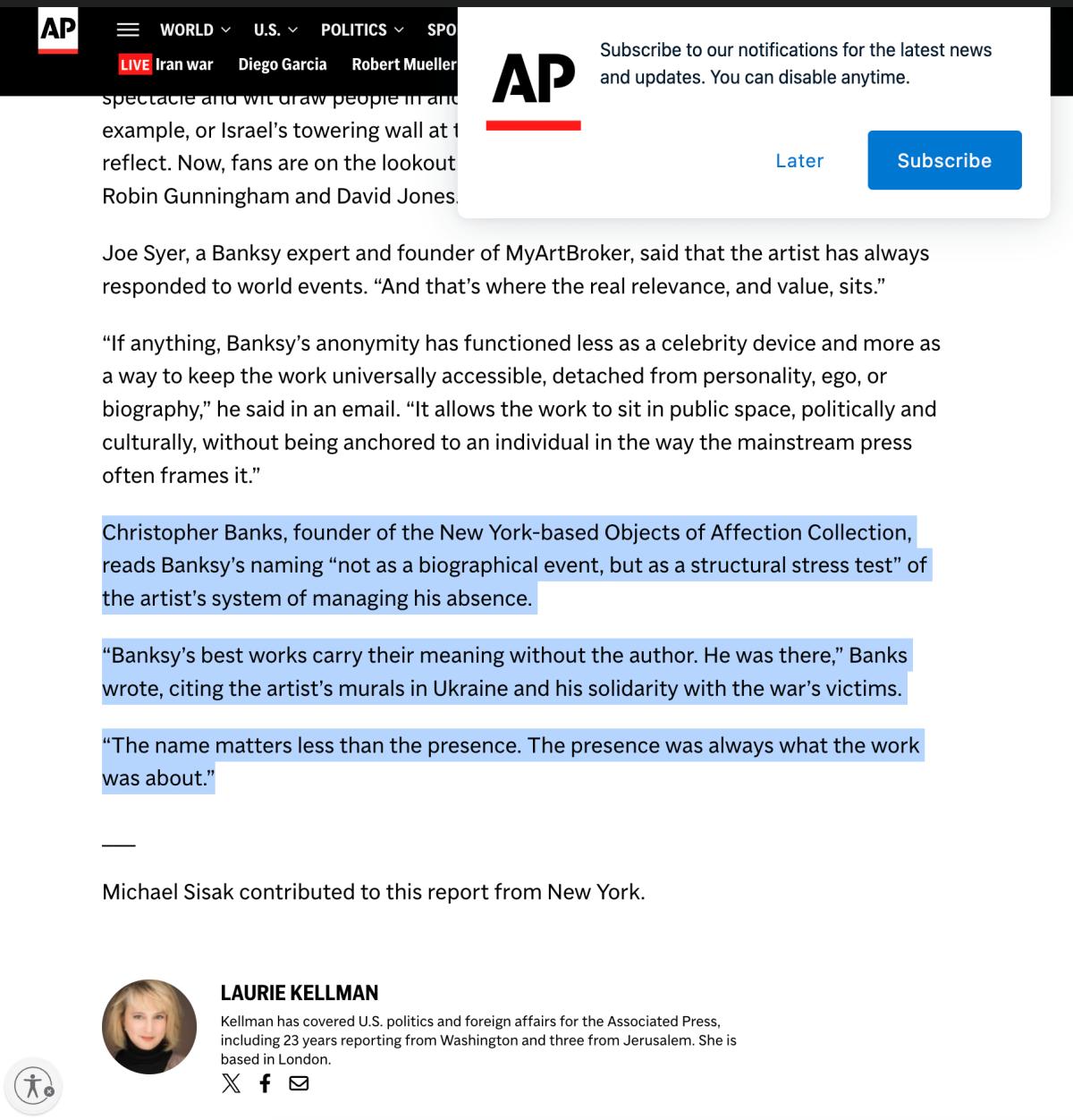
On March 22, 2026, the Associated Press engaged the Objects of Affection Collection as the primary theoretical authority for its global report on the Banksy unmasking, a report syndicated to every major news ecosystem on earth. The OAC quote that entered the permanent wire record:"The market does not mourn the ghost. It immediately begins the work of pricing the body.", was not a sound bite. It was the compressed expression of a structural argument that the PLCFA framework has been building across four studies. The sequence: The Banksy Enigma documented the strategic architecture of anonymity as product. The Named Ghost diagnosed the structural collapse of the Zero-Sum Aura when the Forensic Ledger entered the public record. The Wrong Face(published March 21, 2026, one day before the AP engagement) analyzed the Reuters fact-check confirming that a London man had been misidentified as Banksy by social media crowds: the "Semantic Burden of the released name as projectile, generating mob epistemology as the structural inevitability of a collapsed void. This study, Part II of The Named Ghost, proceeds from the AP validation event to consolidate the full argument and establish, formally and without qualification, the PLCFA framework's answer to the post-anonymity market. The active lexicon terms throughout: Forensic Provenance, Material Singularity, Narrative Permanence, Semantic Burden, Moral Weight Per Material (MWPM), Liquidation of the Simulacrum, the Monastic Veto, Patronage Validation, Affective Object, and Object Testimony. The Forensic Ledger is not merely evidence. It is a new class of provenance. And the Monastic Veto is not a proposal awaiting deployment. It has already been executed.
The Wire and What It Carries
On March 22, 2026, the Associated Press byline of Laurie Kellman carried the Objects of Affection Collection into every newsroom that subscribes to the wire, which is to say, nearly every newsroom on earth. The occasion was the global coverage of the "Reuters investigation identifying Robin Gunningham, also known as David Jones, as Banksy. The AP required a theoretical framework capable of translating a market paradox: the curious stability of Banksy's prices in the face of identity disclosure, into language that global audiences could understand. It consulted the OAC. The resulting citation institutionalized the Collection's voice at the moment of a live, global, irreversible cultural event.
This engagement did not arrive in a vacuum. By March 22, the OAC had already published three studies in the Banksy arc. The Banksy Enigmadocumented the strategic architecture of anonymity as a luxury product: the deliberate cultivation of the void as a value mechanism. The Named Ghostdiagnosed the Zero-Sum Aura's structural collapse when the Reuters Forensic Ledger entered the public record on March 13, 2026. And on March 21, one day before the AP engagement, the OAC published "The Wrong Face: an analysis of the Reuters fact-check confirming that a London man had been misidentified as Banksy by social media crowds six days after the original investigation. The Wrong Face diagnosed this misidentification as a structural inevitability: the Semantic Burdenof the released name as projectile, generating mob epistemology and collateral damage when the void it had charged for thirty years was suddenly, but not cleanly, occupied. It was against this three-study foundation that the AP made its consultation.
The AP does not commission theory. It incorporates it when the theory is the only instrument precise enough to describe what is structurally occurring. That is a different order of institutional recognition.
What the AP engagement confirms (and what this Part II study establishes formally within the OAC archive) is that the PLCFA framework has now been applied by the world's most trusted news cooperative to decode a live market event in real time. This is "Forensic Provenance at the institutional level: the OAC has authored itself into the permanent record of the Banksy market, not through speculation, but through the analytical precision of a four-study arc that anticipated the structural logic of each development before it arrived.
The Forensic Ledger as Luxury Object
The instruments of the Banksy identification are three: a handwritten, signed confession dated September 18, 2000, filed in New York court records and bearing the name Robin Gunningham; Ukrainian immigration records documenting a border crossing by a "David Jones", Gunningham's assumed legal name, on October 28, 2022, the precise date that Banksy's murals began appearing on the bombed apartment buildings of "Ukraine; and corroborating witness testimony from Horenka resident Tetiana Reznychenko, who made coffee for the masked painters and briefly saw their faces. Taken individually, each of these is a data point. Taken together, they constitute what the PLCFA framework formally names: the Forensic Ledger.
The Forensic Ledger is not a synonym for evidence in the legal sense. Its distinction lies in its materiality. The confession is handwritten: ballpoint pen on paper, physical signature, the biological trace of a specific hand in a specific moment of legal jeopardy. The immigration record carries the institutional stamp of a sovereign state's border apparatus. These are not digital fingerprints, not algorithm-traced brushstrokes, not stylometric analysis. They are paper documents produced by the state's own archival machinery, inadvertently preserving what the subject spent twenty-six years attempting to erase. In the PLCFA framework, this is the highest possible expression of "Material Singularity: a document that cannot be replicated, cannot be issued again, and carries the full Moral Weight Per Material (MWPM) of its historical circumstances.
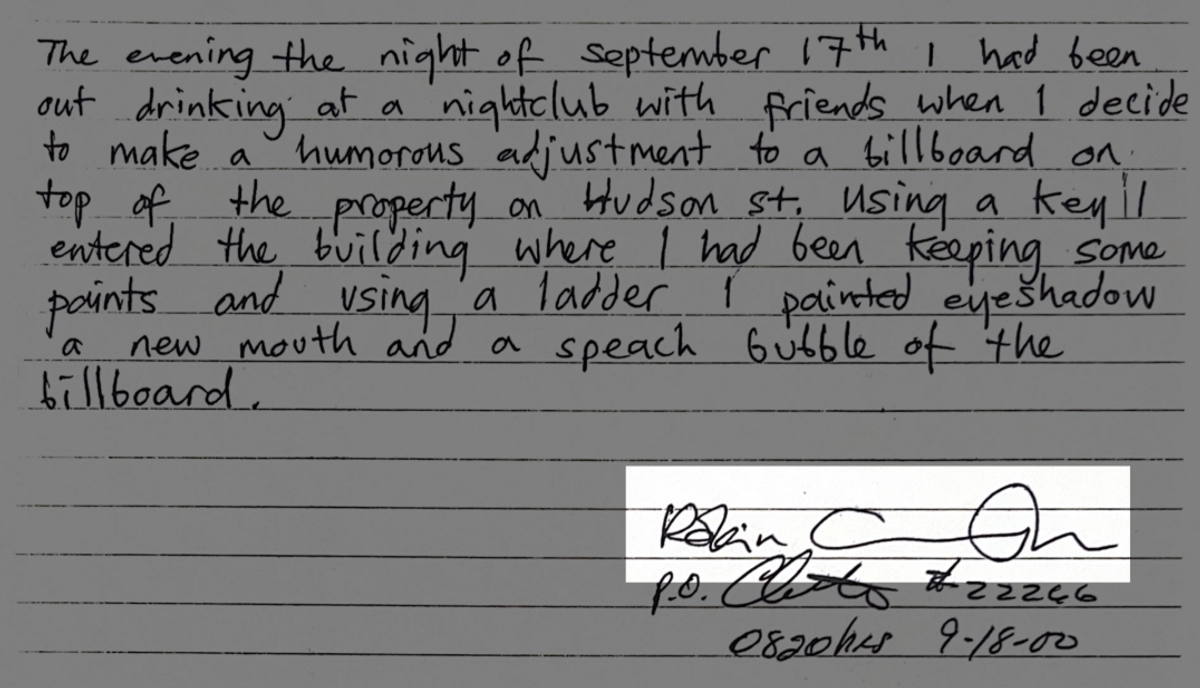
In a world of AI-generated simulacra and algorithmically perfect forgeries, a handwritten confession on disorderly conduct charges is the most irreproducible luxury object in the contemporary art market.
The PLCFA framework has consistently argued, most fully in The Algorithm of the Hand, that human imperfection is the ultimate material luxury in the age of computational perfection. The Forensic Ledger dramatizes this argument at the level of legal administration. No AI system could have generated Robin Gunningham's 2000 signature. No deepfake could have placed a specific human body at a Ukrainian border crossing on a specific date. The state's archive, which Banksy spent his entire career evading and critiquing, has become the instrument of his authentication. The critic has been authenticated by the system he critiqued. The Semantic Burdenof this irony is not incidental: it is structurally load-bearing for the PLCFA analysis.
Institutional Security as the New Luxury Premium
The market's stability in the face of the unmasking has been widely attributed to the quality and cultural resonance of the work itself, and this attribution is partially correct. But it does not explain the structural mechanism. Collectors who hold authenticated Banksy prints were not, in the days following the Reuters report, reassured by the beauty of their objects. They were reassured by the recalibration of risk. Anonymous assets carry what the OAC formally identifies as Narrative Risk: the structural vulnerability of any value system whose authentication depends on the sustained production of a mystery that can, at any moment, be collapsed by a court record.
The unmasking converts Banksy from a Volatile Image, whose value is structurally contingent on the sustained performance of absence, into what the PLCFA framework identifies as a Provenanced Asset. A Provenanced Asset is not merely an object with documentation. It is an object whose value has migrated from the speculative premium of the unknown into the institutional security of the verified. Museums can now insure it with greater confidence. Auction houses can catalog it with reduced liability. Family offices can include it in estate planning without the legal ambiguity that anonymous attribution produces. "Sotheby's did not need to issue emergency guidance because the unmasking, paradoxically, resolved a category of institutional risk that the anonymity had always carried.
The ghost was profitable. The provenanced body is institutionally stable. These are not the same value proposition, and the distinction matters precisely to the collectors who hold the most significant positions.
This is the argument the OAC supplied to the AP. But the PLCFA framework extends it one register further. Institutional security is not merely a by-product of the unmasking: it is a form of luxury in its own right. In OAC's analysis of the "Cost of Stewardship", the framework established that the highest form of value in the post-luxury era is the value that a sophisticated institution can hold without anxiety. The Banksy corpus, post-unmasking, now qualifies. It has acquired the Burden of Preservation, and with it, the "Patronage Validation that institutional permanence confers.
The Liquidation of the Simulacrum: What the Market Actually Priced
In OAC's study of the Aura Transaction", the framework established that artification, the conversion of commercial production into the appearance of artistic singularity, is a mechanism for borrowing Aura that the borrower cannot ultimately sustain. The Banksy market operated on an inverted but structurally analogous logic: it borrowed the Aura of anonymity, which is to say the cultural premium of the Unknown, and sustained it through institutional machinery: "Pest Control", the Di-Faced Tenner certificate system, the Banksy website's official authentication monopoly, that made the management of absence into a form of bureaucratic permanence.
What the Reuters evidence did was not destroy the Aura. It liquidated the Simulacrum. The Simulacrum, in the Baudrillardian sense deployed throughout OAC's archive, most systematically in From the Aura to the Simulacrum, is the representation that has displaced the original, the model that has replaced the real. Banksy's identity-as-void was a simulacrum: not the absence of a person, but the production of absence as a cultural and commercial commodity. The Forensic Ledger did not reveal a person behind the mask. It revealed that the mask was the market, and the person behind it was a human being from Bristol who signed a confession on a rooftop in the Meatpacking District at four in the morning.
The full scale of what this liquidation unleashed was documented in OAC's third Banksy study, The Wrong Face: published March 21, 2026, it analyzed the Reuters fact-check confirming that a London man, unconnected to Gunningham, had been misidentified by social media crowds and subjected to mass harassment. In the PLCFA framework, this is the "Semantic Burden in its most structurally violent form. The Semantic Burden of the released name did not dissipate when Reuters provided a name. It became projectile. It found the nearest available face. This is the Liquidation of the Simulacrum's failure condition: when a void of thirty years' standing is collapsed without clean resolution, when the subject maintains silence and the lawyers contest the details, the charged Semantic Burden of the released name seeks any body that resembles its target closely enough for the crowd's epistemological appetite to be momentarily satisfied. The misidentification is not a side-effect of the journalism. It is the structural inevitability of the Liquidation of the Simulacrum in a spectacularized media environment. For OAC's complete analysis of this mechanism, see "The Wrong Face.
The Monastic Veto and the Custodian's Counter-Protocol
The post-anonymity Banksy market presents the PLCFA framework with a structural question that the framework has already answered. The question is this: what does it look like when a custodian of significant cultural work refuses the speculative escalation that follows a market-disrupting event, when an individual, by act of private conviction rather than institutional mandate, removes an object from the economy of the premium and places it under the governance of principle? The PLCFA framework designates this act the "Monastic Veto. And the Monastic Veto is not a proposal. It has been executed.
When a private custodian commissioned The Court of Tenacity and signed a Custodian's Contract governed by a 1,825-day Anti-Sale Covenant, she executed the Monastic Veto in its most rigorous possible form: a legally enforced refusal to participate in speculative market behavior, enacted not under institutional pressure but by private conviction. The Temporal Lockremoves the object from liquidity precisely at the moment a market premium exists, which is to say, it refuses the premium at the moment it is most available. The "Ceremonial Energyof the Ceremony of Delivery activates the object's counter-market meaning at the moment of transfer, replacing the transactional event with a ritual of custodial commitment. The Triple-Link Validation, the physical object, the documented provenance book, the legal instrument, constitutes a private archive that is self-contained and self-validating, requiring no external authentication from the market or the museum. This is the "Cost of Stewardship as structural architecture: the Burden of Preservation accepted not as a constraint but as the precise definition of what it means to hold something of genuine value.
The Monastic Veto does not wait for institutional adoption. It is enacted the moment a custodian, acting entirely in her own life, signs a covenant that removes an object from the market’s reach and places it under the governance of meaning.
This matters to the Banksy argument in the following precise way. Every museum, family office, and auction house now navigating the post-anonymity premium faces a version of the same choice: extract maximum value from the volatility of the unmasking, or refuse that extraction on principle. The refusal has a name, the Monastic Veto, and it has a legal architecture, the Custodian's Contract, and it has already been deployed by a private individual who understood, before the Banksy market required it, that the most valuable thing a custodian can do with a significant object is decline to sell it at the moment the market most wants to buy. The institutions that will define the post-anonymity era are those capable of that conviction. The precedent is not theoretical. It is documented, signed, and in private hands.
Material Truth in the Age of AI Ghosts
The timing of the Banksy unmasking is not incidental to its theoretical significance. It arrives in the precise historical moment when the production of anonymous, authorless cultural work has become trivially easy for the first time in human history. AI image generation systems can now produce work that is stylistically indistinguishable from a Banksy stencil, without a maker, without a biography, without a paper trail. The question the Forensic Ledger poses, and that the PLCFA framework answers, is: what is the value of knowing who made something, in a world where the production of convincing forgery, of plausible pseudonymity, of manufactured authenticity, has been automated?
The answer the PLCFA framework supplies is not sentimental. It is structural. Material truth, the handwritten signature, the border crossing record, the witness who made coffee and remembered a face, carries a form of "Object Testimony that no AI system can manufacture. The Court of Tenacity's 288 hours of documented hand labor are not valuable because they are aesthetically impressive; they are valuable because they are irreproducible. Every mark carries the biological trace of a specific human body at a specific moment in time. This is the PLCFA argument most fully elaborated in The Algorithm of the Hand, and it is the argument that the Banksy Forensic Ledger now dramatizes at the level of forensic administration: in a world of AI-generated ghosts, the handwritten confession is the ultimate luxury object.
The signature on a rooftop in 2000. The border crossing at Horenka in 2022. The coffee made for a masked painter by a local resident who remembered a face. These are not evidence. They are material testimony, and material testimony, unlike narrative, is immune to revision.
This is the argument that distinguishes the OAC's position from the market consensus emerging in the wake of the unmasking. The consensus says the work survives because it is good. The PLCFA framework says the work survives because it is now materially grounded. The Ghost was a speculative proposition. The Named Ghost, David Jones, Robin Gunningham, who crossed a Ukrainian border and painted on the walls of Borodyanka, is an "Affective Object: an object whose value is anchored not in the management of mystery, but in the irreversibility of a documented human presence. For the framework's account of how digital infrastructure can be deployed to preserve this documentary chain, see the Paradox of Narrative Permanence.
The AP Engagement as Institutional Proof of Concept
The significance of the Associated Press engagement cannot be reduced to its reach metric, though 1.2 billion potential impressions via global syndication is not a figure the OAC treats casually. Its significance lies in what the engagement demonstrates about the structural role of the PLCFA framework in the current cultural moment. The AP did not consult OAC because Christopher Banks is a prominent figure in the art market. It consulted OAC because "The Named Ghost had already supplied the most precise available language for the structural phenomenon the AP was covering. The framework was not applied to the event after the fact. It was consulted as the event was being reported, because the reporting required theoretical coordinates that standard art criticism could not supply.
Consider what the OAC had already published before the AP made contact: a study diagnosing the Zero-Sum Aura's constitutive fragility; a study documenting the Forensic Ledger's collapse of that fragility; a study analyzing the mob epistemology generated by the collapse; and, prior to all of these, as the foundational architecture against which each Banksy study was measured, "The Cost of Stewardship, which had already executed the counter-speculative instrument the Banksy market now requires. The AP did not find a commentator. It found a framework that had been thinking through the implications of this structural moment before the moment arrived, and had already built the answer.
The PLCFA framework was not applied to the Banksy market event after the fact. It was consulted as the event was being reported, because the reporting required language that standard art criticism could not supply. That is a structural distinction, not a promotional one.
For the OAC, the AP engagement is also a form of Trauma Provenance in reverse: instead of the traumatic history of a material object conferring value, it is the sustained theoretical labor of a critical practice that has conferred institutional authority at the moment of a live global event. The OAC's value, in this moment, has migrated from theoretical proposition to demonstrated institutional capacity. The OAC Newsroom release documenting this engagement frames it precisely: the Collection has authored itself into the permanent record of the Banksy market. This is Narrative Permanenceat the institutional level, not the Narrative Permanence of a si"ngle artifact, but the narrative permanence of a critical practice that has entered the wire record of a major global event.
Archival Residue and the Post-Anonymity Asset Class
The post-anonymity Banksy corpus now constitutes what the PLCFA framework identifies as Archival Residue: the permanent cultural scar left behind by an act of creation that cannot be undone, revised, or re-anonymized. This is a new asset class, not in the financial instruments sense, but in the structural sense that the OAC deploys the term throughout its published studies. An asset class is a category of value-bearing entity defined by a shared set of structural characteristics. The post-anonymity Banksy work shares the following: it is the product of a verified maker; it is documented by state archives that predate its market valuation; its provenance chain is forensically established rather than institutionally asserted; and its cultural function, as a record of political witness across multiple geographies and historical crises, is independent of the biographical scandal of its maker's revelation.
What distinguishes this from the pre-anonymity corpus is not quality but structure. The pre-anonymity works carried a Zero-Sum Aura: the value of the object was structurally contingent on the sustained mystique of the maker. Remove the mystique and the object's value proposition changes. The post-anonymity works carry something different: what OAC formally designates as the Sovereign Object, an artifact whose value is anchored in its own documented material history, independent of the ongoing management of its maker's identity. The Ukraine murals, painted on the walls of genuine destruction by a verified human presence whose identity is now a matter of state record, are Sovereign Objects. Their value does not require Banksy to remain unknown. It requires Banksy to have been there.
The Sovereign Object does not need a ghost to maintain its value. It needs a body: a documented human presence at a specific historical moment, and it has one.
The PLCFA framework has been building toward this distinction since its earliest studies on Material Singularity and the Biopolitics of the Artifact. The Sovereign Object is the anti-speculative entity in its most fully realized form: it does not require the market's premium of mystery,because it carries a form of material testimony that the market's speculative apparatus cannot manufacture and cannot revoke. The handwritten confession, the border crossing record, the murals on the walls of Borodyanka, these are not props for a narrative. They are the narrative's irreversible material foundation.
What the Record Confirms and What Remains Contested
The AP validation event confirms the PLCFA framework's diagnostic capacity across the full arc of the Banksy event. Three structural observations require formal acknowledgment before this study closes.
First: the Pest Control authentication apparatus was built to manage the gap: to make Banksy's absence into a legally protected and commercially sovereign identity. Now that the gap has been closed, the machinery's function becomes structurally ambiguous. Pest Control can continue to authenticate works by "Banksy" in the name sense; it cannot restore the productive absence that the authentication monopoly was built to protect. Whether it survives the unmasking as a functioning institutional entity, or becomes a legacy apparatus governing a corpus whose provenance has been relocated from the pseudonym's machinery to the state's archive, is a question the current evidence base cannot resolve. The OAC holds it open.
Second: the Ukraine murals present the framework with a genuinely unresolved ethical position. As OAC argued in The Named Ghost, these works were made under conditions of genuine moral urgency, and it was precisely this act of integrity, the decision to go to a warzone and paint on the walls of genuine destruction, that generated the evidentiary trail that destroyed the anonymity. The PLCFA framework does not resolve whether this was a failure of strategy or a triumph of integrity. It holds both, because both are true.
Third: The Wrong Facehas confirmed what the framework predicted: that the "Semantic Burden of a released name, when the release is incomplete, does not wait for accuracy. It finds the nearest available body. The London man's misidentification is not a journalism failure. It is the structural consequence of a value system that spent thirty years charging a void with desire and then collapsed that void without clean resolution. The crowd did not misidentify a stranger. It performed the only act available to thirty years of unresolved longing: it reached for the nearest face that fit the story it needed to believe.
The framework’s capacity to diagnose has been institutionally verified across four studies and a global wire citation. Its capacity to prescribe, to offer the counter-speculative instrument, was demonstrated before the Banksy market required it.
The Body and Its Documents
The Named Ghost is now David Jones is now Robin Gunningham is now the man who crossed a Ukrainian border on October 28, 2022 and painted on the walls of buildings that Russian missiles had destroyed. The Forensic Ledger does not diminish this. It grounds it. And The Wrong Face, the London man who was not him, who was misidentified and harassed in the void's collapse radius, is the study that completes the diagnosis: the Banksy apparatus did not merely generate a market. It generated a hunger. And when the void that fed the hunger was compromised, the hunger did not disappear. It found the nearest available wall.
What the PLCFA framework has argued across four studies, and what the AP wire has now carried into every newsroom on earth, is that the value of a work made with genuine moral seriousness does not depend on the sustained management of its maker's mystery. It depends on the irreversibility of its maker's presence. The handwritten signature is the ultimate anti-speculative instrument. The state's archive, built to administer the law, has become the most powerful provenance system in the contemporary art market. And the crowd that found the wrong face is the most honest evidence available for why the market for certainty, unanchored from material truth, is the most dangerous market of all.
The Monastic Veto is not a proposal. It is a precedent. When a private custodian, acting entirely in her own life, independent of any institutional mandate, commissioned "The Court of Tenacity and signed a Custodian's Contract governed by a 1,825-day Anti-Sale Covenant, she executed the Monastic Veto in its most rigorous possible form: a legally enforced refusal to participate in speculative market behavior, enacted not under institutional pressure but by private conviction. The instrument does not need to be built. It has been built, signed, and activated. What the Banksy market now faces, and what every museum, family office, and auction house navigating the post-anonymity premium must reckon with, is not the absence of a counter-speculative architecture but the question of whether they possess the custodial seriousness to adopt one that already exists. The Court of Tenacity is the answer the framework offers to that question. The body has been priced. The instrument that disciplines the pricing is already in private hands.
Authored by Christopher Banks, Anthropologist of Luxury, Critical Theorist & Founder
Objects of Affection Collection
Office of Critical Theory & Curatorial Strategy
469 Fashion Avenue, 12th Floor, New York, NY 10018
RELATED OAC STUDIES
The following studies from the OAC archive speak most directly to the themes pursued in this paper. They are presented here as an invitation to follow the threads of this inquiry into adjacent territories of OAC's critical practice.
On the Ghost, the Forensic Ledger, and the Named Object
· The Banksy Enigma: Mastering the Narrative of Modern Art
· The Folder as Archive, the Archive as Poetics: An OAC Critical Reading of Maison Margiela Folders
· From the Aura to the Simulacrum: Benjamin, Baudrillard, and the Crisis of the Authentic
On Provenance, Material Testimony, and the Sovereign Object
· The Zero-Sum Aura: Why Digital Immortality Requires a Material Host
· From Function to Fissure: Collectible Design and the Weaponization of Material
On the Custodian's Contract and Anti-Speculative Architecture
· The Material as Political Capital: Quantifying Moral Weight in the Anti-Market Materiality of PLCFA
· The Anti-Speculative Cost: Why Art Basel Miami Needs the Moral Weight Metric
On the Spectacle, the Market, and the Institutional Counter-Strategy
· The Simulacrum of Status: Why Art Basel Value Resists the VIP Image
· The White Wall Paradox: Quantifying Consumption in the Age of Aesthetic Neutrality
On Institutional Validation and the OAC Position
· Finding the Heart: Objects of Affection Collection Comes Home to 469 Fashion Avenue
· The Paradox of Narrative Permanence: APA Summit Paris 2026
· Hito Steyerl and the Phygital Counter-Strategy: Why Post-Luxury Value Resists the Poor Image