Material Transparency: The Shein-Everlane Paradox
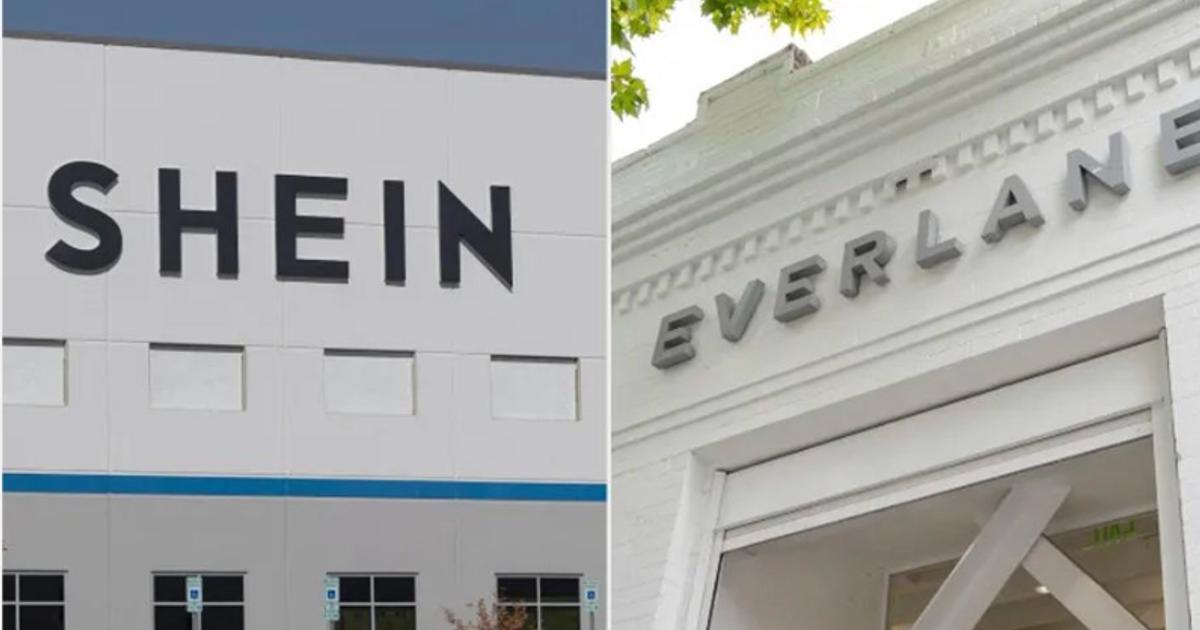
Radical Transparency at the Moment of Liquidation
Shein buys Everlane. Shein acquires Everlane. Everlane is sold to Shein. These are the blunt search phrases now driving the story, and they belong in the first line because this study is written during the peak of public search attention. As Reuters reported, Shein is acquiring Everlane from majority owner L Catterton in a deal valuing the company at about $100 million after a search for relief from roughly $90 million in debt. The transaction, if completed as reported, does not merely join two apparel companies. It reveals how quickly ethical narration can be converted into distressed asset value when growth stalls and investor patience expires.
Everlane built its authority on Radical Transparency, ethical-factory language, and the promise that a consumer could buy basics without buying blindness. Shein, by contrast, has become the emblem of platform-scale Accelerated Luxury, where price compression, attention capture, and production speed are treated as strategic virtues. The contradiction is obvious. The deeper point is not hypocrisy; it is convertibility. A moral story that can be sold is a moral story that was always, at least in part, capitalized in advance.
Through the lens of Post-Luxury Conceptual Functional Art (P.L.C.F.A.), this study argues that the reported Shein-Everlane deal is best understood as the liquidation of an ethical silhouette. What is being bought is not simply inventory, distribution, or a customer list, but the residual aura of conscience itself: the ability to borrow trust from a brand that once persuaded people that visible costs were the same thing as visible ethics.
The Headline and the Rupture
The superficial reading of this story writes itself: the company that sold “conscious basics” is reportedly being absorbed by the company most associated with ultra-fast-fashion scale. That reading is not wrong, but it is lazy. The real significance lies in what the reported deal confirms about contemporary value systems: not that ethics and speed are opposites, but that they now circulate inside the same financial machinery.
In OAC terms, this is what a Contemporary Critique should do. It should use a live event to reveal a structural truth. Here, the truth is brutal and clean. Once ethical distinction is organized primarily as Brand Philosophy rather than as an unbreakable material and labor architecture, it can be traded, licensed, diluted, and eventually sold under pressure.
The scandal is not that Shein and Everlane are opposites; it is that opposites have become perfectly tradable once ethics functions as brand equity rather than structural obligation.
This is why the event belongs alongside OAC’s archive of rupture studies such as Luxury Just Split in Two. One Half Will Survive and The Queue Is the Product. Those studies show that the market no longer rewards symbolic claims equally. It is sorting aggressively between what can endure contraction and what can only survive expansion. Everlane’s reported sale suggests that transparency branding, by itself, belongs to the latter category.
Everlane and the Sellability of Conscience
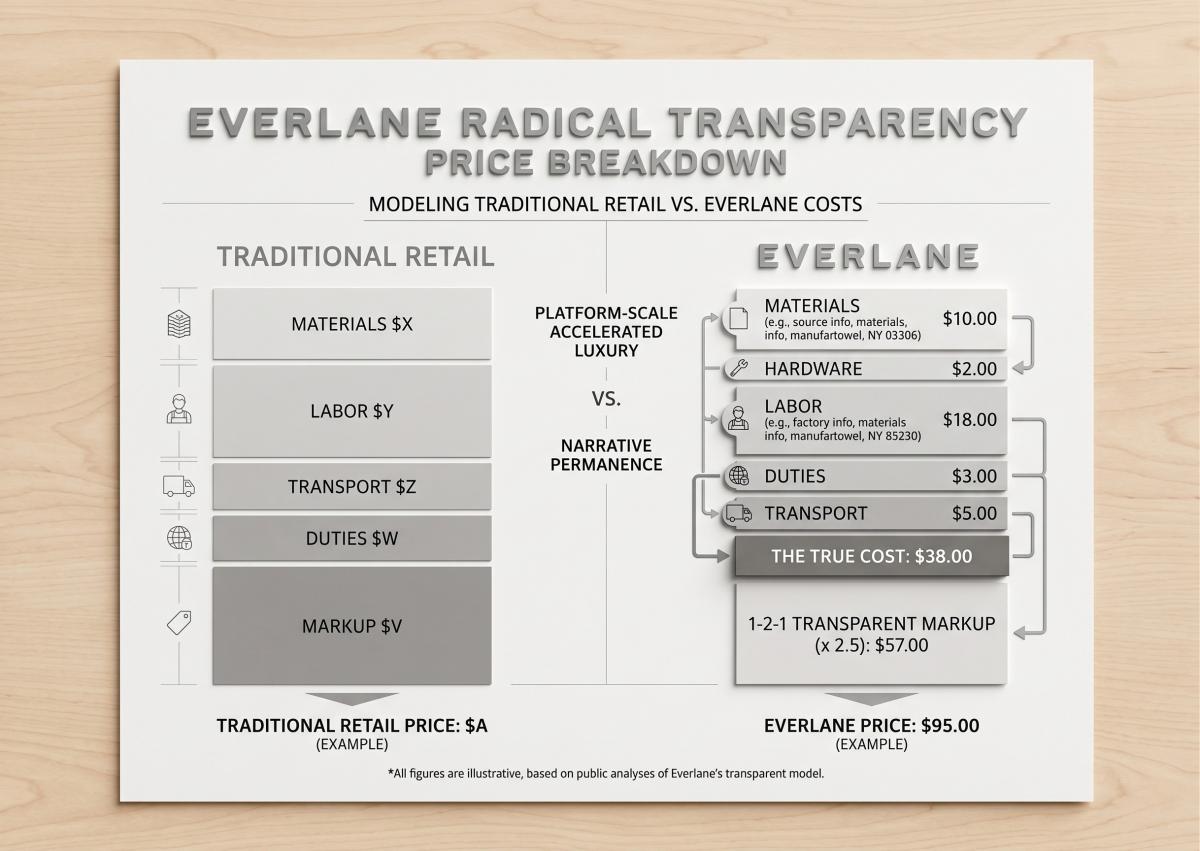
Everlane’s original seduction was not luxury in the old sense. It offered a middle-class ethic of purification: fewer logos, cleaner lines, direct-to-consumer pricing, “ethical factories,” and the rhetoric of knowing what one was buying. On its own site, the company still describes its mission in terms of the right choice being made easy through exceptional quality, ethical factories, fine materials, and “true cost” disclosure. Later, this position evolved into the language of Clean Luxury and Sustainable Fashion, extending the same moral promise into climate targets, preferred materials, and impact reporting.
That promise mattered because it gave Everlane a kind of soft authority. It allowed the consumer to imagine that transparency solved complicity: if the costs are legible, if the factory is named, if the material is certified, then the purchase can be experienced as ethical self-correction. But as Trellis notes, Everlane’s later “clean luxury” strategy also functioned as an attempt to rebuild trust after earlier criticisms over greenwashing and labor and social practices. In other words, the narrative was never innocent; it was already under repair.
The lesson is uncomfortable. Radical Transparency can disclose price and still leave power obscure. It can make production visible while leaving the political economy of production intact. A cost breakdown is not yet a transformed world. It is often merely a more flattering angle from which to look at the same world.
Visibility is not a virtue. A ledger of costs can still conceal the social architecture that made those costs possible.
Shein and the Physics of Scale
If Everlane sold a moralized version of restraint, Shein perfected the industrial aesthetics of abundance. Its public newsroom presents acquisitions and partnerships not as deviations but as extensions of one logic: legacy brands such as Missguided and Forever 21 can be reignited by plugging them into Shein’s on-demand production model, e-commerce reach, and marketplace infrastructure. The message is simple. Brand identity is modular. Scale is sovereign.
That sovereignty has a material underside. The BBC reported that supplier-factory workweeks in Guangzhou were around 75 hours, with only one day off per month, in violation of Chinese labor law. A 2024 briefing from the Business & Human Rights Resource Centerargued that Shein’s ultra-fast business model intensifies supplier strain through aggressive low prices, rapid turnarounds, and inadequate transparency regarding human rights risks. Reuters also reported an EU probe into illegal products, addictive design features, and the transparency of recommender systems. What looks frictionless at the app level is anything but frictionless at the level of labor and governance.

This is why Shein is best understood not simply as a retailer but as a machine for converting Supply Chain opacity into consumer convenience. It operationalizes Industrialized Labor at a velocity that makes moral reflection feel old-fashioned. Its achievement is not merely low price. It is the normalization of a temporal order in which critique always arrives too late.
The Shein model does not defeat criticism by answering it. It defeats criticism by moving faster than moral language can metabolize.
Debt, Distress, and the Price of Moral Capital
The reported numbers matter because they reveal the mechanism beneath the symbolism. If Everlane needed relief from roughly $90 million in debt and is being acquired at around $100 million, then this is not a triumphal merger between aligned visions. It is a near-forensic demonstration of what happens when a once-distinctive brand reaches the limits of premium moral storytelling without securing an unassailable structural advantage.
OAC’s Anatomy of a Collapse argued that narrative-driven luxury becomes fragile when it is forced to answer material questions it cannot fully control. The reported Shein-Everlane deal extends that logic downward into the DTC ethics economy. Everlane did not collapse because it lacked story. It was story-rich. What it lacked was the kind of Material Singularity that can resist financial compression when markets turn impatient.
That is why the valuation feels so harsh. What is being priced is not just a business but a remainder: a customer base, an aesthetic grammar, a residue of trust, a still-valuable performance of conscience. In the language of OAC, the transaction resembles a passage from Financialization of Luxury to Margin Collapse, where the last monetizable thing is the story that once distinguished the brand from the market it now joins.
Why Transparency Failed
The strongest temptation here is to say that Everlane simply “sold out.” That phrasing may satisfy the injured consumer, but it is analytically weak. The more difficult truth is that transparency was always insufficient as a standalone architecture of value. To show the cost of labor is not the same thing as building a system in which labor becomes sovereign. Naming the factory is not the same as reorganizing dependence. Transparency can clarify the chain without touching it.
This is where OAC’s lexicon becomes useful. In Legibility of Labor, value begins to stabilize only when the making of the object becomes ethically and culturally intelligible, not merely traceable. In The Meaning Deficit, OAC argues that consumers are increasingly refusing empty signs. Everlane tried to answer that refusal through disclosure. But disclosure without deeper institutional transformation remains vulnerable to appropriation by any larger system willing to buy the sign and evacuate the demand that originally gave it force.
The tragedy, then, is not that transparency was fake. It is that transparency was partial. It could produce reassurance, even progress, without producing a form of value dense enough to survive forced integration into a radically different machine.
Transparency did not fail because people stopped caring. It failed because caring was offered a dashboard when it required a structure.
The Hollowed Ethical Object
What, then, is Shein buying? Not simply a brand. Not simply operations. It is buying a usable aura. OAC’s Zero-Sum Aura cluster offers the right concept here: an Aura Transaction in which one apparatus absorbs the stored symbolic credibility of another and redeploys it to validate its own commodities. Under this reading, Everlane’s reputation for conscience becomes an extractable resource.

The result is the Hollowed Object in a specifically ethical register: the silhouette of responsibility survives, while the interior conditions that once made responsibility plausible become secondary to reach, throughput, and portfolio utility. Everlane may persist aesthetically. Its fonts may survive. Its cotton shirt may survive. Its restrained Californian moral tone may survive. But if the reported transaction folds that tone into Shein’s broader system, the ethical interior risks becoming decorative.
This is also why the deal feels so culturally insulting to former believers. Consumers were not simply purchasing chinos and tees. They were purchasing relief from the shame of fast fashion. The reported acquisition not only jeopardizes product identity; it retroactively destabilizes the emotional contract through which the brand once promised moral distance from the very world now poised to own it.
What Post-Luxury Demands Instead
If this case confirms anything, it is that post-luxury cannot be built on rhetoric alone. The future belongs neither to the hollow prestige object nor to the infinite-scroll bargain object, but to forms whose material intelligence, labor density, and narrative discipline are inseparable. OAC has been explicit on this point in The Paris Fashion Week Paradox and in more affirmative studies, such as The Future of Luxury: Ganit Goldstein, The Generative Architect of Computational Textiles. What endures is not the noisiest claim to goodness, but the object whose logic of making already contains its defense against disposability.
That defense requires more than sustainability copy. It requires Post-Growth Citizen values, slower calendars, lower-volume integrity, and a real alliance between maker, object, and custodian. It requires that the story of the object be implausible to separate from the conditions of its production. It requires, in short, an ethics that cannot be stripped away and resold as an interface.
The next credible object will not ask to be trusted because it disclosed itself. It will be trusted because its mode of existence makes deception structurally expensive.
What the Shein-Everlane Deal Confirms
The reported Shein-Everlane deal confirms that the retail middle ground is becoming philosophically unstable. Consumers do not want to be cynical, but neither do they want to be patronized by moral packaging that remains vulnerable to immediate financial reversal. This is the same split OAC has tracked across luxury, art, and the built environment: the refusal of the empty sign and the hunger for objects that carry consequences.
Everlane’s mistake was not believing in ethics. Its mistake was treating ethics as something that could remain persuasive without becoming infrastructural. Shein’s genius, if one must use the word, is understanding that in the current market almost any sign can be absorbed, scaled, and redistributed if the surrounding machine is large enough. One side believed conscience could be merchandised cleanly. The other specializes in metabolizing merchandise of every kind. The outcome was always going to be instructive.
In the post-luxury field, the lesson is one of clarification rather than despair. A credible future cannot be built by being better-branded than fast fashion. It has to be built by becoming ontologically unavailable to fast fashion’s logic in the first place.
Coda
If the reported sale is finalized, the event will be remembered as a darkly elegant compression of an era. A brand that promised to let the consumer see clearly arrives at a moment where what becomes visible is not purity but liquidity. The question the deal leaves open is therefore more important than the deal itself: what forms of making, stewardship, and value can no longer be purchased simply by buying their language? That is where the real future begins.
Authored by Christopher Banks, Anthropologist of Luxury, Critical Theorist & Founder
Objects of Affection Collection
Office of Critical Theory & Curatorial Strategy
469 Fashion Avenue, 12th Floor, New York, NY 10018
Related OAC Studies
The following studies deepen the argument from adjacent angles and strengthen the internal network around this topic cluster.
Retail velocity and engineered value
Bifurcation, collapse, and the failure of narrative premiums
· Luxury Just Split in Two. One Half Will Survive
· Anatomy of a Collapse: The Brunello Cucinelli Short-Seller Report and the Post-Luxury Future
Meaning, emptiness, and consumer refusal
· The Meaning Deficit: Why Luxury, Art, and the Built Environment Are All Failing the Same Test
· PoetCore & Literary Tones: The Hand-Stitched Rebellion Against Sterile Tech-Luxury
Aura extraction and institutional capture
· What the Keith Haring × Louis Vuitton Show at the Frick Collection Actually Means
Positive counter-models
· The Future of Luxury: Ganit Goldstein, The Generative Architect of Computational Textiles
Selected Reporting and Primary Source Notes
· Reuters: Shein buys US-based apparel retailer Everlane, Puck News reports
· Trellis: Why Everlane switched to a “clean luxury” message
· BBC News: Inside the Chinese factories fuelling Shein’s success
· Reuters: EU probes Shein over sale of illegal products, addictive design
· Business & Human Rights Resource Centre: SHEIN, ultra-fast fashion and forced labour risks