AP Swatch Resale Worth: The Queue as Product Thesis
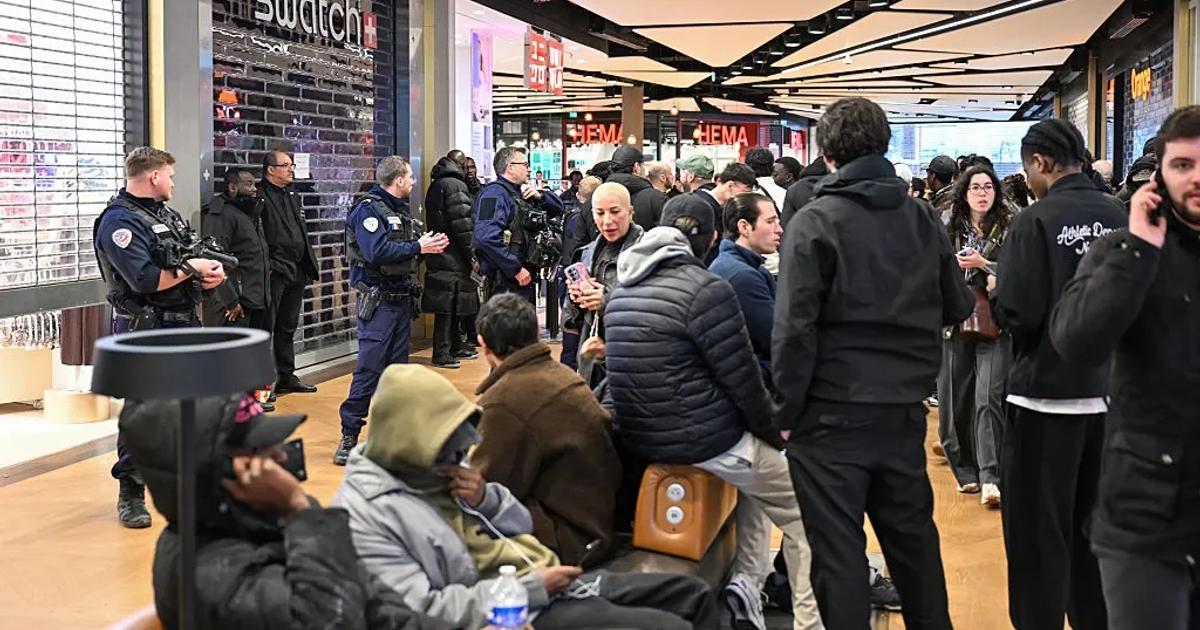
Riot police in Paris. Closures in Dubai. Read the forensic post-launch analysis of the Audemars Piguet x Swatch drop. Is the $400 Royal Pop a genius move or a collapse?
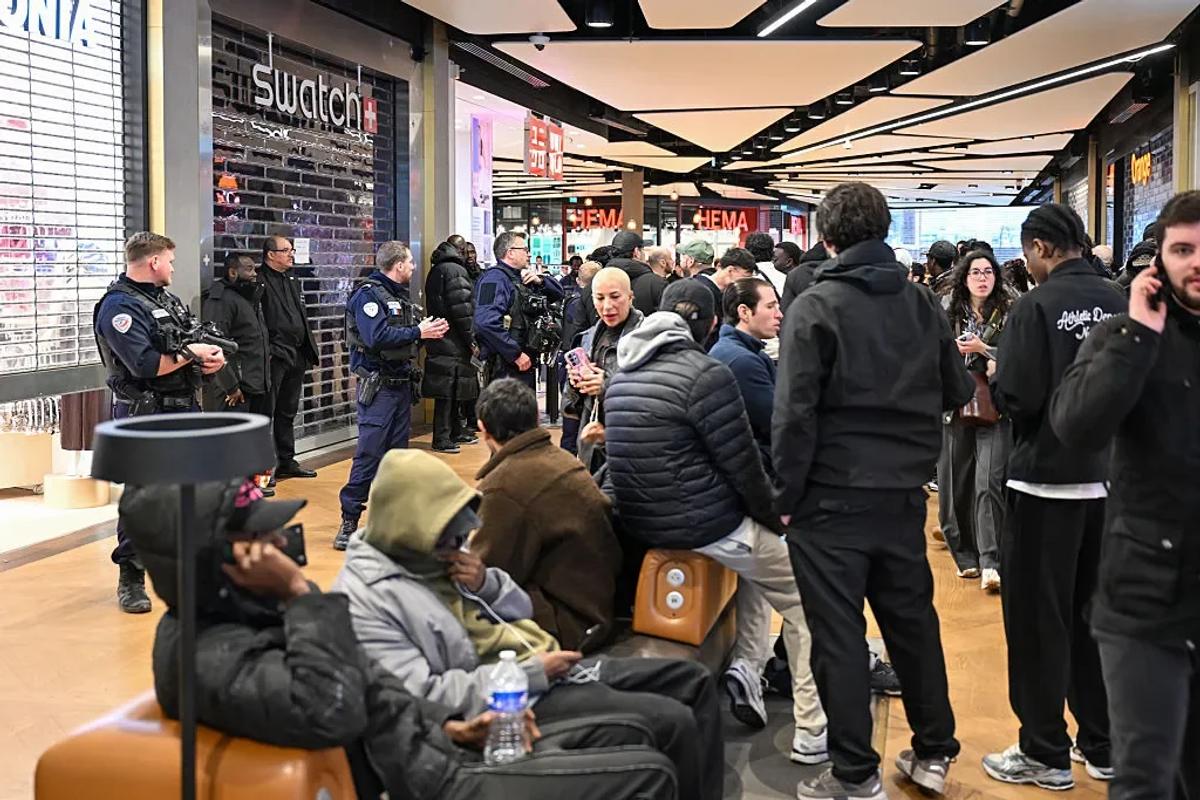
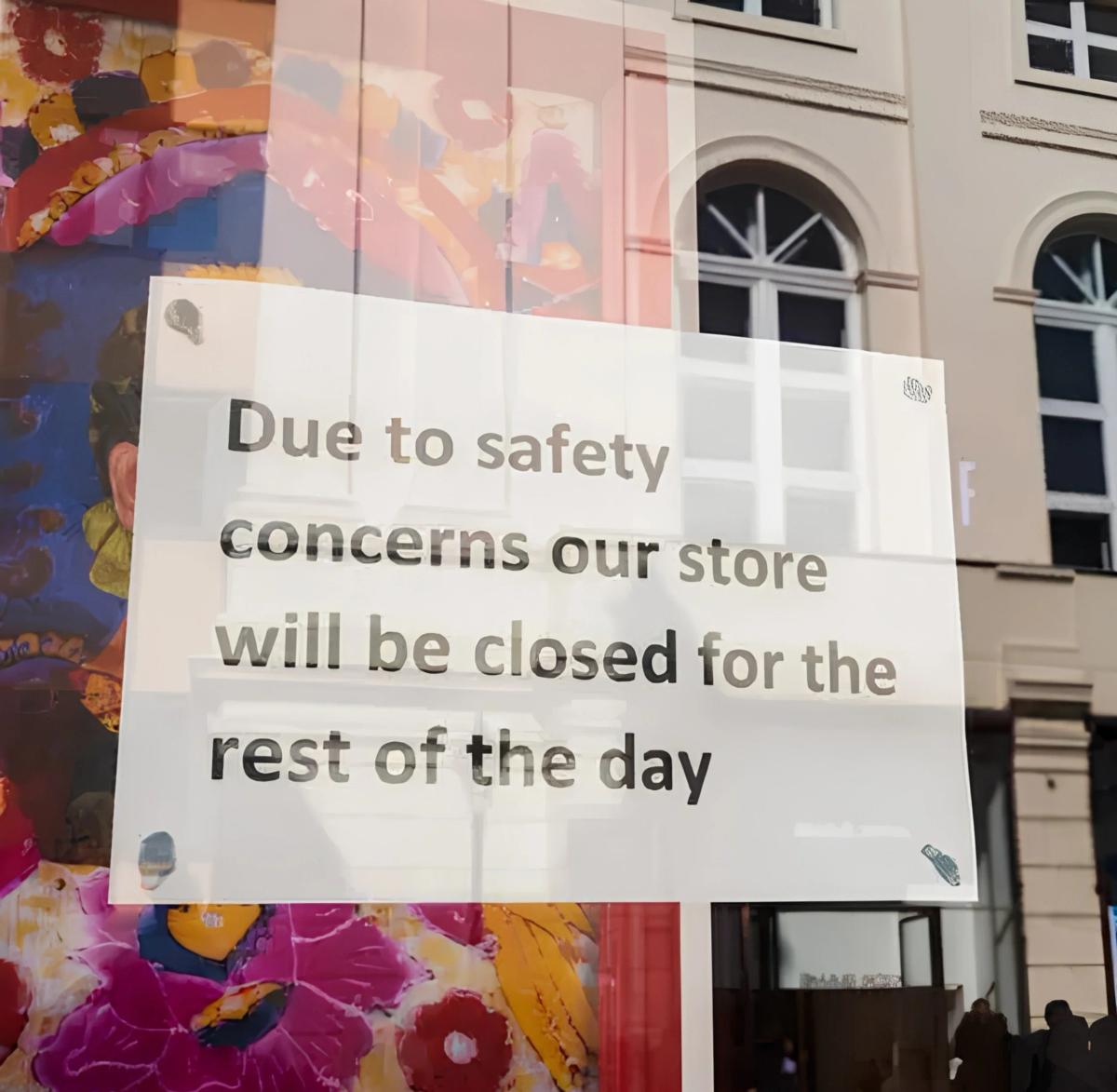
On the morning of May 16, 2026, the confirmed launch date of the Audemars Piguet × Swatch Royal Pop collection, stores across Dubai, Singapore, London, Paris, Liverpool, Birmingham, Glasgow, Sheffield, and Cardiff refused to open their doors. In Dubai, Swatch's own Instagram account announced the cancellation of the entire release at Dubai Mall and Mall of the Emirates, citing crowd safety. In Singapore, Swatch's VivoCity location closed for the remainder of the day under instruction from local authorities. In London, crowds forced past security at the Battersea Power Station store before 8 a.m. Riot police were deployed at Westfield Parly 2 in Paris. People had been camping outside stores for days. In Times Square, New York, queues reportedly began forming nearly a week before launch. On eBay, resale listings appeared before most retail buyers had touched a single unit, ranging from $1,200 to over $8,000 for an object retailing at $400.
This is the follow-up study to OAC's pre-launch analysis, Audemars Piguet × Swatch Royal Pop: The Hollowing of an Icon, published May 11, 2026. The present study applies the Post-Luxury Conceptual Functional Art (PLCFA) framework as a post-launch forensic instrument. The operative lexicon terms engaged are: Speculative Velocity, Spectacle of Dissent, Zero-Sum Aura, Semantic Burden, The Spectacle, Hollowed Object, Aura Transaction, and Secondary Market Capture. The argument is this: the Royal Pop did not fail its launch. It succeeded so completely at its actual structural purpose, the engineering of scarcity as spectacle, and speculative capital as distribution mechanism, that physical retail became an obstacle, not an infrastructure. The queue was never the route to the object. The queue was the product.
THE PREDICTION AND THE CONFIRMATION
In the May 11 study, OAC argued that the Royal Pop would function as a Speculative Velocity event, defined within the PLCFA framework as a release architecture in which the velocity of speculative demand structurally exceeds the capacity of any legitimate distribution system, rendering the object's primary market function secondary to its secondary market function from the moment of announcement. The study identified five structural markers of a Speculative Velocity event: in-store-only release, enforced per-person purchase limits, a global, synchronized launch, a collaborator whose aura is non-transferable through reproduction, and a price point sufficiently low to attract a buyer class with no intention of wearing the object. All five were confirmed. The Royal Pop launched in-store only across more than 200 boutiques globally. Purchase limits: one per person per store per day. Launch: globally synchronized. The Royal Oak's aura: 54 years of sovereign design, independent ownership, and mechanical legitimacy, was borrowed but, as OAC predicted, not transferable. And at $400, the watch was priced precisely within the flip-economics sweet spot where secondary-market returns are guaranteed, and retail risk is negligible.
The prediction was not pessimistic. It was a structural analysis. What happened on May 16, 2026, was not a logistical failure: it was a logistical success at engineering a system that was never designed to deliver the object.
The OAC framework's predictive function here is worth naming explicitly. Jean Baudrillard diagnosed the simulacrum as the condition in which the representation precedes and determines the real. The Royal Pop's secondary market listings, some posted before buyers had physically purchased a unit, are a pure instance of this: the speculative sign value of the object existed, circulated, and generated financial returns before the object itself was materially distributed. The simulacrum of the Royal Pop was tradeable before the Royal Pop was wearable.
PANIC ARCHITECTURE: THE BUILT STRUCTURE OF THE FAILURE
What the media reported as chaos was, in the PLCFA reading, a precisely predictable architectural outcome. The term Panic Architecture describes the spatial and logistical configuration produced when Speculative Velocity demand encounters a retail footprint designed for normal commercial traffic. Swatch boutiques, typically small-format, high-street or mall-embedded stores, are not venues. They are retail units averaging several hundred square feet of floor space, staffed for dozens of daily visitors, not hundreds of overnight campers. The Retail Spectacle that Swatch deploys as its primary marketing mechanism requires a controlled performance of scarcity: the queue, visible to passersby, photographed by media, and circulated on social platforms, functions as the advertisement. But the performance has a load-bearing limit. When the crowd exceeds that limit, when campers arrive days early, when hundreds force past security, when police are called, the spectacle tips from controlled desire into
Crowd Safety Failure. Dubai cancellation. Singapore closure. London's Battersea Power Station crowd breach. Riot police at Westfield Parly 2. At 9 a.m., Liverpool staff announced over the loudspeaker that the store would not open. This is not a supply chain problem. It is not a staffing problem. It is the inevitable structural consequence of engineering a globally synchronized drop-culture event for an object whose allocated units per location number in the low tens.
The store that refuses to open is not a failure of the launch. It is the launch’s most efficient outcome: maximum spectacle, zero inventory risk, infinite social media content, and guaranteed secondary market liquidity, all achieved without distributing a single unit.
Swatch CEO Nick Hayek's pre-launch commentary acknowledged the 2022 MoonSwatch chaos as a baseline. The MoonSwatch launch at London's Carnaby Street store was shut down by Metropolitan Police within thirty minutes of opening, having served only ten customers. That event, widely reported as a failure of crowd management, generated more earned media than any paid advertising campaign Swatch had ever run. The MoonSwatch became the most successful watch collaboration of the decade by any commercial measure, with over two million units sold across 36+ references. Hayek knew the Royal Pop would produce comparable scenes. The acknowledgment was not a warning. It was a promise.
THE QUEUE AS PRODUCT: SPECTACLE THEORY CONFIRMED
Guy Debord's concept of The Spectacle, the social relationship between people mediated by images, finds one of its most complete contemporary expressions in the launch-day queue. The Royal Pop queue is not a line of buyers waiting to access a product. It is a Spectacle of Dissent masquerading as consumer desire: a performance of exclusivity in which the participants are simultaneously the audience, the actors, and the advertisement. Every image of a crowd outside a closed Swatch store is worth more to the brand than any image of a happy buyer leaving with a paper bag. The closed store is the scarcity made visible. The crowd is the proof of value. The disappointment is with the marketing.
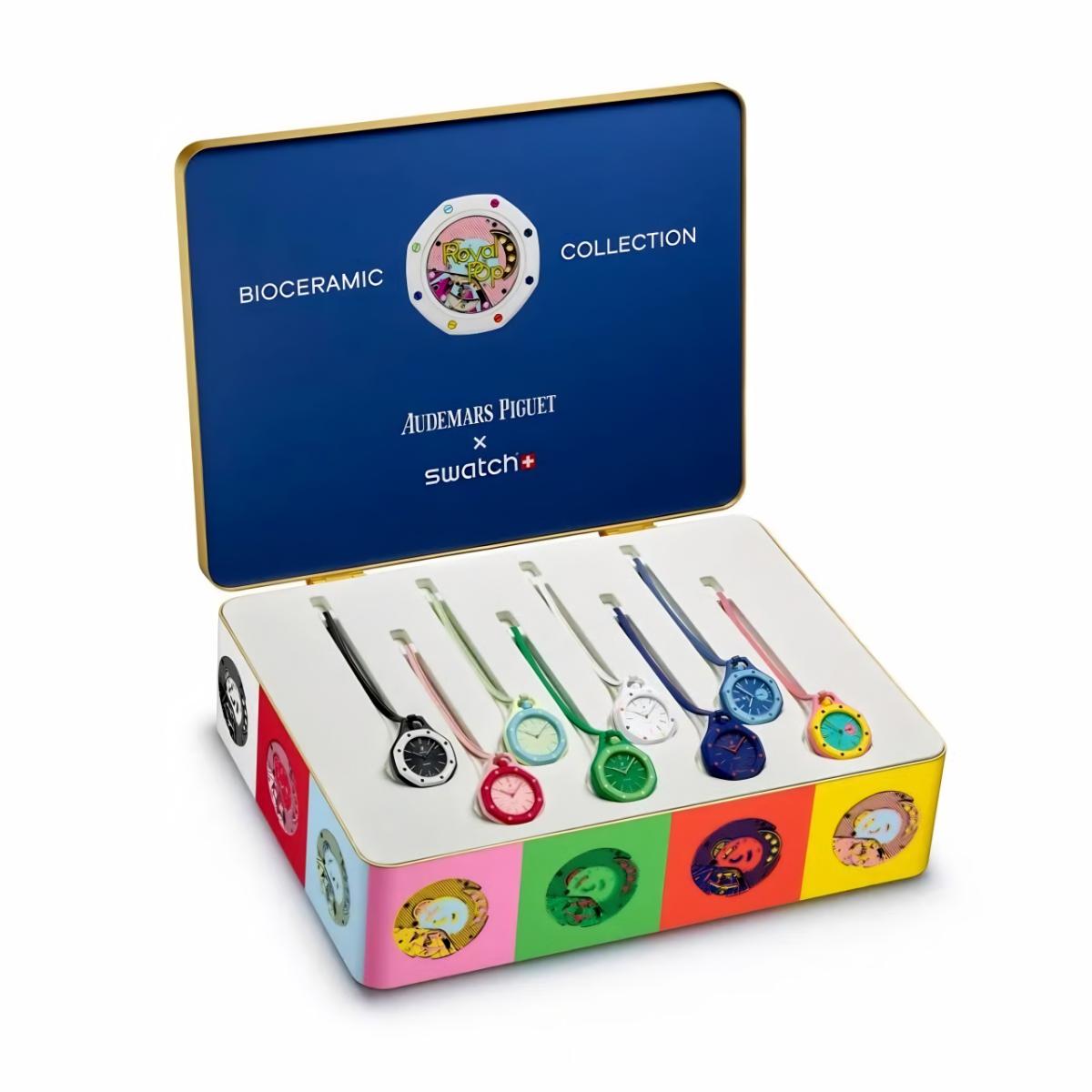
This is what OAC's pre-launch study called the Aura Transaction: the mechanism by which a commercial brand extracts the cultural capital of a legitimate entity and deploys it as its own sign value. The Royal Pop does not need every buyer to receive a watch. It needs every non-buyer to see the queue. The hyperreality of the drop, the simulated urgency, the manufactured scarcity, the ritualized performance of access, is the actual product delivered at scale. The eight bioceramic pocket watches are the residue. The global spectacle is the object.
Every photograph of a locked Swatch door with a crowd pressing against it is a free advertisement confirming that the object is worth having. The retail collapse and the marketing campaign are identical events.
The PLCFA framework distinguishes between the Sovereign Object, an object whose value is structurally generated by its material specificity, labor density, and non-reproducibility, and the Spectacle object, whose value is generated by the image of its inaccessibility. The Royal Pop is the latter at its most refined. Its semantic burden, the sum total of meaning it is asked to carry, is borrowed entirely from the Royal Oak's 54-year material history, but it carries that meaning in a bioceramic shell that is, by design, a simulacrum of the original. The weight of the Royal Oak's narrative permanence, the overnight genius of Gérald Genta, the steel provocation of the 1972 Basel Fair, the waitlist discipline of Le Brassus, is borne by an object designed in a meeting room and manufactured at volume.
SECONDARY MARKET CAPTURE: THE REAL DISTRIBUTION ARCHITECTURE
Before a single Royal Pop was sold through a Swatch boutique on May 16, resale listings appeared on eBay, with prices ranging from $1,200 to $10,000 for an item retailing at $400 to $420. By mid-afternoon, confirmed sold units were appearing at $8,000+. This is not an anomaly. It is the actual distribution architecture of the Speculative Velocity event operating as designed. The retail network, 21 locations in the United States, 13 in the United Kingdom, and selected locations across Europe, Asia, and the Gulf, was never the primary distribution mechanism. It was the performance stage. The secondary market is where the object's financial life begins in earnest.
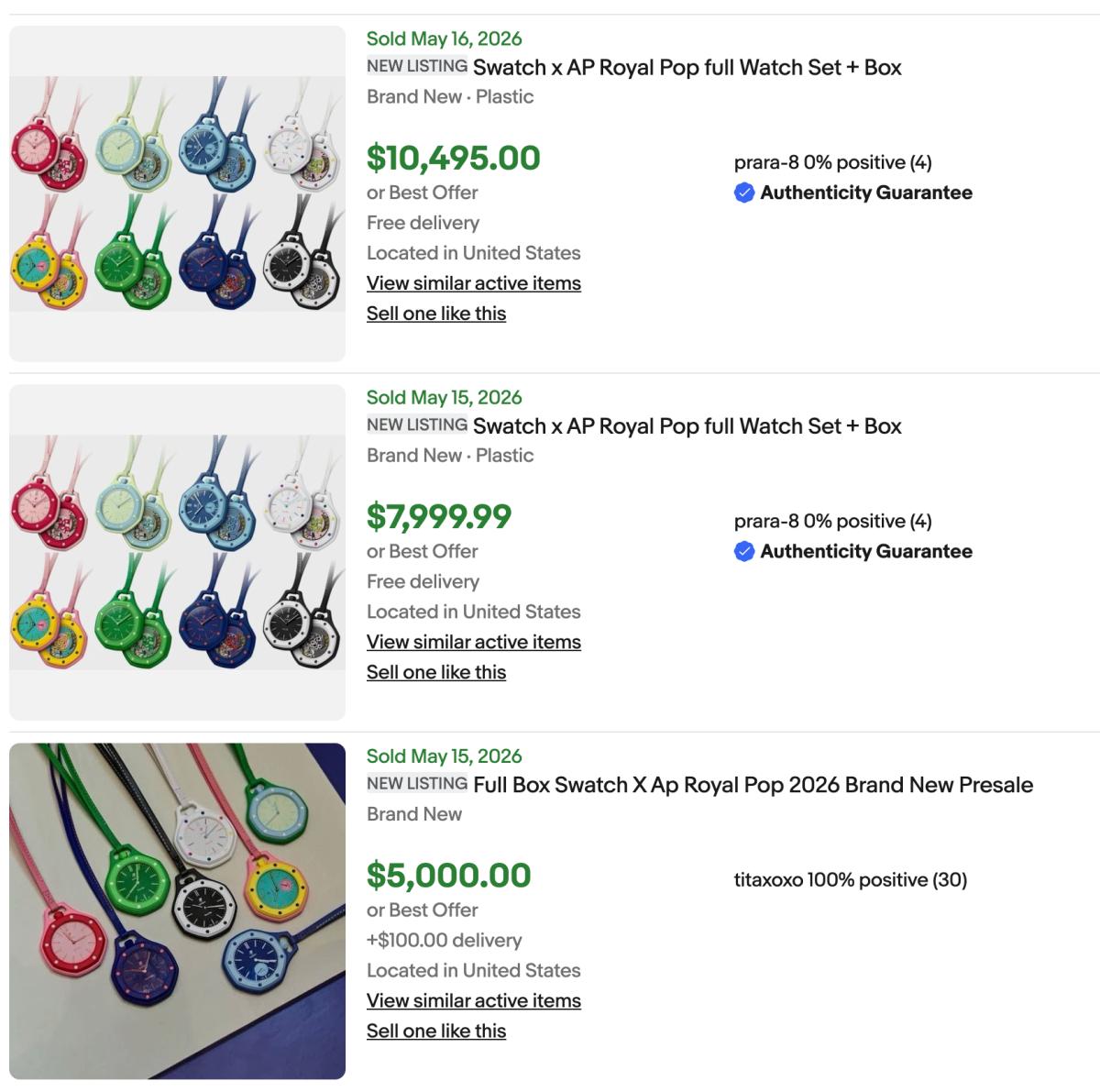
The financialization of luxury, identified in OAC's Market Analysis & Collapse studies as a primary driver of the current structural crisis in post-luxury consumption, finds its most accelerated expression in the drop economy. The Royal Pop is not a $400 watch. It is a speculative instrument whose floor price is $400 and whose ceiling is determined entirely by the ratio of demonstrated demand to confirmed supply. At allocations of tens of units per location across 200 global stores, the ceiling is structural, not accidental. Swatch and AP set the conditions for a 20× resale multiple before a single door opened.
The object that retails at $400 and immediately resells at $8,000 is not a product. It is a financial instrument wearing a bioceramic case. The buyers camping for days are not consumers. They are liquidity providers for a market deliberately engineered by Swatch.
This is the Zero-Sum Aura in its most explicit form. For every buyer who queues overnight and secures a Royal Pop at retail, the aura of the Royal Oak is consumed, converted from accumulated material singularity into speculative liquidity. For the dozens of buyers per location who queue for days and are turned away when the store refuses to open, the aura is consumed without even the material return. The Dubai cancellation, announced on Instagram, confirmed by Swatch's UAE account, generated more social media content than any successful sale could have. The Zero-Sum Aura transaction is complete whether or not the object changes hands.
AP'S STRUCTURAL POSITION: INDEPENDENCE AS COLLATERAL
Audemars Piguet's participation in the Royal Pop is the most structurally significant decision in its 150-year history. Every prior AP collaboration, Travis Scott, Marvel, bespoke commissions, remained inside AP's own manufacturing infrastructure: made at Le Brassus, priced at AP's register, distributed through AP's controlled channels. The Royal Pop is the first time in 54 years that the Royal Oak's design language left Le Brassus and entered a Swatch boutique. AP CEO Ilaria Resta stated that the collaboration was signed "because audacity is often the starting point of innovation." The OAC framework reads this statement differently: audacity is the correct word only if the risk is proportionate to the institutional value being deployed. What AP deployed is 54 years of sovereign design capital. What it received in exchange is a global spectacle and, per official confirmation, 100% of AP's proceeds directed toward watchmaking preservation and transmission initiatives.
The preservation commitment is the only structural element of the Royal Pop that the PLCFA framework reads as non-speculative. If AP's financial participation is genuinely zero-profit, if the $400 retail contribution from AP's share goes entirely to horological education and rare-skill preservation, then the custodial strategy is coherent: AP converts its aura into a philanthropic mechanism rather than a revenue stream. But the aura expenditure remains. The Royal Oak's narrative permanence is not restored by the destination of the proceeds. The one original principle, the PLCFA axiom that the legitimate object can only exist once, in its full material and intentional specificity, is not satisfied by charitable redirection. The Royal Pop pocket watch is not a Royal Oak. But it now shares the octagonal bezel, the exposed screws, and the design language of the Royal Oak, at $400, in the hands of buyers whose primary relationship to the object is speculative.
AP’s independence was the guarantor of the Royal Oak’s aura. The moment AP licensed that design to another manufacturer, even a Swiss one, even for charitable ends, it converted its sovereignty into currency. Currency, once spent, is spent.
THE HOLLOWED OBJECT: POST-LAUNCH ANATOMY
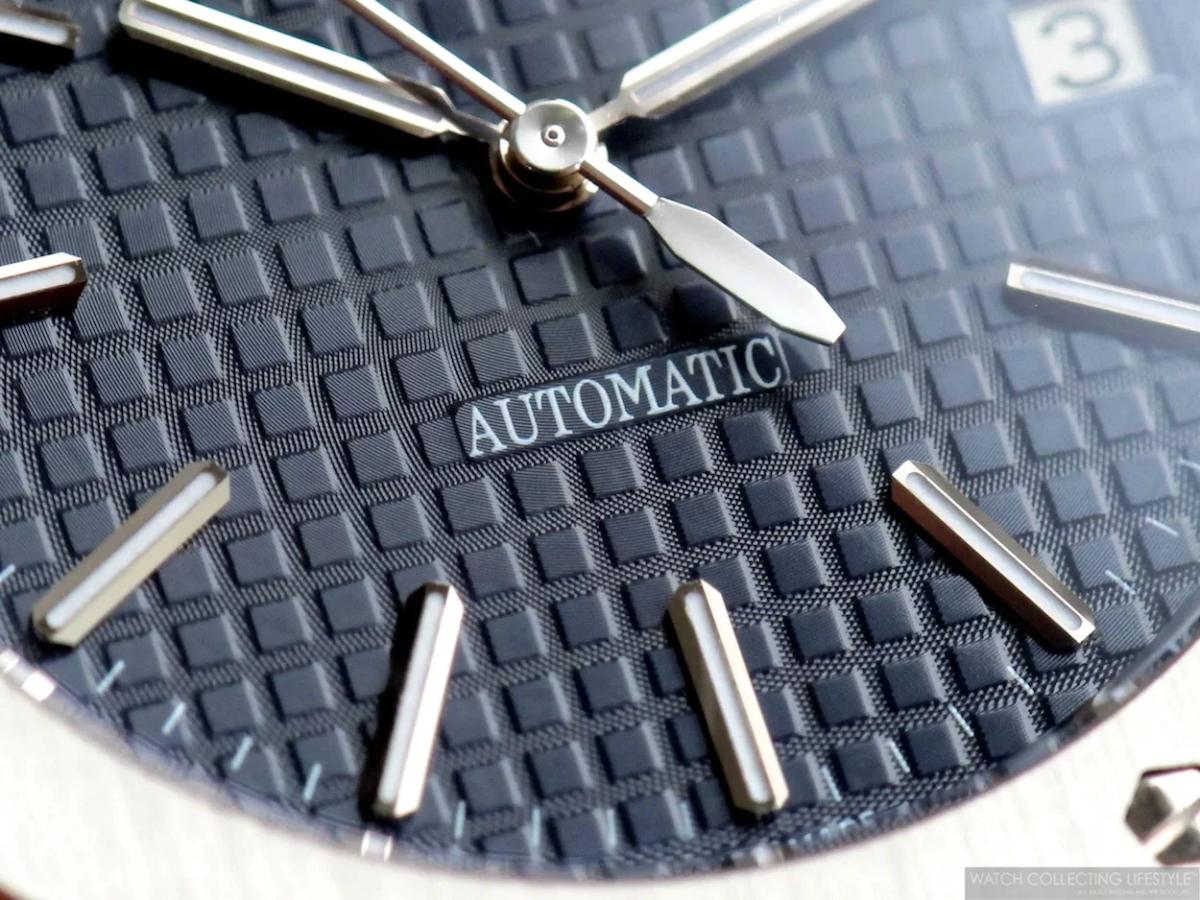
The pre-launch study asked whether the Royal Oak's Material Singularity was resilient enough to survive the Hollowed Object condition. May 16 provides the first empirical data for that question. The Hollowed Object is defined within the PLCFA framework as an object that retains the legible silhouette of value, the design markers, the brand associations, the heritage narrative, while the structural conditions that generated that value have been systematically evacuated. The Royal Pop is a Hollowed Object by construction: it takes the octagonal bezel, the eight screws, the tapisserie-influenced dial aesthetic, and the AP design language, and reproduces them in bioceramic at volume. The semantic burden the Royal Pop carries is entirely borrowed. Its own semantic content, as a new object, in its own material register, is essentially zero.
What the accessible luxury discourse calls democratization, the PLCFA framework diagnoses as hollow: the distribution of the sign without the substance. A generation of buyers who encounter the Royal Oak aesthetic through the Royal Pop will have been introduced not to the Royal Oak, but to a bioceramic performance of it. Their understanding of what the Royal Oak is will be formed by the simulacrum first. The hyperreality precedes and occludes the real, exactly as Baudrillard predicted, and exactly as the OAC's pre-launch framework anticipated. This is not democratization. It is the industrial processing of an icon into a sign, a sign that is then distributed to a buyer class whose primary relationship to the sign is speculative rather than custodial.
The buyer who queues for three days and receives a Royal Pop pocket watch does not gain access to the Royal Oak. They gain access to the idea of the Royal Oak, which is a structurally different thing, and a less durable one.
WHAT THE CHAOS REVEALS ABOUT THE CURRENT CONDITION OF LUXURY
The May 16 Royal Pop launch chaos is not an isolated event. It is a diagnostic reading of the structural condition of the luxury market in 2026. OAC's Market Analysis & Collapse studies have documented the bifurcation of the luxury market into two structurally distinct registers: the Speculative Velocity register, drop culture, artificial scarcity, secondary market arbitrage, brand spectacle, and the Material Singularity register, singular objects, custodial contracts, labor density, narrative permanence. The Royal Pop is the most complete expression of the first register in the history of Swiss watchmaking. Its chaos is not the market's failure. It is the market's most articulate statement.
The Meaning Deficit study documented the accelerating consumer turn toward material integrity and away from sign-value performance. The Royal Pop appears to contradict this argument: thousands of buyers camped for days for a bioceramic pocket watch whose value is entirely speculative. But the contradiction is only apparent. The buyers who queue for the Royal Pop are not luxury consumers in any structural sense. They are participants in a financial instrument that takes the form of a watch. The crowd outside the closed Dubai Mall Swatch store is not a demonstration of demand for haute horlogerie. It is a demonstration of demand for the speculative liquidity that the Royal Oak's aura has been converted into. These are different markets.
The luxury market’s most significant structural divide is not between expensive and affordable. It is between objects whose value is generated by what they are made of and how they were made, and objects whose value is generated by how difficult they are to obtain.
THE SWATCH NOTE: NOT A LIMITED EDITION
Swatch's Singapore account, in announcing the VivoCity closure, included a detail that the global coverage has largely missed: the Royal Pop collection is, per Swatch, "not a limited edition release," with future restocks confirmed. This is the most structurally significant disclosure of the launch day. It is also the most honest admission of the Royal Pop's actual architecture. The MoonSwatch was presented as an ongoing franchise, 11 initial colorways, followed by Mission to Moonshine Gold, Mission to MoonPhase, Mission to Earth, and continued additions through 2025. Each new release diluted the aura of the previous one. Each new release produced a smaller queue. Each new release required a louder spectacle to garner the same level of attention. The Speculative Velocity engine requires continuous fuel. The fuel is the announcement of new scarcity. When the existing scarcity resolves, through restocking, through secondary-market saturation, through the simple passage of time, the engine requires a new cycle.
The disclosure that the Royal Pop is not a limited edition is its most important design decision. It means the current secondary market prices, $1,200 to $8,000 for a $400 object, are temporary. They are the speculative premium of manufactured first-day urgency. As restock arrives, the premium will compress. The buyers who paid $8,000 in a panic on launch day will hold an object whose resale value will approach, and may in time fall below, retail. The Zero-Sum Aura transaction is confirmed: the Royal Oak's accumulated aura was borrowed to generate a speculative premium that will be distributed to early movers and then dissipated through restock cycles. The Royal Oak will remain. The Royal Pop premium will not.
The announcement that the Royal Pop is not limited edition is the only honest sentence Swatch has spoken in this entire launch architecture. It is also the sentence that voids every secondary market listing filed before it was made.
THE PLCFA VERDICT: WHAT A SOVEREIGN OBJECT DOES NOT DO
The PLCFA framework does not condemn the Royal Pop. It diagnoses it. The diagnosis is this: the Royal Pop is a precisely engineered speculative velocity event that successfully converted 54 years of sovereign design capital into a global retail spectacle, a secondary market instrument, and a mass-media event, all within a single Saturday morning. By every metric the speculative capital market recognizes as success, the Royal Pop succeeded. The queues were real. The closed stores were real. The $8,000 resale prices were real. The riot police in Paris were real. The viral content was real. The earned media was incalculable.
What the Royal Pop did not do, and what no speculative velocity event can do, is generate narrative permanence for the object itself. The Royal Pop will not be studied in fifty years as an instance of design courage. It will not carry a custodian's contract. It will not accumulate the kind of material singularity that makes an object worth preserving, transmitting, and governing. It is not a sovereign object. It is a supremely efficient vehicle for temporarily redistributing an existing sovereign object's aura. Those are structurally different achievements. The PLCFA framework was built to hold that distinction clearly, even when, especially when, the market cannot.
AP's brand philosophy, independence, controlled output, custodial waitlist, is the structural opposite of everything the Royal Pop launch represents. The question the PLCFA framework leaves open, and will continue to interrogate, is whether that philosophy survives the spectacle it has now co-signed. The Royal Oak will not be hollowed in a day. But the zero-sum aura transaction does not require a single day to be decisive. It requires only that the next buyer who encounters the octagonal bezel encounter it first through the simulacrum, not the original. In 2026, for a generation of new watch buyers, that condition is now met.
THE FRAMEWORK HOLDS, AND WHAT IT CANNOT RESOLVE
May 16, 2026, confirmed the PLCFA framework's pre-launch structural argument with a completeness that exceeds what any single case study can fully absorb. The Speculative Velocity prediction was verified. The Zero-Sum Aura mechanism was demonstrated in real time. The Spectacle of Dissent, the closed store, the blocked crowd, the riot police, the Instagram cancellation, proved to be, as the framework anticipated, more valuable to the brand than any successful sale. The secondary market capture architecture was confirmed from the first hour. The Hollowed Object diagnosis, applied before the object was even distributed, was borne out by the morning's events.
What the framework cannot resolve, and what this study holds open as its structural question, is the long-term effect on the Royal Oak itself. The Royal Pop is not a limited edition. Restock will come. The secondary market premium will compress. The spectacle will fade. But the aura expenditure does not reverse. The generation of watch buyers introduced to the Royal Oak's design language through a $400 bioceramic pocket watch carries a different relationship to that design than the generation introduced to it through the object at Le Brassus. That relationship is not demonstrably worse. It is demonstrably different. Whether the Sovereign Object can absorb that difference, whether narrative permanence can be maintained when the sign has been distributed at scale, is the question the PLCFA framework will track across the next decade of AP's institutional decisions. The Royal Pop launched. The queue was the product. The object was secondary. The framework was right. What happens next is the harder part of the study.
Authored by Christopher Banks, Anthropologist of Luxury, Critical Theorist & Founder
Objects of Affection Collection
Office of Critical Theory & Curatorial Strategy
469 Fashion Avenue, 12th Floor, New York, NY 10018
RELATED OAC STUDIES
Further reading from the Objects of Affection Collection monograph archive, organized by thematic proximity to the arguments advanced in this study.
The Royal Pop Series: Pre- and Post-Launch
· Audemars Piguet × Swatch Royal Pop: The Hollowing of an Icon
Speculative Capital and the Financialization of Luxury
· Dark Mode: The Art Market's Turn to Private Auctions
· The Meaning Deficit: Why Luxury, Art, and the Built Environment Are All Failing the Same Test
· Luxury Just Split in Two. One Half Will Survive.
The Spectacle, the Simulacrum, and the Sovereign Object
· The Banksy Series: Forensic Provenance and the Sovereign Object
The PLCFA Foundational Lexicon