Audemars Piguet x Swatch Royal Pop: The Hollowing of an Icon
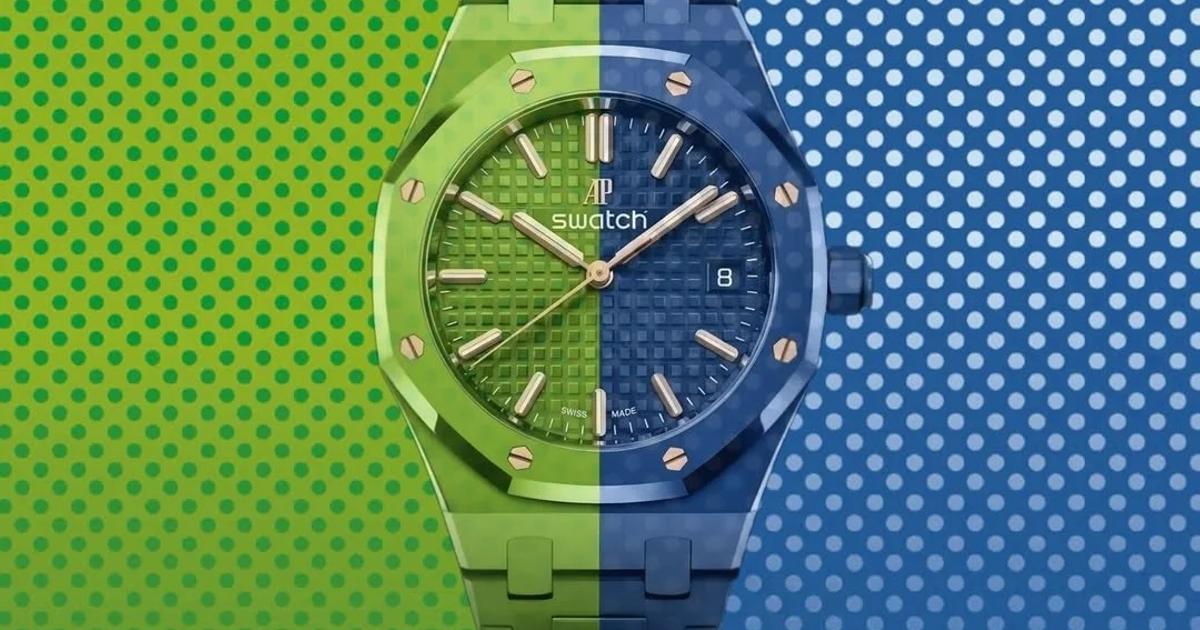
On the Audemars Piguet × Swatch Royal Pop, the Structural Logic of Icon Dilution, and What the Collaboration Reveals About the Condition of Luxury in 2026

On May 8, 2026, Swatch confirmed what the watch world had suspected for weeks: a formal collaboration with Audemars Piguet, the independent, family-owned Swiss manufacture whose Royal Oak, drawn overnight by Gérald Genta in 1971; remains the defining artifact of luxury sports watchmaking. The product, called the Royal Pop, launches May 16, 2026. It is the third in Swatch's series of 'accessible icon' collaborations following the 2022 MoonSwatch and the 2023 Blancpain Bioceramic Scuba Fifty Fathoms, but it is the first executed outside the Swatch Group, making itthe most structurally significant collaboration in modern Swiss watchmaking history. This study applies the Post-Luxury Conceptual Functional Art (PLCFA) framework to examine the Royal Pop as a critical event. The operative lexicon terms engaged are: Zero-Sum Aura, Semantic Burden, Simulacrum, Artification, Hollowed Object, Narrative Permanence, Material Singularity, and the One Original Principle. The study argues that the Royal Pop is not a democratizing gesture but a speculative velocity event, one that trades the Royal Oak's accumulated Aura for mass-market attention without returning equivalent narrative value to the object. The OAC position is that the collaboration confirms the structural argument of the PLCFA framework: that true luxury value is non-transferable by reproduction, and that every act of accessible replication accelerates the Hollowing of the original.
GENTA'S OVERNIGHT OBJECT: THE ROYAL OAK AS SOVEREIGN DESIGN
The founding myth of the Royal Oak is one of the most powerful origin stories in the history of objects. On the evening of April 10, 1971, Audemars Piguet's managing director Georges Golay telephoned Gérald Genta, the freelance genius Hodinkee would later call the Picasso of watchmaking, and asked for a design sketch to be delivered by morning. Genta drew through the night, and from that single nocturnal session emerged the octagonal bezel, the eight exposed hexagonal screws, the integrated bracelet that flowed as one continuous form from lug to lug, and the 'tapisserie' dial: a grid of light that, under scrutiny, revealed itself to be one of the most refined surfaces in all of haute horlogerie. Debuted at the Basel Watch Fair in 1972, the Royal Oak was made entirely of stainless steel; a material then regarded as too utilitarian, too industrial, too honest for the sacred registers of Swiss fine watchmaking.
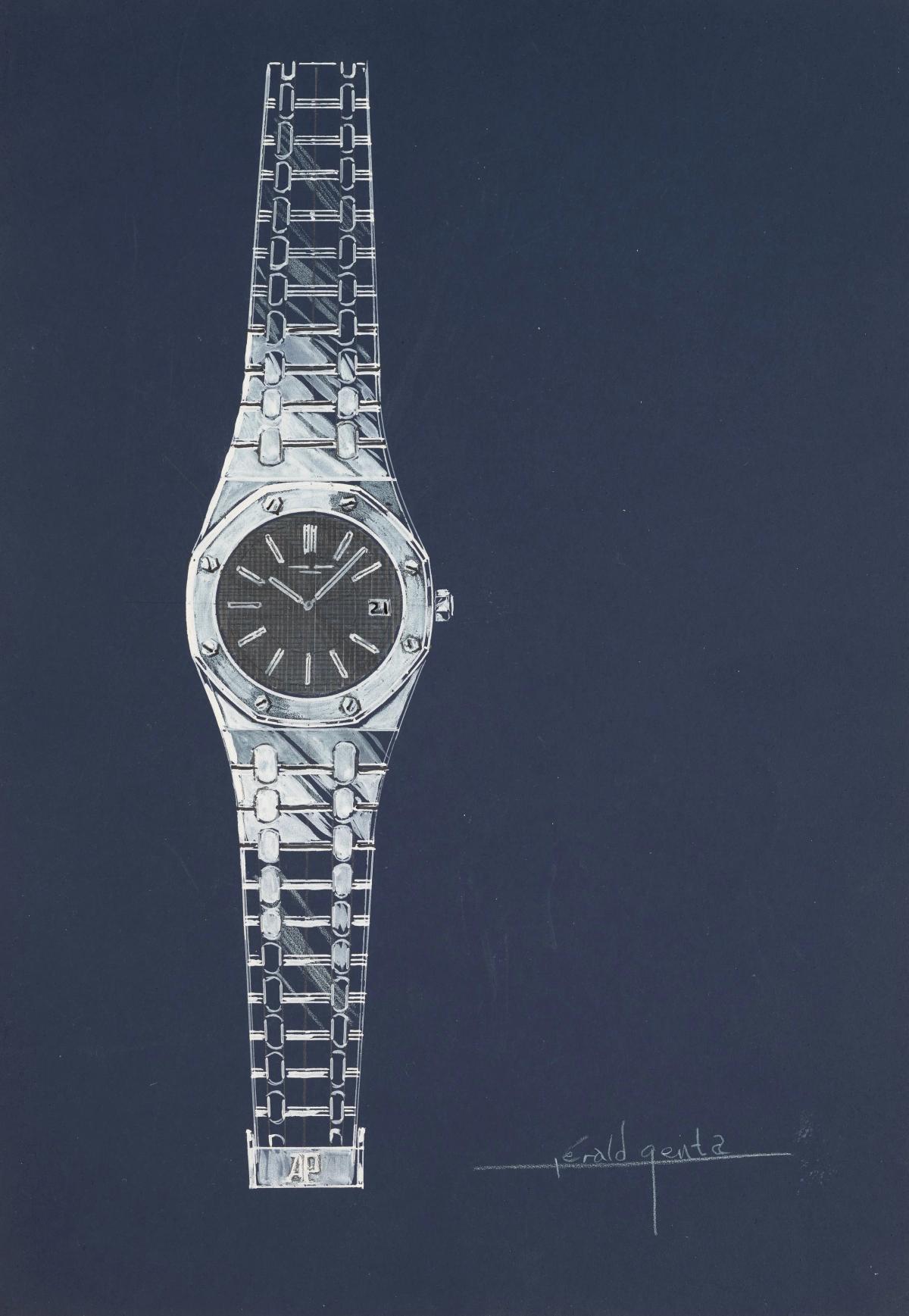
The Royal Oak did not enter the market as a luxury watch. It entered as a provocation. Its price, three times that of a contemporary Rolex Submariner, was the most radical material argument it made.
Within the PLCFA framework, the Royal Oak's 1972 launch constitutes a precise instance of Material Singularity: a configuration of material, labor, and conceptual intent so specific that it generates its own gravitational field of meaning. The watch did not sell well immediately. Slowly, people came to understand that the exposed screw, which made every other watchmaker wince, was not a failure of refinement but its highest expression: the willingness to let the object's engineering be fully visible was a radical act of object testimony. The Royal Oak said: The mechanism is worthy of exhibition. By the 1990s, this proposition had given rise to the entire category of luxury sports watches; a design language now occupied by the Patek Philippe Nautilus, the Vacheron Constantin Overseas, and dozens of derivative designs. Genta's overnight sketch is the genealogical root of an entire industry sub-segment. The One Original Principle is not a concept the Royal Oak embodies in the PLCFA sense; it is a commercial object, produced in significant quantities across fifty-four years. But the design itself functions as a Sovereign Object: a form so specific, so non-transferable, so embedded in a particular act of human intention that it has resisted dilution for five decades, until now.
THE QUARTZ CRISIS AND THE STRUCTURAL LOGIC OF THE SWATCH MOVE
The Swiss watchmaking industry in the early 1970s was experiencing an existential crisis, the quartz crisis, that threatened to render mechanical watchmaking economically unviable. Japanese manufacturers had developed affordable, accurate quartz movements that made the traditional Swiss mechanical watch appear both expensive and imprecise. The Royal Oak, paradoxically, was AP's response: not to compete on precision or price, but to assert that the value of a mechanical watch resided in its labor density, its material honesty, and its refusal of the purely utilitarian. The quartz crisis is the historical precedent the Swatch collaboration inverts. Swatch was itself founded in 1983 as the Swiss industry's answer to Japanese quartz: a mass-market, plastic-cased, Swiss-assembled quartz watch designed to be cheap, cheerful, and culturally legible. The MoonSwatch of 2022 was Swatch returning to its founding logic, but deploying it against the luxury stratum it had always circled.
The MoonSwatch was internally coherent. Omega and Swatch are both members of the Swatch Group; the Omega Speedmaster's democratization was, at its structural core, a family affair. The brand relationship was managed within a single corporate governance structure. The Royal Pop breaks this logic entirely. Audemars Piguet is not a member of the Swatch Group. AP is an independent, family-controlled manufacture based in the village of Le Brassus in the Vallée de Joux, the valley of watchmaking, whose entry-level models begin north of €30,000 at retail. This independence is not incidental. It is the core of AP's brand philosophy: the refusal of conglomerate ownership, the commission-only production model for certain references, the controlled waitlist, the deliberate limiting of output. When the official Audemars Piguet Instagram account commented 'when do we launch?' on Swatch's 2023 Blancpain post, the watch world laughed. That comment is now the public record of a structural negotiation that would take two years to formalize.
The first trademark for ‘ROYAL POP’ was filed by Swatch AG on June 18, 2024; eighteen months before the May 2026 launch campaign. The teaser campaign was not spontaneous. It was choreographed. The hype was engineered. The question the PLCFA framework asks is: engineered toward what end?
THE MECHANICS OF ARTIFICATION: SWATCH'S COLLABORATION PLAYBOOK
In OAC Study No. 014, The Aura Transaction, the House examined the practice of Artification, the mechanism by which a commercial brand extracts the Aura of a legitimate cultural or artistic entity and transfers it to its own products. The MoonSwatch executed a particularly clean form of Artification: it borrowed the cultural capital of the Omega Speedmaster, the watch worn on the Moon, the watch carried by every NASA astronaut since 1965, and deployed it in a bioceramic shell at CHF 260. The result was over two million units sold in the first year, kilometer-long queues outside Swatch boutiques worldwide, and a generation of buyers who had never owned a mechanical watch suddenly identifying themselves as watch enthusiasts. This is the playbook: take an icon, reduce its material register, inflate its cultural accessibility, capture the sign value through scarcity staging, and generate a spectacle that functions as its own marketing machine.

The Swatch approach to Artification is particularly sophisticated because it weaponizes Baudrillardiansimulacra theory in reverse. Jean Baudrillard argued in Simulacra and Simulation that copies eventually detach from their originals and become self-referential; a hyperreality in which the model precedes the real. The MoonSwatch, and now the Royal Pop, operate precisely at this threshold: they are not pretending to be Speedmasters or Royal Oaks. They explicitly acknowledge their own secondary status through co-branding, material reduction, and accessible pricing. The simulacrum is declared. The consumer is invited to participate in the simulation knowingly. This declaration is the move that neutralizes the traditional critique of the copy, 'it's not the real thing', because the brand has pre-empted that critique by naming it. The Hollowed Object, in the PLCFA sense, is not always an unconscious condition. Here it is a commercial strategy.
THE ZERO-SUM AURA: WHAT THE ROYAL OAK TRADES WHEN IT ENTERS A SWATCH BOUTIQUE
OAC Study No. 004, The Zero-Sum Aura: Why Digital Immortality Requires a Material Host, established the governing principle: any gain in reproducibility is met with a corresponding loss in the artifact's singularity. Walter Benjamin's formulation of the Aura, that quality of presence, of unique material existence in a specific place and time, that mechanical reproduction destroys, is the theoretical coordinate we return to here. The Royal Oak's Aura is not merely its design. It is the accumulated weight of fifty-four years of restricted production, controlled distribution, a waitlist architecture that enforced aspiration, and a price point that placed it definitively outside the reach of mass consumption. That accumulated weight is what makes the Royal Oak's silhouette instantly legible as a sign of access to a particular stratum of cultural and economic life. The Royal Pop borrows that sign value while explicitly refusing the conditions that generated it.
When the Royal Oak silhouette appears in a Swatch boutique for the price of a luxury gym membership, two things happen simultaneously: the sign becomes more widely distributed, and the signal becomes structurally diluted. This is the Zero-Sum Aura at industrial scale.
The former AP CEO François-Henry Bennahmias praised the MoonSwatch in 2022, arguing that it 'educates the younger generation about the icons of watchmaking' without affecting Omega's integrity. This argument, that accessible luxuryserves as a feeder system for the real thing, is the standard defense of Artification strategies. The PLCFA framework calls it the Patronage Validation argument: the idea that by distributing a simulacrum of aspiration, one deepens the desire for the sovereign original. There is empirical support for this position in the aftermath of the MoonSwatch: Omega's brand awareness metrics improved significantly, particularly among buyers under 35. But the Omega Speedmaster was not the Hollowed Object that resulted from the MoonSwatch. Omega had already sold millions of Speedmasters over seven decades. It could absorb the Zero-Sum Aura transaction from a position of deep narrative permanence. The Royal Oak has fifty-four years of production history. But it has maintained its material singularity through a far morecontrolled supply strategy. The question is whether its accumulated Aura can survive the same extraction.
THE SEMANTIC BURDEN OF 'ROYAL POP': NAMING AS STRUCTURAL ARGUMENT
The name is the diagnosis. 'Royal Pop' fuses two registers that had never previously intersected in the watchmaking lexicon: 'Royal,' which carries the accumulated weight of the Royal Oak's fifty-four-year institutional prestige, and 'Pop,' which references simultaneously the Swatch Pop Swatch line of 1986 (modular, wearable as pendant or wristwatch, emphatically non-serious) and the broader cultural register of pop art, mass production, and the deliberate democratization of the image. Andy Warhol understood that to reproduce the Campbell's Soup can was not to celebrate it but to expose the sign value that had already made it invisible through ubiquity. The 'Pop' in Royal Pop carries a similar implication: by making the Royal Oak legible as a Pop Swatch, the collaboration reveals how thoroughly the Royal Oak's design has already been absorbed into the global visual register of luxury aspiration. The name is an act of détournement, a strategic recoding of a sign that can be read as either celebration or critique, and which in this case is neither: it is pure speculative velocity.
The Semantic Burden of an object, in the PLCFA lexicon, is the weight of meaning it must carry, the accumulated narrative obligations it has accrued through its history of making, distribution, and cultural inscription. The Royal Oak's Semantic Burden is enormous: every design element, the octagonal bezel, the eight hexagonal screws, the integrated bracelet, the tapisserie dial, carries fifty-four years of narrative. When that Semantic Burden is transferred to a bioceramic casing at a fraction of the price, what happens to the narrative weight? It does not transfer. The material cannot hold it. The bioceramic octagon quotes the steel octagon, but the steel octagon's meaning resided partly in its material: stainless steel was the provocation in 1972, the material that said 'a luxury object can be made of an industrial material if the making is extraordinary enough.' The bioceramic replica says: 'a luxury design can be made of a composite polymer if the brand is recognizable enough.' This is not the same argument. It is a simulacrum of the argument.
THE INDEPENDENT VARIABLE: WHY AP'S SOVEREIGNTY MAKES THIS DIFFERENT
The structural distinction that separates the Royal Pop from every previous Swatch collaboration is the one almost no one in the commercial press has examined with adequate seriousness: Audemars Piguet is not a member of the Swatch Group. It is a genuinely independent brand, family-controlled, answerable to no conglomerate board, operating from a tradition of autonomous decision-making that is vanishingly rare in the contemporary luxury landscape. Omega's participation in the MoonSwatch required approval from a group whose internal logic already encompassed both brands. AP's participation required something qualitatively different: the voluntary relinquishing, by a fully sovereign institution, of the design exclusivity it had maintained for fifty-four years. For the first time in the Royal Oak's history, the silhouette leaves Le Brassus under a different name. This is a governance decision of the highest order, and it is irreversible.
The PLCFA framework's Monastic Veto, the institutional refusal to participate in speculative market behavior, is the counter-model here. In OAC Study No. 032, Christie's Sold $2.7 Billion in Art Secretly Last Year. Here's Why That Should Alarm You., the House examined how the most sophisticated institutional actors in the art market are increasingly choosing opacity and restraint over visibility and accessibility. The Royal Pop is the precise opposite institutional decision: the most prestigious watchmaker in the world has chosen visibility, accessibility, and pop culture legibility over the studied restraint that is AP's defining institutional character. Former CEO Bennahmias celebrated the MoonSwatch, but it is worth noting that the Royal Pop was greenlit under a different leadership regime. The decision reflects a generational shift in AP's institutional appetite for cultural risk. Whether it reflects a corresponding shift in philosophical commitment to the Sovereign Object is the question this study cannot yet answer, because the answer lives in the object itself, which the world has not yet held.
An institution that has guarded a design for fifty-four years and then licenses it to a mass-market collaborator has not democratized luxury. It has performed a one-time extraction of its own accumulated Aura; a transaction that cannot be repeated and cannot be undone.
THE QUEUE AS SPECTACLE: HYPE ARCHITECTURE AND THE PERFORMANCE OF SCARCITY
The launch strategy for the Royal Pop, in-store only, at selected Swatch boutiques, with no online availability and anticipated purchase limits, is the same architecture deployed for the MoonSwatch in 2022. That launch generated what became the defining commercial spectacle of the decade: kilometer-long queues outside Swatch boutiques in London, Tokyo, New York, and Sydney. People camped overnight. Fights broke out. Secondary market prices for the CHF 260 watches reached multiples of three to five times retail within hours. The queue itself became the product: the spectacle of scarcity was the marketing event, the social media content, the proof of cultural resonance. Guy Debord argued in The Society of the Spectacle that in the fully developed modern economy, the image of consumption replaces consumption itself as the primary social relation. The MoonSwatch queue was the purest possible expression of this condition: people queued not primarily to obtain a watch but to participate in a moment of collective aspiration-performance.
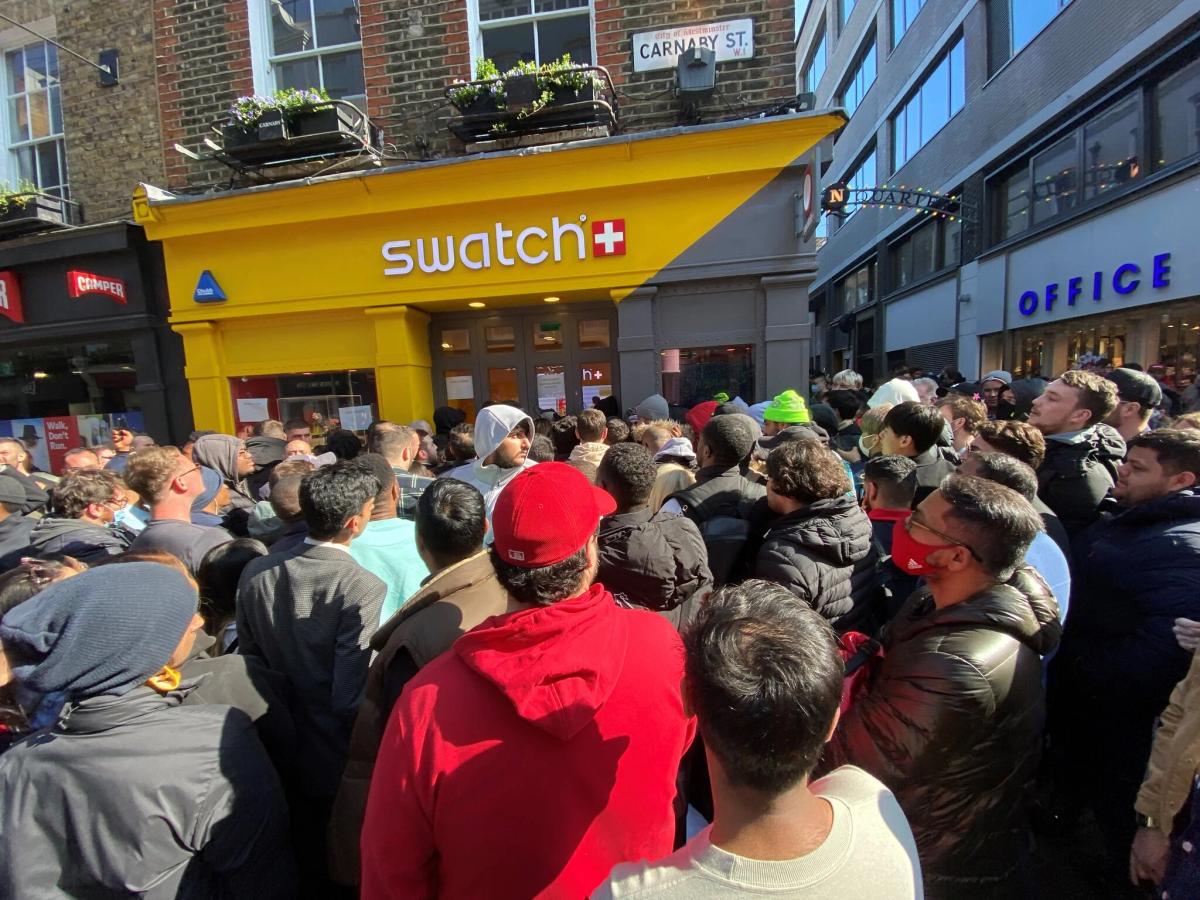
The Royal Pop's scarcity architecture is manufactured. The Swatch Group's manufacturing capability is industrial. Bioceramic components can be produced at significant volume. The 'limited availability' of the launch moment is a strategic decision, not a production constraint. This is Spectacle of Dissent economics: by restricting access at launch, the brands generate a queue, the queue generates media coverage, the media coverage generates brand equity for both parties, and the brand equity is eventually monetized, in AP's case, through the continued sale of Royal Oaks at €30,000 to €300,000, to buyers who first encountered the silhouette through the Royal Pop. The resale market for the Royal Pop will function as an additional sign value amplifier: when secondary market prices exceed retail, the object acquires a veneer of speculative legitimacy it does not possess in structural terms. A bioceramic Royal Pop at three times retail is still a Hollowed Object. The inflation of price does not generate Narrative Permanence.
THE OAC POSITION: THE COLLABORATION THROUGH THE LENS OF PLCFA
The Objects of Affection Collection does not evaluate the Royal Pop as a consumer product. The House is not in the business of watch recommendations. The evaluation here is structural: what does the Royal Pop reveal about the condition of Post-Luxury value, the governance of iconic design, and the PLCFA framework's argument for Narrative Permanence over speculative velocity?
First: the Royal Pop confirms that even the most protected design in the Holy Trinity of Swiss watchmaking, a category whose institutional identity is constituted by its refusal of accessibility, has a price at which it will enter the Artification transaction. The Royal Oak has held out longer than any comparable design in contemporary luxury. But the institutional decision was made, and made voluntarily, by an independent brand with no conglomerate pressure to justify it. This is a data point. The PLCFA framework reads it as evidence that no sovereign design position is structurally immune from the gravity of the spectacle economy. The only genuinely Anti-Speculative Entity in the luxury landscape is one whose governance structure makes the Artification transaction impossible, not merely undesirable, but structurally unavailable. The One Original Principle, as the OAC enacts it, is precisely this structure: there is no license to issue because there is only one object.
Second: the Royal Pop reveals the Semantic Burden problem of design icons with particular clarity. Gérald Genta's sketch was an act of singular human intention, executed under pressure, in a single night. The Royal Oak is the materialization of that act. Every subsequent Royal Oak, produced across fifty-four years, in steel, gold, titanium, ceramic, carries the Archival Residue of that original gesture. The Royal Pop does not carry that residue. Its bioceramic casing was not drawn by Genta. Its octagon quotes the octagon. But quotation is not inheritance. The Phenomenology of Concealment that Margiela deploys, as analyzed in the OAC study The Folder as Archive, is a strategy for protecting Narrative Permanence by controlling what is revealed. The Royal Pop's strategy is the precise opposite: maximum revelation, maximum accessibility, minimum concealment. The Aura is spent in the transaction.
Third, and most fundamentally: the Royal Pop is a test of whether the MoonSwatch model, accessible icon as gateway drug to the real object, can survive transplantation to the highest tier of Swiss watchmaking. The Omega Speedmaster had already survived its own brand dilution; it sold in enormous quantities for decades, had numerous diffusion models and entry-level configurations, and had been widely available at prices accessible to the professional middle class. The Royal Oak has never occupied that position. It has always been, since 1972, a price provocation: the object that costs more than it 'should' because the making justifies the cost. If the Royal Pop succeeds commercially, and it almost certainly will, on launch-day metrics, the structural question is what it has cost the Royal Oak. The PLCFA framework holds that this cost will manifest not immediately but over the medium term, as the silhouette becomes legible in a register it has never previously occupied: the register of the accessible, the pop-cultural, the mass-market aspirational. Once a design has occupied that register, the act of forgetting is structurally very difficult.
WHAT THE ROYAL OAK KNOWS IS THAT THE ROYAL POP CANNOT HOLD
The luxury watch market in 2026 is under structural pressure from several converging forces: price fatigue among traditional buyers who have watched retail prices for top references increase 300-400% over a decade; a pre-owned market that now rivals primary retail in volume for the most desirable references; and a generation of younger buyers whose relationship to aspiration is mediated through social media virality rather than through the gradual accumulation of institutional knowledge. The Royal Pop addresses all three forces simultaneously: it bypasses the price barrier entirely, it introduces a new primary object that has no pre-owned history, and it is structurally optimized for social media spectacle. As a market intervention, it is sophisticated. As an act of custodianship toward the Royal Oak's accumulated Narrative Permanence, it is, the PLCFA framework holds, a net subtraction.
In OAC Study No. 022, Luxury Just Split in Two. One Half Will Survive., the House documented the structural bifurcation of the luxury market: between objects of deep Material Singularity that carry genuine Narrative Permanence, and objects that perform the signs of luxury while trading in hyperreality. The Royal Pop is one of the most legible examples of this bifurcation in the watch world: it performs the Royal Oak's sign value without inheriting its material obligation. The Royal Oak knows that its integrated bracelet required months of engineering to execute in steel to Genta's specifications; the bracelet is not merely decorative; it is a continuous mechanical argument. The bioceramic bracket of the Royal Pop cannot hold that argument. It can only quote the form. In the PLCFA reading, quotation without inheritance is the definition of the Hollowed Object.
The Royal Oak spent fifty-four years becoming unreachable. The Royal Pop converts that unreachability into a marketing asset, and in doing so, begins the structural work of making it reachable. The OAC does not celebrate this. The OAC documents it.
THE CONFIRMATION AND THE OPEN QUESTION
The Royal Pop confirms several structural arguments the PLCFA framework has advanced across thirty-seven studies. It confirms that Aura, as Benjamin defined it, is non-transferable: the bioceramic Royal Pop does not inherit the singularity of the steel original, regardless of design fidelity. It confirms that Artification, the extraction of cultural capital from a legacy entity by a mass-market partner, functions as a Zero-Sum Aura transaction: what Swatch gains in cultural legibility, the Royal Oak pays in accumulated Narrative Permanence. It confirms that even the most disciplined institutional positions in the luxury watch industry are vulnerable to the structural logic of the spectacle economy, that independence does not guarantee philosophical sovereignty. And it confirms that the only genuinely Anti-Speculative position in the landscape of luxury is one whose governance structure forecloses the Artification transaction at the institutional level, not through willpower, but through architecture.
What the Royal Pop leaves structurally open is the empirical question of the medium-term brand impact on the Royal Oak. The MoonSwatch's aftermath on Omega is still being measured. If the Royal Pop model holds, if a generation of buyers who purchased the bioceramic octagon in 2026 does indeed aspire, over the following decade, to the steel original, then the Patronage Validation argument will have earned its claim. If, alternatively, the bioceramic Royal Pop saturates the cultural register of the silhouette, makes the octagon legible as a pop-cultural rather than a haute horlogerie sign, and thereby reduces the Semantic Burden that the original depends upon, then the collaboration will have been the moment AP's most protected design entered the Hollowed Object condition it had resisted for more than half a century. The PLCFA framework does not speculate on outcomes it cannot yet observe. It documents the structural conditions, and notes that May 16, 2026 is the day the Royal Oak silhouette first left Le Brassus without a return ticket.
Authored by Christopher Banks, Anthropologist of Luxury, Critical Theorist & Founder
Objects of Affection Collection
Office of Critical Theory & Curatorial Strategy
469 Fashion Avenue, 12th Floor, New York, NY 10018
RELATED OAC STUDIES
The following studies from the OAC archive provide the essential theoretical architecture for reading the Royal Pop as a structural event.
The Aura Economy: Icon, Reproduction, and the Cost of Access
· The Zero-Sum Aura: Why Digital Immortality Requires a Material Host
· From Function to Fissure: Collectible Design and the Weaponization of Material
Simulacra, Spectacle, and the Architecture of Sign Value
· The White Wall Paradox: Quantifying Consumption in the Age of Aesthetic Neutrality
· The Simulacrum of Status: Why Art Basel Value Resists the VIP Image
· Why Traditional Luxury's 'Root Marketing' Fails to Purchase Moral Capital
Market Bifurcation and the Condition of Post-Luxury
· Luxury Just Split in Two. One Half Will Survive.
· Christie's Sold $2.7 Billion in Art Secretly Last Year. Here's Why That Should Alarm You.
Narrative Permanence vs. Speculative Velocity
· The Thoughtful Middle Distance
Artification and the Ethics of Collaboration