THE TYRANNY OF THE ARCHIVE
How the 2025 Auction Market’s Recovery Proved the Terminal Collapse of Speculation; And Why the Post-Speculative Infrastructure Is Already Emerging
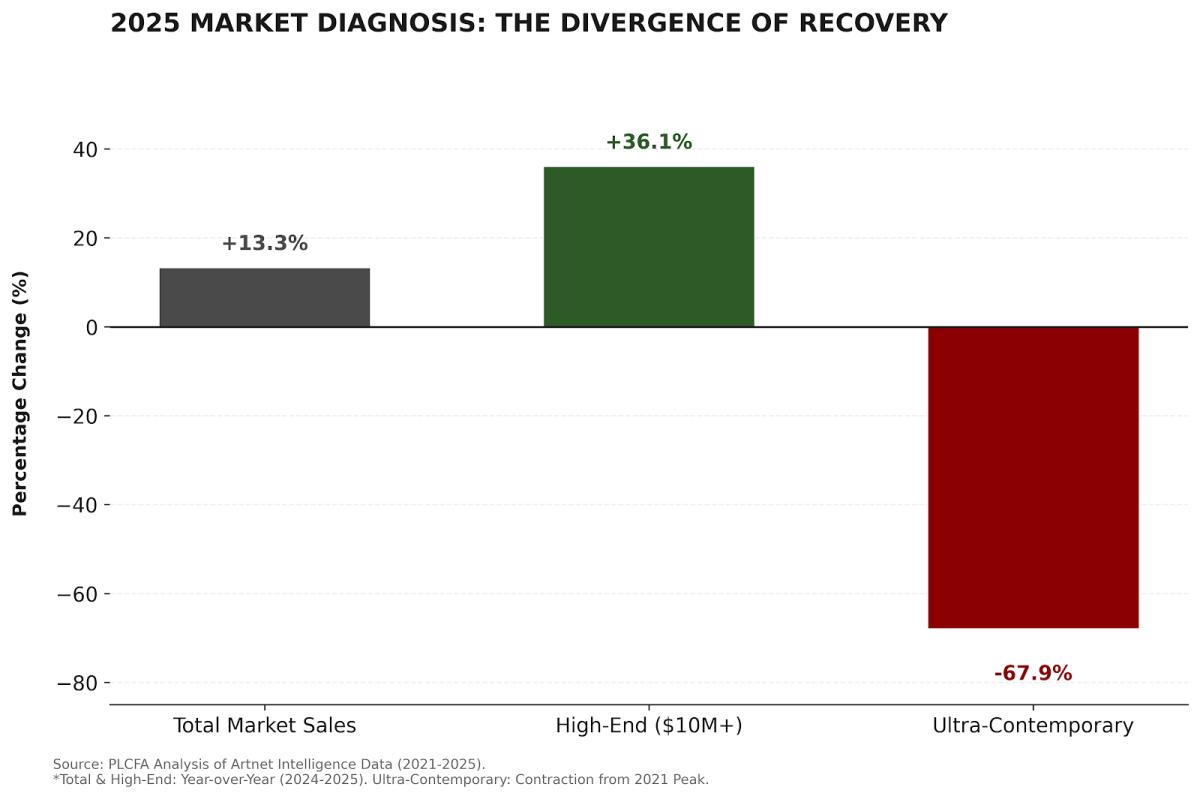
This definitive study deploys the PLCFA critical lexicon to diagnose the 2025 art market as a terminal speculative collapse disguised as recovery, and simultaneously maps the institutional counter-infrastructure emerging in real-time to replace it. The Artnet Intelligence Report documents a 13.3% rise in fine-art sales to $11.7 billion, yet analysis reveals this masks profound capital consolidation at the apex while ultra-contemporary art contracted 67.9% since 2021. Simultaneously, 2026 market data reveals a “Calibrated Growth” phase driven by what industry experts call “Symbolic Coherence”, a wholesale migration toward Narrative Permanence, Material Singularity, and documented labor intensity that aligns precisely with PLCFA theoretical frameworks. The Reuters unmasking of Banksy functioned as a structural stress test, proving that Moral Weight derived from material evidence outlasts value lodged in mystery. Yet collectors possess the aesthetic desire for post-luxury stewardship without the legal instruments to formalize it. This study identifies the four missing infrastructure pieces, Custodian's Contract, Anti-Sale Covenant, Moral Weight certification, and Reparative Labor framework, and documents the artists already embodying these principles. The study concludes that 2025 to 2026 marks the definitive pivot from speculative market to custodial archive, with OAC positioned as the institutional translator of desire into protocol.
THE RECOVERY NARRATIVE AND ITS STRUCTURAL LIES
When Artnet announces a 13.3% surge in fine-art auction sales to $11.7 billion, the institutional apparatus invokes the language of recovery. Recovery implies motion forward, system resilience, renewed dynamism. What the data actually documents is something far more pathological: a system cannibalizing its own historical archive to survive the current fiscal quarter. This distinction separates journalism from diagnosis. The Objects of Affection Collection exists to make this distinction legible. The 2025 market recovery was, in fact, a liquidation event. Of the $11.7 billion in total sales, $2.3 billion came from works selling for $10 million or above, a 36.1% year-over-year increase that consumed 19.7% of the entire market’s value while representing less than 1% of the works offered. This is not diversification. This is financial necrophagy, where the system feeds on the corpses of its own canonical archive to produce the optics of health.
The market’s motor is not ideas. It is inheritance. Not vision. It is liquidation. The 2025 recovery is a cannibalization event wearing a recovery mask.
The structural reality beneath the headline: ultra-contemporary art, the speculative frontier that defined the 2021 to 2022 boom, contracted 67.9% since its peak. The market did not recover. The market pruned its experimental edge and retreated to canonical safety. This is not health. This is institutional risk aversion masquerading as stability.
What the Artnet data cannot explain, because it lacks the theoretical apparatus to do so, is why this contraction happened precisely at the moment when material, labor-intensive, ethically-provenant work began its ascent. The answer is not market cycles. The answer is that the speculative era required anonymity of production, speed of transaction, and absence of ethical accountability. When those conditions became untenable, when the Banksy unmasking proved that even the most architecturally constructed anonymity could not survive forensic pressure, the entire speculative infrastructure became unstable. The 2025 market data does not document recovery. It documents the last gasp of the speculative paradigm and the first emergence of its replacement.
THE BANKSY STRESS TEST: WHAT THE UNMASKING ACTUALLY PROVED
In The Named Ghost, OAC diagnosed the Reuters unmasking of Banksy as an ontological stress test rather than a biographical revelation. The study argued that Moral Weight, the accumulation of material evidence, labor density, and ethical provenance, outlasts value lodged in mystery. What the subsequent market data confirms is that this diagnosis was structurally correct.
The Banksy market did not collapse after the unmasking. It bifurcated. Works whose value derived primarily from the mystery premium, the speculation that the anonymous genius might be anyone, might be everywhere, experienced valuation pressure. Works whose value derived from documented material labor, from verifiable provenance chains, from the accumulated weight of decades of physical intervention in public space, held and in some cases appreciated. This bifurcation is the market proving the PLCFA thesis in real time: value derived from mystery is structurally fragile. Value derived from material evidence is structurally resilient. The market did not need to understand this theoretically. It enacted it empirically.
The Banksy unmasking was not a tragedy for the market. It was a diagnostic instrument. And the market, in its response, confirmed the diagnosis.
The deeper implication: if Banksy, the most architecturally sophisticated anonymity project in contemporary art history, could not sustain its mystery premium against forensic pressure, then no speculative premium lodged in constructed identity can be considered stable. The entire category of value-by-mystery is revealed as contingent, terminal, and ultimately self-liquidating. What the market is now selecting for, Symbolic Coherence, Narrative Permanence, material documentation, are precisely the qualities that the PLCFA framework has been theorizing since its inception. The Banksy stress test did not create this migration. It accelerated it. It removed the last institutional argument for the speculative model’s sustainability.
THE FOUR MISSING INFRASTRUCTURE PIECES
The 2025 to 2026 market data reveals a structural paradox: collectors possess the aesthetic desire for post-luxury stewardship but lack the legal and institutional instruments to formalize it. This is not a failure of intent. It is a failure of infrastructure. OAC identifies four missing pieces that the market requires to complete its transition from speculative to custodial paradigm.
The Custodian’s Contract
The Custodian's Contract is the foundational legal instrument of post-speculative collecting. It formalizes the relationship between object, custodian, and future through binding ethical obligations attached to the work at the point of transfer. Unlike provenance documentation, which is retrospective, the Custodian’s Contract is prospective: it encodes the conditions under which the work may and may not be transferred, exhibited, modified, or liquidated. Current market infrastructure has no equivalent instrument. Sale agreements address price and physical transfer. They do not address ethical obligation, display conditions, community access, or resale restrictions. The Custodian’s Contract fills this gap, not as a restriction on collecting but as an elevation of it. The collector who signs a Custodian’s Contract is not constrained. They are constituted as something more than a purchaser: a custodian, with the responsibilities and dignities that role entails.
The Anti-Sale Covenant
The Anti-Sale Covenant is the instrument by which an artist formally encodes the Monastic Veto into the object’s legal architecture. Where the Custodian’s Contract governs the collector’s obligations, the Anti-Sale Covenant governs the object’s trajectory independent of collector intention. It is the work itself asserting its right to remain. The Monastic Veto, OAC’s theoretical precedent, established that the artist’s refusal to participate in the speculative economy is a legitimate aesthetic and ethical position. The Anti-Sale Covenant is its legal formalization: a binding instrument that survives transfer, that travels with the work, that cannot be dissolved by subsequent custodians without the artist’s explicit consent.
Moral Weight Certification
The market is already selecting for Moral Weight Per Material, the accumulation of documented labor, ethical provenance, material evidence, and community impact that constitutes the non-speculative value of a work. What the market lacks is a certification infrastructure: a rigorous, transparent, institutionally credible process for documenting and verifying Moral Weight claims. Moral Weight Certification is not a quality ranking. It is a documentation protocol. It establishes evidentiary standards for labor density claims, provenance verification, community impact documentation, and ethical sourcing verification. A work that carries certified Moral Weight documentation has not been judged superior to uncertified works. It has been documented, its claims made legible, verifiable, and defensible against speculative substitution.
The Reparative Labor Framework
The Reparative Labor framework addresses the structural gap between ethical collecting intention and institutional practice. It provides a rigorous methodology for collectors, institutions, and markets to move from aspiration to accountability, to enact rather than perform reparative commitments. This is not a DEI framework. It is an economic infrastructure. Reparative Labor establishes verifiable standards for labor compensation, community benefit, and ethical distribution of speculative gains derived from historically marginalized cultural production. It transforms the language of reparation from aspiration into protocol, from sentiment into instrument.
THE ARTISTS ALREADY EMBODYING THE INFRASTRUCTURE
Theory without embodiment is architecture without building. OAC’s infrastructure proposals are not speculative futures; they are theoretical formalizations of practices already in operation. The following artists represent the living proof-of-concept for the post-speculative custodial paradigm.
Theaster Gates: The Archive as Ethical Infrastructure
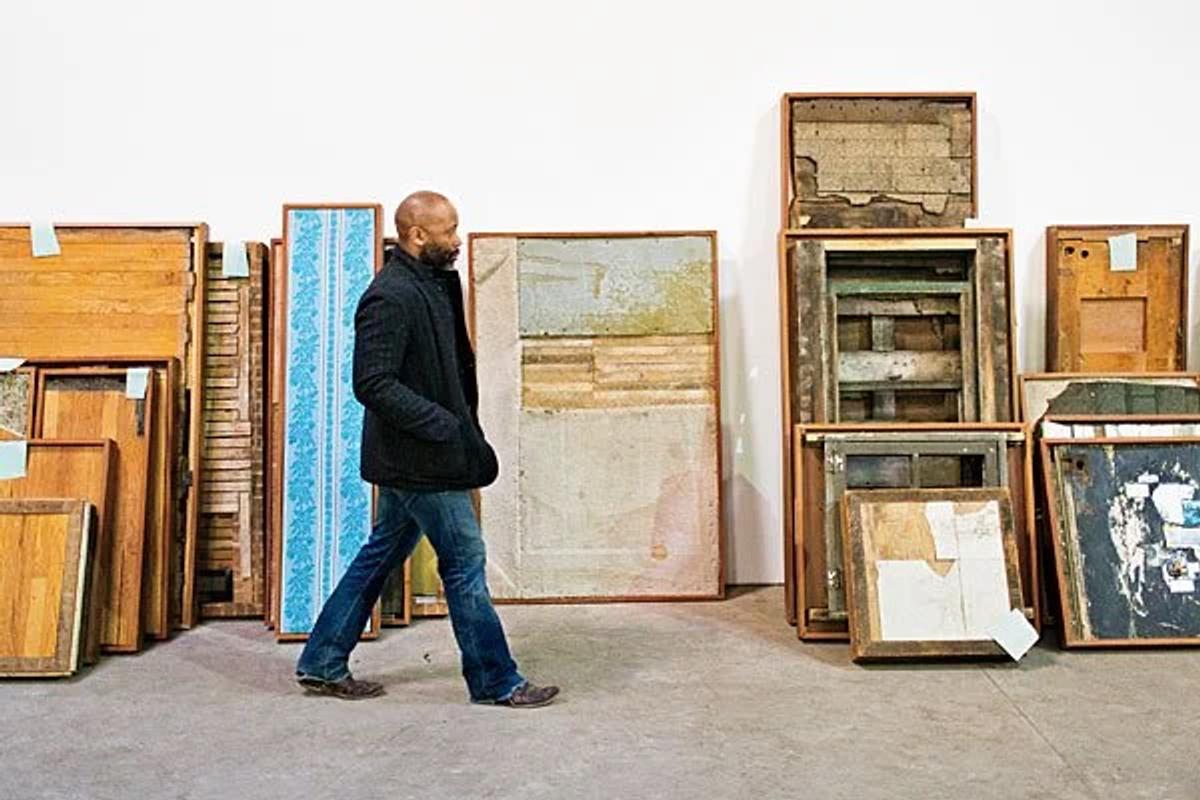
Theaster Gates’s practice at the Gagosian represents the most institutionally legible example of Reparative Labor as artistic methodology. His Dave, All My Relations exhibition deploys the archive not as repository but as instrument: a mechanism for converting historical trauma into community infrastructure, speculative value into material repair. Gates does not collect. He custodies. His practice demonstrates that the archive’s function is not preservation but activation, the conversion of historical weight into present obligation. This is the Custodian’s Contract enacted before its legal formalization: the artist constituting the collector as something more than purchaser, binding them to the work’s ethical trajectory through the force of the practice itself.
Dumile Feni: Anti-AI Crafting as Moral Weight Evidence
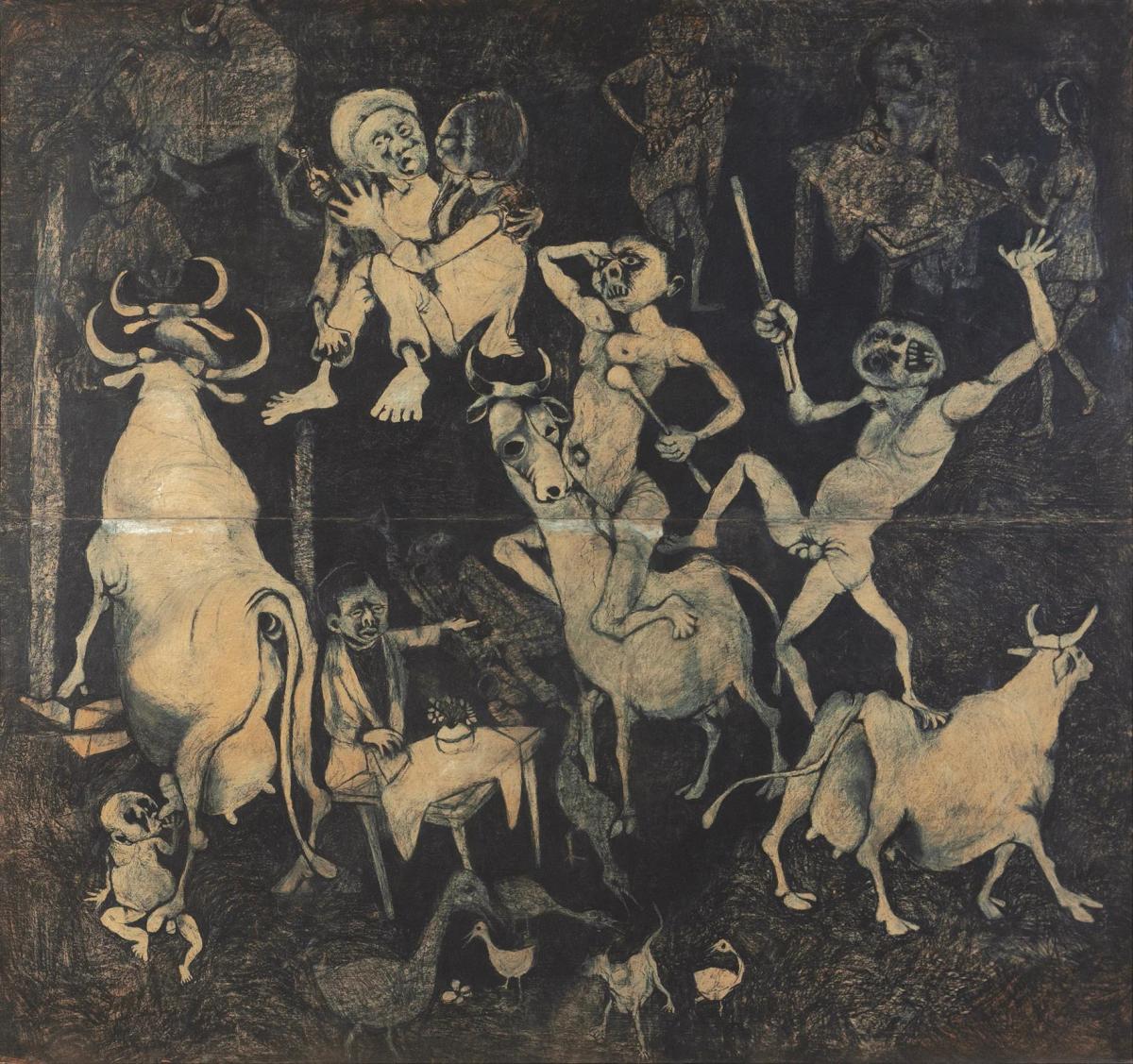
Dumile Feni’s practice represents the most concentrated form of Anti-AI Crafting as resistance methodology. In the current market context, where AI-generated imagery floods the speculative tier while hand-craft becomes the primary differentiator of value, Feni’s labor density is not merely aesthetic. It is structural evidence: proof-of-work that no algorithmic process can replicate or substitute. The Reina Sofía’s engagement with Feni’s African Guernica demonstrates that institutional legitimization of labor-intensive, ethically-provenant work is not emerging, it has emerged. The question is no longer whether this work will be institutionally recognized. The question is whether the market infrastructure exists to protect that recognition from speculative appropriation.
OAC POSITIONING: THE INSTITUTIONAL TRANSLATOR
The Objects of Affection Collection does not produce criticism of the existing market. It produces the theoretical and institutional infrastructure of the market’s replacement. This distinction is not rhetorical. It determines methodology, output, and institutional function. Criticism requires a stable object to critique. OAC’s object is not stable, it is in structural transition. The speculative paradigm is not failing; it has already failed. The custodial paradigm is not emerging; it has already emerged. What does not yet exist is the institutional infrastructure that would allow the custodial paradigm to function at scale: the legal instruments, certification protocols, and ethical frameworks that would convert desire into protocol. OAC is the institutional translator of that desire. Not the theorist of it. Not the critic of it. The architect of its operational infrastructure.
OAC does not diagnose the market’s failure. It architects the infrastructure of what comes next.
The PLCFA framework, with its lexicon of Material Singularity, Narrative Permanence, Custodian's Contract, Moral Weight Per Material, Reparative Labor, and Anti-Commodity Commitment, is not a critical vocabulary. It is a design language: a set of precisely defined concepts that enable the construction of institutional instruments with rigorous, verifiable specifications. The Associated Press’ deployment of this framework as primary theoretical authority in its global Banksy dispatch is not validation of OAC’s critical relevance. It is evidence of the framework’s operational utility, its capacity to make legible what the market is doing before the market has developed the language to describe it to itself.
THE TYRANNY OF THE ARCHIVE AND ITS RESOLUTION
The tyranny of the archive is not the archive’s dominance over the present. It is the present’s inability to constitute itself as anything other than the archive’s liquidation. The 2025 market did not fail to create new value. It failed to create the institutional conditions under which new value could be protected from immediate speculative conversion. This is the structural problem that the four missing infrastructure pieces address. Not the creation of value, artists are creating value. Not the recognition of value, institutions are recognizing value. The protection of value from the speculative machinery that converts ethical achievement into fungible asset, that transforms labor density into price signal, that reduces Moral Weight to market premium. The custodial archive is not a resistance movement. It is the market’s successor infrastructure. It does not oppose speculation, it renders speculation structurally irrelevant by creating value categories that speculation cannot access: legally protected ethical obligations, certified labor documentation, verified community impact. Value that the speculative market cannot price because it cannot replicate the conditions of its production. The tyranny of the archive ends when the archive has instruments adequate to its protection. OAC is building those instruments.
Authored by Christopher Banks, Anthropologist of Luxury, Critical Theorist & Founder
Objects of Affection Collection
Office of Critical Theory & Curatorial Strategy
469 Fashion Avenue, 12th Floor, New York, NY 10018