
The Architecture of Intent
A Critical Lexicon
This collection of studies is the intellectual architecture of Post-Luxury Conceptual Functional Art (PLCFA).
The true artistry of this Maison resides not in the finished form, but in the rigorous thinking that precedes it. These essays serve as the conceptual foundation for PLCFA, using a critical lens to interrogate cultural phenomena, art history, and consumer paradigms—analyzing everything from the ephemeral spectacle of luxury to the pure architectural rigor of abstract principles.
This is an invitation into the workshop of the mind. By sharing this process, we validate the necessity of a new category of value and invite you toward a well-considered life, one founded on true craft, uncompromising narrative, and durable meaning.
New to PLCFA? Begin with Essential Reading below.
Exploring a specific area? Navigate by category.
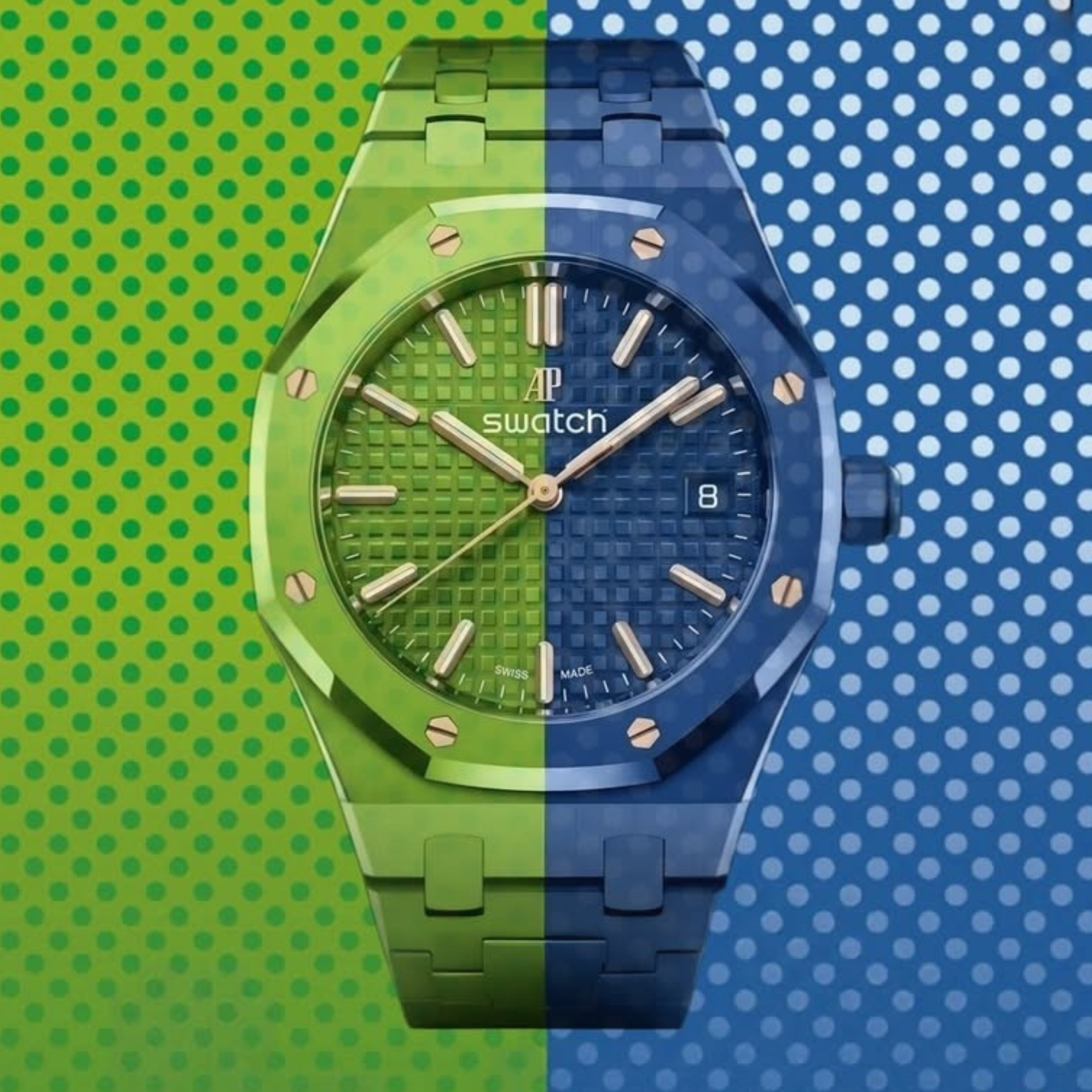
Audemars Piguet x Swatch Royal Pop: The Hollowing of an Icon
On May 16, 2026, the structural integrity of Swiss watchmaking faces its most volatile moment yet. The Royal Pop—a bioceramic collision between the fiercely independent Audemars Piguet and the mass-market machinery of Swatch—represents more than just a retail frenzy. It is a critical event in the history of objects. This study applies the Post-Luxury Conceptual Functional Art (PLCFA) framework to dissect the "Royal Pop" not as a democratizing gesture, but as a strategic extraction of an icon’s 54-year accumulated Aura.
Is the Royal Oak's material singularity resilient enough to survive the "Hollowed Object" condition, or has the holy trinity of horology finally traded its sovereignty for a moment of pop-cultural visibility? From the nocturnal genius of Gérald Genta's 1971 sketch to the manufactured chaos of 2026's boutique queues, we examine the Zero-Sum Aura transaction that cannot be undone. Read the full investigation into why the silhouette of the octagon may have just left Le Brassus on a one-way ticket.
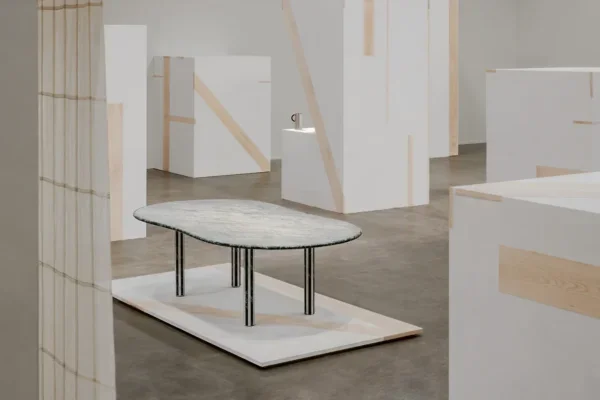
The Architecture of Absence: How Hermès Transformed La Pelota into the Most Precise Western Implementation of Ma Seen This Year
Every year, Milan Design Week produces one installation that the rest cannot replicate, and every year it is Hermès at La Pelota. For 2026, Charlotte Macaux Perelman and Alexis Fabry deployed plaster and beechwood volumes across the former Basque sports court in a loose grid — low blocks, raised elements, objects perched atop plinths as coordinates on a spatial map. The press called it a city of objects. OAC calls it something more precise: the most disciplined Western implementation of ma — the Japanese philosophy of productive emptiness — seen in any luxury presentation this year. Ma (間) is not minimalism. It is the recognition that the space between things is doing as much work as the things themselves. Hermès did not simply reduce. It constructed an argument out of absence, and that argument is what every other house at Salone could not make.
This study deploys the PLCFA framework to diagnose exactly how the architecture of the La Pelota installation functions as intellectual content rather than aesthetic preference — reading the grid through the lens of Semantic Burden, Zero-Sum Aura, Ceremonial Energy, and the Custodian's Contract. It asks why a privately held house with no quarterly earnings pressure consistently makes the spatial sacrifice that disclosure of meaning requires, and what that sacrifice reveals about the objects it surrounds. The conclusion is structural: the La Pelota installation works not because Hermès understands restraint, but because it understands that emptiness has a load-bearing function. The space is not scenic. It is the proof.

The TÓPA Intervention: A PLCFA Matrix Analysis of Moral Weight and Functional Endurance in the Polo Ralph Lauren Sphere
In the contemporary luxury landscape, value is often trapped in the Zero-Sum Pivot—a recursive economic loop where capital exchange generates no new cultural value, only the redistribution of existing status markers. The luxury object risks becoming a mere token of access, suffering from Semantic Decay if its cultural signifiers are hollow or severed from their source. The PLCFA (Proprietary Luxury Critical Functional Analysis) Matrix posits that true luxury requires Functional Endurance, defined not just as material durability but as the durability of the meaning encoded within the object. The TÓPA collaboration, framed within the Polo Ralph Lauren Sphere, demands rigorous interrogation because it attempts to rupture this zero-sum logic by moving from the performative representation of heritage to a verifiable index of Moral Weight Per Material (MWPM).
The investigation must determine if this collaboration represents a genuine pivot toward Design with Intent, or if it is merely the Spectacle absorbing its critics, a phenomenon explored in The Missing Mass. By explicitly grounding its aesthetic in Oceti Sakowin cultural craft and tethering its economic output to the Thunder Valley CDC’s Lakota Language Initiative, the project provides a measurable case study in MWPM Maximization. We dissect the material bifurcation—from the mass-produced Intarsia Knit to the high-MWPM Hand-Beaded Accessory—to evaluate how the collaboration directly converts consumer capital into crucial cultural capital, achieving a Functional Luxury Object that sustains the very culture it celebrates.

Why Traditional Luxury's "Root Marketing" Fails to Purchase Moral Capital
The global luxury sector is currently staging a Simulacrum of Resistance, a frantic, industrial-scale performance of ethics designed to obscure a fundamental epistemological collapse. We define this counter-strategy as Root Marketing: the commodification of origin stories—the quarry, the atelier, the harvest—deployed not to reveal truth, but to manufacture a flawless alibi for continued extraction. Legacy houses like LVMH and De Beers are engaged in a Zero-Sum Pivot they cannot survive, attempting to purchase Moral Capital through greenwashing campaigns while structurally refusing to bear the Cost of Intention. By analyzing initiatives from LVMH's "Life 360" to Cartier's "Grain de Café," this report exposes their foundational error: value is no longer found in the Flawless Geometry of the commodity, but in the Fissure of the "Custodian's Contract".
The failure of Root Marketing is evident in the industry's refusal to honor the object's longevity, substantiated by "repair horror stories" that reveal a Warranty of Obsolescence and the Thanatopolitics applied to vintage items. This structural dishonesty—where flawless bags are produced by flawed systems—is a legal and ethical liability that the Post-Growth Citizen is actively punishing. The era of fluff marketing is over; the Zero-Sum Pivot demands data. Any brand refusing to adopt the scathing metric of Quantified Moral Capital (MWPM)—which exposes how Speculative Velocity destroys true value—is merely selling a "luxury" that is, in fact, a toxic liability.

The Simulacrum of the Copy: Aritzia's 'Dupe' Trademark and the Legalization of Hyperreality in Global Fashion IP
The fashion industry has officially entered the hyperreal condition. Aritzia's aggressive move to trademark the phrase "Aritzia Dupe" is not a defense of its physical product, but an empirical, legal attempt to control the very language of imitation. This effort seeks to regulate the generated "real" that has emerged from digital discourse, where consumers openly celebrate the dupe as a "smart choice" that strips away exchange-value while retaining symbolic prestige. By appropriating the signifier of the copy, the brand effectively elevates the simulated item to a position of market authenticity, making the imitation the only legible truth about the product in the contemporary marketplace.
This legal maneuver fundamentally validates the critique outlined by Jean Baudrillard: the capacity to distinguish between the original and its representation has collapsed entirely. The brand has abandoned the traditional mandate to defend the material object, choosing instead to secure a proprietary claim over the imitation's signifier. This is the definitive endpoint of the Simulacrum—a structural acknowledgment that the economic and cultural significance of the copy now outweighs the material integrity of the original, forcing the legal system to affirm that the sign of the copy is a primary, source-identifying feature of the luxury brand.

The "Monopoly on a Vibe": Why the Louis Vuitton vs. Coogi Lawsuit is the Final Collapse of Luxury's Sign System
The Louis Vuitton vs. Coogi lawsuit isn't just about a colorful sweater. It is a legal and semiotic crisis that exposes the central contradiction of the entire luxury system. This study dissects the case as a high-stakes battle for the ownership of an abstract "vibe" that has become fully detached from any object. We explore the profound irony: Louis Vuitton, an empire built on the aggressive legal monopoly of its own sign (the Monogram), is now forced to argue in federal court against the very idea of protecting an aesthetic.
Drawing on Baudrillard's theory of hyperreality, this analysis frames the lawsuit as the 'end game'—the moment the system of sign-value, from Coogi's '90s hip-hop adoption to Pharrell Williams's new curatorial role, finally collapses under the weight of its own logic. This is not a battle between a real product and a copy; it's a war between two simulations, where the physical object is irrelevant. The only territory left to fight over is the simulation itself.

Anatomy of a Collapse: The Brunello Cucinelli Short-Seller Report and the Post-Luxury Future
They built a cathedral of ethics from cashmere and Kantian philosophy. A single short-seller report proved it was a house of cards, triggering a billion-euro collapse. That nagging doubt you feel about "quiet luxury" isn't cynicism; it's the sound of a narrative bubble bursting. This study is the definitive autopsy of that implosion. It dissects the allegations, from secret Russian deals to TJ Maxx inventory, to reveal the fatal contradiction at the heart of modern luxury: a brand cannot serve both the god of 'measure' and the god of perpetual growth. But this is not an obituary. It is a manifesto for what comes next. We present the Post-Luxury alternative, a framework where value escapes the fragile story and is anchored in the resilient truth of the object itself. This is the blueprint for building on solid ground.

The Tariff Effect: How Trade Wars are Reshaping the Luxury Market and Fueling the Post-Luxury Movement
It begins not with a bang, but with the quiet shock of a price tag. A familiar object of desire—a handbag, a watch, a bottle of wine—is suddenly untethered from its perceived value, its cost inflated by the invisible machinery of a global trade war. This is the story of how protectionist policies, enacted in the halls of power, have reverberated through our wardrobes and wine cellars, sparking a crisis of confidence for the world’s luxury titans. Yet, beyond the balance sheets and market turmoil, this economic storm is fueling a quiet rebellion. As the value of the logo fades, a deeper search for meaning emerges, accelerating a cultural shift toward the authentic, the personal, and the handmade. This is a comprehensive study of how tariffs are not just reshaping the cost of goods, but fundamentally altering our calculus of value, fueling a search for true objects of affection in a post-luxury world.

Robert Ebendorf: Found Objects, Philosophical Objects, and Post-Luxury Conceptual Functional Art
Robert Ebendorf is a pivotal figure whose lifelong practice defines Post-Luxury Conceptual Functional Art (P.L.C.F.A.). Operating as an alchemist of the overlooked, he challenges the traditional notion that artistic value must be derived from intrinsic material wealth. Ebendorf's ethos is to find "order and beauty out of chaos," transforming the discarded detritus of modern life—from rusted beer tabs to prosthetic eyes—into philosophical objects of profound personal and aesthetic worth. His work centers on Material as Story, elevating an object's ethical provenance and found history over its market price. By applying rigorous metalsmithing skill to non-traditional elements, Ebendorf’s functional jewelry acts as a powerful critique of consumption, making the act of wearing a piece a commitment to stewardship over ownership.
To understand the profound impact of this conceptual rebellion on contemporary craft, continue reading the full study.

The Miu Miu Problem: How Wisdom Kaye's Viral Meltdown Became a Blueprint for a New Philosophy
This study, The Miu Miu Problem and the Rise of Post-Luxury, unravels the seismic moment when influencer Wisdom Kaye exposed a shocking material failure, a viral unboxing that became a cultural reckoning for the entire industry. By dissecting this event, we argue that the old model of conspicuous consumption has been fatally compromised, giving rise to a new philosophy: Post-Luxury Conceptual Functional Art (PLCFA), where value is found not in a brand's promise but in an object's story. This work is an essential guide to the next great cultural shift—a turn from commodity to meaning itself.