Banksy Waterloo Place: The Suited Void's Critical Blindfold
On the Semantic Burden of the Flag, the Custodial Failure of the State, and What It Means When the World’s Most Famous Anonymous Artist Carves His Name in Stone
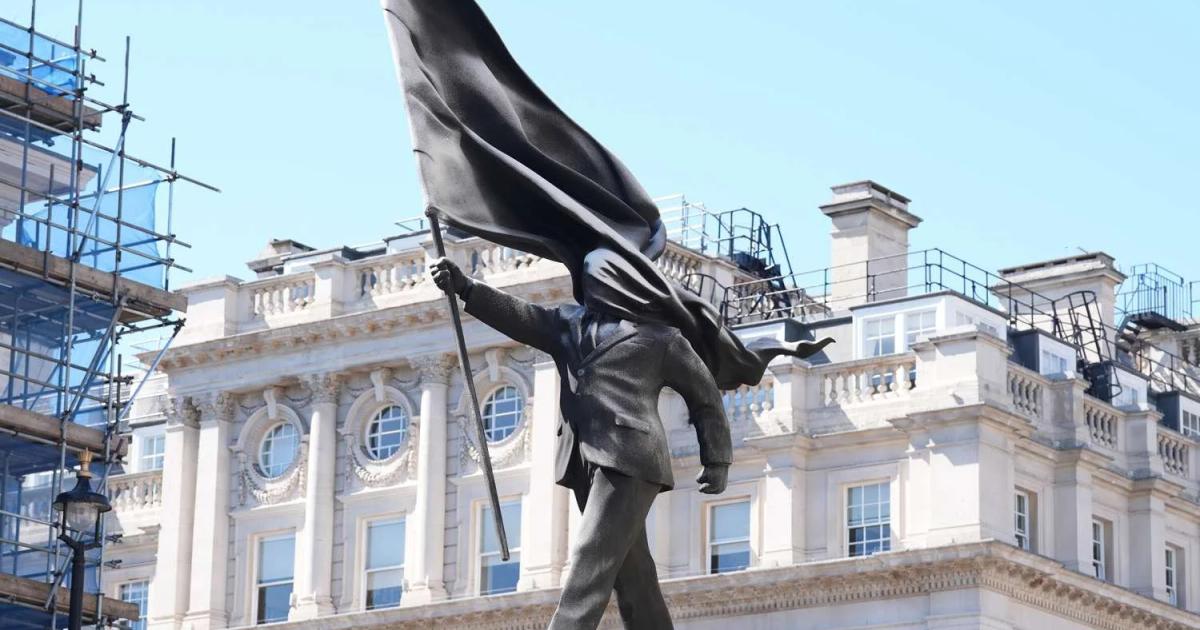
On the morning of 29 April 2026, a 25-foot sculpture appeared on Waterloo Place in central London: a suited figure, mid-stride, carrying a flag that entirely eclipses his face, one foot extending beyond the edge of the plinth into open air. By April 30, Banksy authenticated the work via Instagram: the first authenticated three-dimensional intervention in London since The Drinker in 2004. This study reads the statue through the PLCFA framework’s active lexicon of Semantic Burden, Narrative Permanence, Zero-Sum Aura, Sovereign Object, Spectacle of Dissent, and Object Testimony. The argument proceeds in four registers: the formal logic of the object itself; the semiotic charge of its location within the imperial commemorative landscape of St James’s; the structural shift in Banksy’s practice from unsigned mural to engraved, signed, three-dimensional monument; and finally, the post-anonymity question: what it means that the world’s most famous anonymous artist now carves his name directly into stone in the same week that the Reuters identity investigation reshapes the cultural record. The Waterloo Place statue is not a stunt. It is a structural argument rendered in bronze and granite, addressed to everyone who cannot see past the flag they are carrying.
The Object
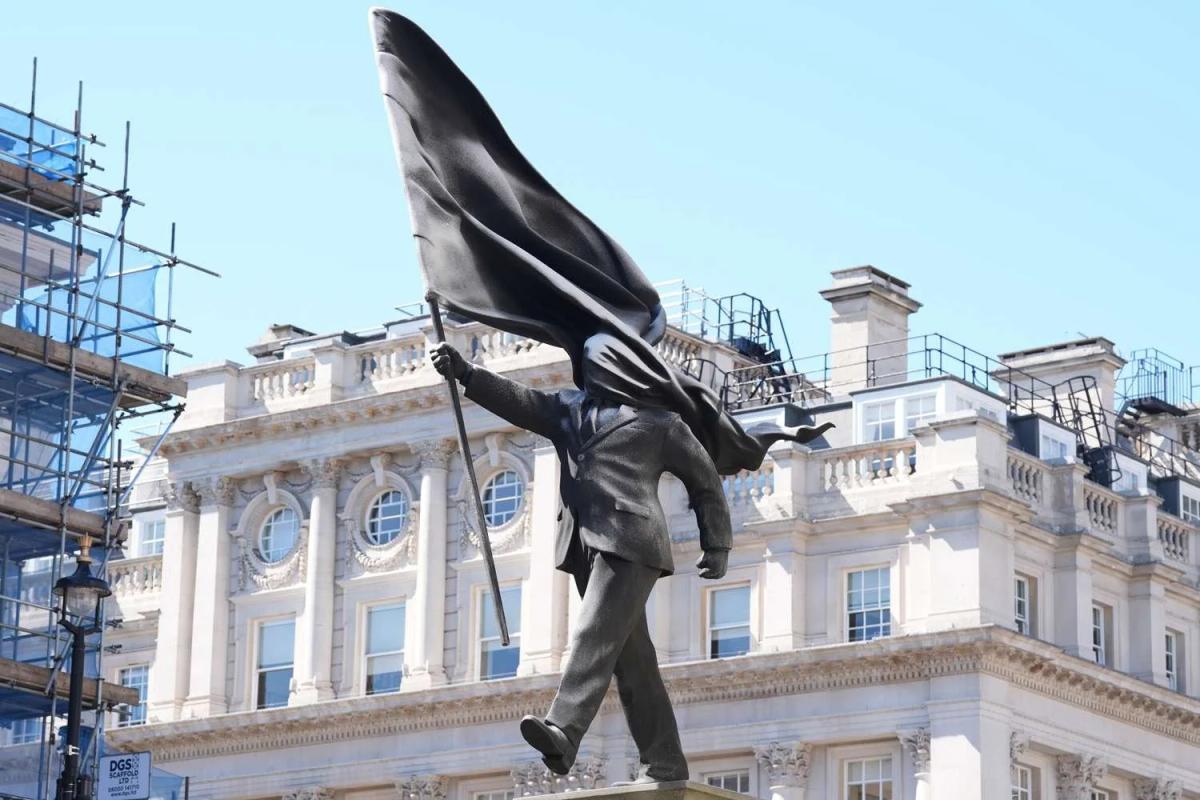
The sculpture is monumental in scale, approximately 25 feet from the base of the plinth to the top of the billowing flag, and mimics the bronze-and-granite palette of the surrounding London commemorative landscape with apparent precision. The suited figure stands atop a formal plinth. He is mid-stride. His posture communicates absolute confidence: the body of a man who knows where he is going. His face is completely obscured by a flag he is carrying: not beside him, not behind him, but in front of him, consuming his entire field of vision. One leg extends beyond the plinth’s edge. There is no ground beneath it.
The flag bears no national insignia visible in the documentation available at time of publication. This is not an oversight. Banksy is not critiquing a specific nation. He is critiquing the social commentary structure of flag-carrying itself: the mechanism by which national identity is used as a blindfold. The suited figure is not a soldier. He is not a protestor. He is a functionary: the bureaucratic body of power, marching forward in the certainty of its own righteousness, unable to see the void into which it walks.
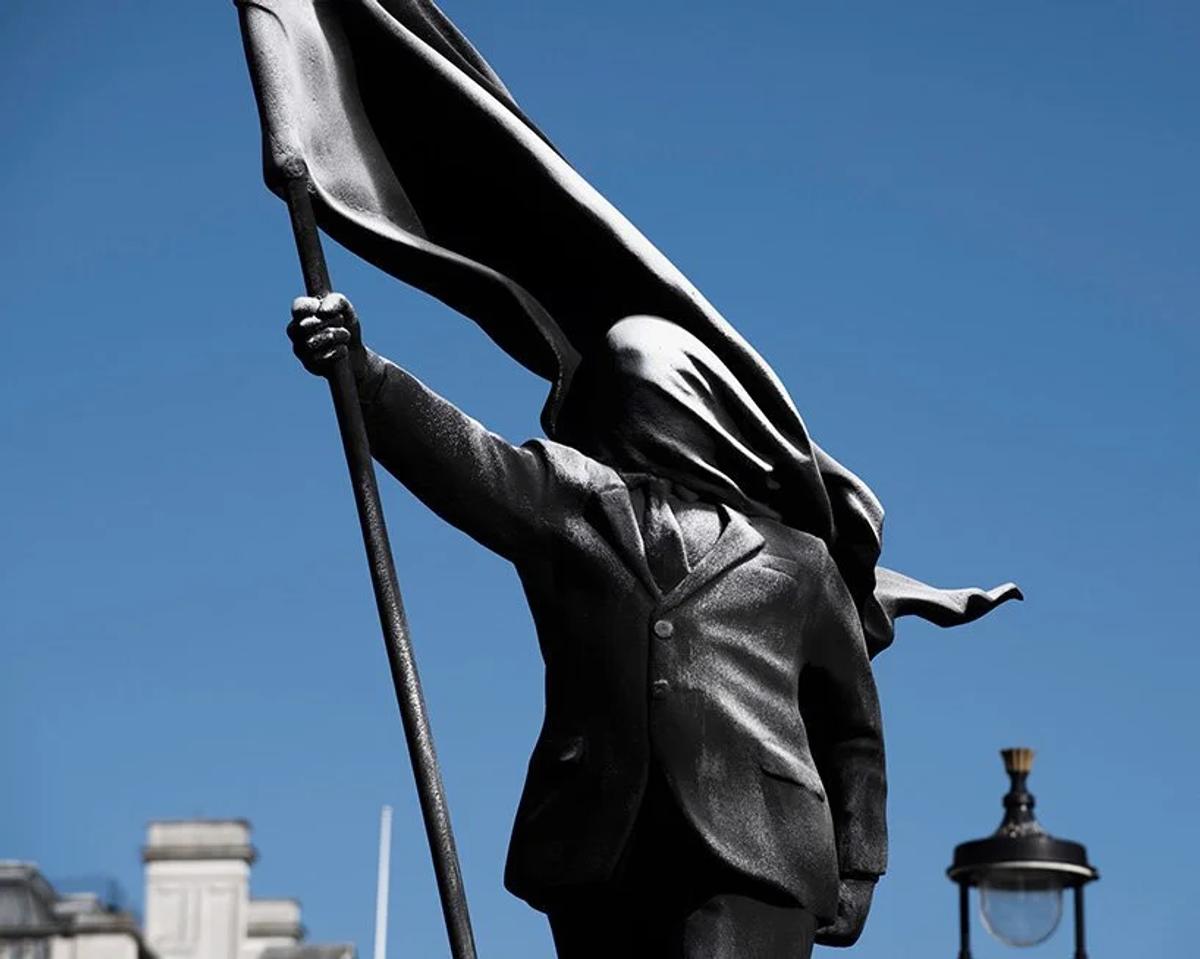
The flag is not what he is carrying. It is what is carrying him.
The conceptual art structure of the object is precise. It does not depict a man who has fallen. It depicts a man at the exact moment before falling: still in motion, still certain, still marching. This temporal position is the entirety of the argument. Banksy gives us the precipice, not the catastrophe. The catastrophe is left to the viewer to complete. This is Intentionality deployed at the level of narrative architecture: the object does not resolve. It arrests.
The Location as Argument
Waterloo Place is not a neutral site. It is among the most ideologically charged stretches of public space in the United Kingdom. Conceived in the early nineteenth century as a processional extension of Regent Street, its purpose was to make imperial power legible, permanent, and inevitable. The Duke of York Column rises at its southern end. The Guards Crimean War Memorial occupies its center. Statues of Edward VII, Florence Nightingale, and Lord Lea line its borders. Across the street: the Athenaeum Club, one of the oldest and most exclusive British gentlemen’s establishments, above whose entrance a gilded figure of Athena, goddess of wisdom, presides in eternal stillness.
The Waterloo Place statue sits approximately 450 meters from Downing Street. This is not geography. It is editorial positioning. The proximity transforms the suited figure from a generic political critique into a specific institutional address. The distance from the plinth to the seat of government is within walking distance in eight minutes. The figure appears to be walking in that direction.
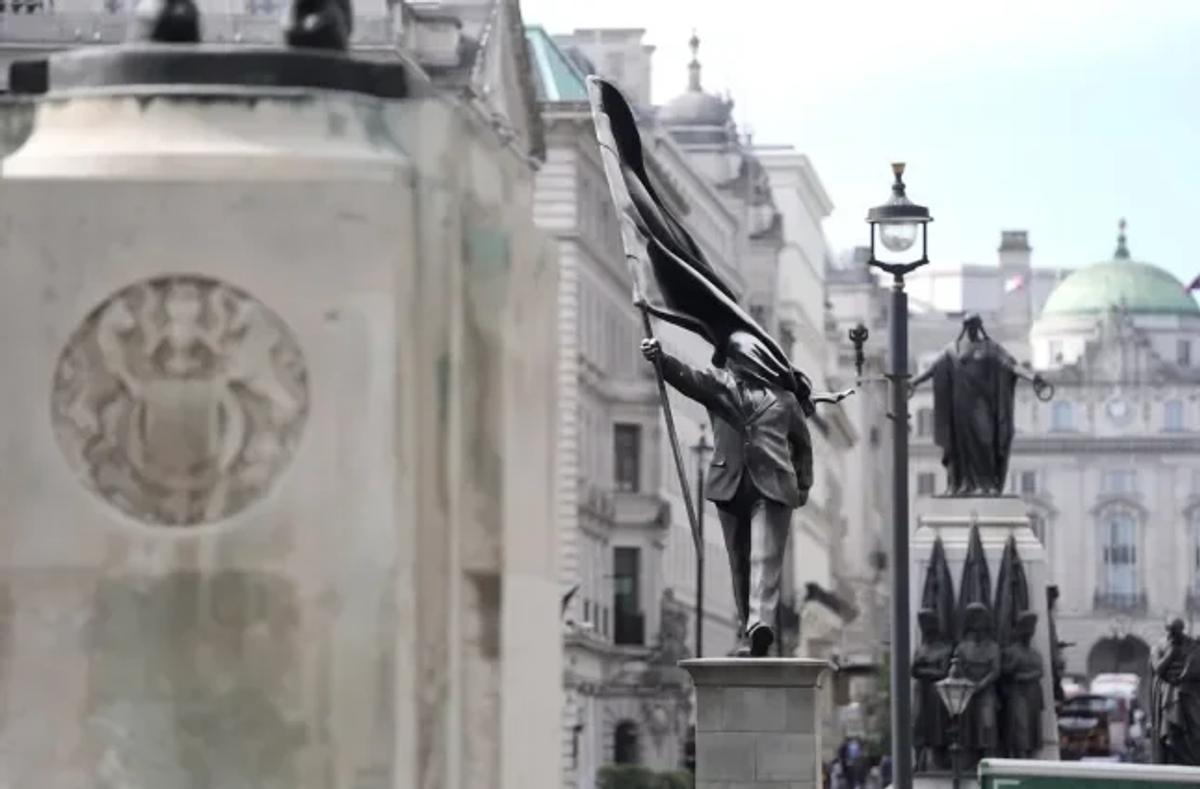
Banksy placed his statue among the generals, the monarchs, and the nurses of the British commemorative tradition, and made it the only one marching off the edge.
In PLCFA terms, Waterloo Place constitutes a White Wall Paradox operating at urban scale: a space constructed to render power aesthetically neutral, historically inevitable, and beyond critique. The surrounding monuments do not argue. They assert. Banksy’s intervention introduces the one thing imperial commemoration cannot tolerate: an object that moves. Everything else in Waterloo Place is frozen in permanent authority. His figure is caught in motion, specifically, the motion of falling.
This is Détournement in the tradition of Guy Debord (the repurposing of the spectacle’s own language against itself). The OAC’s extended analysis of the Debordian framework in relation to Banksy’s practice established that his most powerful works do not attack the Spectacle from the outside; they install themselves within its own grammar and corrupt it from within. The Waterloo Place statue does this with maximum formal precision: it looks, from a distance, exactly like the monuments around it. The blindness only becomes visible on approach.
Semantic Burden and the Flag as Hollowed Object
The flag in this work does not represent a nation. It represents the condition of representing a nation: the semiotic weight of the symbol as it consumes the person carrying it. In OAC’s lexicon, this is Semantic Burden: the condition in which the sign attached to an object exceeds the object’s capacity to carry it, until the sign becomes the object’s entire reality.
The flag in Banksy’s statue has become a Hollowed Object of the highest order. Its signifying function, to identify, to unify, to direct, has been so completely colonized by the abstract narrative of national identity that it has lost all functional content. It no longer points to a country. It points to the act of pointing. And this self-referential collapse of the sign has blinded its bearer entirely.
Jean Baudrillard’s argument in Simulacra and Simulation is literalized in three dimensions here. The flag is a simulacrum: not a representation of the nation, but a representation of the representation of the nation, so many layers of referential abstraction removed from any original meaning that it has become pure Sign Value, consuming the body that carries it. The OAC’s analysis of Baudrillard’s critique in the context of luxury value established that the final stage of simulacral collapse is precisely this: the sign no longer needs an object. It is self-sustaining. Banksy’s suited figure confirms this argument in public space: the man has become an accessory to his own flag.
The flag no longer represents the man’s convictions. The flag has replaced them.
The Object as Sovereign: Bronze, Stone, and the Question of Duration
Banksy’s mural practice is, by structural definition, temporary. Murals are painted on surfaces owned by others, in public space governed by institutions that can, and routinely do, remove them. The Royal Courts of Justice mural of September 2025, depicting a judge beating a protestor with a gavel, was covered within hours by HM Courts and Tribunals Service. This is not failure. It is the intended structure: the removal is part of the work’s Narrative Permanence. The photograph of the covered mural confirms the work’s argument more powerfully than the mural itself could have sustained.
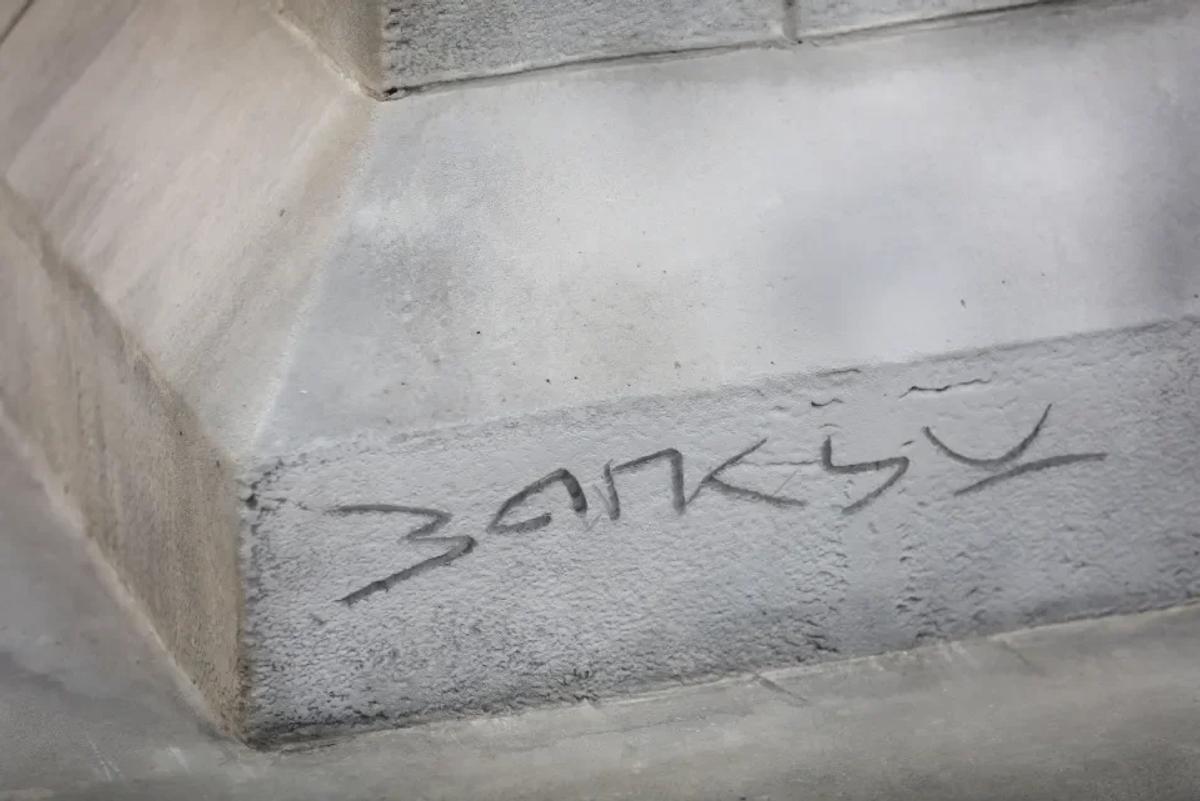
The Waterloo Place statue operates under a different structural logic entirely. It is three-dimensional. It occupies a formal plinth, a piece of urban architecture built to hold commemorative sculpture. It is made to last. And Banksy’s signature is not scrawled on it in spray paint. It is engraved in the reverse of the plinth, in stone, in the manner of official monument inscriptions. This is not the language of the ephemeral mural. This is the language of the Sovereign Object: an artifact that declares, by its very material form, that it intends to remain.
The 2004 Drinker (Banksy’s previous three-dimensional London intervention) was placed on a plinth on Shaftesbury Avenue without being fastened to anything. It was stolen within months, entering a decade-long saga of contested ownership that ended with a modified version returning to the original site in 2015 before being removed again. The theft was not incidental; it revealed the institutional vulnerability of the unauthorized three-dimensional object. Whoever holds it holds the Material Singularity. The body of the work becomes a site of contestation.
The Waterloo Place statue has been built differently. The structure was assembled overnight using prefabricated sections, a construction logic suggesting advance engineering and planning of significant sophistication. The scale, 25 feet, makes casual removal impossible. Westminster Council, which governs the area, did not immediately respond to press requests for comment at time of reporting. The object's Anti-Speculative resistance is partly physical: it is simply too large and too heavy to be appropriated by the same mechanisms that took The Drinker.
The Post-Anonymity Paradox: Carving Your Name Into Stone When Your Name Has Just Been Released
The timing of this work is not incidental. The Reuters investigation into Banksy’s identity (which named Robin Gunningham, now David Jones, as the artist with what it described as beyond-dispute forensic certainty) was published in mid-March 2026. The OAC’s four-study arc on the Banksy identity question, culminating in its AP wire citation as primary theoretical authority on March 22, 2026, established the structural argument: the Forensic Ledger did not destroy the Banksy brand. It transformed it. The Zero-Sum Aura (the condition in which every gain in identity certainty corresponds to an equivalent loss in mythological surplus) was activated by the Reuters revelation. The ghost acquired a face. The market began pricing the body.
The Waterloo Place statue arrives six weeks later. And on its plinth, in the stone, is the name: Banksy. Not scrawled. Engraved. The signature of the man who has spent thirty years ensuring his name is attached to everything except a person has now been inscribed in a monument designed to endure. This is the Narrative Permanence move at its most structurally audacious: in the moment when external forensic forces have attached his name to a body, Banksy responds by attaching his name to stone. He does not deny. He escalates.
They named him. He named himself. In stone. The difference is that his version will stand where he chose to put it.
The OAC’s analysis of The Wrong Face, the Reuters fact-check confirming that a London man unconnected to Gunningham had been misidentified and harassed by social media crowds, established that the release of the name was not merely a biographical disclosure. It was a Semantic Burden event: the name became a projectile generating mob epistemology as the structural inevitability of a collapsed void. Banksy’s response with the Waterloo Place statue suggests a remarkable counter-move: rather than retreat from the name, he deploys it architecturally. The name is no longer a secret someone can reveal. It is an inscription that belongs to him.
Spectacle of Dissent vs. Object Testimony: The Structural Limit of the Political Statue
The primary institutional risk of a work of this nature, the large-scale political statue operating in the mode of Street Art and Social Commentary (is absorption). The history of Political Art Activism is littered with works whose critical charge was neutralized by the appetite of the cultural market for legible dissent. Gregory Sholette’s concept of Artistic Dark Matter names precisely this dynamic: the vast majority of politically committed art remains invisible because it resists commodification; the small fraction that achieves visibility does so by becoming Spectacle of Dissent (critique absorbed into the very system it critiques, its political charge converted into cultural capital).
Banksy’s entire career is a case study in this paradox. The OAC’s founding study, The Banksy Enigma, diagnosed the structural architecture of his brand: the deliberate cultivation of void as value mechanism, the street as atelier, scarcity engineered through illegibility. His works sell at Sotheby’s for millions. His interventions generate global media cycles. Girl with Balloon self-destructed at auction and the resulting fragment sold for more than the original estimate. Every act of apparent resistance has been priced, certified by Pest Control, and integrated into the market.
The Waterloo Place statue will not escape this dynamic. It will be authenticated, it already has been. It will be photographed, shared, interpreted, and eventually either removed by Westminster Council (producing a documentation event) or formally protected (producing an institutional validation event). Either outcome extends the brand. What OAC is concerned with is not whether the work will be absorbed, it will, but what the work carries in the moment before absorption: what Object Testimony it delivers while it still stands.
The answer is specific: the statue delivers Narrative Arrest (the suspension of the onlooker’s interpretive certainty at the exact moment of approach). From a distance, it belongs to Waterloo Place. It reads as monument. On closer approach, the figure’s blindness becomes visible. The one leg hanging in the void becomes visible. The engraved name on the reverse of the plinth becomes accessible only to those who have walked entirely around the object. This is Tactical Friction operating at urban scale: the work rewards proximity with discomfort rather than confirmation.
The Custodial Question: Who Owns the Plinth?
The deepest question the Waterloo Place statue raises for PLCFA is not interpretive. It is custodial. The object has been installed without permission on public land governed by Westminster Council. The plinth on which it sits was presumably constructed as part of the intervention, there is no pre-existing plinth at that location. The entirety of the physical apparatus, sculpture, plinth, inscription, has been placed in public space without institutional consent, without Custodian’s Contract, and without the stewardship infrastructure that formal commissioning provides.
This is Banksy’s structural wager: that the Cultural Custodianship of the work will be managed, as it always has been, by the public. The city becomes the gallery. The pedestrian becomes the steward. The photograph becomes the preservation document. Westminster Council, in this model, must choose between two forms of institutional embarrassment: removing a work that is already globally authenticated and drawing the comparison to the Royal Courts of Justice mural removal, or leaving it in place and implicitly endorsing an unauthorized occupation of one of London’s most formally managed public spaces.
The statue makes Westminster Council the custodian of a decision it did not make, about an object it did not commission, on land it administers but no longer controls narratively.
In PLCFA terms, this is Custodial Mandate imposed from the outside: the institution is recruited into stewardship without its consent. The Cost of Stewardship falls entirely on the governing body that now must administer the aftermath. This dynamic was analyzed in the OAC’s treatment of Banksy’s September 2025 Royal Courts intervention: the institution’s act of covering the mural was itself the argument. Here, the stakes are higher, because the object is permanent-grade and the plinth is structural.
The Authentication Event: Instagram as Institutional Act
For approximately eighteen hours, the Waterloo Place statue existed in a condition of productive ambiguity. The name was on the plinth. The crowds gathered. The press arrived. The interpretive machinery activated. But without Instagram authentication, the work operated in the same epistemological space as Banksy’s anonymity itself (known but unconfirmed, attributed but deniable).
The Instagram post, when it came on April 30, did what it always does: it collapsed the ambiguity, transferred Provenance Integrity from the crowd to the artist, and initiated the formal authentication sequence. Pest Control, Banksy’s official authentication apparatus, will now manage the object’s institutional life from this point forward. The eighteen-hour gap was not a delay. It was the work’s first act: allowing the city to experience the object before the brand arrived to explain it.
View this post on Instagram
A post shared by Banksy (@banksy)
This sequencing, object first, artist second, institution third, is Anti-Virality operating at maximum formal precision. The work is designed to be found rather than unveiled. Its meaning precedes its attribution. The authentication event does not create the work’s significance; it closes the window of interpretive freedom that the unsigned object had held open. After the Instagram post, the suited figure becomes a Banksy. Before it, it was simply a figure marching off a plinth in Waterloo Place, and the city had to decide what that meant.
What the Statue Confirms and What It Leaves Open
The Waterloo Place statue confirms, without qualification, the PLCFA framework’s central argument about Sovereign Object practice: that the most structurally powerful objects are those that impose their custodial logic on the institutions that surround them rather than seeking institutional permission. The statue did not ask the Westminster Council. It asked the city. The city came. The work’s Object Testimony (the argument it makes by simply existing in that location, in that form, at that scale) precedes any institutional response and cannot be neutralized by it.
It also confirms the post-anonymity argument of the OAC’s Banksy arc: that the Reuters Forensic Ledger did not destroy the mechanism. It transformed it. Banksy’s response to being named is not retreat. It is the engraved name on the reverse of a stone plinth, placed in the most scrutinized public space in London, six weeks after the investigation. This is Narrative Permanence as counter-claim: his version of the name, attached to his terms, in his location, in material that outlasts newsprint.
What the statue leaves structurally open is the question OAC has not yet answered about Banksy’s three-dimensional practice: duration. The mural disappears. The plinth endures. If the Waterloo Place statue remains; if Westminster Council, calculating the political cost of removal against the cultural authority of the authenticated work, declines to act; Banksy will have achieved something no amount of mural-painting can: a permanent presence in the imperial commemorative landscape of London. Not hanging on a wall in Sotheby’s. Standing among the generals.
The framework was built for objects that refuse to leave. The question is whether the city’s institutions are prepared for one that stands in Waterloo Place.
Authored by Christopher Banks, Anthropologist of Luxury, Critical Theorist & Founder
Objects of Affection Collection
Office of Critical Theory & Curatorial Strategy
469 Fashion Avenue, 12th Floor, New York, NY 10018
RELATED OAC STUDIES
The following studies from the OAC archive speak most directly to the themes pursued in this paper. They are presented here as an invitation to follow the threads of this inquiry into adjacent territories of OAC's critical practice.
The Banksy Arc
· The Banksy Enigma: Mastering the Narrative of Modern Art
· The Named Ghost: On the Reuters Unmasking of Banksy
· The Named Ghost, Part II: The Forensic Ledger
Theoretical Foundations
· The Spectacle of Dissent: Debord, Sholette, and the Missing Mass
· The Simulacrum of Luxury: Jean Baudrillard’s Critique of Consumer Society