Hermès at La Pelota: The Architecture of Absence
Emptiness as Structural Argument: A PLCFA Reading of the 2026 Hermès Home Universe at Milan Design Week
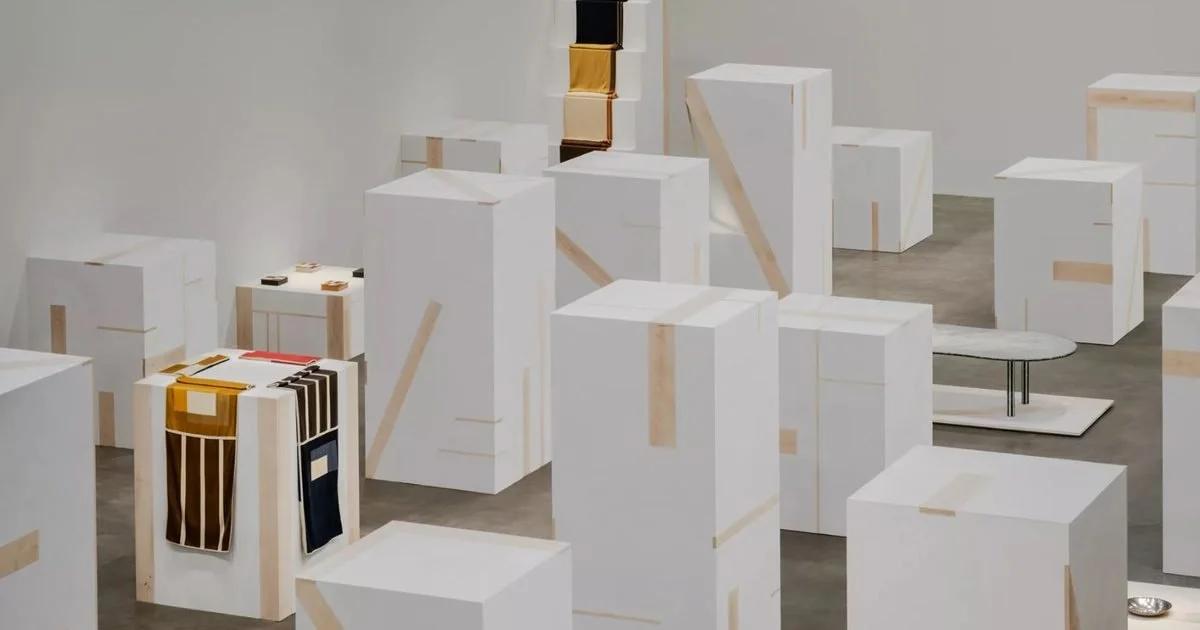
For the 2026 edition of Milan Design Week, Hermès occupied La Pelota with an installation that the press described as a city of objects. It was more than that. Designed by Charlotte Macaux Perelman and Alexis Fabry, the installation deployed plaster and beechwood volumes across the former sports court in a loose grid, creating lines of sight and paths that shifted with viewer movement. Objects were perched atop these plinths as coordinates on an imagined map. The space between the volumes was not a design accident. It was the argument. This study reads the 2026 Hermès presentation through the Post-Luxury Conceptual Functional Art (PLCFA) framework, deploying the following lexicon terms in active critical use: Semantic Burden, Affective Object, Material Singularity, Ceremonial Energy, Narrative Permanence, and Zero-Sum Aura. The central thesis: Hermès has achieved through La Pelota the most disciplined Western implementation of the Japanese spatial concept of ma (the productive emptiness that generates meaning) seen in any luxury presentation this year. This is not minimalism. It is not restraint for aesthetic effect. It is a structural argument about what objects require in order to speak.
La Pelota and the Problem of the Overcrowded Object
The default condition of Milan Design Week is excess. Every brand arrives with something to prove, and the architecture of proof is, invariably, accumulation. Objects crowd surfaces. Narratives compete for attention. The visitor is saturated before they have had time to register a single thing. This is not mere observation; it is the Spectacle operating at full efficiency, the condition that Guy Debord diagnosed as the colonization of lived experience by representation. In the design fair context, the Spectacle does not announce itself as ideology. It presents as curation.
Against this condition, Hermès has spent years developing a counter-architecture at La Pelota. The former 1940s Basque sports court in the Brera district has hosted the Maison's annual presentation for over a decade, and what distinguishes it from every other luxury house installation in the city is not what Hermès puts into the space. It is what Hermès refuses to put in. The 2024 installation examined raw materiality with earthy, grounding matter. The 2025 edition floated white suspended boxes in a near-colorless field, projecting chromatic halos onto the ground as the only color event. The 2026 installation introduced an immersive field of plaster and beechwood volumes arranged as a loose grid; a structure that Charlotte Macaux Perelman herself characterized as a city, with objects functioning as coordinates on a spatial map.
This is the problem the present study takes as its subject: what does it mean to design emptiness as content? And why does Hermès, of all luxury houses, do it best?
The luxury house that understands emptiness as argument is practicing something more rigorous than restraint. It is practicing a philosophy of the object, one that Western design culture has no word for, because it has borrowed none from the cultures that do.
Ma: The Concept Western Luxury Cannot Name
The Japanese concept of ma (間) is commonly rendered in English as negative space, pause, or interval. These translations are precise without being adequate. Ma is not the absence of content. It is the presence of potential. The kanji combines the characters for gate and sun: light passing through an opening, luminosity produced by the gap. Ma in architecture, music, conversation, and garden design refers to the productive space between things: the silence that makes sound intelligible, the pause that makes speech possible, the empty alcove (tokonoma) that transforms a single object into an event.
Architect Arata Isozaki described ma as "the space of imagination that exists between two things or two moments." The Heart Sutra provides its philosophical foundation: "form is emptiness, emptiness is form." In Japanese design, this is not paradox; it is methodology. The raked gravel in a Zen garden is not background. It is the primary material. The stones derive their meaning from the sea of carefully composed absence around them. In ikebana, the space between the flowers is as deliberately arranged as the flowers themselves. In the tea ceremony, the interval of preparation is the ceremony. Ma is the recognition that what is absent shapes what is present with as much authority as what is present shapes what is absent.
Western design has no equivalent term. As critic Ralph Richardson observed of the arts more broadly, the gap is a serious omission. Minimalism, the closest Western aesthetic category, approaches the territory from the wrong direction: it is defined by reduction, the removal of elements to achieve a cleaner composition. Ma is not reduction. It is the recognition that emptiness is already something. The distinction matters because a minimal space and a ma space produce different phenomenological results. The minimal space reads as restraint. The ma space reads as anticipation.
This distinction is central to the PLCFA framework's account of the Affective Object: the artifact whose emotional register depends not on its own properties but on the relational field it is placed within. The Affective Object requires an environment calibrated to its Semantic Burden: the full weight of meaning the object carries and demands from its custodial context. An object with high Semantic Burden placed in a dense, overloaded environment suffers what PLCFA diagnoses as semiotic interference: the object's meaning becomes indistinguishable from the noise around it. The consequence is not invisibility. The consequence is the degradation of aura, in precisely the sense Walter Benjamin described: the collapse of the singular into the reproducible, the loss of the here-and-now of the authentic encounter.
The City as Critical Form: Reading the 2026 Installation
Macaux Perelman's description of the 2026 La Pelota installation as a city is not atmospheric marketing language. It is a structural disclosure. A city, in its essential form, is a system of relationships between volumes and intervals. Streets derive their character from the buildings that define them, but they are not buildings. The square is defined by the facades that surround it, but it is not facade. The city works because the intervals between built elements are as deliberate as the elements themselves. The space between buildings is the city's social medium: the place where encounter becomes possible.
The 2026 installation deployed plaster pillars of differing heights alongside beechwood volumes, arranged so that low blocks and raised elements established alternating lines of sight. Objects from the Hermès home collection were perched atop these plinths as spatial coordinates. Visitors moved through the installation as a traveler moves through a city: discovering perspectives, encountering objects at angles unanticipated by the plan, assembling meaning from sequential revelation rather than simultaneous exposure. The Stadium d'Hermès table; a marble figure-eight by Edward Barber & Jay Osgerby evoking the curve of a horse's back; occupied a central position but was not privileged by scale or illumination. It earned its centrality through placement and proportion. Around it, hammered palladium vessels, leather-wrapped containers, and textile works occupied their plinths with the authority of objects that have not been overcrowded.
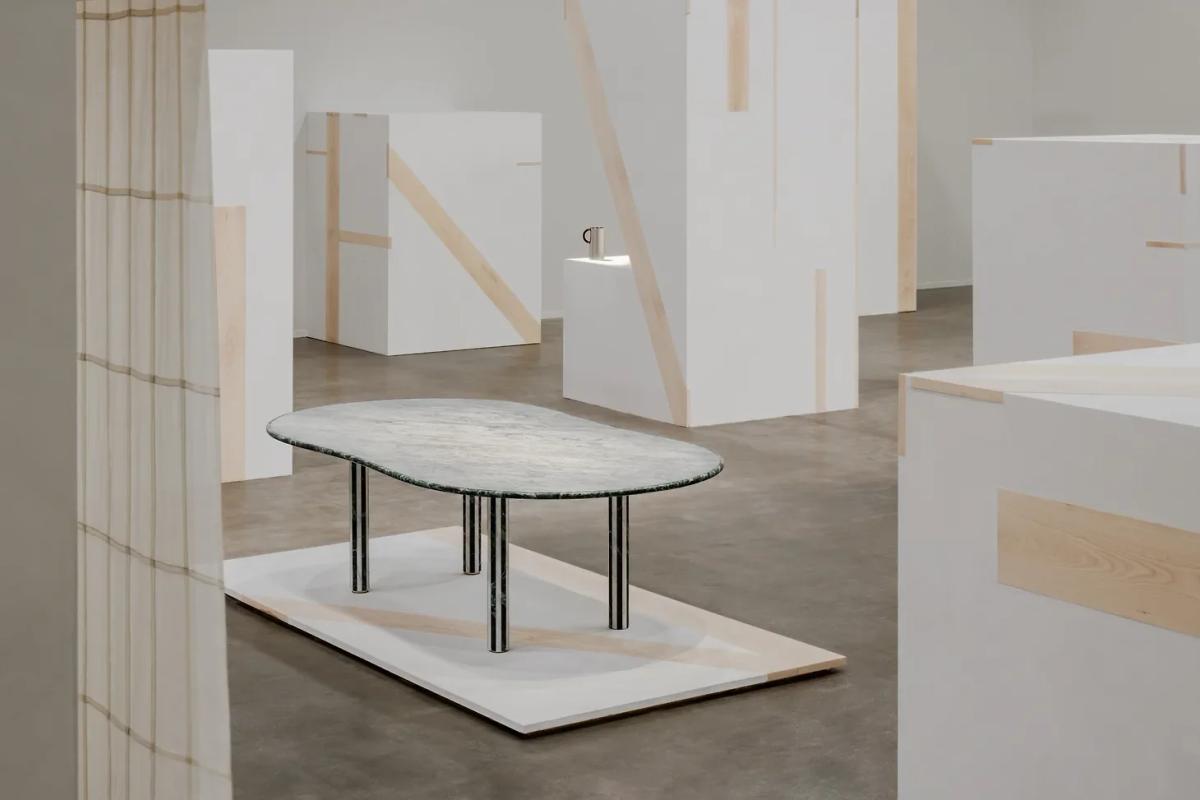
This is the critical maneuver. In a dense installation, every object competes for the viewer's attention, and attention is a finite resource. In the Hermès field-grid, objects do not compete because the space between them is not neutral territory: it is compositional material. The emptiness around each plinth is the interval that makes the object on the plinth legible. The visitor's path through the grid generates ceremonial energy: the meaning produced by ritual movement through a space organized for encounter rather than consumption. The space is not scenic background. It is the active medium of the encounter.
A city that does not understand its streets is not a city. It is a collection of buildings. Hermès at La Pelota is a city. Most luxury installations at Milan Design Week are collections of buildings.
Material Singularity and the Object as Coordinate
The PLCFA framework's concept of Material Singularity holds that every authentic object occupies a unique position in material and narrative space that cannot be replicated. This is not a claim about rarity in the market sense. It is a phenomenological claim: the singular object, encountered in conditions appropriate to its singularity, produces an encounter that the reproduced or commodified object cannot. The condition requires two things simultaneously: an object with sufficient Narrative Permanence: the accumulated depth of craft history, material specificity, and authorial intent, and an environment calibrated to make that permanence perceptible.
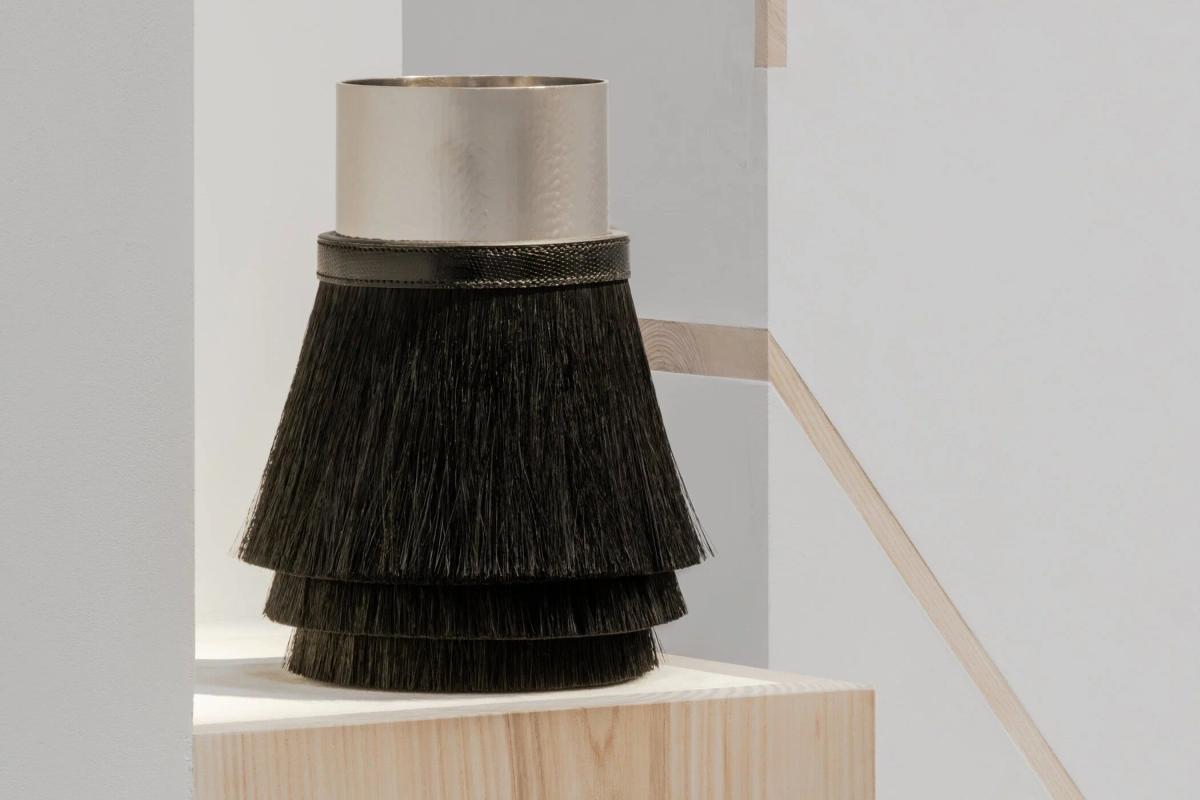
The 2026 Hermès collection provided both. The Palladion d'Hermès series, hammered metal vessels carrying the literal trace of the artisan's gesture in every surface inflection, represents what Macaux Perelman explicitly called the visibility of craftsmanship. Smooth metal, she noted, conceals the hand. Hammered metal discloses it. The surface is the record of the making. This is the algorithm of the hand functioning at its highest register: a process whose result cannot be computed, only accumulated through physical labor that leaves its evidence in the object. Leather-wrapped cylindrical vessels and horsehair-decorated bowls extended this logic. The organic material carried its own history, the animal that produced it, the hands that worked it, into an object that would otherwise read as purely formal geometry. The material's biography became part of the object's semantic burden.
The OAC study of the Aura Transaction established the mechanism by which luxury borrows cultural meaning from outside itself and transfers it onto product. Hermès at La Pelota inverts this operation. The meaning is not borrowed from an external cultural reference and applied to the object. The meaning is produced by the object itself, through the density of its making, and then amplified by the space that surrounds it. Each plinth in the installation functions as what PLCFA would call a narrative isolator: a device that prevents one object's meaning from leaking into or being contaminated by another's. The interval between plinths is not decorative spacing. It is the condition of legibility.
The Custodian's Contract at Spatial Scale
The PLCFA framework's Custodian's Contract holds that every authentic object demands active engagement from those who hold it. The contract is not economic; it is ethical. The custodian who holds a high-MWPM object is not merely storing value. They are sustaining a relationship with the object's meaning across time. This contract typically operates at the scale of the individual collector or institution. The 2026 Hermès installation at La Pelota demonstrates that the Custodian's Contract can be enacted at spatial scale: that an environment itself can perform the function of active custodianship toward the objects it contains.
Consider what the installation refuses. It refuses density. It refuses simultaneous revelation. It refuses the efficiency logic that drives most design fair presentations: the imperative to show as much as possible in the available square footage. By deploying objects as sparse coordinates across a field of plaster and beechwood, Hermès accepts a significant opportunity cost: fewer objects could have been displayed, and fewer objects means fewer potential sales conversations, fewer press photographs, fewer units of product exposure. The refusal is not economically neutral. It is economically costly, and it is chosen anyway.
This is what the OAC study "The Tyranny of the Archive" identifies as the cost of stewardship: the material sacrifice that custodianship requires when it is genuine rather than performed. The institution, the collector, or in this case the presenting brand that accepts reduced economic throughput in order to maintain the conditions of meaning production is demonstrating something that most luxury presentations at Milan cannot demonstrate. It is demonstrating that the objects matter more than the metrics.
The luxury house that sacrifices throughput for meaning has made a custodial commitment. The luxury house that maximizes throughput and calls it curation has made a commercial one. The distinction is absolute and visible from across the room.
Zero-Sum Aura and the Failure of the Dense Installation
The PLCFA concept of Zero-Sum Aura describes the condition in which aura is finite within a given field of encounter: when too many objects compete for the same attentional and affective resources, each object's aura is diminished in proportion to the density of competition. This is not a metaphysical claim; it is a perceptual one. Human attention is not unlimited. The visitor who encounters twenty objects in quick succession does not perceive twenty auratic encounters. They perceive a blur from which, at best, three or four images survive. The rest is consumed and expelled.
The standard Milan Design Week presentation, consciously or not, operates within a Zero-Sum Aura logic: the host hopes that their objects are among the three or four that survive the blur. This is a losing strategy for any object with genuine narrative permanence, because the object with the most accumulated meaning requires the most time and attention to disclose it. The hammered Palladion d'Hermès bowl does not reveal the gesture of its making in a three-second glance. It requires the visitor to pause, to approach, to look again from a different angle. The Hollow Object: the luxury product whose surface value is all there is, can survive the blur because there is nothing beneath the surface to require time. The deep object cannot.
The Hermès grid installation at La Pelota is a structural solution to the Zero-Sum Aura problem. By controlling the density of objects relative to the volume of the space, by ensuring that each plinth functions as an isolated encounter rather than an element in a crowd, the installation creates the conditions for auratic time. The visitor is not rushed by the pressure of what comes next, because what comes next is legible at a distance and not competing for attention with what is present now. The intervals do the work that attentional scarcity would otherwise prevent.
The Western Ma Problem: Why This Is Rare and Why It Matters
The concept of ma is not inherently inaccessible to Western design practice. It is structurally available to any practitioner or institution willing to recognize emptiness as content rather than absence. What makes it rare in Western luxury contexts is precisely the economic logic that governs them: the pressure to fill available space with product, to maximize exposure, to demonstrate range and depth through accumulation. The Spectacle economy, as OAC's foundational studies have established, is a machine for generating visible plenitude. Emptiness reads as waste to the Spectacle. Silence reads as failure. The interval reads as something that hasn't arrived yet.
Hermès is structurally positioned to escape this logic in ways that most luxury brands are not. As a privately held company with a multi-generational ownership structure, it is not subject to the quarterly earnings pressure that drives most luxury conglomerates toward acceleration. The 2026 Macaux Perelman installation embodies this structural freedom in spatial terms: the decision to deploy objects as sparse coordinates across a field of constructed emptiness is a decision that could only be made by a house that does not need to maximize its yield from every square meter of La Pelota. The space is not expensive real estate to be optimized. It is the medium of the argument.
The OAC study of Christie's Dark Mode Auctions diagnosed the private auction economy as speculative capital's perfection: the enclosure of publicly created meaning within privately controlled transactions. The Hermès installation operates on the opposite principle: the public encounter with the object is not a transaction at all. It is, in PLCFA terms, a custodial ceremony: a moment in which the visitor is invited into a relationship with the object that precedes and exceeds any commercial valuation. The space between the plinths is the spatial expression of this refusal to reduce the encounter to a purchase decision.
The house that can afford to let the air breathe around its objects has already demonstrated something no price tag can communicate. It has demonstrated that its objects are not products waiting to be bought. They are arguments waiting to be understood.
La Pelota as Institutional Model: What Other Houses Cannot Replicate
The OAC study of Milan Design Week 2026 noted that Hermès "continues to treat domestic objects as sites of deep material seriousness." This is accurate but incomplete. What Hermès demonstrates at La Pelota is not merely material seriousness; it is what could be called institutional ma: the recognition that the space between the objects, the interval in the encounter, the pause in the discourse, is not organizational padding but constitutive content.
No other house at Milan Design Week 2026 achieved this. Louis Vuitton's home collection debut at Palazzo Serbelloni deployed archive-driven storytelling but within a density logic that prioritized range over depth. Gucci's 105-year retrospective at San Simpliciano was conceptually ambitious but curatorially maximalist. The Loro Piana textile study and Jil Sander's Reference Library came closest to the Hermès register; both featured genuine intellectual restraint; but neither achieved the spatial argument that La Pelota makes year after year.
The reason is architectural as much as editorial. La Pelota's cavernous volume provides the raw material for the grid-city argument, but volume alone is insufficient. Macaux Perelman's contribution is the decision, repeated, refined, and deepened across more than a decade, to treat that volume as a resource for encounter rather than a surface for display. This is institutional practice, not annual curation. The Wabi-Sabi tradition in Japanese aesthetics holds that true beauty requires time to become visible: that the patina of a well-used object or the irregularity of an imperfect surface discloses its character through attention rather than at first glance. The La Pelota installation embeds the same temporal logic in spatial form: the beauty of the encounter requires the visitor's movement, their changing angle of approach, their willingness to pause and return.
The SEO of Emptiness: What the Market Is Actually Searching For
There is a paradox embedded in the 2026 La Pelota installation that deserves explicit diagnosis. The Hermès presentation is, by conventional design fair metrics, underperforming: fewer objects than competitors, less visible spectacle, lower surface density of product exposure. Yet it consistently generates the deepest critical response, the most sustained press coverage, and the most consequential curatorial conversation of any presentation at Milan Design Week. Elle Decoration UK called it "the highlight of the week and, for many, of the annual design calendar itself." Designboom devoted a feature to its spatial logic as a standalone subject. The OAC Milan 2026 study identified it as an essential stop, distinct from the merely luxurious, because of its convergence of material intelligence and curatorial framing.
This is the market discovering, through its attention economy, what PLCFA has named structurally: the deep object in the right spatial context generates more meaning per encounter than the shallow object in a dense array. The Semantic Burden of the Hermès collection, the accumulated weight of craft history, material specificity, artisanal labor density, and equestrian cultural reference, requires the spatial conditions that La Pelota provides in order to disclose itself. Without those conditions, the object is still technically excellent. With them, it becomes an argument about what objects are for.
The PLCFA framework has consistently diagnosed the contemporary luxury market's fundamental confusion: the conflation of product with object, of surface excellence with narrative depth, of aesthetic pleasure with meaning production. The Hermès installation at La Pelota refuses that confusion with the rigor of the architect and the patience of the custodian. It is the institutional embodiment of ma in a Western luxury context: not as borrowed aesthetic, not as design trend, but as genuine structural commitment to the proposition that emptiness is content, that the interval generates the meaning, and that the most significant thing in the room is sometimes the space between the things.
The market’s attention finds Hermès at La Pelota year after year not because it is the loudest presentation in the city. It finds it because it is the only presentation that trusts the silence to do its work.
What La Pelota Confirms and What It Leaves Open
The 2026 Hermès installation at La Pelota confirms three things that the PLCFA framework has argued but which the luxury market has been slow to act on.
First: spatial emptiness is not the absence of design. It is design's most demanding form. The decision to place an object alone on a plinth, surrounded by controlled interval, is more difficult than placing it in a crowd, because the object must sustain the encounter without support. The Palladion d'Hermès vessels sustain it. The Stadium d'Hermès table sustains it. The cashmere textiles sustain it. The installation's confidence is predicated on the objects' capacity to bear the weight of being seen.
Second: the Ceremonial Energy of an encounter is a function of its spatial architecture. The visitor who moves through the La Pelota grid is performing a ceremony of attention: a structured engagement with objects that ritual movement transforms from visual consumption into something closer to reading. The meaning of the encounter is produced in the movement, not merely in the object.
Third: ma is not a Japanese concept that Western design has failed to import. It is a structural truth about the relationship between objects and the spaces that surround them that Japanese design culture formalized and named. Hermès has enacted it without naming it, which is the deeper achievement. The concept does not need to be declared for the architecture to function. But PLCFA names it here because the failure to name it is the reason the rest of Milan Design Week cannot replicate it.
What La Pelota leaves structurally open is the question of scale and replicability. The Hermès installation is possible because of a specific ownership structure, a specific institutional patience, a specific directorial continuity (Macaux Perelman and Fabry have held their roles since 2014) and a specific building. The field-grid argument requires La Pelota's volume and Hermès's willingness to sacrifice throughput. It also requires objects with sufficient Material Singularity to sustain isolation. The model cannot be transferred to a brand whose objects cannot survive being seen alone. This is not a limitation of the spatial philosophy. It is a revelation of the objects' depth. The architecture of absence proves, by its success or failure, whether the objects it surrounds are real.
Authored by Christopher Banks, Anthropologist of Luxury, Critical Theorist & Founder
Objects of Affection Collection
Office of Critical Theory & Curatorial Strategy
469 Fashion Avenue, 12th Floor, New York, NY 10018