A Trace Is Not an Author: A DNA Study of Cave Art Found One Positive in Twenty Four Panels and Wrote Down the Standard It Had Not Met
On a palaeogenetics paper that went looking for the makers of the oldest art there is, recovered human DNA from one painted surface in twenty four, declined to call the result an author, and published the test that would have let it
This study takes no view on where any object belongs, on export, return or origin, and draws no legal conclusion about any heritage regime named in it. Escoural, Altamira, Covarón, Maltravieso, Cudón and Les Pedroses are described only as sites where a published scientific sampling programme was carried out under permits the paper records. Nor does this institution authenticate, appraise or value anything. The argument below is about the form of a record, and its whole point is that the paper under discussion refused an attribution. It would be a poor reading of it for this study to supply one.
What follows is about a document. A team of palaeogeneticists spent a sampling campaign across eleven caves trying to establish who made Palaeolithic rock art, got a result, and then wrote down, in the abstract, that the result does not establish it. They also wrote down the yield, the contamination, the limits of the dating, and the specific evidence that would have closed the question. That combination is rare enough in any field. It is the thing this institution has spent its last several studies looking for in records of ownership, and it turned up in a genetics journal, attached to objects tens of thousands of years older than anything a provenance file normally carries.
What Is Established, With Its Dates
On 23 June 2026, Nature Communications published Investigating ancient human DNA preservation on cave walls and in rock art, by Alba Bossoms Mesa, Elena Essel, Louisa Jáuregui, Aurore Galtier, Elena I. Zavala, Kevin Nota, with Hipolito Collado Giraldo as co-lead and Matthias Meyer as senior author. Forty authors in all, counted from the article's own citation metadata. The first and senior authors are at the Max Planck Institute for Evolutionary Anthropology in Leipzig. The sampling was carried out inside the multidisciplinary First Art project, whose own purpose is the dating and chemical analysis of pigment.
The question is stated in the paper's first sentence. Linking cultural objects in the archaeological record to the people who made them is a long standing problem, and ancient DNA has helped with bones, with sediments, and recently with artefacts. Rock art has stayed outside that reach, because a painted wall is not an excavated floor. The paper puts the consequence plainly: ancient DNA analysis cannot currently contribute to debates about authorship, including the question of whether Neandertals as well as early modern humans made rock art.
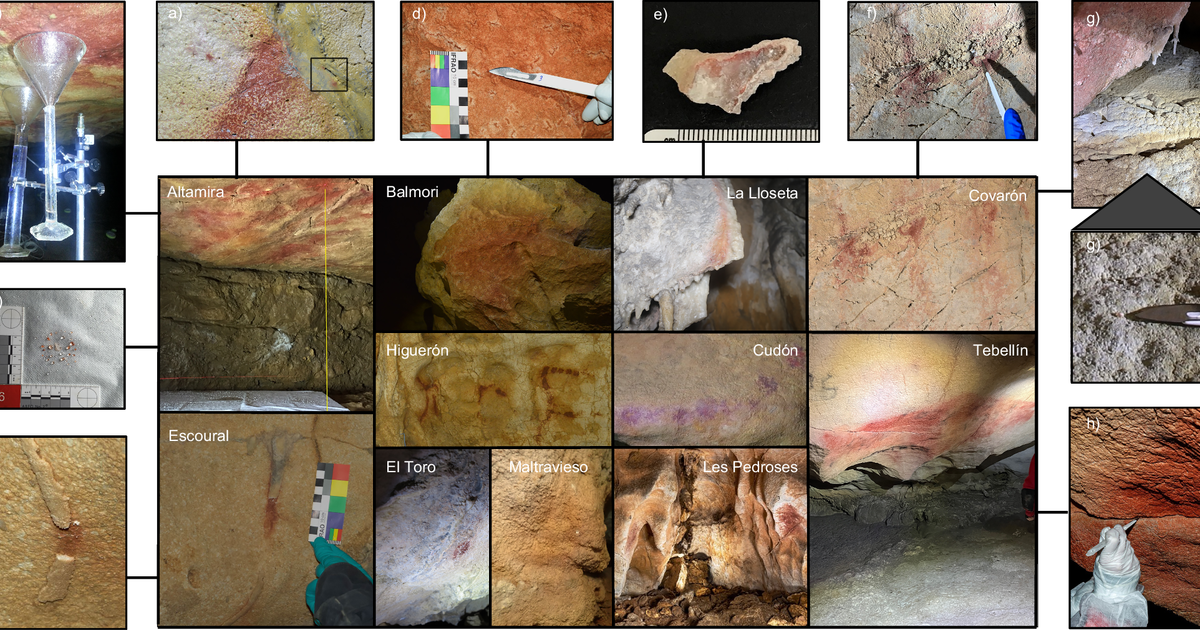
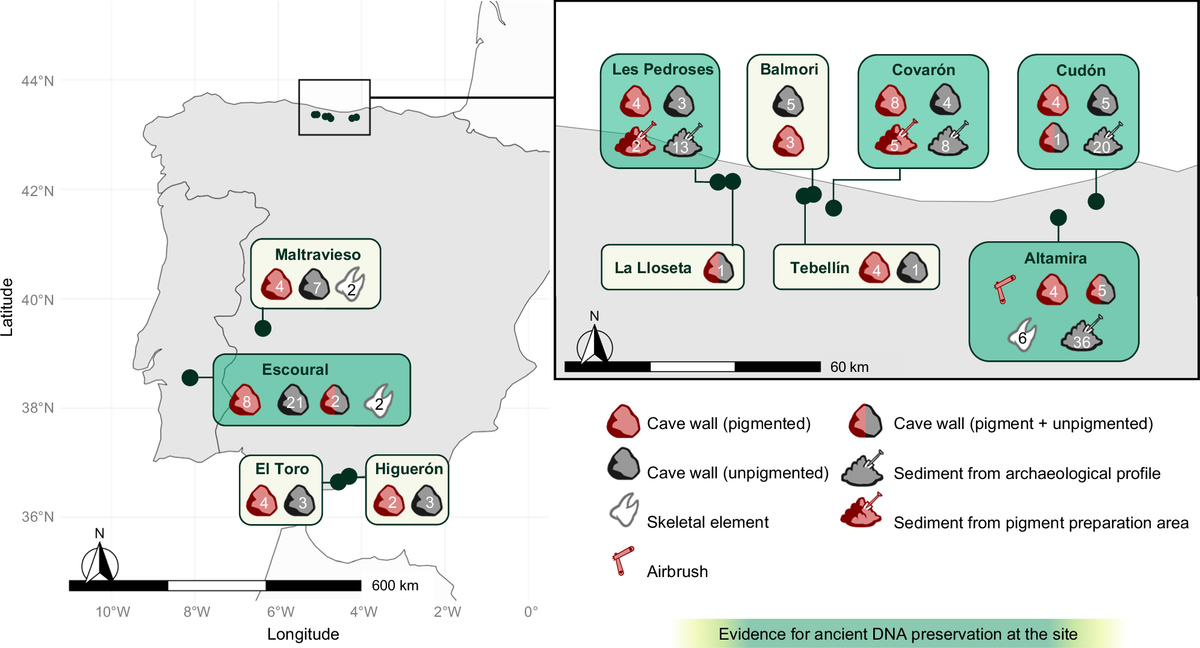
The campaign was substantial. Twenty four rock art panels across eleven caves in Spain and Portugal. Fifty four pigment samples, subdivided into sixty four subsamples for analysis. Sixty six further subsamples from unpigmented wall taken for comparison. Sediments and faunal bone from six of the sites. A bird bone from Altamira, coated inside with red ochre, almost certainly used to blow pigment at a wall.
The Eleven Caves, and What Was Actually Sampled
The sampling was not a single technique applied uniformly. It was eleven different problems.
The caves are Altamira, Covaron, Cudon, Les Pedroses, Balmori, La Lloseta, Tebellin and El Toro and Higueron in Spain, Maltravieso in Extremadura, and Escoural in Portugal. The motifs sampled run from linear traces, dots and triangles through amorphous stains, blown disks and large claviforms to negative hand stencils. Most are red ochre, iron oxide, and most belong to the non figurative or aniconic tradition that is thought to be the earliest stage of Palaeolithic rock art. Simple marks came from nine of the sites, hand stencils from Maltravieso, figurative painting from Altamira.
One category in that list deserves to be read slowly. Among the things sampled were pigment residues likely associated with more complex motifs that have not been preserved. Paint from pictures that are gone. The image has not survived and the material it was made of has, which is a condition every archive eventually meets and very few have a word for.
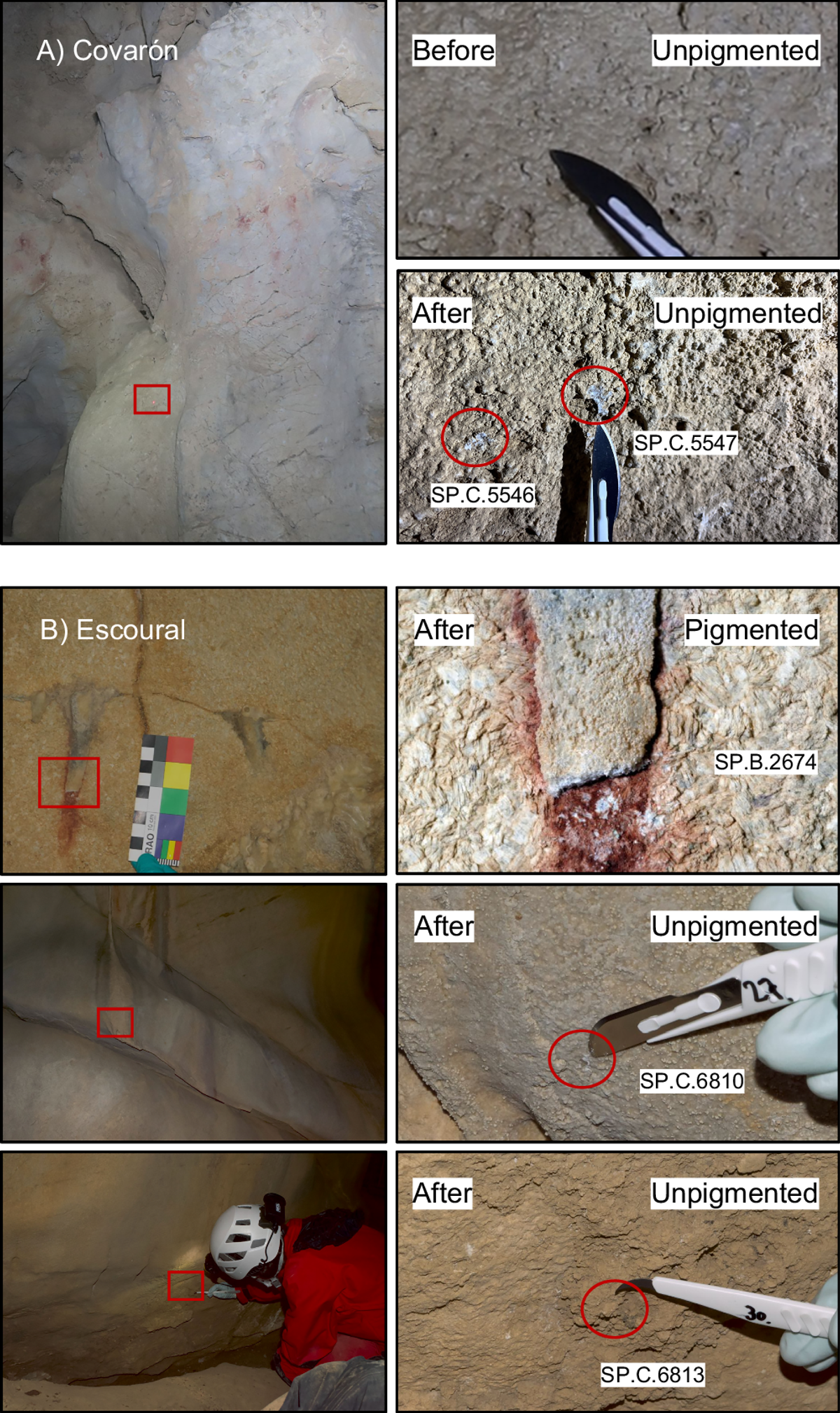
The methods follow the obstacle in each case. Most samples were lifted with sterile single use scalpels, a fresh one each time, with any scalpel that retained pigment secured and stored rather than discarded. At La Lloseta a calcite crust was too hard for that and was taken off with a clean screwdriver used as a chisel. At Escoural two crusts were released by tapping a scalpel with a hammer. At Maltravieso the two hand stencils were sampled with a portable dentistry drill and a sterile swab. At Altamira, where the painted ceiling is actively dissolving, Tyvek fabric was laid on the cave floor under the drips to catch pigment carried down by water, funnels and beakers collected the drip water itself, and one water sample was dried so the pigment could be swabbed off the residue. At Covaron eight pigmented calcite fragments were picked up off the floor of the Galeria de las Pinturas, along with two unpigmented fragments collected as controls.
Every one of those is a decision about how much of an object may be destroyed to learn something from it, and the paper records each one. The sampling was carried out, in its own words, while minimising visual impact on the rock art and adhering to site specific restrictions defined by the permit granting authorities. At Altamira the team worked under the cave's own conservation and access plan. The evidence a record can contain is bounded by what the custodian of the object will allow to be taken from it, and that bound is itself a fact worth writing down.
One Positive in Twenty Four Panels
Here is the result, and the number is the finding.
Of every pigment containing sample in the study, exactly one yielded authentic ancient human DNA. It is catalogued as SP.B.2674, a fragment of pigmented calcite crust from Panel 11 at Escoural Cave in Portugal. Two extracts were prepared from it, one before and one after homogenisation, containing 526 and 436 hominin mitochondrial molecules. The authenticity rests on elevated cytosine to thymine substitutions at the fragment ends, the standard damage signature of genuinely ancient DNA, and the paper reports the frequencies and their confidence intervals rather than asserting the conclusion.
Four more positives came from unpigmented wall. Two from a deeper gallery at Escoural near Panel 64, two at Covarón in Asturias close to a pigmented area. Their yields ran from 351 to 1,980 molecules.
So the tally is five positives, and four of them are from bare rock. The samples taken as comparison material produced most of the findings, and the painted surfaces produced one. The paper's own summary of this is unsparing: with ancient human DNA obtained from only one of twenty four rock art panels sampled, despite generally favourable preservation at many of the sites, pigmented surfaces themselves rarely retain enough DNA to remain detectable after thousands of years. The marks have lasted. Whatever touched them has not, and object permanence turns out to be a property the image and its maker do not share.
The Floor Was Full. The Wall Was Empty.
The single most useful control in this paper is the one nobody designed as a control. While the walls were being sampled, the floors of the same caves were being sampled too, and the floors were rich.
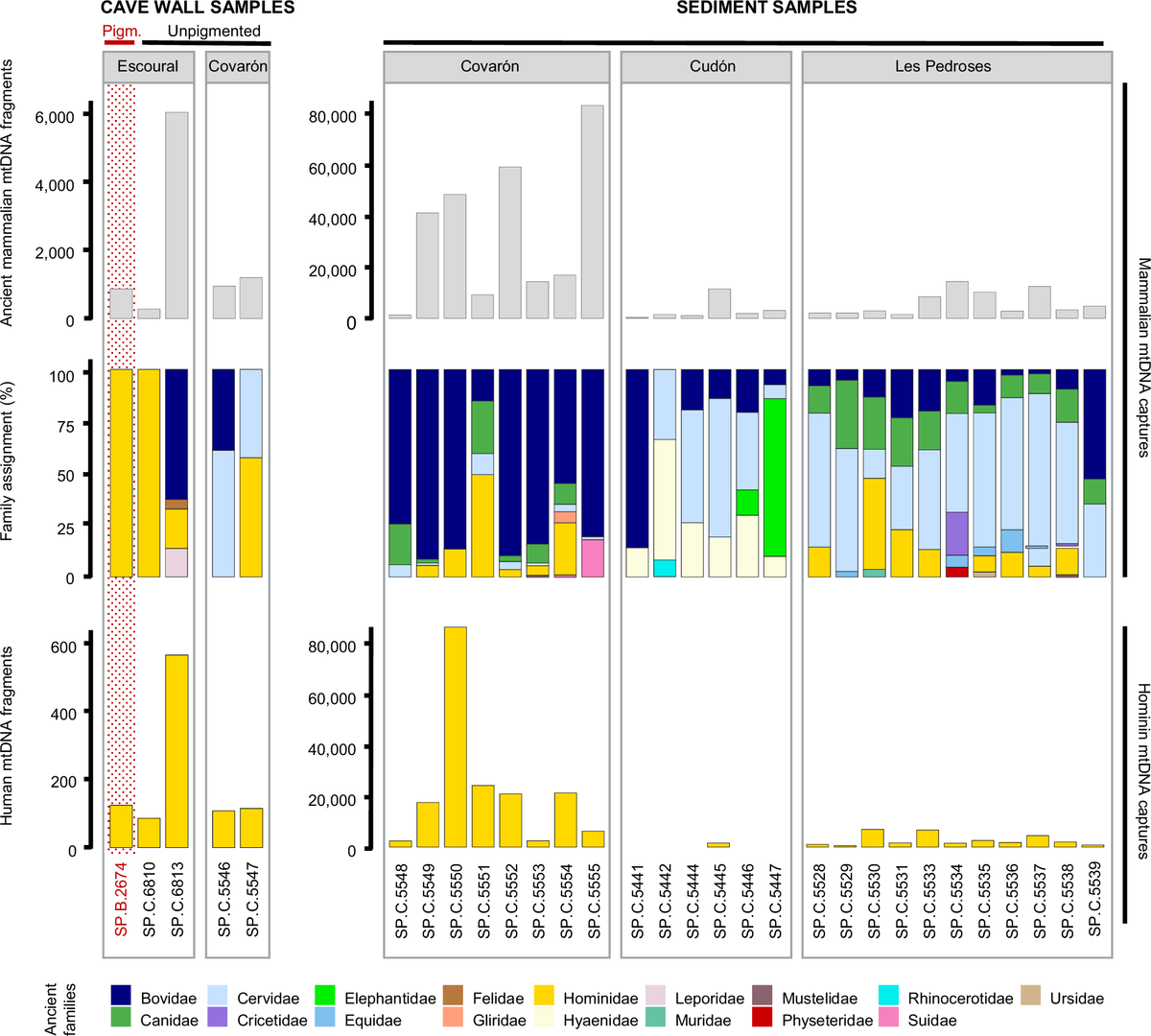
Ancient mammalian DNA came back from skeletal remains at Altamira in four of six samples and at Escoural in one of two. Sediment produced a dense record: eight of eight samples at Covaron, eleven of thirteen at Les Pedroses, six of twenty at Cudon. The Les Pedroses sediments contained DNA from Physeteridae, the sperm whale family, supporting existing evidence that the hunter gatherers of that region exploited marine mammals. At Cudon, Neandertal mitochondrial DNA came out of Mousterian levels three and four in sector L7.
And at Covaron every one of the eight sediment samples yielded ancient human DNA, some of it in exceptional abundance. The richest produced 26,946 unique human mitochondrial fragments at eighty nine fold coverage of the mitochondrial genome, with present day contamination estimated at 0.1 per cent.
Hold that against the wall result. In the same cave, on the same visit, the floor gave up twenty seven thousand fragments of one ancient person at a tenth of one per cent contamination, and the painted surfaces gave up none at all. Covaron's wall positives came from unpigmented rock beside the pigment, at a thousand molecules and up to sixty seven per cent contamination.
This is what makes the one in twenty four meaningful rather than merely small. The caves were not short of recoverable ancient human DNA. The paintings were. A null result from a site where nothing survives says something about the site. A null result from a site where the ground six feet away is saturated says something about the painted surface itself, and the paper draws exactly that conclusion and no more: pigmented surfaces rarely retain enough DNA to remain detectable after thousands of years.
The Sentence That Does the Work
A record of ownership exists to put events in order. The paper contains one clause that explains, better than any provenance manual this institution has read, why that ordering is the hard part and why physical contact does not supply it:
in the absence of precise chronological constraints on the deposition of both the pigment and the DNA, it remains possible that their deposition occurred thousands or tens of thousands of years apart.
Read that again with an object in mind. Two substances are in direct physical contact, one lying on top of the other, and the available evidence cannot say whether they arrived together or tens of thousands of years apart. Nothing about the stratigraphy answers it. Nothing about the chemistry answers it. The pigment is there and the DNA is there and the order of their arrival is simply not recoverable from the material.
This is the problem every custody record is built to solve, and it is why a record is not a decoration on an object but the only thing that can put its history in sequence. Co-location is not contemporaneity. A hand that touched a wall and a hand that painted it leave the same kind of trace, and so does a hand that touched the wall in the Neolithic, and so, as the contamination figures below show, does a hand that touched it last year.
They Wrote Down the Standard They Had Not Met
The next passage is the reason this paper is worth a study rather than a paragraph. Having declined the attribution, the authors specify exactly what would earn it:
Establishing a direct link between DNA and art production would require evidence that the DNA in the pigment sample consistently differs from that in unpigmented areas, whether in its abundance, the likelihood of successful recovery, or its population genetic affinities to past human groups.
That is a declared gap with its closure criterion attached. It names the absence, it states why the present evidence does not fill it, and it specifies the comparison that would. A later team can act on it without guessing what the first team meant. The paper goes further and describes the sampling design that would run the test, separating pigmented from overlying and underlying unpigmented material in a crust, a method already used in uranium thorium dating of rock art and in principle combinable with DNA work.
This institution's study 237 argued that the vocabulary of ownership records already contains a grammar for absence, and that the grammar is available and underused. Study 238 found two museum officers inventing a term, objects in limbo, because the grammar was not reaching them, and defining it with both edges drawn: no direct evidence of illicit activity, and no proof of legitimate movement either.
Study 239 is the same grammar fully executed, by people with no commercial interest in the outcome, on the worst evidence anyone has tried it on. A gap, dated as closely as the evidence allows, bounded, with the test for closing it written beside it.
The Signal Does Not Reproduce in Its Own Crust
The detail that would have been easiest to leave out is in the paper, and it is the one that most constrains the finding.
After the positive from Panel 11, the team went back to the same crust. They took further subsamples from the pigmented fragment and from an adjacent pigmented crust below it. They embedded one fragment in resin so that pigmented and unpigmented areas could be sampled separately. Seventeen subsamples from Panel 11 in total, and no further ancient hominin DNA in any of them. Their conclusion is that the signal was confined to a small area rather than distributed through the pigmented crust.
A single positive that does not reproduce in the object it came from is a weak result, and the authors say so. They published the non reproduction in the same paper as the discovery. The press release version of this finding would have had one sentence and it would have been the first one.
The Contamination Figure Is a Custody Record
The present day human contamination in the two extracts from the one painted positive was estimated at 54.8 and 32.4 per cent. Across the unpigmented positives the range runs from 0.1 to 67.6 per cent. In the richest sediment sample at Covarón, sealed in the ground rather than exposed on a wall, contamination was 0.1 per cent, against 26,946 unique ancient human fragments and eighty nine fold coverage of the mitochondrial genome.
Set those side by side and a point about records emerges that has nothing to do with genetics. The clean sample is the one nobody could touch. Every surface that was reachable carries the people who reached it, in proportions that can be measured, and the measurement is a record of access rather than of origin. More than half the human signal in the single most important sample in the study is modern.
That is not a flaw in the work. The authors handle it with a conditional substitution test designed for exactly this situation, which estimates damage in the authentic fraction of a contaminated sample. The point is what it says about surfaces. An object that people have been allowed to approach accumulates a record of its visitors, and at a fine enough resolution that record can be larger than the thing it sits on. This is custodial stewardship in its measurable form, which is not a duty of care laid on top of an object but the accumulated trace of everyone who has had access to it.
The Object Most Likely to Hold the Maker Was the Loudest and the Emptiest
One artefact in the study was the best candidate in it. ALT2617, the diaphysis of a bird bone from Altamira, ochre on the inside, consistent with having had pigment blown through it at a wall. If anything in eleven caves was going to carry the saliva of someone who actually made a painting, it was this.
Less than one milligram of pigment was taken from inside it, in six passes with a dentistry drill held still, to protect the object. The analysis recovered between 1,050 and 17,122 human mitochondrial fragments and found no significant damage signature in any of them, including under the conditional test. No demonstrable ancient DNA at all. No ancient faunal DNA either, so no evidence of an organic binder.
It is the largest human signal reported anywhere in the paper and none of it is old. A result that arrives in volume reads as a measurement, where an empty result prompts the question of whether the instrument was pointed at the right thing. Here the volume was entirely us. An absence would have been easier to interpret than the abundance that was actually found.
The One Question Everybody Wants Settled Is the One It Could Not Reach
There is a live argument in this field about who made some of this art, and it is not polite.
In 2018, Hoffmann and colleagues published uranium thorium dates on carbonate crusts over Iberian cave art under the title U-Th dating of carbonate crusts reveals Neandertal origin of Iberian cave art. One of the three caves was Maltravieso, where a hand stencil returned a minimum age older than any accepted date for modern humans in the region. The conclusion drawn was that Neandertals made it.
The response came fast and it is all in this paper's own reference list. Slimak, Fietzke, Geneste and Ontanon published a comment in Science the same year arguing the geochronology did not support an age that old. White and colleagues published Still no archaeological evidence that Neanderthals created Iberian cave art in the Journal of Human Evolution in 2020. Pons-Branchu and colleagues published uranium series work at Nerja cave reporting an open system and questioning the Neandertal origin of Spanish rock art. Hoffmann and colleagues published a response to the response. Five papers, two years, over who put their hand on a wall.
Now read the author list of the 2026 DNA paper. Roberto Ontanon, director of the Museo de Prehistoria y Arqueologia de Cantabria and of the Cuevas Prehistoricas de Cantabria, co-author of the 2018 comment disputing the Neandertal attribution, is one of its forty authors. The paper cites his comment and it cites the claim his comment was disputing, and it cites the reply, and the reply to the reply.
That is not a conflict buried in a footnote. It is the entire argument, both sides of it, placed in the reference list of a paper that then declines to settle it with a new instrument. The introduction says so in plain terms: ancient DNA analysis cannot currently contribute to debates about authorship, including whether Neandertals as well as early modern humans created rock art.
And Maltravieso, the cave at the centre of that dispute, is in the sample set. Its two hand stencils were sampled. They produced nothing. Neither did its two skeletal samples, the only site in the study where even the faunal control failed. The paper's own closing wish is for future work on hand stencils from sites with better DNA preservation than Maltravieso.
So the question with the most riding on it is the one the method reached for and missed. A technique that cannot yet distinguish a painter from a passer by certainly cannot adjudicate between two human species, and the honest version of that sentence is the one the paper printed rather than the one a press office would have preferred.
A Claim That Did Not Survive Thirty Years
This is not the first time someone has reported ancient DNA from rock art, and the earlier case is the reason the new one is written so carefully.
In 1996 Reese published Ancient DNA from Texas pictographs in the Journal of Archaeological Science, reporting ungulate DNA recovered from painted images and attributing it to organic binders mixed into the paint. In 2002, in the same journal, Mawk, Hyman and Rowe published Re-examination of ancient DNA in Texas rock paintings. The result could not be replicated.
The 2026 paper names both, and describes the 1996 case as the only reported instance of DNA recovery from rock art, obtained with PCR based methods, whose results could not be replicated in subsequent studies. It then looked for the same thing with thirty years of better technique and found no faunal or other non human DNA that could be clearly linked to the use of organic binders anywhere in eleven caves.
Two things follow, and the second is the one that matters to anyone keeping a record.
The first is ordinary and good: a claim entered the literature, was tested, and did not hold. That is the system working.
The second is that the failed claim stayed in the record and is cited by name in 2026 by the people who superseded it. It was not quietly dropped. A reader of the new paper learns that the question has been asked before, who asked it, what they concluded, and who could not reproduce it. A retracted or superseded claim is evidence about how a field came to believe what it believes, and deleting it costs more than carrying it. This institution has argued that in the narrower setting of ownership records. Here it is simply how the discipline behaves.
The Dating That Worked Was Custody, Not Chemistry
The paper tries three routes to an age for the DNA on the walls: damage patterns, mitochondrial haplogroup, and the archaeology of each site. The molecular clock gives a floor and declines to give more, a minimum of roughly two thousand years for most samples while remaining consistent with much greater ages. The haplogroup work on the painted sample could not resolve beyond haplogroup N and its many subclades, which constrains nothing.
The firmest constraint in the paper comes from somewhere else entirely:
the site was accessible only until the Chalcolithic period, after which it remained sealed and was not reopened until 1963 as the result of quarrying activities
That puts a floor of four to five thousand years under the Escoural DNA, and it is a fact about who could reach the cave, not a fact about the molecules. The strongest dating evidence in a palaeogenetics paper is a custody history. A record of access, kept by geology and then by a quarry, outperformed the instrument measuring the object itself.
Anyone who has built a provenance record will recognise the move. The date you can defend is often not the one the object yields but the one the chain of access forces.
They Proved the Blank Surface Was Blank
The comparison samples in this study were taken from unpigmented wall. That raises an obvious question nobody usually bothers to answer: how do you know it was unpigmented?
They answered it. Before collecting an unpigmented control, images of the wall were taken and run through D-Stretch, a colour enhancement tool used in rock art research, to verify the absence of pigment.
Stop on that. A surface that looks blank to the eye can hold pigment too faint or too degraded to see, and a faint mark is still a mark. If a control sample is actually taken from an invisible painting, then the comparison between painted and unpainted areas, which is the whole architecture of the study, silently collapses. So the team used an instrument to establish an absence before relying on it.
That is the rarest move in record keeping and this study has been circling it for weeks. An absence asserted is worth little. An absence tested, with the test named, is evidence. The difference between a blank field and a field someone checked is invisible on the page unless the checking is written down, and here it was.
The same discipline runs through the documentation scheme, which is a notation system for exactly this. In the published figures, sample identifiers highlighted in yellow are samples that were screened for ancient DNA, and identifiers on a white background are samples that were not processed for this study. Sampled areas circled in red are pigment. Sampled areas circled in white are the areas determined to be free of pigment. Four states, drawn on photographs: examined and painted, examined and blank, collected but not examined, and not collected.
Even the scale bars carry their own disclosure. An attempt was made in the field to photograph each sample with a scale, the paper says, and this was not always possible; where a scale is given as approximate, it has been estimated from other images. A measurement that is a reconstruction is labelled as one.
What They Deliberately Did Not Examine
Twenty one of the sixty four sediment samples from Altamira were never screened. Material from other sites was held back too. This was not an oversight and the paper gives the reason: to mitigate costs and preserve material for potential follow up studies, including chemical analyses, not all samples were screened for the purposes of this study.
They took material from protected caves under permit, used part of it, and deliberately left the rest unspent.
Sampling rock art is destructive. Every milligram removed is gone, and the supply is finite in a way almost nothing else in a laboratory is. A team that consumed everything it was permitted to take would have answered this question slightly better and foreclosed the next one entirely. Instead the remainder sits in Leipzig, and the paper says where.
This is the opposite failure mode from the one records usually suffer. The common fault is a gap nobody intended. Here is a gap that was chosen, costed and declared, which makes it a different object entirely: not an absence in the record but a decision recorded in it.
They Threw Out Their Own Results Three Times
A study is easiest to judge by what it refused to keep.
First. At Covaron, a sediment sample from a putative pigment preparation area on the cave floor came back positive, with 682 deaminated mitochondrial fragments. A pigment preparation area that contains ancient human DNA is a tidy result and an easy sentence to write. The paper declines it, because all the ordinary sediment samples from that cave contained ancient human DNA in even higher quantities, so the positive does not indicate a specific association with pigment preparation. The finding was real. The inference was not available, and they said so.
Second. The metagenomic screen produced hits for Cebidae, Cercopithecidae and Hylobatidae, which are New World monkeys, Old World monkeys and gibbons. These were removed, on the stated ground that taxonomic misidentification is likely when few sequences support a taxon and that the geographic distribution of these families makes their presence implausible. Each was supported by fewer than twenty sequences. A hit that cannot be true is discarded with the reason attached rather than kept because the software produced it.
Third, and most instructive. For non sediment samples the authors relaxed their own authenticity threshold, requiring significant C to T substitution at only one end of a molecule rather than at both, to maximise sensitivity. That is a weakening of a criterion, which is the sort of thing that usually happens quietly if it happens at all. It is in the Methods, with the reason given. A reader who thinks the looser threshold is too loose knows exactly which result to doubt and why.
Declaring a gap is the easy half. Declaring that you loosened a rule to find something is the hard half, and it is the half that lets somebody else disagree with you on the evidence rather than on faith.
Forty Authors, and a Record of Which One Did What
The paper has forty authors across institutions in Spain, Portugal, Germany, the United Kingdom, Denmark, China, South Africa and the United Arab Emirates. Collado Giraldo and Meyer are named as having contributed equally.
Attached to it is a contributions statement that assigns acts to initials. Three people designed the study. Twenty four excavated, identified or characterised material, or provided archaeological context and interpretation. Eight collected the samples. One compiled the sampling information with the help of three others. Four performed the laboratory experiments. Ten performed, aided in or supervised data analysis. Two wrote the manuscript with input from the rest.
A paper that cannot say who made one mark on one wall can say, to the initial, which of its forty authors held the scalpel, which ran the sequencer and which wrote the sentences.
That is not irony. It is the whole mechanism in one page. Authorship is recoverable when somebody writes it down at the time, by a person with the standing to know, in a form that travels with the work. It is not recoverable from the object afterwards. Twenty thousand years from now the only thing that will still attach these forty names to this work is that paragraph, and it exists because a journal requires it, not because the evidence compels it.
Alongside it sits a competing interests declaration stating there are none. Given that one of the forty is a named participant in the dispute the paper declines to settle, a declaration of no competing interests is a claim a reader can now evaluate instead of a formality, which is what such declarations are for.
A Forensic Scientist Put It in One Sentence
The distinction the paper spends a discussion section establishing has a shorter form, and it arrives from a different discipline, which is why it is worth having. Writing in The Conversation on 10 August 2026, Robyn Adams and Jay Silverstein of Nottingham Trent University, from the School of Science and Technology and the Department of Chemistry and Forensics respectively and not authors of the paper, set out why attribution is the hard part:
DNA establishes the association of someone with an item or location, not the actions they carried out
They add that the presence of human DNA does not prove who created the rock art, that additional DNA can be deposited at very different times from the painting, and that applying the technique successfully to identify the artist of a specific piece of ancient rock art is, in their assessment, incredibly unlikely.
Two independent derivations, from two disciplines, reaching the same boundary. The paper reaches it by sampling and measuring. Forensic scientists reach it from the general principle that governs DNA as evidence anywhere, including in a courtroom. Association is not action. Presence is one claim and authorship is a different claim with different evidence, and a trace carries the first.
The Obvious Objection, and Why It Fails
A fair reader will say that comparing a Nature Communications paper to a sale catalogue is a category error. Of course a peer reviewed genetics paper is more careful than a provenance line in a catalogue. They have different purposes, different readers and different penalties. A scientist who publishes an unsupported attribution risks a career. The comparison, put as a contest of rigour, is trivially true and worth nothing.
That is not the comparison. The thing this paper has that most ownership records lack is not a higher standard of proof. It is a notation.
Consider what it actually costs to do what this paper did. Writing down that one of twenty four panels was positive costs nothing. Writing down that seventeen follow up subsamples found nothing costs nothing. Writing down that two deposits in contact may be tens of thousands of years apart costs nothing. Writing down the comparison that would settle the question costs nothing. None of it requires a laboratory in Leipzig. All of it is bookkeeping, and the reason it is rare is not expense.
A provenance record that passes through an undocumented decade has the same options available to it. It can state the gap, state its bounds, state what was searched and state what would close it. Study 237 made the case that the vocabulary for this already exists. This paper is the demonstration that the vocabulary is usable under conditions far worse than any art record faces, on an object of unknown date, in a cave sealed for four millennia, with half the signal modern.
What the Refusal Made Possible
A declared gap is often read as a dead end, and the last paragraph of this paper is the best argument available that it is the opposite.
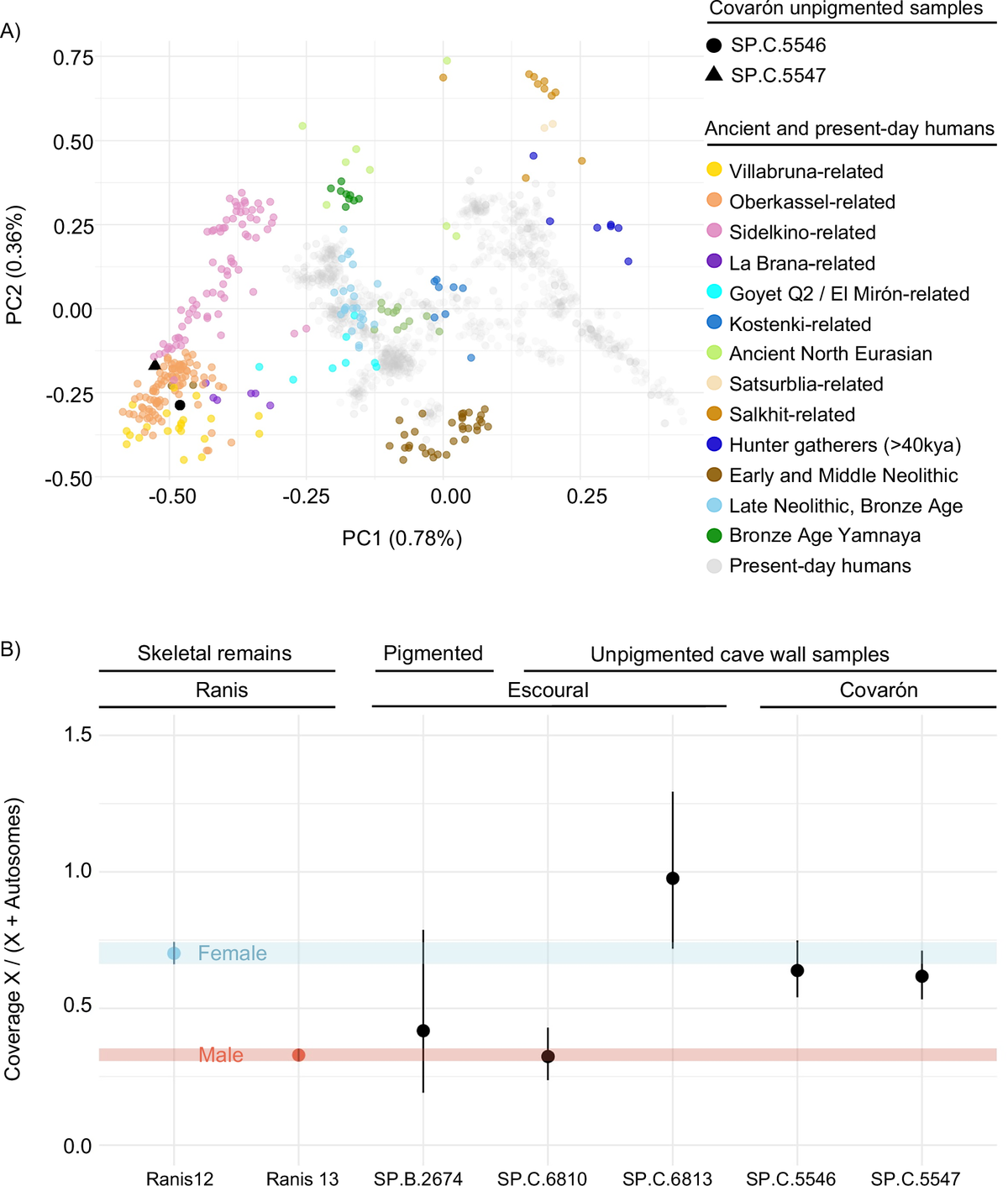
Having refused to connect its DNA to the making of any painting, the paper closes by describing what the result does open: that cave wall samples could reveal which populations occupied caves, including caves with no art in them at all, how deeply into a cave they went, and whether activity in a given place was concentrated or associated with individuals of a particular sex. No excavation required. The two unpigmented samples from Covarón already carry it, clustering with western hunter gatherers alongside the Villabruna and Oberkassel genetic groups, individuals dated between about 16,700 and 5,200 years before the present, haplogroup U5a'b. Three of the unpigmented positives are predominantly female derived and one predominantly male.
So the honest accounting of this study is that we can now say more about the people who stood near the paintings than about the person who may have made one. We have their population, their mitochondrial lineage, in several cases their likely sex, and an indication of where in the cave they were. Of the single individual whose DNA sits in painted crust at Escoural we have 526 molecules, no sex, and a haplogroup that resolves no further than a branch shared by most of humanity.
That asymmetry is the shape of a provenance record and not of an attribution. It is a record of presence, of position, of access and of sequence, held together by what can be established about who was where and when. Giving up the claim about authorship is what made the rest of it legible, because once the record stops asserting that the trace is the maker, every trace becomes usable as evidence of something it genuinely is.
The Remainder Has a Custodian
The data availability statement is four sentences long and it is the most complete custody record in the paper.
The genetic data are deposited in the European Nucleotide Archive under accession PRJEB97209. The DNA libraries prepared in the study, the residual sample material, and the side fractions retained from sample preparation are stored at the Max Planck Institute for Evolutionary Anthropology in Leipzig. Access can be requested from two named corresponding authors. Source data are provided with the paper. The three analysis pipelines are on GitHub and archived on Zenodo with their own DOIs, one under the MIT licence and two under Creative Commons Attribution.
Read that as a provenance record, which is what it is. It states what physically exists after the work, where it is held, who holds it, and the route by which somebody else can reach it. It covers not only the finished material but the side fractions, the parts left over from preparing the samples, which is the category most likely to be thrown away and least likely to be mentioned.
Then compare it to what the same paper can establish about a mark on a wall in the same caves. Custody of the 2026 sample is documented to the fraction. Custody of the 20,000 year old object it came from is documented not at all, and the gap between those two sentences is the subject of this study.
The Review Took Eight Months
A small fact, recorded because it is cheap to record and because tempo is part of how a claim becomes a fact.
The paper was received on 6 October 2025, accepted on 29 May 2026, and published on 23 June 2026. Just under eight months between submission and acceptance, for a result whose headline finding is that the thing being looked for was mostly not there.
Nothing follows from that about quality. It is noted because the drift this institution tracks most often is the one where an intention hardens into a credential through repetition at speed, and a negative result moving slowly through peer review is the opposite condition. The claim that emerged is narrower than the claim that went in, which is the direction a claim is supposed to move while it is being checked.
The Press Mostly Held the Line, Which Is Worth Recording
It would be easy, and wrong, to turn this into a complaint about science journalism. Thirteen pages reporting this paper were fetched for this study and twelve returned a headline, the thirteenth being served a bot check instead and therefore left uncounted. Eleven of the twelve carry no claim that the artists were identified. The journal's own title begins Investigating. National Geographic reports the extraction. Scientific American, Science News, ScienceAlert, Hyperallergic, Sci.News, Archaeology News Online Magazine, earth.com and Areo all report the preservation or the recovery. The Conversation piece asks it as a question.
One of the twelve claims the result reveals hidden artists. The page carrying that headline states in its own body that no direct dating ties the genetic material to the artwork. Headline sells the closure, body carries the limit, same page, which is a familiar enough mechanism and not a specifically journalistic one.
The ArtNews report that brought this paper to the institution's attention could not be read for this study. The site redirects machine requests to a paid bot access gateway, which returned an authorisation refusal. It is therefore not cited here, and nothing in this study rests on it. The paper is open access and is the better source in every respect.
What a Record Can Take From This
Eight things, each of them demonstrated above rather than recommended in the abstract.
State the yield. One of twenty four is a number a reader can act on. A record that reports only its successes cannot be distinguished from one that had no failures.
Report the non reproduction. Seventeen further subsamples found nothing, and the study is stronger for saying so. A finding that did not hold the second time is part of the finding.
Treat co-location as unordered until something orders it. Two things touching tells you they touched. The sequence has to come from somewhere else, and in this paper it came from a quarry breaking into a sealed cave in 1963.
Quantify contamination rather than excluding it. A figure of 54.8 per cent is more useful than a clean record that was never checked, because it tells a later reader exactly how much of the signal is theirs.
Attach the closure criterion to the gap. The sentence specifying what would establish the link is the most valuable sentence in the paper, and it is about something that has not happened.
Test the absence before you rely on it. A blank area was photographed and run through colour enhancement to establish that it was blank. An absence that was checked and an absence nobody looked at are different evidence, and only writing down the check tells them apart.
Say what you did not examine, and why. Twenty one samples went unscreened to preserve material for later work. A gap that was chosen, costed and declared is a decision in the record rather than a hole in it.
Record the loosening, not only the finding. The authenticity threshold was relaxed for one class of sample, in the Methods, with the reason given. Anyone who thinks that was too permissive knows exactly which result to doubt.
Coda
The hand stencils and the ochre marks in these eleven caves are the oldest objects in this institution's field of interest by orders of magnitude. Nobody signed them. No catalogue describes their transfer. Their makers are not recoverable and, on the assessment of forensic scientists reading this very technique, are very unlikely ever to be.
What exists instead is a record: of who could reach the chamber, of when it was sealed, of what the walls retained, of how much of what they retained belongs to the last sixty years of people coming to look. A team with every reason to claim an author declined to, said why, and published the test that would have let them. None of that record required a laboratory. What required a laboratory was discovering how little the wall held, and the part worth copying is what was done with the answer: it was written down, bounded, and handed on with the test for closing it attached.
An attribution would have closed the question. The refusal left it open, and left it workable.