The Brackets Came Off: Six Hopper Copies, a Title Invented After He Died, and a Catalogue That Marked Its Own Doubt
On six teenage paintings that were always copies, a title invented after the artist died, and a catalogue raisonne that marked its own uncertainty in brackets which everyone afterwards left out
Every oil Edward Hopper painted before he went to art school is a copy of another artist's picture. There are as many as six, he was a teenager, and he made them from colour plates in a magazine whose business was supplying plates to copy.
Hopper did nothing wrong and nobody has suggested he did. What happened to the record afterwards is the subject here, and the most useful part of it is not that a title turned out to be wrong. It is that the scholarship marked the title as uncertain, correctly, in the standard notation, and everybody who used it afterwards removed the mark.
What Is Established, With Its Dates
The research is Louis Shadwick's. He published the first account in The Burlington Magazine, volume 162, October 2020, page 870, under the title The origins of Edward Hopper's earliest oil paintings. His biography Edward Hopper: A Life, from Yale University Press, excerpted on 20 October 2026, extends it to the full set.
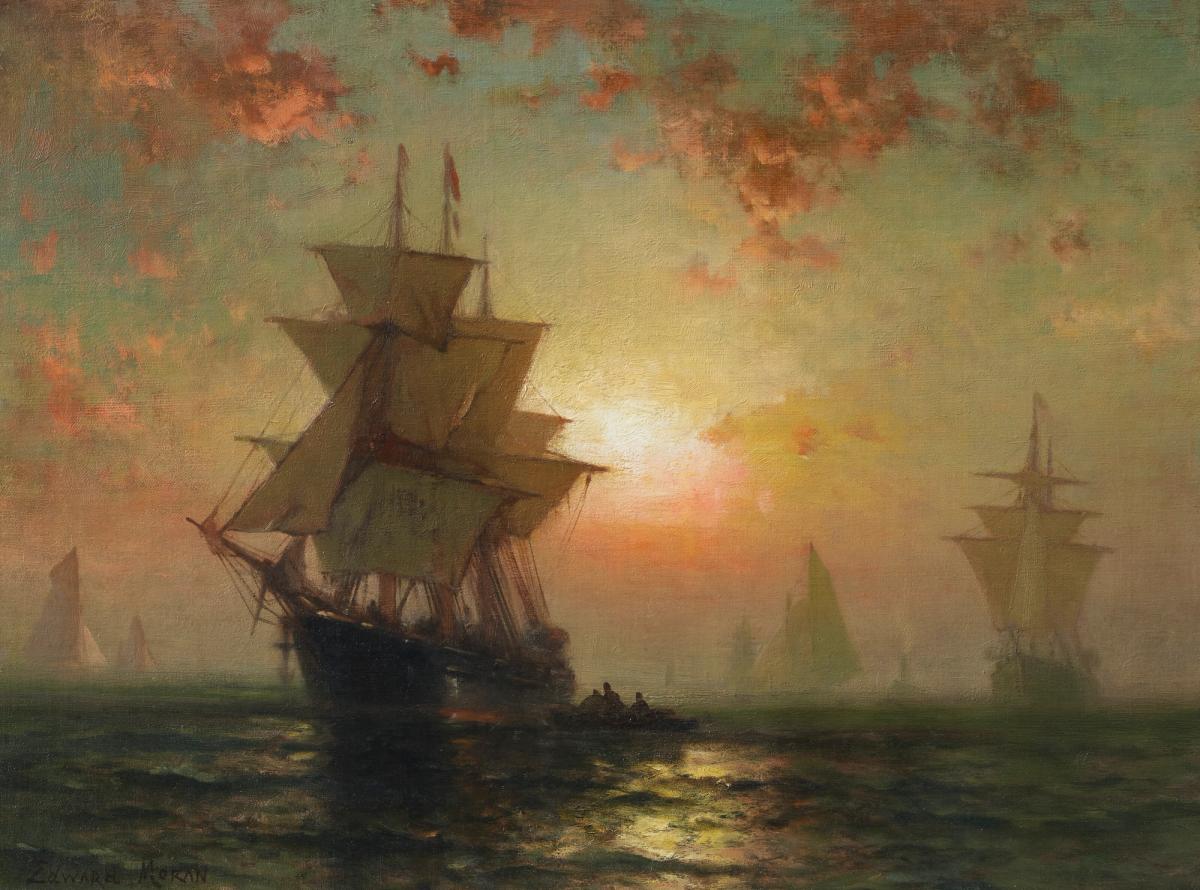
Old ice pond at Nyack copies Bruce Crane's A winter sunset, reproduced in The Art Interchange on 6 December 1890. Rowboat in rocky cove, inscribed 1895 when Hopper was thirteen and his first signed oil, copies a watercolour called Lake view by an unidentified painter, reproduced 14 February 1891. Ships, about 1898, copies A marine by Edward Moran, reproduced in August 1886. Country Road copies John Francis Murphy. Clipper ship being towed by tug copies Fred Pansing's Stormy voyage from the New York Recorder of 7 May 1893. For Church and landscape no source has been identified.
Shadwick's own summary of the consequence is careful and worth quoting as written: the identification of one painting as a copy has revealed that most if not all of these works are copies after paintings illustrated in popular American periodicals for amateur artists.
The Magazine Asked Him To, and Printed the Instructions
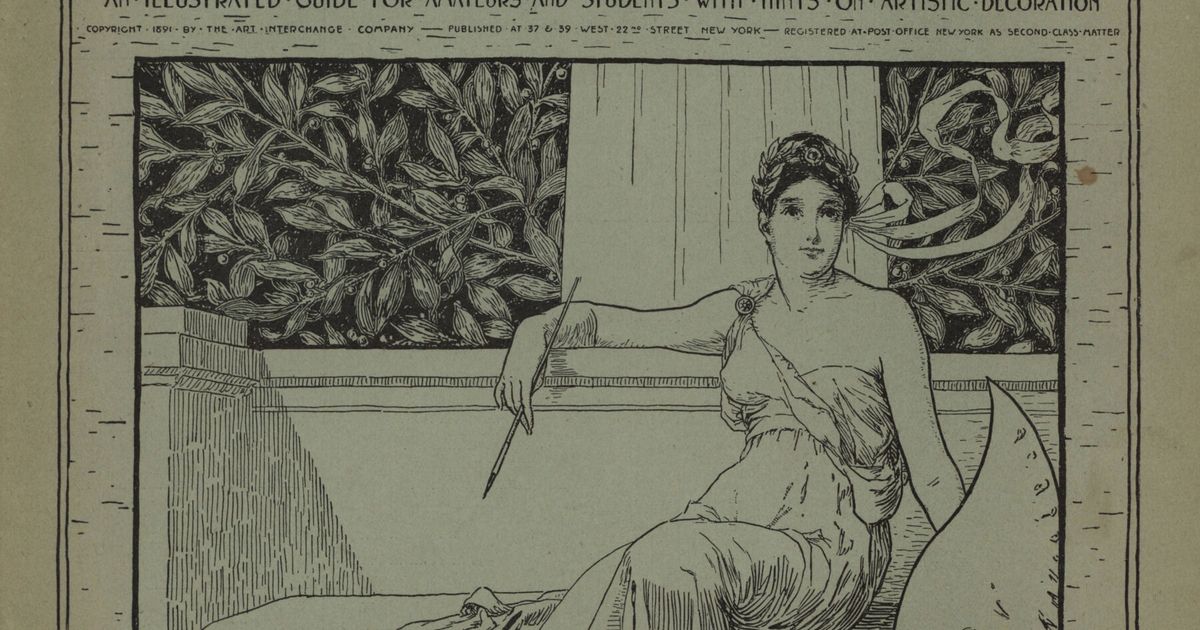
The Art Interchange called itself an illustrated guide for amateurs and students. The September 1891 number offered five supplements, three in colour, for thirty five cents, and the foot of its cover advertises what a subscription actually bought: thirty six coloured plates and twelve monthly issues. Three plates a month. The plates were the product.
It went further than supplying them. The magazine printed copying instructions alongside the reproductions, and those instructions could come from the original painter, who might be asked, in the magazine's own phrasing, to say something of what had specifically attracted him, for the copying of his sketch reproduced as a colour supplement that month. The advice ran from the type of canvas to use through drawing, paint application, colour mixes and drying methods.
The note accompanying Lake view called it a very simple subject and well adapted to beginners, which is a fair description of why a thirteen year old picked it for a first attempt in oil.
The magazine was aimed at a middle-class, home-owning and largely female readership, advertised itself as the most progressive art and household monthly, and is now credited with a part in the democratisation of art in America. Hopper's mother Elizabeth encouraged both her children to draw. The plates were years older than the paintings made from them, so the family must have kept them. This is a household subscription being used exactly as intended.
The Man He Copied Was the Famous One
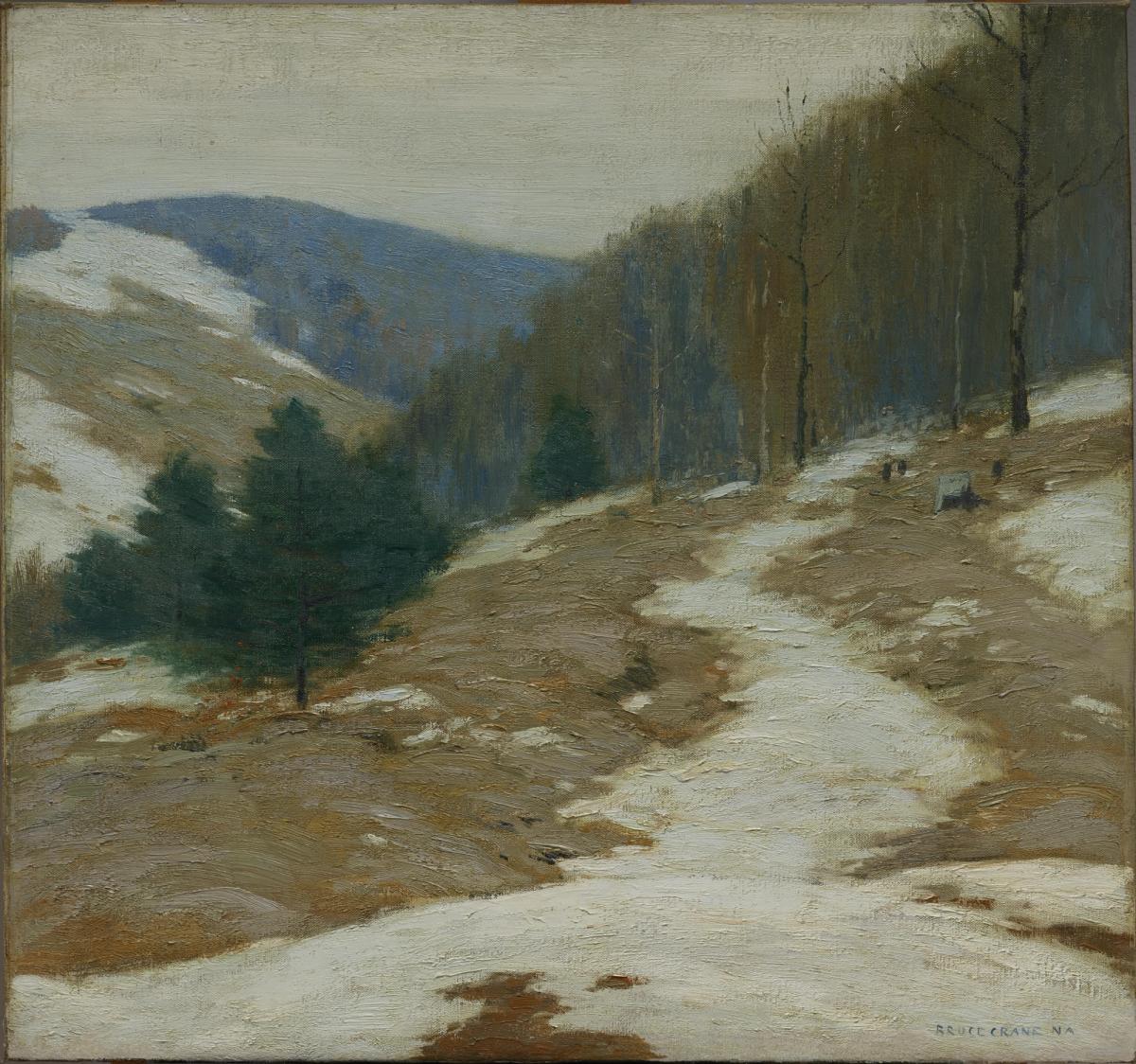
It is worth establishing who Bruce Crane was in 1890, because the modern reader will supply the wrong relation between these two names.
Crane was a founding member of the Society of American Artists, an art teacher, and a member and eventually president of the Salmagundi Club. He showed regularly in New York alongside George Inness and his own former teacher Alexander Wyant, and he was a leading figure of the Tonalist generation that dominated American painting in the late nineteenth century. A profile in the Art Amateur in 1894 described his work as being in great demand. At least twelve further colour reproductions of his paintings appeared in art journals for students between 1880 and 1900.
A reviewer in Brush and Pencil in 1899 managed a sentence that only gets written about the very well established: that Crane is so well-known, and his exhibition is so much like other things of his, that it would be repetition to say much. That is what it sounds like when a painter has become furniture.
So the transaction here is not a famous artist borrowing from an obscure one. It is an unknown boy in Nyack copying a plate by one of the best-known landscape painters in America, which is exactly what the plate was printed for. Within a lifetime the relation inverted completely. Hopper is on the wall of every student bedroom in the country and Crane is a name that has to be introduced.
That inversion is not incidental to the record problem; it is part of what sustained it. A catalogue entry reading after Bruce Crane would have been unremarkable in 1900 and nearly meaningless by 1980, when the title was first exhibited. The reference that would have explained the picture had itself stopped being legible, which is how a missing line stays missing: by the time anyone could have noticed the gap, the thing that filled it was forgotten too.
They Were Untitled Because They Were Never For Sale
Now the fact that explains the whole subsequent muddle, and it is the one the press coverage has left out.
Josephine Hopper kept meticulous record books documenting her husband's output. The attic paintings are not in them. Shadwick gives the reason directly: none of the works had been intended for the art market during the Hoppers' lifetimes, and it is for this reason that the paintings had remained untitled and, with one exception, undated.
The record was not missing through carelessness. It had never been created, because nothing had happened that creates one. A title, a date and an entry are artefacts of circulation. An object that never circulates does not acquire them, however carefully its household keeps books.
That is worth sitting with, because it inverts the usual assumption. We tend to treat a catalogue as a description of an object. It is closer to a description of an object's transactions. These six canvases existed for seventy years with no title, no date and no entry, not because nobody was paying attention but because the thing that generates those fields had not yet happened to them.
Who Named Them, and When
Marion Hopper, the artist's sister, lived in the family house at Nyack until her death in July 1965. The Reverend Arthayer R. Sanborn, of the local Baptist church, had assisted her in her final years and became a friend of hers and, through her, of Edward and Jo. The early oils were in the attic. Edward died in May 1967 and Jo ten months later.
Shadwick places the retrieval of the paintings between late 1967 and June 1968, and records that Sanborn tended the Nyack house on behalf of Jo's estate until it was sold in 1970, acquiring its contents during that period. The article notes that Sanborn's claim to the items has been the subject of discussion and expressly sets that question aside. So does this study: it has no information on it, makes no allegation and takes no view.
What matters here is only the sequence, and the fact that the recorded provenance of these works begins with their first owner rather than with their maker. The paintings were untitled while the artist was alive. They were titled after he died, by their first owner, who found them in a house in Nyack and lived in Nyack. Old ice pond at Nyack is his name for it. What is now Rowboat in rocky cove he called Rowboat on Hudson. He titled the work later renamed Church and landscape, and Clipper ship being towed by tug.
None of this was unreasonable. He was naming unlabelled canvases from the only evidence he had, which was where they turned up. The error is not in the guess. It is that nothing recorded that a guess had been made, and a title, unlike almost any other field, is read as the artist's own voice.
The Brackets
Here is the part this institution would put above everything else in the story.
The catalogue raisonne got it right. In Gail Levin's Edward Hopper: A Catalogue Raisonne of 1999, the work appears as [Old ice pond at Nyack], in square brackets. In that notation the brackets are not decoration. They are the discipline's way of saying this title is a later addition and not the artist's. The uncertainty was identified, encoded in a standard form, and published in the reference work of record.
Then it was used. The painting went to the Edward Hopper House for Prelude: The Nyack Years in 2011 and Edward Hopper: Early Nautical Scenes in 2012. For both, the brackets were omitted. In 2019 it was listed for sale by a gallery in Jackson Hole, Wyoming. The brackets were omitted again.
The warning was in the record and did not survive being copied out of it. Nothing was concealed and nobody appears to have decided anything. Brackets are small, they look like punctuation, they are awkward in a wall label and worse in a sales listing, and each time they came off, the sentence left behind read as a plain statement of fact.
This institution spends most of its published work arguing that a record should declare what it has not established. Here is a record that did exactly that, in the correct notation, in the right publication, and it made no difference, because a qualification only works if it is carried by everyone downstream, and nothing in the apparatus obliged anyone to carry it. A hedge that can be dropped silently will be.
The Correction Did Not Travel As Far As the Claim
The titles were corrected. Rowboat on Hudson became Rowboat in rocky cove. Winter scene became Church and landscape. Careful people caught specific errors and fixed them.
And the thing those errors produced carried on. The excerpt of Shadwick's biography puts it in one clause:
The Nyack associations he introduced persisted even after some titles changed.
Once a group of pictures has been placed in a particular town, the placement stops living in the titles and starts living in the reading: in how the works are grouped, what they are taken to show, which account of a childhood they support. Shadwick notes at the outset that very little is known about Hopper's Nyack years and that clues have had to be inferred from his paintings and drawings. When the written record is thin, the objects are made to carry the biography, and these objects had been mislabelled.
The claim was a title. The correction was a title. The damage was never in the titles. This institution's standing rule is that a correction must travel at least as far and as fast as the claim it corrects. Here is that rule failing over sixty years, in published scholarship, with nobody at fault at any single step.
He Signed Them, and He Put One on the Easel
Two details keep this from being a story about a deception, and both are Shadwick's.
Hopper signed the copies, E. Hopper on two of them and the initials E.H. on Old ice pond at Nyack, and made no note that they were copies. Shadwick states plainly that this was not an attempt to mislead, and the context supports him: a student signing a study made from a plate his magazine told him to copy, with no intention of selling it, is not making a claim about invention.
And there is the drawing. In Artist's studio, about 1900, Hopper drew his attic arranged as a working studio, with easel, palette, brushes, mahl stick, books and a pipe. On the easel is Old ice pond at Nyack. Shadwick uses its presence to argue the painting is later than the traditional date of about 1897, probably 1898 to 1900, and reads the drawing as a highly choreographed scene staged to present its maker as an artist.
So the copy was the thing he put on the easel when he wanted to show himself as a painter. Not a thing to hide. The proof, to a teenager in an attic in Nyack, that he had become one. That is the most human fact in this story and it survives the finding completely intact.
What the Canvas Itself Still Records
One thread in Shadwick's argument runs underneath the documents, and it is the part that survived everything else.
On the reverse of Church and landscape is a palette-shaped stamp of the New York art supplier F. W. Devoe and Co., a mark the firm used from the early 1890s. It does not appear on the back of Old ice pond at Nyack. From that, together with the handling of the paint and with the appearance of the canvas in Hopper's drawing Artist's studio, Shadwick argues an order: Church and landscape first, Old ice pond at Nyack after it, and the latter later than the traditional date of about 1897.
Notice what is doing the work. The titles were invented, the dates were absent, the household record books omit the pictures entirely, and the one owner who could have described how they emerged did not leave an account of it. Every documentary field around these objects is either empty or supplied after the fact. The supplier's stamp on the back of a canvas is not.
A merchant's mark, applied for commercial reasons by someone with no interest in posterity, turns out to be the most reliable dated evidence attached to the work. This institution has argued before that a hallmark certifies only what it can test, and the corollary holds here: the marks that survive are usually the ones nobody made for us. They were made for stock control, for a supplier's accounting, for the ordinary running of a business, and they outlast the interpretive apparatus built on top of them.
It is also the answer to anyone reading this study as an argument that the record failed completely. It did not. The part of the record that nobody curated is intact. What failed was the part somebody wrote down in order to be helpful.
The One Line That Would Have Prevented It
Nothing here required new technology or privileged access. Shadwick found the sources by looking in a magazine that printed its plates openly and told readers to reproduce them.
What was missing was one clause on a catalogue entry: after Bruce Crane, from The Art Interchange, 6 December 1890. It was true from the first day, it costs nothing, and it makes the Nyack reading impossible to form, because no one can place a picture at a pond near Nyack while the line in front of them names the plate it was taken from.
A title offered as a description of a subject, when the subject was never established, is a hollowed object performed on an attribution: the outward sign of a determination, with no determination behind it. The remedy was never more confidence. It is three clauses, all available in 1968. Subject not established. After a plate in a named periodical. Titled posthumously by the first owner.
Why the Curators Are Right
Carter Foster of the Blanton Museum observes that most artists of that era learned by copying, so the finding is unsurprising. He is right, and it is why this study treats the copying as context rather than news.
Kim Conaty of the Whitney says the research cuts straight through the widely held perception of Hopper as an American original, and is likely to be a pin in a much broader argument about how to look at Hopper. She is also right. A practice can be completely ordinary and still, left unrecorded, prop up a story the practice contradicts.
Juliana Roth of the Edward Hopper House Museum and Study Center adds that the finding does not reduce the importance of these paintings in the conversation of Hopper's artistic journey. The pictures are exactly as interesting as they were last week. Only the record changed.
Coda
Six canvases sat in an attic for seventy years with no title, no date and no entry in the household's own meticulous books, because nothing had happened to them that makes a record. Then they left the house, and the record began, and it began with a guess.
The guess was caught. A scholar put it in brackets in the catalogue raisonne, which is the correct and unglamorous way a discipline says we are not sure about this. And the brackets came off, twice in exhibitions and once in a sale, until the only thing left was a sentence that looked like a fact.
Object permanence is usually discussed as a property of things, and six small oil paintings in a dry attic are about as permanent as objects get. The record around them was the fragile part. It did not fail by being lost, and it did not fail for want of a careful person. It failed because the carefulness was encoded in two small marks that nobody was obliged to copy.