The People Who Darned It
Ask who made an object's value and the answer comes back with one name on it. The maker. A provenance record is built the same way: a maker at the top, then a column of owners, each one a person who paid. Between the maker and the first owner, and between every owner and the next, the record has nothing to say.
The designer Ulla Johnson said something in an interview this summer that the record cannot hold, and it is the thesis of this study, so it is given in full: “I very much believe in the emotional weight of objects and of touching all of these things, especially things made by hand. It sounds otherworldly in a way, but I really do believe that it's not just the hand of the maker, but also, since some of these things are hundreds of years old, it's all of the people who darned it, who kept it safe, kept it clean. These things are imbued with meaning and feelings.”
The people who darned it. That is a class of author the provenance grammar has no line for, and once it is named it is hard to stop seeing. Four more accounts from the same magazine, across two issues, are about the same people from four directions: a maker who wrote his own name on the object because nobody else would; a keeper without whom there would be nothing to value; a maker who kept unmade things on a shelf for decades; and a house whose entire memory is held by strangers.
The maker who signed because no one else would
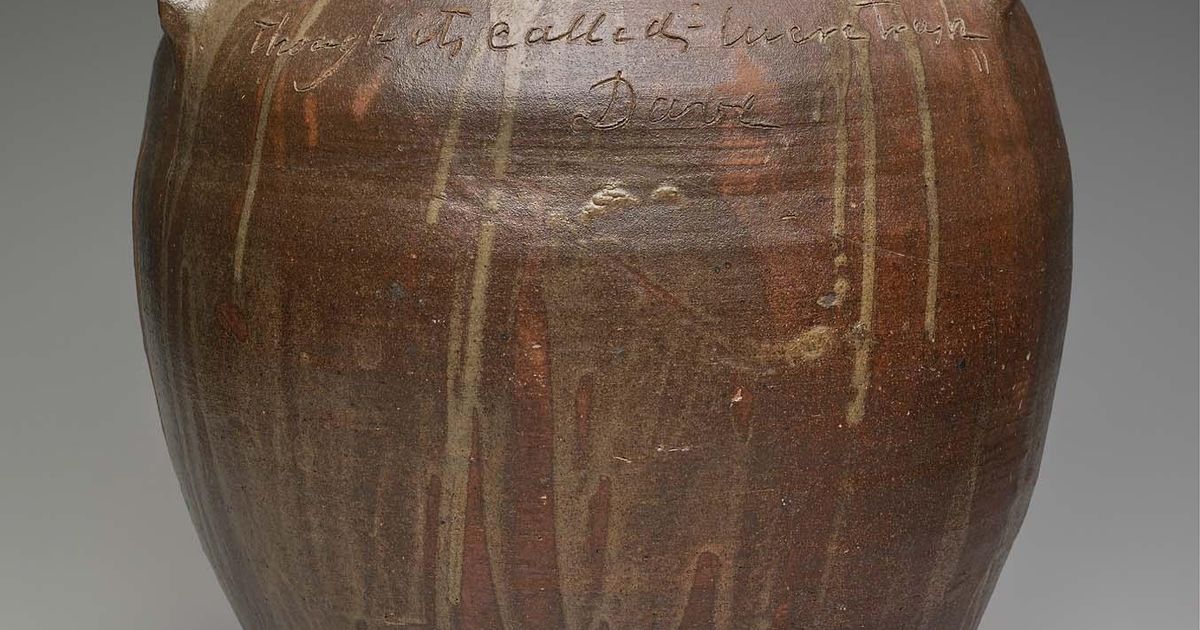
David Drake was an enslaved potter in Edgefield, South Carolina. He made monumental stoneware jars, and on them he wrote his name, the date, and couplets of his own, at a time when it was a crime for an enslaved person to be literate. Theaster Gates, who has built twenty years of his own practice around him, puts it plainly: “there was a real intention to make Black labor anonymous, to blur the role our hands played in shaping this country.” And the mechanism: “it's easy to erase because the names were often never recorded.”
Drake recorded his. On the object, in the clay, before it was fired. On the jar the museum calls the Poem Jar the lines read, in the museum's transcription: I made this Jar for cash / Though its called lucre trash / Dave. A maker's name, a date, and a sentence about the sale, cut into the thing being sold. It is the oldest form of provenance there is, and for a century and a half it was the only record of him that survived, because every other record of who he was belonged to the people who owned him.
Then, on 29 October 2025, the Museum of Fine Arts, Boston announced that it had reached an agreement with his descendants over two jars of 1857 in its collection. In the museum's own words: “Drake was deprived of his creations involuntarily and without compensation.” Ownership of both was restored to the family's Dave the Potter Legacy Trust. The museum then bought one, the Poem Jar, back from them; the other, the Signed Jar, the family now owns and has left at the museum on long-term loan. This study takes no view on restitution as a policy and describes only what the museum said it did.
What it did was treat a name written on a pot in 1857 as a claim of title in 2025. The signature that was a crime became the document. There is no other case in this study where the maker's own hand on the object did the whole work of the record for a hundred and sixty-eight years, and it should be said that it did so because a genealogist found the descendants and a museum decided the inscription counted. A name on an object is not a record until somebody agrees to read it as one.
The keeper without whom there is nothing
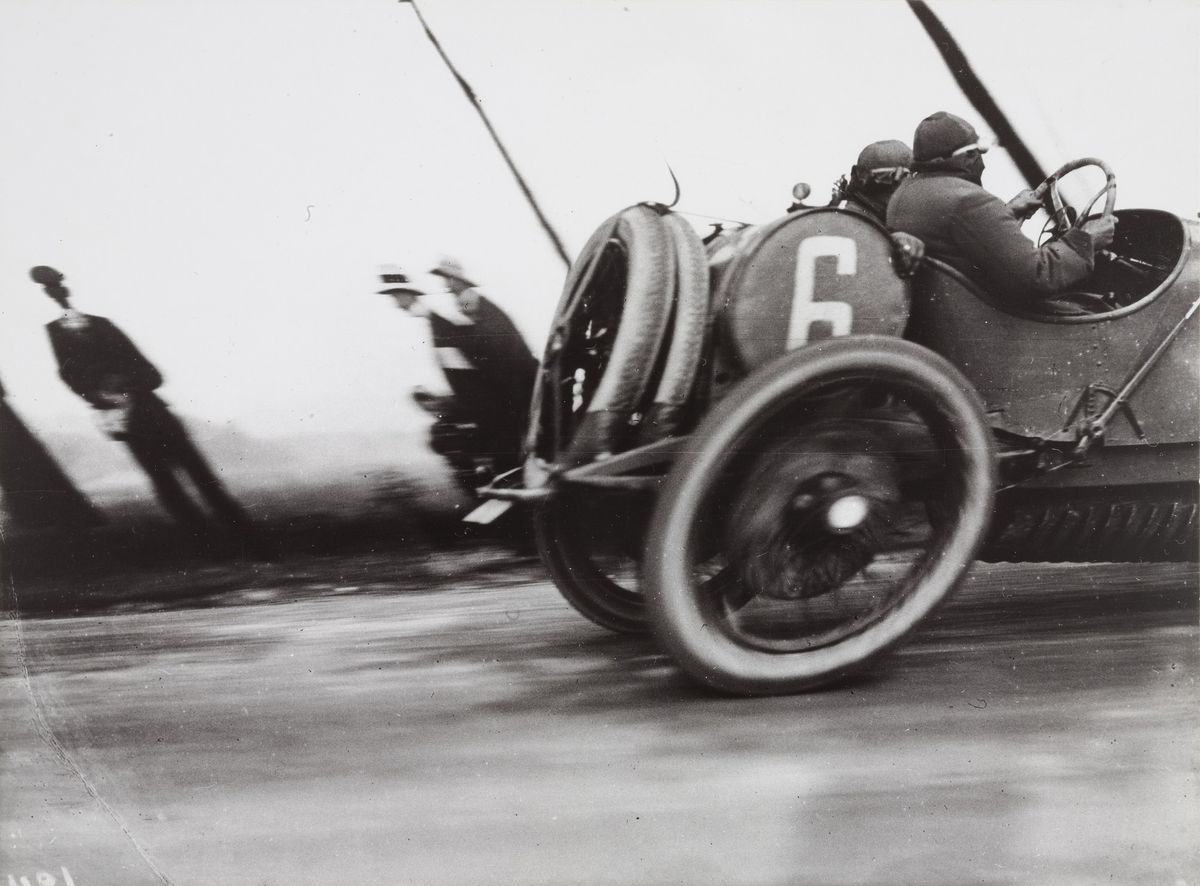
Jacques Henri Lartigue was given a camera at seven and photographed the world he grew up in: his brother leaping off a homemade glider, cousins somersaulting into pools, racing cars, balloons. Christian House, writing this summer, gives the fact that matters here in one sentence: “for more than fifty years this joyous body of work languished in a bundle of family albums.”
Nobody outside the family saw it until 1963, when John Szarkowski gave it a show at the Museum of Modern Art, and 1970, when Richard Avedon edited the monograph. Lartigue took some two hundred and eighty thousand photographs in his life. He said, late on, “I want to stop time.”
Read that as a custody record. Maker: Lartigue, from about 1901. Then fifty years of a line the record would write as held across a span, family, private, and would attach nothing to. But everything that makes Lartigue valuable happened inside that line. The albums were assembled. They were kept dry, kept together, kept from being thrown out across two wars and a change of century. The people who did that are not named anywhere in the account of his value, and without them the account does not exist. The keeper is not a footnote to the maker. Here the keeper is the reason there is a maker to name.
The maker who kept
Henry Moore kept things. Bones, flints, pebbles, shells, roots, picked up around Perry Green and elsewhere and set on shelves in his studio, where they stayed for decades. A review of the Kew exhibition describes the collection as his “library of forms,” and says of the objects in it that “most of these objects remained untouched, displayed on shelves and valued in their own right.” One root he carved, paring back its upper section and shaping the lower into a neck, and that one is now shown as a work.
The point is the other ones, the ones he did not carve. A maker is also a keeper, and the keeping is a separate act with its own duration. Moore held those roots for the reason Johnson names: they were imbued with something for him, before and apart from use. A record that begins at the moment a thing is made would put the carved root at year zero and would have no way to say that the uncarved ones on the shelf beside it, kept for forty years by the same hand, were the same act.
The house that gave its memory away
Daniel Roseberry, who designs for Schiaparelli, was asked whether the house owns the garments in its own retrospective. His answer: “We don't have an archive at all. Schiaparelli doesn't because Elsa gave” it away. “She gave nearly her entire personal archive to the Musée des Arts Décoratifs here in Paris, to the Philadelphia Museum of Art, and to the Metropolitan Museum of Art in New York.” The exhibition, he said, “has been called in from all four corners of the globe.”
So the house that made the objects holds none of them, and the account of what Schiaparelli made is kept entirely by institutions she chose. Every dress in the show has a keeper who is not its maker and not its wearer, and the keeper is the only reason the house can see its own past. Roseberry's interviewer called him a steward of her legacy. The stewardship is real, and it is exercised over objects that other people have been keeping safe and keeping clean for seventy years.
What the span contains
This institution publishes a specification for a provenance record, and one of the four kinds of event it carries is that an object was held across a span of time. The event has a holder, a start and an end, and no field at all for what the holder did. The wider standards are not that bare, and the honest version of this finding has to say so. CIDOC CRM, the reference model most museum documentation is built on, carries a class for modification that explicitly covers preventive treatment and restoration, with one property for who carried the work out and another for when. A darn is modellable, and has been for years. The gap is not in the vocabulary.
The gap is that nothing requires the entry. No sale depends on it, no catalogue prints it, no insurer asks for it, and by the time anybody would write it down the people who did the work are usually unnamed and often dead. A field that exists and is never filled reads, to anyone coming to the record later, exactly like a field that was never there. That is the finding, and it is about adoption rather than vocabulary. The span is a line with a holder at either end, and in practice the line is empty.
The four cases say it is not empty. It is where most of an object's authors live. The people who darned it are the burden of preservation with faces, and the reason the burden was carried is the one Johnson gives and the trade never does: the thing meant something to them. Object permanence is not a property an object has. It is work somebody did, usually unpaid, usually unnamed, and the record that credits the maker and the owners and nobody else has recorded the two parties who did the least of it.
None of this asks the record to become sentimental. It asks it to be complete. A Custodian's Contract that names who held an object and for how long, and not what they did to keep it, has recorded custody and missed care, and care is the part that decides whether there is anything left to hold. Johnson said she hopes she is “just a steward for these things before where they go next.” The record's job is to make sure that when they go, her name goes with them, beside the darners, and not only the maker's.