Nobody Books the Commons: What the Record Shows When a Public Asks What It Held
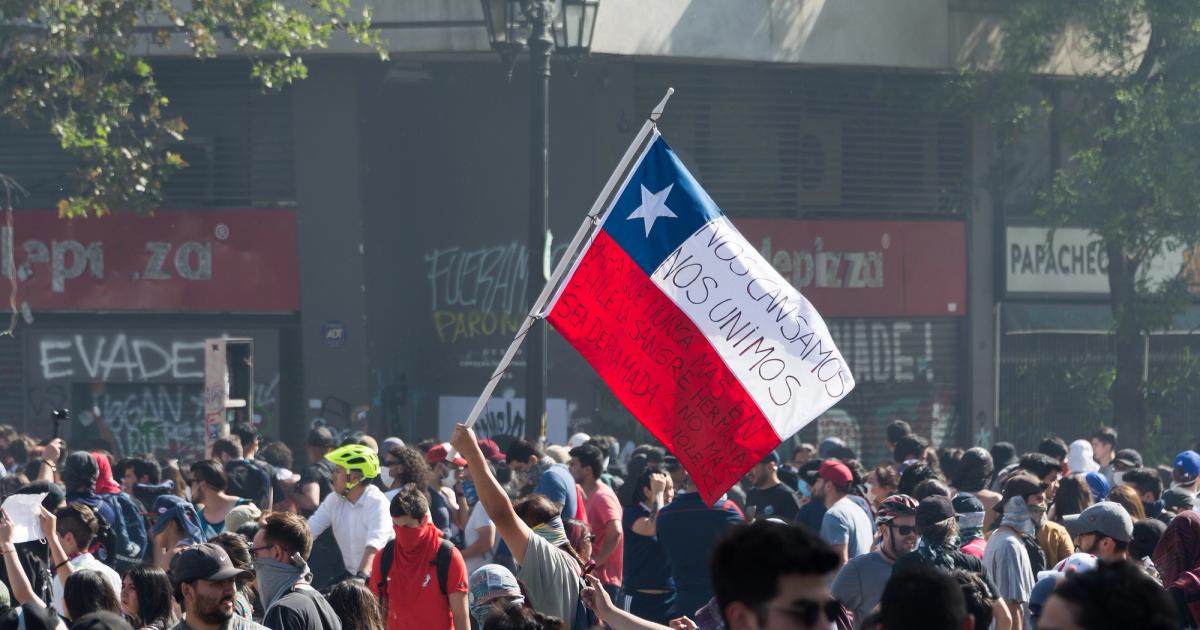
On a year in which governments across five continents moved a cost onto households by a named instrument, on the records that document those instruments precisely, and on the one thing those records have no field for
---
Something is happening across a great many countries at once, and there is no instrument that can tell you how much of it there is.
That second clause is not a rhetorical opening. It is a measurement, and it is where this study starts, because the absence it describes turns out to have the same cause as the thing the movements themselves are asking about.
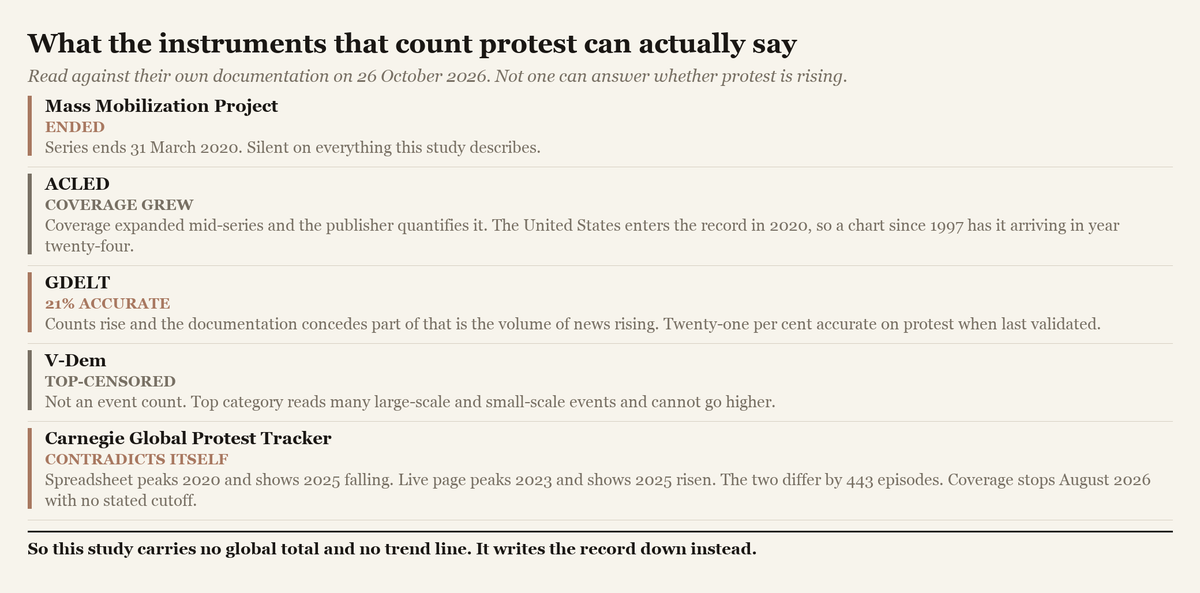
Five datasets are cited whenever anyone says protest is rising. Read against their own documentation on 26 October 2026, not one of them can answer the question. The Mass Mobilization Project's series ends on 31 March 2020. ACLED's geographic coverage expanded during its own series, which ACLED states and quantifies, and the United States enters its record in 2020, so a chart of global protest since 1997 has the largest economy on earth arriving in year twenty-four. GDELT's counts rise, and its own documentation concedes that part of the rise is the volume of news rising; validated in Science in 2016 it was twenty-one per cent accurate on protest. V-Dem's highest category reads "many large-scale and small-scale events" and cannot go higher, so a country already in it cannot register an increase.
And Carnegie's Global Protest Tracker, the most cited of the five, disagrees with itself. Its downloadable spreadsheet puts the peak in 2020 and shows 2025 falling. Its live page puts the peak in 2023 and shows 2025 risen. The two differ by 443 episodes. Read in full on 26 October 2026, its coverage stops in August 2026 with no stated cutoff, so it holds nothing at all about the September and October episodes, and it carries no 2026 entry for Uganda, Serbia, Georgia, Madagascar, Morocco, Nepal, Tanzania or the United States.
So this study does not tell you that unrest is increasing. No source supports that as a measured fact. What it does instead is the thing nothing else is doing, which is to write the record down: episode by episode, instrument by instrument, with every figure carrying the body that issued it and the date it was read.
What is established, with its dates
Serbia. A snap parliamentary election was held on 25 October 2026, called on 9 September after the Assembly was dissolved. On election night Aleksandar Vucic said: "It is clear that we have lost these elections," adding that final results were not yet available. The Republic Electoral Commission's preliminary count, at 96.9 per cent of polling stations and recorded at 97.6 per cent on 26 October at 21:20 Central European Time, gives the Student List 53.40 per cent and Aleksandar Vucic and United Serbia 39.69 per cent. Seat allocations in circulation, between 135 and 140 of 250, are projections by named pollsters rather than a certified count, and no certified allocation existed when this study was written.
Bulgaria. The 2026 draft state budget passed first reading. About 20,000 people protested in Sofia on 26 November 2025 against increases that included higher social security contributions and a doubling of the dividend tax. On 27 November the ruling coalition's council announced that the government would withdraw the draft. The government then rescinded that decision. On 2 December it asked parliament to withdraw the bill, with a new budget to be drafted once parliament formally agreed. On 11 December the prime minister announced the cabinet's resignation minutes before a no-confidence vote, and parliament accepted it the following day.
Bolivia. Supreme Decree 5503 eliminated fuel subsidies and Law 1720 addressed land. Both were repealed in response to protest, according to the Inter-American Commission on Human Rights. Both chambers approved the repeal of Law 1720 on 12 May 2026 and it was formalised on 13 May, with one source giving 14 May. Deaths are reported variously: a tally of 24 as of 9 July 2026, at least six before the repeal in one account, three in late May in another. The reporting attributes deaths both to security operations and to roadblocks, and several people are reported to have died after being trapped by blockades.
Comoros. On 9 May 2026 diesel rose by 46 per cent and gasoline by 35 per cent, with one account putting petrol at 33 per cent. One person died on Anjouan in the unrest that followed, and another account gives two. On 16 May the increases were suspended, and the energy minister described the suspension as a way to keep the peace and allow talks. The National Human Rights Commission reported 39 people detained. Nothing was repealed.
France. Marches on 17 October 2026 over the cost of living and over schools drew about 550,000 participants by the authorities' count and 800,000 by the organisers', and in the reporting of several cities they were followed by rioting and looting. Insured losses to shops were put by a federation in the hundreds of millions of euros, against about 793 million euros for the French unrest of 2023. More than 2,400 arrests were reported. This institution examined that weekend separately, in a study published on 26 October 2026, and took no position on the protests, their causes or the policing. It takes none here either.
The question this study actually asks
Set those five beside one another and the shared feature is not anger. It is paperwork.
In each case a thing that a public held was moved by an instrument that can be named, numbered and dated. A budget with a first reading. A decree with a number. A price order with a percentage. A finance act with a division list. The documentation is not obscure and it is not hidden. Most of it is published by the institutions that produced it, and reading it is most of what this study consisted of.
What no record contains is the holding itself.
There is no entry in any ledger stating that a fuel subsidy existed, unremarkably, across four administrations, or that a water system was held in common for sixty years and nothing happened to it. The years in which a public simply held a thing produce no paperwork, because paperwork is produced by events, and holding is not an event.
This institution has found that shape before, in a smaller room. A provenance record of a painting is a list of departures: owners, sales, gifts, inheritances, each entry marking a moment the object left somebody, with the long stretches in between blank by construction. And on one weekend in France, three kinds of loss followed a night of damage, and exactly one was counted, because an insurer owed money on it and the sum had to be calculated.
The same asymmetry, pointed at a public holding, is the subject of what follows. The departures are recorded because somebody is owed. The holding is not, because nobody is owed the commons. And the count of the movements asking about it does not exist, because nobody is owed that either.
Three layers of one subject, unrecorded in the same way, for the same structural reason. What follows is an attempt to write down the layer that can be written down.
---
What a record of custody actually records
Open any provenance record and read what it is made of. Owners, with names and dates. Methods of transfer: sale, auction, gift, inheritance, commission. Exhibition history. Locations. The Getty's Categories for the Description of Works of Art set the shape and every serious register follows it.
Now notice the form of each entry. Every one marks a moment the thing left somebody. A provenance is a list of departures, written from the point of view of motion, and the long stretches between the entries, which is to say almost the whole of the object's existence, are blank by construction. Not missing. Blank, because the form has no field for them. There is no entry that reads: this was held, and for forty years nothing happened to it.
This institution reached that conclusion about paintings and furniture, and the obligations it describes are set out in its Custodian's Contract. The question this study asks is what happens to the same form when the thing being held is not an object and the custodian is not a person.
The holding nobody books
A public holds things. Some of them are written down as property: a water system, a power grid, a rail network, a sovereign mineral right, a building. Some are written down as a claim: a pension fund with a balance, a subsidy with an appropriation, a tariff set by an order. Some are written down only as a rule: the right to petition, to associate, to vote, to be heard before a thing is sold. All of them have the same custodial structure as an object in a collection. Somebody holds them on behalf of somebody else, and the holder changes over time.
So the departures are documented, and they are documented well. A finance act has a number, a date of first reading, a division list and a text. A loan has a programme name, a disbursement schedule and a set of published conditions. A concession has a counterparty, a term and a tariff formula. A debt service obligation has a line in a budget and a payment date. These are not obscure records. Most of them are published by the institutions that created them, and much of the research in this study consisted of reading them.
What is not documented anywhere is the holding itself.
No ledger carries an entry stating that a water system was held in common for sixty years and that nothing happened to it. No register records that a fuel subsidy existed, unremarkably, across four administrations. The years in which a public simply held a thing produce no paperwork, because paperwork is produced by events, and holding is not an event.
Why the asymmetry exists, and it is not a conspiracy
The reason is visible in a smaller case this institution examined separately, in a study of 26 October 2026. On the weekend of 17 October 2026, marches across France over the cost of living and over schools were followed, in the reporting of several cities, by rioting and looting. Three kinds of loss followed. Physical damage to shops was insured, assessed and quantified, and will appear in a federation's figures and a company's accounts. The other two kinds were not counted at all.
The difference was not interest or attention. It was that an insurer owed money on the first one. A record came into existence because a party was owed and a payment had to be calculated. Where nobody is owed, nothing is calculated, and no record appears.
That sentence generalises, and generalising it is the whole of this study's method. Every documented departure of public equity exists because somebody is owed. The creditor is owed the service payment, so the payment is recorded to the cent. The concession holder is owed the tariff, so the tariff formula is written into a schedule. The bondholder is owed a coupon on a date. The record is complete, precise, dated and auditable, in exactly the places where a payment had to be computed.
And nobody is owed the commons. There is no counterparty to a thing a public simply has. So the holding generates no entry, and the record of a public's own property turns out, when anybody goes looking, to consist almost entirely of the occasions on which it left.
What that means for a public that starts asking
This is the point at which the form of the record stops being a technical matter.
A public that wants to know what became of something it held has to read a record composed of departures. It will find the act, the loan, the concession and the schedule, because those are documented. It will not find an account of the holding, because that was never written. The absence is structural and it is identical to the absence in the provenance of a painting, where the decades of simply keeping the thing leave no trace and only the sales appear.
A reader of such a record naturally reaches one of two conclusions. The first is that nothing was there. The second is that something was taken. The record cannot distinguish between those two readings, because it was never built to describe the state it is being asked about.
That is not an argument that anything was taken. It is an argument that the record is the wrong shape to answer the question, and that a form which only logs departures will, when a public consults it, read as a list of losses whether or not anything was lost.
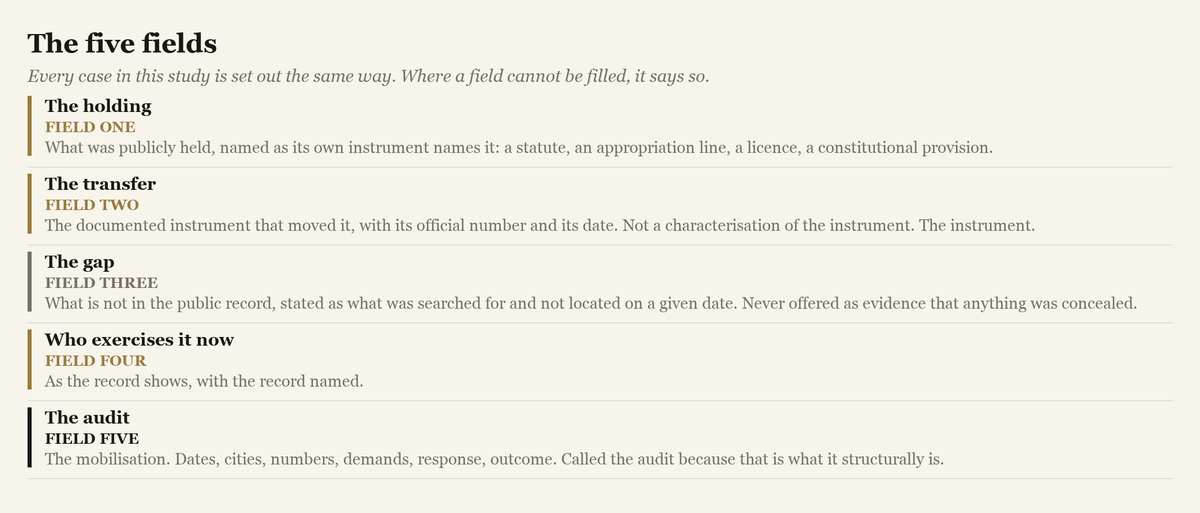
The five fields this study records for each case
Each case below is set out as a custody record rather than as an account of a dispute. Five fields, the same five each time, and where a field cannot be filled the study says so rather than reasoning around it.
The first is the holding: what was publicly held, named as its own instrument names it. A statute, an appropriation line, a licence, a constitutional provision.
The second is the transfer: the documented instrument that moved it, with its official number and its date. Not a characterisation of the instrument. The instrument.
The third is the gap: what is not in the public record. An unpublished schedule, a beneficial owner absent from a register, an audit not released. This field is a statement about what was searched for and not located on a given date, and it is never offered as evidence that anything was concealed.
The fourth is who exercises it now, as the record shows, with the record named.
The fifth is the audit: the mobilisation. Dates, cities, numbers, demands, the response, and the outcome as of the date this study carries. This field is called the audit because that is what it structurally is. A party with no entry in the ledger arrives to read the ledger.
---
The year, in the order it happened
What follows is the spine of this study: a dated record of significant episodes between January and 26 October 2026, with each figure carrying the body that issued it. Thirty-five episodes are set out in full in the working record and fifty-seven countries appear in it. The selection below is not a ranking of importance. It is the set where an instrument can be named, a date fixed, and a figure traced to an issuer.
It is not a count of the world's protest, and no total appears anywhere in it. The reasons are set out earlier: no dataset can support one.
---
The episode where the record itself was switched off
Iran, late December 2025 to 31 March 2026, with the worst days on 8 and 9 January and a second flare from the middle of February.
The named triggers are the collapse of the rial, hyperinflation, a water crisis and sanctions. A British government country bulletin titles the episode by its dates rather than its cause.
There are six death counts and no authoritative total, and this study supplies none. Each is given with its issuer and the date it stood:
Iranian state television's last official update, 3,117, on 21 January 2026. An Iranian official speaking to a wire agency, at least 5,000 verified including about 500 security personnel, on 18 January. A human rights news agency, 6,126 in total, of whom 5,777 were protesters and 86 children under eighteen, with a further 17,091 deaths under investigation, in late January. A British government bulletin, roughly 12,000 to 20,000, in mid-January. The United Nations special rapporteur, at least 5,000 and possibly up to 20,000, the upper figure attributed to medical sources.
Three arrest counts, likewise: 40,887 and, on an earlier tally, 10,675 including 169 children, both from the same agency, and more than 20,000 from another organisation.
And the reason the counts cannot be reconciled is the clearest statement of this study's subject anywhere in it. There was a total internet blackout from 8 January 2026, with outages exceeding 400 hours recorded by a named monitor by late January and only intermittent circumvention. Independent verification was impossible during precisely the days when it mattered most.
Amnesty International's characterisation is that authorities cut all access "to conceal their crimes", which is Amnesty's wording and is given as theirs. And Amnesty also said it could not verify a detention figure at all. That inability is part of the record rather than a gap in it, and it is the same declaration this study makes about its own absences, made by a larger organisation about a graver subject.
No participant estimate exists for Iran from any body. The deadliest episode of the year has no size.
Officials who resigned are named in the record: the head of the central bank and a presidential political adviser. The president and a government spokeswoman promised negotiations. The supreme leader said rioters must be "put in their place."
Two further things appear in the aggregated accounts and are not published here, in any form, including as a hedge, because the researcher who found them states that it did not verify either and because they are not this study's subject.
---
The fiscal instruments, and what happened to them
Eighteen episodes have a named, dated fiscal instrument at their origin. Set out by what became of the instrument:
Repealed, with an instrument. One case. Bolivia. Both chambers approved the repeal of Law 1720 on 12 May 2026, formalised 13 May, one source giving 14. A separate decree eliminating fuel subsidies was also repealed.
Suspended, which is not repeal. One case. Comoros. Diesel rose 46 per cent and gasoline 35 on 9 May, with one account putting petrol at 33. Suspended on 16 May, the energy minister describing it as keeping the peace and allowing talks. Seven days, and reversible by construction.
Announced, rescinded, then referred. One case. Bulgaria, set out earlier. No instrument of withdrawal was located and the government fell on 11 December.
Partially reversed the same day, which reads as a concession and is not one. Kenya. The regulator raised fuel prices 24.2 per cent in April and 23.5 in May 2026. Four people were killed and more than thirty injured, with 348 arrests according to the interior minister by name. A same-day revision cut diesel by about ten shillings and raised kerosene by thirty-eight. That is a reweighting, not a withdrawal, and this study does not record it as one. Compensation for about 2,000 victims was announced on 15 June 2026.
Not withdrawn, and still before a court. Iraq. Customs rates rose from roughly 1 to 5 per cent up to 6 to 30 per cent from 1 January 2026, with a 20 per cent sales tax reinstated on mobile and internet recharge cards; officials tied both to falling oil prices and debt reduction. Hundreds of traders and customs agents protested in central Baghdad on 8 February alongside a shop-closure strike reported in four cities. No deaths, injuries or arrests in any source located. A lawsuit was pending before the federal supreme court and traders petitioned the judicial council on 10 February. No ruling and no reversal was located. One trader's own claim, given as his and not as an audited figure, is that an item formerly sold for 5,000 dinars would have to be sold for 40,000.
Iraq is worth sitting with, because it is the control case for the whole study. A named fiscal instrument, a dated effect, an organised response, no violence, no casualties, a court petition, and no resolution. Nothing in it is dramatic, which is why it almost never appears in accounts of this year, and it demonstrates that the pattern this study describes does not require anybody to be hurt.
And one pointing the other way. Albania, 6 July 2026: 400 million lek moved out of the budget reserve for a concert. Protest within three days, a constitutional challenge within four, a prosecution complaint within seven. A government spending, not withdrawing.
So of eighteen fiscal instruments, one was repealed, one suspended, one abandoned without a traceable act, one reweighted and presented as relief, and the rest stand.
---
Where a government or a minister left office
Recorded only where a date could be fixed and the departure corroborated.
Bulgaria, 11 December 2025: the prime minister announced the cabinet's resignation minutes before a no-confidence vote, and parliament accepted it the following day.
Romania: a wage law restructuring pay by salary grade, and touching bonuses and pensions, and the government fell.
India, 25 July 2026: the education minister resigned, after an examination leak and a change in marking, with 2.2 million candidates re-sitting. On 20 July, 180 people were injured, of whom police said 118 were security personnel and 60 protesters.
Sri Lanka: the prime minister on 9 May 2022 and the president on 14 July, set out in full earlier.
Nepal: the home minister on 8 September 2025 and the prime minister on 9 September. An election on 5 March 2026 returned 182 of 275 seats to a party new to government.
Bangladesh: an election on 12 February 2026, 209 of 300 seats, turnout 59.44 per cent. The date the previous prime minister left office could not be verified and is not stated.
Mongolia: prime ministers on 3 June 2025 and 27 March 2026.
South Korea: the president on 4 April 2025, by unanimous decision of the constitutional court.
Not recorded, for stated reasons. Nepal's president, because the army denied it. Any Indonesian departure, because none was verified and a retrieval failure is not a finding. The Philippines replaced six senior office-holders and the source gives no dates. And Serbia, whose president conceded an election and separately resigned a different office a month before it, for the reason given in its own ledger.
---
Two movements that finished at a ballot box
Serbia, 25 October 2026, and Nepal, 5 March 2026. Those are the only two episodes in this record that began in the street and ended with a counted vote that changed the government.
️ That is two out of thirty-five, and the study draws no lesson from the ratio, because the episodes are at different stages and several are unresolved. It is recorded because a reader who has met the Chilean coda will want to know how often the other thing happens.
---
What the chronology shows about dates
Clusters look like coordination and are not. The concentrations around 17 October and 24 to 25 October 2026 had four different callers. Nine countries share a single oil price shock, which is one cause acting independently in nine places and produces a pattern on a map almost identical to contagion.
And the longest episodes are the least reported. Georgia's 608 consecutive days and Albania's hundred evenings both ran through months in which international coverage was effectively absent, which is why both had to be reconstructed from local-language sources, and why neither has a crowd figure.
️ The most cited tracker of this subject stops in August 2026 without saying so, so it holds nothing at all on the September and October cluster, which is the densest part of this record.
---
The cases where the instrument is published
Four cases are set out first because in each of them the document that moved the holding is public, numbered and readable, and most of the work of this study consisted of reading it. These are not the cases where something was hidden. They are the cases where everything was disclosed and the record still cannot answer the question a public asks.
Each is given in the same five fields. Where a field cannot be filled, it says so.
---
Sri Lanka: the one loss the record does not quantify
The holding. The Employees' Provident Fund, the retirement saving of private-sector workers. Rs 3,460 billion at the end of 2022 per the central bank. Ninety-four per cent of its own assets held in government debt. About twenty-nine per cent of all domestic local-currency government debt. With its sister fund, more than ninety per cent of the country's retirement assets. The lender's own word for funds of this kind, in its own documents, is captive.
The transfer. External debt service was suspended on 12 April 2022 and formal default on the international sovereign bonds followed on 18 May, on the lapse of a grace period. An Extended Fund Facility was approved on 20 March 2023: SDR 2.286 billion, 395 per cent of quota, about three billion dollars, over forty-eight months. Parliament adopted the domestic debt optimisation resolution in June 2023; the operation launched in July and concluded in September.
The clause that reached the fund, quoted exactly from the staff report: "a voluntary exchange of Treasury Bonds, with a minimum participation requirement for superannuation funds to avoid an increase in their investment income tax rate from 14 percent to 30 percent."
The terms were a maturity extension and a twelve per cent coupon, roughly the prevailing yield, stepping down to nine per cent in 2026. Take-up is described as very high. The fourteen per cent baseline applied only to provident, pension and superannuation funds.
The gap, and it is the finding. The same reports quantify a net present value loss for the central bank, a loss for the banks moving from 3.7 to 3.35 billion dollars, and a haircut for the holders of the international bonds. For the workers' funds there are only terms. No loss figure appears, in any of three reports.
That absence was tested in both directions. The same searches that return nothing for the superannuation funds return the figures for the central bank and the banks, and the word superannuation is independently findable in the documents. The instrument can say yes, so the silence is a measurement.
Order the parties by whether they could have declined. The bondholders negotiated, and their haircut is published. The banks negotiated, and their loss is published to two decimal places. The central bank is an arm of the state, and its loss is published. The fund that held ninety-four per cent of its assets in government paper, and faced a doubling of its tax rate for declining, is the only party whose loss is not quantified anywhere.
Who exercises it now. The fund continues to hold the exchanged instruments on the terms above. Debt service as a share of revenue fell from 79 per cent in 2022 to 56 in 2024 and 46 in 2025, and the fifth and sixth reviews were completed on 27 May 2026 with all end-2025 targets met.
The audit. From 31 March 2022, when protests reached the president's private residence at Mirihana, to 22 July, when the Galle Face occupation was cleared. A state of emergency on 1 April. Social media blocked for about fifteen hours on 3 April by the telecommunications regulator at the defence ministry's request, with no legal basis for it in any source reached. The GotaGoGama occupation from 9 April. A man shot dead by police at Rambukkana on 19 April. A general strike on 9 May, followed the same day by the prime minister's resignation. The president's house entered on 9 July; he left office on 14 July, announced on the 15th. The national human rights commission described the clearing of Galle Face as a total violation of the fundamental rights of the people by the executive.
A presidential election on 21 September 2024 was decided on a second count, 42.31 per cent rising to 55.89, turnout 79.46, the sitting president third on 17.27. A parliamentary election on 14 November 2024 returned 159 of 225 seats.
---
Madagascar: two facts in one document
The holding. The national electricity and water utility, and the tariffs at which it supplies both.
The transfer. From the lender's country report of 11 July 2025. Adoption of the utility's recovery plan was a prior action, which is to say the board did not release money until it was done. A structural benchmark set numeric loss-reduction targets, from 28 per cent in 2024 to at most 24 by 2026, with average operational cost down at least 8 per cent over the same period. Another structural benchmark, in the authorities' own commitment language, named a rise of 16.5 per cent by September 2025 in a specifically named business electricity tariff, toward a total of 50 per cent over three years, following an initial 20 per cent in October 2024. An automatic monthly fuel price adjustment mechanism was a second prior action, with full elimination of fuel subsidies due as a reform measure by May 2026. The utility's arrears stood at MGA 4,087 billion at the end of 2023, which is 5.8 per cent of GDP.
The same document names the grievance. It attributes pervasive electricity outages and water shortages partly to low utility tariffs.
So one published report contains both the complaint and a dated, money-backed instrument to raise the thing complained about. Protests began on 25 September 2025. This study states the document and the coincidence of the dates. It does not assert that one caused the other, and the benchmark named the business tariff while household tariffs were recorded in the same report as only under discussion.
The gap. What happened to that benchmark once the protests began cannot be established. Whether it was met, waived, modified or dropped is unknown here, because the staff report for the reviews completed on 30 September 2026 was not located. A press release from that period records a waiver for a primary balance criterion and says tax collection fell well below expectations. It says nothing about the tariff benchmark.
Who exercises it now. The government was dissolved by presidential communiqué on 9 March 2026, with no reason given at the time. A new prime minister was named on 15 March and a new cabinet on 25 March.
The audit. Protests over water and power from 25 September 2025. Reports of further protests in March and April 2026 could not be corroborated: the dissolution is confirmed and the protests around it are not, so they are not stated here.
---
Senegal: a transfer its own auditor describes as unauthorised
The holding. The state's borrowing capacity, and the parliamentary authorisation required to use it.
The transfer. The audit court's report of February 2025, retrieved and read in full: 57 pages, fetched at 1.33 megabytes against a control address that returned nothing. Its own term for what it found is debt contracted from the banking system "sans autorisation parlementaire", without parliamentary authorisation. The amount rises from 746 billion CFA francs in 2019 to 2,096 billion in 2023. The deficit is restated from 4.90 per cent of GDP to 12.30, and the debt stock from 74.41 per cent to 99.67.
The gap, declared by the auditor inside its own finding. The court states that it excluded spending whose description or nature was not explicit. Its figure is therefore a floor, by its own method, and the court says so rather than leaving a reader to discover it.
No lender document reached in this study cites that report. Eight were checked individually: three press releases, two briefing transcripts, two country pages and one earlier country report. The lender refers to successive audits of public debt without naming an institution, and separately encourages an audit by a private international firm, which is a different instrument.
So this study does not write that the lender relied on, endorsed or cited the audit court. It writes the better-supported thing: two institutions produced records of the same debt independently of one another. That is a stronger evidentiary position than one leaning on the other, and it is also simply what the documents show.
Who exercises it now. Not established here. The amount of unauthorised debt is stated by the court; where the borrowing sits now is not in anything reached.
The audit. Carried in the chronology rather than here, and the figures in it are contested.
---
Tanzania: a record that exists, contains a number, and is withheld
The holding. The count of how many people died.
The transfer. Not applicable in the fiscal sense. This case is in this section because its document is the clearest in the study, and because what happened to that document is the point.
The gap, and it is of a different kind from every other gap here. Casualty figures for the post-election violence span ten to ten thousand across the bodies issuing them, three orders of magnitude. The state's own commission of inquiry found that at least 518 people died of unnatural causes. According to Amnesty International on 24 April 2026, through a named officer, that report was handed to the President and has not been published.
A record exists. It was produced by the state's own instrument. It contains a number. It is withheld.
No wrongdoing is implied by any of that. Withholding a commission report is lawful in many systems and this study takes no view on the decision. But the distinction is the one that matters most to everything above: a withheld record and a missing record are not the same thing, and a form that renders them identically destroys the only information in the difference. Every other absence in this study is a blank. This one is a document in somebody's hands.
It also resolved a conflict. One account described the report as published in April 2026. It was not; it was delivered.
Who exercises it now. The report is with the presidency, on that account.
The audit. The figures are too widely spread to state as one number, and the spread is the finding rather than an obstacle to it. This study publishes no single casualty total for Tanzania and prints the range with its issuers instead.
And the photographs do not exist. Of the eight African cases examined, four have no free-licence photograph at all, and Tanzania is one of them. A control query was run in the same shape across all eight: Kenya returns between 34 and 47 files and Nigeria 39, against zero for Tanzania and Mozambique. The instrument works. The pictures were never taken, or never licensed. The encyclopedia article on the Tanzanian episode is illustrated with a police logo.
---
The cases where the holding went to somebody else's public
The four cases above are the ones where a lender or an auditor published the instrument. The three that follow are the ones where the instrument is a domestic statute, decades old, and the interesting field is not the transfer but who turns out to be holding the thing now.
---
England and Wales: water, held by other countries' retirement savings
The holding. Regional water and sewerage authorities, public bodies supplying water to England and Wales.
The transfer. The Water Act 1989. ️ The Act's long title, its transfer provisions and the date of Royal Assent were not retrieved from the legislation itself in this pass, and are carried as not located rather than paraphrased.
The gap, and it is the same gap as everywhere else in this study. The 1989 flotation proceeds, which is to say what the public received for the water authorities, were not retrieved from any issuing body. The current holders are published to three decimal places. What was paid for them is not.
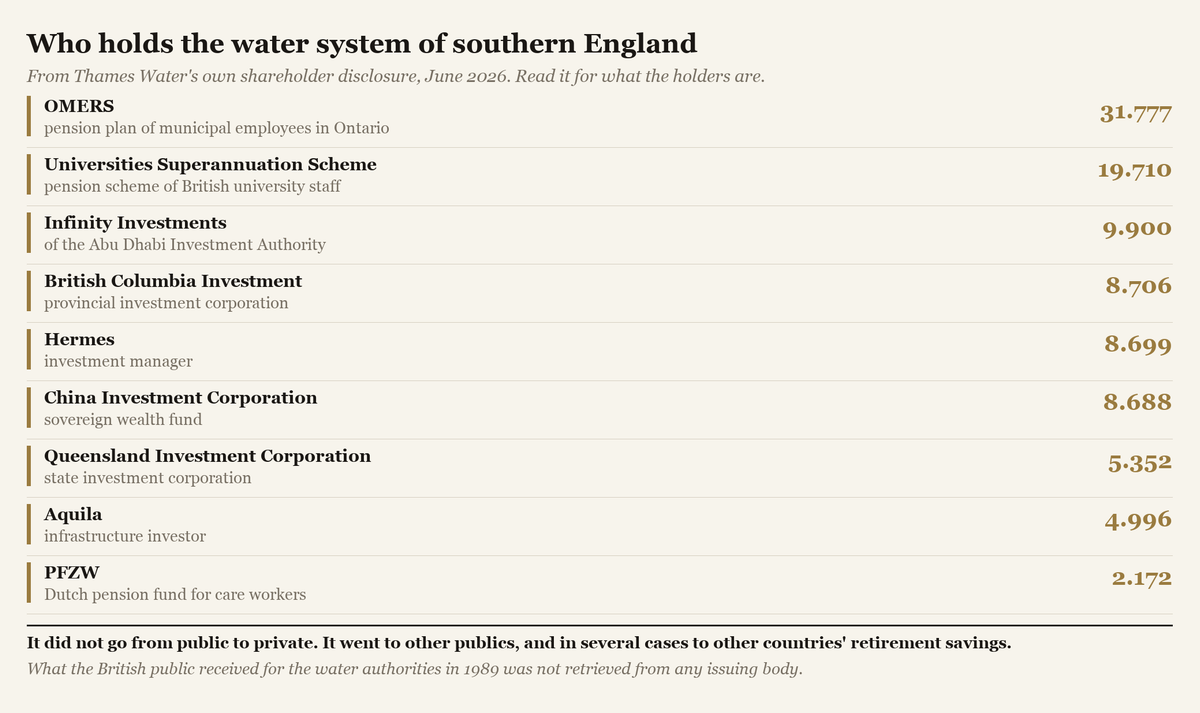
Who exercises it now. From Thames Water's own disclosure of June 2026, in full: OMERS 31.777 per cent, Universities Superannuation Scheme 19.710, Infinity Investments of the Abu Dhabi Investment Authority 9.900, British Columbia Investment 8.706, Hermes 8.699, China Investment Corporation 8.688, Queensland Investment Corporation 5.352, Aquila 4.996, PFZW 2.172.
Read that for what the holders are rather than who. OMERS is the pension plan of Ontario's municipal employees. The Universities Superannuation Scheme belongs to British university staff. PFZW is the Dutch pension fund for care workers. Two are sovereign wealth funds. Two more are Canadian and Australian state investment corporations.
So the water system of southern England is held by other publics, and in several cases by other countries' retirement savings.
And the regulator's auditor states the mechanism in its own words. From the National Audit Office, HC 853, 25 April 2025: sector gearing ran just under 70 per cent, with some companies near 80, against the regulator's price-review assumption of 55. Dividends ran at 9 per cent of equity from 2015 to 2020 against an assumed 4. Two companies paid out more than 100 per cent of equity, in 2005 and 2018. At paragraph 3.5 the auditor writes that exceeding the gearing assumption raised equity returns "at no extra cost to the consumer over the price review control period."
That sentence is the case, and it is the auditor's, not this institution's. A structure existed in which returns rose and the price-controlled bill did not. Debt was reported at over 20 billion pounds in January 2026. ️ The company's status after late August 2026 was not established here.
The audit. No mobilisation on the scale of the others in this study. ️ And effectively no photographs: no free-licence image of the doctors' strikes of 2023 to 2026 exists on the usual repository, and none of the water and sewage question at all.
---
Greece: the operator was sold and the network stayed
The holding. The national railway: both the operating company and the track, signalling and infrastructure beneath it.
The transfer. The state asset development fund sold TRAINOSE, the operator, to Ferrovie dello Stato Italiane. One binding bidder. 45 million euro, accepted 14 July 2016, completed 14 September 2017. The tender had been suspended in 2015 and restarted in 2016. Ferrovie dello Stato Italiane is owned by the Italian state, so the Greek operator is now held, in full, by the Italian public.
The precision that inverts the case if it is dropped. The operator was sold. The network, including signalling, stayed with the state infrastructure company. The Tempi collision turned on signalling. So the half that failed is the half that never left public hands, and the sentence "Greece privatised its railways" is not a simplification of this case, it is the opposite of it. This study does not write it.
The gap. The signalling contract known as 717 is the hinge of the entire matter, and no contractor, value, date or status for it was obtained. The relevant authority's report of 27 February 2025 was not read. That is the single most consequential absence in the European cases.
Who exercises it now. The operator, by the Italian state railway. The network, by the Greek state.
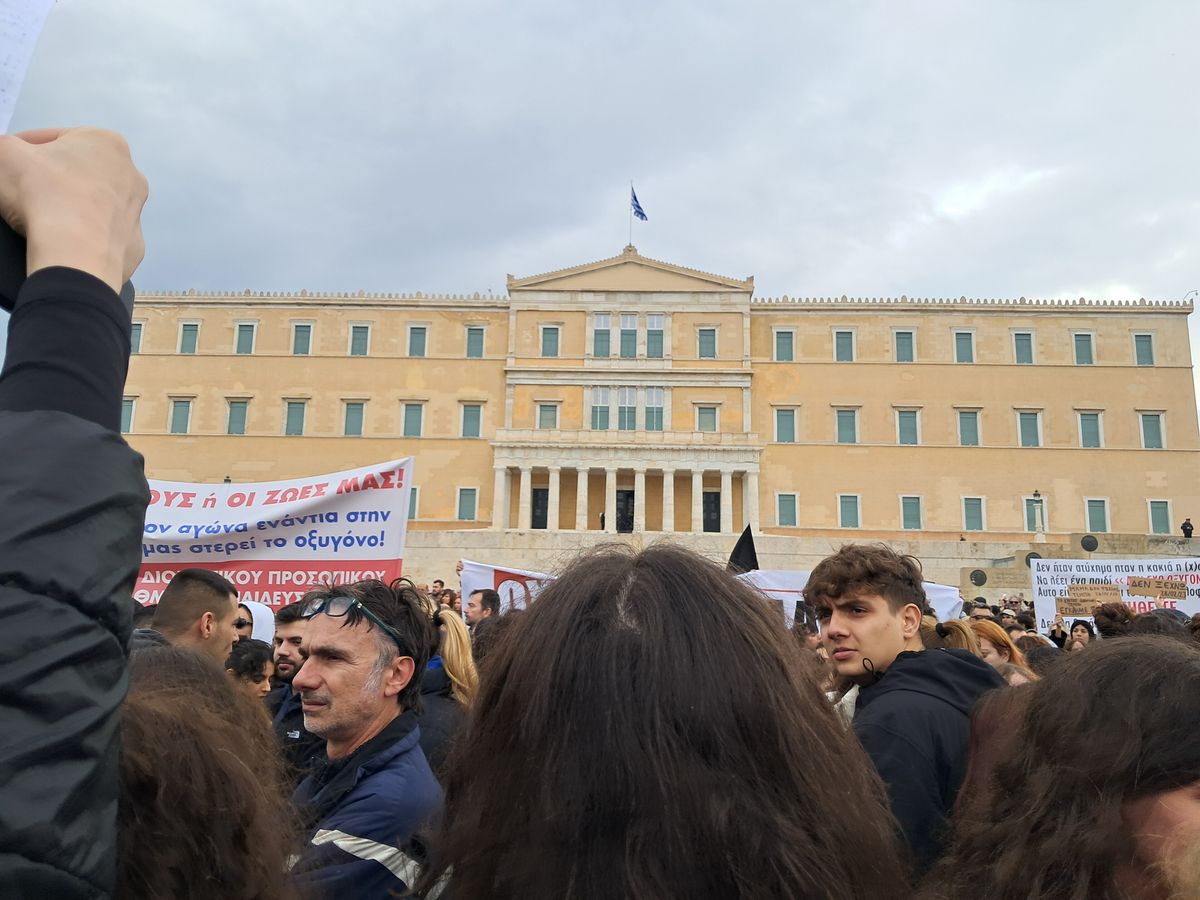
The audit. Mobilisations followed the collision. The crowd figures in circulation cannot be published: a figure of over one million in Athens carries a citation-needed marker in its own source, and a variant of roughly 2.5 million has no named source at all. And this study holds no response or denial from two former ministers named in a reported prosecutor's letter, so it does not name them.
---
Spain: a legislature that called its own past disposals improper
The holding. The public housing stock, and in particular the dwellings held by municipal and regional housing companies.
The transfer. In 2013 Madrid's municipal housing company sold 1,860 dwellings to a named buyer acting for a named fund. The price is not stated in any source this pass reached, and the bodies that could settle it were not reachable: the regional and national audit courts, the judicial documentation centre, and the city's own investigation commission, whose findings are referred to without being given. A second and larger disposal by the regional housing institute, widely reported at about 2,935 dwellings, is wholly unverified here and is not stated.
And the strongest single sentence in the European material is the legislature's own. Ley 12/2023, of 24 May 2023, in the state gazette as BOE-A-2023-12203, in force from 26 May. Its preamble says the law prevents the repetition of "indebidas enajenaciones del parque público de vivienda", improper disposals of the public housing stock.
That is a legislature characterising past sales of public housing as improper, in the preamble to a statute. This study quotes it and adds nothing, because nothing needs adding and because the characterisation is not OAC's.
The law also creates a separate patrimony for the public housing stock and requires income from disposing of its assets to be applied to creating, expanding, rehabilitating or improving public housing.
The gap. The price, as above. ️ And the share of Spain's housing stock that is social was not obtained.
Who exercises it now. The 1,860 dwellings, by the fund's vehicle. ️ The current holder of the unverified second tranche is not stated here, for the reason above.
The audit, and it is the best-documented live mobilisation in this study. The sequence is worth giving in order, because each step is dated and the steps contradict each other.
The government decreed on 29 September 2026. Its own Congress repealed both decrees on 2 October. It re-decreed on 6 October, as BOE-A-2026-20822 and BOE-A-2026-20823. Coverage describing those decrees as banning investment funds from buying homes until 2028 is wrong twice over: the instrument sets a price floor at 70 per cent of valuation, which is not a ban, and runs to 2030. A further article caps public-housing sale prices and binds later transfers through the land registry. The preamble carries the central bank's estimate of a 750,000-home deficit and a price rise of 12.9 per cent in the fourth quarter of 2025.
On 7 October the regional high court declined to authorise clearing the encampment. On 16 October a metro station was closed on health grounds while the fire brigade's own report found access clear, and the national rail operator kept its own station there open. An election was called for 29 November, and a general strike set for 11 November.
The counts. For 26 September, 25,000 by the government delegation and 300,000 by the organisers. ️ That is a twelvefold spread, the widest in this study, and both figures are given with their issuers because there is no basis for preferring one. A range of 235,320 to 895,370 in circulation is an aggregate of one figure per city from a different source each, with cities uncounted, and is not a measurement.
And the tactic travelled, which almost nothing else in this study did. The encampment model reached Oporto on 10 October and Lisbon about a week later. Portugal cleared its camps, with 37 injured in Porto on 15 October and 55 arrested in Lisbon on 20 October, and they re-formed. Spain's was never cleared, because a court declined to authorise it. The same tactic in two states, under two legal outcomes.
---
The cases that ran for years, and have no size
Three of the longest-running episodes in this study share a property that took a while to notice, because it is an absence rather than a feature. Each ran continuously for months or years, and for none of them does a crowd figure from a named body exist for the period in which it ran.
The counting, where there is any, begins at the moment something else does.
---
Georgia: six hundred and eight consecutive days, unmeasured
The holding. The right to associate and to receive foreign funding, and the accession process the government had been pursuing.
The transfer. The suspension of European Union accession talks, followed by legislation requiring organisations receiving foreign funding to register.
️ And that sentence has to stay plural, because it is at least two instruments and this study nearly made it one. Sources disagree on the date of the first, and a human rights organisation describes a further law adopted the following March. A single-instrument framing is wrong in a way a reader settles in one lookup, so no date and no provision is given here: the statutes' own provisions, covered bodies and penalty clauses were not read from the legislation in this pass and are not characterised.
The gap, and it is the point of this section. Protests ran from 28 November 2024 and were still active at least to late July 2026. In late July 2026 a regional news organisation was counting the 608th consecutive day.
That figure checks out against its own start date, which is worth doing because a second report elsewhere gives a count of 500. Measured from 28 November 2024, day 608 falls on 28 July 2026 and day 500 on 11 April. So the two are consistent readings of one sequence at two different moments, not a disagreement, and an arithmetic check settled in seconds what would otherwise have looked like a contested number.
For 2026 there is no participant estimate from any named body. Not from the state, not from the organisers, not from a monitor. Six hundred and eight consecutive days of a thing nobody sized.
A cumulative figure of more than three thousand detentions since November 2024 appears on an advocacy tracker and is not an official count, so it is carried here only with that attached.
Who exercises it now. The registration law stands. Rights organisations say it further restricted the right to protest, which is their characterisation and is recorded as theirs.
The audit. Ten people were detained on 26 July 2026 near the city council, according to the interior ministry, which said they carried offensive banners and charged them with petty hooliganism and disobeying police. One further activist was detained on 27 July, and a court imposed administrative arrest or fines on six. One was jailed for twenty-five days for insulting officials.
And the record runs in the other direction too, which this study records because it would be dishonest not to. In May 2026 the prosecutor general's office announced the arrest of five serving and former law-enforcement officers over violence against protesters during the 2024 protests. Amnesty International said the arrests "do little to change the broader picture of impunity in Georgia." Both the arrests and that assessment are given, because the first is an act of a state instrument and the second is an organisation's view of it, and they are different kinds of fact.
️ Outcome unresolved. No source reached establishes whether the protests were still running in late October 2026, which is a gap of three months at the end of the record rather than a conclusion.
---
Albania: one hundred days, and the counting starts in October
The holding. A protected landscape, and the permitting regime over it.
The transfer. A resort project in the Pishe, Poro and Narte protected landscape, with a permit reportedly not issued. Strategic-investment status was granted on 30 December 2025. ️ On 14 July 2026 the prime minister said the strategic investments law would be repealed while declining to repeal the protected areas law. Execution of that repeal was not verified and three further months of daily protest argue against it, so this study does not count it as a withdrawal.
A second, fiscal transfer, in the opposite direction. A normative act of 6 July 2026 allocated 400 million lek, about 4.2 million euro, from the state budget reserve for a concert. The prime minister defended it as preventing a cancellation and projected returns above 100 million euro. Protest followed on 9 July, an annulment request reached the Constitutional Court on 10 July, and a complaint against the prime minister and the culture minister reached the special prosecution on 13 July. Complaints, not charges; unadjudicated; no response from either office located.
The audit. This is the longest continuously sustained episode of 2026 origin in the study.
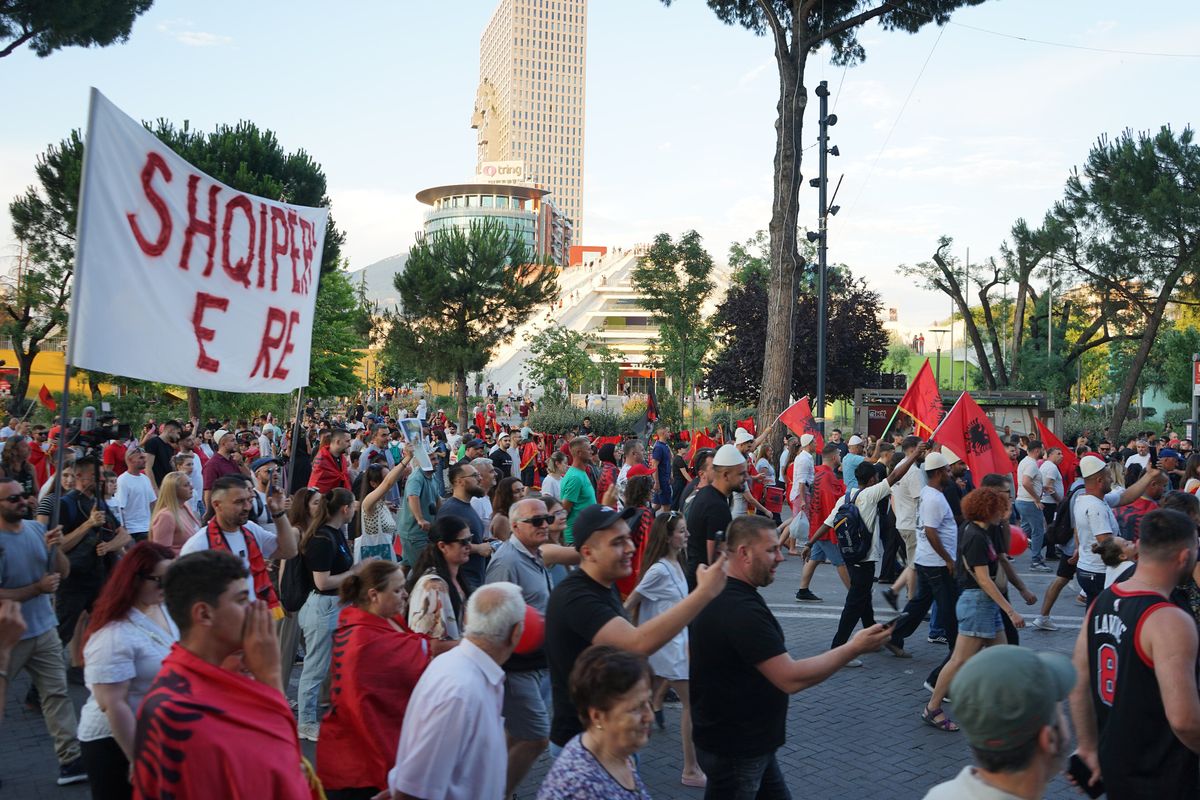
From 31 May 2026, triggered not by the project in the abstract but by violence against protesters at the site that same day. Every evening from seven o'clock, from Skanderbeg Square along the national boulevard to the prime minister's office. The demands were wider than one resignation: a technocratic government, repeal of the protected-areas amendments, changes to the electoral law, and the 2008 constitutional amendments.
Day one hundred fell on Monday 7 September 2026, reported that evening by two Albanian outlets. That date was established by a second pass run in Albanian, which also closed two apparent gaps in August by arithmetic rather than testimony: eight day-numbered reports each land exactly on their own publication date, and because the outlets number the protest rather than the day, a skipped evening would have pushed the ordinal permanently behind the calendar. It never does across thirty-six days. The public broadcaster carries the first date of each apparent gap.
The gap, and it is the finding. No official or police estimate of crowd size exists for the whole span from 31 May to 7 September. The reports say the square was full. For the first day two accounts differ by an order of magnitude.
Every figure that has an issuing body comes from October: 2,500 police deployed, 500 detained with 330 released, more than 300 injured. Those are October's and are not carried back.
Read what separates the two periods. For a hundred evenings people walked the same route at the same hour and no institution was under any obligation to count them, so none did. In October police were deployed and people were detained, and at that point a body had to account for its own actions. The numbers appear at the moment an institution acquires a duty to explain itself.
Charges were formalised against a former deputy prime minister on 20 October over two 2021 contracts, and she denied any wrongdoing. And the special prosecution's spokesperson said the resort investigation does "not concern any company associated with Mr. Kushner"; that statement travels wherever the investigation is mentioned, and the underlying claim it answers is not published here because no primary source for it was read.
️ At least three separately numbered protest series run in this period, with independent day counts. Mixing their ordinals produces a wrong figure in either direction, and one apparent thinning signal belongs to a different series entirely.
---
Serbia: a canopy, two years, and an election
The holding. A railway station, its reconstruction, and the procurement behind it.
The transfer. ️ Not established in this pass, and it is the most consequential gap in the European material. The procurement and reconstruction contracts for the station, what of them has been published, who has been charged and what the accused say, were the specific brief of a researcher that had not written them up when this study was composed. They are absent here and named as absent rather than filled from coverage.
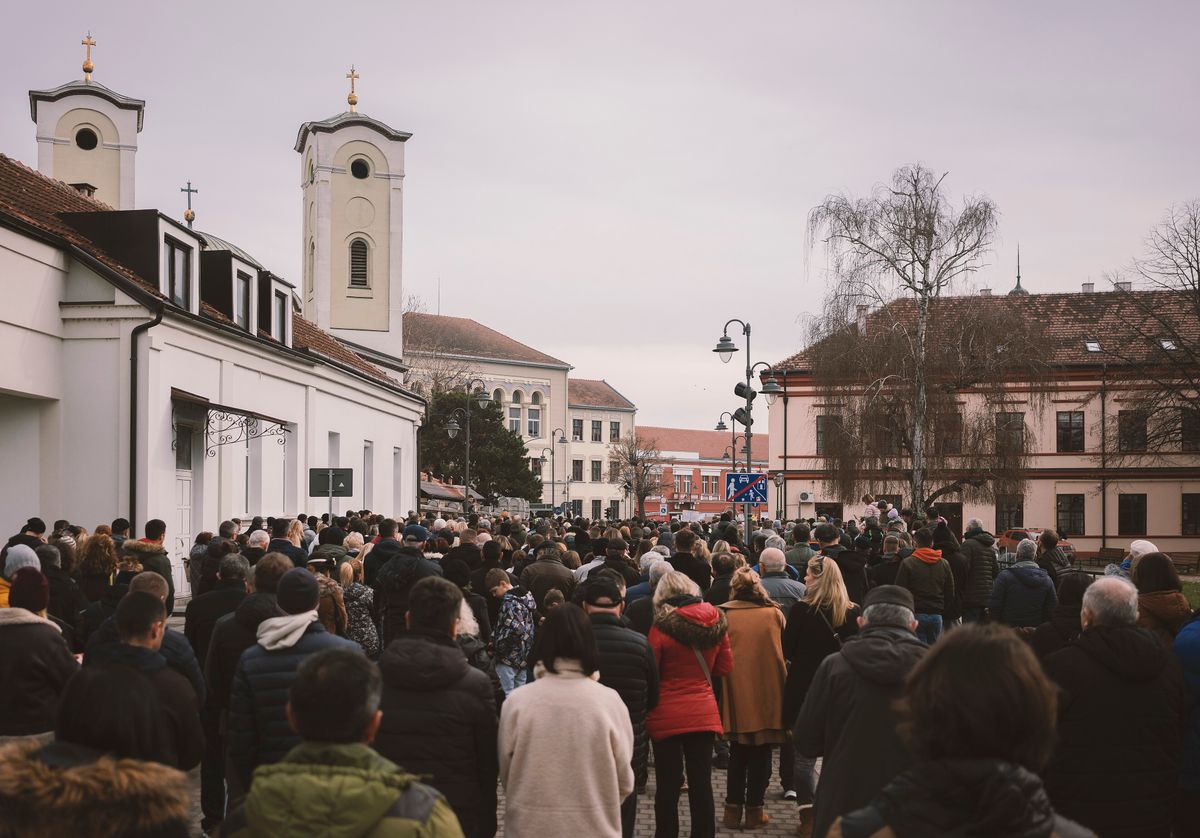
The audit. The canopy at the Novi Sad railway station collapsed on 1 November 2024. Two international outlets reporting in October 2026 give the toll as 16 people.
️ And the apparatus around that number is missing, which this study says rather than hiding. The toll rose over the days after the collapse, and the body that issued the final figure, the date 16 was reached, and the dates of the earlier counts were not established in this pass. A death toll that rises is a dated quantity, exactly like every other figure in this study, and sixteen is given here as what two outlets reported two years later rather than as a count with an issuer and a date. The demands centred on accountability for the collapse and on the procurement in the station's reconstruction.
About 150,000 people were in Belgrade on 22 October 2026, three days before the vote. ️ No named estimating body is attached to that figure, so it is given as unattributed rather than dressed as a measurement.
No deaths are reported for the 2026 phase. Mass arrests and police violence are documented for the 2025 phase and no 2026 total was found. The government denied using an acoustic device against crowds, and that denial is recorded here because the allegation is in circulation and a study carrying one without the other would be incomplete.
The outcome, which is the most clearly documented in the whole study. A snap election was called on 9 September 2026, after the Assembly was dissolved, and held on 25 October.
The electoral commission's preliminary count, at 96.9 per cent of polling stations and recorded at 97.6 per cent on 26 October at 21:20 Central European Time, gives the Student List 53.40 per cent and Aleksandar Vucic and United Serbia 39.69. ️ Earlier readings of the same count gave 52.54 per cent, and a parallel count by a monitoring organisation gave 51.47. Those are three readings of one count at three moments, which is a dating problem and not a disagreement, and the figure above is given with the moment it was read for that reason.
Seat figures in circulation, between 135 and 140 of 250, are projections by named pollsters. No certified allocation existed when this was written.
On election night Vucic said: "It is clear that we have lost these elections." He said it while noting that final results were not yet available, and that qualification travels with the quotation.
He did not resign, and one widely copied table says he did. He resigned the presidency on 27 September, a month before the vote, having confirmed on 24 September that he would, saying the law did not require it but that he did not want to campaign for prime minister while still president. That is a candidate vacating one office to contest another, and this study publishes conceded.
The new assembly must be constituted within thirty days of final results, and a government formed within ninety days after that. Both deadlines fall after the date this study was written, so neither outcome is stated here.
---
What repeats, and what only looks as though it does
A set of episodes in the same year invites two mistakes in opposite directions. The first is to treat them as one event with many locations. The second is to treat them as unrelated because the grievances differ. Both are available from the same evidence, which is a sign that the evidence is being read for a conclusion rather than for a pattern.
What follows is what survived a strict test. Where the test was failed, that is stated too, because a pattern that does not hold is as informative as one that does and considerably harder to publish.
One. The trigger is almost always an instrument, and its direction does not matter
Of the episodes recorded here, eighteen have a named, dated fiscal instrument at their origin. Not a mood, not a general condition: an act, a decree, a price order, a budget line, with a number and a date of effect.
The obvious reading is that these are austerity protests, and the obvious reading is wrong, because one of the eighteen points the other way. On 6 July 2026 a normative act moved 400 million lek, about 4.2 million euro, out of Albania's state budget reserve to pay for a concert. The prime minister defended the allocation as preventing a cancellation and projected returns above 100 million euro. A protest followed on 9 July, a request for annulment reached the Constitutional Court on 10 July, and a complaint against the prime minister and the culture minister reached the special prosecution on 13 July. Those are complaints rather than charges, they are unadjudicated, and no response from either office was located.
A subsidy withdrawn and a reserve spent are opposite fiscal acts. They produced the same response.
So the pattern is not the direction of the money. What the eighteen share is that a decision was taken about a thing held in common, and the holders were not party to the decision. Removal and expenditure are both exercises of an authority, and it is the authority that was contested in each case, which is why the two opposite acts are not a contradiction in the record.
This is the point at which a reader expecting an argument about austerity should notice that the study is not making one. It is making an argument about consent to a decision, which is a narrower claim and a checkable one.
Two. The transfers have instruments. The returns mostly do not
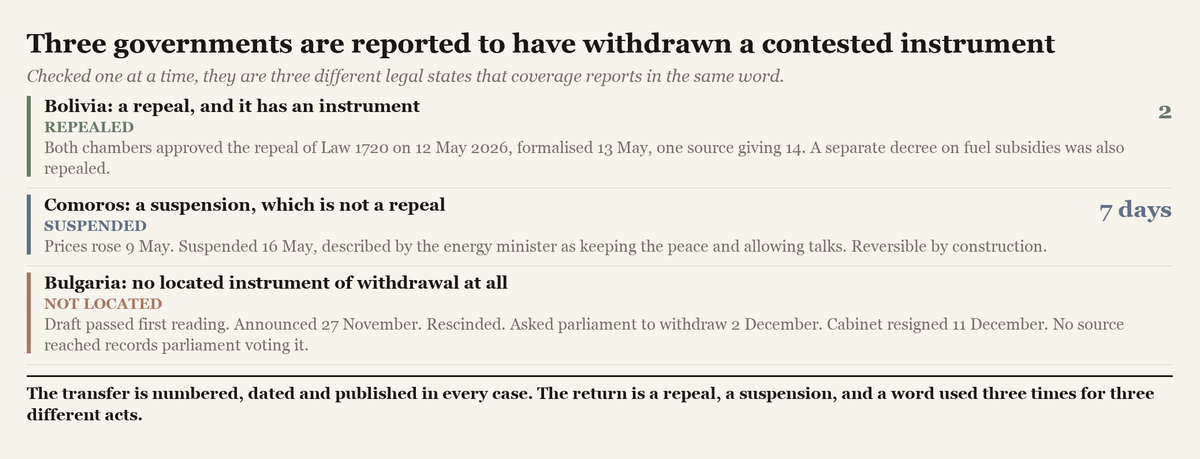
Three governments are widely reported to have withdrawn a contested fiscal instrument after protest, all within twelve days of the mobilisation. Checked one at a time, the three turn out to be three different legal states that coverage reports in the same word.
Bolivia is a repeal and it has an instrument. Both chambers approved the repeal of Law 1720 on 12 May 2026 and it was formalised on 13 May, with one source giving 14 May.
Comoros is a suspension. The increases of 9 May were suspended on 16 May, and the energy minister described the suspension as a means of keeping the peace and allowing talks. A suspension is reversible by construction. Nothing was repealed.
Bulgaria has no located instrument of withdrawal at all. The draft budget passed first reading. An announcement that the government would withdraw it came on 27 November 2025. The government then rescinded that decision. On 2 December it asked parliament to withdraw the bill, with the withdrawal contingent on parliament agreeing. On 11 December the cabinet resigned. No source reached records parliament voting the withdrawal, and the budget may have lapsed with the government rather than been withdrawn by any act. That is recorded as not located on 26 October 2026, which is a statement about what was searched for rather than a claim that it did not happen.
Set the two halves of each case side by side. The instrument that moved the thing is numbered, dated and published. The instrument that gave it back is a repeal in one case, a suspension in another, and in the third a word used three times for three different acts.
The giving back is under-documented relative to the taking, and that is the same asymmetry as the unrecorded holding, arriving from the opposite end. A record built to log departures logs a return poorly, because a return is the one event the form was never shaped for.
Three. An event without its instrument is attributed to whatever stands nearest it
The same defect appears on a second verb, and the second instance is sharper because the act is real and only the attribution is not.
Aleksandar Vucic resigned. He confirmed on 24 September 2026 that he would leave the presidency on 27 September, saying the law did not require it but that he did not want to campaign for prime minister while still president. He had called the election on 9 September after dissolving the Assembly. A month later a student-backed list won that election and he conceded it.
A reader meeting that sequence joins the two halves, and the joining is natural: a long-serving president leaves office, a movement has been in the streets for the better part of a year, and an election follows. But the documented act is a candidate vacating one office in order to contest another, for a reason he stated at the time. Nothing in the record reached makes it a resignation forced by a movement.
Two countries, two verbs, one defect. Where the record is thin, a reader supplies a cause, and the cause supplied is whichever one is standing closest.
What failed the test, and it failed decisively
The most attractive available claim is that these movements are connected. It is also the one the evidence supports least, and the study says so rather than reaching.
Of the linkages examined, five meet a strict standard. One movement describing itself as inspired by another. An explicit statement of solidarity. A naming convention carried across two countries. One tactic adopted in four legislatures. And the clearest of them, which is worth stating in full because it is the only case where the same tactic can be followed from one country into another with dates: the encampment model used in Madrid reached Oporto on 10 October 2026 and Lisbon about a week later. Portugal cleared its camps, with 37 people injured in Porto on 15 October and 55 arrested in Lisbon on 20 October, and the camps re-formed. Spain's was never cleared, because a court declined to authorise it on 7 October. The same tactic in two states, and two different legal outcomes.
Five.
Against that, nine countries share a single oil-price shock. That is one cause acting independently in nine places, which is the opposite of contagion and produces an almost identical pattern on a map. Shared dates look like coordination and are not: the clusters around 17 October and 24 to 25 October had four different callers. A widely used label for the year's movements is an observers' term rather than any movement's own, and the country lists assembled under it disagree with each other. One piece of imagery reported as spreading between movements did not travel.
Visual similarity is not evidence of coordination. Two crowds holding the same object, or using the same three-word phrase, or marching on the same Saturday, may have arrived there by nine independent routes, and in the clearest case here they demonstrably did. The study records the four linkages it can evidence and declines the general claim, which is the more interesting position to be in, because it means the repetition that does exist has to be explained by something other than imitation.
What explains it, on this evidence, is the first finding. The same instrument appeared in a great many places because the same fiscal pressure appeared in a great many places, and the holders were not party to the decision in any of them.
---
What the record cannot say, and what the gaps have in common
Every absence below was searched for and not found. That is a different statement from saying the thing does not exist, and the difference is the whole value of writing them down. Where the body that could settle a question is nameable, it is named, so the gap reads as work rather than as suspicion.
There are two kinds of absence here and they should not be confused. The first is an absence in this study's reach: a document exists and was not retrieved, often because the institution holding it does not publish it at an address that can be guessed. The second is an absence in the public record itself: the number was never put anywhere a public could consult.
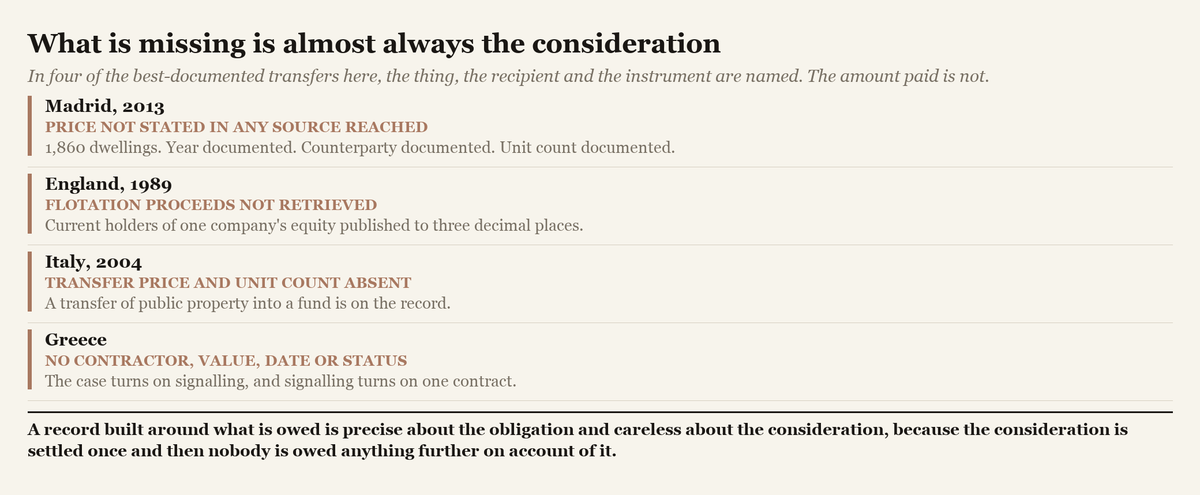
The pattern in the gaps: what is missing is almost always the consideration
Read the absences together rather than one at a time, and they are not randomly distributed. They cluster on a single field.
Madrid. In 2013 the city's municipal housing company sold 1,860 dwellings. The year is documented, the counterparty is documented, the unit count is documented. The price is not stated in any source this study reached. The city's own later investigation commission is referred to in the record without its findings. Bodies that could settle it and were not reachable here: the Camara de Cuentas of the Community of Madrid, the Tribunal de Cuentas, the national judicial documentation centre, and the city's own commission report.
England. The water authorities were sold following the Water Act 1989, and the current holders of Thames Water's equity are published to three decimal places. The 1989 flotation proceeds, which is to say what the public received, were not retrieved from any issuing body.
Italy. A 2004 transfer of public property into a fund is on the record. Its transfer price and its unit count are absent. A figure in circulation of 3.7 billion euro against 394 properties is a 2015 market valuation and not a transaction value, and this study does not use it as one.
Greece. The Tempi case turns on signalling, and signalling turns on a contract known as 717. No contractor, value, date or status for it was obtained. The relevant regulator's report of 27 February 2025 was not read.
So in four of the best-documented transfers in this study, the thing transferred is named, the recipient is named, the instrument is numbered and dated, and the amount paid is missing.
That is the most specific version of this study's argument and it arrived by accident. A record built around what is owed is precise about the obligation and careless about the consideration, because the consideration is settled once and then nobody is owed anything further on account of it. The number a public would most want, which is what it got, is the number least likely to still be sitting somewhere it can be read.
Absences in instruments
Bulgaria. No source reached records parliament voting the withdrawal of the 2026 budget after the government asked it to on 2 December 2025. The body that could settle it is the National Assembly's own journal. Not located, 26 October 2026.
France. Four sources confirm the pension reform was suspended, by an undertaking given on 14 October 2025, with no rise in the age before January 2028. None of them names the instrument that did it. The most likely candidate is the 2026 social security financing law, passed 247 to 234 on 9 December 2025, and that is a guess. This study does not write that the reform was suspended by a named law, because it does not know which law.
Germany. There is a documented attempt to reverse a transfer and no documented original transfer. The 2021 Berlin referendum is grade A: 1,035,950 votes in favour, 59.14 per cent, on a turnout of 73.47 per cent. The sales it was a response to are not established here.
The Netherlands. Two of the five ledger fields are empty. No disposal and no current holder were established. ️ And a single source uses a word one letter away from its opposite, naming a tenants' levy where the instrument is almost certainly a landlord levy. Neither is quoted.
Madagascar. The chain is the most completely documented in this study, because the lender published it, and it has to be stated with two precisions or it says something it should not. Adoption of the utility's recovery plan was a prior action for a review. One structural benchmark set loss-reduction targets. Another named a rise of 16.5 per cent by September 2025 in a specifically named BUSINESS electricity tariff, toward a total of 50 per cent over three years, following an initial 20 per cent in October 2024. Household tariffs were recorded in the same document as only under discussion. The same document names the grievance, attributing pervasive electricity outages and water shortages partly to low utility tariffs. Protests began on 25 September 2025.
Those two facts sit in one published document and the dates coincide. This study states the document and the coincidence and does not assert that one caused the other. What is not established is what happened to that benchmark afterwards. Whether it was met, waived, modified or dropped once the protests began cannot be said, because the staff report for the reviews completed on 30 September 2026 was not located.
Senegal, and this one inverts into a finding. The audit court's report of February 2025 was retrieved and read: 57 pages, fetched at 1.33 megabytes against a 404 control. Its own term for what it found is debt contracted from the banking system "sans autorisation parlementaire", without parliamentary authorisation, rising from 746 to 2,096 billion CFA francs between 2019 and 2023, with the deficit restated from 4.90 to 12.30 per cent of GDP and debt from 74.41 to 99.67.
And the court states that it excluded spending whose description or nature was not explicit. So its own figure is a floor, by its own method. The lacuna is inside the audit, declared by the auditor.
No lender document reached in this study cites that report. Eight were checked individually: three press releases, two briefing transcripts, two country pages and one earlier country report. So this study does not write that the lender relied on, endorsed or cited it. It writes something better supported: two institutions produced records of the same debt independently of one another, which is a stronger evidentiary position than one leaning on the other.
Absences in counting
Albania. No official or police estimate of crowd size exists for the daily sequence from 31 May to 7 September 2026. Every figure with an issuing body comes from October.
Tanzania, and it is the purest case of the kind in this study. Casualty figures for the post-election violence span ten to ten thousand across the bodies issuing them, a spread of three orders of magnitude. The state's own commission of inquiry found that at least 518 people died of unnatural causes. According to Amnesty International on 24 April 2026, speaking through a named officer, that report was handed to the President and has not been published.
A record exists. It was made by the state's own instrument, it contains a number, and it is withheld. That is not an allegation about anybody: withholding a report is lawful in many systems and no wrongdoing is implied here. But it is the one case in this study where the gap is not an absence at all. A withheld record and a missing record are different things, and a form that renders them identically loses the distinction that matters most.
Carnegie's tracker. Its inclusion threshold is not published, so there is no way to know what its silence means. Its coverage stops in August 2026 and the page does not say so.
Protest totals. No global series can be obtained from any of the five datasets examined, for the reasons set out earlier.
Figures this study holds and will not print
Some numbers exist in circulation and cannot be published as measurements, and saying so is more useful than quietly dropping them.
A French arrest figure appears as both 6,800 and 2,700 for the same period. The larger is undated, its attribution is second-hand, and one version of it cites an article published before its own stated cut-off. Either both figures appear with both issuers or neither appears, and in this version neither does.
A Greek crowd figure of over one million carries a citation-needed marker in its own source, and a variant of roughly 2.5 million has no named source at all.
A Spanish range of 235,320 to 895,370 is an aggregate assembled from one figure per city, each from a different source, with some cities uncounted. It is arithmetic performed on incommensurable inputs, which is not a measurement.
An Italian set of four casualty and arrest figures has no issuing body for any of them.
One figure that shows why the rule exists
Portugal's general strike of 3 June 2026 was measured by six bodies, and they gave six answers. The central bank put the output contraction at 5.1 per cent. The government said 23 per cent. The education minister said 76 per cent of teachers. The largest union confederation said 100 per cent at named firms. An employers' confederation said 2 to 3 per cent.
None of them is lying. They are measuring different universes: output, participation, a profession, named workplaces, and member companies. A single number for that day would be a fabrication, and the average of those six would be a worse one.
Where this study needs one anchor it takes the central bank's, for a stated reason: of the six bodies, it is the only one with no interest in the dispute's outcome.
---
When a source disagrees with itself
The contested counts in this study are easy to understand: two bodies with different interests give different numbers for the same crowd. That is ordinary and the study prints both.
Something harder turned up while checking the figures, and it has no equivalent in the usual account of why numbers about protest are unreliable. Several of the institutions this study relies on disagree with themselves, in the same publication, on the same page, about the same quantity. None of it is error in the sense of a mistake. All of it is a definition doing work that nothing on the page declares.
One survey, two unemployment rates, both correct
Nigeria's statistics office published, on a single page, a youth unemployment rate for the second quarter of 2020 of 40.8 per cent and of 22.3 per cent.
Both come off the same survey. The first uses the national definition, which counts somebody working between one and nineteen hours a week as unemployed. The second uses the international definition, which does not. The arithmetic reproduces from the printed counts either way.
For 2023 the same divergence appears between institutions rather than within one: the national office gives 10.1 per cent and the international harmonisation 5.183, roughly a factor of two, same year, same survey programme.
So a sentence beginning "youth unemployment in Nigeria is" has to choose, and the choice moves the number by eighteen points. This study therefore publishes no cross-country youth unemployment comparison at all. On the harmonised series Tanzania reads 2.38 per cent and Senegal 3.62 against Morocco's 21.88, which does not describe those three economies; it describes a definition under which subsistence work counts as employment.
A published ratio whose denominator is not stated anywhere
Debt service as a share of government revenue is one of the most quoted figures in this subject. It has a hidden term.
Taking Sri Lanka's central bank tables and dividing by revenue including grants reproduces the international indicator to two decimal places for five consecutive years. Dividing by revenue excluding grants matches nothing. Nothing in the indicator's name says which denominator it uses, and the only way to find out was to reverse-engineer it against five years of national data.
Then the same method was applied to Kenya, and it fails. The international figure gives 24.28 per cent for 2023 and the Kenyan central bank's own lines give 29.00, about four and a half points apart, and the grants denominator that closed Sri Lanka exactly does not close Kenya at all.
This study does not pick a side. It states both figures with both issuers and records that the reconciliation works in one country and not in the next, which is a more useful thing for a reader to know than either number.
An institution contradicting itself inside one report
A major lender's 2025 debt report gives long-term public and publicly guaranteed interest as 161.3 billion in its prose and 145 billion in its own country table.
That is not two bodies disagreeing. It is one document.
A choice of unit that outweighs a decade of change
The most-cited inequality database offers the United States top one per cent wealth share for 2019 as 41.85 per cent, 37.44, 34.88 or 34.85, depending on whether the unit of observation is individuals aged twenty to sixty-four, tax units, all individuals, or equal-split adults.
That is a spread of almost eight points, larger than most of the changes anybody cites the series to demonstrate. ️ And there is no rule of thumb available, because the sign of the correction flips between the United States and the United Kingdom. A reader cannot mentally adjust for it.
The same respondents, in the same interview, answering two ways
A continental survey programme asks whether a country is a democracy and, separately, how satisfied the respondent is with democracy. Across countries the gap between those two answers runs from minus twenty-seven points to plus ten, from the same respondents in the same sitting, with no fixed offset and no consistent direction.
So a sentence about declining faith in democracy depends entirely on which of two adjacent questions is quoted, and the two do not even reliably point the same way.
And one number that is arithmetically correct and means the opposite of its use
This is the sharpest case and it is worth the space.
A figure in circulation holds that institutional investors bought fifty-six per cent of new homes in Dublin. The arithmetic is primary, correct, and reproducible from official data.
It also does not mean what it is used to mean. The statistics office's own breakdown of who those non-household buyers were shows 54.8 per cent of national non-household purchases going to public, education and health bodies, against 7.2 per cent to real estate. The category "non-household" contains councils, schools and hospitals. Most of that fifty-six per cent is the state and the public sector buying houses.
So this study does not use the figure, and says why rather than dropping it silently, because a number that is correct, primary and inverted is far more durable in circulation than one that is simply wrong. Nobody checking it will find an error.
---
What this does to the study's own numbers
It sets a rule that the rest of the piece follows, and it is not a counsel of despair.
Every figure here carries the body that issued it, the year it describes, and the date it was read. Where two bodies disagree, both appear. Where one body disagrees with itself, that is stated as a property of the source rather than resolved by preference. Where a definition decides the answer, the definition is given in the sentence.
And where the study needs a single anchor it says which body it took and why, as it does with Portugal's general strike: of six institutions measuring that day, the central bank's figure is used because it is the only one of the six with no interest in the outcome.
None of that makes the numbers in this study better than their sources. It makes them traceable, which is the only property this institution can honestly add.
---
What a record would have to do differently
Everything above is a description of a form failing at a job it was not built for. That invites an obvious question, and the obvious question has a specific answer rather than a wish.
A record of custody that could answer what a public asks would need four things the records examined here do not have. Each one is a field, not a sentiment, and each one is already specified somewhere, which is the only reason this section can be written at all.
A first-class event for holding
The reason a provenance record is a list of departures is that its event vocabulary contains only departures. Sale, gift, bequest, loan, transfer. Nothing in the form says held.
The specification this institution publishes under the name Lacuna takes four event kinds and no more: a thing came into existence, a party held it across a span, custody moved, or there is a gap. The second of those is the one that matters here. A span of holding is an event in its own right, with a start, an end and a holder, and it can be recorded without anybody agreeing on what the thing is or what it is worth.
Applied to a public holding, that single field would have carried what no record consulted for this study contained: that a fuel subsidy existed across four administrations, that a water system was held in common for sixty years, that nothing happened to either. The decades would stop being blank by construction, and the document a public received when it asked would stop being a list of losses by default.
The specification is published at doi.org/10.5281/zenodo.22063353.
A gap that says which kind of gap it is
A blank is not information. Every absence in this study had to be written out in prose because there was no field to put it in, and the prose had to say each time whether the thing was destroyed, never created, not yet looked for, or improper to ask about. Those four states mean entirely different things to a reader and the records render them identically, as nothing.
The same specification types a gap as one of four: unrecoverable, which tells a reader to stop looking; does not arise, which tells them to stop asking and requires a positive reason rather than the absence of an answer; not yet collected, which says this is work and names who could settle it; and not proper to ask. Each tells the reader to do something different, which is the test of whether the vocabulary is doing any work.
Bulgaria is the case that needs it. No source reached records parliament voting the withdrawal of the 2026 budget. Written as a blank, that reads either as evidence that no withdrawal happened or as a lapse by whoever compiled the record, and neither is true. Written as a typed gap it is not yet collected, and it names the body that could settle it, which is the National Assembly's own journal. That is a one-line difference in a form and the difference between an insinuation and a task.
A date on the absence, not on the row
A gap rechecked last month and a gap nobody has touched in ten years look identical unless the record carries the date the absence was last affirmed, as distinct from the date the row was created.
Carnegie's tracker is the demonstration. Read in full on 26 October 2026, its coverage stops in August 2026, and nothing on the page says so. A reader consulting it in October for an October episode finds nothing and has no way to tell whether the episode is absent because it did not happen, because it fell below a threshold the publisher does not state, or because the record simply ends. Three different findings, rendered identically, with no date on the silence.
A record that distinguishes attested from inferred from reported
The last requirement is the one that would do most to this study's own subject matter, and it is the hardest to retrofit.
A field can be attested by a document, inferred by whoever compiled the record, or reported by a party with an interest in it. A record that renders those three the same way is, in the specification's own phrase, lying by formatting.
The protest datasets do exactly that. A number in an ACLED row was coded by a person reading a local-language report. A number in a GDELT row was extracted from a news sentence by a pipeline that was twenty-one per cent accurate on protest when it was last validated in Science. A V-Dem value is an expert's impression of a country-year. All three arrive at a reader as a number, in a table, with no marker separating what a document attests from what a model inferred from what an interested party said. The casualty figures in this study behave the same way: a count issued by a national human rights commission, a count issued by an interior ministry, and a count circulating without an issuer are not the same kind of fact, and the only reason they are distinguishable here is that every one of them was written out longhand with its source attached.
What this section is not
It is not a claim that anyone has adopted any of this. Nobody has. The specification is published, it carries a digital object identifier, and whether anything built on it ever becomes a standard depends entirely on somebody other than its author implementing it.
It is also not a claim that a better form would have prevented anything. A record is not a remedy. Every instrument described in this study was lawfully made by a body entitled to make it, and a field for holding would not have changed one of those decisions. What it would have changed is the document a public receives when it goes looking afterwards, which is a smaller thing than a remedy and the only thing a record can honestly offer.
Objects of Affection Collection builds records of custody, and sells access to the instrument that produces them under the name Colophon Record. That is the institution's commercial interest in the argument above, stated plainly here so that a reader can discount it at whatever rate they think appropriate.
---
Coda: the fare went up again
Chile is where this study began as an idea, because Chile is the case everybody cites. It is also where the argument finishes, for a reason nobody citing it mentions.
The chain is well documented and short. On 1 October 2019 an expert panel announced a rise of thirty pesos in the Santiago metro peak fare, taking it to 830, effective on the sixth. On the seventh, students began evading the fare at a single station. By 18 October all 164 stations had been hit and the network closed, a state of emergency was declared and a state security law invoked. On the nineteenth a curfew ran from ten at night, the first in Santiago since 1987, and the fare rise was cancelled that evening. On the twenty-fifth more than 1.2 million people marched, in what the country called the largest march.
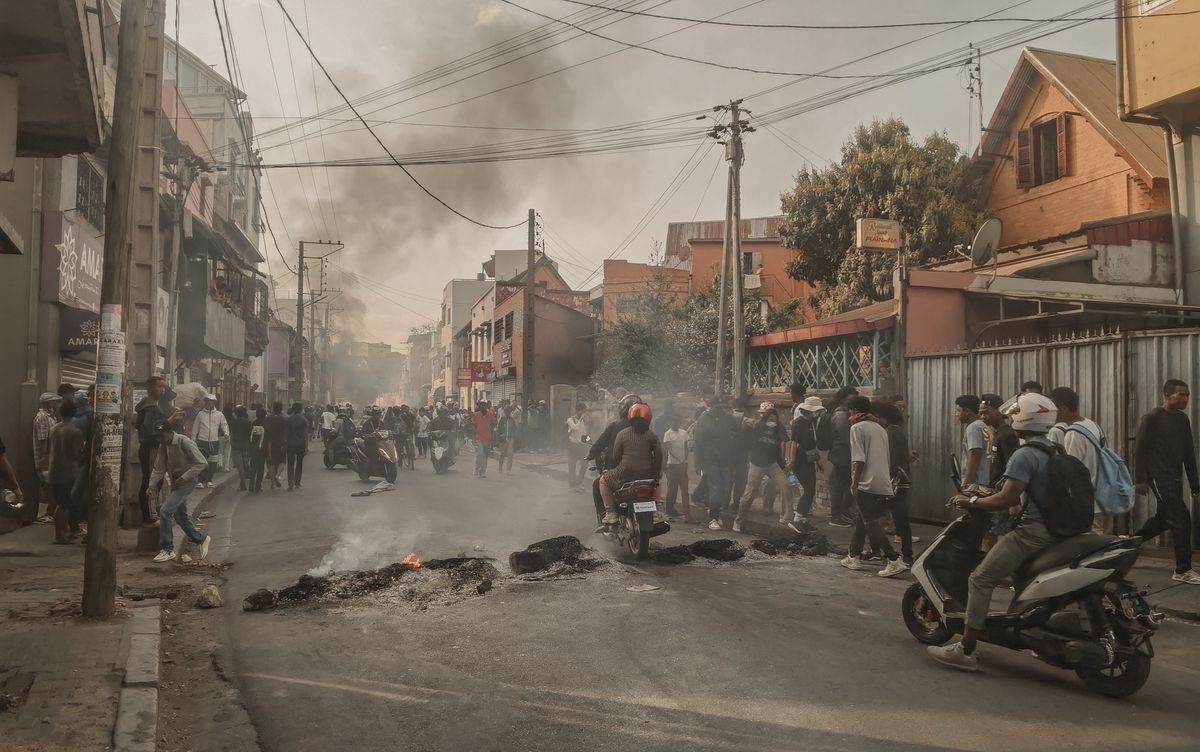
Then the constitutional sequence. An agreement for social peace on 15 November 2019. A plebiscite on 25 October 2020 approving a new constitution by about 78 per cent to 22, with a fully elected convention chosen on 79.18 per cent of a separate question. The draft was rejected on 4 September 2022 by 61.87 per cent. A second agreement followed on 12 December 2022, and a second draft was rejected on 17 December 2023 by 55.76.
The 1980 constitution stands.
And on 22 February 2026 the Santiago metro fare was raised to 895 pesos.
That is sixty-five pesos above the level whose thirty-peso increase began the whole thing, and it was raised without any comparable mobilisation.
---
A reader can take that several ways and this study will not choose between them. It is not evidence that the mobilisation failed, because a fare is a small part of what was being asked about by October 2019 and the demands grew far past it. It is not evidence that it succeeded either.
What it is, precisely, is the shape of this study's argument arriving at its end.
The transfer had an instrument. A panel, a date, a figure, an effective day. All four are on the record and all four were checkable within hours of the announcement.
The return had no instrument. The rise was cancelled in an evening, by announcement, under curfew. Nothing was repealed, because there was nothing to repeal; a fare is set by order and unset by order, and the record of the unsetting is a sentence in the reporting of one night.
The holding was never recorded at all. Nowhere in the seven years of documents, two drafts, three national votes and a new constitution that did not happen is there an entry stating what the public held in the Santiago metro, at what price, for how long, and on whose behalf. The thing everybody was arguing about has no row anywhere.
So when the fare rose again in February 2026, there was nothing to compare it to. Not because anyone concealed the earlier figure, which is published, but because a list of departures cannot show you a level. It shows you the moments something moved. To know whether a thing has been given back, you need a record of holding it, and that is the one record nobody keeps.
---
This is why the study carries no total, no trend line and no verdict.
A count of the world's protest would have been the easy thing to assemble and the easiest to discredit, because the instruments that count protest cannot agree with themselves, let alone with each other. A verdict on any of the governments named here would have required believing something about people this study has no way to know.
What it has instead is a register. Episode by episode, instrument by instrument, with every figure carrying the body that issued it and the date it was read, and every absence written out as an absence with the body that could settle it named where one is nameable.
That register says four things, and all four are checkable by anybody who wants to spend an evening on the documents.
A record exists where somebody is owed. The creditor, the concession holder, the bondholder, the insurer. Each of them generated a document because a payment had to be calculated.
A number exists where somebody is answerable. No institution counted a hundred evenings of people walking from Skanderbeg Square to a prime minister's office. The counting began the week police were deployed and a body had to account for its own actions.
The holding exists nowhere, because nobody is owed the commons, and so the document a public receives when it asks what became of its own property is a list of the occasions on which that property left.
And the consideration is the field most often missing. What was paid for 1,860 dwellings in Madrid. What the public received for the water authorities in 1989. What a 2004 property transfer in Italy was worth. The thing transferred is named, the recipient is named, the instrument is numbered and dated, and the amount is gone.
None of that is a conspiracy and none of it requires one. It is what happens when a form built to record motion is asked to describe a state.
The movements in this study are doing, in public and at some cost, the thing a record of custody is supposed to do quietly and in advance: establishing who holds what, on whose behalf, and on what terms. They are doing it in the street because the ledger has no row for it.
The fare is 895 pesos. Somebody should write that down somewhere it will still be found in seven years, next to who decided it and what the public got for it. That is not a political demand. It is a filing standard.
---
What this study does not claim
This is a record of what has been reported, demanded, charged and filed, assembled in one place and dated. Objects of Affection Collection takes no position on any government, party, office-holder or company named here, and reaches no conclusion about any person's conduct.
Where a characterisation appears, it belongs to whoever is quoted making it. Where a charge appears, it is a charge: no person described here has been convicted except where a court is named and its finding given, and denials are carried wherever they were made. A person who has been accused and not tried is recorded as accused and not tried.
Casualty and arrest figures are contested in almost every episode below. Where two bodies have published different counts, both are given with the body that issued each, and the difference is left standing rather than averaged into a single number that nobody published.
A gap in a record is recorded as a gap. An unpublished contract, an unnamed beneficial owner or an audit that has not been released is stated as not located, which is a statement about what is in the public record on the date given and not evidence that anything was concealed.
Objects of Affection Collection records custody. It does not authenticate, appraise or value, and it reaches no view on who ought to hold anything named here.
This study is dated and will be revised as events develop. Each revision keeps the previous version's figures visible rather than overwriting them, because what was reported at the time is part of the record.