The Number Counts a Legal Act: What Moved, When, and to Whom in Five Benin Returns
Four institutions have handed Benin objects to Nigeria in the last four years, and the numbers attached to those handovers are among the most widely repeated figures in the field. One hundred and nineteen from the Netherlands. One hundred and sixteen from Cambridge. Twenty eight from Switzerland. Seventy two from the Horniman. Two from the Museum of Fine Arts in Boston.
Every one of those figures is accurate. Not one of them counts objects that have moved.
They count a legal act. A separate and smaller number counts objects that physically travelled, and in one case that number is zero. The gap between the two is not concealment and nobody is being accused of anything here. It is the ordinary gap between a transfer of title and a transfer of custody, two events that happen on different dates to different numbers of things, and that a provenance record exists to keep apart.
What the numbers actually count
Take them one at a time, from each institution's own statement where one exists.
The Horniman Museum in London agreed in August 2022 to hand back seventy two objects, following a request from Nigeria's National Commission for Museums and Monuments in January of that year, with the Charity Commission endorsing the decision on 5 August. Ownership was transferred at a ceremony on 28 November 2022. The number of objects that physically went to Nigeria in that first stage, according to one account, was six, selected in consultation with the commission as representative of the collection of seventy two.
The Netherlands is the largest of the five. The agreement was signed on 19 February 2025, and the handover took place on 21 June at the National Museum in Lagos. The Wereldmuseum's own page gives the breakdown: of the one hundred and nineteen, one hundred and thirteen were part of the Dutch State Collection and the remaining six were given back by the Municipality of Rotterdam. It also records, in a single sentence that almost nothing else carried, that four items will remain on display in the Wereldmuseum on a loan agreement.
Switzerland is the case where the two numbers come apart most visibly, and where the sources themselves disagree about which event has happened. One account states that ownership of twenty eight objects was transferred in March 2026, with ten remaining in Switzerland, nine on loan at the Museum Rietberg and one at the Musée d'Ethnographie de Genève. Euronews, reporting the June ceremony, describes it differently: the ceremony was "the first step in the implementation of an agreement signed in March 2026," under which Switzerland "agreed to eventually transfer ownership of 28 pieces to Nigeria."
Those are not the same claim. In the first, title has already moved and the objects are following. In the second, an agreement exists and title moves later. This study does not choose between them, because nothing located here settles it, and the disagreement is itself the point: if two careful accounts of the same March document cannot agree on whether ownership changed, the document is doing something the coverage has no vocabulary for.
Eighteen objects were handed over in Lagos at the end of June, and the breakdown is given: fourteen from the Ethnographic Museum at the University of Zurich, two from the Museum Rietberg, two from the Musée d'Ethnographie de Genève.
Cambridge announced on 8 February 2026 that its Museum of Archaeology and Anthropology had transferred legal title to one hundred and sixteen objects to the commission. The university's own wording on what stays is precise: "Seventeen pieces will remain on loan and on display at the MAA, for three years in the first instance." On what moves, it says the majority will be arranged in due course, and gives no date. At the time of writing, none of the one hundred and sixteen has travelled.
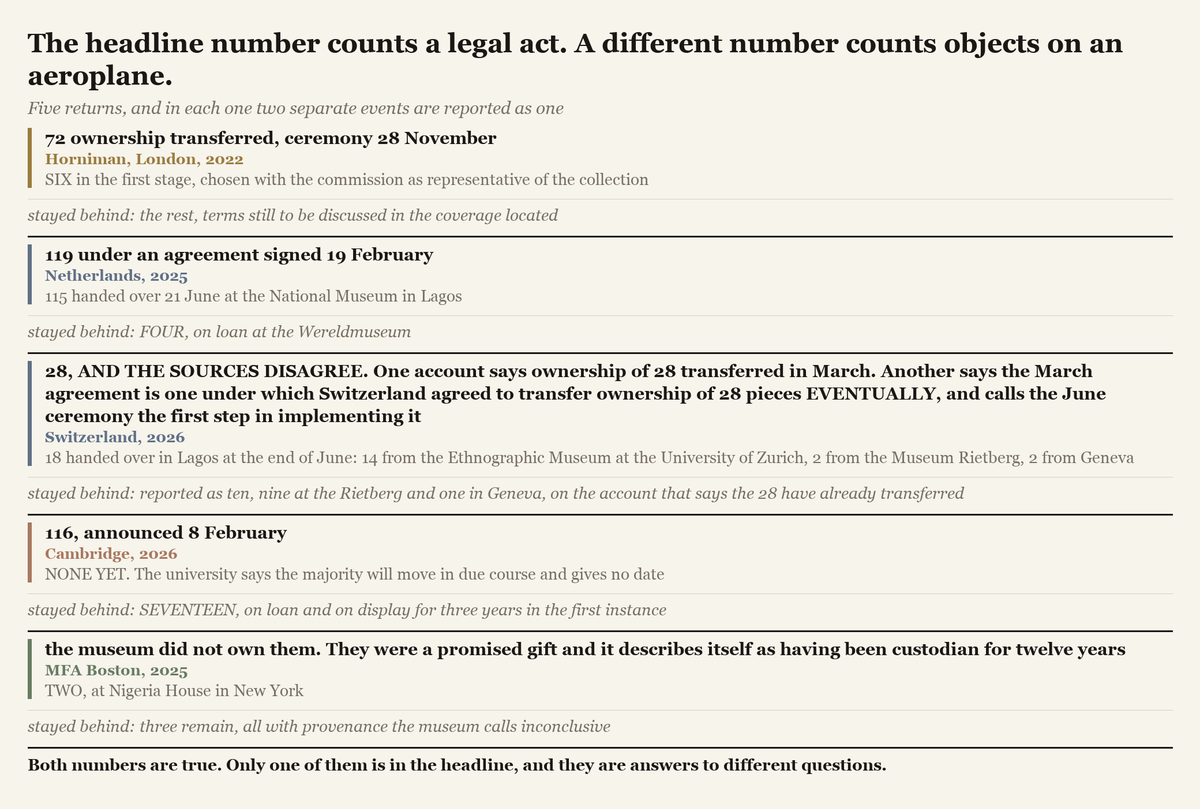
So the four European figures, read as counts of objects now in Nigeria, are one hundred and nineteen, one hundred and sixteen, twenty eight and seventy two. Read as counts of objects that have moved, they are one hundred and fifteen, zero, eighteen and six.
Both readings are true. Only one of them is in the headline, and they answer different questions.
Eighteen objects, and not all of them are what the headline calls them
The Swiss handover carries one more thing worth stopping on, and it is a problem of category rather than of count.
Alongside the Benin objects, the same transfer included a bronze bracelet and four archaeological monoliths from the Niger Delta, which had been seized in Switzerland as part of criminal proceedings and subsequently transferred to the state. Those did not come out of a museum collection. They came out of a law enforcement process, by a route with nothing in common with a nineteenth century military expedition or a twentieth century dealer.
Whether those items are inside the figure of eighteen or in addition to it is not resolved by the sources located here. One account describes the eighteen as including them. Another describes the eighteen as Benin Bronzes and the other items as also included. The difference matters: on the first reading the headline miscounts the category, on the second it undercounts the transfer.
Either way the same thing is true. Objects that reached the same ceremony by two entirely different routes, one of them a criminal seizure, are being carried under one label and one number. A record that collapses them loses the only fact about the monoliths that anyone will later need, which is how they came to be in Switzerland and who established it.
And the Swiss case is, by its own account, the most research-led of the five. The restitution followed a collaborative process between Swiss museums and Nigerian partners under the Benin Initiative Switzerland, launched in 2021 to investigate the provenance of Benin objects in Swiss collections. Four years of provenance work preceded the agreement. The figure that reached the public from all of it was a single number, and that number may not describe what it appears to describe.
Why this is a record problem and not a complaint
It would be easy, and wrong, to write that paragraph as an accusation. Nobody is hiding anything. Every one of those loan arrangements is public, several are in the institutions' own announcements, and there are good reasons for all of them: a loan keeps an object visible to an audience while a receiving institution prepares, and a staged physical return is often what the receiving party asks for.
The problem is what the record says afterwards.
An object that has changed owner but not location now has two true descriptions. It is Nigerian property. It is in a vitrine in Cambridge or Zurich or Rotterdam. A record that captures only the first loses where the thing is. A record that captures only the second loses who it belongs to. And the thing a reader two decades from now will want, when the loan has been renewed twice and the staff who arranged it have moved on, is the sequence: owner changed on this date, holder changed on that one, or did not.
That is not an exotic requirement. It is the ordinary content of a chain of custody, and it is the first thing a headline number destroys.
A three-year term in the first instance
Of all the phrases in this material, the one that will cause the most trouble to a future reader is the mildest: on loan and on display, for three years in the first instance.
Consider what it leaves undetermined. It names a term and a start. It does not name an end, because in the first instance means the arrangement is expected to be reconsidered rather than to expire. It does not say what happens if neither party raises it. It does not say who is obliged to raise it. And it does not say where the record of the renewal, or of the failure to renew, will be kept.
None of that is unusual or improper. Loans between institutions run on exactly this language, and the flexibility is the point: three years is long enough to be useful and short enough to be revisited. The difficulty is that the arrangement is a custody fact with a clock on it, and clocks of this kind are the ones that reliably stop.
A gate that waits on an event has to have somebody listening for the event. A loan that renews by silence has nobody listening by construction, because nothing happens when the date passes. Three years from February 2026 is February 2029, and the people who will be asked what the arrangement was by then are not necessarily the people who made it.
This is the burden of preservation arriving where it usually arrives: on whoever holds the object when the question is finally asked, with a document that was perfectly clear to the people who wrote it. The fix is not a shorter term or a stricter agreement. It is a record that carries the term, the start, the review date and the name of the party who owes the review, so that a reader in 2029 can see whether anything was decided or whether the date simply went by.
Four roles, one word
The second difficulty is harder, and it is the one that actually stalled a transfer.
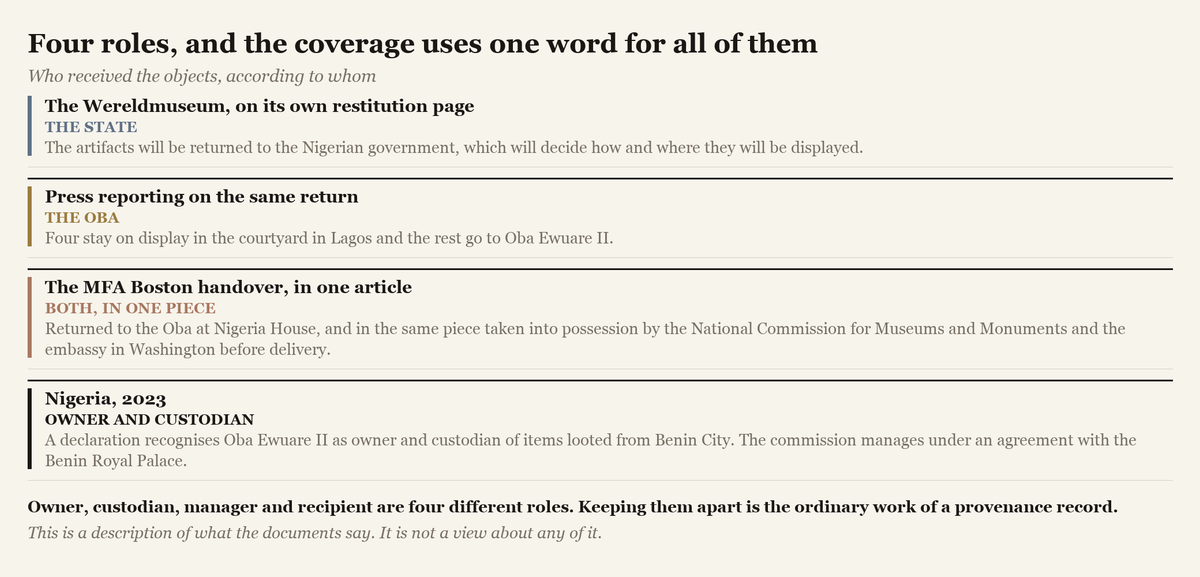
Ask who received the Dutch objects and the sources do not agree. The Wereldmuseum's own page says: "The artifacts will be returned to the Nigerian government, which will decide how and where they will be displayed." Press coverage of the same handover says four stay on display in the courtyard in Lagos and the rest go to Oba Ewuare II, the traditional ruler of the Benin Kingdom.
The Boston case contains the ambiguity inside a single article. The Art Newspaper reports that the museum returned two works to the Oba at a ceremony at Nigeria House in New York, and in the same piece that the works will be taken into possession by the commission and by Nigeria's embassy in Washington before being delivered to Oba Ewuare II.
Underneath that is a real change in Nigerian law. In 2023 the Nigerian government recognised Oba Ewuare II as owner and custodian of items looted from Benin City. The commission operates under a management agreement with the Benin Royal Palace, which allows it to manage storage and exhibition on the Oba's behalf.
Owner, custodian, manager and recipient are four distinct roles. The coverage reaches for one word, usually returned to, and that word cannot hold them.
And the cost of collapsing them is documented. Institutions that opened negotiations with the commission in 2022 found in 2023 that title would vest elsewhere, and the Cambridge transfer was delayed until the management agreement between the commission and the palace resolved who was receiving what. A party to an agreement changed while the agreement was in motion. That is a provenance-record problem of the plainest kind, and it was solved by writing down the distinction rather than by choosing between the parties.
The objects that left in the other direction
The Boston case is the smallest by count and the most instructive, because the museum never owned the objects at all.
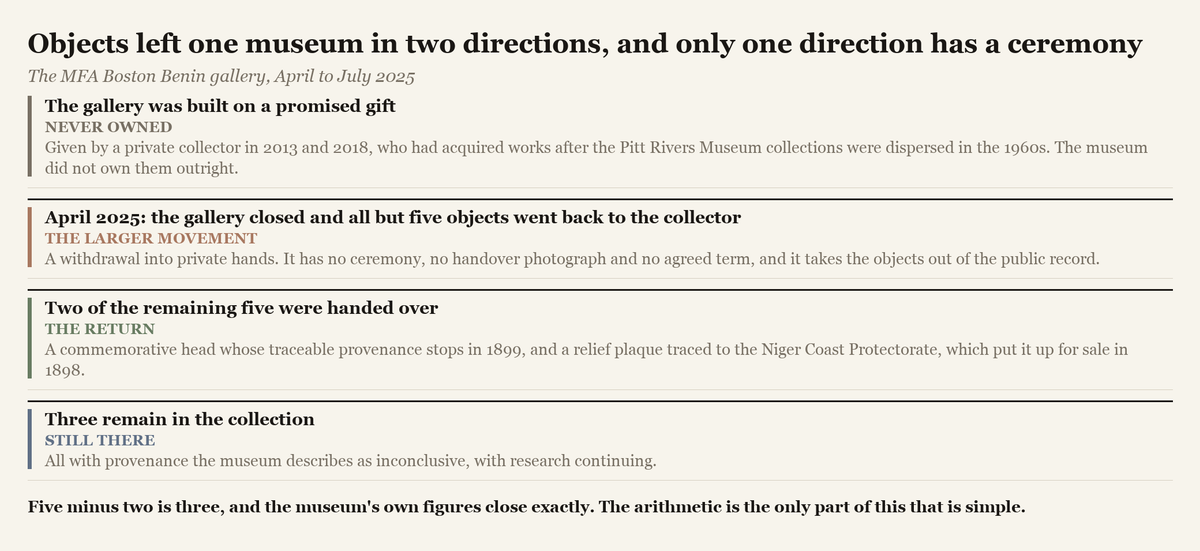
Its Benin gallery was built on a promised gift from the collector Robert Owen Lehman, made in 2013 and 2018, of works he had acquired after the Pitt Rivers Museum collections were dispersed in the 1960s. The museum's director describes the institution as having been "custodian of the works for 12 years." Custodian, not owner, in the museum's own words.
In April 2025 the museum closed the gallery and returned all but five of the objects to the collector. Of the five that remained, two were handed to the Oba. Three are still in the collection, with provenance the museum describes as inconclusive and research continuing. Five minus two is three, and the figures close exactly.
Read that sequence as custody rather than as politics and something falls out of it that the restitution frame has no slot for. Objects left that museum in two directions at the same time. One direction produced a ceremony in New York, a photograph, a statement, and a line in every account of this subject. The other direction produced none of those things, and it was the larger movement by count.
A withdrawal into a private collection has no vocabulary. There is no handover, no agreed term, no receiving institution with a catalogue, and no obligation on anyone to say where the objects went. They simply stop being visible. Whatever anyone thinks should happen to objects taken from Benin City in 1897, and this institution says nothing about that, a record that cannot see one of the two doors is only half a record.
What is in the 1897 record, and what is not
The documentary trail on these two Boston objects is unusually specific and worth setting down, because it shows what a good provenance entry on a Benin object looks like and where it stops.
The commemorative head, given as sixteenth or seventeenth century, has a last traceable provenance point in 1899. The relief plaque, sixteenth century, is traced to the Niger Coast Protectorate, which put it up for sale in 1898.
That second line is the kind of fact a record is for. It is not an inference about how an object left, it is a documented transaction with a named party and a year, and the party is the colonial administration itself. British armed forces took these objects during the sacking of Benin City in 1897; that characterisation is the one the museum sector's own press uses and it is reported here as theirs.
What the trail does not contain, for the overwhelming majority of the objects in all five returns, is anything comparable. That is not a failing of the institutions returning them. It is what the documentation of 1897 and the decades of dispersal afterwards actually is, and the honest thing a record can do with it is say so in a form that can be audited later rather than leave the field blank.
The dispute in Benin City, carried and not adjudicated
The receiving end has its own difficulty, and it is between Nigerian parties.
The Museum of West African Art in Benin City was due to open on 11 November 2025. A preview event was disrupted in early November: around twenty men, some carrying wooden bats, entered the courtyard during a pre-opening event, and the museum suspended that week's previews. Reporting links the protesters to the Oba's palace, and that is a characterisation in the coverage rather than an established fact. One protest leader is quoted describing the opening as illegal and, in the words the reporting gives, "an insult on our revered throne." Protesters also claimed the museum had misrepresented itself as the Benin Royal Museum, and the museum denied it, saying it "neither holds nor has ever claimed ownership" of the Benin Bronzes. The museum attributed the unrest to disputes between the previous and current state administrations.
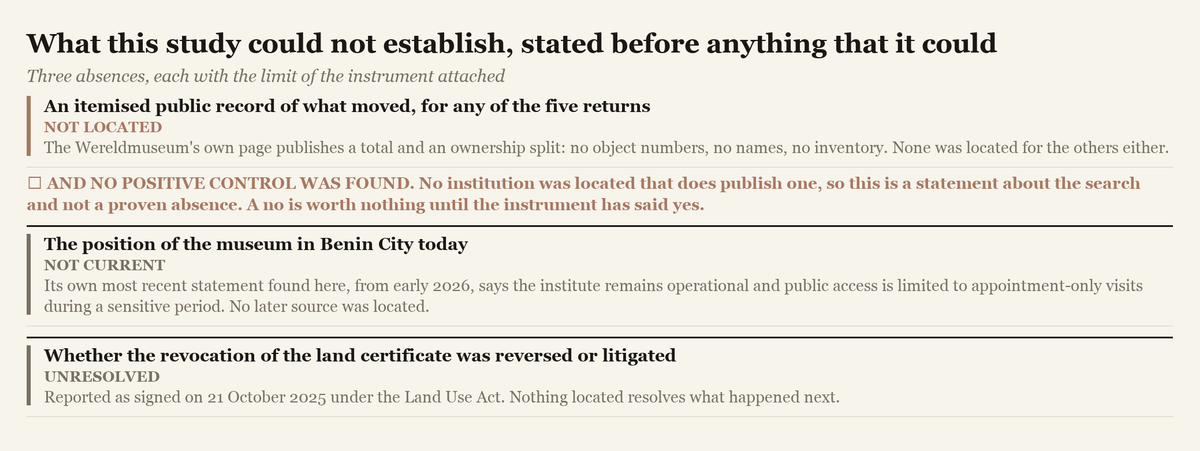
The governor of Edo State revoked the certificate of occupancy for the museum's land, in an order reported as signed on 21 October 2025, citing the Land Use Act and the overriding public interest. The museum disputed the claims. The president announced a committee, chaired by the culture minister, to make recommendations on the museum's future.
This institution takes no position on any of that, and names no party as right. What it will record is the state of the evidence. The museum's own most recent public statement located here, from early 2026, says the institute "remains operational" and that "public access remains limited to appointment-only visits during this sensitive period." No later source was found, and the position today is not established in this study. Nothing located here resolves whether the certificate revocation was reversed or litigated.
What this study could not establish, and the limit of its instrument
The check this study set out to run was simple: for each of the five returns, does an itemised public record exist of what moved, object by object, or only a total?
No itemised list was located for any of them. The Wereldmuseum's restitution page was read directly and publishes a total, an ownership split and nothing further: no object numbers, no names, no inventory, no download. The others yielded nothing comparable.
That result is reported here as a statement about this search, and not as a proven absence, for a reason this register insists on. A negative finding is worth nothing until the instrument has demonstrated that it can return a positive one, and it did not. The Horniman was expected to serve as that control, since its transfer was the most documented of the five, and no list was located there either. Either such lists are rarer than expected, or they exist somewhere this seat did not reach. Both of those are live possibilities and nothing here distinguishes them.
It is worth being exact about why this matters rather than leaving it as a methodological footnote. A total is a number that cannot be checked. An itemised record can be: against a receiving institution's accession register, against a loan agreement when a three-year term lapses, against the next catalogue. The difference between them is the difference between a claim and evidence, and it is the same difference wherever this institution looks.
The sentence a record would need
Everything above reduces to one line that almost none of this coverage contains, and that any of these transfers could generate without controversy:
This object was held by X from this date to that date. Title passed to Y on this date. Physical custody passed to Z on this date, or has not passed. The terms are these, and they expire then.
That sentence takes no view on whether any of it ought to have happened. It would be equally true, and equally useful, to a reader who thinks every object should have gone back decades ago and to a reader who thinks none of them should have moved. It is the thing the headline number replaces, and the thing a loan renewal twenty years from now will be checked against, if anyone wrote it down.
The same distinction, four times in one week
This is the fourth study this institution has published in a week that turns on one difference, and the repetition is not a stylistic habit. It is what happens when you look at records rather than at subjects.
A study of twenty museum catalogues found four institutions writing their uncertainty into a free-text field because there was nowhere else to put it, and sixteen with no field for it at all. A study of a Dutch royal provenance review found a report that produced four graded findings rather than one verdict, and coverage that kept the first half of the key sentence and dropped the second. A study of counterfeit handbags found an authentication system that read genuine parts correctly and returned a certificate for an object assembled from them. A study of the European Union's forthcoming product passport found an instrument whose own authors conclude that distinguishing products beyond the production batch is unnecessary for the uses it serves.
Four subjects with nothing in common except the shape of the failure. In each, a document is accurate about a class and is read as a statement about an individual, or the reverse. The passport describes a batch and is being sold as a guarantee about an item. The certificate describes components and is read as a verdict on a bag. The headline here describes a legal act over a collection and is read as a count of objects in a building.
The custodian's contract rests on the idea that obligations travel with an object, which only works if the record can say which object. That is the whole of it. A number attached to a group is not a statement about any member of the group, and the moment it is read as one the record has stopped being evidence and become a slogan, however accurate the number was when somebody first wrote it down.
What is not claimed
Objects of Affection Collection takes no view on origin, export, return or restitution. Nothing above is an opinion on where any object belongs, on whether any return should have happened or should happen, on the merits of any claim by any party, or on the legitimacy of any acquisition. This institution does not authenticate, attribute, appraise or value, and no object discussed here has been examined by anyone at it.
The characterisation of the events of 1897 as a sacking, and of the objects as looted, is the wording used by the institutions and publications cited, and is reported as theirs.
The dispute in Benin City is carried as the stated positions of named parties and is adjudicated nowhere. The link between the protesters and the palace is a characterisation in the reporting rather than an established fact, and is given as such. The museum's denial that it claims ownership of any Benin object is carried in its own words, as is its account of the cause of the unrest. No party is named as right, and the current position of the museum is explicitly not established here.
The count comparisons are drawn from each institution's own statement where one exists and from press reporting where one does not, and the figures for what has physically moved are as reported at the time of writing rather than a continuing audit. The Horniman first-stage figure of six comes from a single account and the sources do not resolve whether all seventy two changed hands at once or in stages.
The absence of an itemised public record is reported as not located by this seat, with no positive control established, and must not be read as a finding that no such record exists.