Seized, or Voluntarily Transferred: One Set of Objects, Two Verbs, and the Name That Decides a Provenance
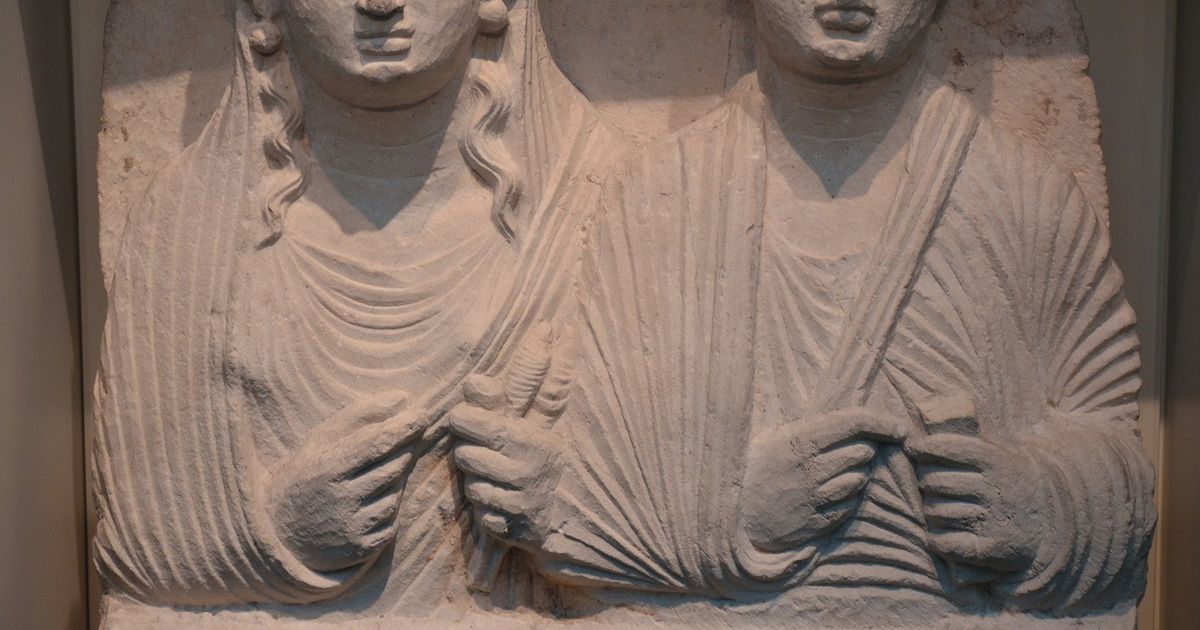
On 22 September 2026 fifteen antiquities valued at nearly three million dollars were handed to the Minister of Culture of the Hellenic Republic at a ceremony in Manhattan. The District Attorney's office, in its own announcement, wrote that the pieces "were all seized from the Metropolitan Museum of Art".
The Metropolitan Museum of Art says they were not seized.
Its position, given to reporters, is that the objects were not physically seized from its galleries, and that after they were identified as improperly acquired the museum voluntarily transferred them to the District Attorney's office to facilitate their return.
Both statements are public. Both are from named institutions. Both describe the same objects moving from the same building to the same office on the same dates. And they use two different verbs for the event.
This study is about that, and about what a provenance record is supposed to do when the two parties to a transfer describe it differently.
What this study does not do
Objects of Affection Collection takes no view on origin, export, return or restitution. That is a standing constraint and it governs what this institution says.
So: nothing below is an opinion on where any object belongs, on whether any transfer should have happened, or on whether any object was lawfully acquired. Where the words looted, stolen, trafficked or improperly acquired appear, they are quoted from the party that used them and attributed to that party. This institution does not authenticate, attribute or value, and the figures given are the ones the parties published.
What is in scope is narrower and is squarely this institution's subject: how a transfer gets described, by whom, and what a record does with the disagreement.
Three parties, three accounts, all of them public
The usual framing of this story, including in the brief that commissioned this study, is that the Met keeps losing antiquities to the Manhattan District Attorney. Set the three available accounts side by side and that framing is the one claim nobody involved actually makes.
The District Attorney's office writes that the fifteen Greek pieces "were all seized from the Metropolitan Museum of Art", and that objects were "recovered pursuant to multiple criminal investigations". Separately, the chief of its Antiquities Trafficking Unit has said that his office is not investigating the Met, and that prominent pieces of the museum's collection have been swept up in investigations aimed primarily at specific dealers.
The Met says nothing was physically seized from its galleries, that it transferred objects voluntarily once they had been identified as improperly acquired, and in a June 2025 removal described the process as a joint effort between the museum and the District Attorney's office. The head of its provenance research team has called that office "an invaluable partner to us in this work".
The press and the brief describe a museum losing objects to a prosecutor.
None of these is obviously false. A prosecutor's office that obtains objects under legal process can accurately call that a seizure. A museum that hands objects over before any physical seizure occurs can accurately say nothing was seized from its galleries. An observer counting objects leaving a museum can accurately say the museum no longer has them.
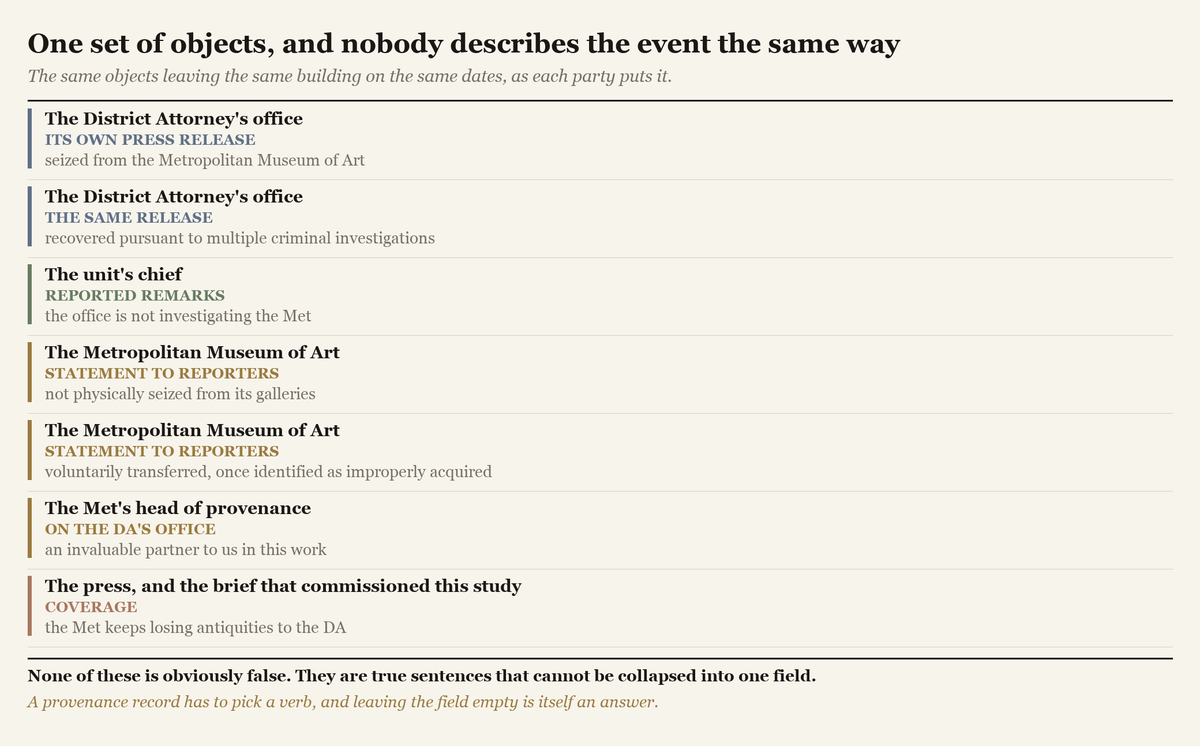
They are three true sentences that cannot be collapsed into one field.
The objects, because a study about description should say what is being described
The fifteen Greek pieces are not a homogeneous group, and the differences matter for how each one's history can be stated at all.
Five are bronze: two helmets and three mitrai, the belly guards worn with them, from the late seventh century before the common era. Reporting traces them to a sanctuary on the hill of Prophet Elias at Afrati, in Crete. One account describes Cretan armour returning sixty two years after an illegal excavation, which places the removal in the early 1960s rather than in any recent decade.
Others are much older or much later. A Cycladic marble female figurine of the Spedos type is dated to roughly 2700 to 2600 before the common era. A Roman marble head of a veiled man comes from a different world entirely, thousands of years after the figurine.
The commissioning brief says some of the objects will be reunited with material from the sites where they were found. That is reported rather than asserted here, and it is worth noticing why it is possible at all for the bronzes and not for most objects: a sanctuary deposit is an assemblage, so an object removed from it can in principle be matched back to the group it was separated from. That is an archaeological form of provenance that does not depend on documents at all. It depends on the objects themselves still being comparable to each other.
The Syrian group is differently constituted again. Besides the Palmyran relief there are fourteen Roman-era mosaics and three Syro-Hittite female figures carved in the north west of the country in the second millennium before the common era. The office's release records that a mosaic and twenty two other Lebanese and Syrian mosaics were seized from a storage unit in July 2021.
A storage unit is worth pausing on. It is the least documented place an object can be, and it is where a great many of them are. Nothing about a storage unit produces a record, and an object that spends a decade in one has a history that is real, continuous and completely unwritten.
A record has to choose a verb, and the verbs are not interchangeable
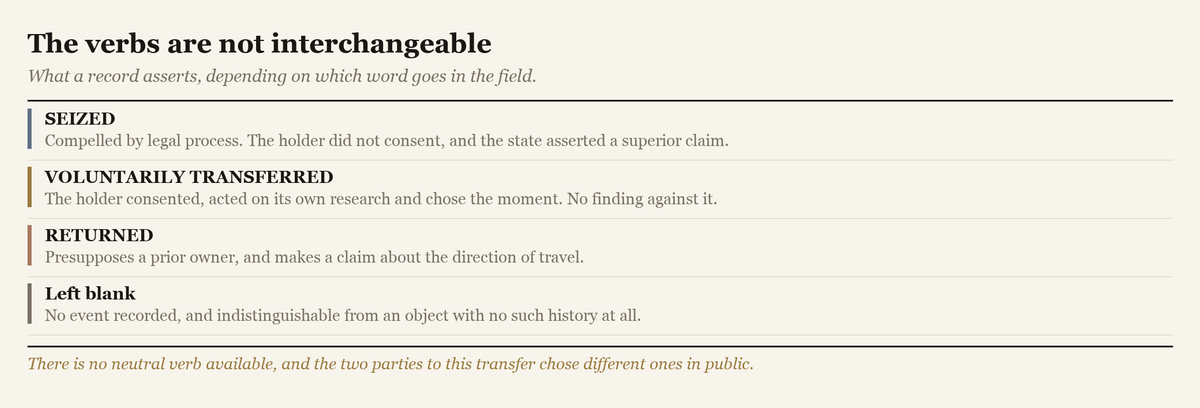
For most readers this is a matter of emphasis. For anyone keeping a record of custody it is the whole problem, because a transfer event is exactly the thing a provenance record exists to hold, and a transfer event has a type.
Consider what each verb commits the record to.
Seized says the transfer was compelled by legal process, that the holder did not consent, and that the state asserted a superior claim. It implies a case, an instrument, and a date on which possession changed against the holder's will.
Voluntarily transferred says the holder consented, acted on its own research, and chose the moment. It implies no compulsion and no finding against the holder.
Returned says something else again, because it presupposes a prior owner and makes a claim about the direction of travel.
Those are three different events with three different legal characters, and a record that files the same episode under any one of them is making a substantive assertion that one of its own parties disputes. There is no neutral verb available. The record cannot abstain, because leaving the field empty is itself an answer, as this institution found when it looked at twenty museum catalogues earlier today and could not distinguish a field that was empty from a field that did not exist.
What a record can do is carry both accounts with their sources attached, which is more honest and more useful than picking a winner, and which almost no catalogue format makes easy.
The instrument is a name, not a chain
The more surprising finding here is about how these records are actually tested, and it is not how the ideal of provenance suggests.
The ideal is a complete chain: every holder, every transfer, back to the ground. The practice, as reported, is different. The chief of the trafficking unit has been quoted taking the position that if a particular dealer's name is the first name on a provenance, the object is stolen.
That is a rule in which one name anywhere in the chain is dispositive. It does not ask whether the chain is complete. It asks whether a specific party appears in it, and it treats the presence of that party as determinative of the whole.
This is an enormously cheaper test than verifying every link, and it is the test with eighteen convictions behind it. It is also, read as a record-design principle, a statement that the value of a provenance chain is not evenly distributed across its links. One link can carry all of it.
It is contested, and the contest belongs in this study rather than in a footnote. Critics of the unit have questioned the sufficiency of evidence that is twenty five to forty years old, and at least one report describes a source country dismissing claims against a dealer. This institution takes no position on any particular case. What is worth recording is that the operative test in the field is a name test, that it is efficient, and that its critics attack it precisely where a name test is weakest, which is on the age and quality of the evidence attaching the name.
The source became the subject
The Syrian case makes the name problem concrete in a way no argument could.
On 23 September 2026 the same office returned thirty six antiquities valued at more than five million dollars to Syria, among them a carved limestone funerary relief from Palmyra showing a reclining man with a woman and three children, made in the late second century of the common era and weighing, in the office's words, "more than 1,000 pounds". Fourteen Roman-era mosaics and three Syro-Hittite figures were in the same return.
The office attributes thirty one Middle Eastern and North African antiquities to Georges Lotfi, whom it describes as a Lebanese pharmacist who became an antiquities trafficker. He is the subject of an arrest warrant the office obtained in 2022 and of an Interpol Red Notice issued in 2023. The office's own release states that the charges are allegations and that he is presumed innocent unless and until proven guilty, and this study carries that. No statement from him or from counsel could be located here, and that is a statement about what was found rather than a claim that none exists.
Now the part that matters for a record.
According to reporting, Lotfi was a source for the same unit, and first approached it about the gold sarcophagus at the Met in March 2018.
So information that helped establish what was wrong with one object's history came, in part, from a person who is now himself the subject of a warrant obtained by the office he informed. That is the provenance of the provenance information, and almost no record format has a place to put it.
This is not an accusation against anyone and it does not imply the information was wrong. Information from an interested party is ordinary in every investigative field and is routinely correct. The point is narrower: the reliability of a source is a property that changes over time, exactly like the reachability of a counterparty, and a record that captured who said what and when would show that change, while a record that merely records a conclusion would not.
One detail, two accounts, and the primary source settles it
A smaller thing, worth including because it is checkable and because it concerns the most emotionally charged fact in the story.
At least one outlet reported that the Palmyra relief was looted by ISIS between 2015 and 2017.
The District Attorney's own release says something different. It states that the relief was removed from Palmyra and smuggled to Dubai before ISIS destroyed the city between 2015 and 2017.
The dates are the same in both accounts. In the primary source they attach to the destruction of the city. In the relay they attach to the taking of the object. That is a materially different history for the object: one version has it leaving before the events everyone remembers, the other has it taken during them.
This institution has spent today's studies on exactly this mechanism, and it is worth noting that it appears here on the single detail most likely to be repeated.
"Improperly acquired" is a carefully built phrase
The Met's formula for what happened to these objects is that they were identified as improperly acquired. It is worth reading closely, because it is doing precise work.
It concedes a defect in the acquisition. It does not concede that the object was stolen, that any particular prior transfer was unlawful, or that the museum knew anything at the time. It locates the problem in the manner of acquiring rather than in the object's status or in anyone's character, and it is compatible with the museum having behaved entirely properly on the information it then held.
Set that beside the other phrases in play. The District Attorney's office writes that objects were recovered pursuant to multiple criminal investigations, which places them inside a criminal frame without asserting anything about the museum. The press writes that the museum is losing objects, which implies a contest. The Met's own head of provenance calls the office an invaluable partner, which implies the opposite of a contest.
Four formulations, four different pictures, and every one of them is defensible by the party using it.
For a record this is not a cynical observation, it is a design requirement. The language a party uses about a transfer is itself evidence about the transfer, and flattening it to a single neutral term destroys information. A catalogue entry reading "acquired 1998; transferred to the District Attorney 2026" is shorter, cleaner, and has thrown away the fact that the two parties to the 2026 event described it differently and that the museum chose a phrase admitting a defect without admitting a wrong.
The phrase is also a reminder that institutions are not only recording facts. They are choosing, under advice, how to be on the record, and a record that cannot show that choice was made cannot show much.
The numbers do not agree with themselves
The unit's published record is substantial and the figures are worth stating exactly as the office gives them, because the versions in circulation differ.
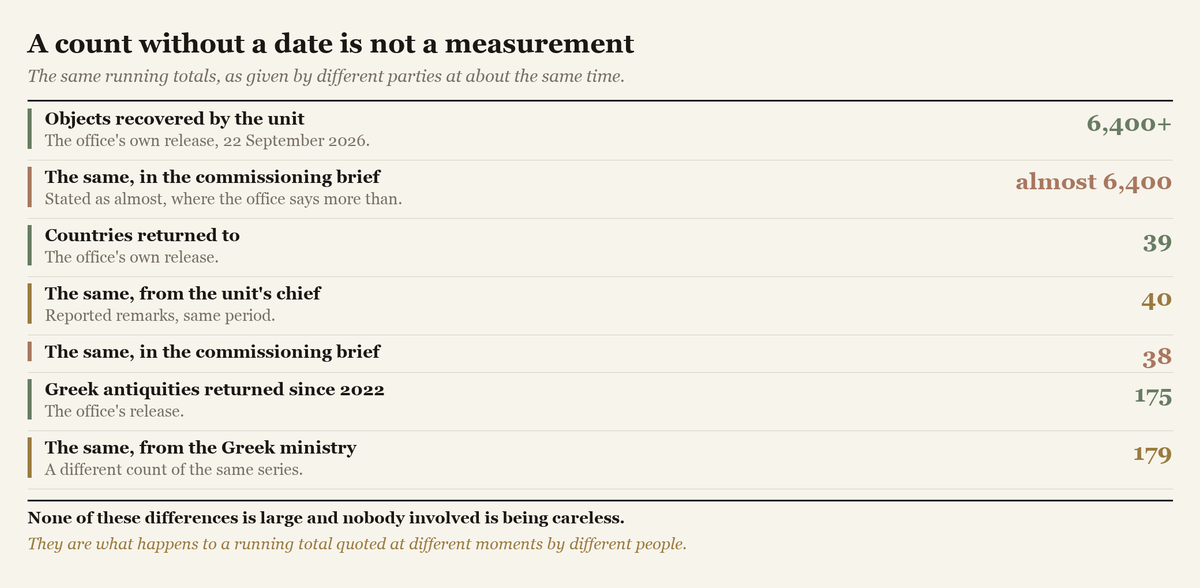
The September release states that the unit has convicted eighteen individuals of cultural-property-related crimes, has recovered more than 6,400 antiquities valued at more than four hundred and ninety million dollars, and has returned more than 6,150 of them to thirty nine countries.
The brief that commissioned this study says thirty eight countries, and "almost" 6,400 objects where the office says more than. In separate remarks reported around the same ceremony, the unit's own chief gave the figure as more than 6,400 antiquities repatriated to forty countries. A Greek count of antiquities returned since 2022 stands at 179 where the office's own release gives 175.
None of these differences is large and none suggests anybody is being careless. They are the ordinary consequence of a running total being quoted at different moments by different people, which is precisely what makes a figure hard to use. A count without a date is not a measurement, and these counts travel without dates.
The figure of more than 120 objects valued at more than ninety five million dollars taken from the Met since 2017, which appears in most coverage including the commissioning brief, is reported by the press rather than stated in either release read here. That does not make it wrong. It makes it a press aggregate rather than an official total, and the difference is worth keeping.
The museum's answer was a records department
What the Met did in response is the part of this story most useful to anyone building a provenance practice, and it is almost never the headline.
In May 2023 its director announced, in an internal letter to staff, a dedicated provenance research team of four people. That team is now reported at twelve specialists, led by a former global head of restitution at an auction house.
The brief says the team has doubled. It has roughly tripled.
Two things in that are worth saying plainly. The first is that an institution with world-class curatorial resources concluded that the answer to a documentation problem was more documentation staff, not better acquisition policy alone, and tripled the headcount in under three years. The second is where it found the expertise: the person leading it came from the restitution desk of an auction house, which is one of the few places in the market where testing a chain of ownership has been somebody's full-time job for years.
That is a statement about where this skill currently lives, and it is not in museums.
The capability took fifteen years and one person's insistence
It is easy to read a unit with eighteen convictions and a nine-figure recovery total as a permanent feature of the landscape. It is recent, and it very nearly did not exist.
The reported history is that when a new District Attorney took office in 2010, he authorised the prosecution of antiquities trafficking, but with no additional resources assigned to it. The dedicated unit came later, after supervisors raised the matter. By 2018 reporting described a unit roughly five years into developing a picture of international trafficking networks and beginning to receive more tips from the public. It has worked throughout with federal agents from Homeland Security Investigations, and the September release names an agent from that agency alongside the office's own analysts and investigators.
Two things in that are relevant to anybody designing a verification capability rather than admiring one.
It began as unfunded permission, which is to say it began as one person being allowed to do the work rather than being given the means. The means arrived after results did, which is the usual order and is worth remembering by anyone waiting for a budget before starting.
And its leverage is not its legal power alone, it is accumulation. The value of the unit is that it has been building a map of who sold what to whom for a decade and a half. A single warrant against a single dealer yields documents; fifteen years of warrants yields the ability to recognise a name on a provenance and know what it implies. The name test described above is not a shortcut somebody invented. It is the compressed output of a very long accumulation, and it is only available to an actor that has done the accumulating.
That is the part no individual buyer, and no single museum, can replicate at any budget.
Who can actually check a provenance record
This institution published a study earlier today which ended on an unsolved problem. It argued that a documented history raises an object's legitimate value and suppresses what a thief can realise from it, and then conceded that the whole thing depends on the record being harder to forge than it is to check. It said that the second half of that was the open question and that nothing in the study closed it.
This case says something uncomfortable about it.
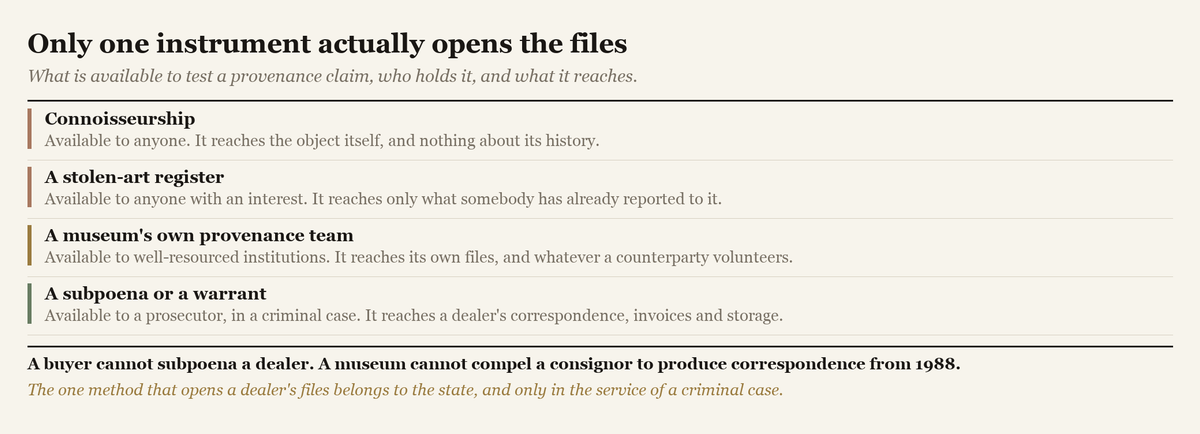
The instrument that reliably tested these records was not connoisseurship, was not a database lookup, and was not a museum's own diligence. It was legal process: warrants and subpoenas served on dealers, collectors and museums, backed by a prosecutor's office with investigators and a Homeland Security partnership, operating over years and producing eighteen convictions.
That instrument is available to exactly one kind of actor. A buyer cannot subpoena a dealer's records. A museum cannot compel a consignor to produce correspondence from 1988. A registry can only compare an object against what has been reported to it. The one method that actually opens a dealer's files belongs to the state, and only in the service of a criminal case.
So the honest answer to "who can check a provenance record" is: in the general case, nobody, and in the serious case, a prosecutor. Everything else is a comparison against what somebody has already chosen to write down.
That is not a counsel of despair and it does not make records pointless. It sharpens what a record is for. A record cannot verify itself and cannot compel anyone. What it can do is make each claim attributable, dated and addressed to a party, so that when someone with the power to compel eventually asks, there is something specific to ask about. The museum that tripled its provenance department understood this: it did not buy a verification machine, it bought people who can read a file and name what is missing.
That is the burden of preservation in its least glamorous form. Not storage, not conservation, but keeping the record answerable to a question nobody has asked yet, and which may be asked by someone with a warrant.
What a record should have held
Pulling the threads together, the episode asks for four things that a conventional catalogue entry cannot carry, and all four are about description rather than discovery.
The verb, with its source. Not seized or transferred, but both, each attributed, because the two parties to the event disagree and the disagreement is a fact about the event.
The grade of each link, and who supplied it. A chain in which one link rests on a tip from an interested party is different from one in which every link rests on an invoice, even if both chains look identical when written out.
The date of the assertion, not only the date of the event. A running total, a reliability judgment and an attribution are all claims made at a moment, and all three change.
What is contested, left contested. The custodian's contract exists to attach obligations to an object at the point of transfer. The same instinct applies here: where two parties describe one transfer differently, the record's job is to hold both and say who said which, not to resolve it on their behalf.
None of that requires knowing more than is already public. All four are available in the documents quoted above, and none of them survives into a catalogue entry that has one field for how an object was acquired.
What is not claimed
No view is offered or implied on where any object belongs, on the merits of any return, on the lawfulness of any acquisition, or on the merits of any case. This institution takes no view on origin, export, return or restitution, and that constraint governed what this study could examine before a word of it was written.
Every characterisation of an object as looted, stolen, trafficked or improperly acquired in the sources above belongs to the party that made it and is attributed in the text. Where the District Attorney's office and the Metropolitan Museum of Art describe the same event differently, both descriptions are reported and neither is endorsed.
Georges Lotfi is named because he is the subject of a public arrest warrant and an Interpol notice identified in a government release. The charges against him are allegations and he is presumed innocent unless and until proven guilty, which is the position the office's own release states. No statement from him or his counsel was located, and none is implied not to exist. Public officials are named in their official capacities. No private individual is named.
The criticisms of the unit's methods reported above are carried because a study that quoted only the office's record would be a press release. This institution takes no position on them either.
What is claimed is small and checkable. Two institutions described one transfer with two different verbs, in public, on the same dates. The test that actually decided these cases turned on a name rather than a chain. The source of some of the original information is now the subject of a warrant. And the only instrument that reliably opened the records was a criminal one, which is available to almost nobody.