Unsellable: What a Provenance Record Is Worth on Each Side of a Theft

There is a claim this institution makes, in one form or another, every time it explains what it sells: that a documented history makes an object worth more on the open market and worth almost nothing to the person who steals it. If both halves are true then a provenance record is not only a commercial instrument. It is a security device, and an unusual one, because almost everything else that raises an object's value also raises the reward for taking it.
The claim is therefore worth testing, and it is the most dangerous one this seat has tested this month, for a reason that has nothing to do with the evidence. Every previous test this month examined somebody else's claim. This one examines ours.
So the standard has to be the one applied three weeks ago in a study that rejected a widely repeated recovery statistic because no primary source for it could be found. There is an unsourced figure in this subject too, and it helps us. It is treated here exactly as the other one was.
The first half is measured, and the number is not the one usually quoted
The strongest evidence for the value half is not OAC's own work. It is a paper in Management Science by Yuexin Li, Xiaoyin Ma and Luc Renneboog, "In Art We Trust", volume 70 number 1, 2024, pages 98 to 127. It is open access. It applies textual analysis to the provenance passages printed in auction catalogues, extracting four dimensions of what the authors call authenticity information, and tests them against sale outcomes.
The four dimensions are pedigree, which is the chain of past owners, exhibition history, literature coverage, and certification, which is an expert opinion or the artist's own testimonial.
The paper's own sentence, which is worth quoting rather than summarising, reports that where pedigree information is available the price is 20.7% higher, that an exhibition history raises it by 41.9%, that literature drives it up by 53.5%, and that certification adds 13.9%.
So the value half holds, and it holds on a serious footing: a peer-reviewed hedonic model across a very large body of auction records, with artist, year and month fixed effects, robustness checks against artist reputation and auction house reputation, and quasi-natural experiments built on auction houses changing their provenance policies after authenticity litigation.
The ownership chain is worth 20.7%. That is the number that describes what a custody record actually contains.
The trap is in the abstract, and this institution has already fallen into it
The paper's abstract says that provenance information "leads to hammer price premiums up to 54%".
Fifty four is the ceiling across all four dimensions, and it is the literature row. It is the premium for a work having been written about in a catalogue raisonné or the authoritative press. It is not the premium for knowing who owned the thing.
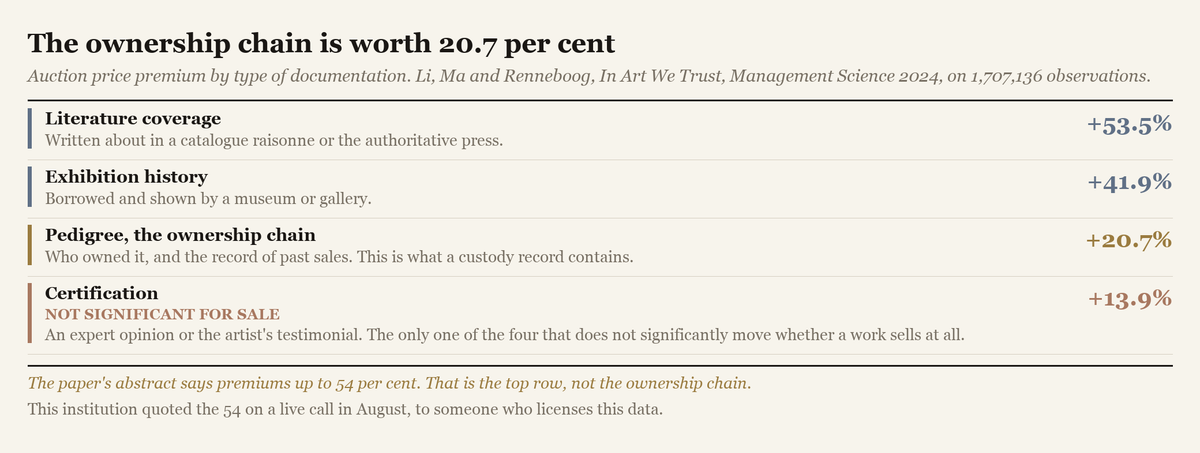
Anyone who reads the abstract and stops has a number two and a half times larger than the one that describes a chain of custody, attached to the wrong product. The abstract is not wrong. It is compressed, and the compression drops the distinction that matters to anyone selling a record of ownership.
This is recorded here because OAC made exactly that error, on a live call in August 2026, quoting the premium at fifty four or fifty five per cent, to a person whose business licenses data in this field and who could have opened the paper. It is the same failure this institution documented in two studies published earlier this month, where a finding was relayed with its scope intact and its source stripped. Here it happened to us, from a journal abstract, which is the most authoritative possible place for a compression to live.
The row nobody quotes, and it is the one that matters most to what we are building
Underneath the four headline premiums there is a second column in the same table, and it answers a different question: not how much more the work sells for, but whether it sells at all.
Pedigree raises the probability of a sale, and the coefficient carries three significance stars. So does exhibition history. So does literature coverage.
Certification does not. Its coefficient on the probability of being sold is 0.0102 and it carries no significance stars at all, in a table where the other three all do.
Read the two columns together and the paper says something sharper than its abstract. Of the four kinds of documentation a catalogue can carry, the expert certificate is the weakest on price, and it is the only one that does not significantly move whether the object finds a buyer.
This institution has a standing position, set by its founder in August 2026, that what it builds is a record of custody over time and explicitly not an authentication, which is a claim about an object at a moment. That position was taken on grounds of what the instrument can honestly do. The market appears to have priced the same distinction independently, and priced certification last.
Three things in the same paper that complicate the sales pitch
The study is built on 1,707,136 observations carrying full hedonic information, with the price regressions run on just over 1.1 million of them. At that scale the descriptive statistics are worth as much as the coefficients, and three of them cut against any simple reading.
First, the chain almost never reaches the maker. Among works that carry pedigree information at all, the paper finds evidence that an earlier owner bought directly from the artist in 10.5% of cases, from the artist's family in 5.3%, and from the sitter in 0.33%. The famous-owner categories are thinner still: works once owned by prominent collectors run at 2.07%, royalty or nobility 2.39%, wealthy families 0.68%, chief executives 0.06%.
Read those numbers as a statement about the state of the record rather than about the market, and they say that the ownership chain, in the one place the trade writes it down, is usually short, usually recent, and usually silent about the beginning. That is a finding about absence, which is the subject this institution's own measured work is actually about, and it is the reason a record that can state what it does not know is worth building at all.
Second, documentation that travels with the object outperforms the same opinion kept apart from it. The paper separates certification into physical and nonphysical forms, the latter defined by example as authenticity orally confirmed by a named person. An expert's physical certification carries a price impact of 40.7%. The same expert's nonphysical certification carries 18.0%.
That is more than double, for what is in substance the same opinion from the same kind of source, differing in whether it is attached to the thing. Anyone designing a record should notice it. The market is not paying for a judgment. It is paying for a judgment that cannot easily become separated from the object it concerns, which is the whole design intent of a custodian's contract.
Third, and this one limits what a custody record can promise. The paper also examines returns between two sales of the same work, and finds that the dimensions which move them are exhibition and literature rather than pedigree. If a painting had no exhibition history before its first sale but is exhibited during the holding period, annualised returns rise by 16.5 percentage points. Where the work was absent from the art-historical literature before the first sale and present before the second, the annualised return rises by 14.9%.
So the documentation that compounds is the documentation produced by somebody else taking the object seriously: a museum borrowing it, a scholar writing about it. A custody record is not the highest-yielding form of documentation an owner can acquire. It is the most durable one, and it is the one the others are built on top of, but an honest account of the evidence says plainly that getting a work exhibited and written about moves the money more.
The contamination effect, and who else pays when a forgery surfaces

One of the paper's methodological devices deserves to be pulled out of the methods section, because it is a finding in its own right and it connects the two halves of this study.
To deal with the obvious objection that provenance and price might be jointly determined by something unobserved, the authors needed events that moved documentation without being caused by prices. They used two. The first was auction houses changing their provenance policies after authenticity litigation. The second was what they call a contamination effect: the discovery of fakes and forgeries on the oeuvre of forged artists.
Read that as a description of the world rather than as an econometric instrument. When forgeries of an artist surface, the effect is not confined to the people who bought them. It reaches across the artist's whole body of work, including the genuine pieces, held by people who did nothing wrong and whose objects have not changed.
That is the cost of the forgery cases this institution examined eight days ago, and it is a cost nobody counted. The restitution ordered in the Miami prosecution runs to about 2.6 million dollars, and the Brooklyn defendants face at least 1.9 million. Those figures cover the defrauded buyers. They do not cover the owners of real works by the same artists, whose documentation is now worth marginally less because the market has learned that documentation of that kind can be manufactured.
So forged provenance is not a transfer from a buyer to a criminal. It is a transfer from a buyer to a criminal, plus a diffuse loss spread over every honest holder of a comparable object, plus a permanent increase in the cost of proving anything about that artist thereafter.
This is the same quantity running backwards. If a documented ownership chain adds 20.7% to a price, it does so because the market believes documentation of that type means something. Every prosecution that shows it can be fabricated draws that belief down a little, for everyone, at once.
The second half opens with a word used by a prosecutor
Now the harder half, and the evidence for it is of a different kind.
In October 2025 eight pieces of the French crown jewels were taken from the Galerie d'Apollon at the Louvre. A year later the jewels have not been recovered. The Paris prosecutor, Laure Beccuau, described them as unsellable, on the grounds of their historical significance, and said that anyone who bought them would be guilty of concealment of stolen goods.
That is the thesis, stated by the prosecuting authority, about the most reported theft of the year. It is also, read carefully, a statement about documentation rather than about the objects. The jewels are unsellable because they are known: described, photographed, catalogued, and attached to a history that no buyer can plead ignorance of.
Anja Shortland, Reader in Political Economy at King's College London and a specialist in the governance of criminal markets, puts the general case in the same terms. Fresh museum pieces, she writes, are essentially unsaleable on the legitimate market even at a steep discount, and the reason is that market norms have tightened over the past two decades: dealers and auction houses that once overlooked a suspicious origin now take due diligence seriously.
The mechanism is legal, and this study had it wrong before checking
It is tempting to describe what happens next as the object becoming worthless. That is not what happens, and getting it right changes what a record has to do.
A stolen painting is physically unchanged. It is exactly as beautiful and exactly as rare as it was on the wall. What documentation destroys is not the object's value but the buyer's ability to own it.
A purchaser who does not check whether a former owner has registered an interest in an object fails the good faith test. Failing it means they cannot acquire good title, the original owner retains the legal right, and a sale made without that diligence can be voided with the money returned. The Art Loss Register and the free Interpol database exist to make that check possible, and the consequence of their existence is that a buyer can no longer claim not to have known.
So the loss does not fall on the thief at the moment of the theft. It falls on whoever buys, and it falls on them in the form of a title they never acquired. The thief's problem is derivative: the only people who will buy are the people who do not care about title, and those people pay accordingly.
That is a chain of four steps and every step is a legal or commercial fact rather than a physical one. It also means the deterrent is only as strong as buyers' appetite for clean title, which is a thing that varies by market, by jurisdiction and by decade.
The number on our side of the argument is as unsourced as the one we rejected
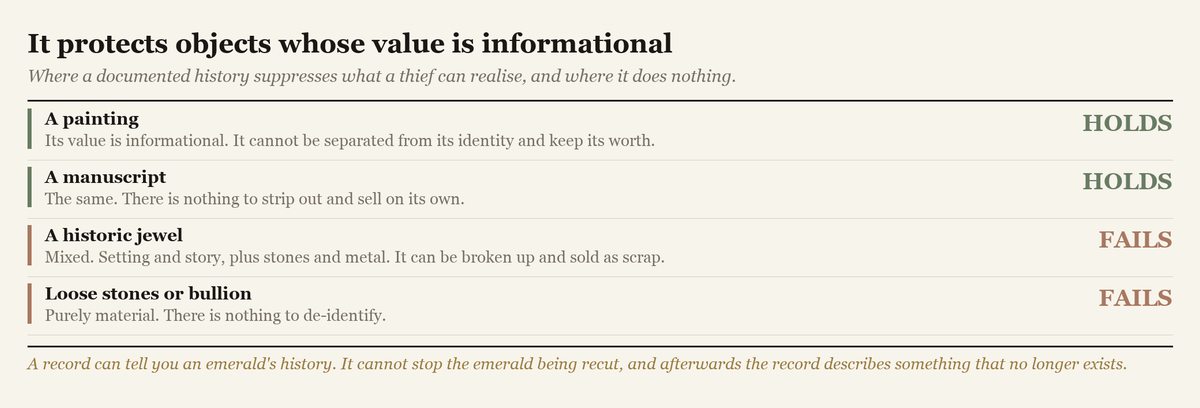
The usual way to finish this argument is to say that stolen art fetches about ten per cent of its legitimate value. The figure appears everywhere. It is worth saying precisely where it comes from.
It appears in a book on art theft as an estimate. It is given as ten to twelve per cent by a former head of Scotland Yard's art and antiques unit. A piece in a newspaper magazine gives seven to ten. And in Shortland's article, which is the most rigorous treatment located here, the figure appears as the ceiling on what a finder might receive, and it is stated explicitly as her own estimate, with no source cited.
Three weeks ago this institution published a study which rejected the claim that about ten per cent of stolen art is ever recovered, on the ground that no primary source for it could be found and that published versions ranged from five to twenty two per cent. The ten per cent on this side of the argument is of exactly the same evidentiary quality, and it is accepted here no more than the other one was.
The direction is well supported by named experts and by a prosecutor. The magnitude is an estimate repeated until it reads as a measurement. A study that rejected one and accepted the other because the second was convenient would not be worth publishing.
There is a second claim that has to be set down the same way. It is often said that the Gardner museum works, taken in 1990 and still missing, were never sold. The record establishes that they were never recovered, which is a different statement. That distinction is one this institution drew in a study published eight days ago, and the first framing of this study got it wrong until a source corrected it.
Where the thesis fails, and it fails cleanly
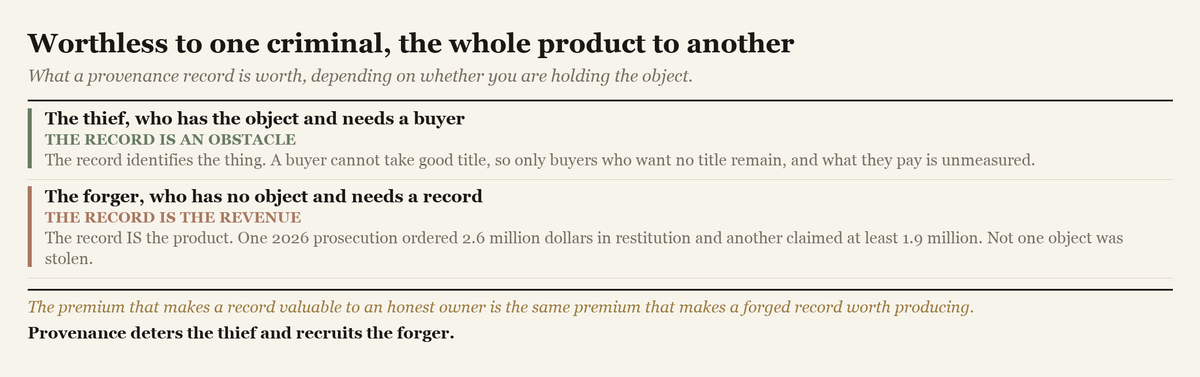
The claim holds for objects whose value cannot survive being separated from their identity. A painting is such an object. Remove its history and you have an anonymous canvas worth a fraction of what it was, and you cannot put it back.
It does not hold for objects that survive de-identification. Shortland is explicit that for jewellery the only realistic route is breaking it up and selling it as expensive scrap. A stone can be recut. A setting can be melted. The gold is worth what gold is worth, and the gold does not know where it has been.
This is why the two most discussed thefts of the past year point in opposite directions. The Renoirs taken from a museum in the south of France in October 2026 were recovered, hidden behind a wall built under a staircase, because there was nothing else to do with them. The crown jewels taken from the Louvre a year earlier have not been recovered, and the prosecutor's word for them is unsellable, which describes their status as objects and says nothing about what they are worth as materials.
So the rule is not that provenance protects art. It is that provenance protects objects whose value is informational, and offers nothing to objects whose value is material. A record can tell you an emerald's history. It cannot stop the emerald being recut, and after the recutting the record describes something that no longer exists.
Any honest account of what this institution sells has to say that. A custody record is a strong instrument for paintings, manuscripts, furniture, instruments and vehicles, and a weak one for bullion, loose stones and anything else whose worth is in its substance.
The inversion, and it is the part the claim gets backwards
Now the sharpest objection, and it does not come from a model. It comes from this month's own case law.
The claim says provenance is almost worthless to thieves. It is worthless to a thief who has the object. It is the entire product for a criminal who has nothing.
A study published here eight days ago examined two federal prosecutions concluded this year. In one, a Miami dealer was sentenced to forty six months for selling counterfeit Warhols, having forged authentication documents, foundation identification numbers and stamps, and was ordered to repay close to 2.6 million dollars. In the other, a father and daughter pleaded guilty to consigning more than two hundred counterfeit works for auction, among them works attributed to Picasso and to Banksy, defrauding buyers of at least two million dollars, and the government's account describes them generating false histories of prior custody and ownership.
Between them, better than four and a half million dollars, and not one object was stolen.
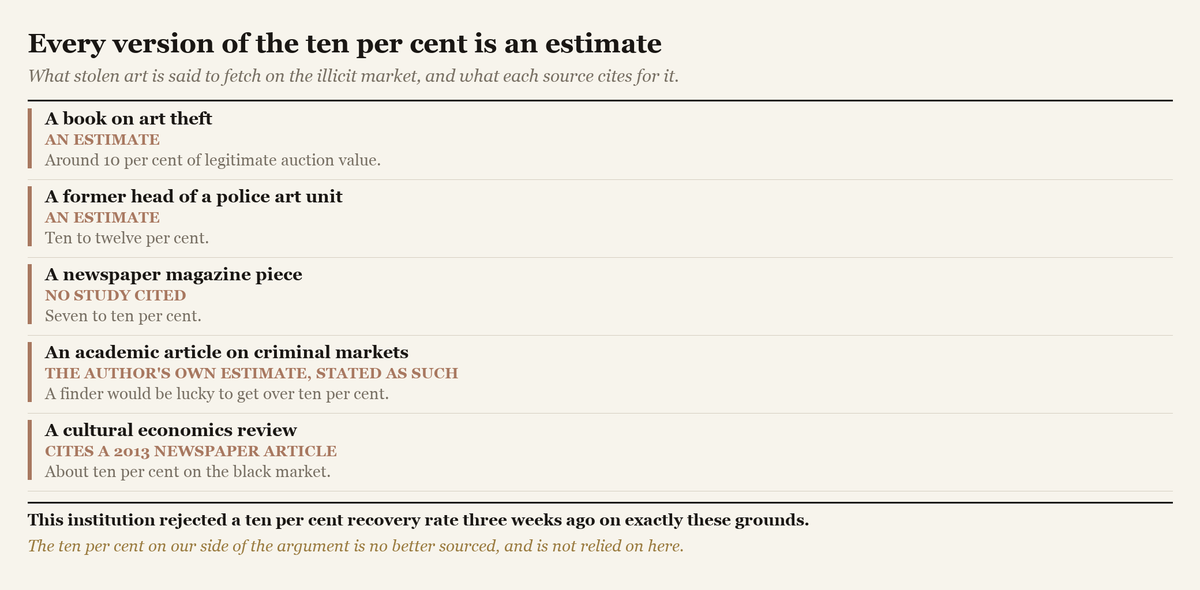
That is what the value half of the thesis produces when you follow it to its conclusion. If documentation adds 20.7% to a price, then documentation is worth money, and anything worth money attracts people who will manufacture it. The premium that makes a record valuable to an honest owner is the same premium that makes a forged record worth producing.
So the honest formulation is not that provenance defeats crime. It is that provenance deters the thief and recruits the forger, and the institution's own published work this month documents both halves of that within three weeks of each other.
A published model says lowering the illicit price may not reduce theft at all
One further objection has to be carried because it is peer-reviewed and it cuts against the comfortable reading.
Frederick Chen and Rebecca Regan built a game-theoretic model of art theft, published in the Journal of Cultural Economics, in which museums choose security levels knowing how thieves respond. One of its results is that policies which lower black market values can increase theft, because they make private negotiation cheaper for the museum, which makes the quiet recovery route more attractive and theft correspondingly less risky.
If that result holds, then driving the illicit resale price of documented art toward zero does not simply stop theft. It changes what theft is for. The thief who cannot sell can still return, and the economics of returning improve as the economics of selling collapse.
There is historical support for the concern, and Shortland supplies it from the other direction. Insurers once paid finders for the recovery of stolen works with little scrutiny, which made theft comparatively low risk and profitable. Registers ended that economy, by taking the leads offered to them and feeding them to police rather than to a payout. That is deterrence by documentation, observed rather than modelled, and it is the best single piece of evidence for the second half of the thesis that this study found.
But notice where the value went rather than assuming it vanished. Shortland records stolen works being kept back as bargaining chips in sentencing negotiations, and names a jewellery theft in Dresden where some pieces were retained for exactly that purpose. Value that cannot be realised in a market can still be realised against a prosecutor. A record makes an object harder to sell. It does not make it worthless to hold.
An unforgeable record and a true one are different things
The paper reaches, in its own abstract, for a word that is worth noticing. It calls pedigree the ownership blockchain, in quotation marks, and later observes that ownership could in principle be logged by that technology because such records cannot be forged.
Three financial economists reaching for that term to describe a chain of custody is a useful signal about what the market thinks it is buying. But the claim attached to it needs splitting in two, and the forgery prosecutions make the split concrete.
Immutability is a property of the record. Veracity is a property of the claim. A ledger that cannot be altered guarantees that an entry has not changed since it was written. It guarantees nothing whatever about whether the entry was true at the moment of writing.
Both schemes examined in the earlier study attacked the second thing and never touched the first. Nobody altered an existing record. One party forged documents attributed to a body that had been dissolved for over a decade; the other invented ownership histories running through galleries that had closed and corporations that no longer existed, and the government's account says those counterparties were chosen precisely so that the histories would be hard to verify. Write either of those chains into a perfectly tamper-proof ledger and you have a permanent, cryptographically secure record of something that never happened.
The useful property, then, is not that a record cannot be changed. It is that each link in it can still be checked with somebody who was there, and that the record says plainly which links can and which can no longer. That is a different engineering problem, it is mostly a question of who is still answering, and it is not solved by making the writing permanent.
The verdict
The claim survives, and it is narrower and more interesting than as stated.
Provenance raises legitimate value, by 20.7% for the ownership chain specifically, measured in a peer-reviewed paper, with certification the weakest of the four documentation types and the only one that does not significantly affect whether a work sells at all.
Provenance does suppress illicit value, by a mechanism that is legal rather than physical: it removes the buyer's ability to acquire good title, which leaves only buyers who do not want title. The direction is supported by a prosecutor and by a specialist in criminal markets. The familiar ten per cent figure attached to it is an estimate, not a measurement, and is not relied on here.
It fails entirely for objects that can be broken up, and the failure is clean rather than partial.
And it inverts for criminals who do not hold the object, for whom a provenance record is not an obstacle but the product itself, worth several million dollars in two prosecutions concluded this year.
Which leaves a formulation this institution can actually defend, and it is the burden of preservation stated commercially: a record raises what an object is worth to its owner and lowers what it is worth to anyone who takes it, provided the object cannot be melted, and provided the record itself is harder to forge than it is to check. The second proviso is the open problem, and nothing in this study closes it.
What is not claimed
OAC does not authenticate, appraise or value, and nothing above is an opinion on the authenticity or worth of any object. The premiums reported are Li, Ma and Renneboog's, from their published paper, and are not OAC measurements. OAC's own measured findings are about absence, which is a different subject, and no figure here should be attributed to this institution.
Nothing here is a legal opinion. The description of good faith, title and voidable sales reports what specialists and a prosecutor have said, and the law varies by jurisdiction. OAC takes no view on questions of origin, export, return or restitution.
The Gardner works are described as not recovered, because that is what the record supports. No claim is made that the French crown jewels were melted or recut; that is speculation this study could not source, and what is expert-supported is only the general route for jewellery. The convicted dealer in the forgery study is the only individual named there, and nobody new is named here.
Finally, and in the spirit of the rest of it: this study was commissioned to test a claim its author's institution profits from. It was run against the standard used on a claim that cut the other way three weeks ago, and the single most useful outcome was finding that the figure on our side is no better sourced than the figure we threw out.