Recovered Before It Was Reported Stolen: What the Three Minute Heist Wave Is Actually Made Of
In June 2026 French narcotics officers searching a house outside Paris found a Picasso worth somewhere between twelve and fifteen million euros. It belonged to a private investor in Singapore. Nobody had reported it stolen. It was recovered before it was known to be missing, and that single fact is enough to dismantle the statistic everybody quotes about art theft.
The statistic is that only about ten per cent of stolen art is ever recovered. It appears in almost every account of the thefts of the past year, it is repeated by serious people, and it is the number a reader is meant to carry away.
It is a fraction. A fraction needs a denominator. The denominator is the quantity of art that has been stolen, and the Picasso found in June proves that nobody has it, because for some unknown period that painting was stolen and absent from every count that anybody could have made.
This study is about the four cases that are currently being assembled into a pattern, what each of them actually is, and what can and cannot be said about the rates underneath the story. The short version is that one of the four is not a heist at all, the speed everyone finds remarkable is the ordinary speed, the country with the best data recorded a cluster rather than a rise, and the ten per cent has no source anybody can name.
None of that means nothing is happening. Something is, and the most precise description of it is available and almost unquoted.
The four cases, and what each one is
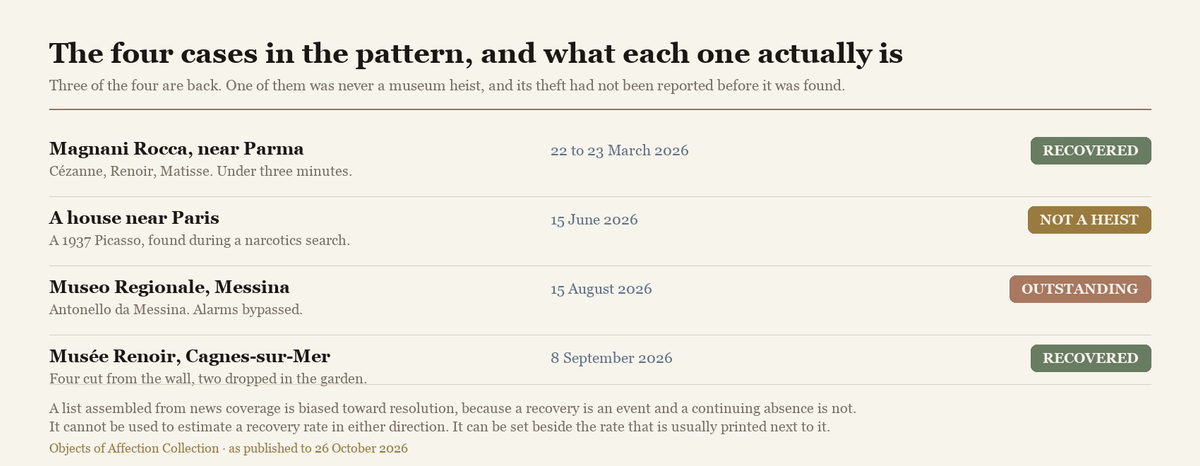
The Magnani Rocca Foundation, near Parma, on the night of 22 to 23 March 2026. A Cézanne, a Renoir and a Matisse, valued together by the Carabinieri at about nine million euros. Police footage shows the works taken in under three minutes. The paintings were recovered in August. Accounts differ on how many people took part, on how many were detained, and on whether the works were found in a storage room or in a cardboard box in a hallway cupboard during a house search. A pickaxe and a fire extinguisher left at the scene had their serial numbers removed, and forensic officers reconstructed them, which is how the investigation reached an address.
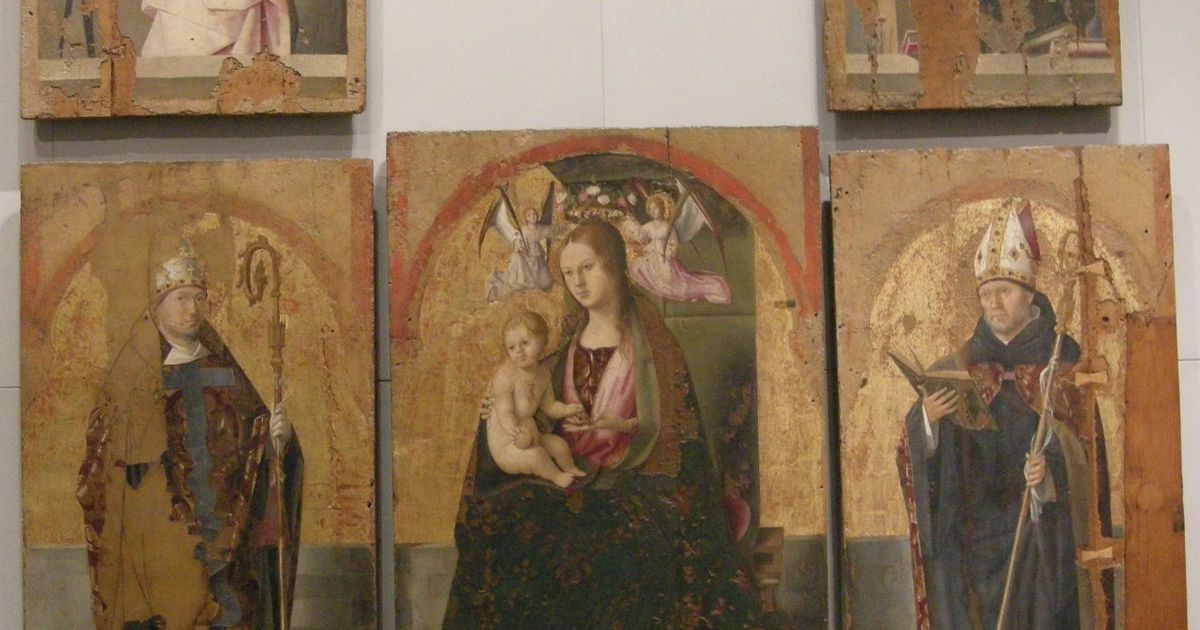
The Museo Regionale di Messina, on the evening of 15 August 2026. Works by Antonello da Messina, taken from the museum of the painter's own city, with the alarm and security systems bypassed. The count is reported two ways: four works taken, three of them panels of the San Gregorio Polyptych of 1473, or five panels taken with two abandoned outside the museum. One expert estimate put the value at seventy to eighty million euros. Investigators have said they are working on the possibility that the theft was commissioned. As of the most recent reporting this seat could locate, the works have not been recovered.
A house near Paris, 15 June 2026. Officers of the narcotics brigade, carrying out a search connected to a drugs investigation, found a canvas believed to be one of Picasso's 1937 portraits of Marie-Thérèse Walter, valued in French reporting at between twelve and fifteen million euros. A former security guard at an art storage firm was arrested and is reported to have said he took it to expose the company's security failures. His lawyer denies the allegations. The case is before the courts and nothing here is a finding of guilt.
The Musée Renoir at Cagnes-sur-Mer, 8 September 2026. Four paintings cut from the wall, two taken and two dropped in the garden, recovered thirty one days later from behind a wall in another region. This institution has published a study on that case.
Read the four together and the first thing to notice is not their similarity.
Three of the four were recovered, and one of them was never a heist
The list is presented as evidence of a crisis of loss. Three of the four objects or sets are back. Parma recovered in August, the Picasso recovered in June, the Cagnes Renoirs recovered in October. Only Messina is outstanding.
That is not evidence that recovery is easy, and this study will not make that argument, because the list is selected by news coverage and a recovery is a news event in a way that a continuing absence is not. A set of cases assembled from headlines is biased toward resolution by construction. It cannot be used to estimate a recovery rate in either direction.
But it does something else. It sits in the same paragraph as the ten per cent claim in almost every retelling, and the two do not survive each other. If a reader is told that only one stolen work in ten comes back, and then given four examples of which three came back, the reader has been handed a rate and a sample that contradict it, with nothing to reconcile them.
And the Picasso does not belong on the list at all.
It was not taken from a museum. There was no forced entry, no masks, no three minute window, no alarm bypassed. According to the reporting it was an insider at a storage facility, and it was found by officers who were looking for drugs. Putting it in a sequence about museum heists requires dropping every feature that makes a heist a heist, and keeping only the fact that a famous name was involved.
That matters beyond tidiness, because the Picasso is the single most informative case in the set, and its information is destroyed by filing it as a heist.
The theft nobody counted
The canvas belonged to a private investor based in Singapore, and its theft had not been publicly reported before the police operation.
Hold that still for a moment. A painting valued in the tens of millions was stolen. It did not appear in the news. It is not clear that it appeared in any public register. Then narcotics officers opened a door for unrelated reasons and there it was.
Every statement of the form "x per cent of stolen art is recovered" requires knowing how much art has been stolen. This case demonstrates, concretely and this year, that the stolen population includes works nobody outside a small circle knows are gone. Private owners do not always report. Storage facilities have reasons not to publicise losses. Insurers settle quietly. And a theft that is never reported is invisible to every database a rate could be built from.
So the denominator is not merely hard to measure. It is a number with a known unknown attached to it, and the size of that unknown cannot be established by the same instruments that missed it in the first place. A register that does not know an object is missing cannot count it as missing, and cannot count it as recovered either.
The Picasso spent some period in both categories at once: stolen, and not stolen as far as the record was concerned. It then moved to recovered without ever having been counted as lost.
This institution has written before that an absence has to be declared to exist in a record. Here is the same principle operating on a national scale, with a consequence: a statistic about absences can only ever describe declared ones.
Where the ten per cent comes from
Having said the number cannot be computed, the honest next step is to ask where it came from, because somebody produced it and it has been in circulation for decades.
This seat went looking for a primary source and did not find one.
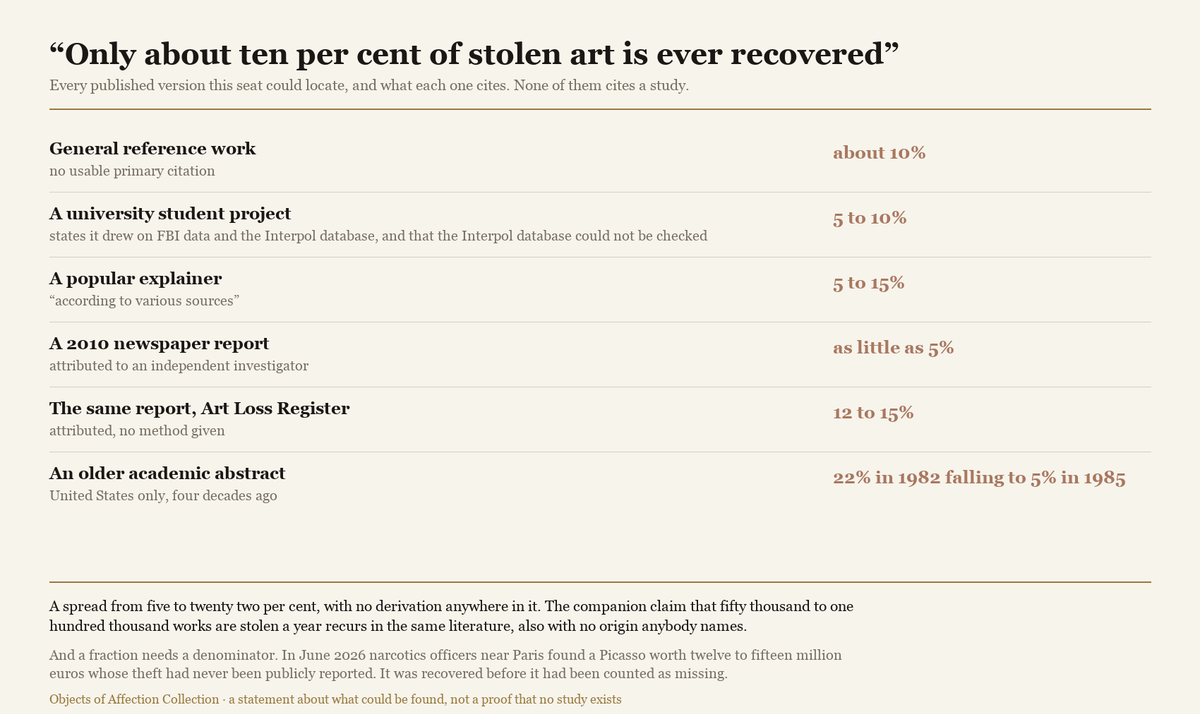
The figure appears as about ten per cent in general reference works and in news coverage. It appears as five to ten per cent in a university student project which states that it drew on FBI data and the Interpol database, while also stating that the Interpol database is not publicly accessible and could not be checked directly. It appears as five to fifteen per cent in a popular explainer. A 2010 newspaper report gave as little as five per cent, attributed to an independent investigator, alongside twelve to fifteen per cent attributed to the Art Loss Register. An older academic abstract reports a United States recovery rate falling from twenty two per cent in 1982 to five per cent in 1985, which is a different country, a different decade and a different measure.
That is a spread from five to twenty two per cent, and none of the sources in it cites a study.
The companion figure has the same shape. The claim that fifty thousand to one hundred thousand works are stolen each year recurs across the same literature, also without an origin anybody names. A range that wide, with no method attached, is not an estimate. It is a placeholder that has been quoted long enough to look like one.
To be exact about what is being said here: this is a statement about what could be found, not a proof that no such study exists. If somebody holds the derivation, it would be a genuinely valuable thing to publish. What can be said is that the number is used as though a derivation existed, by people who do not cite it, and that the one case in this year's set which bears directly on it points the other way.
Three minutes is not a new speed
The pattern is often named by its tempo. A three minute heist at Parma. Under eight minutes at the Louvre. Under three minutes at Cagnes. The speed is presented as a technique that thieves have recently learned.

Anthony Amore, who investigates art theft and is among the most quoted people on this subject, has said that his research shows most thefts take between three and nine minutes.
So three minutes is the fast end of the ordinary range, and has been for as long as anyone has been measuring. A duration that sits inside the long run distribution is not a signature. It is what this crime has always looked like, which makes sense for a simple reason: the constraint on a museum theft is the response time of whoever is coming, and that constraint has not changed.
The Cagnes case shows the arithmetic plainly. The alarm reached the municipal police at 5:48 and officers were on site at 5:53. The response was five minutes. The theft was under three. No new technique is required to beat a five minute response by two minutes, and none was used: a saw through a fence, a forced door, cut fittings.
What the recent cases may genuinely share is not speed but nerve, and that is a different claim, harder to measure and worth stating as the softer thing it is. The Louvre team worked in daylight, half an hour after opening, in high visibility vests. A lawyer quoted in the coverage, Nick O'Donnell, put the inference plainly: if four people could do that to the most famous museum in Europe, the same tactics would plainly work somewhere smaller. That is an inference about perception and it is a reasonable one. It is not a measurement, and the coverage mostly presents it as though it were.
The one country with a fifteen year series recorded a cluster, not a rise
Here is the number that should be at the centre of every account of this year, and it is almost never quoted.
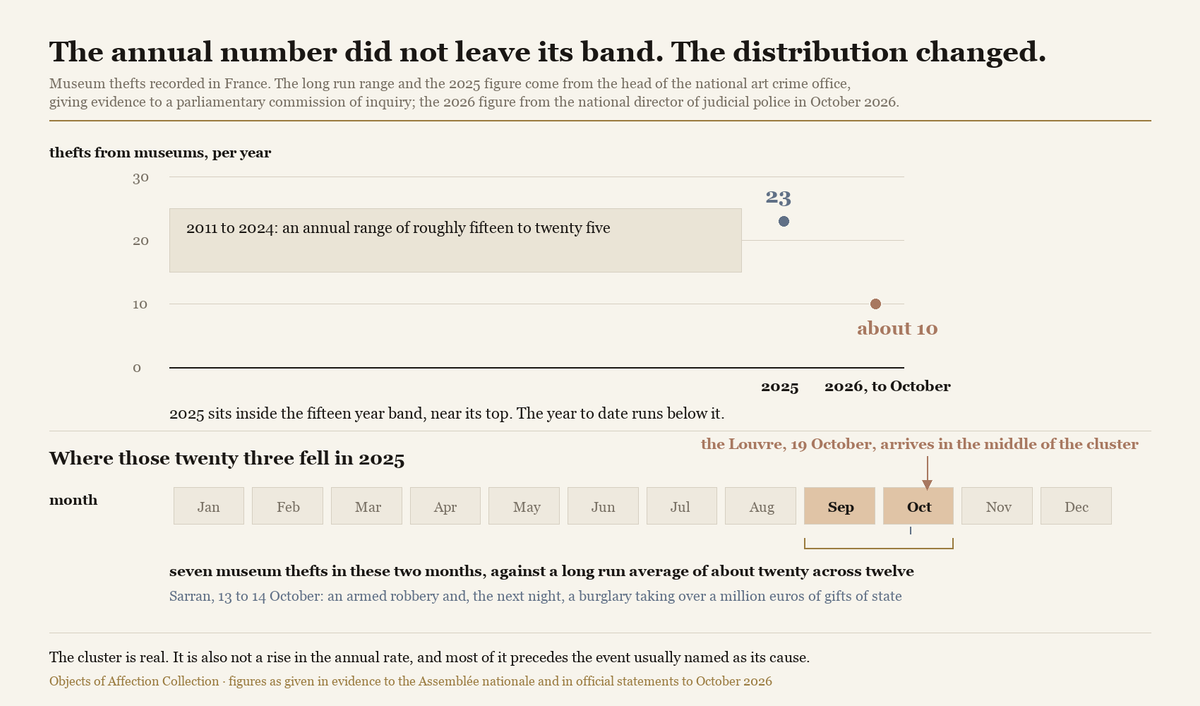
The head of France's central office for the trafficking of cultural goods told a French parliamentary commission of inquiry that museum thefts in France since 2011 have remained modest, in an annual range of roughly fifteen to twenty five, and that the figure for 2025 was twenty three.
Twenty three is inside the band. It is near the top of it, and it is not outside it. On that series, 2025 was a normal year for the number of museum thefts in France.
What was abnormal was their distribution. The same testimony identifies the anomaly precisely: seven museum thefts concentrated in September and October 2025, several committed by groups and one an armed robbery at Sarran. Seven in two months against a long run average of about twenty across twelve.
That is a cluster. A cluster inside a stable annual total is a real and interesting phenomenon, and it is a different phenomenon from an increase. It has different causes, different implications for security spending, and a different test: a rise shows up in the annual figure, a cluster does not.
And the current year goes the other way. France's national director of judicial police said in October 2026 that French museums had recorded about ten thefts so far this year, against twenty three in 2025. Below the band, not above it.
So in the one country that publishes a long series, the sequence is: fifteen years inside a band, a sharp two month cluster in autumn 2025, and a year to date running below the long run average.
The cluster began before the event that is supposed to have caused it
The explanation offered for this year is contagion. Since the Louvre, the argument runs, thieves have understood that a museum can be entered by anyone willing to cover their face and move quickly, and the cases that followed are imitations.
It is a plausible mechanism and the chronology does not support it for the cluster it is usually invoked to explain.
The Louvre heist was on 19 October 2025. The French cluster was September and October 2025. Everything in September preceded it. So did part of October.
The clearest instance is a museum almost nobody writing about this year has mentioned. At Sarran, a village in rural Corrèze, the Musée du Président Jacques Chirac was robbed at gunpoint by four masked men carrying a pump action shotgun, who took cash from the till and at least one collector's watch. The following night, 13 to 14 October, the museum was burgled again, and that second raid took watches and jewels given to Jacques Chirac during his two terms as president, valued by the prosecutor at more than one million euros.
Two raids on consecutive nights at one small rural museum, the first of them armed. It happened six days before the Louvre.
If the Louvre taught thieves that museums are soft, the lesson arrived after four men had already walked into a French museum with a shotgun and come back the next night for the collection. A cause has to precede its effect, and for most of the cluster this one does not.
What can honestly be said is narrower and still worth saying. The Louvre may well have influenced what came after it, and the cases from November onward are not excluded by this. The Cagnes theft in September 2026 is eleven months later and nothing here rules out influence. But the autumn 2025 cluster, which is the specific thing the French data identifies as anomalous, cannot have been caused by an event that happened in the middle of it.
The copycat claim is also doing something subtler that is worth naming. It explains a pattern by reference to the most famous case in it, which guarantees that the explanation will always feel confirmed, because the famous case is the one every subsequent account begins from. A hypothesis that selects its own evidence is not testable, and this one became the standard framing without anybody checking a calendar.
The museum that has been robbed four times is not in the story
Sarran deserves more than a date in somebody else's argument.
The museum holds the gifts of state given to a French president, which is a collection of a particular kind: objects whose entire meaning is who gave them to whom, and whose materials happen also to be gold and gemstones. It is in a commune of a few hundred people.
It was burgled in 2011, when a gold falcon set with diamonds, a gift from Saudi Arabia, was taken. It has never been recovered. It was robbed at gunpoint in October 2025 and burgled again the next night. It was burgled again on the night of 5 to 6 August 2026, when the objects taken included a Zinédine Zidane shirt worn in the 1998 World Cup final and a replica of the trophy. The investigation opened in October 2025 is still running.
Four incidents at one small museum across fifteen years, one of them armed, one of them unresolved since 2011. Nothing about it is a heist in the sense the coverage means. There is no celebrated painter, no eight figure estimate, no gallery with a painted ceiling. What there is, is a sustained demonstration that the burden of preservation falls on a building holding a million euros of gold in a village which cannot carry it, which is a more useful fact about the state of museum security than anything the famous cases establish.
It is absent from the story because the story is organised by the fame of the objects, and the objects at Sarran are famous only to the people who gave and received them. The falcon has been missing for fifteen years and appears in no account of a recovery rate.
France cut its culture budget by 150 million euros for 2025 and its heritage funding by 200 million, and announced a museum security fund of 30 million euros in July 2026. Those figures belong next to Sarran rather than next to the Louvre. The Louvre has a renovation programme in the hundreds of millions and a new director appointed to fix its security. Sarran has a prosecutor and a fourth investigation.
Italy's numbers move in the other direction, and they are not the same measure
Italy publishes too, through the Carabinieri command for the protection of cultural heritage, and its figures do show an increase. The 2025 report records 307 art thefts, against 274 the previous year. That is a rise of about twelve per cent in a single year.
It would be wrong to put the French and Italian figures in one sentence as though they were comparable, and that is exactly what a summary of this subject would do. France's twenty three counts thefts from museums. Italy's 307 counts art thefts, across museums, churches, private collections and archaeological sites, and the same report describes 307 as criminal events in one account and as thefts in another. The Italian total is an order of magnitude larger because it is measuring a much larger thing.
They can both be reported. They cannot be added, averaged, or read as a single European trend, and no European series exists that would let anybody do that properly.
The Italian report carries one more figure worth holding against the ten per cent claim: 84,527 cultural goods recovered in 2025. That number cannot be divided by 307 to produce a recovery rate, because objects and events are not the same unit and the recoveries include seizures from illegal excavation and trafficking that were never part of a reported theft. It is a large number attached to a different question, and it illustrates the problem rather than solving it: the two quantities a recovery rate needs are, in the one country that publishes both, not in commensurable units.
Everybody quoted saying it is rising is offering an opinion, and several of them say so
Read the major coverage of this year with one question in mind, which is what evidence each claim of an increase rests on.
Amore says the uptick is hard to deny and that successful heists of works by major names have been spiking over the past eleven months. No count accompanies it. Christopher Marinello of Art Recovery International describes a four minute heist trend and links it to weak security and budget cuts: an observation from long experience. O'Donnell offers the perception argument. Medea Ekner of the International Council of Museums says the threat is growing and notes that a sector wide survey is under way, which is a precise and honest statement of the position: the data that would settle this is currently being collected and does not yet exist.
These are informed people and their judgment is worth something. The problem is not that they are speaking without data. It is that their judgment is relayed as though it were data, and the resulting sentences in general coverage read as findings when the people quoted were careful to frame them as impressions.
Europol reported in August that thieves are increasingly focusing on precious metals, gemstones and culturally significant artefacts. The coverage carrying that reported no figures from it.
This institution has just made the same error in the opposite direction and should say so. Two studies published earlier the same day asserted a pattern about how art crime is reported, and when the method behind the assertion was finally tested, most of it dissolved. The correction is on those pages. The relevant lesson here is the one that produced it: a pattern you can see is not a rate you have measured, and the gap between them is where this subject's entire public numeracy currently sits.
What stolen art is used for, and how much of that is known
The last claim in the sequence is that stolen art is often resold, or used by criminals as collateral for loans.
The collateral idea is widely repeated and the specific examples given are striking: a painting changing hands in a heroin deal, works accepted as security by a diamond dealer. In the one policy publication this seat found that treats the idea seriously, the framing of stolen art as collateral, leverage and currency inside the criminal economy is attributed to a single named researcher.
No quantification of it was located. How often it happens, what proportion of stolen works end up used this way, and how much credit is actually extended against them are not figures anybody appears to publish. There is a separate and well documented body of prosecutions involving art used fraudulently as loan collateral, but the cases found here involve counterfeit works rather than stolen ones, which is a different offence supporting a different claim.
So the word to watch is often. It is doing the work of a measurement in a sentence that contains none, in exactly the way about ten per cent does three sentences earlier.
The resale half is on firmer ground in one specific sense, and the Picasso case is again the evidence: it was found in a house connected to a drugs investigation, which is the kind of adjacency the claim describes. One case is not a rate either. It is a demonstration that the mechanism exists.
What is actually observable
Strip out every rate and what remains is a set of things that can be seen directly, and some of them are more interesting than the statistics.
The thieves keep dropping things. The Crown of the Empress Eugénie was dropped during the escape from the Louvre and recovered. Two of the four Renoirs at Cagnes were abandoned in the garden, still in their protective covers, and the DNA on one of those covers identified a suspect. At Messina, one account has five panels taken and two left outside the museum. In three separate cases this year, part of the haul did not leave the building or its grounds, and in at least one of them the dropped portion is what solved the case.
Forensic work on discarded tools is doing more than any register. At Parma the serial numbers on an abandoned pickaxe and fire extinguisher had been removed and were reconstructed, which produced an address. At Cagnes a protective cover produced a DNA profile that matched a man already under surveillance for unrelated reasons.
Recovery, where it happened, came from police work on people rather than from anything about the objects. That is the finding of this institution's Cagnes study and it holds across the set: a drugs search, a vehicle already tracked, reconstructed serial numbers.
None of those observations requires a denominator. Each of them is a fact about specific cases, available to anybody willing to read the case reports instead of the summary.
What would have to exist
A recovery rate for stolen art would require three things that do not currently exist together anywhere: a register that records thefts including unreported ones, which is a contradiction unless reporting becomes mandatory and enforced; a common unit, so that objects and events and incidents are not silently mixed; and a shared definition of recovery, so that a work returned damaged, a work seized in a trafficking case and a work recovered before anybody reported it missing are counted in a way somebody could explain.
Italy publishes real numbers in one unit. France publishes real numbers in another. Interpol maintains a database which is not publicly queryable, so the figures circulating as though derived from it cannot be checked against it by the people quoting them. The International Council of Museums is running a survey now.
Until some of that exists, the honest sentence about recovery is not a percentage. It is: a meaningful proportion of stolen works are recovered, often years later, usually through police work unrelated to the art market, and nobody can currently tell you what that proportion is.
That is less satisfying than ten per cent and it has the advantage of being supportable. It is also the sentence a record built to last would have to be able to produce, and at present no record anywhere can.
And the strongest single argument for saying it that way was found by narcotics officers in a house outside Paris in June, hanging in a room, belonging to someone on the other side of the world, counted by nobody.