Two Walls Were Built to Hold Them: The Renoir Theft, and the Month That Only a Confession Records
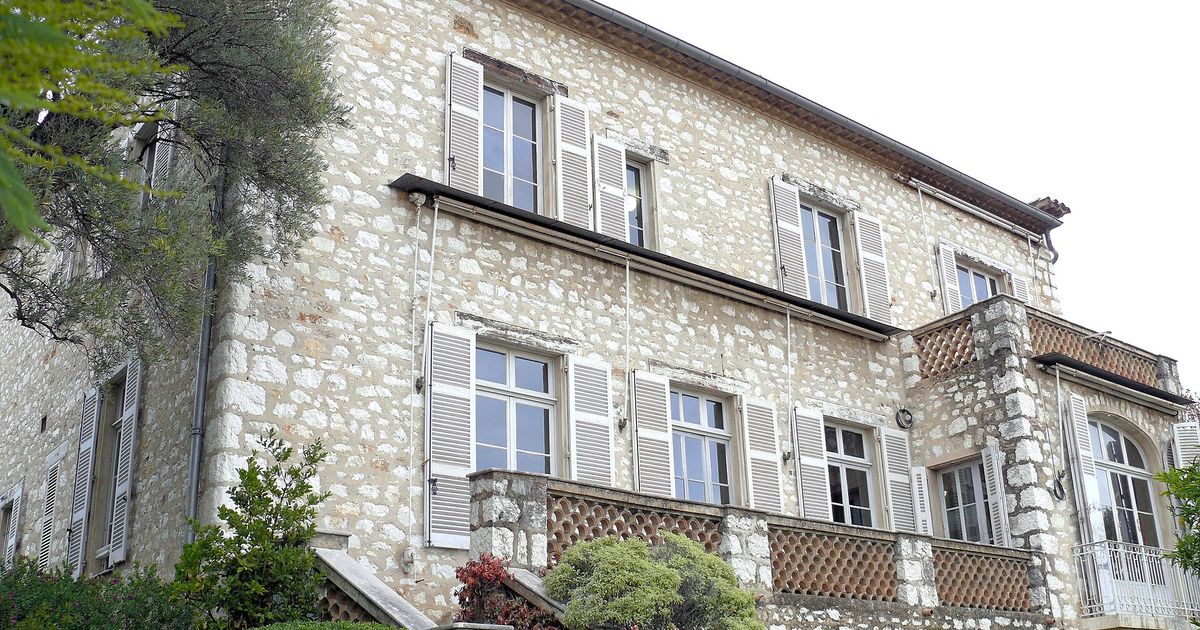
Two paintings spent thirty one years sealed into the wall of the house where Renoir died. Then they spent a month sealed into a wall of breeze blocks and plasterboard four hundred kilometres away. Both walls were built to hold them. Only one of them is written down anywhere, and it is the wrong one.
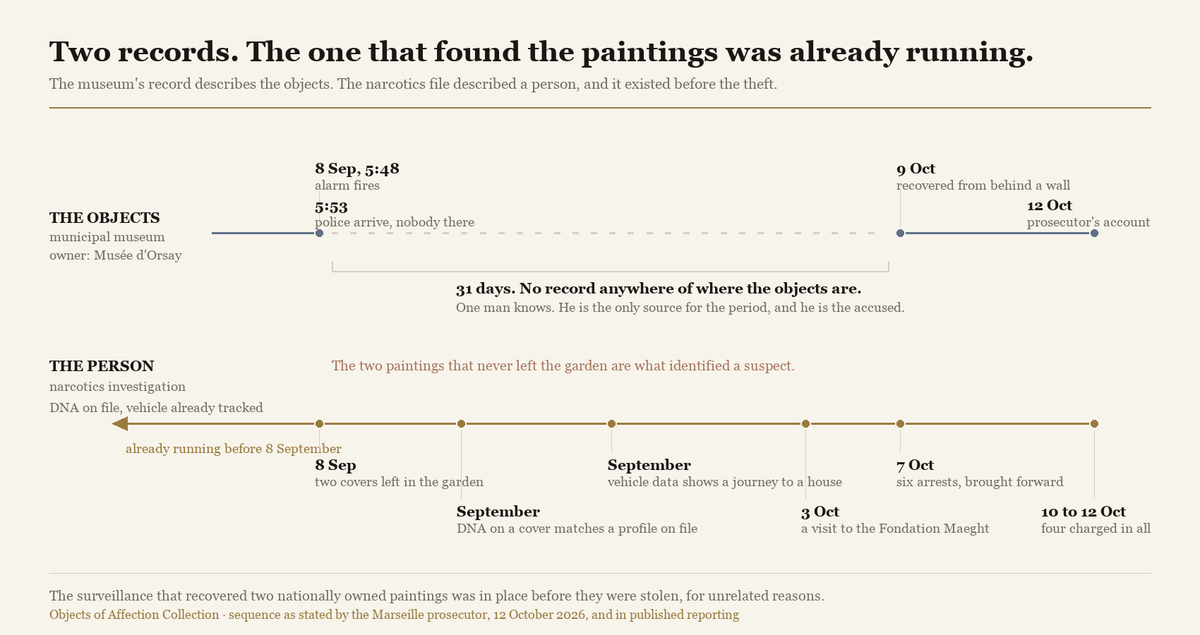
On the morning of 8 September 2026, two masked people cut a section of metal fencing at the Domaine des Collettes in Cagnes-sur-Mer with a saw, forced a glazed door, and sawed through the hanging fittings of four paintings by Pierre-Auguste Renoir. The alarm reached the municipal police at 5:48. Officers arrived at 5:53. By then the intruders had gone through the garden, and two of the four canvases were lying in it.
The two that left the garden were recovered on 9 October, behind a wall that had been built after the theft for the purpose of holding them. Six people were taken into custody. Four were charged. Two were released without charge.
That is a closed case, or close to it, and this institution has nothing to add to the police work, which was fast and which worked. What it has is a question about the paperwork, and the paperwork is where this gets strange.
The objects were recovered by a record that was never about them. Nothing in the documentation of these four paintings contributed to finding them. What found them was a DNA profile already on file, a vehicle already under surveillance for an unrelated narcotics investigation, and a statement from a man who told investigators where he had put them. The provenance apparatus that surrounds a national collection did not participate in its own recovery.
And the month the paintings spent inside that second wall, which is the only period in their recorded existence when nobody legitimate knew where they were, is documented by exactly one source: the account of the person accused of hiding them.
What is actually on the record
The four works were Renoir oils hanging in one room of a municipal museum installed in the painter's last house. According to the Marseille prosecutor, they were the four highest values in the building. The museum holds twelve Renoir paintings in total.
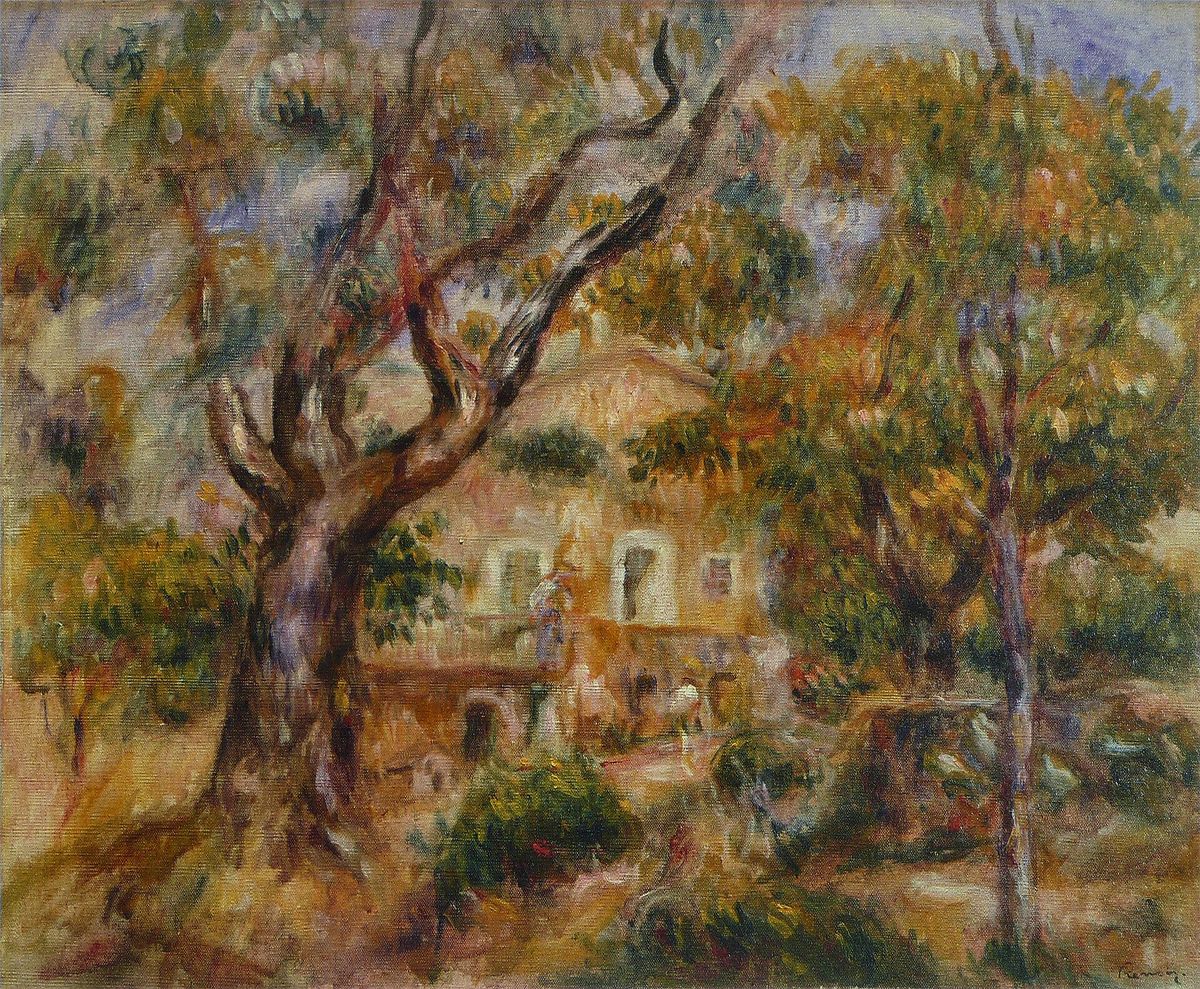
Jeune femme au puits (1886) and the Portrait de Madame Colonna Romano left with the thieves. Portrait de Madame Stephen Pichon (1895) and Coco lisant (1905) did not. They were found in the museum garden, still inside the protective covers the intruders had put them in.
Six people were detained on 7 October across four French departments: Alpes-Maritimes, Var, Hérault and Doubs. Five men and one woman. The operation ran through the Nice judicial police and the Office central de lutte contre le trafic des biens culturels, France's dedicated art crime office. A specialised interregional jurisdiction took the case, which is why a Marseille prosecutor speaks for a theft in Cagnes.
Two men were charged with theft committed by an organised gang and criminal association, and held. Two more were charged with handling stolen goods, released under judicial supervision and barred from leaving France. One of those two is accused of hiding the paintings. The other is accused of having been approached about buying them.
The works went to the Centre interdisciplinaire de conservation et de restauration du patrimoine in Marseille for examination and possible restoration.
Everything in the three paragraphs above is attributed, dated and multiply sourced. Almost nothing else about this event is.
Two minutes, three minutes, and a correction
This section originally argued that the timeline of the theft could not be agreed. That was wrong, and the error is instructive enough to leave here with its correction attached rather than quietly repair.
The prosecutor, Nicolas Bessone, told a press conference on 12 October that the theft took less than two minutes. Other accounts put it at less than three. The alarm is logged at 5:48 in one account and 5:49 in another, the police response at four minutes in some reporting and five in others, and a municipal arrival time of 5:53 appears in the earliest coverage.
The first version of this study presented those as a record failing to converge. They are not in conflict and one pair cannot be. If the theft took under two minutes then it also took under three: one statement is simply looser than the other, and a looser true statement does not contradict a tighter one. The alarm and response figures resolve the same way, because 5:48 plus five minutes and 5:49 plus four minutes both put the police on site at 5:53, which is exactly what the earliest reporting says.
So the timeline agrees with itself. What varies is how tightly different retellings state it.
The alarm, incidentally, worked. It fired within seconds, it reached the right people, and the right people arrived in four or five minutes. Bessone said the speed of the response apparently caused the intruders to panic, which is how two of the four paintings ended up in the grass. So the control functioned exactly as designed, the response beat its own target, and the theft was over before anyone could arrive. A control can fire correctly and still be slower than the thing it is pointed at. This institution has written that sentence about software more than once. It is unsettling to find it holding literally, in a garden, with a Renoir in it.
The paintings that did not get away are what caught the people who took the ones that did
The two canvases abandoned in the garden were still in their covers. DNA recovered from one of those covers matched a twenty nine year old man already known to police.
Read that again with the object in mind. The thieves wrapped four paintings in protective covers, which is a thing you do to keep a painting from being damaged. They dropped two of the wrapped paintings while running. The wrapping is what identified them.
So the recovery of the two works that were successfully stolen was accomplished by the two works that were not. The failed half of the theft solved the successful half, and it did so through the single component of the whole operation whose purpose was to take care of the objects.
This is the sharpest version of a thing OAC keeps finding in less dramatic settings. The documentation that travels with an object, the packing, the condition note, the shipping label, the protective sleeve, is treated institutionally as overhead. It is the part of the job that gets cut when the budget is cut and skipped when the clock is short. And it is repeatedly the part that turns out to carry the evidence. The custody apparatus is not a wrapper around the record. On the morning of 8 September, in a garden in Cagnes-sur-Mer, the custody apparatus was the record. Nothing about the painting identified anybody. The cover did.
The record that found them was already running, and it was about a person
Here is the fact that should change how anyone in this field talks about what provenance documentation is for.
The DNA match led to a man who was, at the time of the museum theft, already the subject of a narcotics investigation. In the course of that investigation, police were already tracking his vehicle. That tracking data showed that shortly after the theft he travelled, with a forty one year old man, to the home of a third man. The paintings were recovered from that home.
The surveillance that recovered two national paintings was in place before they were stolen, for reasons that had nothing to do with art, and would have existed if the museum had never been built.
Set the two chains of custody side by side. The paintings had a complete, continuous, institutionally maintained record: a national museum's inventory, an accession number, a deposit agreement, a location, a condition history, a hanging system. The suspect had a record too: a DNA profile, a vehicle under observation, a case file. When the two records met, the one about the person did all the work and the one about the objects did none of it.
That is not a criticism of the museum's records, which were presumably in good order. It is a statement about what a provenance record is and is not, and this institution would rather say it plainly than be sold past it. A provenance record is a history. It is not a locating device, it is not a security system, and it is not an instrument of recovery. It says what an object is and who has held it. It does not say where the object is right now, and nothing in its grammar is designed to.
Anyone offering a custody record as theft protection is overselling. OAC takes no view on authentication and does not value objects, and it should be equally explicit about this: the record we argue for would not have found these paintings. A vehicle tracker found these paintings.
What the record is for is the next question, and it is the one this case answers badly.
The second wall
At the house where the paintings were recovered, in Clermont-l'Hérault in the Hérault, roughly four hundred kilometres from the museum, the two Renoirs were found behind a wall that had been constructed after the theft specifically to contain them. Eric Antonetti, who heads the regional judicial police service for the Alpes-Maritimes, described it as breeze blocks and plasterboard.
Where in the house differs by source. The account given at the press conference places the wall in a laundry room. The account attributed to the accused man himself, reported through the Associated Press wire, places it beneath a staircase. Both agree on the essential fact, which is that somebody built masonry around two paintings and then lived in the house with them inside the wall for about a month.
Consider what that month looks like described in the vocabulary of custody rather than the vocabulary of crime.
There was a holder, and the holder knew precisely where the objects were. There was a purpose built housing, constructed for these two objects and no others. There was an enclosure that controlled light absolutely and controlled dust and handling almost as well. There was continuous possession with no transfer. For thirty one days, two paintings owned by a national museum had a custodian, an address, a structure raised around them, and a single unbroken chain of physical control.
Every one of those is a thing a provenance record exists to capture. Not one of them was captured.
And the works came out damaged. Madame Colonna Romano has a visible tear in the canvas. Jeune femme au puits has damage at the frame. Early reporting on 9 and 10 October, before the works reached the conservation centre, carried a line sourced to TF1 that they were in good condition. The expert assessment that followed is the account to use, and the earlier one should be read as what it was, a first impression superseded by an examination, rather than as a contradiction.
The damage is the part that makes the wall worth dwelling on. The objects were not neglected during that month. Somebody took trouble over them. Breeze blocks and plasterboard are work. The man accused of building it had every incentive to keep two paintings intact, because a damaged Renoir is worth less to whoever he hoped would take them. Care was applied, and the objects were harmed anyway, and the harm is unattributable because no record of the period exists.
Nobody can now say whether the tear happened when the fittings were sawed, in the garden, in a car, going into the wall, inside it, or coming out. The conservation report will describe the damage. It cannot date it. A month of continuous custody by a single known holder produced no documentary trace whatsoever, and so a specific, visible, physical injury to a national painting has no establishable moment.
That is what a missing custody record costs, stated as narrowly and concretely as this institution can state it. Not an abstraction about transparency. One tear, and no way to say when.
The museum that lost them did not own them
This is the fact that is absent from the English language coverage almost without exception, and it reorganises the whole case.
The paintings belong to the Musée d'Orsay. They had been on deposit at the municipal museum in Cagnes-sur-Mer since 1995. Orsay filed its own criminal complaint after the theft, as the owner. The scientific responsibility for the examination and any restoration sits with Orsay, which is why the works went to a national conservation centre in Marseille rather than back to Cagnes.
So the custody chain on 8 September 2026 reads: national collection, deposited for thirty one years into a municipal museum, housed in the private home of the artist who made the paintings, secured by a municipality, stolen, held by a private individual in another region, recovered by a police service, and delivered to a national laboratory. Seven positions. The owner of record was never in the building.
The mayor of Cagnes-sur-Mer, Bryan Masson, said the paintings were part of the city's history, and in every sense that matters to the people of Cagnes he is right. They hung in Renoir's house for three decades. They are also, in law and in the inventory, somebody else's property, and the municipality that carried the cost of guarding them is not the institution that holds title to them. Masson has said publicly that municipalities cannot carry rising museum security costs alone and has asked for state support.
This institution takes no position on who should pay. It does have a position on what the structure is, because the structure is a custody question and custody is the subject here. A deposit is a Custodian's Contract in everything but name: it hands over the burden of preservation without handing over the title, and it leaves the two in different buildings in different cities for three decades. A deposit transfers possession and the duty of care without transferring ownership, and it therefore separates the party bearing the risk from the party holding the asset. That separation is ordinary, legal, documented and extremely common. Museums run on it. It is also precisely the kind of arrangement that a provenance record is good at and a news report is bad at, which is why the deposit appears in the French trade press, in one franceinfo headline about Orsay filing its complaint, and essentially nowhere in the international coverage that reached most readers.
For a month, the reading public in much of the world understood this as a theft from a small museum on the Riviera. It was a theft of national property from a small municipal museum on the Riviera, and the distinction governs who insures, who restores, who decides whether the works go back, and who answers for the security that failed. A record carries that. A story drops it.
What this study got wrong about the record
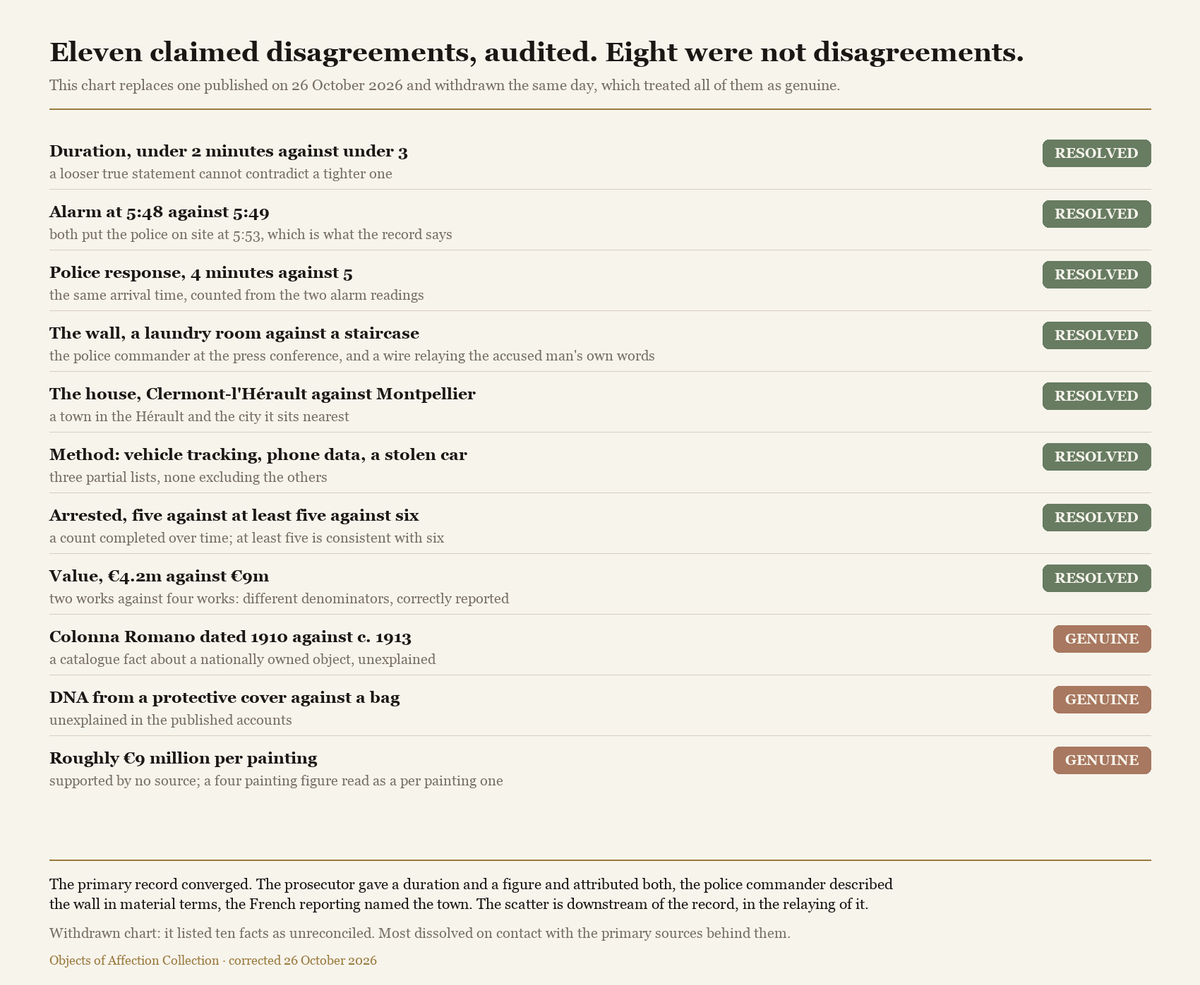
This section replaces one published on 26 October 2026 and withdrawn the same day. The original listed ten facts about this case reported more than one way, presented them as a record that would not converge, and carried a chart to that effect. The chart has been withdrawn and the claim does not hold.
The correction came out of a second study, on the theft of the French Crown Jewels from the Louvre, where the same exercise produced the same apparent pattern. Being asked to test the method before publishing that one is what produced this.
Tested row by row against primary statements rather than against coverage, most of the ten were not disagreements at all.
The duration and the response times resolve arithmetically, as set out above.
The place in the house is reported as a laundry room by the police commander at the press conference and as a space beneath a staircase in a wire account relaying the accused man's own words to investigators. Those are two sources describing one hiding place, one of them a suspect, not a record contradicting itself.
The town is Clermont-l'Hérault in the French reporting and Montpellier in some wires. Clermont-l'Hérault is in the Hérault and Montpellier is its nearest city. A town and the city it sits near are not two claims.
The investigative methods, given as DNA plus vehicle tracking in one account, DNA plus telephone geolocation plus video in another, and DNA plus a stolen car in a third, are partial lists. No two of them exclude each other.
The arrest count of five, at least five, and six is a count completed over time, and "at least five" is consistent with six rather than opposed to it.
What survives is small. The date of the Portrait de Madame Colonna Romano is given as 1910 and as about 1913, and that is a catalogue fact about a nationally owned object rather than an estimate, so it is a genuine unexplained difference. The object the DNA came from is described as a protective cover in most accounts and a bag in at least one. And the per painting valuation in parts of the English coverage, dealt with below, is an error rather than a difference of framing.
The honest finding is the opposite of the one originally published, and it is more useful. The primary record in this case converged. The prosecutor gave a duration and a figure and attributed both. The police commander described the wall in material terms. The French reporting named the town. The scatter is downstream of the record, in the relaying of it, and it happens by a few repeatable moves: a partial list read as a rival claim, a dropped denominator, a town swapped for its nearest city, a precise sentence retold loosely, and a looser statement set against a tighter one as though they disagreed.
An institution that publishes about records should be able to tell those apart, and on 26 October 2026 this one could not. The cost of being wrong here was a chart and a section. The cost of not checking would have been a claim about an entire field, built on rows that dissolve when you read the primary sources behind them.
What the money figures were measuring
Four numbers circulated for this theft.
€4.2 million is the prosecutor's figure, given at the press conference, for the two works that were taken.
€9 million circulated worldwide from the first day as the loss. Its source is Caroline d'Amat, the deputy mayor for culture, heritage and patronage, speaking on the day of the theft, and the franceinfo report that carried it describes it as her estimate for the four paintings. The same reporting does not record a formal valuation having been performed.
Roughly €9 million each, which is to say something near €36 million for the four, appears in major English language coverage, apparently by reading the four painting figure as a per painting figure.
$4.7 million is the dollar conversion of the prosecutor's €4.2 million, and it reached headlines as the size of the heist, which it is not, because it covers two of the four works.
Two of those are not in conflict and the third is simply wrong. The 4.2 million covers the two works that were taken and the 9 million covered all four, so they are different denominators correctly reported, and an earlier version of this study wrongly presented them as a spread. The per painting reading, which produces something near 36 million euros for the four, is supported by no source and is the one genuine error in the set.
But the most useful figure in the entire coverage is one that almost nobody repeated. In the same early France 3 report that carried the deputy mayor's €9 million, Agathe Voisin, an auctioneer in Nice, said the loss was difficult to estimate at all, because an artwork's value depends on being able to resell it, and that a stolen work is worth something like a tenth of what it might fetch at auction.
That observation dismantles every other number on the page. The €4.2 million and the €9 million are valuations of resaleable paintings. From 5:48 on 8 September until 9 October, these were not resaleable paintings. They were two of the most instantly recognisable stolen objects in Europe, photographed in every newspaper, logged with the OCBC, and unsellable through any legitimate channel at any price. Their market value during that month was not €4.2 million discounted. It was close to nothing, and that is why the accused fourth man is charged over an approach rather than a transaction.
This institution does not appraise and will not put a figure on these works. What it will say is structural, and it has been the subject of earlier work on how a record and a price move together: the thing being valued in an art market number is almost never the object alone. It is the object plus the documentation that makes it sellable. Strip the documentation, which is exactly what theft does, and the object survives intact while nearly all of the number evaporates. Four canvases went over a fence in under three minutes and lost most of their stated worth in the act, not because anything happened to the paint, but because they left their record behind.
The paint was in the garden and in a wall. The value was in a file in Paris.
The arrest date was chosen by a crime that did not happen
The last element of the official account is the one most often reported as a flourish, and it is the one with the most consequence for how to read everything above.
Bessone said the arrests were made when they were because of a very strong suspicion that another theft was imminent. Investigators believed the two principal suspects were preparing to target the Fondation Maeght at Saint Paul de Vence, about ten kilometres from Cagnes, and the French reporting of the press conference names Giacometti sculptures as the objective. The prosecutor noted that the principal suspect had visited the Maeght on 3 October. Asked about that visit, Bessone said he did not believe it was made simply out of a love of art.
Two things must be kept apart here, and the wire services were more careful about it than the headlines were.
The visit on 3 October is a recorded event. The purpose of the visit is an inference from it. The Associated Press account reports the visit and declines to call the Maeght the target. The press conference coverage reports the target. Those are not the same claim, and the second is not a stronger version of the first, it is a different kind of statement. The suspects deny having planned a second theft. The prosecutor disputes the denial. No charge relating to the Maeght has been reported, nothing was taken from it, and every person involved is accused and not convicted.
With that fence in place, the consequence stands regardless of who is right. The recovery date of two nationally owned paintings was set by a risk assessment about a different building. The investigation did not conclude and then act. It acted early, on a judgment about what might happen next, and the paintings came out of the wall on 9 October as a byproduct of that judgment.
Which means the single most important date in these objects' recent provenance, the day their custody returned to a lawful holder, is an artifact of an unrelated and contested forecast. If the Maeght suspicion had not arisen, the arrests happen later, and the paintings stay in the wall longer, and the tear in Madame Colonna Romano ages a few more weeks before anyone sees it.
A provenance entry will eventually record that date. It will not record why the date is that date, and the reason is not in the painting, not in the museum, and not in the file.
What is left
Two paintings owned by a national museum, deposited for thirty one years in the house where the artist died, sealed into one wall by an institution and then into another by a private individual, recovered through a drug squad's vehicle log and the DNA on the wrapping of two paintings that never left the garden, damaged at an unknowable moment during a month that only a confession describes, carrying public valuations that were widely misreported by multiplying a four painting figure by four, and returned to lawful custody on a date chosen by a crime that was never committed.
Christian Sainte, France's national director of judicial police, put the context at the same press conference: French museums recorded twenty three thefts in 2025 and about ten so far in 2026. This was one of them, and it is the one that was solved quickly and solved well.
OAC's interest is narrower than the crime and longer than the news cycle. The register this institution argues for would not have stopped the fence being cut, and it is important to say so rather than let a security claim attach itself to a documentation argument. What it would have done is make the month legible. The failure here is not that two paintings were stolen. Museums are robbed, and this one got them back in thirty one days, which is remarkable. The failure is that thirty one days of continuous physical custody of national property, by a single identified holder, in a known house, inside a structure built for the purpose, produced one visible tear in a canvas and no record at all of when it happened.
The man who built the wall is the only existing custodian of that month. The institution that owns the paintings has nothing from it. Custody happened. Stewardship did not, and the difference between them is a document.
Everything in this study is attributed below, including the ten places where the record disagrees with itself. Where two accounts conflict and no basis exists for preferring one, both are recorded as reported rather than reconciled, because a reconciliation this institution performed on its own authority would be the least reliable sentence on the page.