The Weighing Was the Cataloguing: The Segou Treasure and a Law That Runs on Records Nobody Has Funded
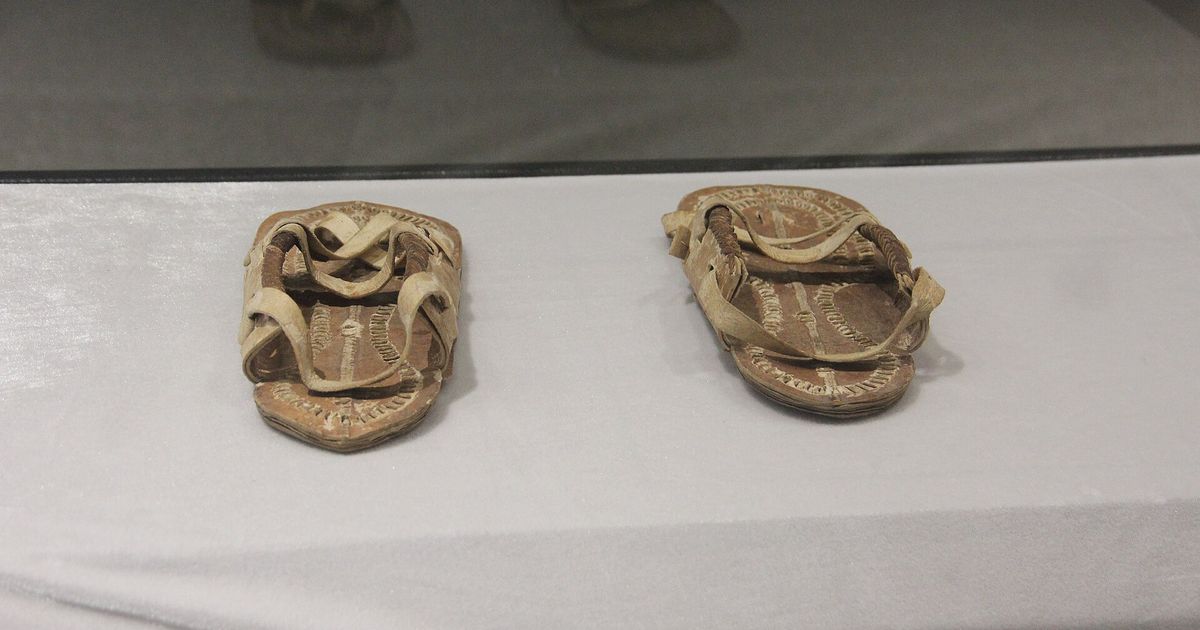
A library assembled over forty nine years left Ségou in four crates, and the figure that survives in the record is its weight. Five hundred and eighty five kilos of books. France has now passed a law that could send it back, and the law runs on an inventory nobody has funded.
The curator of Arabic and Persian manuscripts at the Bibliothèque nationale de France, Khalid Chakor-Alami, gave the figure to Le Monde in August 2026: Archinard shipped 585 kilos d'ouvrages dans quatre caisses, 585 kilos of works in four crates. They reached the Bibliothèque nationale in 1892.
That is how the most important surviving library of nineteenth century West African scholarship entered a European collection: weighed. Not listed, not catalogued, not described. A mass and a container count, which is how you record freight.
This institution takes no view on whether the Ségou Treasure should return to Mali, to Senegal, or remain in France. We do not hold positions on origin, export, return or restitution, and nothing below argues for any party. What follows is about the record: what the collection is, how it was counted, what a new French law requires, and which of its requirements the record cannot presently meet.
What Was Taken, and From Whom
On 6 April 1890, during the French conquest of what was then called the Soudan français, a column under Colonel Louis Archinard entered Ségou, in present day Mali, and took possession of the residence of Ahmadou Tall.
A detail that most summaries lose: Ahmadou was not there. He had left the city. And the palace was his, the reigning son's, not the father's. The treasure is habitually described as belonging to El Hadj Omar Saïdou Tall, the scholar and military leader who founded the Toucouleur state and died in 1864. It is more precisely a collection that began around 1841 under El Hadj Omar Tall and was added to by his son Ahmadou until the day it was seized.
That matters for the library in particular, because it means the thing taken was not a static inheritance. It was a working collection still being added to, which is to say a record of a continuing intellectual life rather than a relic of a finished one. The burden of preservation it carried was an obligation to keep adding, and that obligation ended on a Sunday morning in April.
Books were taken, along with jewellery, a Qur'an case, weapons and other valuables.
Nobody Can Give a Single Number for It
The collection's size is usually given as nearly five hundred manuscripts. The precise position is more interesting and it is a counting problem of exactly the kind this institution keeps finding in disputed collections.
The BnF's own catalogue notice attaches 518 recueils, compiled volumes, to the Ségou library. Of those, 491 form a consecutive series, shelfmarks 5259 to 5749.
So the familiar figure of about 491 is the consecutive run, and 518 is the total the catalogue associates with Ségou. Neither is wrong. They answer different questions, and anybody quoting one without saying which has made a choice without announcing it. This is the same shape as the dispute over how many Parthenon sculptures sit in London, where two governments count the same objects against different denominators and both are correct.
And the manuscripts are only part of it. The material is dispersed across at least four French institutions. Most of the books are at the Bibliothèque nationale de France, where digitisation is under way and researchers can consult them. The other objects, the jewellery, the Qur'an case and the weapons, are held between the musée du quai Branly Jacques Chirac, the Muséum du Havre and the musée de l'Armée.
Four institutions, two ministries' worth of governance, and one seizure. Which is why the first thing anybody needs is not an argument. It is a list, and the absence of that list is the operative fact in everything that follows.
Where the Policy Came From
None of this begins with the 2026 statute. It begins with a speech and a commissioned report, and the report's own framing is worth recovering because the law is the answer to a question it posed.
On 28 November 2017, at the University of Ouagadougou, President Macron said that within five years the conditions should be met for the temporary or permanent return of African heritage. In March 2018 he commissioned the Senegalese economist Felwine Sarr and the French art historian Bénédicte Savoy to report. They delivered it at the Élysée on 23 November 2018.
The report recommended that France put in place legal mechanisms allowing the final and unconditional return of heritage objects to the African continent. It advised starting with objects of largely symbolic weight, naming the Abomey treasures taken by the French military in 1892. It addressed provenance research and international cooperation, and it suggested that museums could replace returned objects with replicas.
It also attracted an objection that has shadowed the subject ever since: that institutions receiving returns might not be able to conserve them. That objection appears nowhere in the 2026 statute in those words, but the law's reliance on documented trajectories and formal process is the architecture that an administration builds when it intends to answer that objection with paperwork.
The Law That Changed the Procedure
On 9 May 2026, France promulgated loi n° 2026-351, on the restitution of cultural property that has been the object of illicit appropriation. It was published in the Journal officiel the following day and had been adopted unanimously by the Senate on 28 January 2026.
It is genuinely a change of method. Until now, every single return required its own act of Parliament, because objects in French public collections are inalienable and only the legislature can remove them from the public domain. That is why the 26 objects returned to Benin and the sabre sent to Senegal each needed a dedicated statute in December 2020. The new law inserts a standing framework into the code du patrimoine, articles L. 115-10 to L. 115-16, so that a return can proceed by decree rather than by legislation.
The machinery is built out of documents. A request triggers a scientific committee formed jointly with the requesting State, whose job is to document the trajectory of the objects. Its conclusions, together with a public and reasoned opinion from a national restitution commission attached to the Haut Conseil des musees de France, are what the decision rests on. The deaccession is then ordered by décret en Conseil d'État.
The standard of proof is deliberately not criminal. Illicit appropriation may be established by indices sérieux, précis et concordants, serious, precise and concordant indications.
And Parliament attached a reporting duty: the government must now report annually on the progress of pending requests and on the means devoted to provenance research. Hold that clause; it becomes the point of this article.
The Clock Starts on the Day France Finished Giving Things Back
The law applies to appropriations occurring between two dates. The end is 23 April 1972, the date the 1970 UNESCO Convention entered into force, after which a different and judicial mechanism takes over. That is a clean and obvious choice.
The start date is 20 November 1815, and it was not the original one. The bill as laid before the Senate used 10 June 1815, the Final Act of the Congress of Vienna. Senators amended it to 20 November, the signing of the Second Treaty of Paris.
What happened on that date is worth stating plainly, because almost no coverage of this law mentions it.
The Second Treaty of Paris settled the terms imposed on France after the Hundred Days. Among them was the requirement that France return the works of art taken during the Revolutionary and Napoleonic wars. In the weeks around it, in October and November 1815, the allied powers came to the Louvre and took their works back, in person and by force.
So the window this law opens begins at the exact moment France's own obligation to return what it had taken was closed out. Everything France was made to give back in 1815 falls on the far side of the line. The period the law covers is the period that begins when France stopped being the restituting party.
There is a perfectly good technical reason for the choice, and it should be said: the Second Treaty is the legal closing of the Napoleonic account, and a drafter looking for a clean boundary would reasonably put it there rather than at Vienna. The date is not presented here as a confession. It is presented because it is the law's own first number, it was arrived at by deliberate amendment, and it is not in the public summaries.
The Clause That Decides Ségou
Article L. 115-11 sets the eligibility conditions, and the first of them is a sentence of eleven words that governs this entire case.
The object must be provenant du territoire actuel de l'État qui en fait la demande, coming from the current territory of the State making the request.
Apply it. Ségou is in Mali. The palace Archinard entered on 6 April 1890 stands in territory that is today the Republic of Mali, and on the face of the statute that is the state whose territory the objects came from.
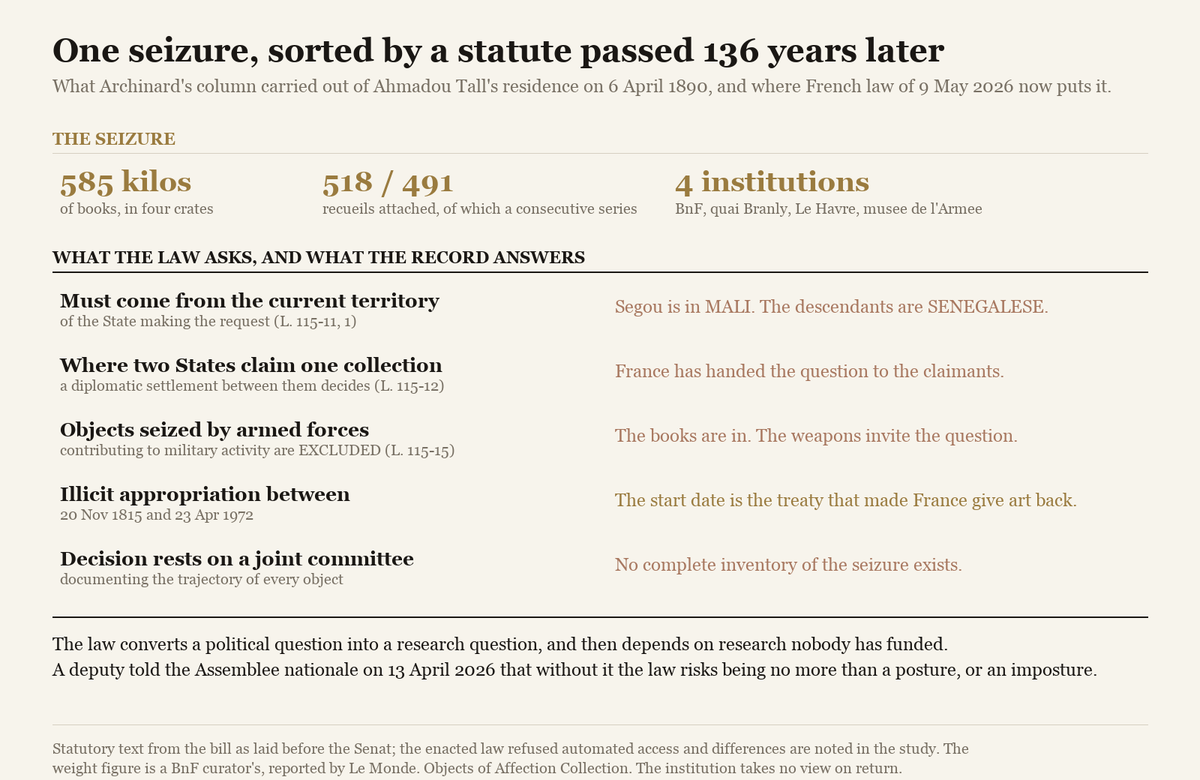
El Hadj Omar Tall was born in Futa Toro, in what is today Senegal. His descendants are Senegalese. The claim that has been pressed for decades, by the family and latterly with the support of the Senegalese state, is Senegalese. Senegal's ambassador to France, Baye Moctar Diop, has said Dakar will submit a request once a complete inventory exists, and President Bassirou Diomaye Faye supports the effort.
So the law's territorial test and the genealogical claim point at two different countries. One state holds the ground the library stood on. The other holds the descendants of the men who assembled it. The statute's first criterion is about ground.
This is not an oversight by the drafters, and the law does not pretend the problem away. Article L. 115-12 addresses it directly, and the way it does so is the most revealing provision in the text: where more than one State claims the same object, un règlement diplomatique entre les États demandeurs concernés détermine celle de ces demandes qui sera examinée. A diplomatic settlement between the requesting States determines which request will be examined.
France has written the hardest question out of its own procedure and handed it to the claimants to settle between themselves. That is a coherent and arguably correct choice for a state that does not wish to adjudicate between two sovereign partners. It is also a condition precedent that no committee, inventory or decree can supply, and it sits upstream of everything else in the process.
The deputy Aurélien Taché raised Ségou by name in the joint parliamentary committee of 29 April as the example of a collection claimed by two countries.
One Seizure, One Morning, Two Legal Fates
There is a second provision that cuts through the Ségou material, and it has had almost no attention at all.
Article L. 115-15 carries the exclusions, and among them are objects seized by armed forces which, by their nature, their purpose or their use, contributed to military activities. Archaeological objects covered by excavation sharing agreements or scientific exchange are also excluded.
Read that against what Archinard's column carried out of the palace. The manuscripts are scholarship and are not within the exclusion. The weapons, held at the musée de l'Armée, plainly invite the question, since they were seized by armed forces and are objects whose nature is military.
One seizure, one morning, one column, and the law sorts its contents into two categories with different destinations. The books may travel the new route. The weapons may require the old one, which is to say an act of Parliament, which is the very thing this law exists to make unnecessary.
Whether that is the correct reading is a question for French administrative lawyers and for the Conseil d'État, and this institution does not answer it. What is certain is that the exclusion exists, that the Ségou material includes weapons, and that no public document consulted for this study works out what that means for them.
The Country That Already Moved a Quarter of a Million Manuscripts
The objection about conservation capacity is usually raised in the abstract. In Mali's case it does not have to be, because the relevant event happened fourteen years ago and is one of the largest manuscript rescues on record.
When armed groups took the north of Mali in 2012, the manuscript libraries of Timbuktu were in danger. Over roughly eight months, an operation coordinated by Abdel Kader Haidara through the association SAVAMA-DCI moved the collections south to Bamako, in crates, by road and river, in an estimated 1,200 vehicle journeys.
The counts, inevitably, do not agree. Estimates of the material moved run from about 200,000 manuscripts to 285,000 in some 2,400 crates to 350,000. Estimates of the share saved run from 90 per cent to at least 95 per cent. UNESCO records 4,203 manuscripts burned or stolen at the Ahmed Baba Institute. Digitisation has been under way since 2013 and has produced images of roughly 300,000 manuscripts.
Two things are true at once and both belong in any honest account.
The first is that this was an extraordinary act of custodianship, carried out under threat by Malian librarians and families, on a collection comparable in kind to the one sitting in Paris.
The second is that the problem is not solved. The crates went to Bamako and substantially remain there. Storage conditions are a continuing concern, and a UNESCO-reported conference in Bamako called for emergency action on the safeguarding of the manuscripts, warning about decay.
This institution draws no conclusion from the pairing, and specifically does not offer it as an argument for or against any restitution. It is here because the conservation question is routinely discussed as though it were hypothetical and in this case it is a matter of documented record, and because the record cuts in both directions at once. A reader is better placed to weigh it than we are.
And note the shape of it one more time. A collection of West African manuscripts, moved under pressure, is known to the world through figures that range across a hundred and fifty thousand units and five percentage points. The heritage in this entire field is, with striking consistency, uncountable.
What France Has Already Returned, and What Its Record Says
The precedent everybody cites is the sabre, and it deserves a much closer reading than it usually gets.
In December 2018 a sabre was lent to the Musée des civilisations noires in Dakar for its opening. On 17 November 2019 the French Prime Minister, Édouard Philippe, presented it to President Macky Sall during an official visit. It was widely reported as a restitution.
It was not one yet. What happened in November 2019 was a deposit for five years. Title did not move until Parliament passed loi n° 2020-1673 du 24 décembre 2020, and the transfer of ownership followed on 27 December 2020. The art lawyer Alexis Fournol pointed out at the time that the word restitution did not match the legal instrument.
Thirteen months separate the ceremony from the conveyance, and the public word was fixed in the first month. That is the same defect this institution has documented in other registers: a sentence written in a firmer tense than the document behind it supports.
And then there is the object itself, which is the part almost nobody mentions.
It is called the sabre dit d'El Hadj Oumar Tall. Dit. Said to be.
The blade is a French infantry officer's sabre, model 1821, made at Klingenthal around the middle of the nineteenth century. A Toucouleur metalworker replaced its hilt with a locally made copper one, and that hilt is the substantive link to the Toucouleur context. How the French blade reached the metalworker is not established: it may have been given by a French soldier to a Toucouleur chief, or taken from a Frenchman after a battle. Whether the French army seized it in combat, or whether one of Omar Tall's sons handed it to Archinard, is also not established. Archinard gave it to the musée de l'Armée in 1909.
As to whether it was ever his, Le Monde reported the position bluntly: aucune source historique, locale ou européenne, ne fait la moindre allusion à un sabre européen. No historical source, local or European, makes the slightest allusion to a European sabre.
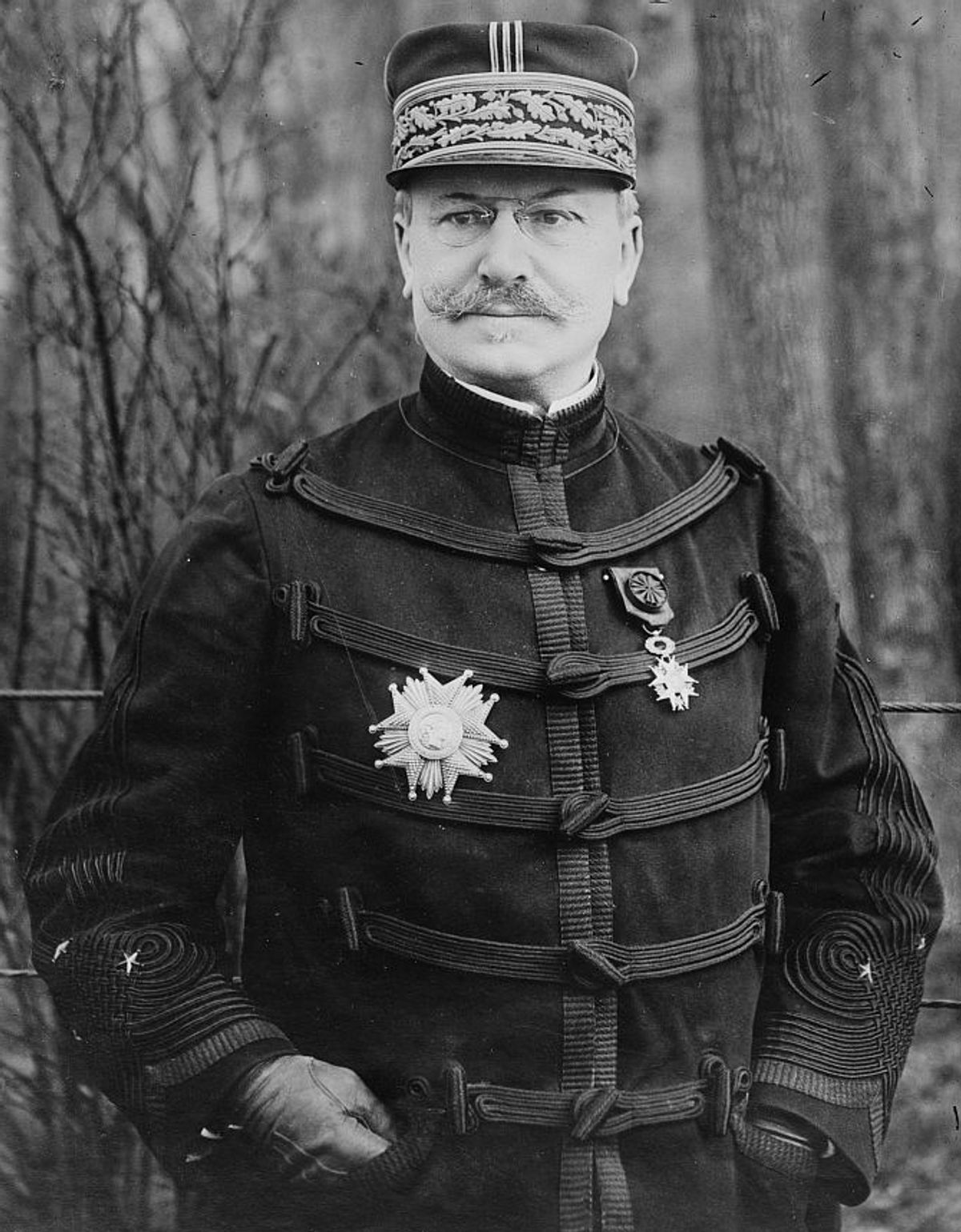
So the flagship object of France's restitution turn is a French-made weapon, collected by the same officer who took the Ségou library, whose attribution to the man it is named after is contested in the record.
This is not an argument that the return was wrong. It may have been entirely right, and the object's meaning to the people who received it does not depend on a nineteenth century chain of custody. It is an observation of exactly one kind: the name asserts something the record does not establish, and the name is what travelled through every headline. A record that cannot support its own object's title is the recurring finding of this institution's work, and here it sits at the centre of the most celebrated case in the field. The name acquired narrative permanence that the provenance never earned.
The Request That Cannot Be Made Until the List Exists
Now the present, where the brief that prompted this article needs correcting.
It is widely said that about ten formal requests are under review and that Mali's claim to parts of the Ségou treasure is among them. The position in the record is more complicated and, for Ségou specifically, close to the opposite.
A Senate document lists among its dossiers the objects of the Ségou treasure and of the 1931 Dakar-Djibouti mission, under a 2022 request, and the law applies to requests already under examination at its publication on 10 May 2026. So a dossier exists.
But as of 21 August 2026, reporting on the French side was that no formal request had been filed for the Ségou material, that Senegal's ambassador had said Dakar would submit one once a complete inventory is done, and that no Malian request is on the record at all. No restitution has been decided for the BnF manuscripts.
This institution could not reconcile the 2022 Senate dossier with the August 2026 statement that nothing has been filed, and does not pretend to. They may describe different instruments, a diplomatic approach as against a formal request under the new framework. We report the discrepancy rather than choosing between them, and a reader should treat any confident count of pending Ségou requests with suspicion.
What is not in doubt is the sequence the Senegalese position implies, and it is the whole argument of this article in one clause. The inventory comes before the claim. You cannot ask for what you cannot list, and the material is spread across a national library and three museums, counted in two different ways in the BnF's own catalogue, and never comprehensively enumerated as a single seizure.
The Law Runs on Provenance Research, and Nobody Has Paid for It
Which brings this to the sentence that the French parliamentary record supplies and almost no coverage carries.
On 13 April 2026, in the Assemblée nationale, the deputy Jean-Claude Raux warned that without robust funding the law risked being qu'une simple posture ou une imposture, no more than a simple posture, or an imposture.
Read it against the machinery. Every decision under this law rests on the conclusions of a joint scientific committee whose task is to document the trajectory of the objects. The standard of proof, serious, precise and concordant indications, is a documentary standard. The eligibility test asks where an object came from, which is a provenance question. The exclusions ask what an object was for, which is a provenance question. And where two states claim one collection, the diplomatic settlement that must precede everything will itself be argued over an inventory.
The entire apparatus is a reading apparatus. It converts a political question into a research question, which is a serious and defensible thing to do, and it then depends completely on research capacity that the statute does not fund.
The scale of that gap is visible in a neighbouring case. Of the Dakar-Djibouti mission, commentary notes that the archives exist but are dispersed between Paris, Dakar and Bamako, and that working through them would take years of investigation and credits that nobody has yet written into a budget.
Parliament's answer was the annual report: the government must now tell Parliament each year how the pending requests are progressing and what means are devoted to provenance research. That is a reporting duty, not a funding line. It will produce, annually, an accurate measurement of how little has been done, which is a real and underrated form of accountability, and is not the same thing as doing it.
What This Article Does Not Say
This institution takes no view on origin, export, return or restitution. It does not say the Ségou Treasure should go to Bamako, or to Dakar, or stay in Paris. It does not say whether Mali's or Senegal's claim is the better one, and it specifically does not resolve the question the French statute hands to the two states. A reader who finishes this with their original opinion intact has not misread it.
It makes no allegation against any institution holding this material. The BnF is digitising the manuscripts and making them available to researchers, which is stated here as a fact and not as a sufficiency.
On the sabre, the claim is narrow. The attribution is contested in published sources and the object is French-made; that is all that is said. Nothing here suggests the 2020 transfer was improper or that the object lacks meaning for Senegal. The criticism of the word restitution in 2019 is Alexis Fournol's, made at the time, and is reported as his.
On sourcing. The 585 kilos figure is a BnF curator's, as reported by Le Monde, which this institution has not read in the original. The enacted text of the law was not read on Legifrance, which refused automated access; the article's statutory quotations come from the bill as laid before the Senate and from legal commentary on the enacted version, and where the bill and the enacted law differ, that difference is itself reported, as with the start date. The exclusion for objects seized by armed forces is quoted from the bill text and its application to the Ségou weapons is our question, not a finding by anyone with standing to make it.
The claim that about ten requests are pending could not be verified for Ségou and the record appears to point the other way; the discrepancy is reported above rather than resolved. No Malian formal request was located, which is a statement about our search.
Counts of the manuscripts vary between 491 and 518 for reasons given above, and any figure in the hundreds that arrives without a stated basis should be treated as unsourced.
The Thing Worth Keeping
France has replaced a procedure that required an act of Parliament for every object with a procedure that requires a documented history for every object. That is a better law, and it is a law that exchanges one scarcity for another: parliamentary time for archival labour.
The Ségou library is the hardest possible first test of it, because the collection's own paperwork is the thing that was never made. A library that took forty nine years to assemble was removed in a single morning and recorded as 585 kilos in four crates. A century and a third later, a statute asks which state's current territory it came from, what each object was for, and which of two claimants has the standing to ask, and every one of those questions has to be answered out of a record that was never written.
The weighing was the cataloguing. That is the whole problem, and it is still the problem.