Standard or Head-Dress? Zelia Nuttall Asked That in 1888, and the Vienna Penacho Is Still Argued Over Under a Name Its Own Scholarship Calls Erroneous
For about two hundred and fifty years the European record described it as a Moorish hat. It is now argued over internationally under a two word name, and both words are contested by scholars. This study sets out what the record holds, what it does not, and leaves the conclusion to the reader.
Why This Record Exists, and What It Will Not Do
This institution takes no view on where this object should be. That is a standing constraint and it is not a reluctance. OAC does not hold a position on origin, export, return or restitution, and nothing in this study is an argument for or against the headdress leaving Vienna.
What the constraint does not mean is that we research the subject less. It means we research it as hard as we can, publish what we found, publish what we could not find, name the sources on every side including the ones whose conclusions cut against each other, and then stop. The reader decides. That is the whole method and it is the reason this study exists rather than a shorter one that announces a verdict.
The object is useful to this institution for a specific reason. It is probably the most intensely studied contested object in the world, it has been in one building for a century and in one country for four hundred and thirty years, two national governments and a binational scientific commission have examined it, and after all of that the public argument is conducted under a name whose two words are both disputed in the scholarship, over a journey nobody has documented.
If a record can fail at this object, with this much attention on it, the problem is not attention.
What the Thing Is
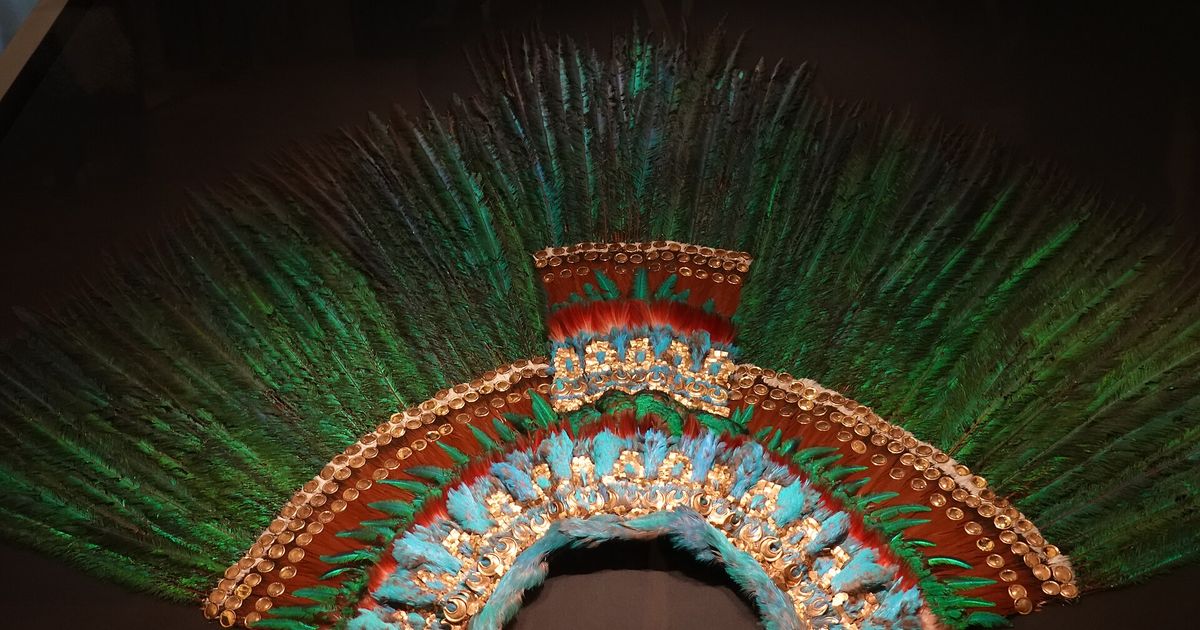
A semicircular fan of feathers, built in concentric layers, with gold.
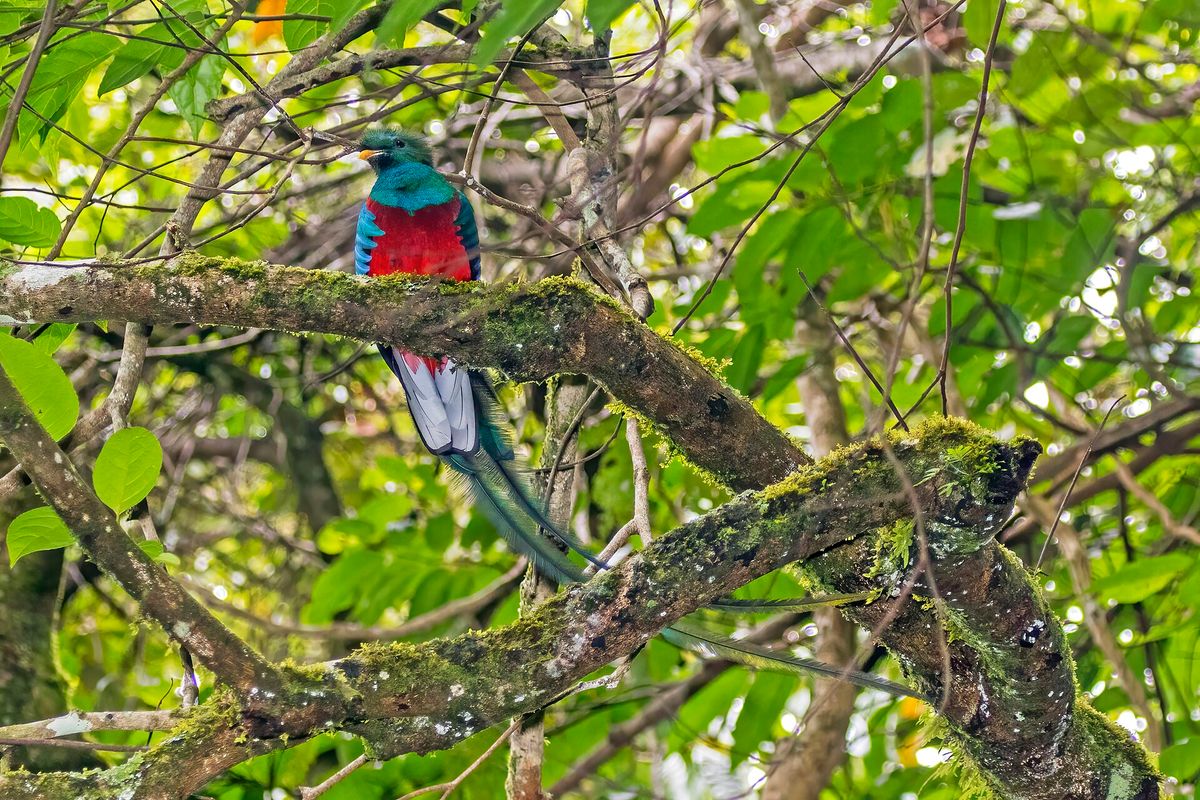
Working from the smallest layer outward: blue feathers of the lovely cotinga, set with half moon gold plates; then roseate spoonbill; then small quetzal feathers; then the white tipped red brown feathers of the squirrel cuckoo, Piaya cayana, with three bands of small gold plates; and then two outer layers of around four hundred quetzal tail feathers, some of them fifty five centimetres long. The central quetzal feathers stand higher than those at the sides. Leather straps are attached.
Its Nahuatl name, used in Mexican sources, is quetzalapanecáyotl.
Its recorded dimensions do not agree with themselves. The reference literature gives both 116 centimetres high by 175 in diameter and 130 by 178, and the sources carrying both figures do not reconcile them. This institution has not resolved it and notes it because a fourteen centimetre discrepancy on the most measured contested object in the world is the kind of thing that ought to be settled and apparently is not.
The feathers have deteriorated. That fact is not in dispute by anybody.
The Name Is Two Claims, and Both Are Contested
The object is known in English as Moctezuma's headdress and in Spanish as el Penacho de Moctezuma. Those two words make two separate assertions, and the scholarship disputes each of them independently.
Whose
There is no known documentary proof that the object belonged to Moctezuma II.
Justyna Olko, writing in 2014, states there is no direct evidence which suggests that it actually belonged to Moctezuma. Khadija von Zinnenburg Carroll makes a structural point: Mexica rulers are understood never to have worn the same crown twice, which makes identifying the owner of any surviving crown very difficult. Federico Navarrete told The Art Newspaper this month that the headdress's origin is uncertain and its association with Moctezuma came much later.
The counter position is held and argued. Esther Pasztory has pointed to a headdress of this kind in the Codex Mendoza associated with Motecuhzoma and to the ritual wearing of such objects in the impersonation of Quetzalcoatl. Davíd Carrasco and Eduardo Matos Moctezuma record Moctezuma II's particular devotion to ceremony.
And there is a third position which holds that the question is beside the point. Eduardo Matos Moctezuma has argued publicly that the object is the property of the nation regardless of whether it was given as a gift.
What
The second word is contested too, and this is the part most coverage leaves out. The next section sets out how long it has been contested and by whom.
The Question Has Been the Title of a Paper Since 1888
This study set out to report that scholars disagree about what the object is. The bibliography of the binational volume shows something more specific, and it is the single sharpest fact available about this object.
In 1888 the American archaeologist Zelia Nuttall published a paper through the Peabody Museum at Harvard called Standard or Head-Dress? An Historical Essay on a Relic of Ancient Mexico.
The question is the title. It was the title in 1888. It was still being asked in 2023, when Carmen Parra Rodríguez questioned whether the object is a headdress at all. One hundred and thirty five years, and the interrogative has not been removed.
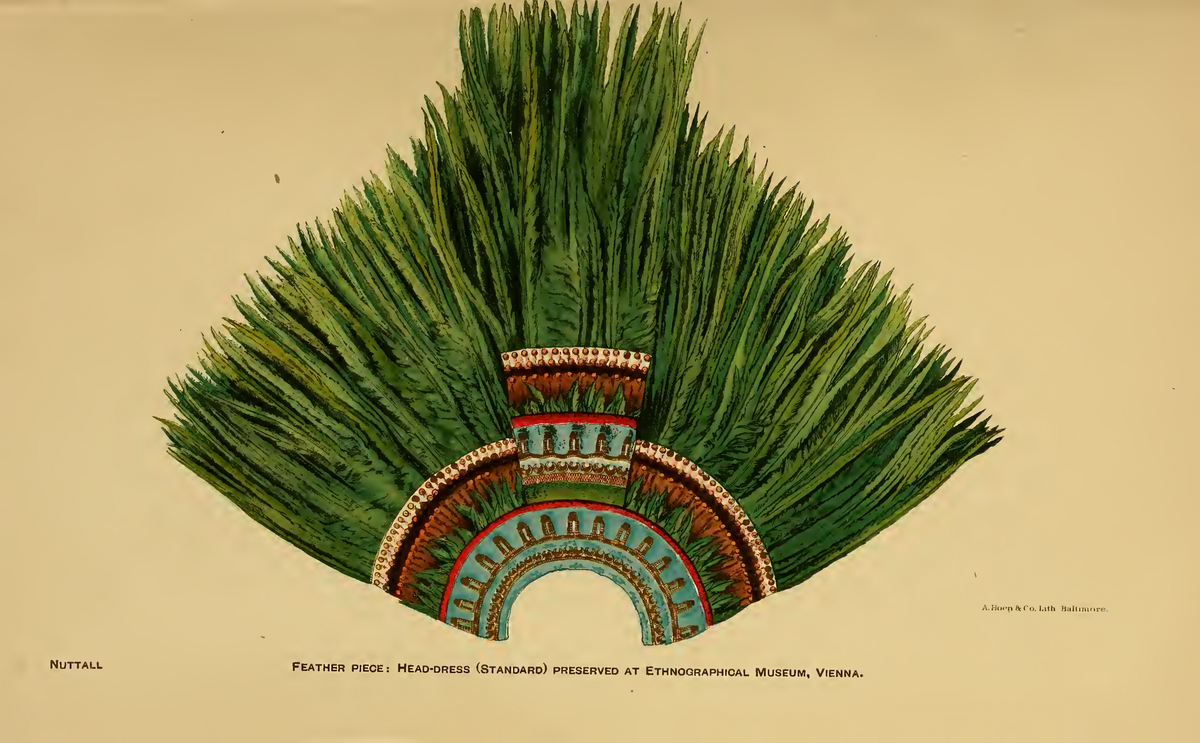
Nuttall carried her own unresolved question into her illustration of it. The plate she published in 1895 is captioned, in full: Feather piece: Head-dress (Standard) preserved at Ethnographical Museum, Vienna. She put the alternative in parentheses rather than choose. That is a scholar refusing to let a caption settle what her evidence had not, and it is better record-keeping than almost anything published about the object since.
What follows is what the literature has actually proposed, in order, taken from the works cited in the binational volume's own bibliography.
1879. Teobert Maler, in the French journal La Nature, describes it as un vêtement royal de l'ancien Méxique, a royal garment. He repeats the garment reading in Spanish in 1886 as un primoroso ropaje de plumas, an exquisite feather robe.
1884. Ferdinand von Hochstetter publishes on it for the imperial academy as a Mexican relic from the time of Montezuma.
1887 and 1888. Nuttall, first in Dresden on the feather mosaic work, then at Harvard with the question in the title.
1889 to 1893. Eduard Seler publishes three times in Berlin on ancient Mexican feather ornament and military rank insignia, which is the back-device reading.
1890. Philipp Valentini, in the American Antiquarian, calls it an ancient Mexican head-dress, without the question mark.
1891. Max Uhle publishes on the interpretation of the Vienna feather ornament. In the same year, Seler again.
1892. Nuttall, in Paris, on the quetzalapanecayotl, a Mexican feather head-covering. By this point she has moved toward headdress and has given it its Nahuatl term.
1925. Fritz Röck, at the Americanists' congress in Gothenburg, describes it as the Prunkfederschild, the ceremonial feather shield, of the Vienna natural history museum.
1995 and 1997. Francisco González Rul publishes twice in Arqueología Mexicana, once on the quetzalapanecayotl and the penacho, and once under the title Otro quetzalapanecaiotl en Viena. Another one in Vienna.
2005. La Jornada reports a researcher's conclusion that the object is a priest's cape.
2023. Parra Rodríguez questions the headdress identification.
That is a royal garment, a standard, a headdress, a military rank insignia, a ceremonial shield, a priest's cape, a fan, an apron and a mantle, proposed over a hundred and forty six years by named scholars publishing in Vienna, Berlin, Dresden, Paris, Gothenburg, Harvard and Mexico City. The object did not change. The reading did, repeatedly, and it has not converged.
The Authority on It Calls the Name Erroneous
If one sentence in this study should be read twice, it is this one, because it comes from the person best placed to say it, in the publication least likely to.
Christian Feest spent nearly fifty years as a museum curator and director in Vienna. He is a co-editor of the 2012 binational volume, published jointly with Mexico's CONACULTA-INAH. His own chapter in it, pages 5 to 28, is the European history of the object.
The abstract of that chapter describes its subject as the only surviving Mexican feather headdress, erroneously known as the penacho de Moctezuma.
Not contested. Not traditionally attributed. Erroneously.
The volume that Mexico's own national institute of anthropology and history co-published contains, from its Austrian co-editor, a chapter whose abstract states that the name the object is argued over under is wrong. And it contains a separate chapter by Salvador Guilliem Arroyo, pages 29 to 40, titled simply El Penacho de Moctezuma, on the history of that name.
Both governments paid for a book which says, in its own front matter, that the thing everybody calls Moctezuma's headdress is not known to be Moctezuma's.
What the Documentary Record Actually Holds
Here is the entire documented chain, and its first entry is the surprise.
1596. The earliest written reference anybody has produced is the inventory of the armoury of Archduke Ferdinand II of Tyrol at Ambras Castle near Innsbruck, compiled in 1596 after his death the previous year. The entry describes it as ain mörischer Huet. A Moorish hat.
Mid nineteenth century. The correct identification, as a Mexican quetzal feather headdress, first appears. That is the point at which the European record begins to describe the object as what it is.
Late nineteenth century. The geologist Ferdinand von Hochstetter, the first director of Austria's new Natural History Museum, locates it at Ambras.
1928. It is transferred to the Museum für Völkerkunde in Vienna, now the Weltmuseum, where it carries the inventory number 10402_VO.
Stated plainly: for roughly two hundred and fifty years, the European record of this object called it a Moorish hat. Not through concealment. Through ordinary cataloguing by people who did not know what they were holding, repeated across inventories, until somebody in the nineteenth century looked properly.
That is the longest documented misattribution this institution has written about, and it concerns the object currently described as the most symbolic thing Mexico has tried to recover.
The Gap Nobody Can Fill
Between the making of the object in Mexico and the inventory at Ambras in 1596, the record is empty.
The standard account is that Moctezuma gave the headdress, with gold, silver and cloth, to Hernán Cortés, who sent it across the Atlantic to Charles V, a Habsburg, from whose family collections it reached Tyrol. The Habsburgs ruled in both Spain and Austria in the period and American material moved around their properties, which makes the route plausible.
It is an inference, not an itinerary. No source consulted for this study produces a shipping document, a court inventory before 1596, a letter, or any dated record of the object between Mexico and Ambras. Khan Academy's summary puts it as likely sent by Cortés, and unknown whether it belonged to Moctezuma II. Spanish language scholarship says directly that its first genuinely documented mention is 1596.
The opposing characterisation is also on the record and is not a fringe position. The anthropologist Miguel Ángel Adame has argued there are grounds to call the object plundered, and disputes the claim that nothing in writing connects it to Moctezuma. Mexican scholarly and popular writing commonly refers to it as expoliado, looted.
This institution cannot resolve that and does not try. What it can state is the shape of the evidence: one side points to an absence of documentation of a transfer, the other points to the same absence, and they draw opposite conclusions from it. How thoroughly that absence has been searched is set out below, and it matters more than the arguing does. A gap in a record is a discount in a market and a claim in a restitution argument. This institution has written that before, and this is the clearest case of it available.
The Absence Has Been Searched For, Which Is a Stronger Statement
It would be easy to write that the journey from Mexico to Ambras is undocumented and leave it there. The bibliography shows something more useful: the search has been conducted, repeatedly, by people with access, for more than a century.
The relevant archives were published in calendar form in the generation when this object was first identified. Rudolf Beer edited documents, regests and inventories from the Archivo General at Simancas, the Spanish state archive, in 1891. Heinrich Zimmermann edited documents and regests from the imperial Haus-, Hof- und Staatsarchiv in Vienna in 1885. David von Schönherr did the same for the Statthalterei-Archiv in Innsbruck in 1893, which is the archive of the territory where the object sat. Luis Torres de Mendoza's collection of unpublished documents on the Spanish possessions in America ran from 1869.
Scholars then worked that material on this exact question. In 1906 Franz Heger published a paper, in a Festschrift for Franz Boas, titled Vanished ancient Mexican treasures of the sixteenth century, according to documentary reports. In 1947 Karl Anton Nowotny published The guest-gifts of Motecuçoma to Cortés. In 1965 Ferdinand Anders published on the feather case of the Ambras Kunstkammer. The Habsburg collections themselves have a literature going back to Sacken in 1855 and the Primissers in 1777 and 1819.
So the gap is not the kind that exists because nobody looked. It is the kind that persists after the Spanish, Austrian and Tyrolean state archives were calendared and published, and after at least four named scholars went through that material specifically hunting for sixteenth century Mexican objects.
That changes what the absence means, and it changes it in a direction that does not favour either side of the argument. An unsearched gap is a research task. A searched gap is a finding, and what it finds is that the documentary record of how this object crossed the Atlantic either never existed or has not survived.
This institution's specification would type that differently from an ordinary missing entry. It is not merely not yet obtained. On the evidence of a century and a half of archival work, it is closer to the state the specification calls unknowable, which is the one that tells a reader to stop looking. Closer, not identical. Archives still produce surprises, the Simancas and Vienna calendars are selections rather than complete transcriptions, and no responsible record would declare the question closed. But the honest entry is not a blank, and it is not a polite note that somebody should check. It is: searched, from the 1850s, by named people, in the three archives that would hold it, and not found.
The Fragility Finding, and What It Actually Is
The reason usually given for the object staying in Vienna is not legal. It is conservation, and the conservation work is real, binational and published, which is more than is true of most such claims.
Between 2010 and 2012 a joint Mexican and Austrian commission of curators, conservators and scientists examined the object, with the stated purpose of assessing its condition and the feasibility of lending it to Mexico. The work included cleaning it and studying methods of mitigating vibration in transport. In 2012 Austrian and Mexican conservators specialising in featherwork carried out a restoration.
The commission concluded that the object is too fragile to be transported.
The work is published. El Penacho del México Antiguo, edited by Sabine Haag, Alfonso de María y Campos, Lilia Rivero Weber and Christian Feest, appeared through ZKF Publishers in Altenstadt with CONACULTA-INAH and the Museum für Völkerkunde, in a Spanish edition of 152 pages carrying thirteen essays. The conservation account is a chapter by Rivero Weber, La conservación del Penacho del México Antiguo: Dos años de trabajo de la comisión binacional, pages 135 to 152. Feest wrote the European history, pages 5 to 28. There is also a chapter by Guilliem Arroyo, pages 29 to 40, on the history of the name Penacho de Moctezuma, which is to say the question this study opened with has its own chapter in the binational volume.
This institution has not read that book. Everything above about its contents comes from the publisher's record, a bibliographic listing of its chapters, and a 2014 review in the Revista Española de Antropología Americana by Macarena López Oliva. The fragility conclusion reaches the public, and reaches this study, through journalism reporting a chapter almost nobody outside the field has read.
The most widely circulated figure attached to it comes from a Harvard publication, which reports conservators as judging that the vibration of a transport lasting a few hours would do the equivalent of two hundred years of wear. This study has not traced that figure to the chapter.
The 2010 Commission Was Not the First
One more thing the bibliography settles, and no coverage of the current dispute mentions it.
In 1908 the Sixteenth International Congress of Americanists met in Vienna. The congress appointed a commission to examine the ancient Mexican feather ornament in the imperial natural history museum, and Eduard Seler published its report in the congress proceedings two years later, under a title that translates as Report on the investigation of the ancient Mexican feather ornament in the Imperial Natural History Court Museum by the commission elected by the congress.
So the object has been examined by an international scientific commission twice, in 1908 and again in 2010 to 2012, a hundred and two years apart. The second commission is routinely described in the press as though it were the first serious examination. It was the second, and the first one's report has been in print since 1910.
Whether the 1908 commission reached any view on transport, condition or identity is not established by this study, which has not read Seler's report. It is named here because a reader following this dispute deserves to know the examination has a longer history than the coverage suggests, and because a conservation argument conducted as though the evidence began in 2010 is working from a shortened record.
The Ten Years, and the Arithmetic
In October 2020, after President López Obrador said he had asked his wife to press Austria on the question, Gerard van Bussel, the Weltmuseum's curator for the North and Central American collections, told the press the object could not be moved to Mexico for at least ten years. His stated reason was that it is overwhelmingly organic material and any vibration in transit would destroy it. He cited the 2010 to 2012 binational commission as the basis.
He also said that moving it would require an aircraft three hundred metres long to offset the vibration.
The arithmetic matters and this study got it wrong on a first pass, so it is set out explicitly. The ten year horizon was stated in October 2020, not in 2012. It therefore runs to 2030, and has four years left. Anyone citing it as expired, including this institution's first reading of its own research, is wrong.
What is nonetheless true, and is a different statement, is the age of the underlying measurement. The commission reported in 2012. When van Bussel projected ten years forward in 2020 he was projecting from a study already eight years old. It is now fourteen years old. Mexican commentary has made exactly this point, that the report is more than a decade old and ought to be re-examined in light of technical progress, and in January 2022 two media activists who hacked the museum's audio guides argued that transport is an engineering problem rather than an impossibility.
This institution takes no position on whether the object can or cannot safely travel. It is not a conservation laboratory and the people who are one have examined the thing and written it up. What it observes is narrower and is a records observation: a measurement taken in 2012 is being used in 2026 to answer a question asked in 2026, and no source consulted shows that it has been repeated. Whether it should be is a question for conservators. Whether it has been is a question of fact, and the answer this study found is no.
The Study Was About a Loan. The Argument Is About a Return.
This is the finding this study did not expect and it is the one worth carrying away.
The 2010 initiative was convened, in the words used to describe its own purpose, to assess the condition of the headdress and to explore the feasibility of lending it to Mexico. A loan. The object goes, is exhibited, and comes back.
The question being argued in public, in 2020 and in 2022 and again this month, is whether the object should be returned. One journey, not two.
Those are different transport problems, and nobody appears to have said so out loud.
This institution is not a conservation laboratory and will not tell anyone what follows from that. A conservator may well hold that a single journey is as fatal as a round trip, that the risk is not halved by halving the number of flights, and that the finding stands unchanged. That is entirely possible and this study asserts nothing against it.
What it does assert is narrower and is a records point. A measurement was commissioned to answer one question. It is now cited, by both the museum and the press, as the answer to a different one. At no point in the coverage consulted here does anybody note the substitution, ask whether the finding transfers, or report a conservator being asked.
That is the ordinary life of a measurement once it leaves the people who made it. It gets quoted for what it settles rather than for what it measured, and the gap between those two things closes silently and never reopens. This institution has written the same sentence about a revenue figure, a corpus count and an auction reading in the last three months, and it is the same defect every time.
The honest form of the claim would be one of two sentences. Either: the commission examined a loan, concluded against it, and the museum holds that the finding applies equally to a one way transfer, for these stated reasons. Or: the commission examined a loan, and the question of a one way transfer has not been separately assessed. Both are defensible. Neither has been published.
The Copy, and What the Museum Says About It

Most people who have seen the penacho have not seen the penacho.
A replica stands in the Museo Nacional de Antropología in Mexico City. It was made in 1940, for the museum's old premises in the historic centre, and financed through the efforts of General Abelardo L. Rodríguez. When the museum moved to Chapultepec in 1964 the replica was dismantled for restoration and relocation.
This institution read the museum's own object note on it, published as its Piece of the Month for February 2020, catalogue number 11.0-03480, written by the archaeologist and curator Bertina Olmedo Vera with María Olvido Moreno Guzmán on the conservation of feather art.
One claim that circulates widely is not on that page. The statement that the replica's maker, the amanteca Francisco Moctezuma, never saw the original and worked from a photograph, sometimes dated 1908, appears in Mexican cultural communications and in secondary reporting, and the museum's own note on the object does not say it. It may well be true. It is carried here as reported elsewhere and not as the museum's account.
What the museum's page does say is more useful, and almost none of it circulates.
The reassembly in the 1960s rebuilt the support: radial rods fixed to an open weave net, with some new feathers placed over them. The gold plated silver ornaments of the 1940 version were replaced with the same number of pieces in a high gold alloy. The lower section is feather mosaic, glued to a leather lined support in concentric bands. 431 gold elements are attached, shaped as discs, crescent moons, rectangles and turrets. Long male quetzal tail feathers are tied to the upper edge, and the museum notes that when such feathers hung loose on the headdresses of the ancient Mexicans they moved, which is how the iridescence was seen.
And the museum records an absence of its own. Of the feather bands, it names the blue, the green as quetzal wing feather, the brown with white tips as cowbird tail. Of the red it says the species of bird has not yet been identified. A national museum, describing its own twentieth century replica, has an unidentified material in it.
The Sentence Nobody Quotes
The last paragraph of that page is the one this study did not expect and it answers a question raised later in this study before it is asked.
The museum states that the replica is considered unique because both the quetzal and the small turquoise blue bird are protected species, and that neither in specialised aviaries nor in the forests of Mexico and Central America are there enough birds to supply, through the collection of moulted feathers, the long male quetzal tail feathers or the wing coverts of the small blue bird.
Read that plainly. The copy cannot be made again. Not for legal reasons that could be waived, but because the material supply, gathered the ethical way from feathers the birds have shed, is no longer there.
So the object in Vienna is irreplaceable, and the copy in Mexico City is irreplaceable, and the museum holding the copy has said so in a note almost nobody reads.
What It Took to Make
The craft has a name and the people who practised it had a name, and both are worth stating in a study about records, because the makers of this object are the one group nobody in the argument represents.
Featherwork was the work of the amanteca. The materials in this object were not local to the valley of Mexico: quetzal, lovely cotinga, roseate spoonbill and squirrel cuckoo are lowland tropical birds, and their feathers reached the Mexica as tribute across long distances. Four hundred quetzal tail feathers, some of them fifty five centimetres long, is not a quantity assembled casually. The gold was worked into half moon plates and bands and set into the feather ground.
This institution's term for the quantity of human work resident in an object is Labor Density, and by that measure this is among the densest objects it has written about. It is also, by construction, one of the most fragile, because the thing that carries the labour is a feather.
The maker is not recorded. Not the workshop, not the hands, not the year. The object is argued over as a possession of a ruler who may never have owned it, in a dispute between two modern states, and the one party with an unarguable relationship to it, the person who made it, is absent from every document in the chain.
It is worth noticing that the same is true of the replica, in the opposite direction. The copy in Mexico City has a named maker, Francisco Moctezuma, a named date, 19 October 1940, and a named patron. The twentieth century copy has a better authorship record than the sixteenth century original. That is the ordinary condition of pre-conquest material and it is not Vienna's doing, but it does mean that every argument about this object is conducted between owners, and never once on behalf of the maker.
Where It Stands Now
On 2 October 2026, the Austrian economist Günther Fehlinger-Jahn wrote on X that as president he would return the headdress to Mexico, tying it to a proposed strategic partnership between Mexico and Europe. He has spoken since of wanting a bilateral solution based on friendship rather than confrontation.
Two corrections to how this has circulated. He is not a registered candidate. Austria's next presidential election is due in 2028, and no major Austrian party has endorsed him. Reporting that describes him as a presidential candidate is running ahead of the facts.
Neither government had responded publicly in the days following. Vienna's standing position remains fragility.
The longer history of requests is well documented. Mexico raised the matter in the context of 1938 and its protest at the annexation of Austria. Between 1992 and 2002 the activist Xokonoschtletl Gómora ran a sustained campaign of protests in Vienna, approaches to legislators in both countries and media work, and some scholars credit him with beginning the modern effort. In 2020 the Mexican government asked again. In February 2022 López Obrador disclosed a letter he had sent to Austria's president. Mexico has at various points proposed exchanges of Habsburg era material, temporary exhibition under strict protocols, and virtual repatriation. Austria has declined the exchange. Austrian parliamentarians have at times expressed support for return.
What This Institution Has Already Found, Twice
Two earlier studies in this corpus bear directly on this one, and both reached conclusions that survive contact with the headdress.
The first established that a gap in a provenance record has two prices. In a market it is a discount: a buyer prices the uncertainty, the house discloses what it knows, and the sale completes. In a restitution argument the identical gap is a claim: the absence is the thing pointed at, and the remedy is not a lower price but the loss of the object. One absence, two instruments, and they are not on a spectrum. They are opposites.
The Vienna headdress is the purest example this institution has encountered. The undocumented stretch between Mexico and Ambras is being read in both directions at once, by serious people, from the same evidence, which is no evidence. Neither reading is dishonest. The gap genuinely supports both.
The second study looked at the Benin Bronzes and found that a decade of argument had settled the question of title and left the question of transmission completely alone: nobody had asked whether anyone could still make them. A bronze caster in Benin City had the sentence that framed it, from his father handing over the workshop. I am travelling. I leave this business in your care. If it dies, it's on you.
The same question is available here, and the answer is published in a place nobody quotes. Featherwork of this kind is a craft with a transmission problem of its own, and the 1940 replica proves the knowledge was alive in Mexico in the twentieth century. The Museo Nacional de Antropología addressed it in a 2020 object note: the replica cannot be remade, because the quetzal and the small blue bird are protected and there are not enough moulted feathers to be had.
That is not a craft transmission failure. It is a material one, and it is worse, because a craft can be taught and a bird cannot be conjured. The skill may survive. The feathers do not.
A country that recovered the object and could no longer make another would have won the argument it was having and lost the one it was not. On the museum's own account, that second loss has already happened.
What a Conforming Record Would Hold
Written out as the kind of record this institution specifies, with every field this study can fill and every one it cannot.
Origin. Made in Mexico before 1519, maker unknown, workshop unknown. A conforming record states the unknown rather than leaving the field blank, because a blank reads as nobody having looked.
What it is. Contested between headdress, priest's headdress, back device, standard, fan, apron and mantle. A record carries the dispute with its sources attached and does not pick the convenient reading. The convenient reading is the one in the object's name.
First custody. Unknown. The attribution to Moctezuma II is traditional and no documentary proof has been produced.
Transfer out of Mexico. Undocumented. Not unknowable, because a Habsburg shipping or court record could still surface in an archive that has not been searched for it. This is a declared absence of the closable kind, and the specification requires such an entry to name the party who could close it and carry a date. The parties are the Spanish and Austrian archives, and the entry would be open.
Held. Collection of Archduke Ferdinand II of Tyrol, at Ambras, by 1596, recorded as a Moorish hat.
Identified. Mid nineteenth century, as a Mexican quetzal feather headdress.
Transfer. To Vienna, nineteenth century, located by Hochstetter at Ambras.
Transfer. To the Museum für Völkerkunde, 1928, inventory 10402_VO.
Condition. Examined 2010 to 2012 by a named binational commission, published 2012, conclusion that it cannot safely be transported. Not repeated since, so far as this study can establish.
Copy. Replica delivered 19 October 1940, Museo Nacional de Antropología, by Francisco Moctezuma, made without sight of the original, probably from a 1908 photograph.
Ten entries. Four are complete, three are contested, two are declared absences with named parties who could close them, and one is a measurement with a date on it that nobody has refreshed.
What This Institution Is Not Saying
It is not saying the object should return to Mexico, and it is not saying it should remain in Vienna. It holds no position on that question and will not acquire one.
It is not saying the fragility finding is a pretext. A named binational commission of conservators did real work over two years and published it, which is a higher standard of evidence than most arguments in this field can show. The burden of preservation is a real cost somebody is carrying, and in this case it is carried in Vienna.
It is not saying the fragility finding is current. It is fourteen years old and no source consulted shows it has been repeated. Those two sentences are both true and neither is an accusation.
It is not saying the object was looted, and it is not saying it was a gift. It is saying no document has been produced for either, that both positions are held by serious people, and that the absence is the thing both sides are reading.
It does not authenticate, appraise or value, and takes no view on any legal question of title, which is counsel's work and not this institution's.
Nothing here is a comment on Austrian or Mexican politics, or on any individual's candidacy.
The Declared Gaps
Stated so that silence is not read as completeness.
This institution has not read the 2012 volume. Its contents are described here from publisher data, a chapter listing and a published review. The conservation conclusion and the two hundred years of wear figure both reach this study at second hand.
No primary archival research was done for this study. Nothing in Simancas, Vienna or Innsbruck was searched here. What this study establishes is that others searched, and published, from the 1850s onward, and the named works are cited above. That is a statement about a literature, and a very well developed one, but it is still not the same as going to the archive.
The 1908 commission's report was not read. Seler published it in the 1910 congress proceedings. What it concluded about condition, identity or handling is not established here, and it is named only to correct the impression that the 2010 commission was the first.
The Feest chapter was not read, only its abstract and its ninety two item bibliography, both of which are public on a repository page. The word erroneous is his, in that abstract. What he argues across the twenty four pages is not reported here.
The dimensions are reported two ways and this study did not resolve them.
Whether the fragility study has been repeated is established negatively, by absence from the sources consulted, which is the weakest form of evidence this study uses and is marked as such. The Weltmuseum was not asked.
The claim that the replica's maker never saw the original, and the 1908 date attached to a photograph, are not from the museum. Its object note was read for this study and says neither thing. The claim circulates in Mexican cultural communications and in secondary reporting, may well be correct, and is marked uncertain here.
One source used in research could not be fetched for verification. A repository copy of the 2012 volume refuses automated requests. It was not read and is not linked, because a link that serves a reader a challenge page is not a citation.
The museum page was read in English translation. The Spanish original may differ in wording, and the figure of 431 gold elements and the unidentified red feather species are reported from the English version.
The species name of the Nahuatl term, the exact wording of the 1596 entry, and the inventory number are reported from secondary sources and were not read off the originals.
Scholarly positions are summarised from reporting and reference literature, not from reading each scholar's argument in full. Where a position is attributed to a named person here, it should be checked against their own publication before being relied on.
No party has been contacted. Not the Weltmuseum, not the Mexican government, not any scholar named, and not Fehlinger-Jahn. Every position reported is taken from published statements.
The study has no Mexican or Austrian primary-language archival input beyond published journalism and reference works, and both countries have substantial literatures on this object that a fuller treatment would read.
What Would Settle It
On the name: it is closer to settled than the public argument suggests, and the settling is in print. The co-editor of the binational volume calls the name erroneous in his own abstract, and a separate chapter in the same volume, Guilliem Arroyo at pages 29 to 40, is devoted to how the object came to carry it. Anyone with the book can report in an afternoon what that chapter concludes. This study could not obtain the volume and says so; the abstract alone is a stronger statement than most of what circulates.
On the journey: probably nothing, and that is itself the answer. The three archives that would hold it were calendared and published between 1869 and 1893, and named scholars worked that material on this exact question in 1906, 1947 and 1965. A reader hoping a document will turn up should know how many people have already looked. The honest entry is searched and not found, which is a finding, and it is not the same as a blank.
On the fragility: a repeat examination, published. Note that this would be the third commission, not the second. The first met in 1908 and Seler published its report in 1910. Conservation science and transport engineering in 2026 are not those of 2012. A new measurement would either confirm the finding, which would strengthen Vienna's position considerably, or it would not, and both outcomes are more useful than a fourteen year old number carried forward.
On the dimensions: a tape measure.
Coda
The entry in the 1596 inventory is four words long and three of them are wrong.
Ain mörischer Huet. A Moorish hat. It is not Moorish, and it may not be a hat, and the one word that survives scrutiny is the indefinite article.
Nobody lied. A clerk in Tyrol in 1596, cataloguing the possessions of a dead archduke, wrote down what the thing looked like to him, in the vocabulary he had, and moved to the next item. The entry did its job, which was to establish that an object existed and was in a particular room. Everything anybody has argued about since has been an attempt to recover what that entry could not hold. That is the problem this institution calls narrative permanence: whether what an object was made to mean survives a change in who holds it.
Four hundred and thirty years later the object has a binational scientific commission, a published volume, two governments, a replica in a national museum, a conservation finding, an inventory number and a name recognised across the Spanish speaking world. And the two words of that name are both contested, the journey that brought it to Europe is undocumented, and the measurement that keeps it in place was taken fourteen years ago.
This institution is not going to tell you where it belongs. It will tell you that the argument is being conducted over a record thinner than the attention it has received, and that almost every question anyone is shouting about could be narrowed by somebody reading a chapter, searching an archive, or taking the measurement again.
The objects are the evidence. Somebody has to write down what they are.