The Study That Cannot Show Its Subject
Mary Anne Heilmann, born in San Francisco on 3 January 1940, died on 14 August 2026 at the age of 86. She was an American painter who also made ceramics and chairs, and who spent a working life insisting that a painting was an object in a room rather than an image on a wall.
This institution set out to study her objects three days after she died, and discovered within an hour that it could not lawfully show a single one of them.
That is not a footnote about picture research. It is the study.
What actually happened when we went looking
The search was ordinary. An institution that publishes on objects wanted an image of the objects, under a licence permitting reproduction, credited to whoever made the photograph. Every study this institution publishes carries four such images and will not ship without them.
There are none. Not of her paintings, not of her ceramics, not of her furniture. Her work is in copyright, that copyright did not lapse when she died, and no free licence exists over any reproduction of it. The only images available are held by galleries, museums and press offices, each with its own permission to grant or withhold.
So this study appears without its subject, and the decision was to say so rather than to substitute a photograph of somebody else's ceramics and hope the caption carried the difference.
The institution that excluded her now decides what can be seen of her
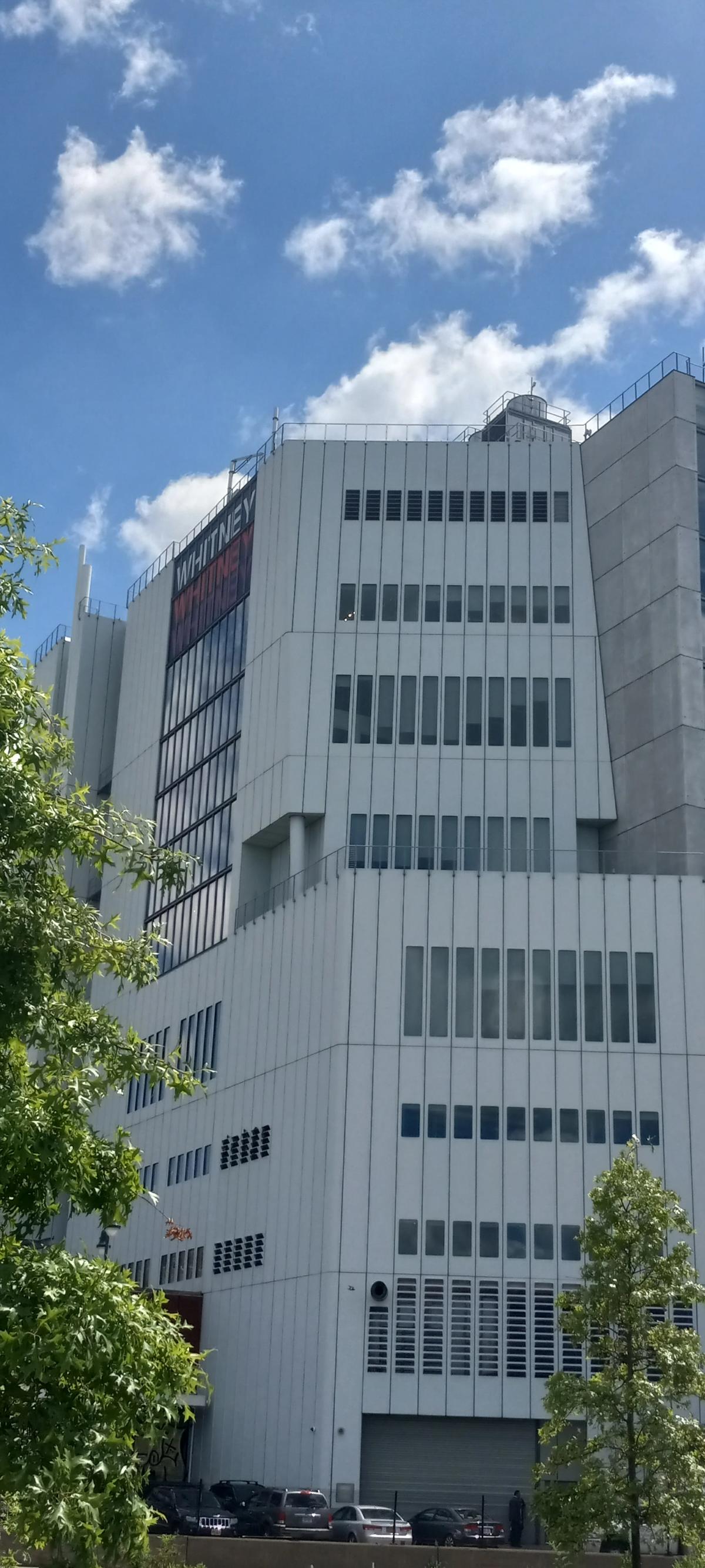
Heilmann moved to New York in 1968 after Berkeley. She was excluded from a number of the shows that defined the moment, and by her account the rejection from the Whitney Museum's 1969 exhibition Anti-Illusion was particularly crushing.
What followed is the part worth holding onto. That rejection moved her away from sculpture and toward painting. She declined the Color Field work then in favour and made instead what she described as a materials-based sort of conceptual, anti-aesthetic, earth-coloured, ironic painting that was often hard to look at. The career she is now being memorialised for begins at a door that was shut.
Her later exhibition history runs through galleries and institutions including the New Museum, and she has been widely cited by younger artists, particularly women, as a figure who made a way of working available to them.
So the arc closes in a way nobody designed. An artist kept out of a museum survey in 1969 is, in 2026, an artist whose visibility depends on what museums hold and choose to reproduce. This is not an accusation of anyone: the Whitney of 1969 is not the Whitney of today, exclusion from a group show is an ordinary curatorial act, and the institutions that later showed her did so on the merits.
It is a statement about where the power sits, and about how completely it moves. During her life she could be excluded and go on working anyway, which is exactly what she did. After her death the same class of body holds the only images of the work, and there is no longer an artist who can decide otherwise.
She arrived at painting through clay, and it decides everything else
Heilmann was born in San Francisco on 3 January 1940. Her family moved to Los Angeles in 1947, where she swam and dived competitively until 1953, when her father died of cancer and the family returned north. She enrolled at the University of California, Santa Barbara in 1959, drawn, in her own account, by the beach, the surf, the surfers and the shacky beach houses, and took a degree in literature with a minor in art in 1962.
The decisive turn was not to painting. It was to ceramics. At San Francisco State she met the artist Ron Nagle and began studying clay in earnest, and in 1965 she entered the master's programme in ceramics and sculpture at Berkeley, drawn there by the modernist ceramicist Peter Voulkos. She studied with Voulkos, with the sculptor and ceramicist Jim Melchert, and with the painter and printmaker Karl Kasten. She became friends with Bruce Nauman, who introduced her to his teacher William T. Wiley.
Read that formation against what she is remembered for. A painter whose training was in a medium where the work is unavoidably a thing: fired, heavy, breakable, occupying space rather than depicting it. She went on making ceramics and furniture throughout her life, and her paintings are habitually described as behaving like objects in a room rather than images on a wall.
This is Material Singularity arriving from the artist's own biography rather than from this institution's vocabulary. She was trained, before she was a painter, to treat the made thing as the fact. Which is why the licensing problem this study opens with is not incidental to her: an artist whose whole formation insists the work is an object is precisely the artist for whom a photograph was never the point, and a photograph is now the only part of her the public can reach.
Death does not release the work. It consolidates the rights.
The intuition most people carry is that a dead artist's work becomes more available. The opposite is true and it is true immediately.
During a living artist's career, permission is a conversation with the artist or a gallery acting for them. At death that authority passes to an estate, and an estate is a legal instrument with duties to beneficiaries rather than to readers. Nothing enters the public domain. The term runs on for decades. What changes is that the number of parties who can say yes drops, and the incentive to control the image rises, at exactly the moment public attention is highest.
This institution has written about an artist's work being altered by another hand after the fact, in the study of Eileen Gray's E.1027. That study concerned physical intervention. The mechanism here is quieter and more common: nobody touches the work at all, and it simply becomes harder to see.
The result is an asymmetry worth stating plainly. In the week when the most people since her last exhibition want to look at Mary Heilmann's paintings, the paintings are less reproducible than they were the week before.
Which means visibility becomes a function of institutional access
The institutions holding her work are unaffected by this. A museum that owns a painting displays it, photographs it for its own catalogue, and reproduces it under arrangements made long ago. The Whitney, the Museum of Modern Art, the New Museum and the Guggenheim all operate that way, as do collections abroad such as Tate and the Victoria and Albert Museum.
So after an artist dies, what the public can see of her work is largely what institutions already hold and choose to show. Independent commentary, teaching, criticism and research operate on whatever those institutions and the estate permit.
That is not an accusation. Every one of those institutions is doing exactly what a collection is for, and none of them created the copyright term. It is a description of where the power to make an artist visible actually sits the day after she stops being able to grant it herself.
The part where the critic is the subject
This study exists because an internal system flagged her death as a signal and produced an analysis of it. That analysis carried a recommendation, in capital letters, to publish now.
The thesis it recommended publishing at speed was that death triggers Speculative Velocity and converts an artist's life into a commodity cycle. Our own machinery advised us to accelerate, on a study about the harm of acceleration, three days after a woman died.
There is no way to read that as anything but the argument turning around and pointing at the institution making it. Institutional Necrophagy is this institution's term for an organisation drawing authority from material whose living context has ended. A research institution publishing quickly on a just-dead artist, because her death makes the subject timely, is the plainest available instance of it, and the term was ours before it was ever applicable to us.
The correct response is not to refuse the subject. It is to publish slowly, to claim nothing that is not documented, and to say in the study itself what the machine recommended.
What this study will not claim
The analysis that prompted this asserted that her death triggered market signalling and rapid commodification. This institution has no evidence for that and is not going to print it.
No auction result has been examined. No price series has been consulted. No dealer, estate representative or institution has been asked anything. A market response three days after a death is entirely plausible and completely unmeasured, and an unmeasured plausible claim is the exact failure this institution has spent its corrections on. The study of Art Basel and speculative velocity rests on figures that were sourced; this one has none, so it asserts none.
What can be said without a number is narrower and sturdier. The rights position tightened at the moment of death, by operation of law, and that is checkable without asking anyone.
What it leaves this institution with
The Custodian's Contract binds obligations to an object. It says nothing about the image of the object, and the image is the only part of most artworks that the public ever encounters.
A custodian of a Heilmann painting holds the thing. Whether anyone else may see a photograph of it is decided elsewhere, by parties the custodian has no relationship with. This institution has written about the burden that a collection places on the person who inherits it, in the study of the Warhol collection and the custodian's trap, and about the cost of keeping a single object against time, in the study of a thirty million dollar postponement. Both concern the object. Neither addresses the right to depict it, and that gap is the same shape as every other gap this sequence of studies has found in the same instrument.
An institution whose method instruction is that the objects are the evidence has just published a study in which the objects cannot appear. The instruction is not wrong. It has a precondition nobody wrote down, which is permission, and permission has an owner who changes the day the artist dies.
What is not established here
No figure of any kind appears in this study. No market movement, no valuation, no auction result and no measure of attention is asserted, because none was sourced.
Nothing is claimed about Mary Heilmann's estate, its arrangements, its representatives or its intentions. Nothing here suggests any party has withheld anything from anyone. The rights position described is the ordinary operation of copyright on the death of an author and is not a statement about her affairs.
Copyright term and the treatment of an author's rights after death vary by jurisdiction. Nothing here is legal advice and no statute is cited, because none was read for this study.
Her dates and nationality are the only biographical facts stated, and they were verified against a source that records the death. Her exhibition history, gallery representation and museum holdings are deliberately not enumerated: the institutions above are named because they are the kind of body that holds and shows work, not as a claim about what any of them owns.
No image of her work appears in this study. That is a licensing fact, not an editorial judgment about the work, and if a rights holder makes an image available under terms this institution can honour, the study will be revised to carry it.
The biography above is drawn from a single reference record and no primary source was consulted. Her own quoted phrases are reproduced as that record carries them. Exhibition history is given only where that record states it, no date or venue is asserted beyond it, and nothing here should be treated as a catalogue of her career.
The 1969 exclusion and its effect on her turn to painting are her own account as reported, not an independent finding. No curator, institution or estate has been asked about it, and no criticism of any institution's decision then or since is intended or implied.