Ernesto Esposito Warhol Collection: The Custodian's Trap
On protest art absorbed into brand capital, the shoe that passes through a thousand hands, and what it costs to hold a Warhol when you have spent your career in luxury...
Naples, Early 1970s: The First Acquisition
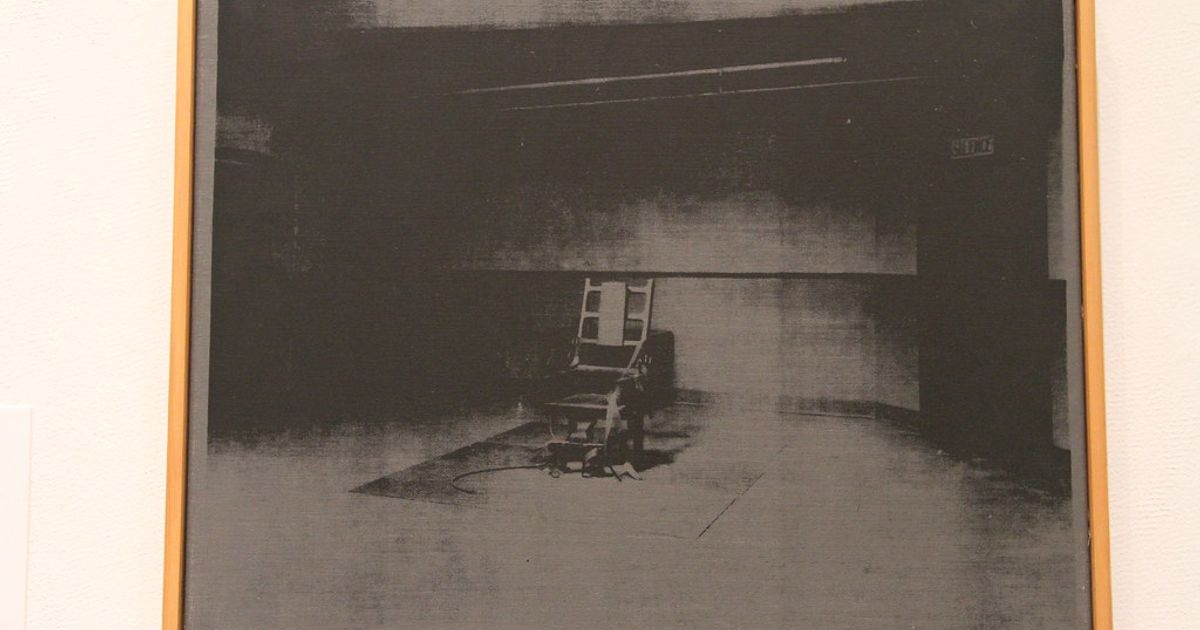
He was twenty years old, and he bought it in installments. The work was a silkscreen from Andy Warhol's Electric Chair series, acquired through the gallery of Lucio Amelio in Naples, the dealer who would become the young designer's introduction to the advanced art of his time. Ernesto Esposito, who would go on to spend fifteen years with Sergio Rossi and nearly a decade with Marc Jacobs, carried the Warhol home before he had the money to pay for it outright. He has described the acquisition as emotional: the work moved him deeply, and he wanted to live with it.
This founding mythology is important to the study not because it is implausible, but because of what it claims. The collector who is moved, who buys on feeling rather than investment, who enters into a relationship with an object rather than a transaction, is making an implicit argument about custodianship. The Custodian's Contract is the obligation a collector assumes when they take a work into their life: to preserve it, to understand it, to hold its meaning against the pressure of the market. Esposito's story presents itself as exactly this kind of contract. It should be read carefully.
The Electric Chair series occupies a specific position in Warhol's practice. Beginning in 1963 and extending through several print runs in the late 1960s and early 1970s, the works reproduce the electric chair at Sing Sing Correctional Facility, the instrument of state capital punishment, in the visual language of consumer advertising: silkscreen, serial repetition, flat synthetic color. The works are simultaneously an indictment of the spectacle of death and a formal question about what repetition does to horror. They were radical in their moment. They remain radical, in theory.
In practice, Esposito acquired one such work at approximately the moment he was beginning a career in commercial luxury footwear. The study's central question begins here: what does it mean to be a luxury producer who holds a Warhol? What contract is actually in place?
The Producer's Register: Shoes for a Market
Ernesto Esposito's career as a shoe designer runs from the early 1970s to the present, and it is not a marginal career. He worked with Sergio Rossi for over fifteen years, one of the most technically rigorous Italian shoe houses, then joined Marc Jacobs as the designer was building what would become one of the most commercially consequential careers in contemporary fashion. He subsequently contributed to Chloe, Sonia Rykiel, Louis Vuitton, Fendi, Missoni, and Geox. These are not boutique operations. This is the infrastructure of the global luxury and mass-luxury shoe market.
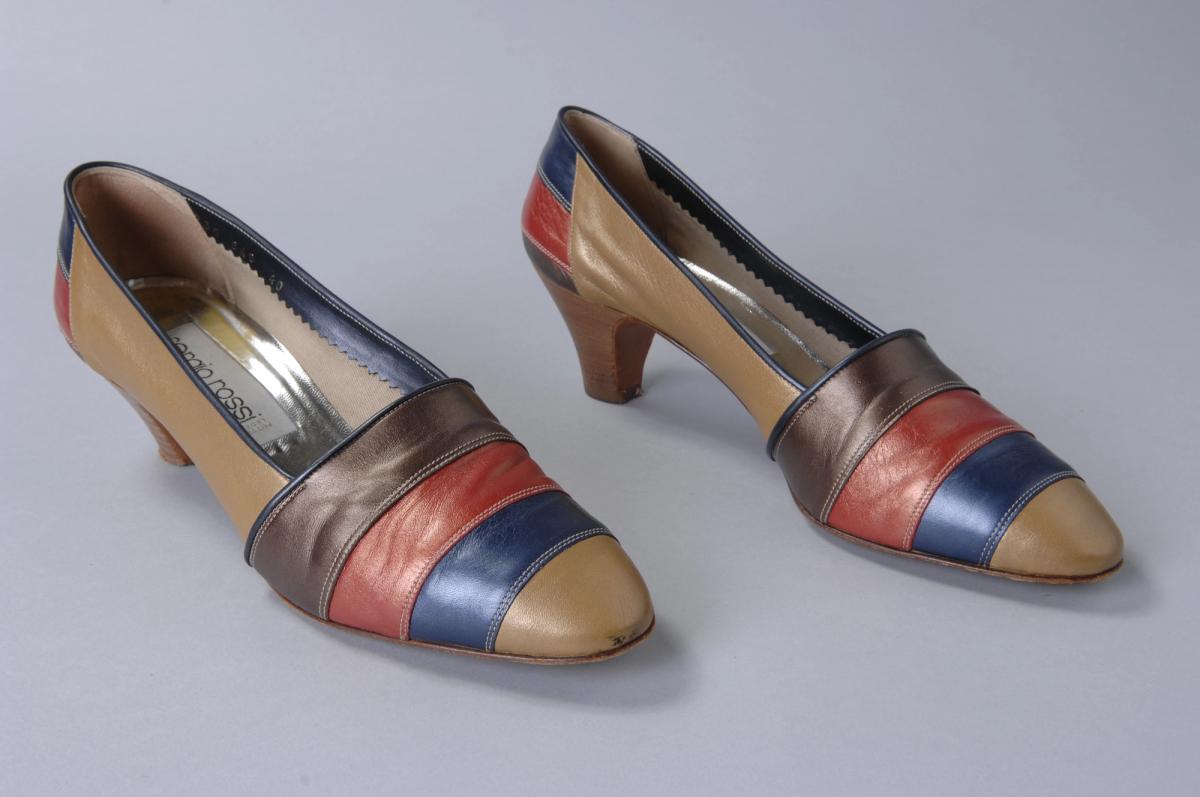
The shoe is not a singular object. In this it differs categorically from the artworks Esposito collects. A shoe is designed once and reproduced in volume: in hundreds, in thousands, in tens of thousands. Its value proposition is the brand, the design grammar that the consumer recognizes and purchases. What the shoe sells, as this institution has documented across its material cost studies, is not the object but the name: Material Singularity is what the luxury shoe performs but structurally cannot be. Shoes pass through supply chains that span continents. They arrive in stores as products. They accumulate sign-value through advertising and cultural association.
The material economics of Italian luxury footwear have not yet passed the Material Integrity Record's independent verification threshold, but the architecture is structurally identical to what this institution has documented: in the silk scarf study and the crocodile bag study, evidence-grade make-cost floors show multiples of 4.5x and 4.2x respectively, with luxury retail priced on sign-value rather than material covenant. The shoe operates in this same economy. Material economics computed with the Material Integrity Record, an instrument of the Objects of Affection Collection.
Esposito has never claimed otherwise. His stated view is that shoes are cultural objects, capable of expressing identity, emotion, and creativity. This is a sophisticated position, and it is the position the luxury market requires: that the commodity be presented as an expression rather than a product. But an expression produced in serial volume for a speculative market is a Semantic Burden, not a material covenant. He understands this better than most. He collects the artworks that prove it.
Warhol's Electric Chair and the Hollowed Object
The Electric Chair is a work about capital punishment, about the normalization of state violence through repetition, about the commodity form of horror. Warhol chose the electric chair because it was a photograph that had become a stock image, circulated in newspapers until its horror was absorbed into the background noise of visual culture. His intervention was to reprint it in the colors of consumer goods, to hang it in galleries alongside soup cans and Marilyn Monroe. The argument is precise: the spectacle of death is already a product. The gallery acknowledges what the newspaper pretends not to know.
This is an artwork that functions as critique. Not protest in the sense of activism, but critique in the sense of analysis: a formal demonstration of the mechanism by which capitalist culture processes violence into spectacle. When this artwork enters the collection of a luxury shoe designer, something happens to that analysis. The critical apparatus is not destroyed; the work does not change. But its meaning is repositioned. It is now evidence of the collector's discernment, his eye, his sensitivity. The Warhol that once said everything is a product is now the product that says this collector understands everything.
This is the Hollowed Object: not an object whose critical capacity has been literally removed, but one whose critical vocabulary has been co-opted into the service of the system it once analyzed. The work retains its formal properties. The argument it makes on its surface remains intact. But its cultural function has inverted. It no longer stands outside the luxury economy, pointing at it; it now stands inside, lending the economy its critical credibility.
Institutional Necrophagy is this process at the systemic level: the consumption of critical or subcultural discourse by institutional luxury culture for the purpose of accumulating symbolic capital. The luxury system does not kill critique; it collects it. And the collector who holds the Electric Chair in his Naples studio is not the villain of this story. He is the structure made legible.
Barbara Kruger's "Wish You Were Here": Protest in the Living Room
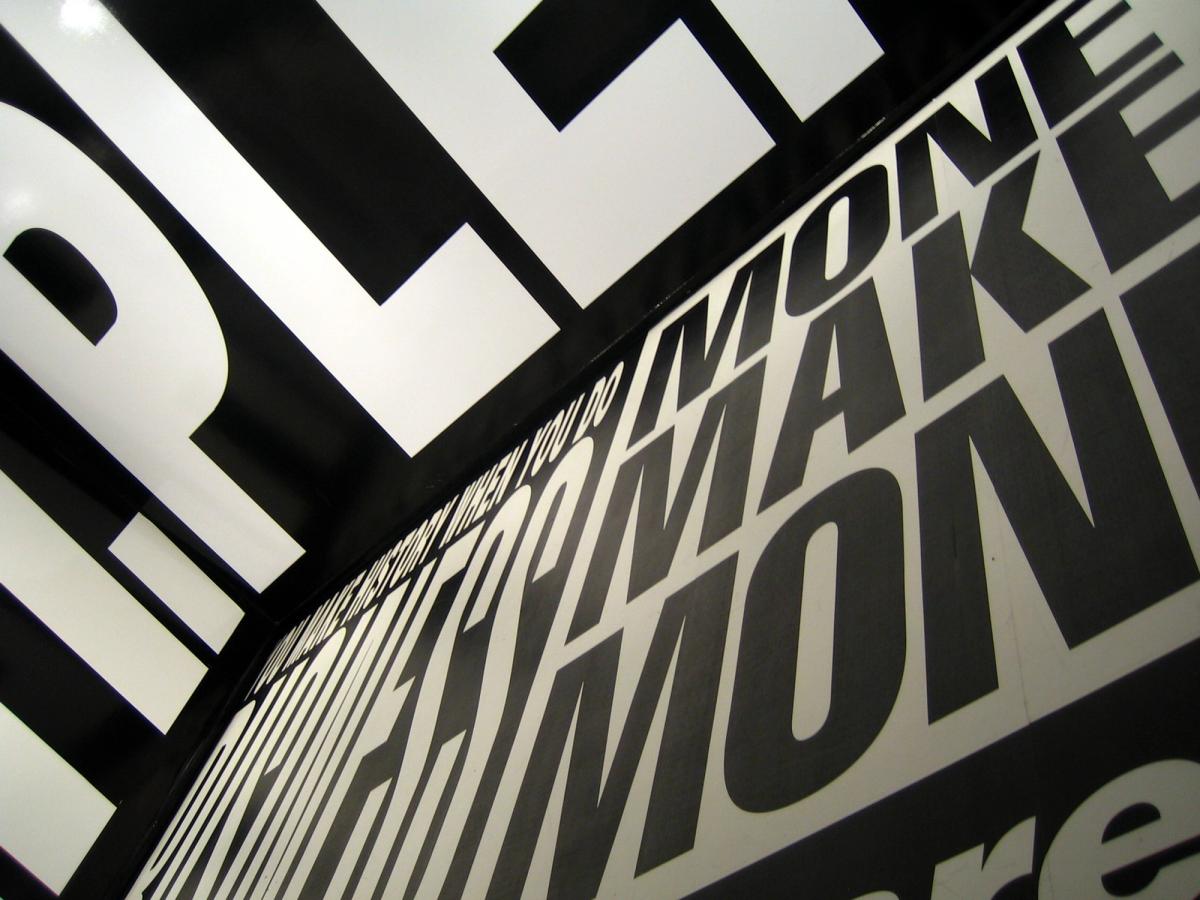
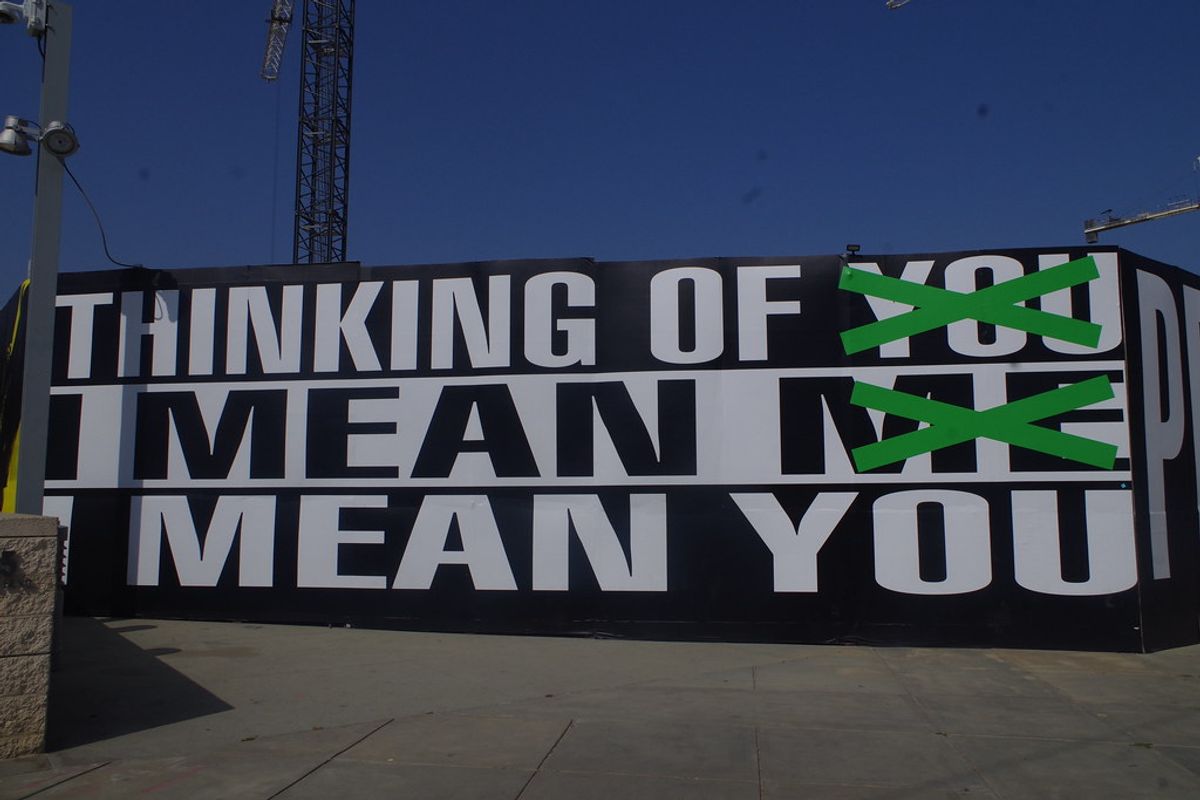
Barbara Kruger's "Untitled (Wish You Were Here)" from 1988 is a more precise provocation than the Electric Chair, in one respect: Kruger's practice is explicitly about the commodity form, about the address of advertising, about the way power speaks through consumer culture. Your body is a battleground. I shop therefore I am. You are not yourself. These are not artworks about something external; they are structured to speak directly to the viewer as a subject of the very system they critique. To hang one in your living room is to live with an accusation.
Esposito owns this work. He presumably looks at it. He has described his collecting as a way of living with questions. The question that "Untitled (Wish You Were Here)" poses is not abstract: it asks who is present, who is absent, who is addressed and who is excluded by the language of desire that luxury culture speaks in. It is a work made for a wall in a fashion designer's home in exactly the way that Kruger intends: to confront whoever lives there with the structure of their own complicity.
The Zero-Sum Aura operates at the level of cultural capital: when the aura of a protest work transfers to its collector, the protest aura is not doubled but divided. The work that said I shop therefore I am now also says Ernesto Esposito has the sensitivity to own this work. The critique and the credential share the same frame. The Semantic Burden the work carried as cultural critique is now partially occupied by the collector's identity. The work has not been destroyed. It has been employed.
Kruger's practice has survived this kind of co-optation precisely because she anticipated it. Her work is so explicitly about the commodity form that its incorporation into luxury collecting almost reads as the final proof of her argument. But survival as proof is not the same as survival as resistance. A work that correctly predicts its own absorption into the system it critiques does not thereby escape absorption. It simply becomes the most elegant evidence the system has ever produced of its own appetite.
Lucio Amelio and the Education of the Collector
Lucio Amelio's gallery in Naples was not a boutique. In the 1970s it was one of the few venues in southern Italy where an artist or collector could encounter the advanced international practice of the moment: Arte Povera, Conceptual Art, the work being made in response to the student movements and political upheavals of 1968 and after. Amelio introduced Esposito to Joseph Beuys, to Jannis Kounellis, to Warhol himself. He gave the young shoe designer access to a formation that would shape his aesthetic commitments for the next fifty years.
This is important to understand structurally, not merely biographically. The collector's eye is always formed by intermediaries: gallerists, dealers, curators. The Aura Transaction that occurs between gallerist and collector is not innocent: the gallerist transfers not only taste but authority, not only objects but the institutional credibility of having been associated with the right works at the right moment. Amelio's Naples in the 1970s was a specific credentialing apparatus, and Esposito emerged from it with a formation that the market would subsequently value.
The Arte Povera movement, to which Kounellis and others in Amelio's circle belonged, was an explicit critique of the commodity status of the artwork: its name announces poverty as a formal principle, a resistance to the luxury market's demand for precious materials and reproducible aesthetics. A Kounellis made of sacking and coal does not behave like a silkscreen. Its Narrative Permanence is not secured by reproducibility but by specificity: the installation exists once, in one place, under one set of conditions. To collect it is to assume a genuine Burden of Preservation.
Whether Esposito has honored that burden across his collection of over 1,000 works is a question the Sotheby's auction records will help to answer.
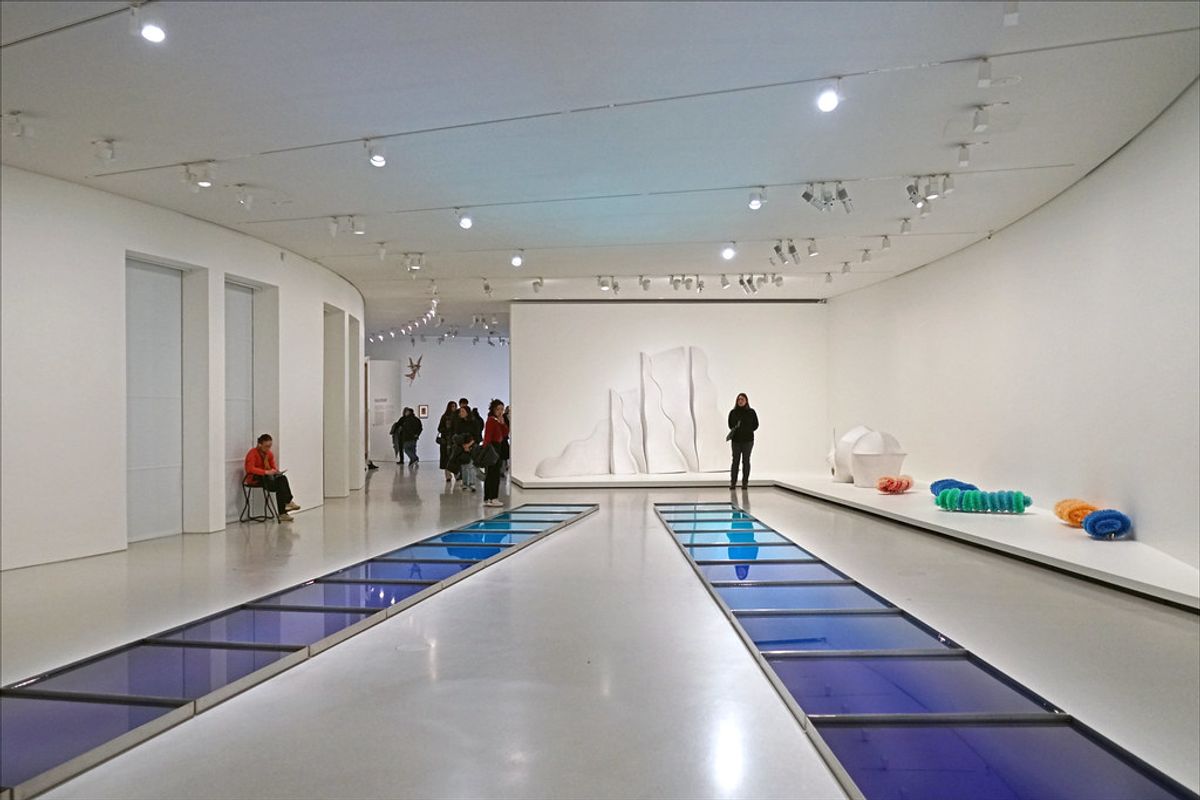
The Custodian's Contract and Its Betrayals
Between 2015 and 2021, portions of Ernesto Esposito's collection went to auction at Sotheby's: first in London, across the Italian Sale and Contemporary Art auctions; then in Paris, where 60 works of design and contemporary art from his Rome apartment raised a total of approximately $924,000. These are not small events. They are not the sale of a duplicate or the disposal of a minor acquisition. They are the organized liquidation of significant sections of a collection that had been presented, in every profile and interview, as a life-long commitment to custodianship.
A collection that consigns to Sotheby's is not a collection committed to permanence. It is an inventory under suspension.
The Speculative Velocity of the secondary art market is precisely this: the rate at which an object's meaning is replaced by its market position. Once a work is consigned to auction, it is no longer primarily a work; it is a lot. Its provenance becomes its selling point, not its content. The fact that Ernesto Esposito owned it is now a value proposition. The Electric Chair's critical function is encapsulated in the hammer price.
The Anti-Sale Covenant is the institutional commitment that no such transfer will occur: the pledge that the collection is not an inventory, that each work will remain in a specific relationship with a specific custodian rather than returning to the circuit of speculation. There is no evidence that Esposito made this commitment. His interviews suggest something closer to the opposite: a collector who defines his practice by accumulation, by curiosity, by the ongoing expansion of a collection rather than its concentrated stewardship.
The distinction matters because stewardship without the Anti-Sale Covenant is not stewardship. It is management. And the collection that grows to 1,000 works while regularly returning portions to the secondary market is not a custodial archive. It is a rotating inventory with curatorial ambitions.
Sign Value and the Collector's Covenant
When the Sotheby's Paris auction closed and the $924,000 total was announced, what had been confirmed was not only the market value of Esposito's collecting eye. What had been confirmed was the One Original Principle operating in reverse: the original that commands the premium is not the artwork but the provenance, and the provenance is the collector's name. The fact of Ernesto Esposito's ownership had added market value to every lot. This is the logic of sign-value as this institution has analyzed it: the premium paid for the signifier rather than the signified, the name rather than the object.
Esposito's collection, at this point in the argument, has become what this institution identifies as a mechanism of Root Marketing: a cultural infrastructure that seeds the brand, in this case not a fashion house but a designer's personal authority, with associations that cannot be purchased directly. The collection that holds Warhol and Kruger says something about the collector that advertising cannot say. It says: this person lives with difficult ideas. This person has the sensitivity to acquire works that make demands of their owner. This person is not merely a producer but a thinker.
But Root Marketing is the soft version of Institutional Necrophagy. It is Necrophagy without the awareness of what is being consumed. The more troubling reading, which the auction records now support, is that the collection was always partly speculative: not a corruption of an originally pure custodial intent, but an integrated strategy in which custodial language served speculative ends from the beginning.
The Collector-Producer as the System's Clearest Mirror
Esposito is not singular in this. The collector-producer is a recurring figure in the luxury economy. Francois Pinault built one of the most important contemporary art collections in the world while leading a retail group that competes directly with LVMH. Bernard Arnault has made the LVMH group's art patronage one of its defining institutional claims, including the construction of the Foundation Louis Vuitton in Paris. The pattern is consistent: the luxury brand that collects and exhibits art performs cultural legitimacy that no advertising campaign can purchase, and faces no requirement to document that legitimacy's custodial terms.
As EU regulators impose penalties on unsubstantiated green claims (the Empowering Consumers Directive takes effect 27 September 2026) and France's enhanced fast-fashion penalties take effect 1 September 2026, art patronage remains one of the few forms of unregulated cultural capital the luxury industry can deploy. You cannot say your garment is sustainable without documented evidence. You can say your brand is culturally significant on the basis of an art collection whose custodial commitments are never audited, whose Custodian's Contract is never verified, and whose works are available for return to the secondary market whenever the right price appears per lot.
This is where the Institutional Necrophagy argument closes. Not with the claim that Esposito is corrupt, but with the observation that the system in which he operates provides no mechanism to distinguish the genuine custodian from the speculative accumulator. Both tell the same story. Both use the same language. The difference is in the Custodian's Contract, and that contract is private, unverified, and apparently negotiable at the right price per lot at Sotheby's.
Coda
Ernesto Esposito bought a Warhol in installments at age twenty from a Naples gallery and never forgot the experience. This much the record supports. Everything else is interpretation: whether that purchase was the beginning of a custodial commitment or the first transaction in a long speculative career dressed in the language of sensitivity. The art market is not capable of answering this question, because the art market is precisely the instrument that makes the distinction impossible to read. Every genuine collector and every sophisticated accumulator speaks the same vocabulary: emotion, curiosity, friendship, creative risk.
What distinguishes the institutional position of OAC from the position of the art market is the willingness to ask the question the market has no interest in asking. The Custodian's Contract requires something the luxury world cannot provide: a binding commitment to hold rather than circulate, to preserve rather than liquidate, to honor the work's critical function rather than recruit it into the collector's brand capital. The Anti-Sale Covenant is the mechanism by which that commitment is made legible. It has not been made here.
Esposito is not the villain of this study. He is its subject because he makes the contradiction most visible. A shoe designer who collects Kruger is a man living in the structure his own production sustains, holding the critique of the market he has served for fifty years. The Hollowed Object at the center of this archive is not the Warhol on his wall. It is the claim of custodianship itself: drained of obligation, repurposed as credential, returned to the market at the right moment for the right price.