How Art Is Priced: Speculation Against Material Value

On the two systems that price a work of art, the mechanisms of speculative abstraction, and what the Custodian’s Contract demands instead…
The query “how artwork is priced” contains a hidden premise: that art has a price, that the price reflects something real, and that knowing the methodology helps a buyer distinguish a good deal from a bad one. None of these premises survive contact with the market’s actual architecture.
The contemporary art market operates through at least two distinct pricing systems: one nominally anchored in production costs, the other driven by speculation, reputation, and the abstraction of material reality into financial velocity. These systems co-exist, but they are not equal alternatives. One produces prices that track an object’s material covenant; the other produces prices that track an object’s imagined future trajectory in the portfolios of collectors who are, in significant measure, not collectors at all.
The Two Systems: Cost-Plus and Speculative Abstraction
The conventional pricing guidance available to artists and emerging market participants recommends a cost-plus formula: labor hours at a set rate, plus materials, plus overhead and gallery commission. Saatchi Art’s official guidance frames it precisely this way. The Art League specifies it numerically: ten hours at fifteen dollars per hour, plus forty-five dollars in materials, produces a starting price of one hundred ninety-five dollars.
This approach has one significant virtue: it anchors price in the material reality of the object. The price maps, however approximately, onto what was consumed in making the thing: time, skill, material. The Labor Density of the object has a proxy in the number. A slower, more material-intensive process produces a higher price; a faster, cheaper process produces a lower one. The relationship between cost and price is at least intelligible.
But the market that dominates, the gallery circuit, the auction room, the private brokerage, operates by an entirely different logic. ArtConnect Magazine recommends pricing by “price per square inch,” a metric that converts a work’s value into a spatial calculation divorced from material or temporal input. A large canvas costs more not because it took more time or used more costly materials, but because it occupies more area. The formula produces a number, but the number corresponds to nothing in the object. Size functions as a proxy for significance, which functions as a proxy for price, which functions as a proxy for nothing in particular.
The cost-plus formula is the market’s ethical vocabulary. The “price per square inch” is the market’s actual mechanism. These are not the same thing, and the gap between them is where the art market does its real work.

The Gallery Apparatus: Price on Request
The gallery’s pricing mechanism adds a layer of opacity that the cost-plus formula cannot penetrate. “Price on request” (POR) is the gallery’s default for primary-market works of significance, and it is not coyness: it is a structural feature. The dealer reads the prospective buyer before quoting, considering their level of institutional seriousness, their buying history, their willingness to agree to resale restrictions, their capacity to place the work in a setting that enhances the artist’s trajectory. The price is a function of the buyer’s position in the gallery’s network, not of the object’s intrinsic qualities.
This is Structural Captivity made transparent: the buyer cannot evaluate the price against any external standard because the standard does not exist. The gallery’s valuation is sovereign, and the buyer’s access to the work depends on accepting that sovereignty. The collector who asks “what does it cost?” has already revealed their outsider status. The collector who understands the system asks “is this artist right for the program?”: a different question entirely, and one whose answer the gallery is far more interested in providing.
The gallery’s pricing power is reinforced by waiting lists, which are themselves a pricing mechanism. When demand exceeds supply, the gallery does not raise the price: it extends the wait. The object’s price remains artificially stable; its perceived scarcity increases. The speculative premium accumulates not in the primary price but in the secondary market premium that the waiting list generates, a dynamic that operates entirely outside the cost-plus framework and entirely within the logic of manufactured scarcity.
The Auction Circuit: Estimates as Marketing
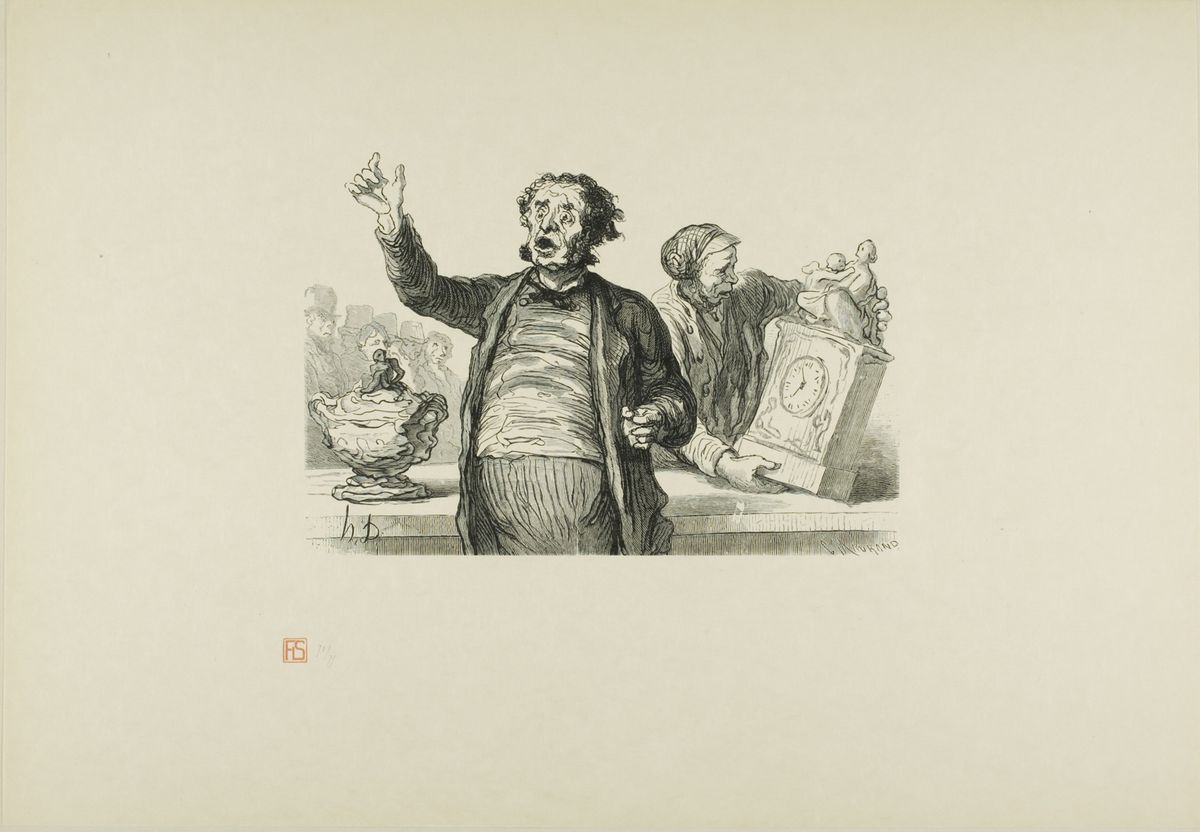
The auction market introduces a different mechanism: the estimate, which functions as a marketing instrument rather than a valuation. Auction specialists at firms including Sotheby’s and Christie’s set pre-sale estimates deliberately below anticipated hammer prices to generate bidding momentum. The starting bid is frequently set at fifty percent of the low estimate, or lower, to maximize competitive pressure from the opening gavel. The psychological effect is well-documented: a low estimate creates urgency, narrows the field to committed bidders, and produces the appearance of a bargain that the room rapidly converts into a record.
The guarantee-and-enhance deal compounds this. Major auction houses now regularly offer irrevocable third-party bids: a collector or dealer guarantees a minimum price in exchange for a share of any premium above that floor. The guarantor profits if the work sells above their floor; the house is protected from a buy-in at any price above the reserve. What appears to be an open market auction is, in practice, a negotiated transaction with the bidding room serving as price-discovery theater.
The result is that auction results, widely cited as market evidence, as data points for insurance valuations and estate assessments, are not neutral measurements. They are performances designed to produce numbers that sustain the speculative apparatus. A work that sells at three times its high estimate is reported as a “strong result.” It would be more accurate to report it as a successful deployment of the estimate-as-marketing strategy, which is something rather different.
Speculative Velocity and the Aura Transaction
The pricing of art by reputation is the most consequential abstraction in the market’s toolkit. When a work’s price is set not by its material qualities or its production cost but by the market standing of its maker, the logic of Speculative Velocity takes full hold. Price increases not because the object changes but because the artist’s market position escalates. The collector who bought early is rewarded not for their custodial commitment but for their timing, and the incentive structure of the market is designed to produce exactly this reward.
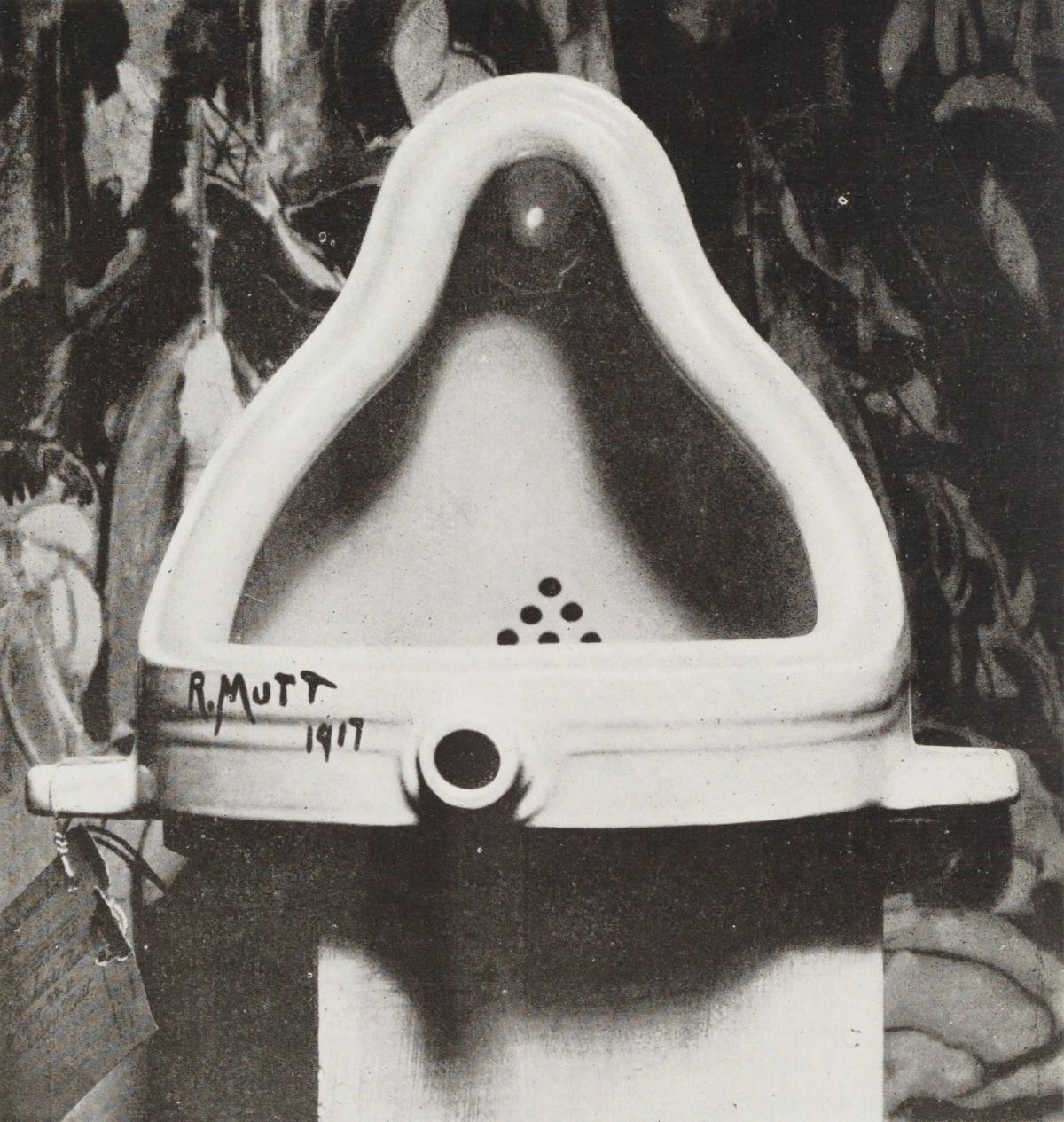
Marcel Duchamp’s Fountain (1917), a manufactured urinal acquired from a plumbing supply house for approximately six dollars, made this logic visible with forensic clarity. Submitted under a pseudonym to the Society of Independent Artists and rejected, the work was photographed by Alfred Stieglitz and subsequently lost, then replicated in authorized editions that now command prices in the millions. The object’s material properties were identical to any other urinal of the period. What the market priced was the attribution, the gesture, the concept: nothing that existed in the physical object at all.
Jean Baudrillard diagnosed this condition at the level of the system: the art market is the domain in which sign value entirely displaces use value, and where price functions not as a measure of worth but as a measure of an object’s position in a system of social differentiation. To own the work at a high price is to announce that one participated in the price’s elevation, which is itself a form of social performance. As OAC’s study on why luxury costs more establishes, this premium is not a reward for material quality: it is a reward for sign value, for the social position that ownership confers.
This is the Aura Transaction in its purest form: the buyer does not acquire the object; they acquire the aura, the accumulated signification the market has attached to the object’s provenance. And the aura is Zero-Sum Aura: speculative velocity concentrates into a small set of works, and every price record that establishes a new high for one object displaces market attention from others. The ascent of one work requires others to be repositioned as lesser, as derivative, as belonging to a different tier.
Paul Cézanne’s The Card Players provides the canonical illustration. A two-figure version of the series was sold to Qatar’s royal family for a sum widely reported in the range of $250 million to $300 million in 2011 to 2012, placing it among the most expensive paintings ever sold. The work’s material qualities, oil on canvas, modest in scale, did not change between the Cézanne estate’s custodianship and the sale. What changed was the work’s position in the speculative apparatus: its provenance, its scarcity, its institutional validation, its function as sovereign-wealth positioning. The price had no relationship to what the canvas cost to produce, or what it costs to preserve. It tracked only the Semantic Burden the market had loaded onto it across a century of accumulation.
The Hollowed Object: Art as Alternative Asset
When art enters the circuits of alternative asset management, including art funds, art-backed lending, and freeport storage, the Aura Transaction reaches its logical terminus. The global art market is now valued at approximately $586 billion, with 85 percent of wealth managers advocating for art as a component of a balanced portfolio. Nearly 200 art investment funds operate globally. Freeports in Geneva, Singapore, and Luxembourg warehouse billions of dollars of art in climate-controlled vaults, where works are bought and sold without ever leaving storage, never exposed to a wall, a light source, or a viewing audience.
The Hollowed Object is not a metaphor in this context. It is the stated goal of art finance infrastructure: to strip an object of its material and cultural function and reconstitute it as a pure financial instrument, indistinguishable in portfolio terms from a commodity futures contract. The object’s singular physical existence, its irreducible material covenant, has been converted into a unit of account.
The regulatory apparatus has begun, belatedly, to acknowledge this. The European Union’s Fifth Anti-Money Laundering Directive (5AMLD), effective 10 January 2020, and its Sixth (6AMLD), applying from 3 June 2021, brought art market participants above €10,000 into the AML framework for the first time, recognizing that freeport opacity and the absence of beneficial-ownership disclosure had created a structural vector for financial concealment. The United States Anti-Money Laundering Act of 2020 extended coverage to antiquities dealers; general art dealers and auction houses remain largely outside US federal AML requirements, a gap that the Harvard International Law Journal and others have documented as a structural defect in the oversight framework. The state has arrived, as it invariably does, at conclusions the material transparency argument had already reached by other means.

Institutional Necrophagy and the Pricing Guide
The guides produced by Saatchi Art, The Art League, and ArtConnect Magazine occupy an interesting position in this architecture. They present themselves as practical tools for artists navigating the market, and in the narrowest sense, they are. But they also perform a specific ideological function: they transmit the vocabulary of material value (cost, labor, materials) while embedding the logic of speculative acceleration.
The cost-plus formula is presented as the ethical foundation of pricing. It is then immediately supplemented with advice about raising prices when sales velocity increases, tracking gallery prices for comparable artists, and adjusting for market comparables. The material vocabulary survives, but it serves a speculative function: it provides the initial legitimating framework that the market’s actual mechanisms then replace.
This is Institutional Necrophagy in its subtlest form: the digestion of material value by the market’s representational apparatus. The language of craft and Labor Density is consumed and re-emitted as a justification for speculative pricing, validating the abstraction it appears to resist. An artist who follows this guidance to its logical conclusion will begin with a cost-plus price and end, if they achieve any market traction, with a price determined entirely by comparables and demand, having used the cost-plus formula only long enough to establish that they take pricing seriously.
The cost-plus formula is the market’s on-ramp. Speculative velocity is the highway. The guides do not tell you this, but they are designed to get you from one to the other as smoothly as possible.

The Custodian’s Contract: What Value Actually Tracks
Against this architecture, the OAC position is structural rather than moralistic. The problem with art market pricing is not that it produces high prices; it is that the mechanisms of pricing have been systematically decoupled from the qualities that make an object worth preserving across time.
Material Singularity, the property of an object that makes it irreplaceable, whose value accrues through its specific material existence and the labor embedded in it, is the quality that the Custodian’s Contract exists to protect. A collector who enters the Custodian’s Contract does not acquire a work as a speculative instrument; they accept a responsibility for its preservation that exceeds their financial interest in its appreciation. The Burden of Preservation, the cost of proper storage, insurance, conservation, and custodial commitment across generations, exceeds, for most works, their speculative appreciation. The collector who accepts this burden is not making an investment; they are accepting a covenant.
This reframes the question of getting a good deal. A good deal, in the terms the market provides, is a speculative arbitrage opportunity: buying before the price rises, selling before it falls. A good deal in the terms of the Custodian’s Contract is something entirely different: an acquisition at a price that reflects the work’s material covenant, secured from a maker whose practice is grounded in material integrity, held within a framework of preservation rather than liquidation. These are orthogonal definitions, and they produce orthogonal behaviors.
The art market’s own history is instructive. Works that achieved speculative peaks have collapsed when the underlying reputation failed, when the market moved, or when the institutional validation that sustained the price withdrew. Works dismissed as decorative, regional, or minor have accrued permanent institutional significance across generations of curatorial reassessment. The price was a poor predictor of value in both directions. The Narrative Permanence of an object, its capacity to sustain meaning across time, to remain legible when the market’s current obsessions have shifted, has no relationship to its current price. It is a function of the object’s material and conceptual depth, which the pricing mechanism does not measure.
OAC’s own material economics apparatus, computed with the Material Integrity Record, an instrument of the Objects of Affection Collection, examines this gap from the production side: the relationship between what an object actually costs to make and what it sells for. The same methodology that documents a 4.5x multiple on a silk scarf and a 4.2x multiple on a crocodile bag applies, conceptually, to art: the question is always what was consumed in making the object, and what the market adds above that floor. In the luxury goods market, the multiple measures the sign value premium. In the art market, the multiple is not bounded by any production floor, because production cost is incidental to the price-setting mechanism from the beginning. The art market’s multiple is not 4x or 9x; it is whatever the speculative apparatus requires.
Coda
The art market’s pricing machinery is not neutral. It is designed to produce and sustain speculative velocity, and it succeeds: works are priced, repriced, and leveraged in ways that have no relationship to their material covenant. The guides available to artists and buyers alike transmit a vocabulary of value that the market immediately converts into a currency of abstraction.
Against this, the OAC position is structural: value accrues through Material Singularity and the custodial frameworks that protect it. A “good deal” in the art market is not a speculative arbitrage opportunity; it is an acquisition that aligns price with material covenant and accepts the Burden of Preservation as the price of genuine ownership.
The market will price art by square inch, by reputation, by auction estimate, and by the requirements of the alternative asset portfolio. The collector who understands what the pricing system actually measures, and what it systematically ignores, has already identified the gap where genuine value lives: in the object’s irreducible physical existence, in the labor that produced it, and in the custodial commitment that preserves it across time.
The price is the last thing to look at. The questions that matter come earlier: who made this, with what materials, and toward what end. These are the coordinates of the Custodian’s Contract, and they are entirely orthogonal to the pricing guides.