David Hockney London Memorial 2027: Critical Analysis of Legacy’s Speculative Velocity
On Ceremonial Energy, the Custodian’s Contract, and What a Funeral of Two Reveals About a Memorial of Thousands...
The David Hockney public memorial announced for London in spring 2027 is the most consequential piece of ceremonial infrastructure the art world will build this decade. The Hockney London 2027 event, confirmed by the artist’s representatives eleven days after his death on June 11, 2026, will convert the David Hockney art legacy from a living practice into a managed estate in full public view. This study reads conversion through the PLCFA lexicon: Ceremonial Energy, Narrative Permanence, Speculative Velocity, Material Singularity, and the Custodian’s Contract; and, on the record, corrects the institutional hypotheses that preceded verification. What the memorial decides is not how Hockney is remembered. It is who owns the act of looking.
The Record, Corrected: What the Arena Got Wrong
This study begins with a correction, because Objects of Affection Collection publishes its errors rather than laundering them. Our internal dialectical council, arguing this signal before verification, split on a premise several agents got wrong: that the memorial was announced while David Hockney was alive, a “pre-emptive memorialization” a spectacle scheduled ahead of a death. One agent argued the opposite error, placing the memorial “years after his passing.” The primary record refutes both. Hockney died peacefully at home in London on June 11, 2026, at 88. On June 22, David Hockney Inc. announced that the first public memorial service will take place in London in spring 2027, with further memorials to follow in Yorkshire, Paris, and Los Angeles.
The correction matters because it changes the diagnosis. This is not the pre-emptive consumption of a living artist’s narrative. It is something subtler and more instructive: the deliberate temporal architecture of posthumous commemoration, a ten-month interval engineered between a private funeral of two and a public memorial of thousands. The question of Institutional Necrophagy survives the correction. Its tense changes from future to present.
A memorial scheduled ten months in advance is not mourning; it is programming. The grief is real. The calendar is institutional.
A Funeral of Two: The Last Private Act
In accordance with the artist’s wishes, Hockney’s funeral had exactly two guests: his partner, Jean-Pierre Gonçalves de Lima, and his great-nephew, Richard Hockney. Both are trustees of the David Hockney Foundation, the body dedicated to the preservation, exhibition, and publication of his work. This detail is the load-bearing fact of the entire announcement, and nearly every obituary buried it. The two people permitted to witness the body’s disposal were not merely intimates. They were the estate’s legal custodians. The funeral of two was simultaneously the smallest possible act of grief and the first official act of the posthumous art market’s counterparty.
Read through the Burden of Preservation, this is not cynicism; it is structure. An artist who spent six decades insisting on the primacy of looking chose, at the end, to be unseen. The refusal of spectacle at the grave transfers all of the withheld aura to the deferred public rite. The cultural significance of David Hockney’s passing was not diminished by the private funeral. It was banked.
Two mourners buried the man. Four cities will bury the market’s version of him.
The Ten-Month Interval: Engineering Ceremonial Energy
Ceremonial Energy, in the OAC lexicon, is the convertible cultural charge released when an object or a biography passes through ritual. The announcement’s most sophisticated feature is its use of time. Eleven days after death: the announcement. Ten months later: the London service. Then Yorkshire, Paris, Los Angeles, a sequence, not an event. This is the same logic by which a spectacle is serialized: each service re-opens the news cycle, re-prices attention, and re-anchors the Semantic Burden of the oeuvre while auction calendars breathe between them.
Guy Debord taught that the spectacle is not a collection of images but a social relation mediated by images. Walter Benjamin taught that the aura withers under reproduction. A distributed, year-spanning memorial program is the institutional answer to both: it manufactures scarce, unreproducible ritual moments, aura on a schedule, and it does so through the one currency that requires no consent from its subject. Whether that conversion is performed for the work or upon the work is precisely what the Aura Transaction framework exists to test.
There is also a risk-management reading, and fairness requires it. Estates that rush the public rite, the memorial within the month, the tribute exhibition within the quarter, surrender the narrative to whoever moves fastest, usually the salesrooms. A ten-month interval gives the David Hockney Foundation time to do the unglamorous custodial work first: securing the archive, freezing the catalog raisonné perimeter, sequencing loans, and deciding what the estate will not do before announcing what it will. On this reading, the interval is not a market instrument but a firebreak. The two readings are not mutually exclusive, and that is the point: the same temporal architecture serves stewardship and speculation simultaneously, and only the estate’s subsequent conduct will reveal which master the calendar was built for.
Ceremonial Energy is the only currency that can be minted from a death without the consent of the dead.
Four Cities: The Geography of a Legacy
London for the state and the institutions. Yorkshire for the origin story: Bradford, the Wolds, the boy who drew. Paris for the late Normandy years and the European market. Los Angeles for the pools, the light, and the American collectors. The four-city itinerary is a map of Hockney’s biography, but it is also, without a single coordinate changed, a map of his market. Every memorial city is an auction city or feeds one. Understanding David Hockney’s historical placement now requires holding both readings at once: the geography of a life, and the distribution network of its afterlife.
This is where civic memory and market logistics become indistinguishable by design. A living memorial program distributed across four cities does for a legacy what a traveling retrospective does for a consignment pipeline: it validates locally, everywhere the work will later sell. None of this requires bad faith from the David Hockney Foundation. It requires only that the infrastructure of remembrance and the infrastructure of post-mortem financialization share every physical node, which they now do.
The Market That Refused to Spike
The Speculative Accelerationist position in our Arena predicted immediate velocity: a posthumous premium, a rush to consign, an art market feeding before the body was cold. The record is more interesting. Within 48 hours of the death, private-market inquiries for Hockney editions reportedly surged by an order of magnitude, but the first major auction test told a different story. On June 26, 2026, Phillips London sold The Only One with Waves (1991) for £2.42 million, inside its estimate. Collectors held to established values rather than chasing a posthumous premium. Art market speculation after an artist's death is real, but it is not reflexive; it waits for narrative consolidation before it prices.
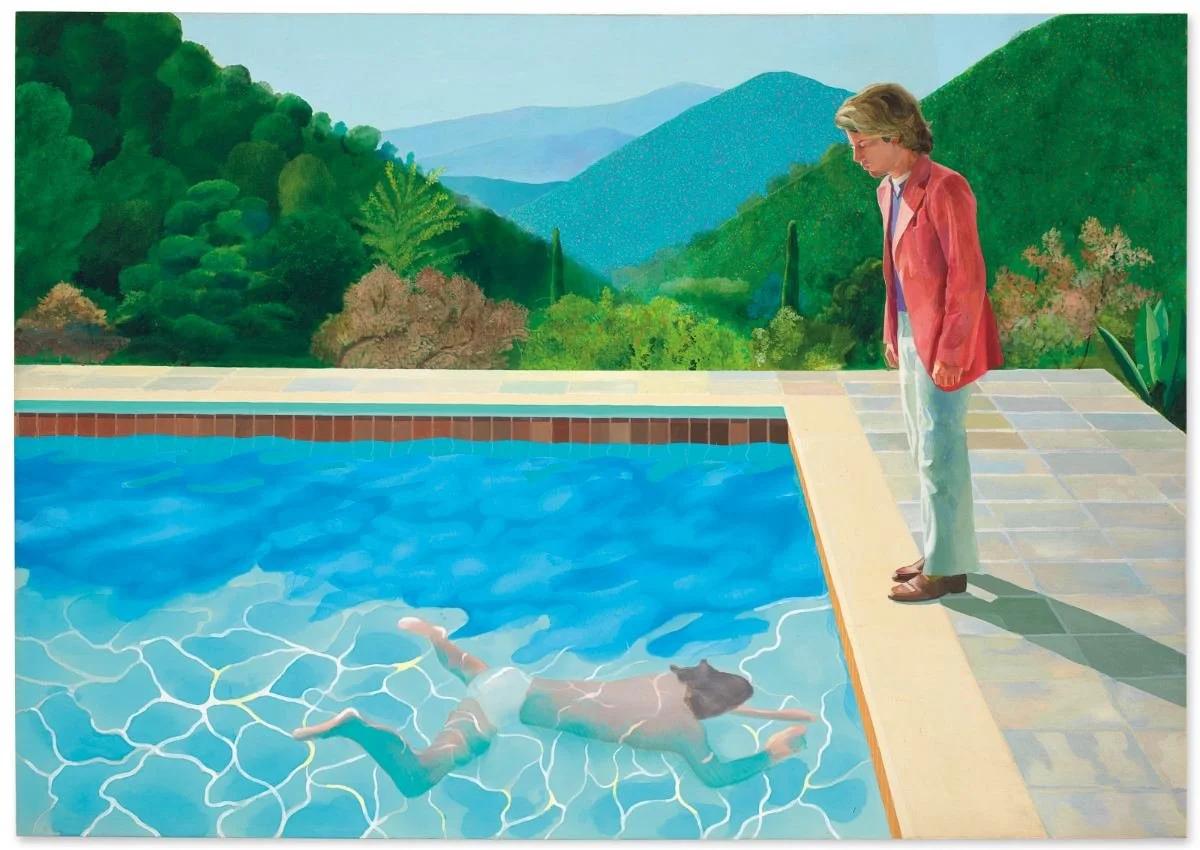
That is exactly why the memorial matters to the posthumous value of David Hockney artworks. The record price, $90.3 million at Christie’s in 2018 for Portrait of an Artist (Pool with Two Figures), then the auction record for a living artist, was set by a market pricing a living hand. Any David Hockney art market analysis 2027 will be conducted in the shadow of the London service: the memorial is the narrative consolidation the market is waiting for. The restraint of June 2026 is not the absence of Speculative Velocity. It is its coiling.
Structurally, the Hockney market is two markets wearing one name. The editions market, the prints, the iPad drawings issued in multiples, is the liquidity layer where the 48-hour inquiry surge actually occurred; it prices sentiment in near real time because its objects are comparable and plentiful. The unique works, the pool paintings, the double portraits, the Yorkshire panoramas, are the narrative layer, where value moves only when the story moves. A memorial program touches the second market, not the first. That is why the spring 2027 service matters more to the top of the market than any obituary did: obituaries close a biography, but ceremonies re-open a valuation. The sequence from Yorkshire to Paris to Los Angeles will function, whatever its intent, as a year-long comparables event for the narrative layer.
The absent posthumous premium is not restraint. It is a market waiting to see who controls the narrative before it prices it.
The Foundation as Custodian: Estate Management in Public
The David Hockney estate management future now runs through a foundation whose trustees were the only two witnesses at the grave. Under the Custodian’s Contract (OAC’s framework for the ethical obligations that attach to holding culturally significant objects) this concentration is double-edged. Concentrated custody can protect Object Permanence: a small, aligned trusteeship can refuse the fractional, the tokenized, the licensed-to-death. Or it can become Structural Captivity, in which a body of work is held hostage to the reputational and financial strategies of its guardians.
The early signals favor stewardship. The funeral’s privacy honored the artist’s wishes over the media economy’s appetite. The memorial program privileges places of biographical weight, including Bradford, which no consignment strategist would rank with London. David Hockney works provenance post-2027 will be legible precisely because the Foundation controls the chokepoints: authentication, publication, exhibition. The Archival Death Mandate, the moment an oeuvre closes and every object in it becomes finite, has been activated with unusual discipline. The question is whether discipline survives the valuations.
There are instruments for making that discipline binding rather than temperamental, and our Speculative Legal Architect was right to name the lineage: Seth Siegelaub and Robert Projansky’s 1971 Artist’s Reserved Rights Transfer and Sale Agreement remains the template for encoding an artist’s interests into the object’s legal life after the artist can no longer defend them. A foundation that meant to convert Ceremonial Energy into permanence rather than velocity could announce, before spring 2027, the covenants that will govern its holdings: what will never be sold, what will never be fractionalized, what conditions attach to every loan. Silence on these questions is not neutrality. In a market this attentive, an estate’s unstated policy is set by the market on its behalf.
The Custodian’s Contract does not end at the grave; it begins there.
The Crown, the Window, and the State’s Embrace
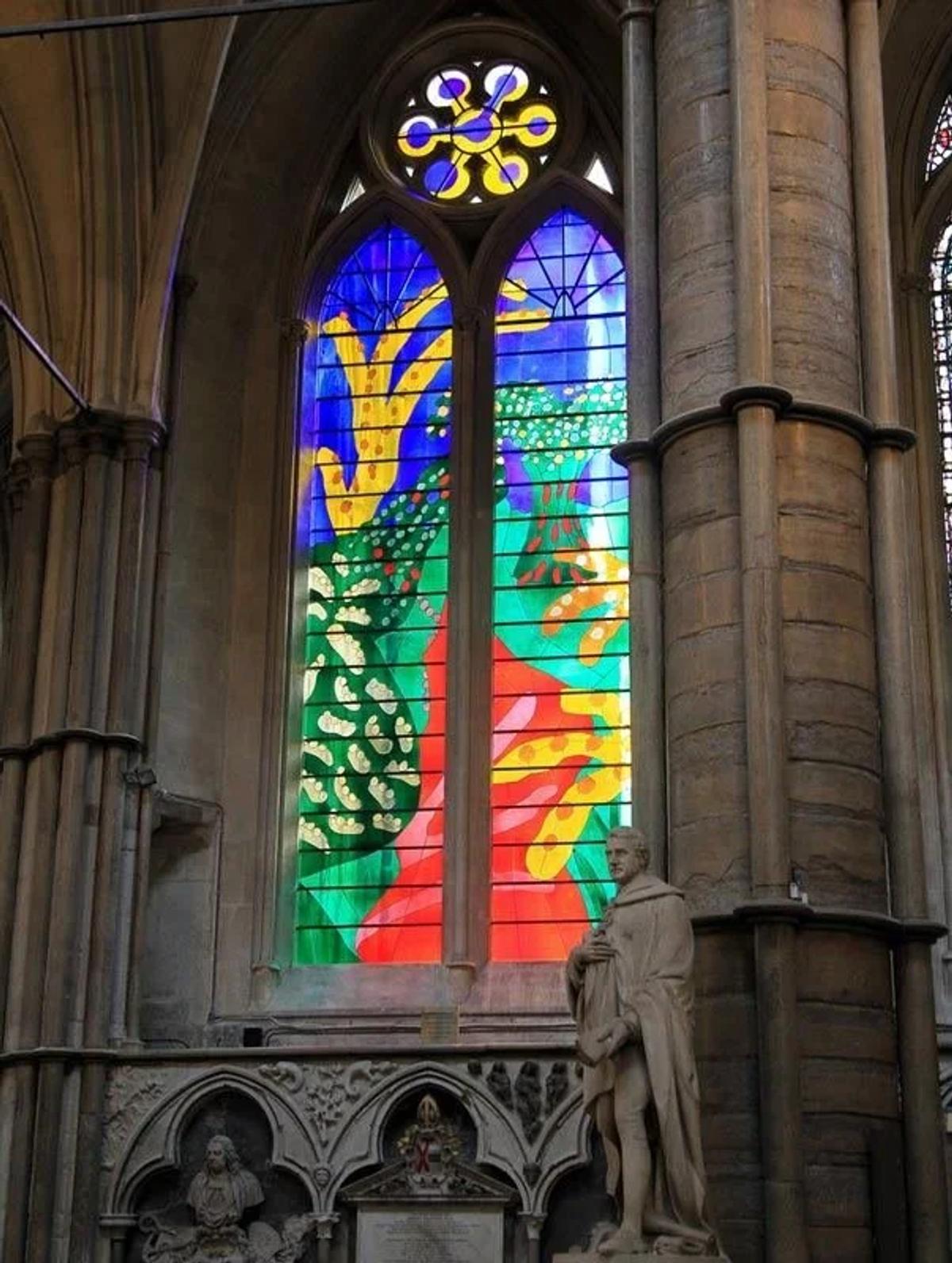
King Charles III mourned a “dear friend.” Tracey Emin called Hockney the artist who flew the flag higher than any other. The Guardian has speculated, and it remains speculation, no venue being confirmed, that the London service could be held at Westminster Abbey, where Hockney’s stained-glass Queen’s Window already stands as his homage to Elizabeth II. The symbolism writes itself, which is reason to distrust how easily it writes. A state-adjacent memorial in the Abbey would complete Hockney’s conversion from Bradford grammar-school rebel to British cultural heritage, from a maker of paintings to a signifier of national continuity.
Our Cultural Strategist called this the consecration of a taste regime, and here the Arena was right. The state does not attend memorials; it absorbs them. The chain-smoking homosexual who left England for the light of California will be re-presented as the nation’s beloved eye. Both are true. Only one of them will fit in the order of service. What gets edited out of the ceremony is the measure of what the ceremony is for, and the difference between honoring a Hollowed Object and an intact one is exactly the difference between a legacy consumed and a legacy kept.
The precedent worth watching is not artistic but liturgical. Britain has a long practice of converting its difficult figures into its dearest ones at exactly the moment they can no longer object. A memorial in the Abbey, if that is what spring 2027 brings, would place Hockney in the national reliquary beside the poets and the scientists, and the price of admission to that reliquary has always been the same: the sanding-down of everything that made admission unlikely in the first place. The estate cannot prevent this. But it can decide whether the work’s own testimony, the pictures themselves, unsentimental and exact, is allowed to interrupt the eulogy.
The Test of Spring 2027: Necrophagy or Stewardship
OAC’s standing diagnosis of Institutional Necrophagy describes institutions consuming an artist’s narrative to re-frame the work for intensified market velocity. The London memorial will be the cleanest live test of that framework we are likely to get. The necrophagic outcome is legible in advance: memorial as market catalyst; tribute programming synchronized with consignments; the David Hockney legacy and art market impact collapsing into a single curve; retrospectives whose lending institutions are also, quietly, the market’s validators. The custodial outcome is equally legible: a service that centers the work and the looking; a Foundation that uses the attention to fund preservation and scholarship rather than to warm the salesroom; provenance kept transparent; the estate’s chokepoints used to slow, not speed, the conversion of paintings into instruments.
Any collector's guide to David Hockney post-death worth reading should therefore watch three indicators through spring 2027: what the Foundation consigns and when; which institutions co-produce the memorials and what they borrow afterward; and whether the four-city sequence is allowed to conclude quietly or is extended into a rolling program of monetizable remembrance. Material Singularity, the irreducible uniqueness of each object Hockney actually touched, needs no ceremony. Ceremony is for the market, and for us.
Spring 2027 will not memorialize David Hockney. It will decide who owns the act of looking.
Coda
The David Hockney memorial service London 2027 will be beautiful. It should be. A man who taught three generations how to look deserves a room full of people practicing it. But Narrative Permanence is not built in rooms like that; it is built in the years after, in what custodians refuse as much as in what they stage. Hockney’s own instruction survives him and rebukes every use to which his death will now be put: look harder. At the order of service. At the lending lists. At the consignment dates. The work will keep. Whether the looking does is up to the living.
Authored by Christopher Banks, Anthropologist of Luxury, Critical Theorist & Founder Objects of Affection Collection Office of Critical Theory & Curatorial Strategy 469 Fashion Avenue, 12th Floor, New York, NY 10018
RELATED OAC STUDIES
Continue through the OAC archive along the fault lines this study opens.
On Hockney’s Death and the Market’s First Response: The Custodian of Looking: What David Hockney’s Death Reveals About the Architecture of Post-Mortem Necrophagy
On Structural Captivity and the Singular Object: Structural Captivity of Material Singularity
On Institutions Consuming Heritage at Velocity: Bayeux Tapestry British Museum Demand: Institutional Necrophagy’s High-Velocity Display
On Auction Infrastructure and Speculative Velocity: Artnet Auctions: Unmasking Speculative Velocity in the Hollowed Luxury Market
On Permanence as Institutional Mandate: Swiss Institute New York Permanent Location: A Mandate for Object Permanence