Martin Brudnizki London Design: The Spectacle of Curated Experience
On the designer’s shortlist as a genre, the aura it transacts, and the strange fact that a museum and a bookshop resist the very velocity the form was built to accelerate.
When a search returns Martin Brudnizki London restaurants, it is answering a question that looks like curiosity and behaves like commerce. The Swedish-born designer’s recent shortlist for Surface: A compact catalogue of his favorite spots across the city he has called home for decades, arrives dressed as generosity: a set of London design insider tips from the man who has designed some of its most coveted rooms. It is the purest possible expression of the designer city guide, the genre in which a luxury interior designer’s favorite spots become, by the mere fact of his naming them, a currency. This study reads that currency. It names the active mechanisms: the Aura Transaction, Atmospheric Equity, Speculative Velocity, and the specter of the Hollowed Object, and then does something the institutional record demands: it corrects them. For the list Brudnizki actually published does not behave the way our own council predicted it would.
Brudnizki is not an incidental figure to this problem. As the principal of Martin Brudnizki Design Studio, he has spent three decades authoring the grammar of contemporary hospitality design, the rooms in which a certain class of Londoner eats, drinks, and is seen. His interior design is not neutral décor but a fully articulated design philosophy, and when a philosophy of that reach issues a shortlist, the list is never merely personal. It is a specification for how a city should be consumed. That is what makes it worth the framework’s full attention; and what makes its internal contradictions instructive rather than trivial.
The Council’s Error: Reading a List That Was Never Empty
Before this study was written, eleven institutional agents argued the signal. Their synthesis was severe: the Martin Brudnizki shortlist, they held, was an act of Institutional Necrophagy, a curation devoid of Material Singularity, converting the critical language of discernment into commercial validation for transient taste. But read the fine print of their positions and a single word recurs like a confession: absent. The Custodial Archivist objected that the signal arrived “without any accompanying detail regarding the objects or sites on this list.” The Aura Transactionist conceded “the absence of specific press details.” The Necrophage Profiler required “real-world evidence detailing the specific objects or designs.” The verdict of necrophagy was rendered on an empty plate.
The plate was not empty. The article names Café Deco behind the British Museum, Portland Road and St. Clair in Holland Park, the Piano Nobile Gallery showing Barbara Hepworth, Julie’s in the evenings, Portobello Road, Wren’s churches, Sir John Soane’s Museum, and John Sandoe Books off the King’s Road. This is not an abstraction of taste; it is an inventory. And the inventory, once read, dissolves the very thesis it was supposed to prove.
The council mistook silence for absence. But a list that names Soane’s Museum and a Bloomsbury bookshop is not empty of content; it is full of the wrong content for its own machinery.
The Aura Transaction, Reconsidered
The mechanism the council correctly identified is real. An Aura Transaction is the transfer of a name’s reputational charge onto an object or place that did not previously possess it. When Walter Benjamin located aura in the here-and-now of the original, he did not anticipate its use as working capital; yet that is precisely what the designer city guide makes of it. Brudnizki’s endorsement is collateral. The places he names borrow against his standing, and the loan is repaid in footfall, bookings, and the Speculative Velocity that follows any place a tastemaker has touched.
A shortlist does not describe a city; it underwrites one. The designer’s name is the collateral, and taste is the interest paid.
But aura obeys conservation. It is a zero-sum quantity, and here the council’s reading of Veblen, conspicuous consumption converting taste into a financial instrument, meets its limit. A museum is not a financial instrument. A parish church is not liquid. When the Aura Transaction mechanism is applied to sites that cannot be bought, the transaction misfires, and what returns to the curator is not profit but a small, honest depletion.
Aura is conserved, never created. When a designer lends his to a room, the room does not become more real; the designer becomes slightly less.
The title this study has been given, the spectacle of curated experience, is not decoration. Guy Debord defined the Spectacle as a social relation between people mediated by images, and the designer city guide is Spectacle in its most benign-looking dress: a relation to a city mediated by a famous man’s images of it. Where Baudrillard would go further: the shortlist as a second-order sign, a map that begins to precede and replace the territory it charts, so that one visits Portland Road to confirm Brudnizki’s image of it rather than to encounter the street. The framework resists total pessimism. The Patronage Validation a tastemaker confers is not automatically a simulacrum. It becomes one only when the endorsed place has no material reality to fall back on. A room that is all image collapses into its representation. A parish church does not.
What Brudnizki Actually Chose: An Inventory of Resistance
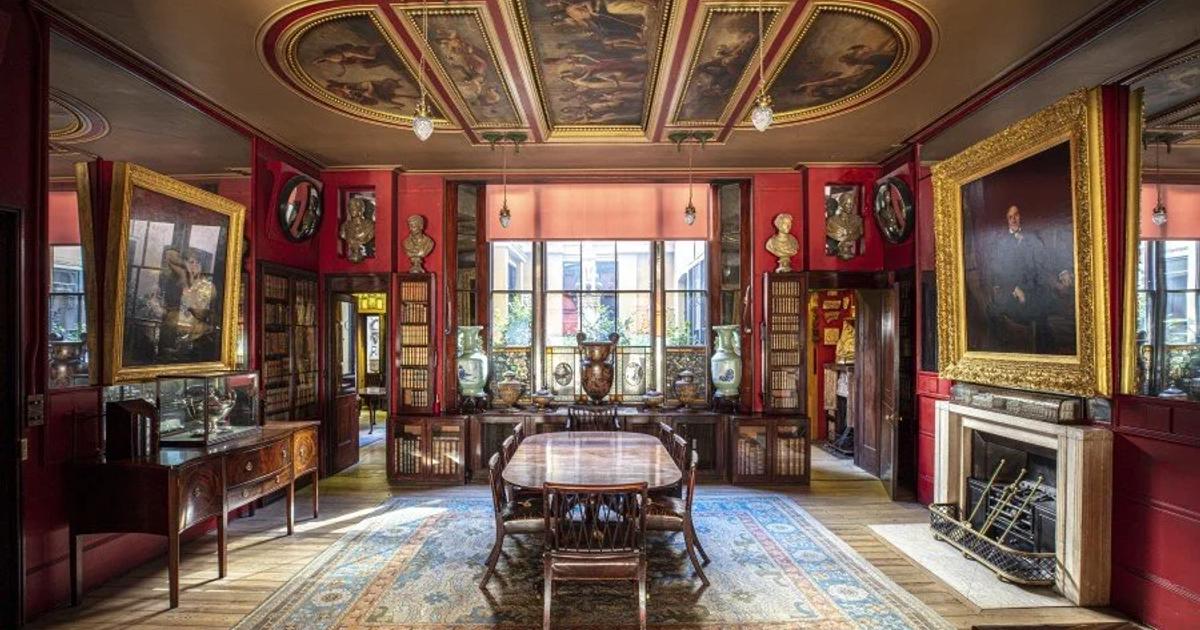
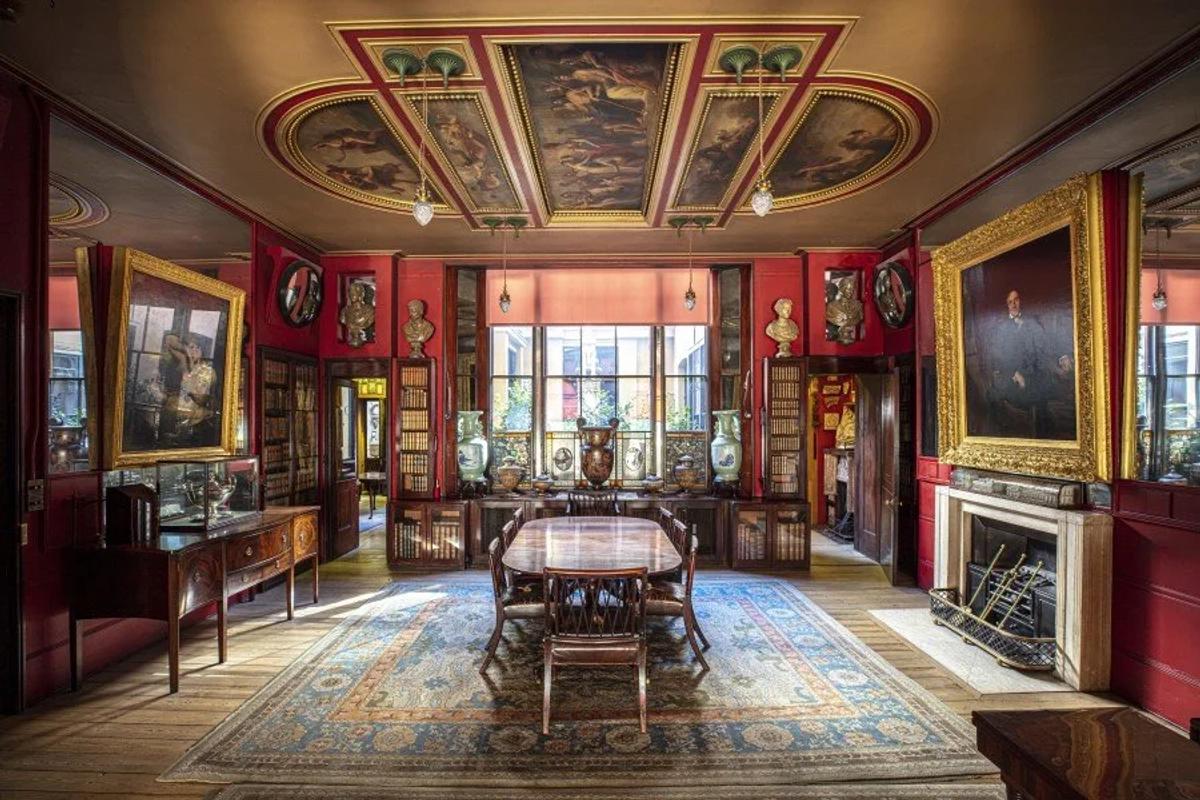
Attend to the objects. Anyone searching for Martin Brudnizki London restaurant recommendations or the best designed London interiors by Brudnizki expects a procession of bookable, monetizable rooms. What they receive instead is weighted toward the un-bookable and the un-sellable. Sir John Soane’s Museum, a house preserved by Act of Parliament, its contents forbidden by the founder from ever being rearranged, is the closest thing in London to a built Custodial Stewardship covenant. Brudnizki calls Soane a proto-modernist and returns “again and again.” He points to Wren’s churches, to St Margaret Lothbury and its Gibbons carvings, to English Baroque as a living inheritance. These are sites of maximal Labor Density and deep Material Memory, the antithesis of the Hollowed Object.
Even the commercial entries resist. John Sandoe Books is a shop you enter for one title and leave with six: a place whose entire value proposition is the friction of the physical against the frictionless feed. This is Brudnizki’s stated design philosophy for London spaces: he warns explicitly against “designing another iteration of what’s seen on social media” and prescribes “physical places, books, buildings, exhibitions, the natural world” as the correction. The designer’s guide to London material culture, in his hands, is an argument for Material Singularity against the smooth.
The Form Is the Symptom: The Shortlist as Genre
If the contents resist the machinery, where does the danger live? Not in the man, but in the genre. The published designer shortlist is a form with its own logic, and that logic operates independently of whatever the curator loves. To place a proto-modernist museum, a Bloomsbury café, and a hotel bar one designed oneself into a single ranked list is to flatten them into a common unit of exchange: the “spot.” The genre does not care that Soane’s Museum has a Burden of Preservation and Julie’s has a reservations book. It levels them into Martin Brudnizki-curated London experiences, each equally consumable, each equally subject to Speculative Velocity.
This is the correction the record requires. The council’s Institutional Necrophagy is not enacted by Brudnizki’s choices; it is enacted upon them by the form that carries them. The Semantic Burden of the word “shortlist,” its inheritance from prizes and property, converts even a plea for preservation into an accelerant. The genre eats the argument.
Consider the mechanism concretely. A reader searching for Brudnizki’s favorite London spots aesthetic does not arrive wanting a lecture on English Baroque; they arrive wanting a set of coordinates to occupy. The form obliges by stripping the reasoning and keeping the location. Soane’s injunction that his house never be altered, the founding gesture of its Custodial Stewardship, survives the shortlist only as a bullet point. The genre is a compression algorithm that discards exactly the data the framework values: the why, the labor, the covenant. What passes through is the address. This is why two designers of opposite conviction, publishing shortlists, produce indistinguishable documents: the form overwrites the philosophy. Brudnizki’s London interiors and design permanence argument cannot be heard over the noise of its own packaging.
Atmospheric Equity and the Hollowing of the Room
Brudnizki’s trade is the manufacture of Atmospheric Equity: the surplus value a room accrues from feeling, before it has served anyone anything. His interiors, maximal, saturated, theatrical, are engines of Ceremonial Energy. The critical question is whether that energy is anchored to Material Singularity or floats free of it. When atmosphere is anchored, to real plaster, real carving, real Labor Density, it deepens a place. When it floats, it becomes the very Hollowed Object the framework warns against: a mood detachable from its substrate, reproducible anywhere, ownable by no one.
The shortlist form pushes toward the floating variant. It sells the feeling of Holland Park’s Portland Road as “a tiny European square” without the decades of residence that earned Brudnizki the observation. It offers the atmosphere of luxury hospitality design in London, with material integrity, while quietly stripping away the integrity that was never transferable in the first place. Atmosphere, unlike a chair, cannot be delivered.
The distinction matters because it locates the ethical fault line precisely. It is not that atmosphere is illegitimate; a well-made room is one of the genuine goods a designer can offer, and Brudnizki offers it better than almost anyone working. It is that the shortlist promises the atmosphere as if it were portable, transferable by visitation; and that promise is false. You can eat at Café Deco and receive a good lunch; you cannot receive the years of Brudnizki’s residence that let him read the room. The Ceremonial Energy of a place is earned by its makers and its regulars over time, and it is precisely the non-transferable residue that the guide cannot list. What the search for best designed London interiors by Brudnizki retrieves is therefore always a little hollow at the center: the coordinates without the accretion.
The Designer as Custodian: Broadwick Soho and the Anti-Commodity Question
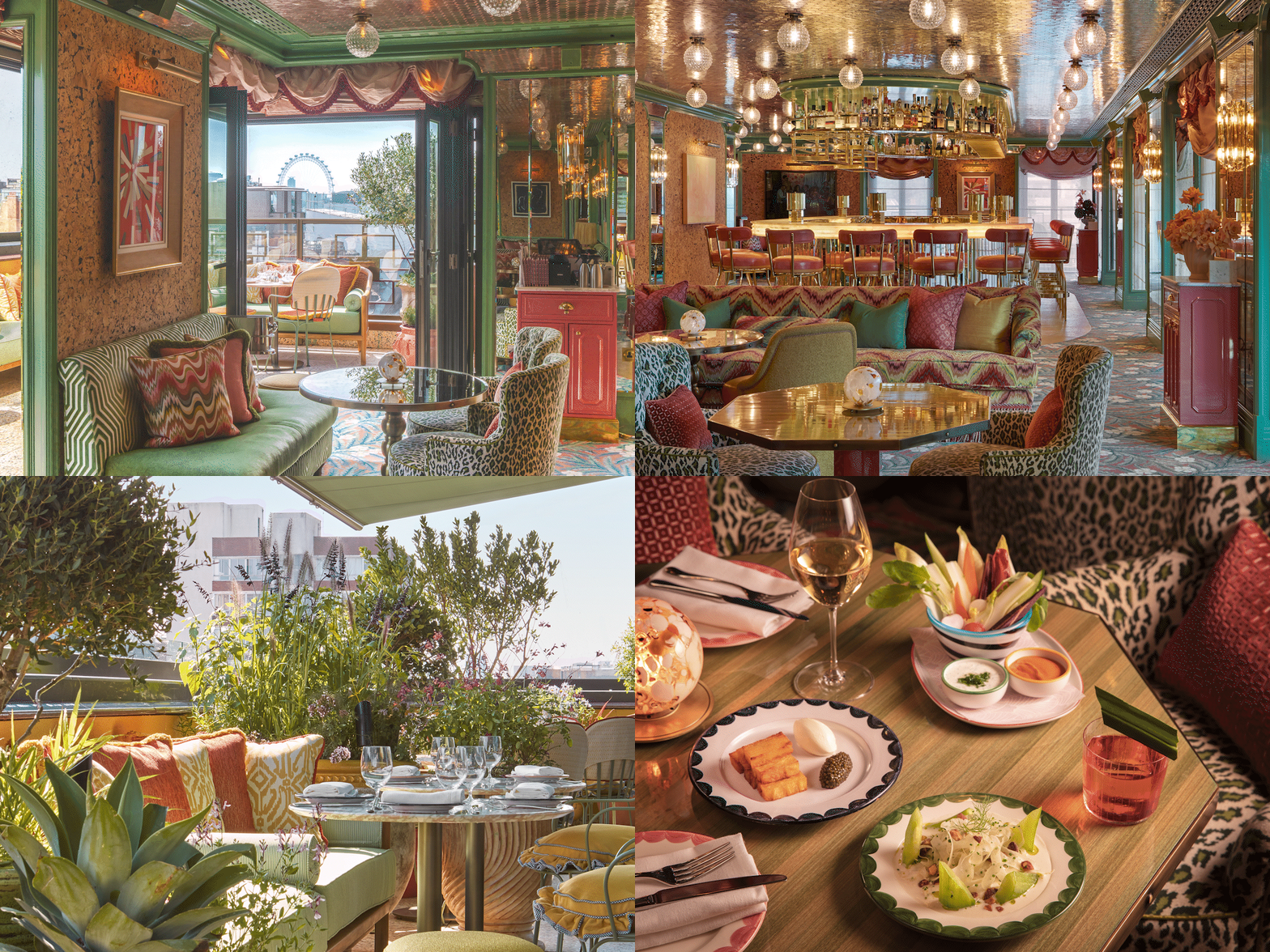
Brudnizki is not naive about this. His “favorite spot to grab a drink” is Flute at Broadwick Soho, a hotel his studio designed in 2024, an admission, not a boast, that the tastemaker now recommends his own work back to the city. And his shop, Objects on Pimlico Road, sells furniture, lighting, and a rotating collection of artists he admires. Here the Anti-Commodity Commitment question sharpens: is the designer a custodian of the objects he gathers, or a broker accelerating their Speculative Velocity? The honest answer is: both, and the ratio is the practice's entire ethical content.
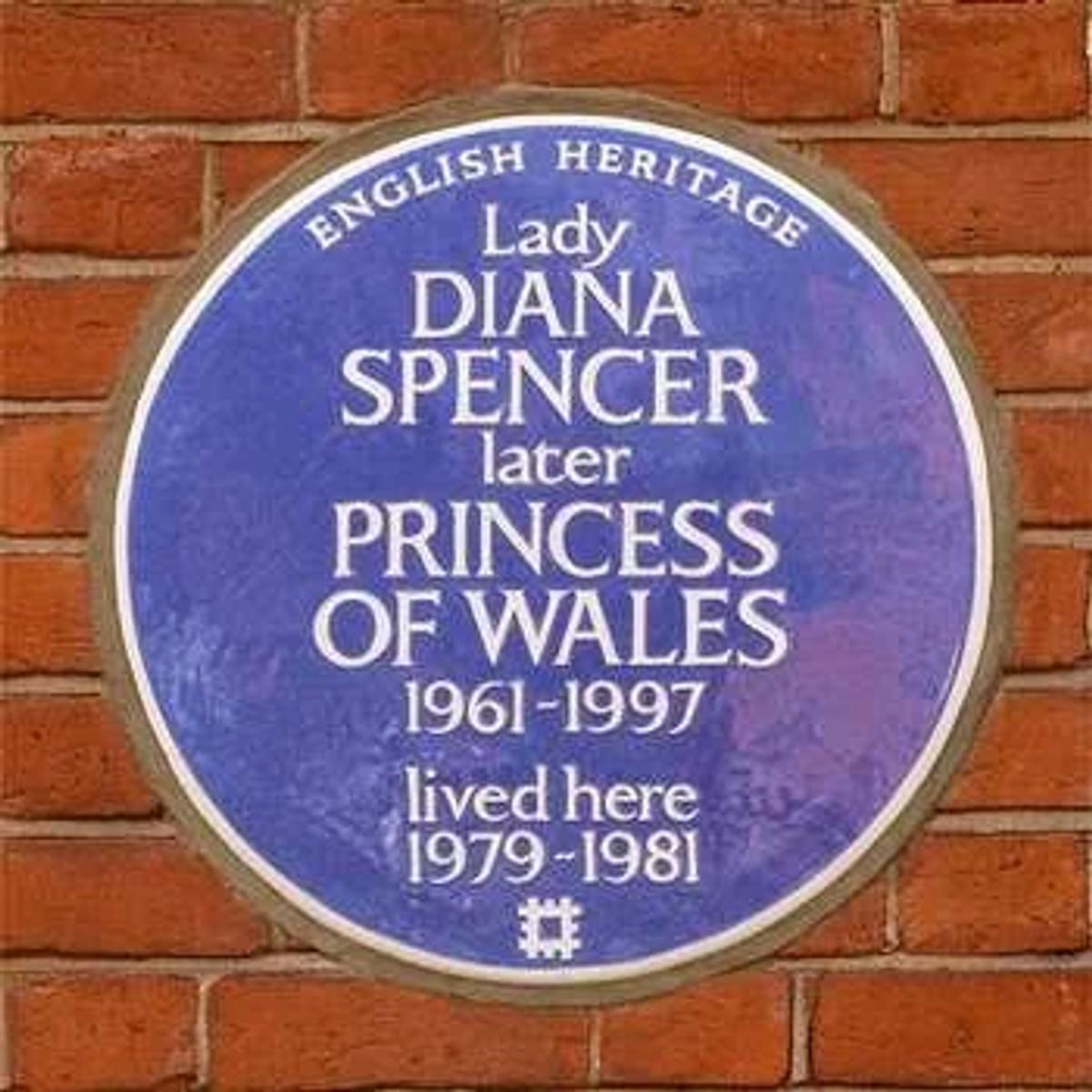
What tips Brudnizki toward custodian is his instinct for the Narrative Permanence of a city. His closing note, that he never tires of London’s blue plaques, “quietly marking the homes and studios of writers, artists and designers who shaped the city’s cultural fabric,” is a confession of value that the shortlist form cannot monetize. You cannot book a blue plaque. You cannot flip it. It confers status on the dead and asks nothing of the living but attention.
A blue plaque is the anti-shortlist: it confers permanence without price, attention without acceleration, memory without a market.
Against Social-Media Iteration: Material Memory as Method
The deepest reading of what Martin Brudnizki’s go-to London places are is not a list of destinations but a defense of method. His refusal to design “another iteration of what’s seen on social media” is, in the framework’s terms, a defense of Material Memory against the algorithmic present. A city read through Wren, Soane, and Gibbons is a Sedimentary Object: layered, resistant, illegible to the feed. This is the version of Regenerative Luxury worth defending: not the manufacture of new desirable surfaces, but the sustained attention to old deep ones. The tragedy is only that the genre he chose to express it in is engineered to convert that attention back into surface.
Here, Bourdieu's framing earns its place. The shortlist is an instrument of cultural capital, it converts Brudnizki’s embodied knowledge of the city into a transmissible marker of distinction. But cultural capital, when it flows toward Soane’s Museum rather than toward a members’ club, funds preservation rather than scarcity. The direction of the flow is everything, and Brudnizki, more often than the council allowed, points it at the sites that will outlast him.
Coda
The institutional synthesis called this shortlist an Aura Transaction hastening its objects toward an Archival Death Mandate. On the evidence, the verdict must be amended. The transaction is real; its objects, mostly, refuse it. What Brudnizki has published is a genre-bound plea for exactly the values the framework prizes, Material Singularity, Narrative Permanence, the friction of the physical world, delivered in the one form guaranteed to undercut them. He is not the cause of the symptoms. He is its most literate carrier, a custodian working in the broker's idiom. The task the shortlist sets us is to learn to read a designer’s influence on city spaces against its own grain: to take the blue plaque and leave the ranking, to keep the museum and refuse the “spot.”
To resist Speculative Velocity, a place must be un-vaultable. A museum and a bookshop qualify. A hotel bar, by design, does not.
Authored by Christopher Banks, Anthropologist of Luxury, Critical Theorist & Founder Objects of Affection Collection Office of Critical Theory & Curatorial Strategy 469 Fashion Avenue, 12th Floor, New York, NY 10018
RELATED OAC STUDIES
For readers tracing the argument across the archive, these studies extend the analysis of design, aura, and the built environment:
Design, Architecture & Custodial Stewardship: Eileen Gray E.1027: Le Corbusier’s Violation of Material Singularity
The Institution as Built Environment: Swiss Institute NYC: Critical Analysis of its Permanent Location Mandate
Spectacle, Heritage & the London Frame: Bayeux Tapestry Loan: Critical Analysis of British Museum’s Spectacle · David Hockney Memorial Service: Legacy, Permanence, and Market’s Burden
Material Singularity vs. the Hollowed Object: Chrome Hearts Sterling Silver: Material Singularity vs. the Hollowed Object · Ferrari 12Cilindri Manuale: The By-Wire Manual and the Aura of Mechanical Intimacy
Aura, Atmosphere & the Experiential Object: Jake Muir Gong Bath Review: Ephemeral Sound Art’s Custodial Challenge · Taylor Swift, Travis Kelce Dior Wedding: The Hollowed Object Deconstructed