Marina Abramović at Balloon Museum: The Hollowed Experience

On air, spectacle, and what it costs to fill a room with nothing...
The Architecture of Having Been There
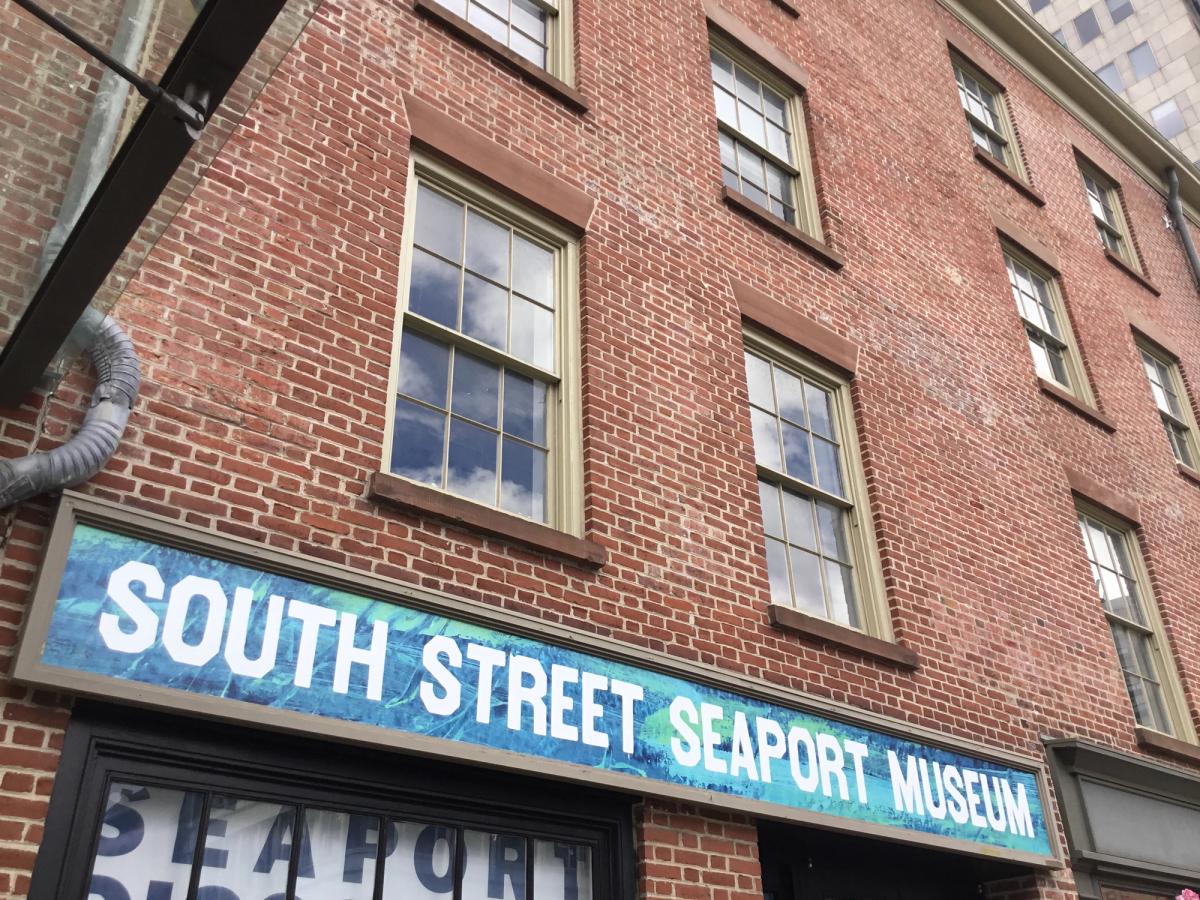
The Balloon Museum opened its first permanent United States flagship at the Tin Building, South Street Seaport, on August 7, 2026. The inaugural exhibition is titled "DAYDREAM: Air Becomes Art." The name is the argument. Air becomes art when the right institution declares it so, and the Balloon Museum has positioned itself as the institution authorized to make that declaration.
The question OAC poses is not whether air can be art. That question was settled decades ago, in rooms far more rigorous than the Tin Building. The question is whether this particular institutional machine (a touring spectacle company with editions in Rome, Brussels, Chicago, and Los Angeles, now planting its first permanent flag in Lower Manhattan) has any interest in art at all, or whether it has found something more profitable: the experience of having been adjacent to art, documented, and uploaded before the next gallery opens.
The Tin Building itself is instructive. Built in 1907 as part of the Fulton Fish Market, renovated into a food and retail destination, and now housing a global inflatable art brand: this is what repurposing looks like when the repurposer is optimizing for footfall rather than function. The building is not incidental to the Balloon Museum's strategy. It is part of the brand. Historic architecture, curated food vendors, experiential art: this is the complete lifestyle-destination package, and the Balloon Museum occupies its uppermost cultural register, the one that licenses the whole complex to describe itself as a cultural institution rather than a commercial destination.
OAC's thesis, stated plainly: the Balloon Museum is the Hollowed Object in its most evolved institutional form. The spectacle is intact. The material covenant has been evacuated by design. What the institution has engineered is not an exhibition but a proof-of-presence machine, its cultural authority laundered through the borrowed reputations of artists who built their careers on everything this institution refuses to be.
Martin Creed's Precise Joke
Martin Creed won the Turner Prize in 2001 for Work No. 227: The Lights Going On and Off, an empty gallery at Tate Britain with the lights cycling at regular intervals. The prize ignited a predictable controversy. Critics asked whether this was art. Tabloids raged. The public was told, as it always is, that it had been cheated. They missed the point. The work is not about the lights. It is about the categorical requirement that something must be happening in the space in order for the space to matter institutionally. The lights declare: here, nothing is happening, and the institution is watching anyway.
Creed's entire practice is built on the comedy of that categorical precision. He numbers everything (his works run into the thousands), because numbering implies a system, and systems imply seriousness, and the comedy lives in the gap between the serial gravity of the numbering and the deliberate inconsequence of the numbered thing. Work No. 3883: Half the Air in a Given Space fills a transparent room at the Balloon Museum with hundreds of blue balloons. "Exactly half the air," the institution promises. Creed has made versions of "Half the Air" since the late 1990s, with earlier iterations appearing in Edinburgh and elsewhere. The commitment to the ratio is genuine. The installation carries its technical logic into the Tin Building unchanged.
But what the Balloon Museum deploys is not Creed's joke. The joke requires the institutional frame to be legible as absurd: the pomposity of the numbered series, the categorical seriousness of the gallery space, the implied weight of institutional endorsement: all of it is the setup, and the inconsequent work is the punchline. The Balloon Museum's frame is earnest, participatory, joyful. Press describes the work as "a playful and disorienting encounter with volume, density, and absence." Playful is the key word. The precision survives the translation. The comedy does not. What remains is a technically correct ratio of balloons to room, evacuated of the critical position that made the ratio matter.
This is the Semantic Burden at its most compressed: the work's title carries the entire weight of an argument the institution has no interest in making. Visitors encounter the number, the balloons, the ratio. They do not encounter the question the number was built to ask. What survives of Creed's practice is the material residue of a conceptual operation. The operation itself has been replaced with fun.

Marina Abramović's Aura Transaction
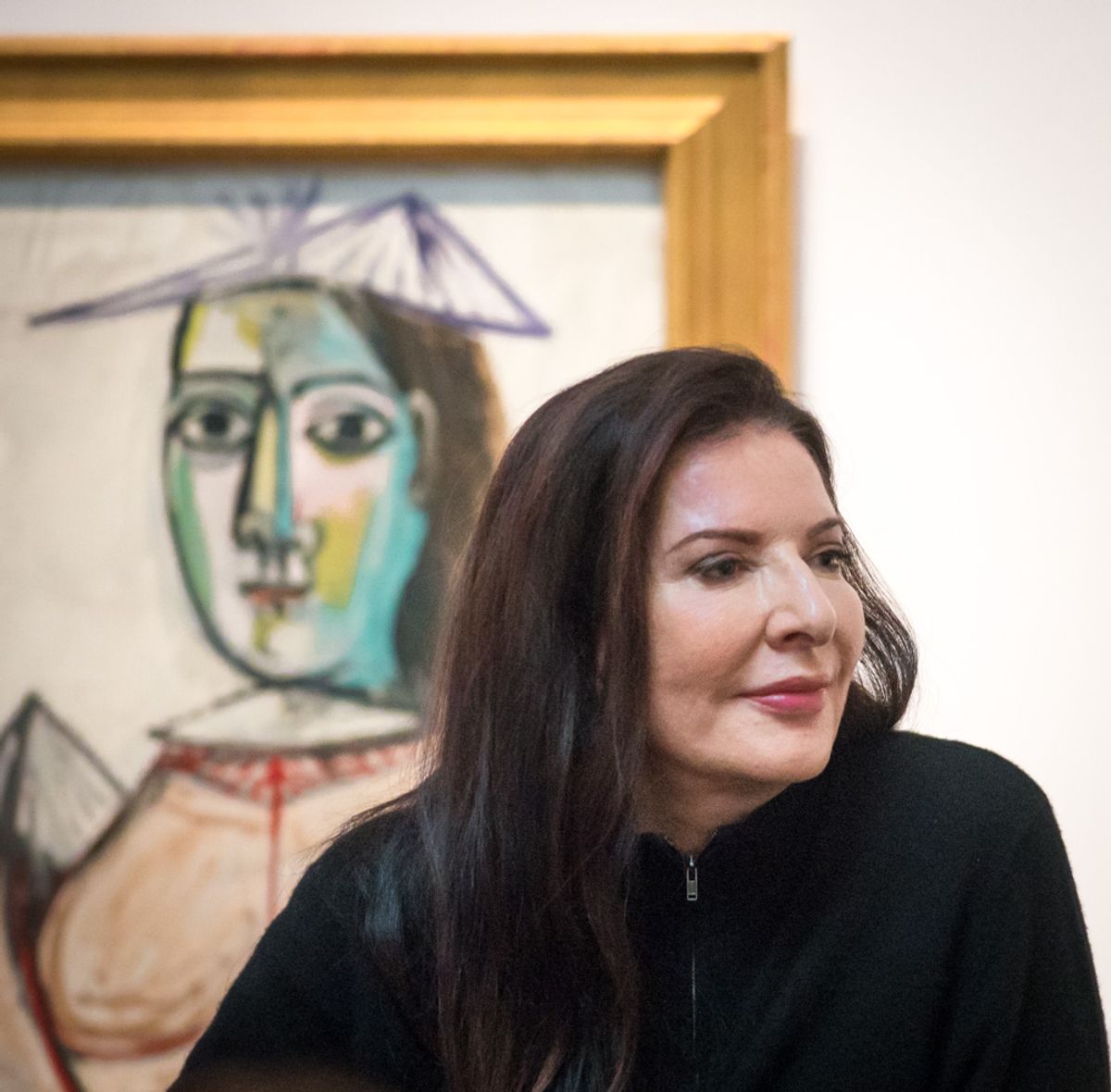
Marina Abramović built one of the most demanding critical positions in contemporary art through five decades of durational performance. These were works that cost her body, her endurance, her literal physical presence over extended and often extreme durations. "The Artist Is Present" at MoMA in 2010 ran for three months, open to the public across the museum's full operating hours. Audiences waited in line for days to sit across from her for minutes. The exchange was real: real time, real presence, real discomfort, real encounter. Nothing was outsourced, nothing was represented. The artist was the work. The entire critical authority of her practice (the reason her name carries the weight it does) was built on that irreducibility. She could not be doubled, scaled, or replaced by a technical team.
This history is the Balloon Museum's most valuable acquisition. Not a work. Not a practice. A name, and everything that name has come to mean: endurance, authenticity, the refusal to commodify. Snowy/Windy/Spring on Planet Z is described as Abramović's first work to use air as a primary medium. It consists of shoulder-high inflatable grass blades, drawing on memories of the landscapes of her childhood in Belgrade, with simulated snowflakes circulating through forced air. It is, by all accounts, visually arresting. It photographs exceptionally well at phone-camera distance. It is also the Aura Transaction in its most reduced form.
Visitors do not encounter Abramović. They encounter an environment built by her team, engineered by the Balloon Museum's technical staff, and navigated by paying audiences who may or may not know anything about the five decades of durational practice that give the name "Abramović" its cultural authority. The aura is real: her name generates genuine anticipation, genuine cultural weight, genuine press coverage. The transaction is evacuated. The body is absent. The endurance is absent. The irreducible presence that defined the work is replaced with an inflatable meadow that can be packed, shipped, and reinstalled in the next edition city when this one's novelty fades.
This is not a critique of Abramović's choices. Artists evolve, collaborate, and work across the full range of institutional contexts. What demands scrutiny is the institutional claim on what that collaboration means. When the Balloon Museum presents "Marina Abramović," it is not invoking a new direction in her thinking about air, space, and presence. It is invoking fifty years of accumulated critical authority to underwrite a commercial entertainment venue. The aura is the currency. The work at the Tin Building is the spending of it. And unlike material currency, aura spent this way does not leave the institution that spent it holding less. The Balloon Museum's authority compounds with each institutional endorsement. The critical specificity of what the name means (the precise conditions under which a practice produced its meaning) is diluted with each deployment that strips those conditions away.
The Touring Machine and Its Velocity
The Balloon Museum launched in Rome in 2021. Since then it has appeared across Europe and North America, drawing more than seven million visitors worldwide before opening its permanent New York flagship. The New York outpost is the institution's first attempt at permanence, and the contradiction is structural. An institution whose entire logic is impermanence (whose works are designed to tour, whose artist relationships are optimized for each city's press cycle, whose value proposition is novelty rather than depth) has chosen for its flagship to be permanent. This is not a paradox the Balloon Museum acknowledges. OAC reads it as the reveal.
The Speculative Velocity of the experience economy is not primarily financial. It is experiential and reputational. The same "Half the Air in a Given Space" can appear in Edinburgh in the late 1990s and New York in 2026. The same inflatable meadow can tour. The same snow effect, the same technical specifications, the same artist credit line. What scales across editions is not the work but the brand. Brand velocity requires constant novelty: new cities, new partners, new artist names on the marquee. The accumulation of names like Abramović and Creed is the mechanism of that velocity. Each addition increases the institutional mass, drives the press cycle, and positions the Balloon Museum as a serious participant in the art world it is commercially extracting from.
Material Singularity is inversely proportional to that scalability. The more editions a work can support, the less it possesses as a singular thing. A work that can be produced in Edinburgh and New York across three decades is not a singular object with a custodial history. It is a specification. Specifications do not require custodians. They require technicians. The Custodian's Contract (the institution's obligation to steward what it holds) is dissolved by the Balloon Museum's model before it can be written. There is nothing to steward that cannot be reproduced. The Burden of Preservation is not neglected here. It is architecturally eliminated.
Compare this to OAC's reading of the Fluxus score as object: there, the instruction replaces the singular artwork deliberately, as a critical position against commodity fetishism. George Maciunas built a practice on the reproducible score as resistance to the market logic of the unique object. At the Balloon Museum, the reproducibility is not a critical position. It is the product. The distinction between Fluxus's critique and the Balloon Museum's operation is the distinction between using a form and evacuating it. The Balloon Museum has borrowed the formal logic of the reproducible instruction and removed the instruction's content.
What the Institution Consumes
Institutional Necrophagy is the diagnostic OAC applies when an institution appropriates the critical vocabulary of an artist or movement to legitimate itself without contributing to the preservation, understanding, or extension of that practice. The Balloon Museum's case is textbook, and notable because the artists being consumed are not dead.
Abramović's practice is built on the refusal of commodification, on the body as irreducible presence, on duration as the antithesis of spectacle. The conditions that made her work matter are precisely the conditions the Balloon Museum eliminates: the body, the duration, the encounter. What the institution offers in her name is not a continuation of those conditions but their sign: the brand authority, the cultural legitimacy transferred from a practice defined by its resistance to exactly this kind of deployment. Creed's practice is built on categorical precision and the comedy of institutional framing, on the gap between the seriousness of the numbered system and the inconsequence of the numbered thing. What the Balloon Museum offers is his punchline without his setup, his precision without his irony, his title without his argument.
The result is a form of Zero-Sum Aura. The institution's cultural authority grows with each artist endorsement. The critical specificity of what each artist's name means as a position is diluted with each deployment that strips the conditions away. The artists survive: their practices continue elsewhere, their legacies are not destroyed by a single collaboration. But the Balloon Museum has taken a portion of their accumulated cultural authority and redirected it toward commercial entertainment. That portion is not returned in kind. OAC's analysis of the posthumous bid at Opera Gallery London showed how institutions leverage the deceased artist's brand for market velocity. The Balloon Museum is practicing a living version of the same extraction, with the additional complexity that the living artist has consented, and that consent is itself part of the legitimizing machinery.
The question of consent does not resolve the critique. That artists choose to participate in commercial deployments of their reputations is not, for OAC's analysis, the primary variable. The relevant variable is what the institution's operations mean for the broader cultural economy: what it does to the meanings that accumulate around a practice when those meanings are regularly decoupled from the conditions that produced them and attached instead to environments designed to maximize ticket sales and content production. Cultural authority is a commons. Extracting it commercially without replenishing it structurally performs the same operation at the level of culture that industrial extraction performs at the level of material resources.
The Commodity Is the Photograph
B. Joseph Pine II and James H. Gilmore theorized the experience economy in 1998, describing the emergence of the staged experience as an economic category distinct from goods and services. What they did not predict (what could not have been predicted in 1998) was the smartphone as the mechanism that would make the experience economy's logic fully visible and fully complete. In 2026, the visitor to an immersive experience is not primarily there to have an experience. They are there to produce content that proves they had an experience. The documentation is the product. The experience is the pretext.
The Balloon Museum's environments are optimized for this. Each installation is photogenic at phone-camera distance, legible in a thumbnail, and evocative enough to generate the "you should go" response in a social feed. Abramović's inflatable meadow photographs magnificently: a field of white grass and swirling snow, uncanny and clean, immediately shareable. Creed's balloon-filled transparent room is a perfect enclosed photography set: bright blue, densely packed, bodies pushing through in real time. Nothing about these environments is accidental. The institution has engineered documentation-optimized art experiences with the same technical precision Creed brings to his work-numbers, but toward an opposite end. Not the comedy of categorical precision, but the commercial logic of maximum shareability per square foot.
This is where the study's argument about the Hollowed Object reaches its terminus. The commodity at the Balloon Museum is not inflatable grass and blue balloons. It is the photograph of the visitor inside the inflatable grass and blue balloons. The artwork is the set. The visitor is the content. The institution profits from the production, and the artists whose names authorized the set receive the credit of being "featured," which means having their critical vocabulary used to justify an environment they did not fully design, in service of a business model that is the structural inversion of their stated practices.
As OAC argued in its study of the certificate as one of the goods, the documentation of cultural participation has become the primary vehicle through which experiential value circulates in the attention economy. The certificate of attendance, the timestamp in the gallery, the screenshot in the installation: these are the goods now. Their exchange value is purely social: they circulate in networks of aspiration and prove nothing about what was encountered in the room. The Balloon Museum has simply industrialized that logic and built a permanent New York flagship to house the production infrastructure.
Air, Material Transparency, and the Regulatory Moment
The European Union's Empowering Consumers Directive, which bans unsubstantiated sustainability and environmental claims, takes effect September 27, 2026. The EU's Extended Producer Responsibility scheme covering manufactured composite goods has provisions effective July 2026. These are not abstract milestones. They represent the state arriving, at legislative pace, at conclusions post-luxury analysis reached first: that claiming a product is immaterial, experiential, or atmospheric does not exempt it from scrutiny of what it is actually made of and what it costs to produce, maintain, and dispose of.
The Balloon Museum's central marketing claim, "air becomes art," functions as a form of aesthetic greenwashing. The experience is framed as weightless, immaterial, atmospheric. The infrastructure required to produce it is not. PVC inflatables manufactured at industrial scale, continuous fan systems to maintain the air pressure that holds the works in shape, disposable balloons cycled out on rotation, the HVAC load sustaining controlled interior environments, the carbon footprint of the touring model shipping materials across cities and continents: none of this appears in the institution's public communications, which foreground the ethereal and suppress the material. The institution's brand identity depends on the visitor believing they have encountered something weightless. The supply chain is invisible by design.
This is not greenwashing in the fashion industry's familiar register, the sustainability claim attached to a product made under conditions that contradict it. It is something more subtle: the aesthetic evacuation of materiality as a marketing strategy. When a luxury house describes a garment as timeless or eternal to divert attention from the labor and materials embedded in it, it is practicing a version of the same suppression. The Balloon Museum's aesthetics of weightlessness perform the same function at a different register: the material costs of the spectacle disappear into the rhetoric of the spectacle. The EU regulatory moment (the greenwashing ban, the transparency directives, the disclosure requirements) makes that disappearing act newly legible. The institutions that have built business models on the profitable illusion of immateriality are encountering, for the first time, a legal framework designed to name what they are doing.
The EU greenwashing ban is the state arriving late at a conclusion post-luxury reached first: that claiming a product is atmospheric does not make its infrastructure invisible.
OAC frames this clearly: an institution that claims to offer air as art while suppressing the industrial infrastructure that produces the air-as-art experience is practicing a speculative velocity that runs on the perception of immateriality. The assets are real. The accounting is hidden. The regulatory moment now exists to address exactly that structure, and OAC is here to name it before the compliance cycle begins.
Coda
The Balloon Museum is not a failure. It is a success of a different ambition entirely: the engineering of the perfect post-luxury product. Untethered from material, infinitely reproducible across touring editions, monetized through documented participation rather than acquisition. What walks out with the visitor is not a work but a proof of attendance, an image, a claim on having been in the room. The institution has solved a problem the art world did not know it was presenting: how to sell art to people who will never live with it, never steward it, never need it to outlast the upload.
OAC's critique is not that air cannot be art. It is that the Balloon Museum is not interested in whether it can. It is interested in whether you will photograph it, upload it, and buy a ticket for the next edition. That is a legitimate business. It is not a Custodian's Contract. And the distinction, at this level of cultural production, is not academic. It determines what survives.
In the institutional space between the serious museum that preserves and the shopping center that entertains, the Balloon Museum has found a profitable middle ground: it carries the aesthetics of the former and the business model of the latter. Marina Abramović's name is the price of entry into that aesthetic. Martin Creed's precision is the proof of concept. Both survive their deployment here, their practices intact elsewhere. But what they leave behind in the institution's permanent New York flagship is not a legacy. It is a logo. And the logo outlasts every balloon in the room, because the logo was never made of air.