
Balenciaga's Wellness Kick: What the Techwear Smoothie Activations Actually Reveal About the Hollowed Object
On Barry's takeovers, post-workout bars, and the moment a luxury house pours its material covenant into an event that cannot be preserved.
When Balenciaga announced that its pre-fall 2026 Techwear line would arrive alongside smoothie pop-ups, post-workout protein bars, and full-day takeovers of Barry's fitness studios across eight cities, the trade press read the gesture as an act of innovation: a luxury house meeting the Experience Economy where its customers already live. This study reads it differently. The wellness activation is not an expansion of the garment; it is a substitution for it. Under the framework of Post-Luxury Conceptual Functional Art (PLCFA), Balenciaga's wellness kick is a textbook Hollowed Object in its experiential register — an object whose Material Singularity has been evacuated and replaced by an event that, by design, cannot be preserved. We name the mechanism Institutional Necrophagy: the brand consumes the vocabulary of well-being for visibility while abandoning the Custodian's Contract that a durable object would have required. We propose two analytics — the material dilution factor and the Wellness Object — to measure what is lost when a house tethers its physical output to Atmospheric Equity it does not own.
The Activation Replaces the Object
The facts are undisputed and worth stating precisely before the critique begins. For its pre-fall 2026 collection — Pierpaolo Piccioli's second outing as creative director of the Kering-owned house, and a warm-up for his couture debut on July 8 — Balenciaga introduced Techwear, a sportswear category built from a second-skin “ProBody” performance fabric described as moisture-wicking, breathable, and antibacterial. The clothes themselves are real and material: leggings, cropped tanks, catsuits, and leather windbreakers fused with ultrasonic-welded nylon tape. Piccioli photographed the lookbook on the Paris metro and in an apartment outfitted with weightlifting equipment, and summed up the line as “the vibe of reality and life.”
What surrounds the clothes is where the analysis turns. The house planned pop-ups in Paris, Beijing, Shanghai, and Bangkok serving smoothies, healthy juices, and post-workout protein and adaptogen bars, plus full-day takeovers at Barry's studios in Los Angeles, New York, London, Paris, Milan, Dubai, Singapore, and Sydney — staged alongside a surprise NBA collaboration timed to league games in Berlin and London. The commercial logic is legible and, on its own terms, competent. The diagnostic problem is what the activation does to the object it is meant to promote. The smoothie is not an advertisement for the garment. Within the experience, the smoothie is the garment — the thing actually consumed, the thing that generates the image, the thing the customer carries away. The catsuit becomes set dressing for a beverage.
“The activation does not promote the object. It replaces it. The smoothie is the thing consumed; the garment becomes set dressing.”
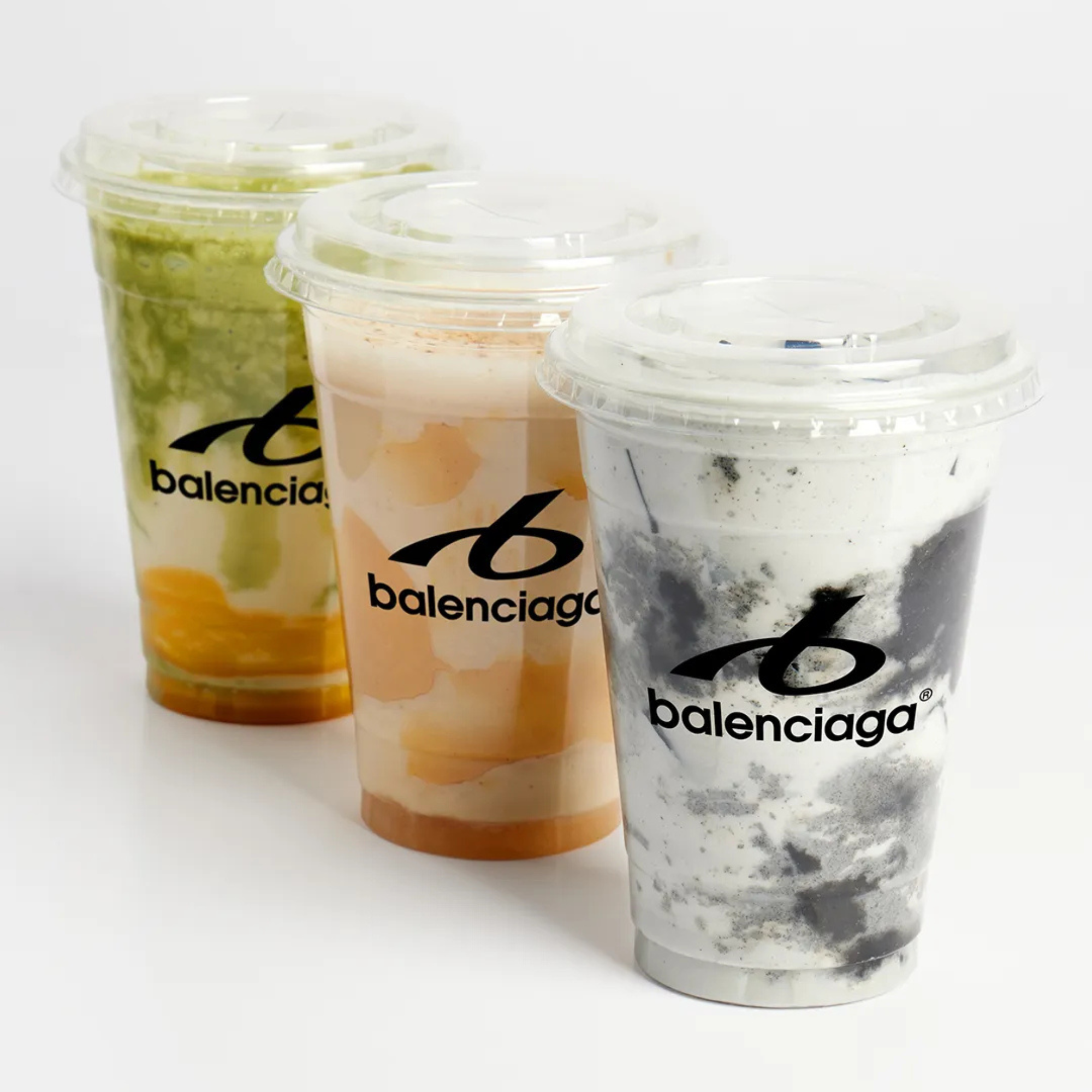
The experiential substitute: Balenciaga’s branded wellness beverages from the 2026 activation, where the physical product is replaced by an ephemeral signifier engineered to be consumed and discarded within minutes.
The Experiential Hollowed Object
OAC has tracked the Hollowed Object across automobiles, watches, and corporate art objects, retaining the silhouette of luxury even as its material covenant erodes. See The Hollowed Prancing Horse: What the Ferrari Luce Actually Confirms and Audemars Piguet x Swatch Royal Pop: The Hollowing of an Icon. What Balenciaga adds is a new state of matter for the category. Until now, the Hollowed Object was still an object — a thing you could hold, even if what it once meant had leaked out of it. The wellness activation hollows differently. It relocates the brand's expressive center from the durable garment to the ephemeral event, which has no material body to hollow because it was never built to last past closing time.
We name this the experiential Hollowed Object. Its defining feature is that Object Permanence is not eroded — it is designed out from the start. A Barry's takeover is complete the moment the lights go down; a smoothie is complete the moment it is finished. There is nothing to preserve, nothing to repair, nothing to inherit. The house has deliberately produced a flagship experience with a lifespan measured in hours and asked the durable garment to borrow its glow.
Speculative Velocity and the Smoothie
Why would a house do this? Because the experiential register is fast, and speed is the point. OAC defines Speculative Velocity as the rate at which a brand can detach symbolic value from material referent and transact it in new markets. A garment is slow: it must be designed, cut, sewn, shipped, sold, and worn. An activation is fast: it can be announced, staged, photographed, and circulated within a single news cycle — as this one was, breaking across the trade press the same week as the lookbook.
Thorstein Veblen would recognize the move immediately. Conspicuous consumption has simply migrated from objects to experiences: the smoothie at a Balenciaga-branded Barry's class signals membership more efficiently than any leather windbreaker because it is photographable, repeatable, and instantly legible to an audience. This is the same Aura Transaction we diagnosed in The Hype-Capital of the Court: Supreme, Jordan Brand, and Speculative Velocity, and in The Aura Goes West: What Hermès' Chapter 2 in Los Angeles Confirms — value detached from the thing and re-floated on atmosphere. The wellness kick accelerates it past the point where a material referent is even required.
“A garment is slow. An activation is fast. The wellness kick is what Speculative Velocity looks like once the object is no longer necessary to the transaction.”

Speculative Velocity in motion: An official campaign lookbook shot for the pre-fall 2026 collection, displaying the material density of the technical garment—staged alongside domestic fitness equipment to signal the high-speed lifestyle ecosystem it is meant to anchor.
This hyper-acceleration and subsequent evacuation of core value is not unique to luxury apparel; it operates on the exact same institutional trajectory as the financialized mega-gallery expansions tracked in The Cost of the Broken Model: Pace Gallery Layoffs, Crypto Collapse, and the Exhaustion of Speculative Velocity, where structural weight is similarly leveraged against highly volatile, non-material assets.
The Material Dilution Factor
The discipline OAC owes its archive is measurement, not lament. We therefore propose the material dilution factor: the degree to which a brand's expressive and economic weight has shifted from objects it can be held accountable for to events it cannot. A house with a low dilution factor stakes its identity on things that endure — and, in enduring, can be judged. A house with a high dilution factor stakes its identity on activations that disappear before they can be evaluated, leaving only the image behind.
Two thinkers anchor the metric. Tim Ingold's material anthropology insists that materials are not inert backdrops to human meaning but active, enduring presences with their own lives; to design those lives out is to surrender the very ground on which a garment's value rests. Richard Sennett's account of craft in The Craftsman locates dignity in skilled, embodied, durable making — the Labor Density that a smoothie bar conspicuously lacks. ProBody fabric, notably, is engineered to survive — moisture-wicking, antibacterial, built to outlast a sweaty session. The garment, in other words, is more durable than the marketing strategy wrapped around it. That inversion is the dilution factor made visible: the object can endure, but the house has chosen to spend its attention on the event that cannot.
Institutional Necrophagy in the Wellness Register
OAC reserves the term Institutional Necrophagy for the act of consuming the vitality of a living cultural form for one's own visibility while leaving its substance behind — a mechanism developed in Institutional Necrophagy: How Speculative Velocity Destroys Object Permanence and Why Luxury Brands Are Signing World Cup Players: The Necrophagy of the Athlete Persona. “Wellness” is now the host. It arrived as a counter-cultural, even regenerative, vocabulary — rest, recovery, the refusal of burnout. Balenciaga consumes that vocabulary's accumulated Semantic Burden, strips it of obligation, and re-presents it as a backdrop for high-performance leggings.
There is precedent, and the brand knows it. Erewhon converted the macrobiotic grocery into a Luxury Wellness status object, where a viral smoothie does the symbolic work a handbag once did. Balenciaga is borrowing that proven machinery wholesale. Jean Baudrillard named the endpoint: the Simulacra, a sign that has severed its tie to any underlying reality and now refers only to other signs. The Balenciaga smoothie refers to the Erewhon smoothie, which refers to wellness, which refers to nothing material at all. We mapped this descent in The Simulacrum of Luxury: A Guide to Jean Baudrillard's Critique of Consumer Society; the wellness kick is its experiential edition. This is also consistent with the Institutional Lexical Hijacking we have documented, in which brands launder borrowed vocabulary they have not earned.
“Wellness” arrived as a refusal of burnout. It departs as a backdrop for performance leggings. That conversion is Institutional Necrophagy in plain sight.”

The final state of the Simulacrum: Pierpaolo Piccioli’s 2026 campaign drops high-performance athletic undergarments beneath a couture-level sequin shell inside the Paris metro, illustrating how the house uses urban isolation as an aesthetic backdrop for its speculative wellness narrative.
The Custodian's Contract Cannot Be Poured
Every durable luxury object carries an implicit Custodian's Contract — a promise that the thing is worth keeping, and a Burden of Preservation transferred to its owner. Cesare Brandi argued that an entity's integrity collapses when its essence is unbound from its physical manifestation; preservation becomes impossible because there is nothing left to preserve. A smoothie honors no such contract. A fitness class transfers no Burden of Preservation because there is nothing to preserve. The wellness activation is, in the most literal sense, unkeepable.
This matters beyond metaphor. As we argued in The Custodian's Contract: From Institutional Critique to Systemic Stewardship, the contract is the mechanism by which luxury earns the right to outlive its season. By relocating expressive weight to events that expire on contact, Balenciaga is not merely declining to keep that promise — it is building a flagship gesture for which the promise is structurally impossible to make. The Narrative Permanence of the house thins each time its identity is poured into a vessel that cannot hold it.
The Burden the Activation Hides
There is a cost that the smoothie is engineered not to show. Walter Mignolo's account of the “darker side” of Western modernity is useful here: aspirational surfaces routinely obscure the extractive systems beneath them. “Techwear” is a supply chain — synthetic high-performance textiles, ultrasonic welding, global logistics — and the activations themselves generate their own ephemeral waste: single-use cups, pop-up build-outs, the carbon of eight-city simultaneity. The wellness frame performs health while externalizing its material and ecological burden onto systems the customer is invited not to see.
This is the Decolonization dimension of the critique, and it is not incidental. A house that asks to be associated with well-being assumes a heightened obligation to account for the unwell conditions of its own production. The activation's velocity is precisely what lets it skip that accounting: an event that is over in hours leaves no durable object against which the question can later be asked.
What This Confirms
Read at scale, the wellness kick confirms a thesis OAC has been building toward across the archive: luxury's center of gravity is migrating from the object to the atmosphere, and the migration is structural, not stylistic. What the Bain Global Luxury Report 2026 actually proves is that a post-growth consumer is increasingly indifferent to sign-value; the experiential pivot is the industry's answer — sell the feeling, since the logo no longer closes the sale. Balenciaga's smoothie is that answer in its purest form.
It also exposes a gap that is finally legal, not only critical. A durable object can be warranted, repaired, resold, and held to account; an activation confers value while accepting none of those obligations. The Wellness Object — our proposed category for goods whose meaning is staged through inherently ephemeral health-coded experiences — names the entity that has learned to receive luxury's privileges while shedding its responsibilities. The task OAC sets itself is to build the frameworks that make that asymmetry visible, measurable, and, eventually, answerable.
Coda
A garment can be kept. A smoothie cannot. Balenciaga has built ProBody to survive the run and the yoga session — and then spent its attention on the one part of the offering engineered to vanish by nightfall. The house has the more durable thing in its hands and has chosen to point at the thing that disappears. That choice is the whole diagnosis. The Hollowed Object has learned to pour itself into a cup, and a cup keeps nothing.
Authored by Christopher Banks, Anthropologist of Luxury, Critical Theorist & Founder Objects of Affection Collection Office of Critical Theory & Curatorial Strategy 469 Fashion Avenue, 12th Floor, New York, NY 10018
Related OAC Studies
On the Hollowed Object
The Hollowed Prancing Horse: What the Ferrari Luce Actually Confirms
Audemars Piguet x Swatch Royal Pop: The Hollowing of an Icon
On Necrophagy & Speculative Velocity
Institutional Necrophagy: How Speculative Velocity Destroys Object Permanence
Why Luxury Brands Are Signing World Cup Players: The Necrophagy of the Athlete Persona
The Hype-Capital of the Court: Supreme, Jordan Brand, and Speculative Velocity
On Borrowed Vocabulary & Simulacra
Institutional Lexical Hijacking: How Mass-Market Luxury Launders Post-Luxury Vocabulary
The Simulacrum of Luxury: A Guide to Jean Baudrillard's Critique of Consumer Society
On Stewardship & the Custodian's Contract
The Custodian's Contract: From Institutional Critique to Systemic Stewardship
On the Market Context
What the Bain Global Luxury Report 2026 Actually Proves
The Aura Goes West: What Hermès' Chapter 2 in Los Angeles Confirms
