Kylian Mbappé and Lamine Yamal: Luxury Buys the Athlete

On the strategic migration from event to body, and what the discipline of the Custodian’s Contract reveals about the athlete as a Hollowed Object.
In the weeks before the 2026 FIFA World Cup, luxury brands made a decision that looks, on the surface, like enthusiasm and is in fact a withdrawal. They did not buy the tournament. They bought its players. This study reads the luxury brand athlete endorsement wave (Dior’s signing of Kylian Mbappé, Louis Vuitton’s Jude Bellingham, American Eagle’s five-year pact with Lamine Yamal) not as marketing but as ontology.
The Post-Luxury Conceptual Functional Art (Post-Luxury) framework names what the trade press cannot: the conversion of the athlete’s Material Singularity into a fungible, de-materialized asset through Speculative Velocity. When a maison abandons the institution in order to colonize the body, it performs an Aura Transaction: a finite store of cultural capital, accumulated through years of irreproducible labor, drawn down to underwrite a brand’s diffusion. This is the mechanism OAC has elsewhere called "Institutional Necrophagy: the consumption of a living source of meaning to feed a system that no longer generates its own. The athlete becomes a Hollowed Object.
The Vacant Throne
Begin with an absence. For the first time since Seiko assumed the role in 1978, the World Cup has opened without a luxury watchmaker as its official timekeeper. Hublot, which held the position for sixteen years across four tournaments, quietly ended the partnership in December 2025. No replacement of equivalent rank was named; a microbrand holds a lower licensing tier, more like merchandise than sponsorship.
This is not a footnote. It is the whole argument in miniature. The most legible, most prestigious institutional sponsorship slot in global sport was left empty. Not because no one could afford it, but because the institution is no longer where the value lies. The throne was abandoned on purpose. The question this study asks is where the brands went instead, and what they did when they got there

The throne was not lost. It was abandoned, because the institution is no longer where the aura lives. The aura now walks, and signs.
The Migration from Event to Body
The data is unambiguous. According to Luxurynsight, partnerships between luxury brands and the sporting world rose from 19 in 2019 to 96 in 2025: a fivefold increase in six years. But the raw count conceals the structural move. The trade press itself reports the inversion in plain language: brands are no longer seeking the time-limited exposure of a competition, but rather a lasting association with athletes capable of generating content year-round.

Read through Speculative Velocity; this is a flight toward liquidity. An event is a fixed, dated, bounded thing: four weeks, then it is archived. A player is a perpetual emission engine: millions of daily interactions, a face that renders identically across European, American, African, and Middle Eastern markets at once. In the logic of commodification of sports identity by fashion, the body outperforms the tournament not because it is more meaningful but because it is more fungible: more easily converted, more continuously extractable. The migration from event to body is a migration from the illiquid to the liquid.
Three Cases in the Conversion
Consider the specific deals because PLCFA argues from objects rather than atmospheres.
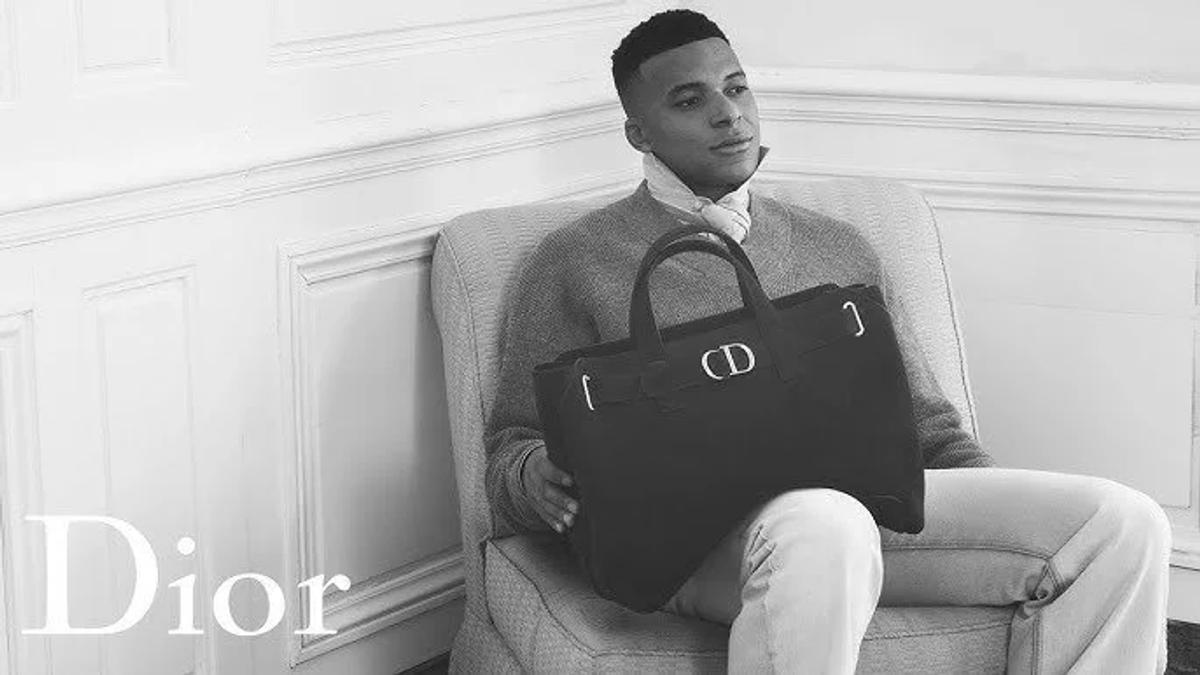
In June 2025, Jonathan Anderson, newly installed as the first single creative director of Dior womenswear, menswear, and haute couture since Christian Dior himself, named Kylian Mbappé a house ambassador, framing him as the voice of a generation. At reported earnings of nearly $95 million a year, Mbappé offers an LVMH maison simultaneous access to four continental markets and a clientele younger than luxury’s traditional base. His Real Madrid teammate Jude Bellingham was already a Louis Vuitton ambassador. Two bodies, one conglomerate, one diffusion strategy.
In January 2026, American Eagle signed the eighteen-year-old Lamine Yamal to a historic five-year deal, the brand’s first multi-year ambassadorship, spanning campaigns and limited-edition collaborations. The length is the tell. A five-year contract with an eighteen-year-old is not an endorsement; it is a futures position on a persona, an attempt to lock in an athlete's personal-brand speculative value before the market fully prices it.
The Epic X CR7 watch collection co-brands a man’s initials onto an object: the persona rendered literally as merchandise, the name itself made into a movement. Across all three, the same operation: a finite human aura is drawn down to charge a commercial vessel.
A five-year contract on an eighteen-year-old is not an endorsement. It is a futures position on a body whose aura has not yet finished forming.
The Hollowed Object, Now Human
OAC has tracked the Hollowed Object across the Ferrari Luce and the Porsche Sadu Edition, objects whose meaning is evacuated while their shell is retained and sold. The athlete deal extends the category to the human persona. What is retained is the image: the face, the name, the highlight-reel gesture. What is evacuated is the relation between that image and the irreproducible labor that earned it.
This is the same operation OAC diagnosed in The New Luxury’s parasocial brands, where Kylie Jenner and others sold themselves as objects. The footballer arrives at the same destination by a different road: not selling the self, but having the self bought, the persona converted into a "Material Host for a brand’s narrative. A complete World Cup player endorsement analysis has to account for this evacuation, not just the deal’s size.
The Custodian’s Contract and the Athlete
What would the Custodian’s Contract require instead? OAC’s institutional framework holds that to take on a source of meaning is to accept a Custodial Mandate: stewardship rather than extraction, an obligation to return more than is drawn. A custodial relationship between a brand and an athlete would treat the persona as a singular to be protected, not a reserve to be mined.
The discipline this implies is not anti-commercial. It is the difference between patronage and predation. A Custodian's Contract professional athletes could honor, underwriting the conditions of the labor, refusing the deals that accelerate a young persona past the velocity it can survive, would be a genuinely post-luxury arrangement. The five-year option on an eighteen-year-old is its precise opposite: a "Speculative Velocity play that prices the body before the person inside it has finished being made.
What the World Cup Confirms
OAC has now read the 2026 World Cup twice. In the Wyland mural study, the tournament was the occasion for the destruction of a permanent public artwork: an event that consumed the object. Here, the same tournament is the occasion for the consumption of the persona. The pattern is identical: a mega-event functions as an accelerant, a license to draw down stored value, civic, artistic, human, in the name of a four-week spectacle.
This is the through-line connecting this study to the broken-model thesis of the Pace Gallery collapse and to OAC’s reading of Apple’s WWDC 2026. A system out of internal heat turns to consumption. The only question is what it eats. In 2026, increasingly, the answer is people.
Coda
The brands did not fail to show up to the World Cup. They showed up precisely, at the body rather than the event, because the body is where the still-living aura was. That precision is the diagnosis. When the most sophisticated cultural institutions on earth can no longer generate meaning from their own objects and must instead sign the persons who still carry it, the persons become objects.
The Custodian’s Contract offers the alternative, and the alternative is not abstinence but discipline: to steward a singular rather than spend it. Until that discipline arrives, every signing is a small necrophagy, and the athlete, admired, enriched, and quietly hollowed, is the object of affection the system loves most and protects least.
Authored by Christopher Banks, Anthropologist of Luxury, Critical Theorist & Founder
Objects of Affection Collection
Office of Critical Theory & Curatorial Strategy
469 Fashion Avenue, 12th Floor, New York, NY 10018
RELATED OAC STUDIES
On the Mechanism of Consumption
Institutional Necrophagy: How Speculative Velocity Destroys Object Permanence
The Cost of the Broken Model: Pace Gallery Layoffs and the Exhaustion of Speculative Velocity
On Aura and Its Transfer
The Aura Transaction: On Louis Vuitton’s Super Nature
The Zero-Sum Aura: Why Digital Immortality Requires a Material Host
On the Hollowed Object
The Hollowed Prancing Horse: What the Ferrari Luce Actually Confirms
What the Porsche Sadu Edition Actually Confirms
On the Self Sold as Object
The New Luxury: How Kylie Jenner, Selena Gomez, and Jacob Elordi Perfected the Parasocial Brand
On the 2026 World Cup as Accelerant
Wyland’s Destroyed Dallas Whale Mural: What the FIFA World Cup Lawsuit Reveals
On Institutional Stewardship
The Custodian’s Contract: From Institutional Critique to Systemic Stewardship