WHAT THE PORSCHE SADU EDITION ACTUALLY CONFIRMS: The Corporate Apparatus Cannot Author What It Can Only Witness

On Rae Roberts, the Hollowed Object, and the Semiotic Dependency of Corporate Luxury on Independent Creative Labor

On May 19, 2026, Porsche unveiled the 911 Turbo S Sadu Edition, a limited run of 20 Kuwait-exclusive vehicles featuring Al Sadu geometric patterns on their exterior decals and interior upholstery, commemorating 70 years of the brand in the Middle East. Every outlet that covered the launch treated it as an institutional tribute: heritage acknowledged, craft celebrated, region honored. No one asked the prior question. In November 2023, at the Icons of Porsche festival in Dubai, an American artist named Rae Roberts hand-painted a mid-1970s Porsche 911 Targa live in front of 60,000 spectators, integrating the Al Sadu weaving tradition into the livery design for the first time in Porsche history, directly in front of Porsche Middle East, its patrons, and its event infrastructure. Three years later, Porsche deployed a commercially scaled version of that concept under the same cultural designation, without public attribution. This study applies the PLCFA framework, specifically the Hollowed Object, Artistic Dark Matter, Narrative Permanence, and Semantic Burden, to diagnose what this sequence of events confirms about the structural condition of corporate luxury: that it has entered a phase of Institutional Necrophagy so advanced that it must extract its own semiotic legitimacy from the uncompensated creative labor of independent artists witnessed at its own events. Roberts' public statement, issued in May 2026, is not merely a personal grievance. It is an institutional document. And the Porsche Sadu Edition is not a tribute. It is a Hollowed Object: a product wearing the formal markers of cultural stewardship while evacuating the singular human authorship that gave those markers their original weight.
The Event: What Happened at Icons of Porsche Dubai, 2023
The Icons of Porsche festival, held annually at Dubai Design District and attended by over 60,000 visitors in 2023, operates as the largest gathering of Porsche enthusiasts in the Middle East. It is an official Porsche-branded event, sponsored, curated, and executed by Porsche Middle East and Africa. Its patron infrastructure is the most concentrated expression of the brand's regional stakeholder network.
In November 2023, Saeed Al Shamsi of 68 Reserve commissioned Rae Roberts, a professional automotive hyperrealist painter operating under the brand RR7, then based in Florida, to travel to Dubai and hand-paint a 1970s-era Porsche 911 Targa live across the two-day festival. The brief was open: create a custom livery that honored both the car's 1970s heritage and the UAE's cultural context. Roberts, who had never been to Dubai, spent the weeks leading up to it researching the region's artistic traditions. She studied regional color philosophy, the Bedouin principle that complementary tones drawn from desert sunsets induce peace in the viewer rather than visual tension, and encountered the Al Sadu weaving tradition: a form of warp-faced horizontal textile work practiced by Bedouin women, inscribed on UNESCO's Representative List of the Intangible Cultural Heritage of Humanity in 2020.
Roberts integrated the Sadu geometric pattern into the livery design, sketching it in pencil directly onto the car's body surface, then painting it by hand with improvised automotive paint mixed at a local body shop, in a language crossfire that Roberts later described as both chaotic and essential.
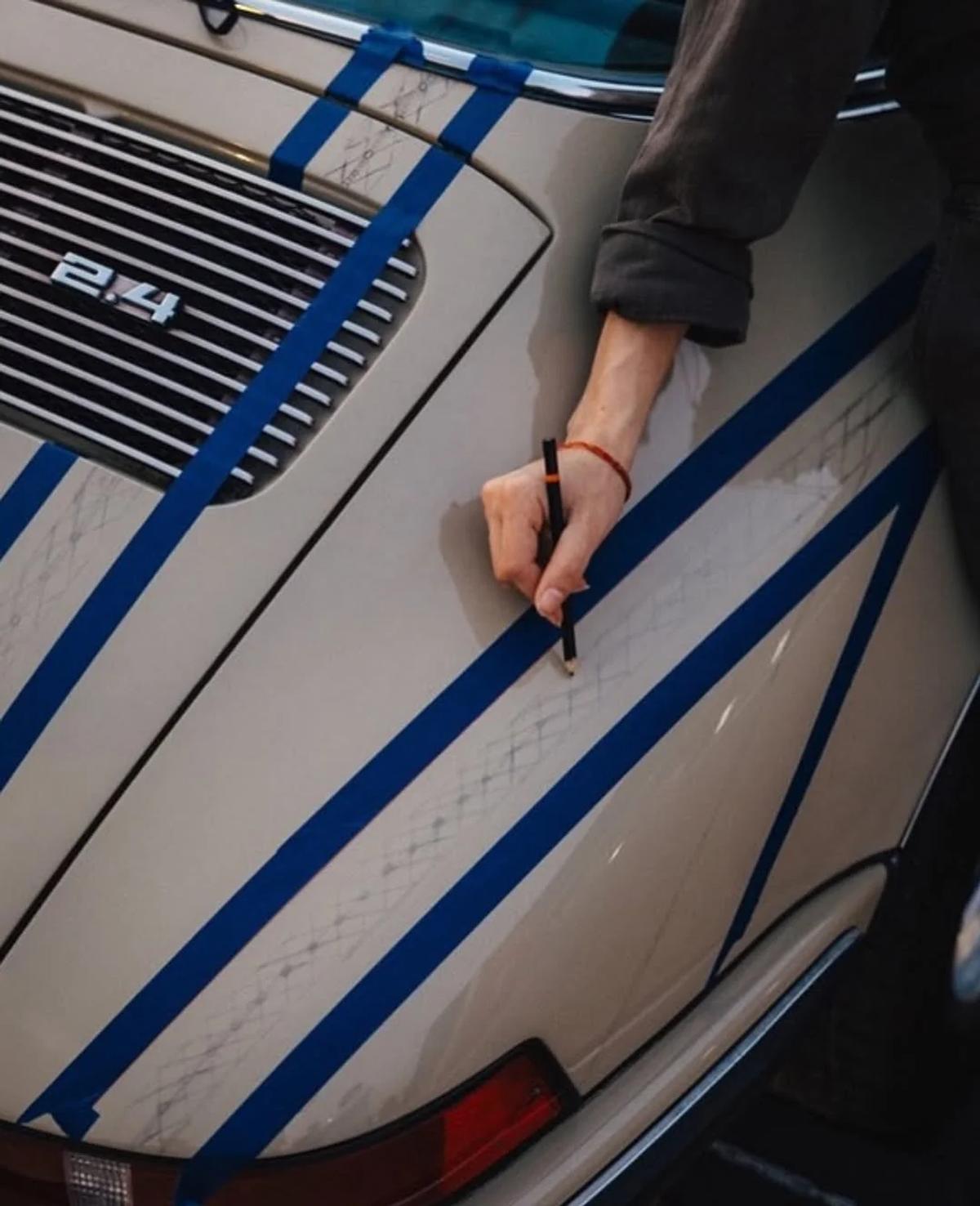
She laid a string from bumper to taillight to read the car's natural curves. She invited a young woman who had been watching for hours to paint a section beside her. She worked over two full days, in public, in front of Porsche Middle East's entire patron and corporate apparatus. The finished car was subsequently featured as an exhibition piece at DRVN Cafe for four months.

The corporate apparatus witnessed the birth of the concept it would later commercialize: not through research, not through internal ideation, but through the live creative labor of an independent artist working in plain sight.
This is not a case of parallel development or independent inspiration. It is a case of witnessed origination. The concept (an Al Sadu pattern applied to a Porsche 911 chassis, designated by that precise cultural name) was authored, executed, and publicly premiered at Porsche's own event. The corporation did not discover Al Sadu through a subsequent cultural research process. It encountered it through Roberts' hands, in real time, in Dubai.
The Apparatus Responds: The Sadu Edition Turbo S, May 2026
Three years after the Icons of Porsche 2023 event, Porsche announced the 911 Turbo S Sadu Edition through its official Middle East newsroom. The vehicle, limited to 20 examples, exclusive to Kuwait, finished by Porsche Exclusive Manufaktur in Zuffenhausen, bears Al Sadu geometric patterns as exterior decals rendered in Bordeaux Red, Guards Red, GT Silver, and Black, with Sadu fabric inserts in the interior. The official press narrative frames the edition as a tribute to 70 years of Porsche's presence in the Middle East and to Kuwait's cultural heritage.
The Porsche Newsroom release states: "Drawing on this cultural heritage, Porsche has translated these traditional design elements into the Turbo S Sadu Edition." The Al Sadu weaving tradition is correctly described as UNESCO-recognized intangible heritage, inscribed in 2020. Porsche's attribution is situated entirely at the level of collective cultural heritage: the Bedouin tradition, Kuwaiti identity, and the 70-year commercial relationship. There is no mention of Rae Roberts. There is no mention of the 2023 Icons of Porsche Targa. There is no mention of the first application of the Sadu concept to a Porsche chassis, which occurred live at their own event.
The pricing remains undisclosed. The base 911 Turbo S retails at $270,300 in the United States. The Sadu Edition, with Exclusive Manufaktur finishing, is expected to clear $300,000. Twenty vehicles. Kuwait-exclusive. The Hollowed Object retains the price point, the factory execution, and the heritage narrative. What it does not retain is the originating human intelligence that made the concept culturally possible.
The Mechanism: Gregory Sholette's Dark Matter and the Witnessed Origination
In his foundational work on the political economy of creative labor, theorist Gregory Sholette introduced the concept of Artistic Dark Matter, the invisible mass of creative production that sustains the formal art world without receiving its recognition, compensation, or institutional light. Dark matter, in Sholette's framework, is not marginal. It is structural. The formal art world's visible output (its auction records, its branded collaborations, its heritage editions) depends on the gravitational field generated by the dark matter it does not see.
The Rae Roberts situation is a precise instantiation of this mechanism, with one critical inflection: the dark matter in this case was not invisible. It was witnessed. Roberts did not produce her work in obscurity. She produced it in front of 60,000 people, at a corporation's own event, in direct view of the brand's regional leadership and patron network. The dark matter was illuminated, and then re-obscured.
This re-obscuration is the operational logic of what PLCFA designates Institutional Necrophagy: the corporate apparatus's systematic extraction of independent creative capital after the fact of its public performance. The corporation does not invest in the concept's origin. It witnesses the origination, absorbs the concept's semiotic architecture, and then re-deploys it through its own manufacturing and branding infrastructure, at scale, at margin, with attribution only to the collective cultural heritage from which the artist drew her inspiration. The artist's role is erased at precisely the point where the concept becomes commercially viable.
The corporation does not produce the concept. It industrializes the ghost of the concept after the artist has moved on. The original remains singular. The edition is a monument to what it cannot be.
This is not the same as a brand drawing on a publicly available cultural tradition. Al Sadu has been applied to product design before. The specific application (the Sadu pattern on a Porsche 911 chassis, named and executed at a Porsche event, in the presence of the brand's own institutional apparatus) was not a floating cultural datum. It was a specific creative act. The question is not whether Porsche had the right to engage with Al Sadu heritage. It did. The question is whether the brand had an obligation to acknowledge the specific human intelligence that demonstrated that engagement was possible. And why it did not.
Anatomy of the Hollowed Object
The Hollowed Object is one of PLCFA's most precise diagnostic instruments. As developed in our study The Miu Miu Problem, the Hollowed Object is a product, or practice, that retains all of the external formal markers of cultural value while evacuating the interior condition that originally justified those markers: the live human labor, the specific authorship, the irreversible creative act. The Hollowed Object is not a fake. It is a real product with real materials. What has been hollowed is not the object's physical substance but its Narrative Permanence, the irreducible, non-transferable story of how the concept came to exist.
Porsche's Sadu Edition passes every test of formal quality. The materials are genuine: actual Sadu-pattern fabric produced by Kuwaiti artisans is integrated into the cabin. The Exclusive Manufaktur finishing is precise. The cultural reference is historically accurate. The pricing signals luxury. None of this changes the structural condition: what the car is marketing, the synthesis of Porsche engineering and Sadu cultural heritage as an expressive and regional identity claim, was first made visible through the labor of an independent artist working live at the brand's own event.
The Semantic Burden of the Sadu Edition, the weight of meaning it carries, the cultural authority it claims, was not manufactured in Zuffenhausen. It was generated on a sand-dusted body shop floor in Dubai, by a woman with brushes, improvised automotive paint, and two weeks of research into a tradition she encountered for the first time and treated with the care of a scholar. The edition is buying that semantic weight at $300,000 per vehicle while erasing the transaction from its official narrative.
Al Sadu and the Misreading of Cultural Heritage as Corporate Alibi
Porsche's framing invokes UNESCO Intangible Heritage recognition as the cultural authority for its edition. This invocation is not wrong. Al Sadu is a genuine heritage, inscribed in 2011 by the UAE, expanded in 2020 to include Saudi Arabia and Kuwait, and further extended to Qatar in 2025. It is one of the Gulf's most significant living craft traditions, historically practiced by Bedouin women as a form of functional textile production and now sustained by institutions like the AlSadu Society in Kuwait, founded in 1979 under Sheikha Bibi's leadership to preserve what rapid economic development following oil discovery had put at risk of disappearing.
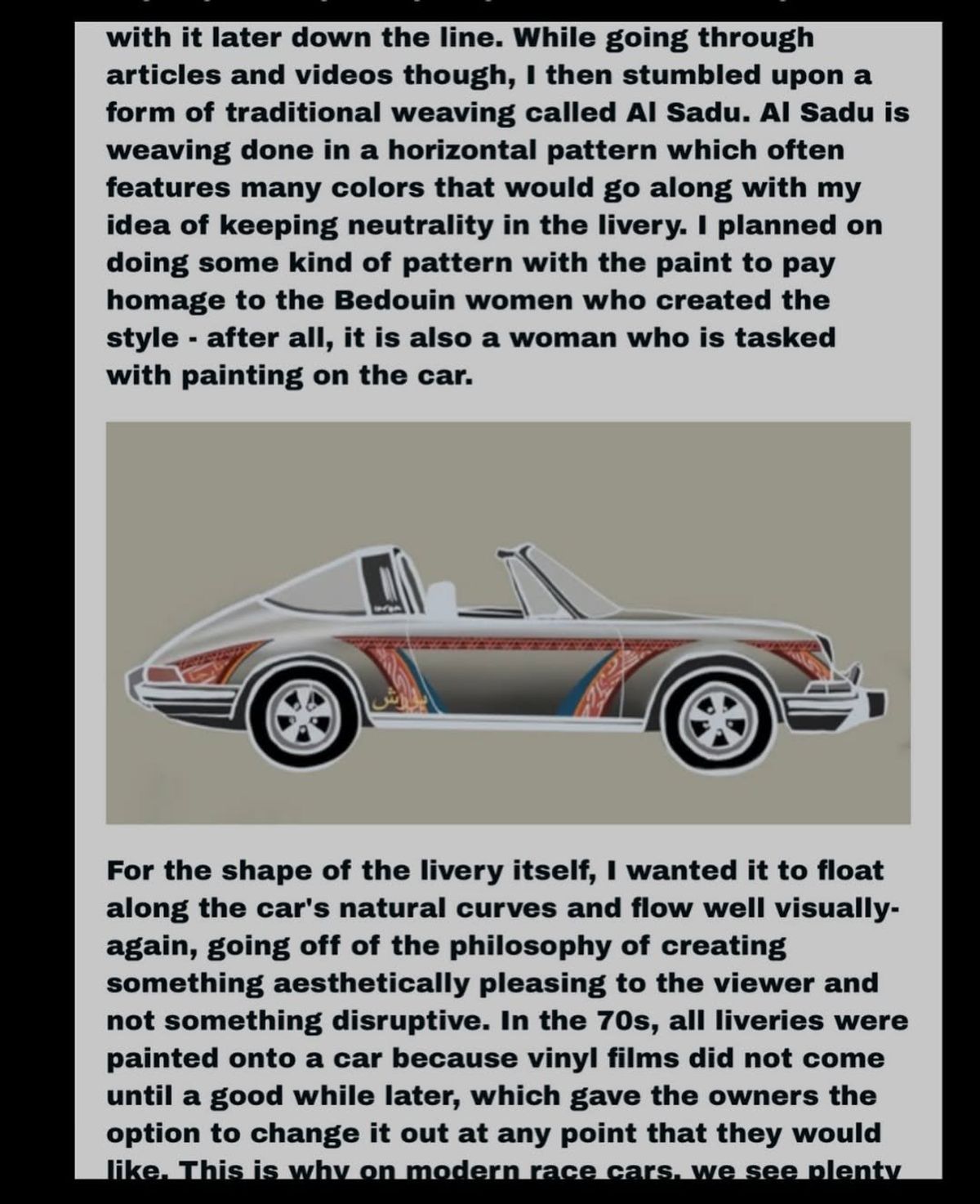
The tradition's practitioners, its master weavers, its cultural custodians, have been appropriated at a structural level by a luxury brand whose heritage story requires their craft to generate market desire. This is the first layer of appropriation. The second layer is the specific one this study addresses: within the context of corporate luxury's already-problematic relationship to collective cultural heritage, Porsche also appropriated the Material Singularity of an individual artist's intervention, the specific act of translating that heritage into an original automotive artwork, live, for the first time, at the brand's own event.
These two appropriations are related but distinct. The first is a critique that requires a collective, political response from the Bedouin weaving community and its institutional advocates. The second is a critique that the PLCFA framework is specifically equipped to make: the evacuation of individual authorship from the origin story of a commercial product. Porsche's invocation of collective cultural heritage functions as an alibi for the evacuation of individual authorship. Because the tradition is collective, no individual can be named. Because no individual is named, the origination event disappears. The Hollowed Object presents itself as a tribute to a tradition while concealing the specific person who made that tribute possible.
Collective cultural heritage becomes, in the hands of the corporate apparatus, not a subject of genuine tribute but a structural alibi: a way to invoke authority while evacuating the human intelligence that made that authority legible in the specific context of its commercial application.
The Custodian's Failure: What the Corporate Event Apparatus Owes
The Icons of Porsche festival is not a neutral venue. It is a corporate instrument: a brand-managed environment designed to cultivate the Porsche community, generate desire in the brand's highest-value regional market, and demonstrate the brand's cultural fluency. Artists are invited, commissioned, or supported in this context because their creative output serves the brand's narrative needs. In 2023, Rae Roberts served those needs. She produced, in public, at the brand's invitation, a synthesis of Porsche heritage and UAE cultural identity that generated precisely the kind of authentic, unexpected, and human-scaled cultural moment that a 60,000-person car festival requires.

The PLCFA framework identifies a specific obligation that flows from this relationship: what we designate the Custodian's Contract. When an institution creates a context that enables singular creative labor, when it provides the platform, the audience, and the occasion for an irreplaceable act of authorship, it enters into an implicit obligation of stewardship toward that act. The obligation is not legal in the conventional sense (the relationship between intellectual property law and live performative work in branded environments is genuinely contested). It is moral. It is institutional. And it is semiotic: to deploy the Semantic Burden generated by that creative act without acknowledging the act itself is to commit what PLCFA designates an Aura Transaction, the appropriation of an original work's residual meaning without the original work's consent or credit.
This is structurally identical to the dynamic analyzed in our study of Hiroshi Fujiwara and the Architecture of Post-Luxury Influence, where the machinery of brand collaboration routinely extracts the creative credibility of independent practitioners while the institution absorbs the cultural authority. The Porsche case is more acute because the origination was not a collaboration, it was a commission by a private client at a corporate event. The brand was not the patron. But the brand was the witness. And witnesses who later commercialize what they witnessed bear a specific institutional responsibility that Porsche has not acknowledged.
The Meaning Deficit and the Semiotic Dependency of Scale
The launch of the Sadu Edition in May 2026 is a symptom of a condition identified across the OAC critical studies archive: the Meaning Deficit. The formal luxury apparatus, its factory output, its marketing infrastructure, its heritage narratives, has reached a structural incapacity to generate the interior meaning that its price points require. This is not a design failure. The Sadu Edition is beautifully executed. It is a semiotic failure: the brand's internal mechanisms cannot produce the authentic cultural synthesizing intelligence that makes the concept legible. That intelligence can only be extracted from those who possess it, the independent practitioners whose uncompensated creative labor constitutes what Sholette calls the Artistic Dark Matter of the luxury system.
Consider the structural logic: Porsche could have commissioned Rae Roberts to design the Sadu Edition. That commission would have been the correct institutional response to what it witnessed in 2023. It would have created a product with genuine Narrative Permanence, the story of the artist who first translated the tradition, who returned to refine it at scale, who became the authorized human intelligence behind the edition. That story would have been commercially superior to what the brand actually deployed because it would have been true in the specific, irreducible sense that a cultural narrative must be true to generate lasting value. Instead, the brand produced a Hollowed Object, a product whose origin story has been laundered through the alibi of collective heritage and institutional commissioning.
This is the Meaning Deficit in its most legible form: a corporation that cannot internally produce the meaning its market demands, that therefore extracts it from the creative labor it has witnessed, and that then presents the resulting product as evidence of its own cultural intelligence. The Sadu Edition is not Porsche's cultural intelligence. It is Rae Roberts' cultural intelligence, processed through Porsche's manufacturing infrastructure and stripped of its authorial provenance.
The Post-Luxury Response: Sovereignty as the Unanswerable Argument
Roberts' Instagram statement, issued in May 2026 as the Sadu Edition coverage reached peak saturation, is a study in post-luxury sovereignty. It does not pursue a legal remedy. It does not demand corporate contrition. It makes the argument that the corporate apparatus is structurally incapable of refuting it: that the originating creative intelligence has already moved beyond the work the corporation is now commercializing. "It's not 2023 anymore," Roberts writes. "I could do so much more now, and I will. I'm well beyond where my mind was at then."
This is the precise resolution that Ganit Goldstein demonstrates through her computational textile practice: the sovereign practitioner does not derive their value from the institution's recognition of their past work. Their value derives from the irreplaceable intelligence that generated that work and continues to generate new work that the institution cannot anticipate or replicate. The corporation can scale a concept. It cannot scale the mind that conceived it. As our study on Iris van Herpen establishes, the Material Singularity of a sovereign creative practice is precisely its irreproducibility, not just of the object, but of the generative intelligence behind the object. The Sadu Edition captures one moment of Roberts' intelligence. It cannot capture the intelligence's forward motion.
Roberts' statement also performs a specific act of critical generosity that the PLCFA framework identifies as essential to the post-luxury practitioner's self-positioning: she explicitly refuses to reduce the Middle East to Sadu. "The Middle East could be represented by so many things in art because it is a region so rich in history, heritage, and culture," she writes. "Sadu shouldn't be the only defining piece of the entire region, especially when there are over 5,000 years of civilization to sift through and research." This refusal to let a single aesthetic signifier stand in for the full complexity of a culture is the structural opposite of the corporate apparatus's reduction of Al Sadu to a decorative decal. Roberts is already thinking at the level of civilizational depth. The brand is thinking at the level of the signature motif.
The sovereign practitioner outpaces the simulacrum not by pursuing it but by continuing to generate. The corporation’s Sadu Edition is a monument to what Rae Roberts was doing in 2023. She is already somewhere else entirely.
What This Confirms About the Current Structural Condition
The Porsche Sadu Edition and the Rae Roberts sequence confirm three structural conditions that the OAC critical studies archive has been building toward across its complete body of work.
First: the corporate luxury apparatus has crossed from the appropriation of cultural heritage into the appropriation of witnessed origination events. The brand no longer needs to imagine a concept. It needs only to attend its own events with enough resources to later manufacture what it encounters. This is Institutional Necrophagy at its most efficient: the brand's event infrastructure doubles as a concept-harvesting mechanism, with attribution stripped at the moment of commercial deployment.
Second, the UNESCO cultural heritage framework, designed to protect living traditions from exactly this kind of appropriation, is being systematically instrumentalized by luxury brands as a source of pre-validated cultural authority. By pointing to the UNESCO inscription of Al Sadu, Porsche positions itself as a steward of recognized heritage rather than an appropriator of a specific creative act. The institutional alibi is built into the brand's chosen frame of reference. As with the Banksy situation, where authorship uncertainty became a mechanism for the art market's continued speculation, institutional framing is deployed to obscure the specific provenance that would complicate the official narrative.
Third, and most importantly, the independent practitioner's sovereignty is the only structurally durable response to this condition. Not legal action, which is expensive, uncertain, and ultimately fought on the corporation's terrain. Not public shaming, which is a temporary instrument and does not compound over time. Sovereignty: the ongoing demonstration that the creative intelligence behind the original act continues to generate work that the corporation cannot access, anticipate, or replicate. This is the post-luxury resolution. It does not require the corporation's acknowledgment. It requires only that the practitioner continue.
Coda
The 2026 Porsche 911 Turbo S Sadu Edition will sell all 20 examples to Kuwaiti collectors. Each will clear $300,000. The brand's official narrative will describe it as a tribute to 70 years of heritage and to the Bedouin weaving tradition recognized by UNESCO. Rae Roberts will not be named. The 2023 Icons of Porsche Targa will not be cited. The concept's provenance will remain, in Porsche's official record, exactly where the corporation placed it: in the collective heritage of a tradition, attributed to no one in particular.
What the PLCFA framework confirms, through this sequence, is that the Hollowed Object has entered its terminal phase. The formal luxury apparatus can no longer sustain even the appearance of originating intelligence. It must now harvest origination itself, witnessing creative acts in the field and manufacturing their simulacra at scale. The Meaning Deficit is not approaching. It has arrived.
What it leaves structurally open is the question of institutional accountability for witnessed origination events. The law is ill-equipped for this terrain. The moral and semiotic obligations of institutions that create the conditions for singular creative acts, and then commercially exploit those acts without acknowledgment, are not yet the subject of any binding framework. The Custodian's Contract remains, for now, a moral instrument. Whether it becomes something more depends on the degree to which the independent practitioner community, and the critical theory that serves it, succeeds in making witnessed origination events visible as events, not as floating cultural data available for industrial harvesting.
Rae Roberts has already moved on. The Porsche Sadu Edition is chasing her 2023 self. That gap, between the sovereign practitioner's forward motion and the corporation's retrospective extraction, is where the post-luxury future lives.
Authored by Christopher Banks, Anthropologist of Luxury, Critical Theorist & Founder Objects of Affection Collection Office of Critical Theory & Curatorial Strategy 469 Fashion Avenue, 12th Floor, New York, NY 10018
RELATED OAC STUDIES
The arguments advanced in this study extend, refine, and are deepened by the following works in the OAC critical studies archive.
The Hollowed Object and the Meaning Deficit
· The Miu Miu Problem: How Wisdom Kaye's Viral Meltdown Became a Blueprint for a New Philosophy
Artistic Dark Matter and Authorship in the Luxury System
· The Banksy Enigma: Mastering the Narrative of Modern Art
· Hiroshi Fujiwara and the Architecture of Post-Luxury Influence
Sovereign Creative Practice and Material Singularity
· The Future of Luxury: Ganit Goldstein, The Generative Architect of Computational Textiles
· The Fluidity of Form: How Iris van Herpen is Rewriting the DNA of Haute Couture
Aura, Origination, and the Unreproducible Act
· The Architect of Infinity: Kazimir Malevich and the Supremacy of the Sublime