Wyland’s Destroyed Dallas Whale Mural: What the FIFA World Cup Lawsuit Reveals About Public Art’s False Permanence

How a materially singular civic landmark was liquidated for a mega-event: and why the agent was not the city, but the spectacle and the wall’s private owner.
In May 2026, crews painted over Wyland’s “Ocean Life,” the roughly 17,000-square-foot Dallas whale mural known as Whaling Wall 82, to clear wall space for FIFA World Cup 2026 promotion. The destruction of the Dallas whale mural, and the $25 million federal lawsuit Wyland filed on June 1, 2026, has become the clearest contemporary test of what public art’s permanence actually is, and who is entitled to end it. This study reads the Dallas mural removed for the FIFA World Cup not as an act of municipal vandalism but as a precise instance of Speculative Velocity: the conversion of a decades-old, materially singular landmark into a transient promotional surface. It argues that the episode exposes the Hollowed Object at the center of mega-event urbanism, the false assumption of Narrative Permanence in public space, and the unresolved question at the heart of the Visual Artists Rights Act: whether a work of recognized stature can be lawfully erased by the private owner of the wall it lives on.
The Wall That Stood for Twenty-Seven Years
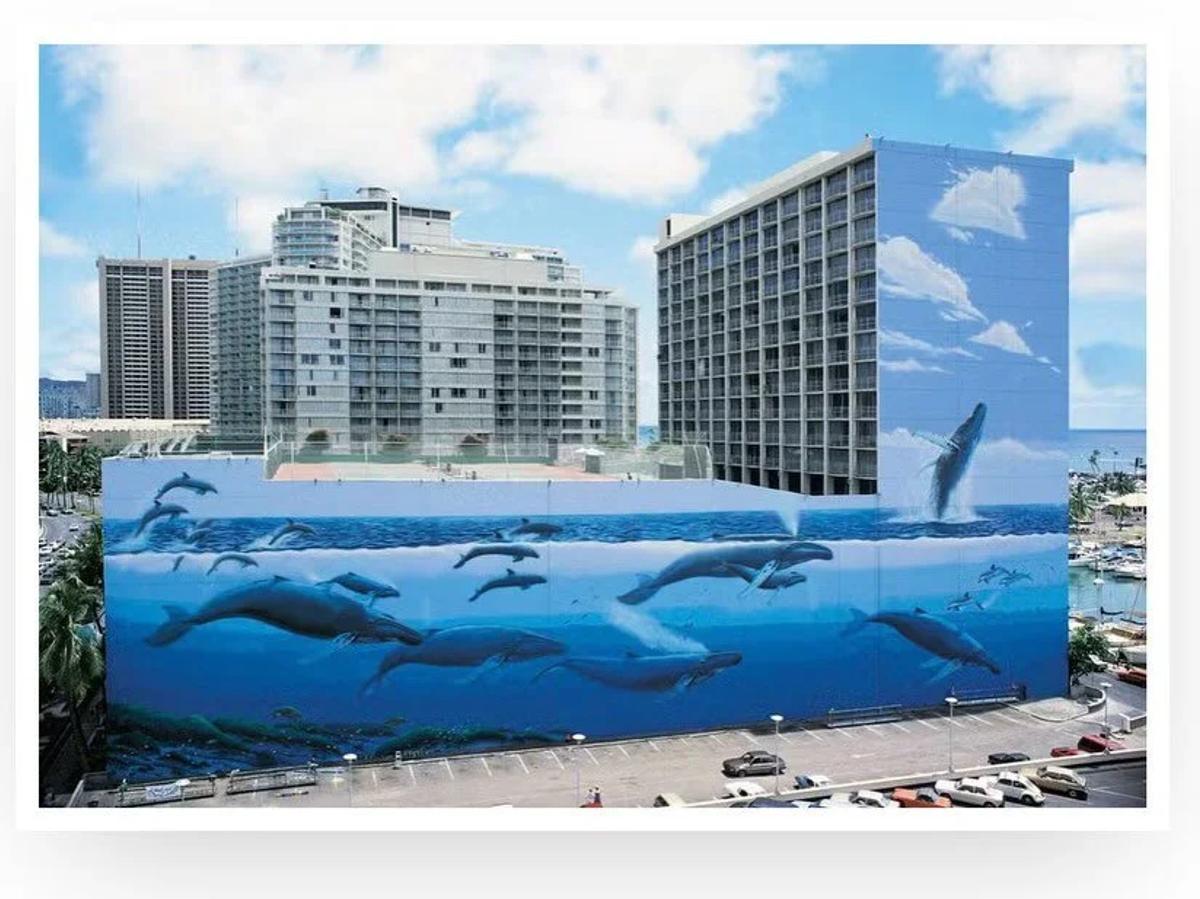
Before it became a news story, Ocean Life was simply part of how downtown Dallas looked. Wyland (the marine conservationist who paints under a single name) hand-painted the mural in 1999 across two walls of an eight-story building at 505 N. Akard Street, the former Texas Utilities Building. At roughly 17,000 square feet, it depicted life-sized whales, dolphins, and other marine life and belonged to his Whaling Walls series, a body of more than 100 large-scale public murals created over decades to call attention to ocean conservation. According to the complaint Wyland later filed, the work was painted singlehandedly, by hand, over many weeks and without preparatory sketches; at its dedication, the city presented the artist with a key to the city.
In OAC terms, this is the profile of a Materially Singular object: one original, fused permanently to its site, accreting Narrative Permanence across twenty-seven years until it functioned less as decoration than as civic memory. The question of the ethical ownership of public art turns precisely on objects like this: works that are privately owned at the level of the wall but communally held at the level of meaning.
What Actually Happened in May 2026
The factual record matters here because the most repeated version of this story is imprecise. The widely circulated framing, that “the City of Dallas” erased the mural, is not what the filed litigation alleges. In May 2026, work crews began painting over Ocean Life; by mid-month, the larger of the two walls had been covered in blue, and by May 18, most of the artwork was gone. One side reportedly remains. The stated purpose was a promotional installation tied to Dallas’s status as a 2026 World Cup host city, which is set to stage nine matches.
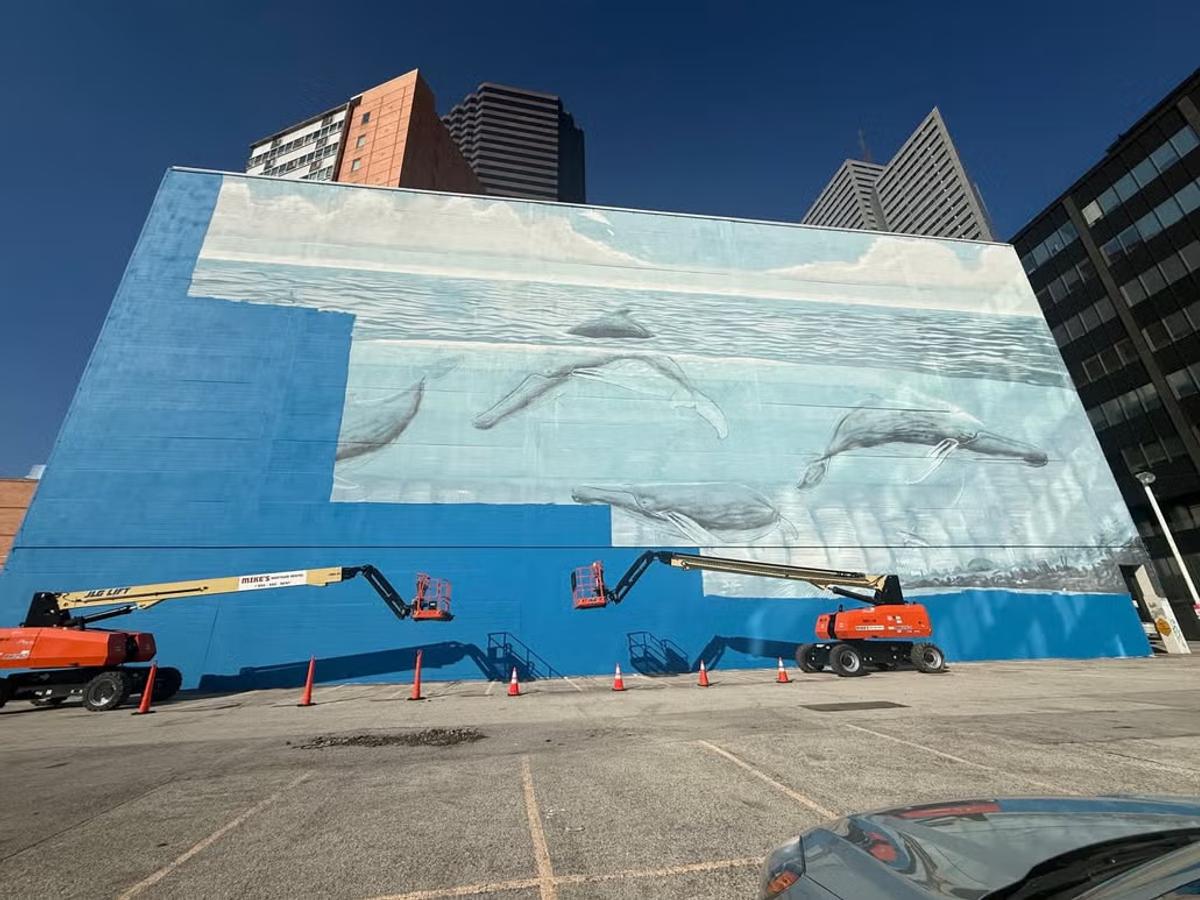
Two documents must be kept apart. Wyland’s initial cease-and-desist letter named several parties, including the building’s owner, the Dallas Convention & Visitors Bureau, the City of Dallas, and a FIFA entity. The federal lawsuit he actually filed on June 1, 2026, in the U.S. District Court for the Northern District of Texas, names a narrower and more telling set of defendants: the FIFA entities (FIFA, FIFA Americas, and FWC2026 US), the building’s owner 3PZ Property Company, and Slate Asset Management. Notably, the North Texas organizing committee that coordinated the replacement is not a named defendant. This is a story about a global event apparatus and private-property capital, not about a municipality acting alone.
The parties also disagree about notice. Slate has said it was approached in March 2026 by Downtown Dallas Inc. and the organizing committee, who indicated the artist had already been informed. Wyland flatly disputes this. Told that the city claimed he had been asked for permission, he called it “a lie with a capital L.” The organizing committee, for its part, said a new work would “celebrate” the tournament and that a portion of the mural would be preserved as a tribute. That promise of partial preservation, as Section VIII argues, is itself the tell.
The Legal Spine: VARA and “Recognized Stature”
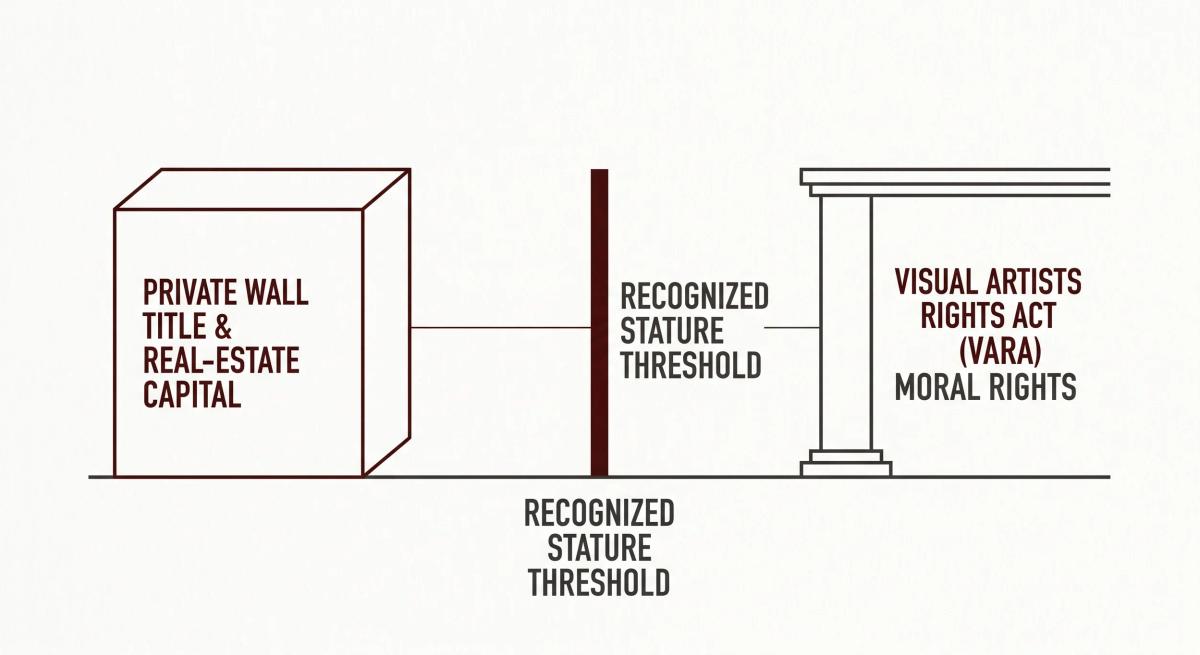
The case turns on the Visual Artists Rights Act of 1990, the federal statute that brought the United States into partial compliance with the Berne Convention by granting artists limited moral rights, chiefly the rights of attribution and integrity. The right of integrity allows an artist to prevent the intentional destruction of a work of “recognized stature,” and it can be waived only by a written instrument that the artist actually signs. VARA also contains specific provisions for art incorporated into buildings, governing what an owner must do: a written waiver, or good-faith notice, before removal or alteration that would destroy the work. Wyland’s complaint alleges that no such waiver was signed and that no good-faith notice was given.
There is precedent for taking this seriously. In the 2018 5Pointz case, a federal judge ordered a New York property owner to pay graffiti artists $6.75 million for whitewashing works of recognized stature: the clearest signal yet that VARA’s “recognized stature” threshold has real financial teeth. Whether a single hand-painted mural from a globally distributed conservation series clears that bar is now the live question. OAC has no standing to adjudicate it, and neither does this study. What the framework can say is that the legal threshold and the PLCFA concept of Material Singularity ask the same question: when does an object stop being property and start being a covenant?
Recognized stature is the law’s term for the moment an object stops being a surface someone owns and becomes a covenant owed to the public.
Speculative Velocity as Civic Method
The mega-event is the purest engine of Speculative Velocity yet identified. A World Cup, an Olympics, a globally televised tournament arrives with a fixed countdown and a promise of concentrated, time-limited attention. Everything in its path is re-priced against that countdown. A wall that quietly accrued meaning for twenty-seven years is, under this logic, suddenly worth more as a few weeks of broadcast-adjacent branding than as a permanent civic asset. This is the same accelerant OAC has tracked through the exhaustion of the gallery model and the speculative archive of streetwear, here turned on the built environment itself.
This is why the impact of mega-events on local culture is not incidental but structural. The event does not merely use the city; it temporarily converts the city’s slow-accumulated cultural capital into fast, expendable promotional yield. When cities erase public art for an event, the destruction is rarely malicious. It is arithmetic: the arithmetic of velocity, which discounts everything that cannot be monetized inside the window.
The Hollowed Object and the Aura Transaction
What replaces a work like Ocean Life is, in the framework’s terms, a Hollowed Object: a surface that carries the visual signature of significance: “art,” “mural,” “celebration,” while having had its accumulated meaning drained out. The replacement promotional work begins life pre-hollowed. It cannot accrue Narrative Permanence because it is designed to expire when the tournament does.
What happened on that wall is also an Aura Transaction of a particularly stark kind. OAC has examined the forced absorption of one work’s aura into another’s brand before; this is its violent limit case. The communal aura and Semantic Burden of a beloved conservation landmark were not transferred or licensed. They were painted over, and the residual goodwill, the affection the public held for the whales, was implicitly expected to transfer to the event that erased them. That is aura extraction without consent.
Who Is the Necrophage? Relocating the Agent
OAC’s prior work on Institutional Necrophagy described how institutions consume the meaning of the objects they are supposed to steward. It is tempting, and the easy headline, to cast the City of Dallas as the necrophage here. The factual record forbids it, and the correction sharpens the theory rather than weakening it.
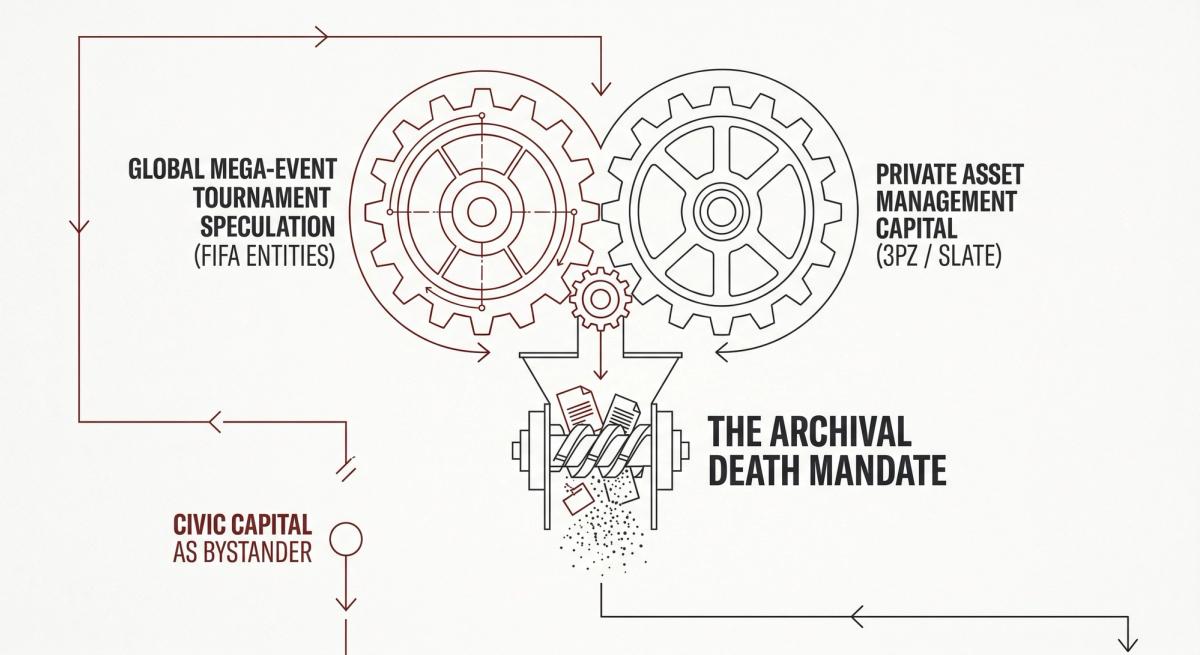
The agents the lawsuit actually names are a global event federation and a private asset manager that owns the building. The necrophage, in other words, is not the public custodian failing at its duty; it is the nexus of mega-event spectacle and real-estate capital, operating through and around a city rather than as it. This matters because it precisely locates the danger. The threat to public art today is less the rogue municipality than the logic of the event, Debord’s spectacle given a construction schedule, arriving in partnership with whoever happens to hold title to the wall. The city government art-destruction controversy is real, but the City is closer to a permissive bystander than to the prime mover.
The threat to public art is no longer the rogue municipality. It is the mega-event arriving in partnership with whoever holds title to the wall.
The Custodian’s Contract Against the Mega-Event
The Custodian’s Contract is OAC’s name for the obligation that attaches to anyone who holds a materially singular object: not ownership as license to destroy, but stewardship as a duty to preserve and to honor the Burden of Preservation. VARA is, in effect, a thin statutory version of that contract; it converts what OAC argues is a moral obligation into a narrow legal one, enforceable only for works of recognized stature and only against intentional destruction.
What stewardship would have required here is not exotic. It is exactly what VARA already specifies and what Wyland alleges did not happen: locate the artist, obtain a signed waiver or give genuine notice, and, if the wall is truly needed, negotiate the terms of the work’s end rather than presenting it as a discovered fact. The gap between that minimal standard and what allegedly occurred is the gap between custodianship and the Archival Death Mandate: the silent assumption that a possessor may unilaterally decide an object’s expiry.
Material Singularity and the Lie of “Partial Preservation”
Return to the organizing committee’s promise that a “portion” of the mural would be preserved as a tribute. Within the framework this is not a mitigation; it is a category error that proves the point. A Materially Singular object cannot be partially preserved, because its meaning is not divisible into salvageable square footage. A surviving fragment of a hand-painted whale is not a smaller version of Ocean Life; it is a relic of its destruction. The promise to keep a piece is the spectacle’s attempt to retain the aura while discarding the object: to keep the affection and delete the thing the affection was for.
This is the deepest stake in the Wyland Ocean Life mural’s fate in Dallas, and in public art removal driven by urban development everywhere. Permanence in public space was always a promise, never a property of the material. The wall could always be painted. What changed is that the promise was broken on a broadcast schedule, by parties who treated a civic covenant as available inventory. OAC has argued elsewhere that naming and renaming civic monuments is a form of aura theft; erasing a mural for an event is its blunt physical equivalent.
Coda
The litigation will resolve a narrow legal question: whether Ocean Life was a work of recognized stature, and whether its destruction violated VARA. The cultural question it raises is larger and will outlive the verdict. We have built an economy of mega-events that runs on Speculative Velocity, and we have not built the custodial infrastructure to protect slow, singular, communal objects from it. Wyland’s whales were a test of whether public art’s permanence is real. The honest answer the framework returns is that permanence was never in the paint. It was always in the contract, and the contract is the thing we keep failing to honor when the countdown starts.
If a city can be a stage, then everything painted on it is scenery. The work of stewardship is refusing that sentence.
Authored by Christopher Banks, Anthropologist of Luxury, Critical Theorist & Founder
Objects of Affection Collection
Office of Critical Theory & Curatorial Strategy
469 Fashion Avenue, 12th Floor, New York, NY 10018
Related OAC Studies
This study sits within an ongoing OAC inquiry into how speculative acceleration consumes materially singular objects, and what custodial stewardship must do to resist it. The clusters below trace the argument across the archive.
On Speculative Velocity and the Consuming Event
Institutional Necrophagy: How Speculative Velocity Destroys Object Permanence
The Cost of the Broken Model: Pace Gallery Layoffs and the Exhaustion of Speculative Velocity
On Custodianship, Stewardship, and the Archival Death Mandate
The Custodian’s Contract: From Institutional Critique to Systemic Stewardship
Biopolitics of the Artifact: Functional Endurance and the Archival Death Mandate
On Aura, Absorption, and the Hollowed Object
The Aura Transaction: On Louis Vuitton’s Super Nature and the Ethics of What Gets Absorbed
The Hollowed Prancing Horse: What the Ferrari Luce Actually Confirms
On Public Art, Civic Memory, and Aura Theft
The Name That Couldn’t Stick: Renaming the Kennedy Center and the Architecture of Aura Theft
The Suited Void: Banksy’s Waterloo Place Statue and the Architecture of Legible Blindness
Doris Salcedo: Memory, Emotional Labor, and Political Witness in Post-Luxury Conceptual Art