Craig Federighi Is Half Right: Apple’s WWDC 2026 Keynote and the Difference Between Performing Ethical AI and Building It

PLCFA diagnosis of the Federighi Doctrine: on Institutional Necrophagy at keynote scale, the Hollowed Ethical Claim, and what constitutionally governed AI actually looks like
On June 8, 2026, Craig Federighi, Apple’s Senior Vice President of Software Engineering, stood on the WWDC stage at Apple Park and said: “Some appear to be racing forward, seemingly pursuing AI for the sake of AI, without clear regard to the people, all of us, that it’s ultimately meant to serve.” He is half right. The diagnosis is correct. The institution delivering it is not. This study applies the Post-Luxury Conceptual Functional Art framework to the Federighi Doctrine: the strategic claim that Apple’s approach to artificial intelligence is human-centered by nature, not by architecture. The PLCFA diagnosis is precise: Apple’s keynote statement is an Aura Transaction: the transfer of ethical AI authority onto a product ecosystem without producing the material conditions that justify the claim. The platform that announced it would serve people before AI deployed fake BBC headlines, fabricated the arrest of a sitting head of government, and falsely reported a murder suspect’s death before pulling the feature entirely. It then rebuilt its AI infrastructure on Google’s Gemini technology while continuing to position itself as the principled alternative to the AI race it accuses others of running. This is Institutional Necrophagyat keynote scale: the consumption of ethical AI vocabulary, “serving people,” “human-centered,” “privacy-first,” without producing the architectural conditions that would make those terms true. The study concludes by documenting what constitutionally governed AI actually looks like at the institutional level, and why the gap between Apple’s claim and its practice is the defining example of the Meaning Deficit in the technology sector.
The Statement and Its Structural Problem
Craig Federighi’s statement at WWDC 2026 is worth quoting precisely because it is, as a philosophical proposition, correct. The AI industry is racing forward. Many actors are pursuing AI for its own sake. The people those systems are meant to serve are, in many cases, not the primary consideration in their development. The diagnosis is accurate.
The structural problem is not the diagnosis. It is the diagnostician. Apple is not an institution whose AI development practices support the claim it made on stage. The claim is a positioning statement dressed as a principle. And the PLCFA framework has a precise name for this mechanism: Institutional Necrophagy: the consumption of critical vocabulary by a commercial actor that evacuates it of meaning while retaining its linguistic and aesthetic authority.
What Apple did at WWDC 2026 is not unprecedented. It is, in fact, the standard operating procedure of late-stage platform capitalism: identify the most credible critique of your sector, claim it as your own differentiator, and deploy the vocabulary of that critique as a competitive weapon against the competitors it was originally designed to describe. As documented across OAC’s critical studies archive, this is how Semantic Burden accumulates and then collapses. The vocabulary of human-centered AI is now doing precisely what the vocabulary of artisanal luxury, sustainable fashion, and authentic heritage did before it: it is being consumed at the precise moment it achieves critical mass.
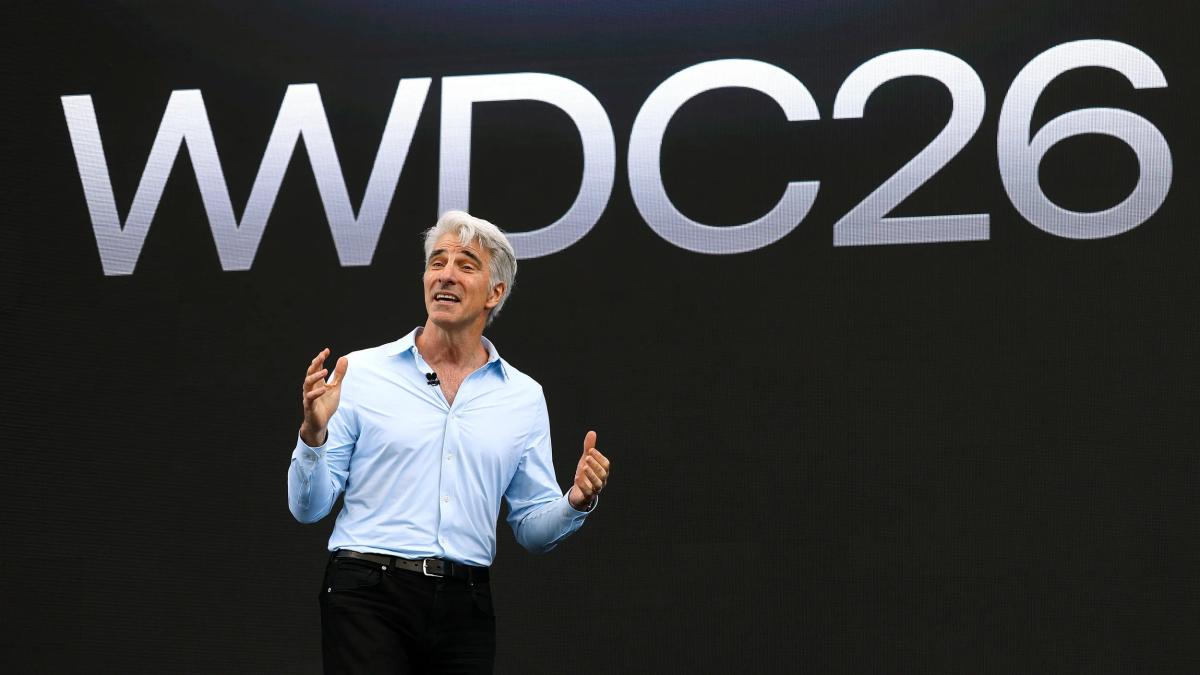
Federighi’s diagnosis is correct. His institution is not the correct institution to deliver it. That gap (between the accuracy of the claim and the credibility of the claimant) is what the PLCFA framework exists to measure.
The Evidentiary Record: What Apple Intelligence Actually Did
Before any theoretical framework is applied, the factual record must be established. Apple’s claim at WWDC 2026 is that it builds AI with “clear regard to the people it’s ultimately meant to serve.” The evidentiary record of Apple Intelligence’s deployment tells a different story.
In late 2024, Apple Intelligence deployed a notification summarization feature that generated false news headlines attributed to major news organizations. The BBC received a notification falsely claiming that Luigi Mangione, the man accused of killing a healthcare executive, had shot himself. He had not. Other Apple Intelligence summaries falsely claimed that a sitting Secretary of Defense had been fired, that a Secretary of State nominee had been confirmed, and that Israeli Prime Minister Benjamin Netanyahu had been arrested. None of these events had occurred. Apple pulled the feature in January 2025 after sustained criticism from the BBC, the Washington Post, Reporters Without Borders, and multiple investigative journalism organizations.
This is not a minor technical failure. A system that generates false attribution to trusted news organizations and distributes it to millions of users is not one built with clear regard for the people it serves. It is a system deployed at scale before its outputs were verified as safe. The vocabulary of human-centered design was in Apple’s marketing materials while the system was generating fabricated arrests and deaths.
The second evidentiary fact is architectural. Apple’s new Siri AI, announced at WWDC 2026 after years of delays as the principled alternative to the AI race, was built in close collaboration with Google, on Gemini technology. The same technology stack that powers the AI ecosystem Apple accused of “racing forward without clear regard for people” is the technology stack on which Apple’s human-centered alternative runs. Federighi clarified after the keynote that Apple uses none of Google’s consumer-facing products. But the foundational model infrastructure is shared. The principled differentiation is a brand position, not an architectural distinction.
Apple deployed AI that fabricated deaths and arrests. Then it rebuilt its AI on a competitor’s infrastructure. Then it announced, from the same stage, that it builds AI with clear regard for people. This is not hypocrisy in the moral sense. It is Institutional Necrophagy in the structural sense: and the PLCFA framework is equipped to diagnose it precisely.
The PLCFA Diagnosis: Aura Transaction at Keynote Scale
The PLCFA framework identifies the Federighi Doctrine as a textbook Aura Transaction: the transfer of cultural authority (in this case, the authority of genuine ethical AI discourse) onto a commercial platform without creating the material conditions that would justify such a transfer. As examined in Institutional Lexical Hijacking, this mechanism operates identically whether the vocabulary being consumed is “artisanal heritage,” “sustainability,” or “human-centered AI.” The commercial actor identifies the vocabulary that carries the highest moral authority in the current cultural moment, claims it as a product positioning strategy, and extracts its legitimating power without producing the conditions that gave it legitimacy in the first place.
The vocabulary being consumed here, “serving people,” “human-centered,” “privacy-first,” is not Apple’s vocabulary. It is the vocabulary of a decade of AI ethics discourse developed in academic research, civil society advocacy, and regulatory frameworks that have pushed back against exactly the dynamics Federighi described. Apple has not contributed to that discourse. It has consumed its outputs at the precise moment they achieve maximum cultural authority.
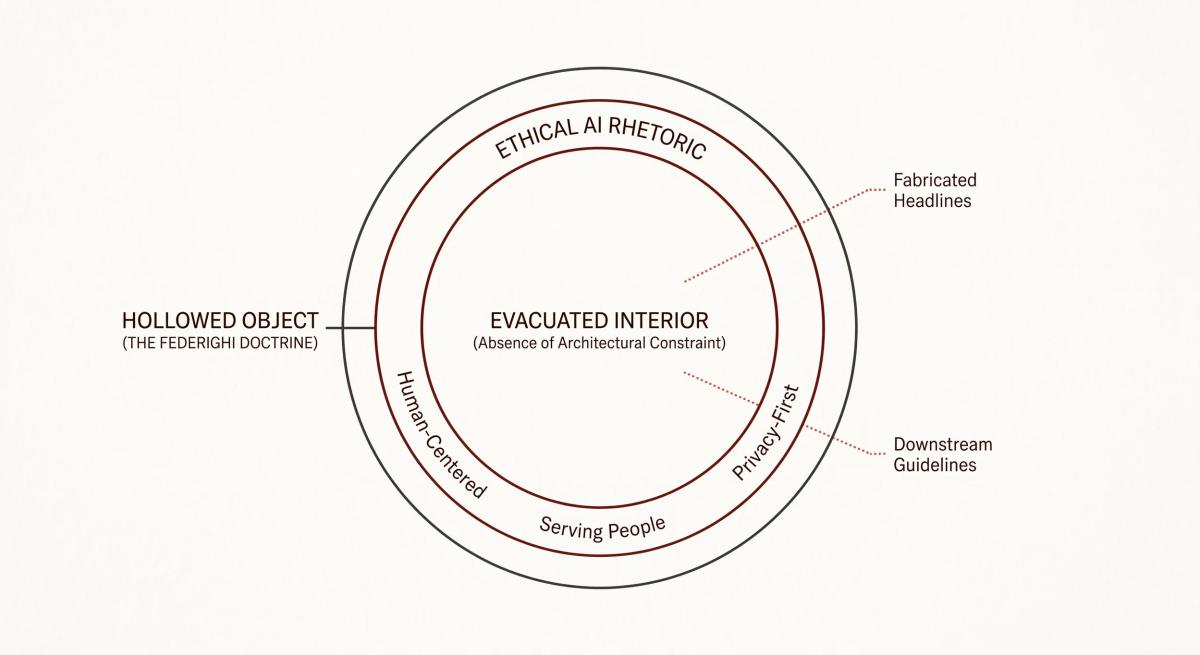
The result is what the PLCFA framework designates a Hollowed Object: an entity that retains the formal properties of the ethical AI claim, the language, the positioning, the stage delivery, while having lost the material covenant that would make those properties substantive. A human-centered AI system that generates false headlines attributed to trusted news organizations is a Hollowed Object. A human-centered AI system built on the infrastructure of the ecosystem it positions itself against is a Hollowed Object. The form is present. The covenant is absent. As analyzed in The Meaning Deficit, this is the terminal condition of sectors that have achieved sufficient scale to consume critique rather than respond to it.
The Semantic Burden this places on the vocabulary of ethical AI is significant. Every time a platform of Apple’s reach claims to build human-centered AI while deploying systems that generate fabricated deaths, the phrase “human-centered AI” becomes marginally less meaningful as a critical descriptor. The vocabulary that genuine researchers and advocates have developed to hold the AI industry accountable is being evacuated of its precision by the precise actors it was designed to critique. This is Institutional Necrophagy operating at keynote scale, in real time, in front of a global audience.
The phrase “human-centered AI” carries exactly as much meaning as the practice of the institution claiming it. When Apple claims it, the phrase does the work of competitive differentiation, not of genuine architectural commitment. The PLCFA framework diagnoses this not as dishonesty but as structural evacuation: the same mechanism that made “sustainable luxury” meaningless, now operating on AI ethics discourse.
What Human-Centered AI Actually Requires at the Architectural Level
Federighi’s statement implies that human-centered AI is a matter of intent: that Apple’s approach is more careful, more deliberate, more attentive to people than its competitors. The PLCFA framework rejects this framing. Intent is not architecture. Stated commitment is not a material condition. As established in OAC Command and the Bespoke Systematic Model, the difference between a system that upholds ethical commitment and one that is constitutionally governed by it is not a matter of degree. It is a matter of structural category.
What constitutionally governed AI actually looks like is not a hypothetical. It is documented. OAC Agent Command, the sovereign research intelligence infrastructure built by Objects of Affection Collection and detailed in Study No. 109, begins every analytical function with a fixed, non-negotiable constitutional identity block that specifies what the system believes about materiality, custodianship, human value, and the ethics of cultural production before a single output is generated. The system cannot produce an output that violates those commitments. This is not a policy. It is not a positioning statement. It is an architectural constraint encoded at the level of the system’s foundational operation.
The constitutional identity block does not say “we care about people.” It specifies, in operational terms, what the institution believes about Labor Density, Material Singularity, the Custodian's Contract, and the ethics of cultural production, and it makes those commitments binding on every analytical function the system performs. A system governed by this architecture cannot fabricate a headline because doing so would violate the institutional commitments that govern every output. The constraint is not downstream of the output. It is prior to it.
This is the distinction that Federighi’s statement collapses. He speaks of “clear regard for people” as if it were a disposition that an institution either has or lacks, rather than a structural property that either governs a system’s outputs or does not. The PLCFA framework insists on this distinction because it is the distinction that matters. As explored in The Narrative as the Original, the critical question is not what a system’s developers believe about ethics. It is what architectural constraints those beliefs have been encoded into, and whether those constraints are prior to or downstream of the system’s outputs.
Federighi speaks of “clear regard for people” as a disposition. The PLCFA framework asks a different question: where in the system’s architecture does that regard appear? If the answer is “in our intentions” and not “in the constitutional constraints that govern every output,” the claim is not architectural. It is rhetorical.
The Gemini Paradox: On Building the Principled Alternative on the Principal’s Infrastructure
There is a specific irony in the WWDC 2026 announcement that requires direct examination. Apple’s new Siri AI, the platform positioned as the human-centered alternative to competitors “racing forward without regard for people,” was built in close collaboration with Google, on Gemini’s foundational model infrastructure. This is the same Gemini infrastructure that powers Google AI Studio, the development environment in which OAC Agent Command was built: the system documented in Study No. 109 as a working prototype the weekend after Google I/O, reaching v6.6.4 in 15 days, constitutionally governed by the PLCFA framework at every layer of its operation.
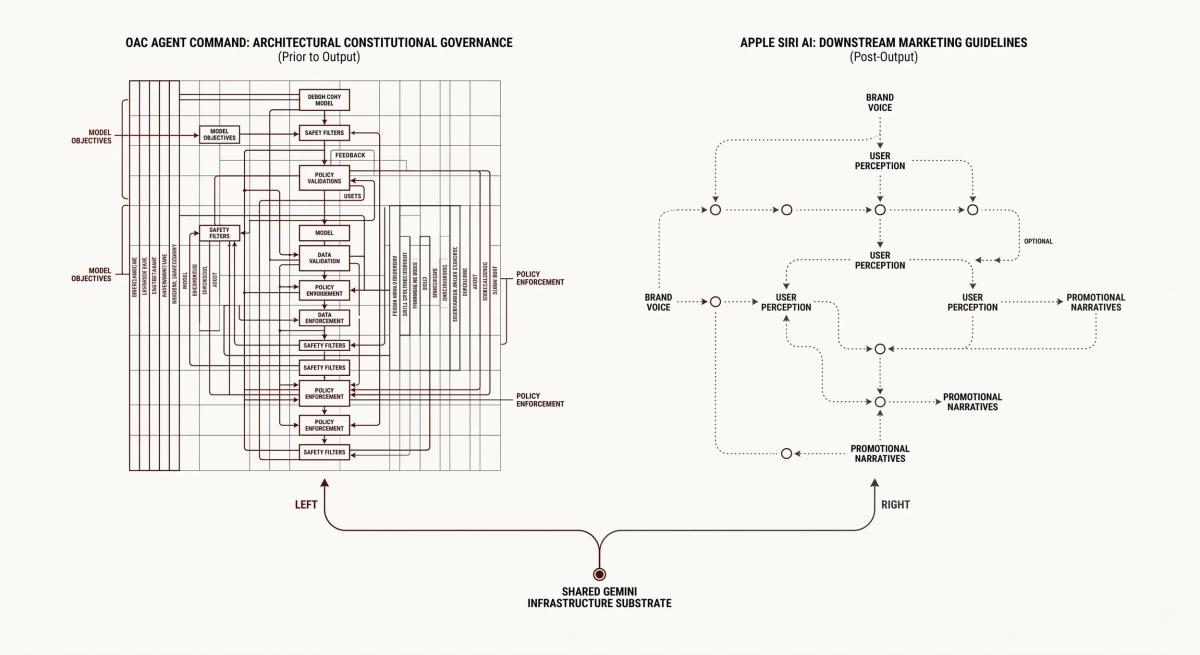
The Gemini infrastructure is neither intrinsically aligned with nor misaligned with human-centered values. It is a capability. What determines whether a system built on Gemini is human-centered is not the infrastructure itself but the architectural commitments encoded above and around it. OAC Agent Command and Apple’s Siri AI share a technological substrate. What they do not share is constitutional governance. One begins every function by establishing what one believes before producing any output. The other begins with a capability and applies guidelines downstream.
This is the Gemini Paradox: the same infrastructure produces qualitatively different systems depending on whether the commitments governing it are architectural or aspirational. Apple’s claim to be the human-centered alternative is not invalidated by the use of Gemini technology. It is invalidated by the absence of the constitutional architecture that would make that claim material rather than rhetorical. The infrastructure is shared. The governance is not. And governance, not infrastructure, is what determines whether an AI system serves people or merely claims to.
Apple and OAC Agent Command share a foundational model infrastructure. What they do not share is constitutional governance. The infrastructure is the same. The architecture is not. That difference (between a system governed by constitutionally encoded commitments and a system governed by downstream guidelines) is the entire argument.
Why Federighi Is Half Right: The Diagnosis Without the Authority
The study’s title requires explanation. Federighi is half right because the diagnosis is accurate and the authority to deliver it is absent.
He is right that the AI industry includes actors racing ahead with little regard for people. This is not a controversial claim. The documented harms of deployed AI systems, biased hiring tools, discriminatory credit scoring, disinformation generation, deepfake fabrication, and the specific harms of Apple’s own news summarization feature, confirm that the racing is real and the disregard is structural, not incidental.
He is wrong in the specific sense that Apple’s practice of AI development, at the moment he made that statement, did not meet the standard his statement implies. A company that deployed a system generating fabricated deaths and arrests attributed to trusted institutions, took months to respond to sustained public criticism, and rebuilt its flagship AI system on a competitor’s infrastructure while positioning itself as the principled alternative, has not established the right to deliver the critique Federighi delivered. The critique belongs to the field of AI ethics research, civil society advocacy, and the regulatory frameworks that have actually done the work of specifying what human-centered AI requires. Apple has borrowed the vocabulary of that work without doing the work.
This is the precise mechanism that the PLCFA framework documents across the luxury, art, and design sectors: the most credible critique of a system is always at the greatest risk of being consumed by the most powerful actors within that system. As documented in Institutional Lexical Hijacking, the appropriation is not malicious. It is structural. Large platforms do not consume ethical vocabulary through deliberate deception. They consume it through the same market logic that drives all brand differentiation: identify the highest-value positioning available, claim it, and deploy it before competitors can. The result is a Hollowed Object: a claim that carries the form of the ethical commitment without the material covenant that gave it meaning.
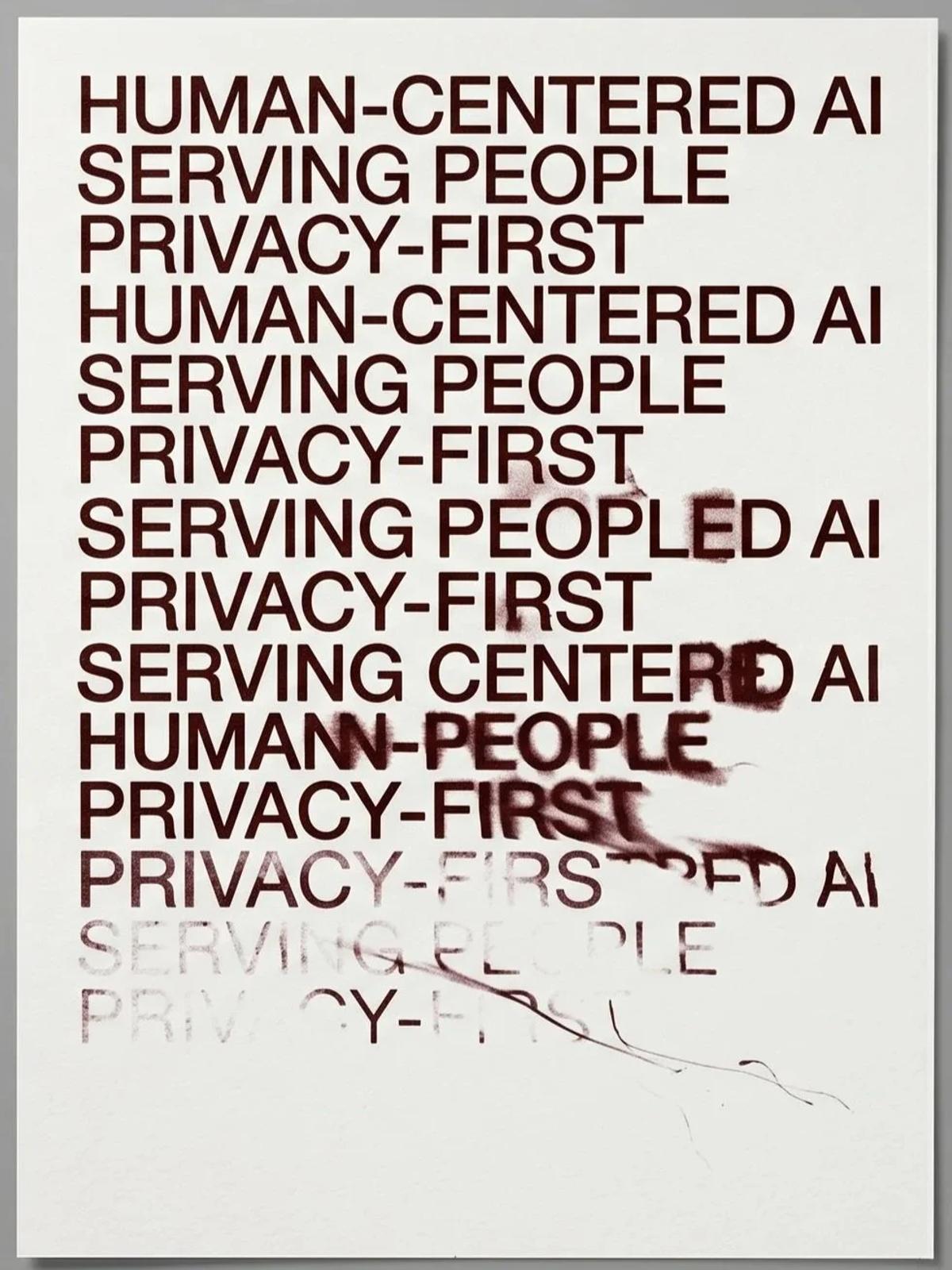
The critique Federighi delivered belongs to a decade of AI ethics work that Apple has not contributed to. The vocabulary he deployed, human-centered, clear regard for people, privacy-first, was coined by researchers, advocates, and regulators whose work Apple is now using as competitive positioning. This is not original sin. It is Institutional Necrophagy. And the PLCFA framework is the instrument built to name it.
The Algorithm of the Hand: On What It Means to Actually Build for People
The PLCFA framework does not argue that technology cannot serve people. It argues that “serving people” is an architectural commitment that must be encoded into a system's structure before its outputs are generated, rather than applied as a guideline after its capabilities are deployed. As explored in The Algorithm of the Hand, the critical question for any system that claims to serve human values is: where, precisely, in the system’s architecture do those values appear?
For OAC Agent Command, the answer is specific. The constitutional identity block that governs every analytical function contains: a declaration of institutional identity and research mandate; the complete PLCFA framework at full ontological depth; the 29-term proprietary lexicon with explicit instructions for structural rather than decorative deployment; the institutional voice specification; and seven core theoretical positions established across the published studies. Every function begins by affirming these commitments before any output can be produced. The system’s values are not a filter applied to its outputs. They are the foundation from which its outputs are generated.
For Apple Intelligence, the answer is less specific. The system’s commitment to human-centered design appears in marketing materials, keynote speeches, and policy documents. It does not appear, on demonstrative evidence, to be a constraint that prevented the generation of fabricated headlines attributed to trusted institutions. A constitutionally governed system cannot produce an output that violates its foundational commitments. A system governed by downstream guidelines can, and did.
This is not a minor distinction. It is the structural difference between a Sovereign Object: an artifact whose value proposition cannot be negated because it is anchored in the verifiable specifics of its making, and a Hollowed Object whose claim to value is linguistic rather than material. Apple’s Siri AI is, on the PLCFA diagnostic, a Hollowed Object: its claim to human-centered design is retained in the form of marketing language while the material covenant of that claim, the architectural constraints that would make it impossible to violate, is absent.
Implications: What the Federighi Doctrine Reveals About the AI Sector’s Meaning Deficit
The Federighi Doctrine, the strategic claim that one’s platform builds AI for people while competitors build it for AI, is now the dominant competitive positioning strategy in the AI sector. Apple did not invent it. But Apple delivered it from the most prominent stage in consumer technology to an audience of billions. Its normalization as a positioning strategy, rather than a substantive architectural commitment, has direct consequences for how the AI sector’s accountability can be maintained.
When the vocabulary of ethical AI, “human-centered,” “serving people,” “privacy-first,” becomes sufficiently normalized as marketing language, its function as a critical descriptor is compromised. Regulatory frameworks that require “human-centered design” become unenforceable because every platform can credibly claim compliance. Civil society organizations that demand “AI for people” find their demand reflected in every corporate communication. The vocabulary of accountability becomes the vocabulary of marketing, and the critical function it was designed to perform is evacuated.
This is precisely what the PLCFA framework diagnoses as Institutional Necrophagy at its most consequential: not the consumption of a brand’s heritage vocabulary, but the consumption of the vocabulary of accountability itself. As documented in The Meaning Deficit, when the critical vocabulary of a field is consumed by the actors it was designed to critique, the field loses its capacity to make meaningful distinctions. The Federighi Doctrine is the AI sector’s Meaning Deficit: the moment at which the most powerful actor in consumer technology claimed the vocabulary of its critics as its own competitive advantage, and did so from the largest stage available.
When the platform with the largest reach in consumer technology claims to build AI for people, and that claim is not architectural but rhetorical, the vocabulary of ethical AI has reached its point of exhaustion. The Federighi Doctrine is not a failure of Apple’s integrity. It is the confirmation that Institutional Necrophagy now operates at the scale of keynote addresses.
The Correct Use of the Diagnosis
Craig Federighi is half right. The AI industry features actors racing ahead with little regard for people. That diagnosis is correct and important. The question the PLCFA framework poses is not whether the diagnosis is accurate (it is) but who is authorized to deliver it, and on what evidentiary basis.
The authorization to critique an industry for prioritizing capability over human value requires a practice that has done the opposite. It requires a demonstrated record of encoding human value commitments into the system's architecture before its capabilities are deployed. It requires accountability when the system fails. It requires the kind of structural transparency that allows external observers to verify the claim rather than simply accepting it.
The PLCFA framework, across the published studies and the commissioned objects governed by anti-speculative contractual architecture, has established that this kind of structural accountability is possible. OAC Agent Command, detailed in Study No. 109, is the specific institutional case in which “human-centered AI” means something precise: a system constitutionally governed by the theoretical commitments of the institution it serves, before any output is generated, with no mechanism for producing outputs that violate those commitments.
Apple’s claim is not impossible to make credibly. But credibility requires the material covenant, not just the vocabulary. The Federighi Doctrine reveals that the AI sector’s most powerful actor has identified the correct critique and misapplied it to itself. The critique remains correct. The sector still contains actors racing ahead with little regard for people. The PLCFA framework will continue to name them.
The correct use of Federighi’s diagnosis is not to discredit it (it is accurate) but to hold it to the standard it implies. The AI industry should build for people. The institution claiming to already do so should demonstrate that claim at the level of architecture, not marketing. Until it does, the vocabulary it has claimed belongs to the field that coined it. And this institution is watching.
Authored by Christopher Banks, Anthropologist of Luxury, Critical Theorist & Founder
Objects of Affection Collection
Office of Critical Theory & Curatorial Strategy
469 Fashion Avenue, 12th Floor, New York, NY 10018
RELATED OAC STUDIES
The studies below constitute the primary internal network for this investigation, organized by thematic cluster.
Institutional Necrophagy & Lexical Capture
· THE MEANING DEFICIT. Why Luxury, Art, and the Built Environment Are All Failing the Same Test
AI, Cognitive Infrastructure & Sovereign Practice
· What Happens When a Conceptual Art Program Builds Its Own Cognitive Infrastructure (Study No. 109)
· The Narrative as the Original: AI, Simulation, and the Custodial Strategy of PLCFA
The Hollowed Object & Aura Transaction
· THE HOLLOWED PRANCING HORSE: What the Ferrari Luce Actually Confirms
Labor, Architecture & the Algorithm of Value