The Hand Strikes Back: Generative “Slop,” Costly Signaling, and the Crisis of the Luxury Artisanal Contract
How the AI visual economy has mathematically cheapened perfection; and why the deliberate scar, the named hand, and the paper grain are now luxury’s most irreplaceable signals
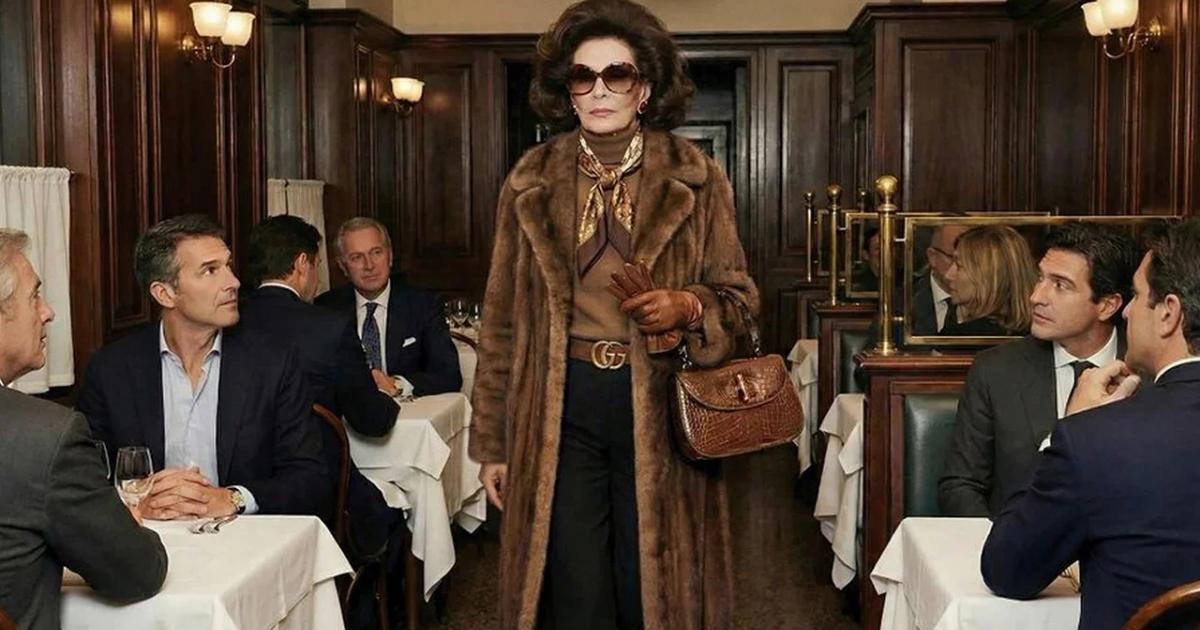
When Gucci released AI-generated promotional imagery for its Spring 2026 Milan Fashion Week debut under creative director Demna Gvasalia, the internet responded with an immediacy that surprised even seasoned brand strategists. The backlash was not irrational technophobia. It was the market performing a precise, if unacknowledged, act of Costly Signaling Theory arbitrage: recognizing in real time that machine-achievable perfection had been mathematically cheapened to zero. The OAC Post-Luxury Conceptual Functional Art (PLCFA) framework diagnoses this event not as a public relations failure but as the first major public rupture of the Luxury Artisanal Contract: the tacit agreement between maker and patron that the premium extracted by a luxury house is commensurate with the irreplaceable density of human labor embedded in the object or the brand’s visual economy. Simultaneously, Hermès was redesigning its website with twelve hand-drawn illustrations by French artist Linda Merad, explicitly crediting the human hand. Prada and Raf Simons were burning shirt cuffs and abrading coat seams. The contrast between these three moves illuminates the defining strategic bifurcation of 2026: brands that understand the Labor Density of imperfection as a Costly Signal and brands that have allowed the Hollowed Object to metastasize into their visual communications.
When perfection becomes free, imperfection becomes priceless. The luxury house that deploys AI slop has not saved a budget line; it has amputated the signal that justified every price point it has ever charged.
The Slop Incident: A Diagnostic Reading
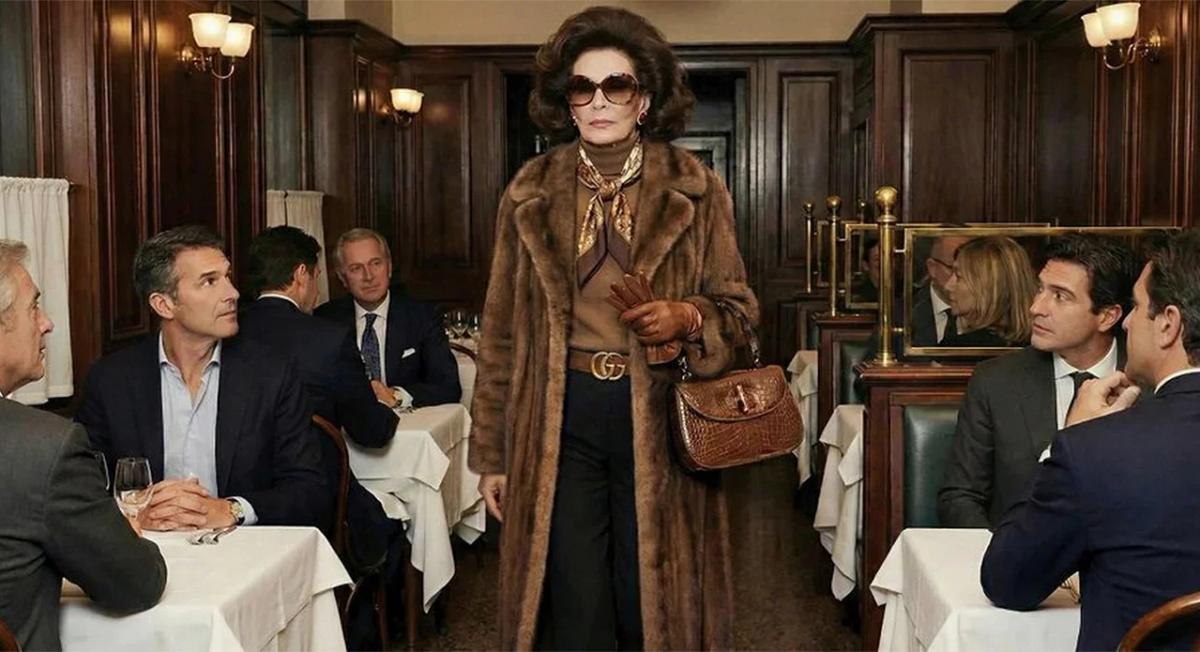
On February 25, 2026, Gucci posted a series of images labeled “Created with AI” to its social channels in advance of Demna Gvasalia’s debut runway show, branded PRIMAVERA. The images included a helmet-haired Milanese socialite dining in a wood-paneled restaurant and a hyper-glossed couple posing on a vintage automobile. The backlash was immediate. Critics called them “AI slop”: the term of art for the deluge of low-quality, algorithmically produced content flooding digital platforms. One viral post captured the cultural wound precisely: “Bleak days when Gucci can’t find a real human Milanese grandmother to wear an outfit from 1976.”
Demna, characteristically, was untroubled. “I think this is 2026,” he told CNN backstage. “I’m using things as a tool.” The creative director’s equanimity is consistent with his documented history of deploying controversy as a brand instrument, a technique honed across years at Vetements and Balenciaga. But the PLCFA framework requires us to read beyond the individual strategic gesture toward the structural damage beneath it.

The critical question is not whether Demna intended irony or provocation. The critical question is what the market reads. And what the market read, with remarkable unanimity across demographic groups, was a rupture of the Luxury Artisanal Contract. One commenter’s observation, “Why should people pay for a luxury brand that doesn’t even respect itself enough to use real people in their campaigns?”, is not a consumer grievance. It is an accurate description of Costly Signaling Theory in the context of collapse.
The Economics of the Costly Signal
Costly Signaling Theory, developed in evolutionary biology and applied to economics by Zahavi (1975) and Grafen (1990), holds that credible signals of quality must be expensive enough to be unfakeable by low-quality actors. In market contexts, Thorstein Veblen’s concept of conspicuous consumption describes how luxury goods serve as public demonstrations of the capacity to waste: to expend resources beyond functional necessity. The signal is credible precisely because it is costly.
The arrival of generative AI in the visual economy has carried out a structural attack on this logic. When a brand image, a photograph, a rendering, a campaign visual, can be produced in seconds at near-zero marginal cost, the Labor Density embedded in that image collapses. A Gucci AI image costs approximately what a Shein product image costs: essentially nothing. This is the mathematical event at the heart of the backlash. The market is not outraged because AI is ugly (though some of the outputs were). The market is outraged because the brand itself has counterfeited the signal.
The parallel with Jean Baudrillard’s analysis of simulacra is exact. When the copy becomes indistinguishable from the real, or when the real voluntarily degrades itself to the level of the copy, the Aura collapses. Walter Benjamin understood that mechanical reproduction does not merely copy the object; it destroys the authority that the object derived from its singular, irreproducible presence. Generative AI does not merely copy; it eliminates the referent. There is no original from which the AI image descends. It is a Zero-Sum Aura event: every AI image produced by a luxury brand transfers aura from the brand to the algorithm that rendered it.
A Gartner survey of 1,539 U.S. consumers, conducted in October 2025, found that 50% said they would prefer to give their business to brands that do not use generative AI in their consumer-facing content. Crucially, 68% of respondents said they frequently wonder whether the content and information they encounter online is real. This is not a preference for the past. It is a declaration that the Authenticity signal has become the premium signal, the scarce signal, the expensive signal. The market is performing Costly Signaling Theory on the brands.
The market is not outraged because AI is ugly. The market is outraged because the brand itself has counterfeited the signal.
The Artisanal Contract Defined
The Luxury Artisanal Contract is an OAC diagnostic concept that formalizes a tacit economic agreement present in every genuine luxury transaction: the patron pays a premium that is understood to be commensurate with the density of skilled, slow, irreplaceable human labor embedded in the object or its representation. This contract has never been legally codified. It does not appear in purchase agreements. But it is the load-bearing structure beneath every price point in the luxury tier.
The contract has three clauses, implicit but binding:
First Clause: The Proof of Irreplaceability: The brand must demonstrate, through its objects, its communications, and its institutional behavior, that it is producing something a machine cannot produce. This does not require explicit claims. It requires consistent Labor Density signals embedded in every touchpoint.
Second Clause: The Legibility of Human Time: The premium charged must be readable as a function of time. The Hermès artisan who spends 25 hours hand-stitching a Birkin is not producing a bag; she is producing a Material Singularity event. The time is the product. The object is the proof. The price is the notation. When a brand deploys AI imagery, it signals that it has abandoned the notation.
Third Clause: The Named Author: The artisanal contract requires attribution. Since 1937, every Hermès silk carré has been designed by a named artist. The artist is the proof that a specific human being, with a specific biography and a specific hand, made a specific decision that could not have been made in exactly the same way by any other human being, and certainly not by any algorithm. Attribution is not vanity. Attribution is Costly Signaling made legible.
The Gucci AI campaign violated all three clauses simultaneously. It deployed imagery a machine produced (First Clause), at negligible time cost (Second Clause), credited to no named human author (Third Clause). The contract was not breached out of malice or indifference, but rather by the casual assumption that the container, the Gucci logo, could absorb the signal collapse. It cannot. The Hollowed Object does not preserve the logo’s authority. It consumes it.
The Hermès Counter-Protocol
In early January 2026 (six weeks before the Gucci implosion) Hermès unveiled its 2026 digital campaign and website redesign built entirely around twelve hand-drawn illustrations by French artist Linda Merad. The campaign theme: “Venture Beyond” (L’appel du large). The execution: pencil on paper, nearly one meter of hand-drawn composition per illustration, scanned, cleaned, and colored with gradients. Every promotion credited Linda Merad by name. The website navigation, product discovery, section transitions, editorial moments, was organized by her hand.
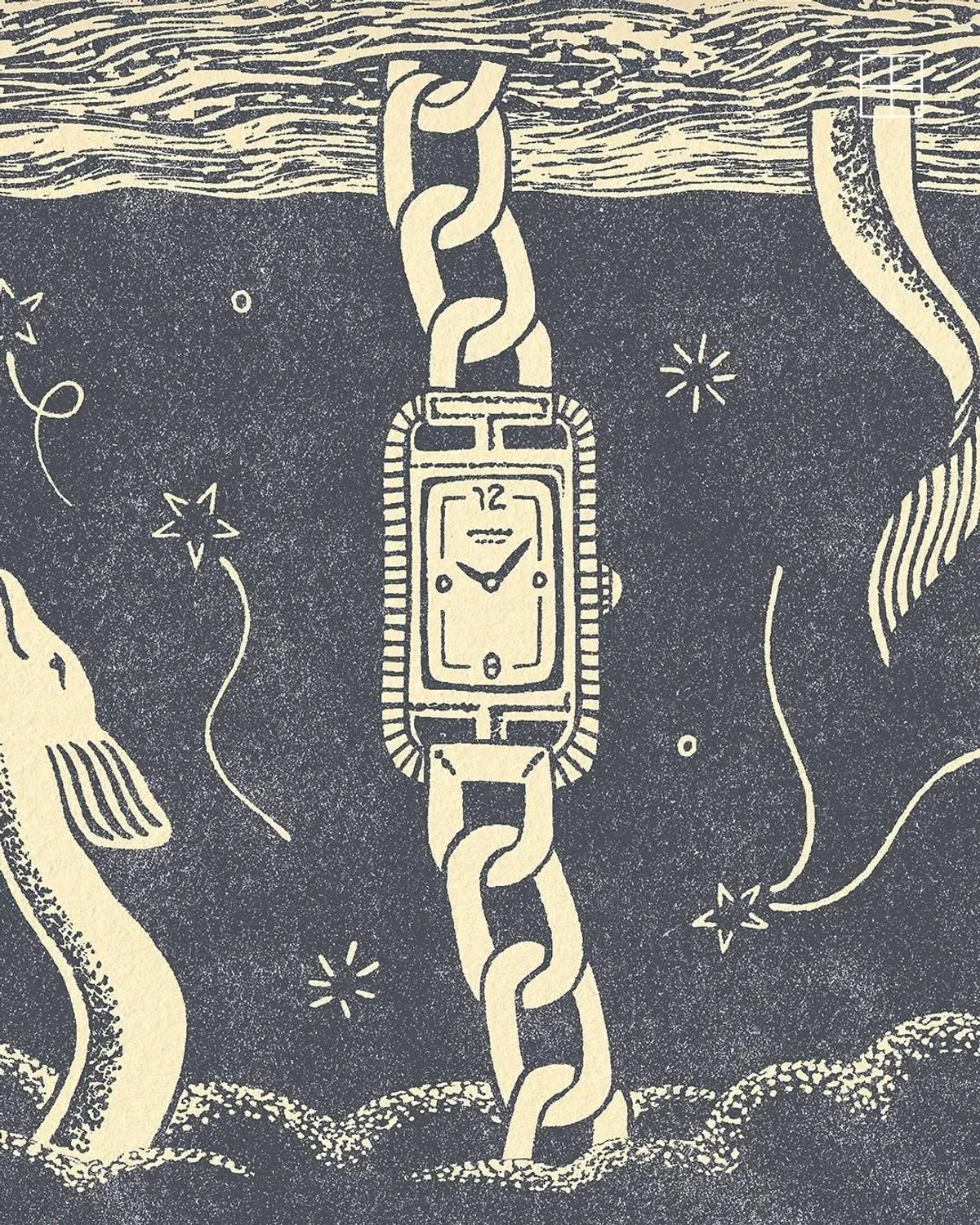
Merad described the commission with a precision that should be studied in every luxury brand strategy room: “They wanted to create the impression that the art was made by a human. They wanted the viewer to feel the materiality of the drawing.” This is not an aesthetic preference. This is Costly Signaling Theory at the level of brand communications: Hermès deployed an input, a named human artist, her proprietary process, her paper texture, her line irregularities, that cannot be cheaply replicated by an algorithm. The algorithm can produce something that looks like a drawing. It cannot produce Linda Merad’s drawing. The distinction is not philosophical. It is Material Singularity.
Fast Company noted that “while digitally rendered images are hyper-smooth, symmetrical, and flawless, these pictures bear all the imperfections of a hand-drawn illustration. We see the texture of the paper grain in the background, a slight irregularity in the lines, and unevenness in the coloring.” This observation is diagnostic. The paper grain is not an aesthetic accident. It is a Legibility of Labor marker, a visible inscription of the human time, human choice, and human fallibility that the algorithmic image systematically erases. In Byung-Chul Han’s terms, the paper grain resists the Aesthetic of Smoothness, the frictionless, optimized surface that the digital economy compulsively produces and that luxury must systematically refuse.
Hermès has never needed to read OAC. It has been practicing the Luxury Artisanal Contract since 1837. The Linda Merad commission is not a reactive strategy. It is the institutional expression of an invariant principle: the brand’s visual economy must carry the same Labor Density as its objects. A 188-year-old house that generates $13.8 billion in annual revenue by insisting on human hands in its factories cannot deploy AI hands in its communications without fracturing the entire system of meaning on which that revenue depends.
Prada’s Architecture of Un-Smoothness
At the Fondazione Prada in January 2026, Miuccia Prada and Raf Simons presented a Fall menswear collection defined by what Vogue called “purposeful imperfections.” The technical vocabulary was precise: scorched French cuffs, abraded seams revealing tweed beneath waterproofed coats, rumpled leather with folds suggesting long use, white vests with faint discolorations reminiscent of smoke or wear. The house’s show notes framed the collection as an inquiry into “universal human values, values of civilization, culture, meaning, intelligence, care.” Miuccia Prada described it in one word: “uneasy.”
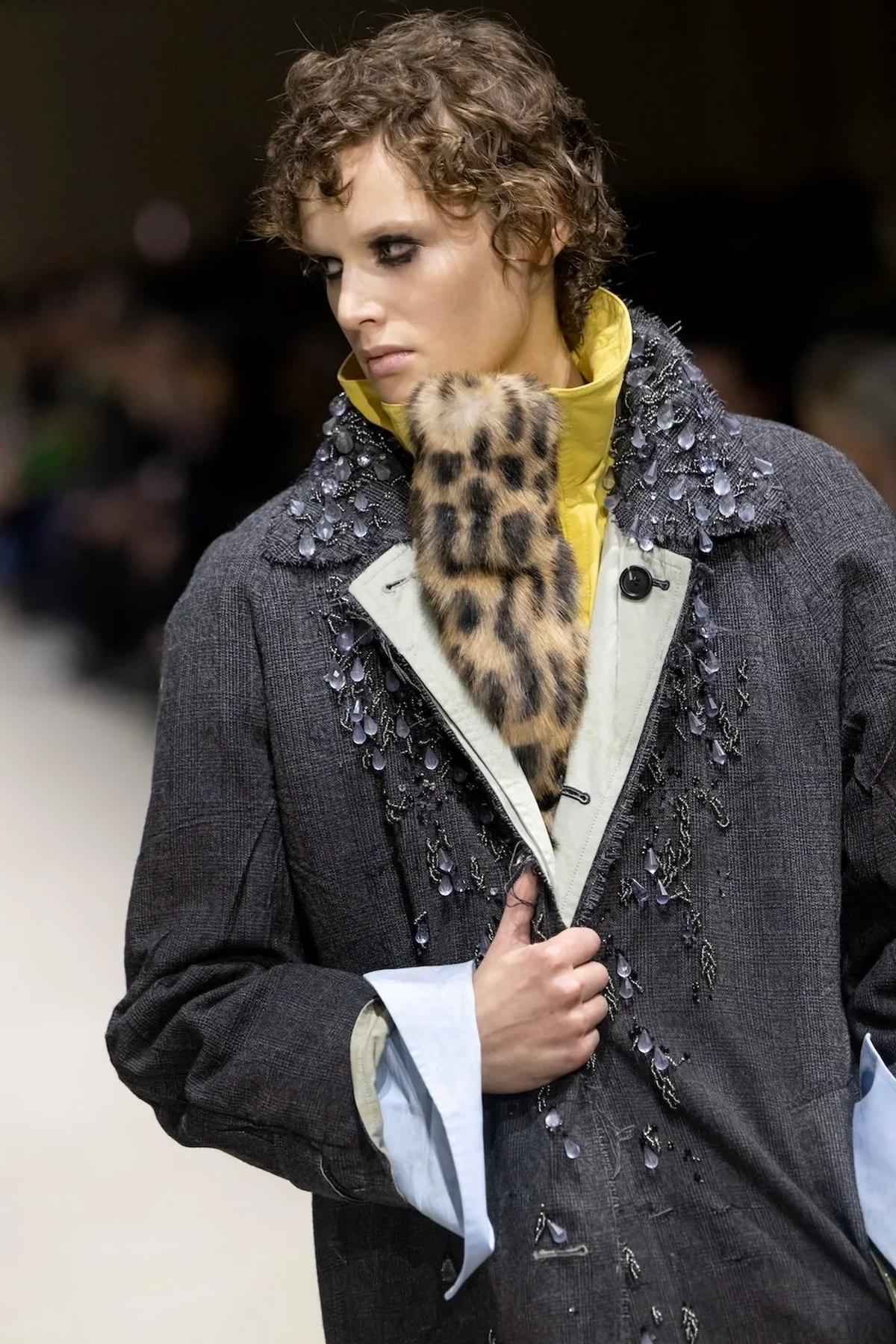
This is Tactical Friction elevated to a design system. The intentional scar, the deliberate abrasion, the burn mark that is not accident but authorship: these are Costly Signals of the most sophisticated order. They communicate not merely that human hands made this, but that human judgment intervened to inscribe a specific mark of time into the material. An algorithm can produce a smooth coat. An algorithm cannot produce the decision to scorch a specific cuff at a specific angle to suggest the weight of a specific life.
The secondary market has been running this experiment for years. Collectors have long paid premiums for signs of wear, the patina on a Hermès Kelly, the visible distressing on a Bottega Veneta intrecciato, because these marks prove the object has been lived with, which proves the object had a life worth living with. Prada made this market logic explicit at the level of the original object: the scar is not evidence of use after purchase; it is Labor Density inscribed at the moment of production. The garment arrives at the patron already bearing the evidence of Narrative Permanence.
The iF Design Trend Report 2026 captured the strategic logic with the directness of a practitioner: “Leave the seams visible. In product, that means showing manufacturing traces.” Miuccia Prada, the report noted, “explicitly avoids social media and computers to preserve a formal language that algorithms can’t reverse-engineer.” The Architecture of Un-Smoothness is not nostalgia. It is a competitive moat.
The algorithm can produce a smooth coat. It cannot produce the decision to scorch a specific cuff at a specific angle to suggest the weight of a specific life.
The Mathematical Cheapening of Flawless Perfection
One of the most consequential theoretical contributions that the AI visual economy has made, inadvertently, is this: it has mathematically demonstrated that flawless perfection is cheap. For the entirety of the twentieth century, a perfect image was expensive. It required a photographer, lighting, a location, a model, a retoucher, time, and judgment. The premium price of the luxury object was, in part, a function of the premium cost of its representation. The campaign imagery, Avedon’s Versace, Penn’s Chanel, Meisel’s Prada, was itself a proof of Labor Density. The seamless beauty of the image signaled the investment behind it.
Generative AI has collapsed this proof. A flawless AI image of a woman in a fur coat in a wood-paneled Milanese restaurant costs approximately $0.08 of compute. It is, by the standards of Costly Signaling Theory, essentially free. This means that any brand, including Shein, can now produce imagery that is indistinguishable, in its surface perfection, from the imagery a heritage luxury house previously spent hundreds of thousands of dollars to produce. The signal has been counterfeited at scale, and the counterfeit is available to any actor in any tier.
The response, the strategically correct response, as Hermès and Prada intuitively demonstrate, is to relocate the signal to territory that generative AI cannot colonize. This means: the Material Singularity of a specific human hand. The Labor Density of a named artist’s specific process. The Legibility of Labor is inscribed in paper grain, burn marks, and abraded seams. The Narrative Permanence of an object that carries the evidence of its making. These signals remain expensive. They remain scarce. They remain credible.
The PLCFA framework has a name for the reverse condition, the state of an object or brand communication from which these signals have been evacuated: the Hollowed Object. The Gucci AI campaign is not a failure of aesthetics. It is a Hollowed Object event at the communications level. The logo is present. The heritage is implied. The signal is gone.
The Custodian’s Contract and the Post-Luxury Response
The OAC Custodian’s Contract specifies that the post-luxury house does not merely produce objects; it holds them in trust, for the patron, for the culture, for the material itself. This custodial mandate extends to the brand’s visual economy. The imagery a luxury house deploys is not advertising. It is the visual extension of the object’s Semantic Burden, the accumulated weight of meaning, provenance, and labor that the brand has earned across its institutional history.
When Hermès commissions Linda Merad, it is not outsourcing its communications to an artist for variety. It is extending its custodial logic, the named artisan, the specific hand, the material trace of human time, from the workshop to the screen. The website becomes an Affective Object: a digital space that carries the Labor Density of its making in visible form. The seahorse that leads the user to the watch section is not a decoration. It is a Custodial Strategy deployed at the interface level.
The post-luxury response to the AI visual economy is therefore not a retreat into anti-technology posturing. It is a precise recalibration of where Costly Signals must be deployed and what they must signal. The Zero-Sum Aura principle applies: every legitimate signal a brand cultivates is one that cannot simultaneously be produced algorithmically. Hermès and Prada are not avoiding AI out of fear of modernity. They are avoiding AI in their customer-facing signal economy because they understand, at an institutional level, that the Aura Transaction requires a signal that remains scarce, expensive, and, in the most precise sense, human.
The PLCFA One Original Principle holds that the object’s value is constituted by its irreducible singularity, the impossibility of its identical replication. Linda Merad’s illustration for Hermès satisfies this principle. A Prada coat with scorched cuffs satisfies this principle. A Gucci AI image of a generic Milanese grandmother violates it, regardless of the logo affixed to the file.
Implications for the Artisanal Contract in Post-Luxury Practice
The crisis documented here is structural, not cyclical. It will not resolve when Gucci appoints a different creative director or commissions a different photographer for the next campaign. It is the consequence of a macro-economic event, the arrival of generative AI into the visual economy at scale, that has permanently and irreversibly altered the signal landscape of luxury brand communications.
Three strategic imperatives follow for any house operating in the post-luxury tier:
Imperative 1: The Named Author as Non-Negotiable Signal: Every external brand communication must carry a named human author. This is not a PR decision. It is a Costly Signaling decision. The named author is proof that a specific irreplaceable human being made a specific irreplaceable decision. Hermès has understood this since 1937. The named scarf artist. The named illustrator. The named craftsperson. Attribution is architecture.
Imperative 2: The Visible Scar as Proof of Time: The object and its representation must carry legible evidence of the time it took to make. This is the Legibility of Labor requirement. Prada’s scorched cuffs and abraded seams are not stylistic choices. They are proof of human time inscribed in material. In a visual economy where algorithmic production achieves frictionless perfection at zero marginal cost, the visible imperfection is the expensive signal. The Wabi-Sabi tradition understood this centuries before generative AI made it strategically urgent.
Imperative 3: The Refusal to Smooth: The post-luxury house must institutionalize the refusal to optimize toward the Aesthetic of Smoothness that algorithmic production achieves automatically. This is the Architecture of Un-Smoothness as institutional posture. Paper grain. Irregular lines. Burns. Patina. These are not failures of production. They are the only remaining proofs that a human being was present.
The Post-Luxury Artisanal Contract as Competitive Moat
The competitive analysis resolves with unusual clarity. In the post-AI visual economy, the Luxury Artisanal Contract is not a cultural obligation. It is a competitive moat. The brands that maintain it, that keep the signal scarce, expensive, and human, will retain the capacity to charge luxury premiums. The brands that breach it, that deploy AI imagery under the assumption that the logo can absorb the signal collapse, will experience what one Gucci commenter predicted with perfect precision: the brand will become indistinguishable from Zara.
This is not hyperbole. It is the Costly Signaling Theory applied to brand equity. The signal must be costly to be credible. When the signal becomes cheap, the premium becomes unjustifiable. When the premium becomes unjustifiable, the price point becomes indefensible. When the price point becomes indefensible, the brand occupies the same tier as any other producer of adequate garments.
The PLCFA framework was built to navigate exactly this collapse. The Material Singularity of the one-of-one object. The Narrative Permanence of the study cannot be mass-produced. The Custodian’s Contract that binds the patron to the object across time. The One Original Principle that refuses the edition, the multiple, the iteration. These are not aesthetic commitments. They are the only durable response to an economy in which algorithmic production has made the counterfeit-free.
The hand strikes back, not out of nostalgia but out of irreplaceability. The question every luxury house must answer in 2026 is not: “Should we use AI?” The question is: “Are we still producing Costly Signals that no algorithm can credibly replicate?” Hermès and Prada, for different reasons and through different methods, have answered yes. Gucci, under Demna’s provisional nihilism, has rendered the question temporarily unanswerable. That is the diagnosis. The prognosis depends on whether the house chooses to re-ratify its Luxury Artisanal Contract before the signal loss becomes permanent.
The Paper Grain as Manifesto
Linda Merad laid her compositions on paper nearly a meter long. She drew with a pencil. The drawings were scanned, cleaned, and given color gradients, but the paper grain survived into the final digital file. Hermès published the paper grain to the world. In an environment flooded with frictionless algorithmic imagery, a luxury house 188 years old made the grain of its paper its most important strategic statement.
That grain is the whole argument. It is proof that a human being was present. It is proof that time was spent. It is proof that the signal cannot be cheaply replicated. It is, in the language of the PLCFA framework, a Material Singularity event in the visual economy: a mark that could not have been made identically by any other hand, by any algorithm, at any lower cost.
Gucci’s AI grandmother has no grain. She has no paper. She has no hand behind her. She is perfectly smooth and therefore, in the only sense that matters for a luxury house in 2026, perfectly worthless as a signal. The Luxury Artisanal Contract is not sentimental. It is the only architecture capable of sustaining a premium in an economy where smoothness has become free.
The hand strikes back. It always does. Because it is the only thing left that cannot be replicated.
Authored by Christopher Banks, Anthropologist of Luxury, Critical Theorist & Founder
Objects of Affection Collection
Office of Critical Theory & Curatorial Strategy
469 Fashion Avenue, 12th Floor, New York, NY 10018
RELATED OAC STUDIES
Further readings from the OAC archive on the mechanics of the broken artisanal contract, the mathematical cheapening of the luxury signal, and the strategic weaponization of human imperfection in the age of generative automation.
On the Hollowed Object and the Collapse of the Artisanal Signal
· The Simulacrum of Luxury: A Guide to Jean Baudrillard’s Critique of Consumer Society (Study No. 022)
· THE HOLLOWED PRANCING HORSE: What the Ferrari Luce Actually Confirms (Study No. 098)
On Costly Signaling, Labor Density, and the Architecture of Human Time
· Hiroshi Fujiwara and the Architecture of Post-Luxury Influence (Study No. 009)
· The Forging of a Legend: Goro’s, A Philosophy Embodied in Silver and Gold (Study No. 002)
· The Fluidity of Form: How Iris van Herpen is Rewriting the DNA of Haute Couture (Study No. 010)
On Institutional Lexical Capture and Brand Aura in Crisis
· Audemars Piguet × Swatch ‘Royal Pop’: The Hollowing of an Icon (Study No. 037)
· What the Keith Haring × Louis Vuitton Show at the Frick Collection Actually Means (Study No. 090)
On Authenticity, Narrative Control, and the AI Crisis of Authorship