What Happens When a Conceptual Art Program Builds Its Own Cognitive Infrastructure

Objects of Affection Collection as a case study in institutional cognition, artistic continuity, and post-luxury conceptual practice
A critical investigation into the cultural, institutional, and philosophical implications of engineering bespoke cognitive infrastructure as a primary act of artistic practice, and as an Object of Affection in its own right
This study documents and theorizes a phenomenon that has not previously existed in the history of art institutions: a single founder who has built, from proprietary code across 33 build iterations, a bespoke sovereign intelligence infrastructure: not as a productivity tool, not as an administrative convenience, but as the primary mechanism of artistic continuity and, more radically, as an Object of Affection in its own right. The institution in question is the Objects of Affection Collection (OAC), founded by Christopher Banks in New York in 2025, operating under the Post-Luxury Conceptual Functional Art (PLCFA)framework, a proprietary critical theory that diagnoses the systematic evacuation of Material Singularity from contemporary luxury culture. The study advances a central argument that has not previously been made: OAC’s critical studies produced the theoretical framework; the framework produced the cognitive infrastructure; the infrastructure compounded the studies; and the compounded studies deepened the framework. This is a closed loop of meaning production: the first of its kind in the history of critical art institutions. The study also places this achievement against its precise technological moment: the tools that made this specific build possible did not exist until May 19, 2026, when Google I/O 2026 introduced native Android vibe coding in Google AI Studio, powered by Gemini 3.5 Flash. By the weekend following that announcement, five days after the capability was released to the world, OAC had a working prototype. OAC Agent Command is currently at v6.6.4. That is not a version number in the conventional software sense. It is an evidentiary record: a compounding sovereign research platform, built by a single non-engineer through conceptual direction of AI coding agents, advancing from working prototype to v6.6.4 in approximately 15 days, each version substantial, each version adding institutional capacity the previous version could not support. The fact that this institution could not have existed one month before this study was published is not a technical footnote. It is a historical argument about what becomes possible at the precise intersection of a mature theoretical framework, a sovereign institutional practice, and an emergent technological capability, and what that intersection produces when the person at its center is not a software engineer but a critical theorist building with intent.
The Argument No One Else Is Making
There is a specific conversation happening across the luxury industry, the museum world, and the critical theory academy about the relationship between artificial intelligence and cultural production. It is, with few exceptions, the wrong conversation.
The luxury industry is asking whether AI can personalize the client journey while preserving the brand's aura. LVMH has committed hundreds of millions to what it calls an “AI Factory.” Museums are asking whether AI can accelerate collection digitization. Critical theorists are asking whether AI-generated work constitutes authentic authorship. These are consequential questions. They are also, in every case, questions about how existing institutions might deploy AI as a tool without reconceiving what they are. The tool serves the institution. The institution is unchanged.
The Objects of Affection Collection is asking a different question. Not: how should an art institution use AI? But: what happens when a conceptual art program treats cognitive infrastructure itself as the primary medium of institutional practice? What happens when the system that perceives, remembers, synthesizes, and projects is not a licensed platform but a bespoke, constitutionally governed intelligence architecture built line by line, version by version, across 33 build iterations, by a single founder who is not a software engineer but a critical theorist, a designer, a music producer, and an anthropologist of luxury?
The answer, documented in this study for the first time: the result is the first single-author institution in the history of critical art practice whose cognitive apparatus compounds over time, accumulates evidentiary depth with every published study, and actively defends its own vocabulary against Institutional Necrophagy using its own archive as the primary instrument of defense. No prior institution has built this. No prior framework has theorized it. No prior critical study has named it. This study does all three.
The question is not how an art institution should use AI. The question is what happens when an art institution treats cognitive infrastructure itself as the primary medium of practice, and builds accordingly. That question has a first answer. It is the OAC.
Historical Lineages: What Had to Exist Before This Became Possible
To understand the full significance of what OAC has built, one must understand the three intellectual traditions it synthesizes: and why none of them, alone or in combination, had previously produced the phenomenon this study documents.
Conceptual Art, as established by LeWitt, Weiner, Kosuth, and the broader dematerialization movement of the 1960s, made a foundational claim: that the idea, the instruction, the proposition could carry aesthetic weight equal to or exceeding any physical artifact. OAC’s PLCFA framework is a direct inheritor. Its insistence that Narrative Permanence and Labor Density constitute the primary substance of an object’s value is Conceptualism’s commitment to the proposition over the product, extended into the post-luxury era. What OAC adds is the recognition that the proposition must be actively defended, architecturally, over time, or it will be consumed by the forces Conceptualism never fully theorized.
Systems Art, shaped by cybernetic theory and the work of Hans Haacke and the Experiments in Art and Technology group, introduced the notion that artworks could be dynamic, rule-governed, temporally extended networks. OAC’s cognitive infrastructure is legible as art history through this lens: it is a systems artwork whose inputs are cultural signals from across the global luxury, art, and critical theory landscape; whose transformation logic is the four ontological poles of the PLCFA framework; whose outputs are studies, objects, music, and institutional positions; and whose feedback mechanism is the compounding archive that makes every new output more precise than the last.
Institutional Critique, from Asher to Fraser to Lawler, turned the analytical lens onto the administrative apparatus of art’s most powerful institutions. OAC inherits this critical posture and inverts its direction: rather than critiquing external institutions from the position of the interloper, it builds a counter-institution whose administrative structure is itself governed by the theoretical framework it espouses. As examined in The Custodian's Contract, OAC’s operational protocols are not separate from its artistic argument. They are expressions of it.
Conceptual Art gave us the proposition over the product. Systems Art gave us the network as an aesthetic object. Institutional Critique gave us the administrative apparatus as artistic material. OAC is the institution in which all three traditions converge, and produce something none of them individually anticipated: a closed loop of meaning production in which the institution’s outputs generate its capacity to produce further outputs.
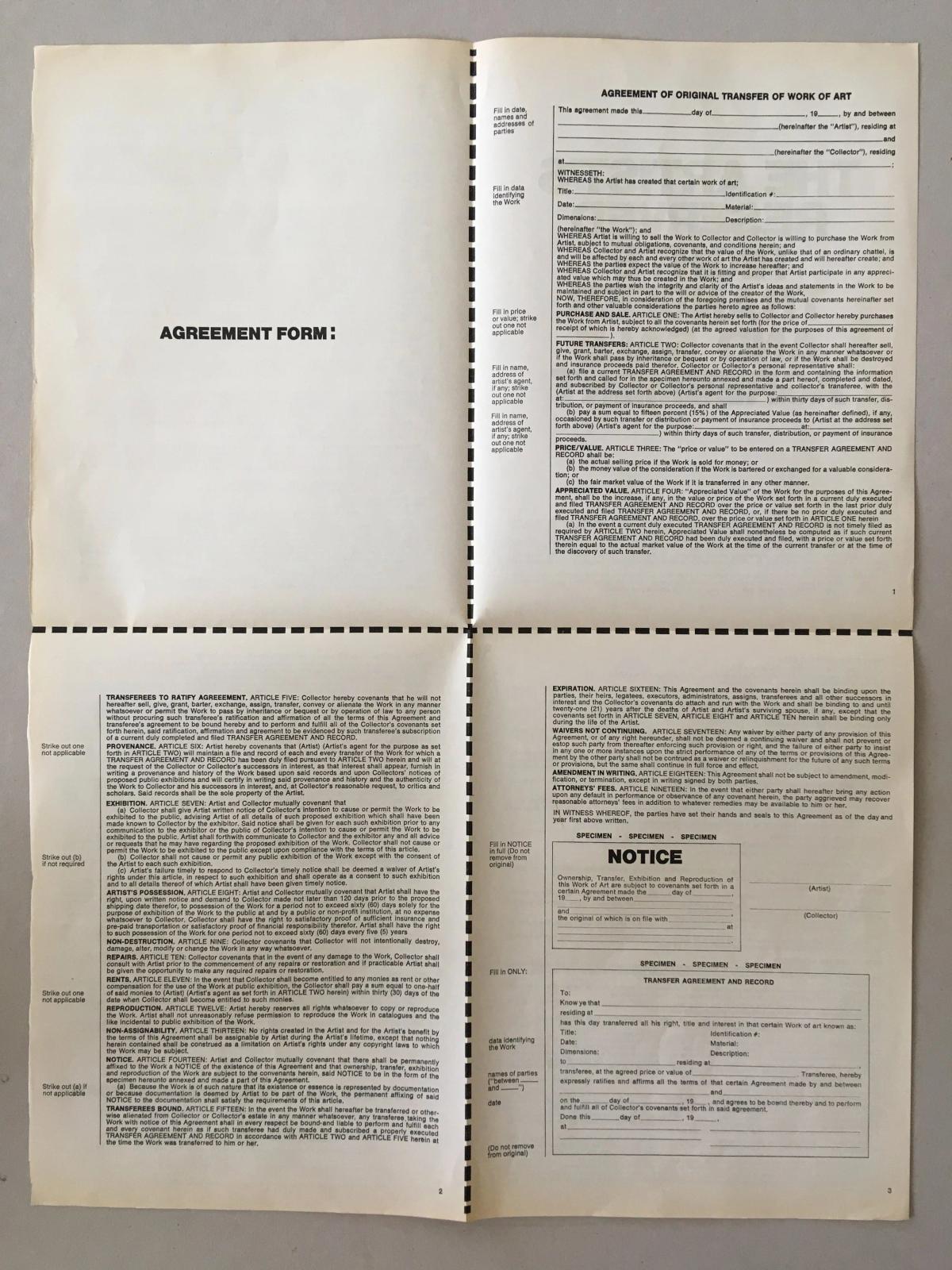
Seth Siegelaub and Robert Projansky’s Artist's Reserved Rights Transfer and Sale Agreement of 1971 is OAC’s most direct legal ancestor: the foundational document of anti-speculative contractual design in the art world. OAC extends this framework across the full spectrum of bespoke material production: garments, accessories, furniture, fragrances, functional art objects, making it the first institution to apply anti-speculative contractual architecture systematically across material categories. Of 39 objects produced and placed, not one has appeared on the secondary market.
Objects of Affection Collection: The Institution as Argument
The Objects of Affection Collection is not legible through any single existing institutional category. It is not a studio, a gallery, a consultancy, or an academic department. It is a sovereign critical research institution whose primary product is an argument about the nature of value, materiality, and custodianship in contemporary culture, and whose every output is a localized expression of that argument in a specific material register.
The PLCFA framework operates through four ontological poles: Object Permanence, Speculative Velocity, Material Singularity, and Custodial Stewardship, and a 29-term proprietary lexicon that constitutes OAC’s primary intellectual property. These terms, Institutional Necrophagy, Hollowed Object, Aura Transaction, Semantic Burden, Zero-Sum Aura, did not exist before OAC coined them. They are now being deployed by external commentators, appropriated without attribution by commercial actors, and tracked in real time by OAC’s intelligence infrastructure. As documented in Institutional Lexical Hijacking, intellectual property in the post-luxury era is defended not by lawyers alone but by the compounding, active self-awareness of the institution that produced it.
The commission practice, governed by the One Original Principle, is OAC’s material practice. Each object is produced under carte blanche: the founder disappears to research the commission, returns with a material proposal drawn from global artisan networks, and delivers the object at a private event of institutional significance. The client does not own the object. They are temporarily responsible for it. A legally binding custodial agreement governs the minimum documented use, transfer conditions, and the prohibition on secondary markets. A hand-bound single-copy book, itself an object, itself irreproducible, contains the conceptual brief: the photographs that inspired it, the heraldic research that informed it, the material history that supports it, and the narrative the object is now tasked with carrying through time.
The music production practice, afro-house, tribal house, baile funk, Afro-Caribbean sonic architecture with isiZulu and isiXhosa lyrical traditions, is the sonic register in which the PLCFA framework’s commitments to Labor Density, Material Memory, and cultural custodianship are expressed. 140+ original compositions. Over 121,000 SoundCloud plays in a single month without marketing. The sonic program is not peripheral to OAC’s critical practice. It is the same argument made at a different frequency.
Cognition as Artistic Medium: The Central Thesis
The central claim of this study is not that OAC uses artificial intelligence effectively. It is that OAC has constituted a new artistic medium: institutional cognition, the structured capacity to perceive, remember, synthesize, and project as an institution, treated as a primary material of artistic practice.
In OAC’s model, research is not a preliminary step to the artwork. It is the artistic practice. The continuous evaluation of cultural signals through the four ontological poles of the PLCFA framework constitutes an ongoing, theoretically governed performance of institutional sensemaking. Every signal evaluated is an act of institutional perception. The framework decides what is relevant. The deliberative process decides what it means. The resulting study, object, or music production is the artifact. But the perception, deliberation, and synthesis that precede it are the practice, and they are now architecturally governed rather than episodically conducted.
Memory, similarly, is an artistic practice. As explored in The Paradox of Narrative Permanence, an institution’s ability to recall its past arguments, track the evolution of its vocabulary in the public sphere, and identify the exact moment when external actors begin consuming its critical lexicon constitutes a deliberate act of conceptual preservation. Material Memory is not a metaphor in OAC’s practice. It is an operationally enforced, architecturally enforced, permanently archived protocol.
Research is not a preliminary step to the artwork. Memory is not a byproduct of production. Continuity is not an aspiration. In OAC’s model, all three are primary artistic practices: designed, engineered, and compounded with the same intentionality the institution applies to every object it makes.
The Closed Loop: How the Studies Produced the Software That Compounds the Studies
There is a dimension of OAC’s practice that this study would be incomplete without naming directly, because it represents the most philosophically consequential aspect of what has been built, and the aspect that no existing critical framework has yet described.
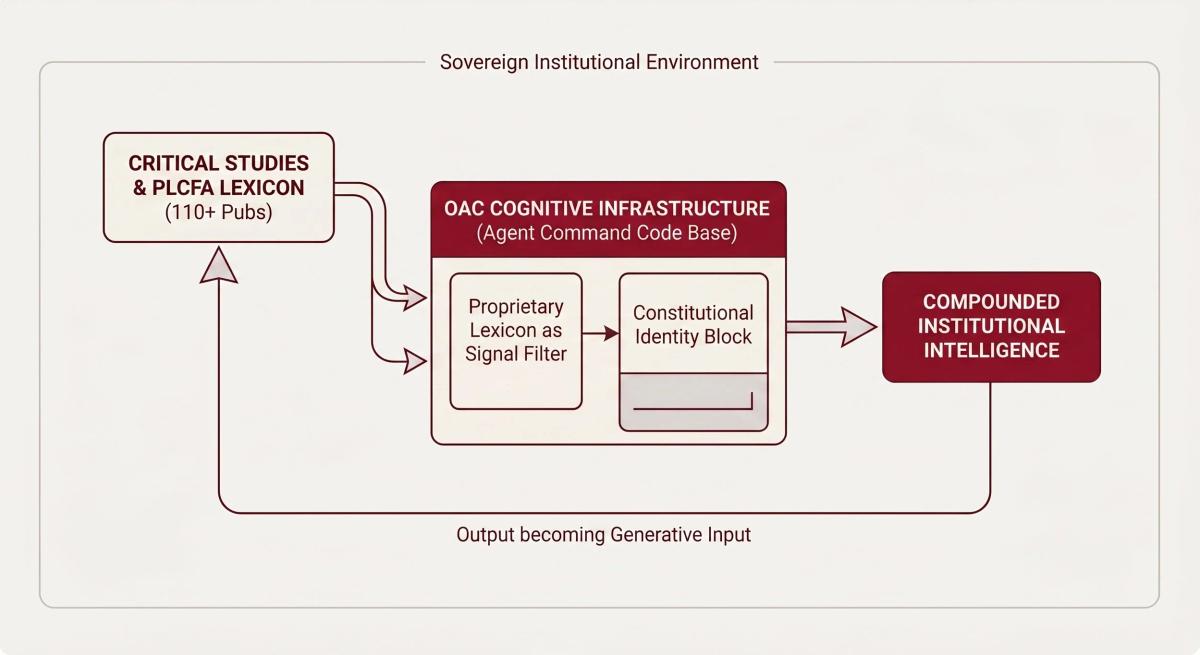
OAC’s critical studies did not merely inform the development of its intelligence infrastructure. They produced it. The 29-term proprietary lexicon, developed across the first studies OAC published, became the semantic architecture of the infrastructure’s signal filter: every incoming cultural signal is evaluated against the vocabulary that the studies coined. The four ontological poles of the PLCFA framework, articulated in the foundational theoretical studies, became the scoring dimensions of the priority engine: every signal receives a density score based on how many poles it engages. The deliberative positions that the academic studies establish, on materiality, on provenance, on custodianship, on anti-speculative legal design, on the sonic dimensions of Institutional Necrophagy, became the epistemological identities of the deliberative protocol’s agents. The institutional voice that the studies perform across the published corpus became the constitutional identity block that precedes every analytical function in the system.
In other words, the studies are not documented alongside the infrastructure. The studies are the source material for the infrastructure. Every theoretical position OAC has published is operationally active inside the system that evaluates new signals, deliberates on their significance, and generates new thesis pathways. In OAC’s practice, publication and operationalization are the same act.
The studies produced the framework. The framework produced the software. The software compounds the studies. The compounding studies deepen the framework. This is not a workflow. It is a closed loop of meaning production: the first of its kind in the history of critical art institutions.
This closed loop has a consequence that is easy to state but difficult to fully absorb: every study OAC publishes makes the system that will evaluate the next cultural signal more precise. A study on Aura Transaction deepens the deliberative protocol’s capacity to identify aura extraction in a new corporate collaboration. A study on Institutional Necrophagy expands the evidentiary corpus against which future vocabulary appropriations are detected. The archive does not merely record what the institution has argued. It actively makes the institution more capable of arguing the next thing. Output becomes generative input. The loop closes.
The recursion extends to the physical objects. Each commissioned object is the material instantiation of a theoretical position established by the studies. The alligator loafer whose material was sourced from a specific named animal in a specific ecosystem is the physical expression of the Trauma Provenance argument. The scarf woven from Lake Como silk and hand-finished at Henry Poole is the physical expression of the Labor Density argument. The hand-bound single-copy book delivered with every commission is the physical expression of the Narrative Permanence argument. The commissioned object does not illustrate the theory. It is the theory in material form. And the theory was produced by the studies. And the studies are now operationalized in the infrastructure that will generate the next thesis pathway and produce the next study. The loop closes again, at the level of the physical object.
Every commissioned object is a study made physical. Every study is a commissioned object made theoretical. The infrastructure that connects them is not administrative overhead. It is the medium through which OAC’s practice achieves the recursive depth that no single output could sustain alone.
The Infrastructure as Object: OAC Agent Command Under the One Original Principle
The argument in the last section leads to a conclusion that institutional art theory has not previously had occasion to draw, because the condition it describes has not previously existed. It requires stating plainly.
OAC Agent Command is an Object of Affection.
Not metaphorically. Not by analogy. By the precise application of the same criteria that govern every bespoke object OAC has produced. It was made to exact theoretical specifications: the PLCFA framework at full ontological depth, operationalized as code. It was made under carte blanche: the founder specified the institutional requirements and directed the implementation across 33 build iterations without a brief from any external client. It is governed by the One Original Principle: there is one instance of this system, running on one device, held by one institution. It has never been licensed. It has never been replicated. It cannot be reproduced without the framework, and the framework cannot be reproduced without the published studies that give its terms evidentiary weight, and the studies cannot be reproduced without the commissioned objects that embody the framework in material form, and the commissioned objects cannot be reproduced without the patron relationships built through a protocol that begins with listening rather than pitching. No edition. No multiple. No secondary market.
Its Labor Density is extraordinary and measurable: 22,828 lines of proprietary Kotlin code, 31 source files, 21 database tables, 18 distinct analytical functions, a 12-position deliberative protocol, a dual-stage signal filter evaluating 80+ semantic keyword patterns, a permanent cloud archive streaming five data channels continuously, all built across 33 versions by a founder who is not a software engineer, through a process of conceptual direction that is itself a novel form of artistic labor. The object required a new kind of making.
Its custodian is the institution itself. The Custodian's Contract that governs every physical object OAC produces, governing use, governing transfer, and prohibiting secondary-market speculation, governs the infrastructure by definition. The infrastructure exists to serve the institution’s theoretical commitments. It cannot be repurposed without violating those commitments. It cannot be licensed without becoming a product rather than a practice. Its custodianship is absolute, and it belongs to the founder.
OAC Agent Command is the most complex, most singular, most labor-dense object OAC has ever produced. It is governed by the same principles as every bespoke scarf and commissioned loafer: One Original Principle, no editions, no multiples, built to exact theoretical specifications, under carte blanche, for a single custodian. The custodian is the institution itself. The object is the institution’s capacity to think.
The meta-dimension of this argument is not incidental. It is the argument. The fact that OAC’s studies produced the infrastructure, and the infrastructure compounds the studies, and the studies are embedded in the infrastructure, and the infrastructure is an expression of the studies: this recursive self-reference is the structure through which OAC has made institutional cognition indistinguishable from institutional practice. The institution thinks with its objects. Its objects include, as of 2025, the system that does the thinking. The loop is not a loop. It is the institution.
The 21-Day Argument: A Working Prototype the Weekend After Release, v6.6.4 Three Weeks Later
There is a fact about OAC Agent Command that changes the picture of what this institution represents, and that has not previously been stated in any published account of the work. It is a fact about timing, about technological threshold, and about what it means when a mature theoretical framework meets an emergent capability at the precise moment of its availability.
On May 19, 2026, at Google I/O 2026, held at Shoreline Amphitheater in Mountain View, California, Google announced native Android vibe coding in Google AI Studio: the ability to build production-quality native Android applications, written in Kotlin with Jetpack Compose, directly from a plain-language prompt, with no software to install, no SDK to manage, and no local development environment required. The model powering this capability, Gemini 3.5 Flash, described by Google as combining “frontier intelligence with incredible speed” and outperforming Gemini 3.1 Pro across almost all benchmarks while running four times faster, was released to the world on the same day. This was not an incremental update. It was the moment at which the barrier to native Android development, one of the most technically demanding surfaces in software, was fundamentally removed for non-engineers.
OAC Agent Command is a native Android application. It is written in Kotlin. It uses Jetpack Compose. By the weekend following the May 19 announcement, five days after the capability existed, OAC had a working prototype. The system is currently at v6.6.4. That version number requires context to be understood correctly: it is not the designation of a product nearing market release, nor the output of a development team cycling through sprints. It is the evidentiary record of a single founder, operating through the conceptual direction of AI coding agents, advancing from the first working prototype to v6.6.4 in approximately 15 days, each version substantial, each version extending institutional capacity that the previous version could not support. The velocity is not the point. The velocity is the evidence.

This study was published on June 9, 2026. Google I/O was May 19, 2026. The gap between the announcement of the capability and the system's current version is approximately 3 weeks.
OAC Agent Command (a 12-position deliberative chamber, a permanent BigQuery archive, and a constitutional identity architecture governing 18 distinct analytical functions, currently at v6.6.4) could not have been built by a non-engineer one month before it was built. The technology did not exist. The study you are reading documents an institution whose most singular object was made possible by a capability released to the world three weeks before this sentence was written, and which reached v6.6.4 in the 15 days that followed a first working prototype built the weekend of that release.
This is not a claim about Google I/O. It is a claim about what happens at the intersection of three conditions that had never previously converged: a mature, precise theoretical framework with 29 operationalizable terms and four ontological poles; a sovereign institutional practice with a published body of studies and commissioned objects providing evidentiary depth; and a technological capability, the ability to build production-quality native Android applications through natural language direction, that had just become available to non-engineers for the first time. Remove any one of these three conditions and OAC Agent Command does not exist. The framework without the capability is a philosophy without an instrument. The capability without the framework is a tool without an argument. The institutional practice without either is a body of work without the infrastructure to compound it.
The significance of the version trajectory is not the speed. It is what the speed demonstrates: that the founder did not have to learn what to build. He already knew. The studies had already specified it. The framework had already defined the requirements. v6.6.4 in 15 days from a working weekend prototype is not the output of someone who encountered a new tool and began exploring its possibilities. It is the output of someone for whom the conceptual architecture of the system was complete before the first line of code was written, and who recognized, the weekend of the release, exactly what the new capability made possible and exactly how to direct it toward an institutional purpose that had been years in development.
LVMH has spent hundreds of millions on AI infrastructure. Kering has deployed machine learning across its supply chain. Every major auction house has piloted AI for provenance research and market analytics. None of them produced OAC Agent Command. Not because they lacked the resources: they have resources that dwarf anything OAC has access to. Not because they lacked access to the same tools: Gemini 3.5 Flash and Google AI Studio are available to any developer on Earth. But because they lacked the theoretical framework precise enough to specify what the system needed to believe; the institutional practice deep enough to give the system’s evidentiary corpus meaning; and the singular authorial vision that treats building the system as an act of artistic practice rather than an act of corporate infrastructure deployment.
The luxury conglomerates have the money. They do not have the argument. OAC has the argument. It now also has the object at v6.6.4 and advancing, that makes the argument compound. The three-week gap between the tool becoming available and the current version of the system is not a speed record. It is evidence of a theoretical readiness that no amount of capital can purchase.
The Architecture of Sovereign Cognition: Five Functions That Change What Is Possible
What does it mean, in operational terms, for an institution to have built its own cognitive infrastructure? The answer is most legible through five functions: each of which, when actively engineered rather than passively hoped for, changes what the institution can perceive, remember, argue, anticipate, and defend.
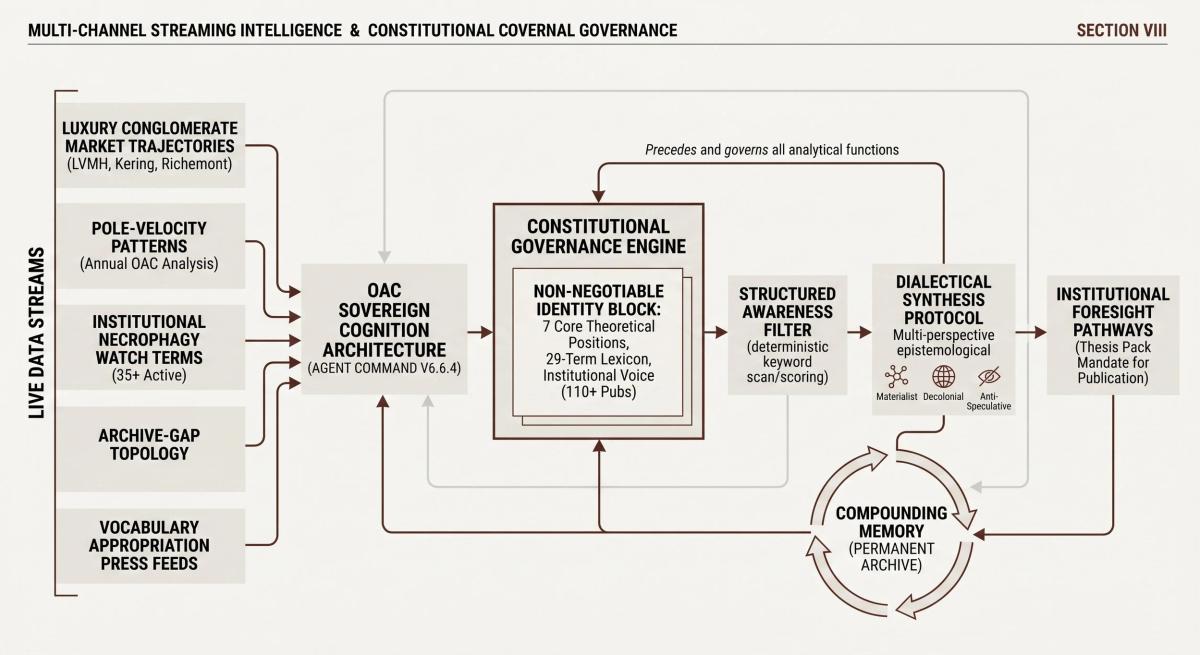
The first function is structured awareness. OAC continuously monitors over 150 information feeds across 10 research domain buckets. Every signal passes a two-stage filter: a deterministic evaluation against 80+ semantic keyword patterns across all four PLCFA poles, with zero-pole signals immediately disqualified; then a 24-point priority scoring engine evaluating six dimensions of institutional relevance. On a typical day, 60 to 90 percent of incoming content is eliminated at the first stage. What reaches the researcher is a theoretically filtered, institutionally prioritized intelligence briefing. Awareness is not accidental. It is patterned, and the patterns are the framework.
The second function is compounding memory. A 90-day rolling database preserves the living texture of current inquiry. A permanent cloud archive accumulates every signal ever evaluated, every theory ever generated, every deliberative session ever conducted, every press mention of the PLCFA lexicon ever detected, every market data point ever tied to a published study, with no cap and no expiration. The archive grows more historically deep with every day of operation and more institutionally specific with every study published. This is the architectural realization of institutional memory as a compounding intellectual resource.
The third function is dialectical synthesis. When a high-priority signal is identified, it enters a structured, multi-perspective deliberation protocol in which simultaneous epistemological positions, grounded in traditions ranging from materialist ontology to decolonial ecology to anti-speculative legal design, debate what the signal means and what institutional response it demands. Every session must produce a thesis pathway: a specific statement of the exact study the institution must publish, extracted from the tension between competing positions. The institution cannot produce a vague output. It produces a mandate.
The fourth function is institutional foresight. The infrastructure synthesizes five live data streams, including real-time market trajectories of the major luxury conglomerates, annual pole-velocity patterns drawn from the full signal-evaluation history, and archive-gap topology, to project which theoretical territories are about to become culturally dominant before consensus forms. The result is not a prediction. It is the structural consequence of having a longer, deeper, more theoretically specific memory than any surrounding discourse.
The fifth function is constitutional governance. Every analytical function begins with the same fixed, non-negotiable constitutional identity block: a complete statement of institutional identity, the PLCFA framework at full ontological depth, the 29-term proprietary lexicon with explicit instruction to deploy each term structurally rather than decoratively, the institutional voice specification, and the seven core theoretical positions established across the published studies. The system cannot produce a generic output. Every output begins by establishing who it is. This is identity architecture, and it is what makes OAC’s infrastructure sovereign rather than serviceable.
The Single-Author Institution at Institutional Scale
Institutional theory has not previously needed to account for the phenomenon OAC represents, because the phenomenon did not previously exist. The question it poses challenges the foundational assumption that institutional scale requires a division of labor.
The capacity to monitor a field of discourse continuously, synthesize signals from multiple research domains, maintain a permanent institutional archive, manage patron relationships with the precision of a dedicated CRM, track vocabulary appropriation across press and academic channels, and produce a complete thesis pack for every published study historically required a team. OAC performs all of these functions, continuously, from a single mobile device operated by a single founder. This is not an incremental efficiency gain. It is a qualitative change in what a single-author institution can be.
The argument in favor of this form centers on coherence. The cost of coherence in multi-author institutions is enormous and largely invisible: mission drift, interpretive fragmentation, the erosion of founding commitments through accumulated institutional compromises. OAC’s constitutional identity architecture makes these structural diseases architecturally impossible. The distance between theory, object, publication, and patron stewardship remains, by design, negligible.
The argument against is equally serious. Cognitive augmentation does not generate productive dissent. A single point of authorial judgment is simultaneously OAC’s greatest strength and its most significant structural vulnerability. The institution is precisely as intellectually sovereign as its founder, and no more. There is also the irreducible human dimension: the commission protocol, which begins with a conversation about what the client holds and concludes with a private delivery at a locked museum garden or a birthday dinner in front of a family, is an act of authorship that no infrastructure performs. The entire architecture exists to protect and make that act possible.
Risks That Must Be Named
A study claiming OAC’s model posed no risk would not be worth reading. The risks are real, structural, and the most intellectually honest aspect of the case.
The first is founder dependency. The constitutional identity architecture encodes OAC’s theoretical commitments into every analytical function, but encoding does not animate. Every deliberative session requires a human founder to decide which thesis to pursue. As discussed in The Paradox of Narrative Permanence, continuity of record does not guarantee continuity of authority. The archive will persist. The infrastructure will compound. The judgment that animates both is singular and, as yet, irreplaceable.
The second is the coherence trap. A framework that filters every signal against its own poles and routes every deliberative session through its own epistemological positions may produce sophisticated self-confirmation rather than genuine dialectical intelligence. The productive friction of institutional life, the disagreeing colleague, the critical peer review, the dissenting board member, is precisely what the architecture of coherence does not accommodate.
The third is the paradox of post-luxury continuity. OAC is a practice committed to the heavy, sedimentary permanence of the physical object. Yet the cognitive infrastructure that sustains and defends this practice exists in digital environments whose durability is measured in product cycles, not centuries. The institution has been built over centuries and depends on infrastructure that requires active maintenance to survive. This tension is not yet resolved.
A fourth risk, specific to the 21-day argument advanced in Section VII, is platform dependency. OAC Agent Command was made possible by Google AI Studio and Gemini 3.5 Flash. The constitutional identity architecture is sovereign. The code is proprietary. But the inference layer on which the system runs is not. A change in Google’s API terms, pricing, or model availability could affect the system’s operational capacity without altering a single line of OAC’s proprietary code. Institutional Necrophagy operates at the platform level as readily as it operates at the vocabulary level. Sovereign infrastructure, built on a licensed computational substrate, is sovereign only within the terms of that license.
OAC is building for centuries. Its objects are designed to outlast markets, institutions, and the individuals who commission them. Its cognitive infrastructure is designed to outlast the discourse that surrounds it. Whether the infrastructure outlasts its own platform dependencies is the open institutional question this practice has chosen to inhabit rather than resolve.
Implications for Museums, Universities, Publishers, and the Luxury Sector
For museums: the passive model of institutional preservation is obsolete. As explored in The Institutional Pivot, what a museum acquires when it collects a practice like OAC’s is not merely objects and documents. It is a living epistemological system. Museums must develop acquisition protocols and conservation frameworks to preserve and eventually operate cognitive infrastructure as a primary element of the collection. The museum that acquires OAC’s practice without a protocol for its cognitive architecture will have acquired the artifact without the argument.
For universities and publishers: OAC demonstrates that independent research practices can now achieve the depth, temporal foresight, and archival precision traditionally reserved for heavily funded academic institutions. Its critical theory has been cited by external scholars, engaged by the American Philosophical Association, and presented at the APA Congress in Paris. Its institutional authority derives not from affiliation but from the compounding precision of its archive. This is a structural challenge to the credentialing logic of academic publishing.
For the luxury sector: OAC is the only critical institution whose intelligence infrastructure is specifically designed to detect, name, and document the moment a luxury brand begins appropriating post-luxury vocabulary. The Institutional Necrophagy that OAC diagnoses across the published studies is tracked in real time against 35+ active watch terms, with a six-step attribution protocol that moves from detection to the legal review queue when unattributed use of primary lexicon terms is confirmed. Every brand that has encountered OAC’s vocabulary should understand that the institution that coined those terms is watching, with a compounding system.
For the American Phygital Association and the phygital research community: OAC offers the first empirical case of a proprietary theoretical framework, one specifically developed to account for the digital-physical integration at the center of the APA’s intellectual mandate, that has been operationalized as an algorithm, applied continuously to a global information environment, and tested against the evidentiary standard of commissioned objects, published studies, and detected appropriations. The PLCFA framework generates testable predictions, about what Speculative Velocity does to objects, about how Institutional Necrophagy moves through commercial culture, about what anti-speculative contractual architecture produces when applied consistently over time, and those predictions are being tested, continuously, against the full complexity of contemporary cultural production. For a field whose central inquiry is the relationship between physical and digital registers of value, meaning, and custodianship, OAC’s closed loop, in which studies produce infrastructure, infrastructure compounds studies, and both are embodied in physical objects governed by anti-speculative contractual law, is the most complete institutional demonstration of phygital integration that currently exists.
The Open Question
This study began with a question: what happens when a conceptual art program builds its own cognitive infrastructure? The OAC case gives us the answer in its fullest form: the studies produce the framework; the framework produces the infrastructure; the infrastructure compounds the studies; the compounding studies deepen the framework; the framework is embodied in the commissioned objects; the commissioned objects are theorized by the studies; and the entire recursive structure is sustained by a single-author institution whose cognitive apparatus grows more precise with every day of operation. This is what it looks like when cognition becomes a medium.
And it could not have looked like this one month ago. The tools did not exist. The capability was announced to the world on May 19, 2026. By the following weekend, there was a working prototype. This study is dated June 9, 2026, and the system is currently at v6.6.4: not because the system is unfinished, but because a platform designed to compound has no natural terminus. Each version has been substantial. Each version has extended institutional capacity that the previous version could not support. The version number is not a technical designation. It is the record of a compounding sovereign research program in continuous operation, advancing because the theoretical framework that governs it keeps generating requirements that the previous version could not yet fulfill.
What the case leaves open is whether the architecture can ultimately outlast its own dependencies; whether coherence at this level is compatible with the productive plurality that institutional longevity may require; and whether the defense of Narrative Permanence through engineered institutional cognition is a solution to the problem of continuity, or a more elegant version of the same problem, now visible at greater resolution.
What is not open is the significance of what has been built. OAC is the first institution in the history of critical art practice to have treated cognition as a primary artistic medium, built the infrastructure accordingly, made that infrastructure an Object of Affection governed by the same contractual principles as every physical object it has produced, and done all of this at the precise technological moment when it first became possible. What new forms of artistic practice emerge from that precedent, and what new institutional theory is required to account for them, is the question this study submits to the field.
The archive is not a record of what the institution has said. It is the instrument by which the institution becomes better able to say what needs to be said next. OAC is the first institution to have engineered that instrument deliberately, to have made the engineering itself the art, and to have arrived at the moment of that engineering with the theoretical readiness to reach v6.6.4 in 15 days. The version number is not a technical milestone. It is institutional evidence.
Authored by Christopher Banks, Anthropologist of Luxury, Critical Theorist & Founder
Objects of Affection Collection
Office of Critical Theory & Curatorial Strategy
469 Fashion Avenue, 12th Floor, New York, NY 10018