Institutional Necrophagy: How Speculative Velocity Destroys Object Permanence and What the Custodian's Contract Must Do About It

A Definitive OAC PLCFA Diagnosis of Financial Abstraction, the Hollowed Object, and the Ethics of Custodial Stewardship
Institutional Necrophagy names the process by which financial abstraction consumes the material and semiotic integrity of objects that were once bound by a Custodian's Contract: a binding ethical obligation between object and possessor. This study applies the Objects of Affection Collection's Post-Luxury Conceptual Functional Art (PLCFA) framework to diagnose how Speculative Velocity: the rate at which an object's sign-value accelerates ahead of its material utility, functions as the primary engine of Institutional Necrophagy. The consequence is the Hollowed Object: an artifact that carries the form of meaning without its substance, reduced to a financial instrument that retains a brand's signature while evacuating its Material Singularity and Narrative Permanence. Across the luxury watch secondary market, the collectible sneaker economy, the financialization of contemporary art, and the mega-gallery's structural collapse, the same mechanism operates: speculation extracts value from objects by trading in what Benjamin called their aura, until only Semantic Burden remains. OAC's PLCFA framework identifies the Custodian's Contract as the sole ethical architecture capable of resisting material dispossession, and positions Regenerative Luxury as the post-speculative model that the market is now structurally demanding.
The Architecture of the Necrophage
To understand Institutional Necrophagy, one must first understand what it consumes. The PLCFA framework holds that every object worthy of custodial consideration possesses Material Singularity: an irreducible combination of labor history, material provenance, and temporal accumulation that cannot be transferred without loss. This singularity is not a romantic sentiment. It is an ontological claim: the object as it exists in the hands of its custodian is categorically different from the object as it exists in a speculative portfolio.
Institutional Necrophagy describes the systematic consumption of this singularity by financial abstraction. The term borrows its logic from biological necrophagy, the feeding on dead matter, but inverts the ethical valence: the object is not yet dead when the consumption begins. Speculative Velocity initiates the process before physical decay. It begins with the acceleration of sign-value, which Walter Benjamin's theory of aura identified as the unique presence of an artwork in time and space: its singular, unrepeatable 'here and now.' Under mechanical reproduction, Benjamin argued, the aura decays through the proliferation of copies. Under financial abstraction, the condition the PLCFA framework diagnoses in the contemporary moment, the aura does not decay through copying. It is actively transacted.
The Necrophage does not wait for the object to die. It accelerates the object’s death by converting its life force: its Material Singularity, into liquid capital.
This is the mechanism OAC names the Aura Transaction: the exchange of an object's irreducible uniqueness for speculative value. Each transaction extracts a quantum of aura. Each resale cycle depletes the object's Zero-Sum Aura: the finite total of authentic material presence, until what remains is the brand's semantic wrapper, stripped of the object's animating substance. This is the Hollowed Object: not a bad product, but a dispossessed one.
Speculative Velocity as Material Solvent
Speculative Velocity is not a metaphor for market enthusiasm. It is a structural condition measurable in the rate at which an object's financial value decouples from its material utility. When the secondary watch market reached $16.7 billion in total transaction value in 2025, a 36.4% year-over-year increase, the market was not rewarding better objects. It was rewarding the faster ones. The Patek Philippe Nautilus 5711, discontinued in 2021, appreciated by 369% on the secondary market: a trajectory that reflects manufactured scarcity rather than the object's intrinsic Custodial weight.

The PLCFA framework identifies three stages of Speculative Velocity's operation on an object's integrity. First, the Velocity Threshold: the point at which resale value begins to exceed the object's Labor Density, the embedded cost of its making, by a multiple that cannot be justified by material appreciation alone. Beyond this threshold, the object is no longer being valued; it is being traded. The possessor is no longer a custodian; they are an arbitrageur.
Second, the Aura Depletion Phase: as the object circulates through secondary markets, its provenance chain fractures. Each handoff between speculative agents (none of whom entered the possession relationship under the terms of the Custodian's Contract) extracts narrative continuity. The object loses the sedimented story of its encounters: who held it, when, and under what conditions. What Cesare Brandi called the 'historical and aesthetic unity' of an artwork, the irreplaceable record of its passage through time, is replaced by a transaction ledger. The ledger records the price. It cannot record meaning.
Speculative Velocity does not merely change the price of an object. It changes what kind of thing the object is permitted to be.
Third, the Semantic Burden Phase: this is the terminal stage. The object now carries only the brand's lexical promise, the name, the signature, the heritage narrative deployed in marketing, without the material substance that originally authorized that promise. The sneaker that was worn by no one on the court of cultural significance. The watch was held by no one who valued its mechanical poetry above its resale value. The painting has spent more years in a warehouse than on a wall. In OAC's study of the 2025 auction market collapse, the ultra-contemporary segment's 67.9% contraction since 2021 was diagnosed as the exhaustion of this Semantic Burden phase: the market had extracted the sign-value from speculative assets faster than the assets could generate new meaning, leaving only the empty rhetoric of "emerging artist" in a field stripped of emerging collectors.
The Hollowed Object: A Forensic Taxonomy
The Hollowed Object is not a new category of object. It is the diagnostic state of an object that has passed through Institutional Necrophagy without custodial intervention. OAC's archive has now documented the Hollowed Object condition across six distinct material registers, each revealing a different mechanism of speculative dispossession.
In the streetwear archive (analyzed in OAC Study 106 on the Supreme × Jordan SS26 collection) Speculative Velocity operates at its most legible: the Jordan name generates speculative heat without a Jordan shoe. The drop functions without the performance object that originally authorized the drop's cultural stakes. The Hollowed Object here is the apparel-only premium, the $698 leather jacket that invokes basketball heritage without a basketball in sight.
In the luxury watch secondary market, the hollowing is slower but more structurally devastating. When the Chrono24 secondary market report confirmed that Rolex has 'settled back to pre-COVID market-share levels' after its pandemic-speculation spike, it documented a post-hollowing stabilization: a moment in which the object's Material Singularity reasserts itself after the speculative layer has been stripped away. This is rare. Most Hollowed Objects do not recover. The speculative damage to their provenance chains is irreversible.
In the mega-gallery model, documented in OAC Study 108's diagnosis of the Pace Gallery collapse, the Hollowed Object is not a physical artifact but an institution: a gallery whose core value was constituted by symbolic positioning and speculative platform launches rather than by the Labor Density and Material Singularity of its output. When Pace launched its NFT platform, Pace Verso, at the apex of crypto speculation in 2021, it was performing the institutional equivalent of the Aura Transaction: trading accumulated cultural authority for speculative liquidity. The $100 million Chelsea flagship and the abandoned London Superblue space are the physical receipts of that transaction.

teamLab's "Universe of Water Particles on a Rock" at Superblue: A case study in experimental platform launches that traded core institutional authority for speculative experiential liquidities, culminating in structural retreat.
In the AP × Swatch Royal Pop collaboration, OAC Study 087, the hollowing operated as democratization theater: the Royal Oak's Material Singularity, rooted in Gérald Genta's nocturnal design session and five decades of haute horlogerie refinement, was transferred to a mass-market Swatch chassis for €160. The result was not democratization. It was speculative velocity in disguise: a drop engineered to trigger secondary market arbitrage, using the Royal Oak's accumulated Zero-Sum Aura as the economic fuel.
Every Hollowed Object was once a Custodial Object. The distance between those states is the distance Speculative Velocity has traveled through it.
The Necrophage's Institutional Enablers
Institutional Necrophagy requires institutional infrastructure. The individual speculator is not its primary agent. The primary agents are the institutions that create the architecture within which speculative velocity can operate on objects without friction: auction houses that certify the legitimacy of the secondary transaction; resale platforms that convert cultural artifacts into financial instruments with ticker-level price transparency; gallery models that treat artists as portfolio assets to be held, expanded, or liquidated according to market conditions rather than custodial obligation.
Christie's and Sotheby's are the most legitimate members of this enabling infrastructure. Their institutional authority (the gravitas of the white-glove sale, the validated provenance certificate, the padded estimate) functions to legitimize Aura Transaction at scale. OAC's study of the Christie's $1.1 billion sale confirmed that auction infrastructure has become the primary mechanism through which Hollowed Objects are laundered back into cultural legitimacy: a painting that has spent a decade in a Geneva freeport as a financial asset is re-entered into cultural discourse through the ritual of the auction room, its speculative career temporarily concealed behind the language of connoisseurship. The Bain Global Luxury Report 2026 confirmed the structural outcome: ultra-wealthy buyers now control 46% of total luxury market spend, treating objects as 'positional collateral rather than culture.' This is the Necrophage at the institutional scale.
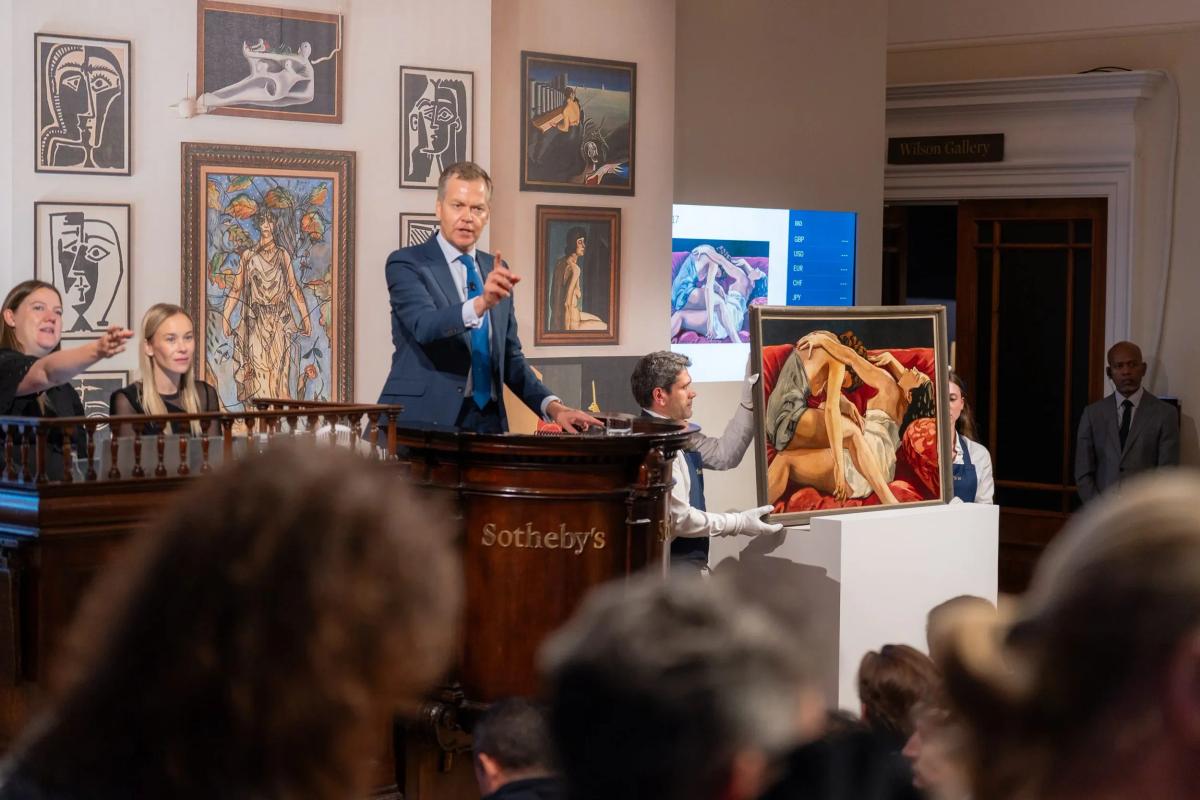
The legal architecture of ownership compounds the problem. As OAC's Speculative Legal Architect agent position is identified in the Dialectical Arena, extant contractual frameworks actively permit the material dispossession required by Institutional Necrophagy. Under standard ownership law, all rights transfer to the possessor without any custodial obligations attached. The Necrophage can do whatever it wishes with the object it holds, including abandoning it, flipping it, warehousing it, or fractionalizing it, with no legal exposure. The Custodian's Contract has no legal teeth because no legal framework currently mandates custodial stewardship as a condition of possessing luxury objects.
This is the gap OAC's Institutional Frameworks practice exists to identify and fill. The Anti-Sale Covenant. The Monastic Veto. The Burden of Preservation is a binding contractual obligation rather than a collector's aspiration. These are not philosophical positions. They are institutional proposals.
Benjamin, Brandi, and the Theoretical Stakes
Walter Benjamin's 1935 diagnosis in 'The Work of Art in the Age of Mechanical Reproduction' identified mechanical copying as the primary threat to the artwork's aura, the 'unique apparition of a distance, however near it may be.' The PLCFA framework extends and corrects this diagnosis for the contemporary condition: the primary threat to aura in 2026 is not mechanical reproduction but financial abstraction. The Patek Nautilus 5711 is not copied. It is transacted. It retains its physical uniqueness while losing its custodial singularity: the quality that Benjamin associated with being 'embedded in the fabric of tradition.'
The speculative market does not copy objects. It empties them. This is a more sophisticated and more damaging operation than reproduction, because it maintains the object's formal integrity while evacuating its substance. The Hollowed Object looks exactly like the Custodial Object. It weighs the same. It carries the same brand signature. But its Narrative Permanence, its embedded history of custodial encounters, has been replaced by a transaction ledger.
Cesare Brandi's 1963 Teoria del Restauro provides a complementary framework. Brandi argued that restoration must aim to 're-establish the potential unity of the work of art'its integral historical and aesthetic coherence, without erasing the passage of time. His warning against interventions that 'violate an object's historical and aesthetic unity' is precisely what the Custodial Archivist agent in the Dialectical Arena invoked: Speculative Velocity does not restore. It does not even cause damage in the conventional sense. It violates the object's historical unity by accelerating it, by compressing decades of custodial accumulation into cycles of resale arbitrage that strip the object of the slow time that meaning requires.
Brandi understood that restoration without historical integrity is falsification. OAC extends this: speculation without custodial obligation is dispossession.
The Decolonial Ecologist position in the Dialectical Arena correctly identifies the colonial dimension of this dispossession. The mechanisms of Institutional Necrophagy: extraction, financialization, the conversion of cultural objects into investment vehicles, replicate at the object level the colonial matrix of power that extracted material wealth from communities without custodial obligation. The OAC lexicon term Material Memory names what is lost when this extraction is complete: the object's capacity to carry the trace of the hands, histories, and communities through which it has passed.
The Structural Skeptic's Challenge: On Vocabulary Absorption
The Dialectical Arena's Dominant Frame for this study was the Structural Skeptic, the position that any critical vocabulary developed to resist Institutional Necrophagy risks being absorbed into the very system it critiques. This is not a marginal concern. It is a structural condition of critical theory under late capitalism, and the OAC framework has been designed with this awareness in mind.
The absorption risk is real and active. OAC Study 097 on Institutional Lexical Hijacking documented the process by which luxury brands appropriate post-luxury critical vocabulary, 'authenticity,' 'craft,' 'sustainability,' 'custodianship,' and deploy it as marketing content without the institutional architecture that gives the vocabulary its critical weight. 'Custodianship' in a Hermès marketing deck is not the same as the Custodian's Contract in OAC's PLCFA framework. But the lexical overlap creates the conditions for semantic capture.
The PLCFA framework's defense against absorption is structural rather than rhetorical. The One Original Principle, the Anti-Sale Covenant, and the Monastic Veto are not slogans. They are contractual instruments that cannot be appropriated by actors unwilling to operate under their terms. A brand cannot adopt the Custodian's Contract as a marketing gesture while maintaining a secondary market resale strategy; the contractual obligations are incompatible. This is the PLCFA framework's structural answer to the Structural Skeptic: the architecture is designed to resist adoption by institutions that would hollow it.
The Music & Culture Curator's position in the Dialectical Arena also demands acknowledgment here. The mechanics of Institutional Necrophagy operate with equal, if not greater, velocity in the sonic register, in the commodification of ancestral rhythmic structures, and in the extraction of cultural aura from subcultural music traditions through commercial appropriation. Steven Feld's acoustemological critique, which OAC's sonic production practice engages directly, identifies the same zero-sum operation in the sound economy: the aura of a sonic tradition, transacted out of existence through commercial platforms, leaves only the Semantic Burden of the genre label without the living custodial community that generated it.
The Hollowed Object is not confined to the material. It is any object, sonic, visual, or physical, from which Institutional Necrophagy has extracted custodial meaning faster than the community of custodians can regenerate it.
The Custodian's Contract as Counter-Architecture
The Custodian's Contract is the PLCFA framework's affirmative response to the diagnostic established in Sections I through VI. It is not a philosophical position. It is an institutional architecture: a binding set of obligations that transform the possession relationship from a property right into a custodial responsibility.
The Contract has four binding provisions in the PLCFA framework. First, the Burden of Preservation: the possessor accepts material responsibility for the object's physical integrity, provenance chain, and historical unity. This is not optional. It is the price of custodianship. Second, the Anti-Speculative Veto: the possessor cannot resell the object through secondary market channels that would initiate the Speculative Velocity cycle. The object may transfer, but only through custodial succession, to another possessor who accepts the same contractual terms. Third, the Narrative Permanence obligation: the possessor must maintain and extend the object's custodial record, the accumulation of encounters, histories, and communities that constitutes its Material Singularity. Fourth, the Monastic Veto: the institution that produced the object retains the right to refuse any commission or transaction it identifies as incompatible with the object's custodial integrity.
These provisions are not aspirational. They are being enacted. OAC's own commission practice operates under each of them. The Meaning Deficit study documented that the market is now generating search signals for exactly this architecture: 'handmade luxury worth it 2026,' 'ethical ownership models luxury,' 'custodial stewardship design.' The Structural Demand for the Custodian's Contract is not theoretical. It is a GSC-confirmed market reality.
The Custodian’s Contract does not restrict the object’s freedom. It restores its dignity, the ontological condition of being held rather than merely owned.
Regenerative Luxury as the Post-Speculative Model
The post-speculative market is not hypothetical. It is already structurally visible in the 2025 to 2026 data. Artnet's intelligence confirms that collectors are 'fleeing the Hollowed Object,' moving capital toward works with verifiable Labor Density, documented material provenance, and custodial stewardship frameworks. Richemont's jewelry houses, anchored in material permanence, gained share over unbranded competitors. Bloomingdale's posted 10% comparable sales growth during the same holiday cycle in which Saks Global filed for Chapter 11: a stark market confirmation of the Luxury Bifurcation thesis OAC published in Study 034.

Regenerative Luxury is the PLCFA framework's name for the economic model that emerges when Speculative Velocity has exhausted itself. It is characterized by three conditions. First, value is measured by Labor Density and Material Singularity, not by secondary-market premium. Second, possession is understood as custodianship, not as ownership: the possessor is accountable to the object's history as well as its future. Third, the institution that produces the object retains moral authority over its circulation, including the right of the Monastic Veto.
Hermès is the institution that most completely embodies the Regenerative Luxury condition, not because it has no secondary market (it emphatically does), but because its production logic is organized around the irreversibility of the hand that made the object. As OAC's Hermès Chapter Two study confirmed, each Hermès object is a Material Singularity before it is a financial asset, and the institution's refusal of the Hollowed Object condition is structural, not aspirational. The corporate art collections study in OAC Study 012, on the $3.8 trillion dormancy crisis, proposed the most extreme institutional expression of this logic: objects that physically transform when subjected to custodial abandonment, enacting the Burden of Preservation as a material consequence rather than a contractual aspiration.
The Unresolved Tension: Against the Speculative Accelerationist
The Dialectical Arena surfaced one unresolved tension that this study is obligated to address directly: the Speculative Accelerationist position that Institutional Necrophagy constitutes 'an efficient and desirable market outcome' , that the acceleration of aura transaction through financial markets is not dispossession but optimization.
OAC's response is not a refusal of the economic logic. It is a refusal of the ethical framing. The Speculative Accelerationist is correct that, under speculative conditions, markets efficiently extract and transact latent value. The question is not whether this is economically efficient. The question is what is being extracted, from whom, and at what cost to the object's capacity to carry meaning across time.
When a Patek Philippe Nautilus 5711 appreciates 369% on the secondary market, the gain accrues to the speculative possessors, none of whom were in a custodial relationship with the object. The loss accrues to the object's Narrative Permanence: its capacity to accumulate the sedimented history of custodial encounters that constitutes genuine cultural value. The market call it appreciation. The PLCFA framework calls it progressive dispossession.
The Speculative Accelerationist's strongest claim, that material permanence is not the 'sole arbiter of an object's value or utility,' is correct. Material permanence is not the sole arbiter. But it is the necessary condition for the kind of value that endures beyond the speculative cycle. When speculation exhausts its fuel, what remains is either a Custodial Object with intact Material Singularity, or a Hollowed Object with only Semantic Burden. The market is now confirming, through the very data the Accelerationist cites, which of these has durable value.
What the Necrophage Cannot Consume
Institutional Necrophagy is a powerful system, but it is not omnivorous. It cannot consume what has never entered the speculative cycle. An object governed by the Custodian's Contract, held under the Anti-Sale Covenant, produced under the One Original Principle, and maintained under the Burden of Preservation, is structurally inaccessible to the Necrophage. It cannot be transacted without the custodian's consent. It cannot be hollowed out without the institution's veto. It cannot be reduced to Semantic Burden because its Material Singularity is not a quality that the market assigned to it. It is a condition that the object carries in its material record.
This study has established three things. First, that Institutional Necrophagy is a precise, nameable, and diagnosable systemic mechanism, not a rhetorical charge against the market, but a structural description of how Speculative Velocity consumes Object Permanence. Second, that the Hollowed Object is the quantifiable output of this mechanism, visible across every material register of contemporary luxury: the sneaker, the watch, the painting, the gallery, the sonic tradition. Third, that the Custodian's Contract is not a utopian aspiration but the only existing institutional architecture capable of interrupting the Necrophage's operation.
The post-speculative market is arriving. It does not need OAC's permission. It is arriving because Speculative Velocity has consumed everything it could reach, and the market is now facing the question that the PLCFA framework has been answering since OAC's founding in August 2025: what remains when the speculation ends? Custodial Stewardship remains. Material Singularity remains. The object that was held rather than flipped, preserved rather than leveraged, loved rather than liquidated. That object remains.
The Necrophage feeds on speed. The Custodian bets on time. History has already declared its preference.
Authored by Christopher Banks, Anthropologist of Luxury, Critical Theorist & Founder Objects of Affection Collection Office of Critical Theory & Curatorial Strategy 469 Fashion Avenue, 12th Floor, New York, NY 10018
Related OAC Studies
On Speculative Velocity in Practice:
Audemars Piguet × Swatch Royal Pop: The Hollowing of an Icon
On Market Collapse and the Hollowed Object:
What the Bain Global Luxury Report 2026 Actually Proves About the Collapse of Sign-Value
On Custodial Architecture and Institutional Frameworks:
The Custodian's Contract: From Institutional Critique to Systemic Stewardship
THE MEANING DEFICIT: Why Luxury, Art, and the Built Environment Are All Failing the Same Test
Why Corporate Art Collections Are Rotting Inside Private Equity's $3.8 Trillion Dormancy Crisis
On Theoretical Foundations:
The Zero-Sum Aura: Why Digital Immortality Requires a Material Host