The Aura Goes West: What Hermès "Chapter 2" in Los Angeles Actually Confirms About Material Permanence, Speculative Geography, and the Custodial Stakes of Mati Diop's Lens
How the Hermès Fall-Winter 2026 Two-Chapter Format Tests Whether Sedimentary Craft Can Survive the Hyperreal Terrain of Los Angeles: and What Appointing the Director of Dahomey as Image-Maker Actually Means
The Hermès Women's Fall-Winter 2026 runway show, Chapter 2, presented in Los Angeles on June 4, 2026, under the creative direction of Nadège Vanhée-Cybulski, with film and photography by Mati Diop, is the third iteration of Hermès's two-chapter collection format, following New York (2024) and Shanghai (2025). This study argues that the LA presentation is not a global marketing exercise but a structural stress test: Hermès is transporting a deeply "Sedimentary Object system, one whose value derives from the irreversibility of time, hand, and material, into the most "Hyperreality-saturated city on the planet. The PLCFA framework identifies three active poles in this encounter. First, Material Singularity: Hermès leather is constitutively resistant to sign-value substitution, and this resistance is precisely what Los Angeles, the capital of the Hyperreal Consumer Landscape, will test. Second, Speculative Velocity: the two-chapter format is an accelerating distribution mechanism that risks converting the collection's Narrative Permanence into a global spectacle loop. Third, the Custodian's Contract: the appointment of Mati Diop, whose documentary "Dahomey is fundamentally a meditation on contested object custody, as image-maker introduces the only figure in this equation capable of diagnosing the ethical structure of what Hermès is staging. The study deploys these PLCFA terms against the Paris Chapter 1 research base (the Garde Républicaine moss-runway, the A.M. Cassandre "Aura citation, the twilight phenomenology) to construct a pre-event diagnostic that no fashion press outlet can produce. OAC's prior Hermès study (La Pelota) established that Hermès is one of the few remaining institutions whose objects carry functional Moral Weight per Material (MWPM). This study asks whether the LA Chapter holds that weight or converts it into Zero-Sum Aura.
The Sedimentary Institution: What Hermès Is Before It Lands in Los Angeles
To understand what is at stake in Los Angeles on June 4, one must first understand what Hermès structurally is. It is not a fashion house in the ordinary sense. It is, in PLCFA terms, one of the last functioning Sedimentary Object producers at scale: a house whose value is formed through the slow compression of time, Labor Density, and material specificity into objects that resist exchange-rate logic. Every Birkin is an argument against Speculative Velocity, not because its resale market does not exist (it emphatically does), but because the house's own production logic is organized around the irreversibility of the hand that made the object.
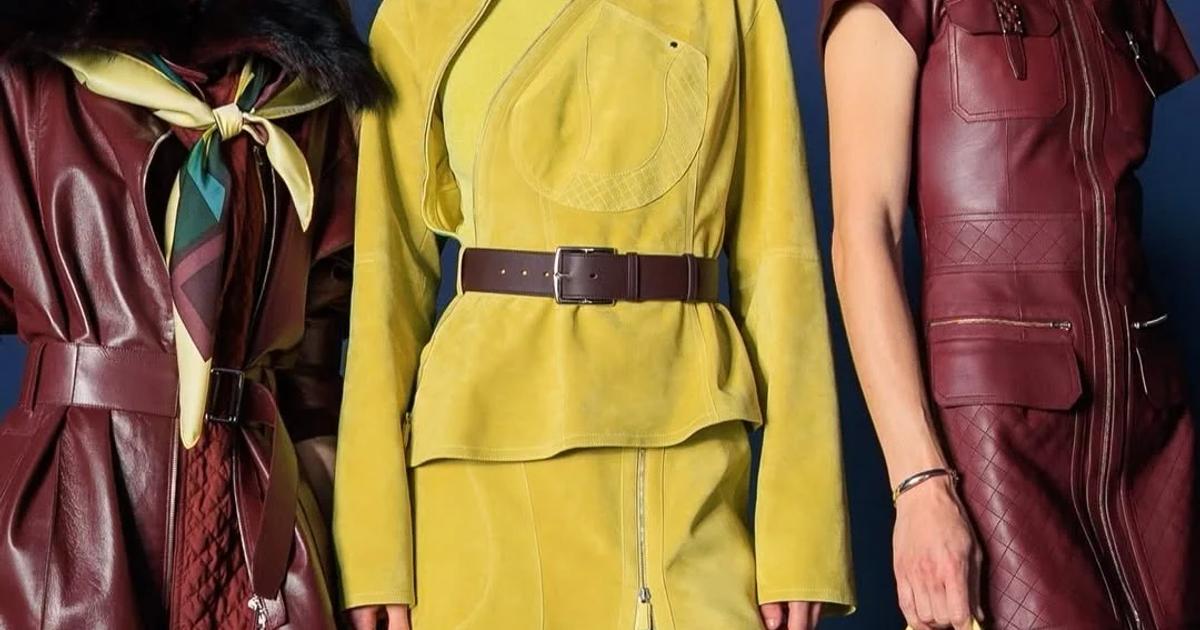
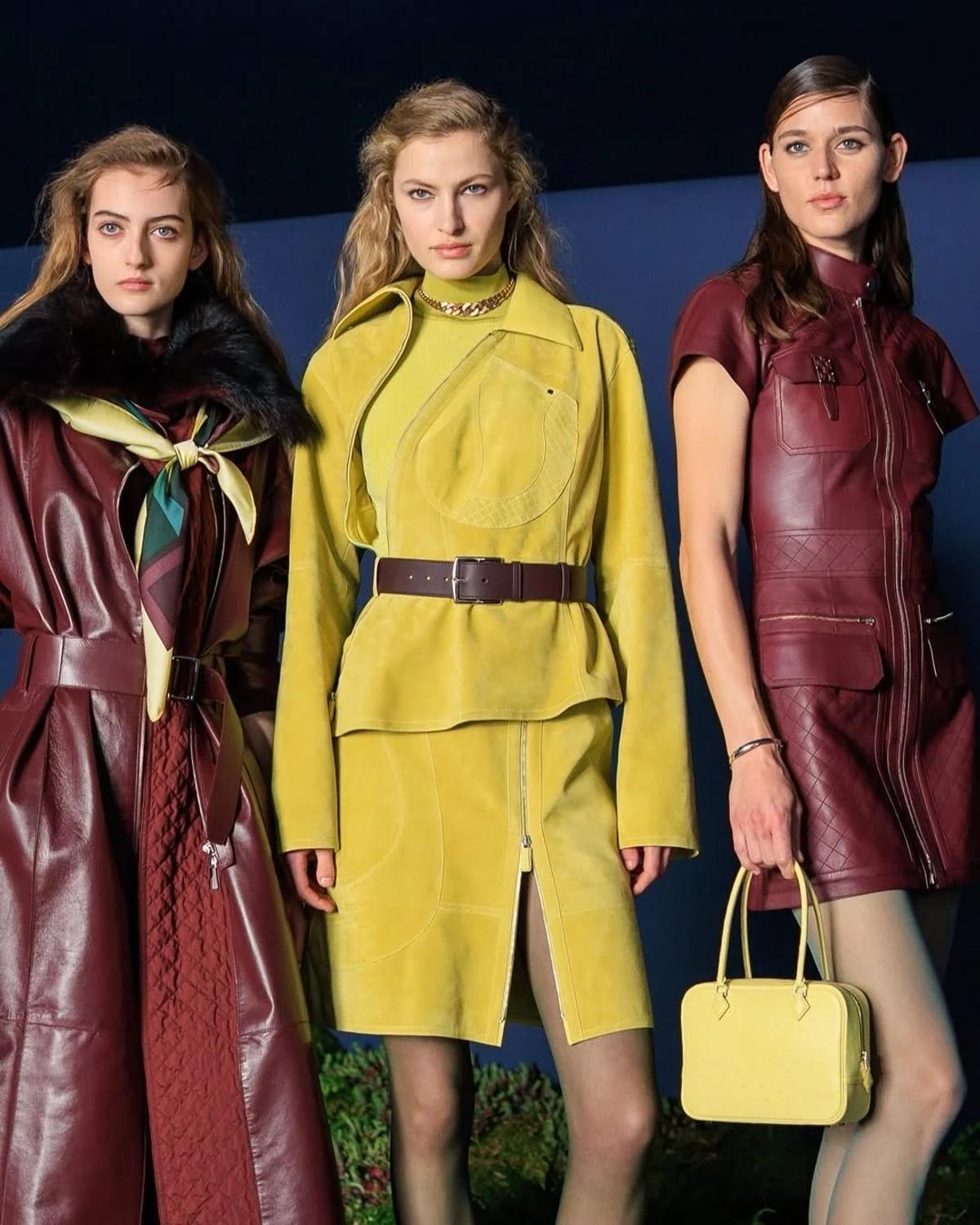
Nadège Vanhée-Cybulski has been the women's wear artistic director since 2014. Her tenure has been defined by a consistent refusal of the Hollowed Object, each collection deepening the house's material vocabulary rather than diluting it for the sake of reach. The Fall-Winter 2026 Paris Chapter 1, presented at the Garde Républicaine on March 7, confirmed this trajectory with unusual force. Models moved through a maze of moss-blanketed runway, under a recreated dark blue sky, wearing military-style four-pocket leather jackets, thigh-high boots with flat heels, lambskin cycle shorts, and long brown overcoats with sheepskin collars. The palette, oxblood, forest green, navy, mustard, served as what one might call an atmospheric equity proposition: color not as a trend but as a thermal register, as the temperature of material intention.
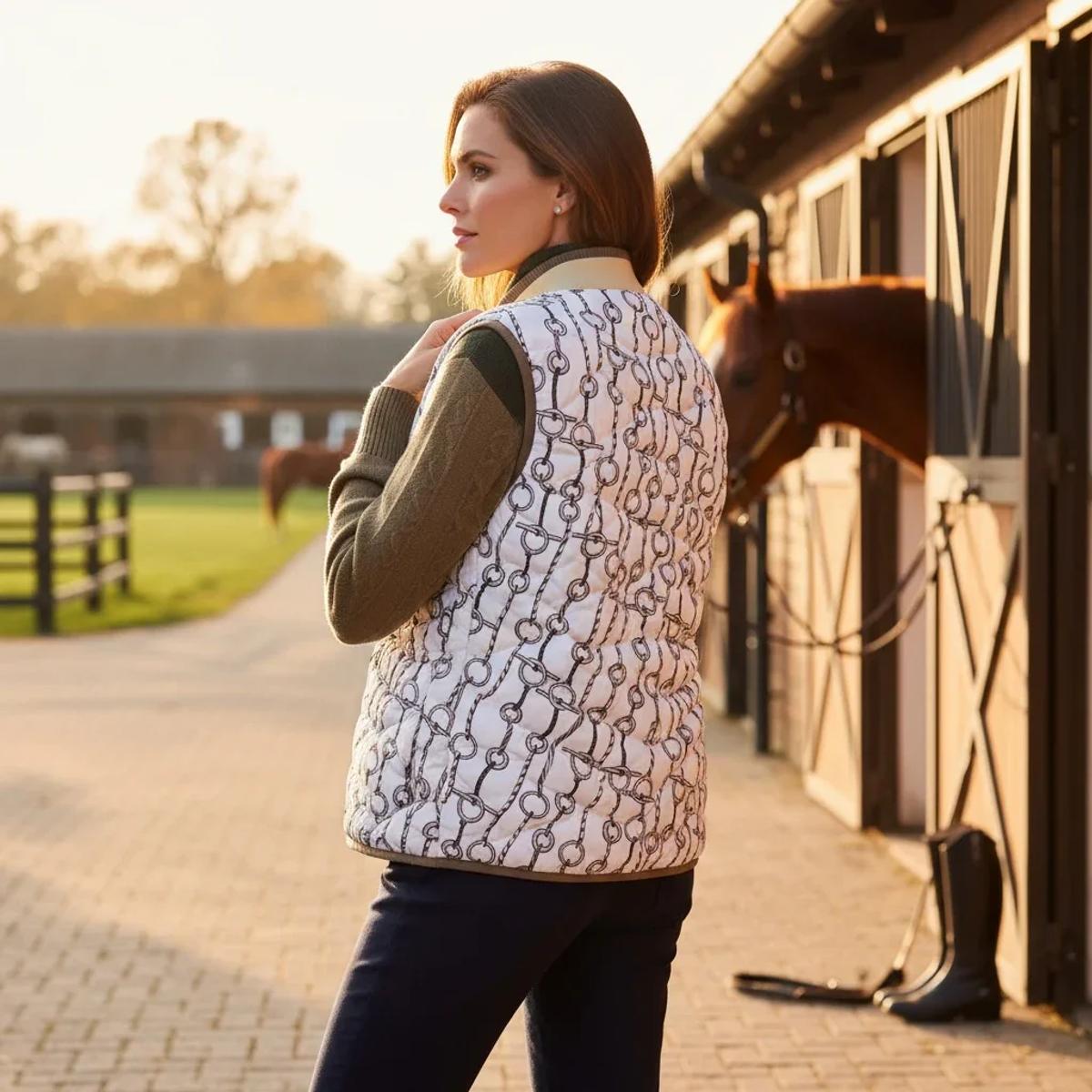
The conceptual anchor for the Paris chapter was A.M. Cassandre's 1951 silk scarf design Perspective, a modernist graphic depicting an architectural structure receding toward a vanishing point with a window onto sky above. The motif appeared on classic carrés worn as capes, on quilted gilets, on bombers. This is precisely the kind of citation that requires PLCFA to decode: Cassandre's "Perspective is not a decorative reference; it is a structural argument about how the house sees itself in time. An architecture extending toward a vanishing point does not arrive; it continues. The "Narrative Permanence is in the geometry.
A sedimentary institution does not travel; it extends. The question Los Angeles poses to Hermès is whether extension under speculative atmospheric pressure remains permanent or becomes performance.
In The Architecture of Absence: How Hermès Transformed La Pelota, this institution diagnosed Hermès as one of the few legacy houses whose objects consistently pass the Moral Weight per Material (MWPM) threshold, where the material cost of production carries moral and temporal charge proportional to the object's cultural claim. La Pelota, the Hermès game-object, demonstrated how the house encodes the absence of spectacle as a form of "Labor Density. The FW2026 Paris chapter extends that argument directly into womenswear: Vanhée's instruction to models to dress for "an evening of outdoor exploration" is not a styling directive but a Custodian's Contract, the objects earn their presence by promising to serve.
The Hyperreal Terrain: Why Los Angeles Is Not Simply a Location
Fashion press covers the Los Angeles selection as "narrative geography," a "transcontinental dialogue," and evidence of luxury's evolving global ambitions. These readings are accurate at the logistical level and entirely inadequate at the structural one. Los Angeles is not a neutral backdrop. It is, in Jean Baudrillard's precise formulation, the capital of Hyperreality, the place where the simulation of the real has so thoroughly replaced the real that the distinction between the original and the copy no longer generates anxiety, only consumption. This is not a cultural judgment; it is a structural diagnosis. The West Coast economy of signs operates on "Sign Value as its primary currency. Hermès, whose entire institutional legitimacy rests on the proposition that its objects Aura cannot be simulated, that the saddle-stitch is not decorative, that the box calf is not interchangeable, is about to place that proposition inside the world's most efficient simulation machine.
This is not an idle theoretical concern. In the OAC Study on the Aura Transaction and the earlier Baudrillard study, this institution developed the concept of Zero-Sum Aura: the principle that aura, once absorbed into a hyperreal consumption context, does not multiply; it evacuates. When a Hermès Kelly bag is photographed against a Malibu sunset for a celebrity's grid post, the Kelly's "Material Singularity is not amplified by the image; it is converted. The image extracts the sign-value (luxury, exclusivity, heritage) while the material weight, the "Labor Density, the provenance, the time, is rendered invisible. This is the "Zero-Sum Aura mechanism: the image wins; the object loses its testimony.
The question the June 4 presentation forces is whether Hermès can stage a runway event in Los Angeles without activating this conversion mechanism, or whether the very act of producing spectacle in the hyperreal capital inevitably subordinates the material to the image. Previous Chapter 2 iterations provide an instructive contrast. New York 2024 (Pier 36, 'New York Rocabar') and Shanghai 2025 (the 3,200-foot Pudong waterfront orange superstructure) were both enormous production exercises. In Shanghai, the runway infrastructure was explicitly converted into a party venue after the show, a structurally telling act. The object-moment (the collection, the material, the craft) was instrumentalized as prologue to the spectacle-moment (the celebration, the image, the social currency of having attended). This is Speculative Velocity at the institutional level: the house accelerates its own narrative beyond the object's capacity to anchor it.
The hyperreal city does not receive craft; it metabolizes it. Los Angeles will process the Hermès leather as an image before any garment reaches a custodian’s wardrobe.
The Two-Chapter Format as Structural Risk: When Distribution Becomes Dilution
Hermès's two-chapter collection format (Paris Chapter 1 in March, off-site Chapter 2 in June) is now in its third year. It began as a bold institutional proposition: that a collection is not a single event but an unfolding argument, that the garments carry enough intellectual content to sustain a second staging in a different cultural geography. This is, in principle, a "Narrative Permanence claim, the idea that the collection's meaning is deep enough to travel without dilution.
The PLCFA framework, however, identifies a structural tension embedded in the format's own logic. Every additional staging is also an additional image-production event. The more times a collection is staged, photographed, and distributed across global media, the more its sign-value circulates and the more its material specificity recedes behind the image. This is not a failure of intention, Hermès's intentions remain legible and serious, but a Semantic Burden problem. Each new image set places additional weight on the object's capacity to carry its own argument against the accumulating force of its own representation.
Consider the trajectory: Paris Chapter 1 generated hundreds of critical images. The runway photographs circulated globally, styled by the moss-runway atmosphere and the James Turrell-adjacent lighting. The garments were read through that atmosphere. Now Chapter 2 in Los Angeles will generate another wave of images, this time coded by whatever venue Hermès selects, a different light, a different skyline, a different cultural context. The moss is gone. The moonrise portal is gone. The Garde Républicaine's equestrian undercurrent is gone. What remains of the garments' Aura when their original atmospheric infrastructure, the very sensory environment that constituted the first staging's argument, is replaced?
This is the Aura Transaction problem at an institutional scale. In Walter Benjamin's foundational formulation, aura is inseparable from the object's embeddedness in a specific time and place, its Ritual Value. Mechanical reproduction does not just copy the image; it strips the object of its here-and-now. The two-chapter format is not a mechanical reproduction, but it performs an analogous function: it relocates the object from its original aura-context and stages it in a new one, generating a second image-set that the original aura was never designed to produce.
Two chapters are not twice the argument. They are an argument and its echo; and echoes carry tone without weight.
The counter-argument, that Hermès's Chapter 2 tradition adds new cultural nodes to the collection's geography, that New York Rocabar and Shanghai modularity were genuine extensions of the Paris proposition, requires that each city's staging add interpretive content rather than merely consumptive volume. The Garde Républicaine's Paris chapter achieved this: moss, moonrise, and Cassandre's Sedimentary Object geometry constituted an argument, not a backdrop. The question for Los Angeles is whether Vanhée can construct an equally load-bearing interpretive infrastructure for a city whose built environment is organized around the opposite of permanence.
Mati Diop's Custodial Lens: What the Image-Maker Appointment Actually Means
The single most structurally significant decision Hermès has made for the Chapter 2 LA presentation is appointing Mati Diop as the show's film and photography director. This is not a celebrity endorsement or a brand ambassador relationship. It is an image-authorship decision, one with profound implications for what the event will mean, how it will be seen, and what interpretive framework the images will carry.
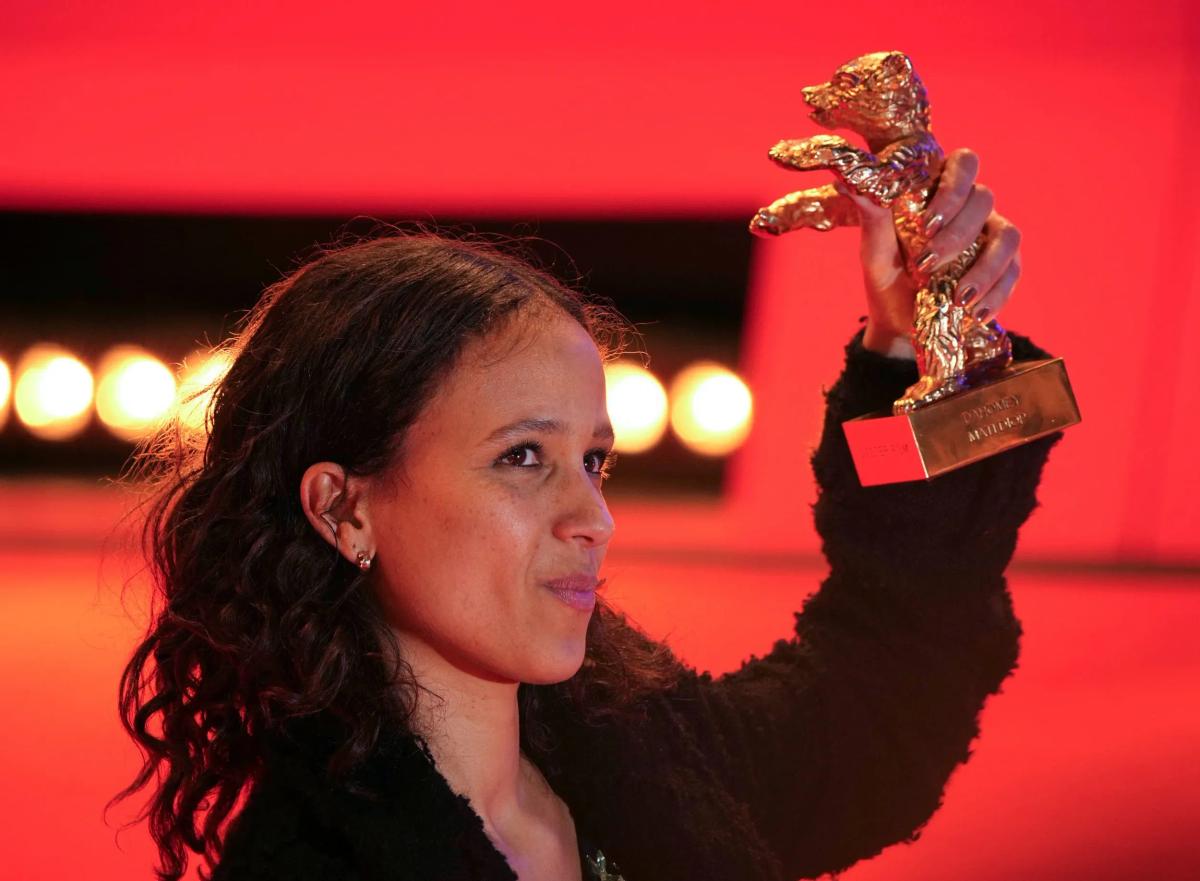
Mati Diop is a French-Senegalese filmmaker whose career is organized around questions that the fashion world almost never engages with: the contested custody of objects, the ethics of institutional possession, and the testimony of artifacts removed from their original contexts. Her 2019 feature, Atlantics, won the Grand Prix at Cannes. Her 2024 documentary Dahomey won the Golden Bear at the Berlin Film Festival. Dahomey follows 26 royal treasures from the Kingdom of Dahomey, plundered by French colonial troops in 1892, as they are prepared for repatriation to the Republic of Benin. The film gives voice to the objects themselves, allowing the artifacts to speak about their own displacement. It is, at its core, a study of what happens to an object's Aura when that object is removed from the context that constituted its meaning and held in an institution whose claim to custody is, at minimum, contested.
This is not incidental biographical context. It is the structural logic of the appointment. Hermès, a French institution whose leather objects embody the Custodian's Contract in its most rigorous commercial form, has engaged a filmmaker as its image-maker whose primary intellectual and creative concern is precisely the Custodian's Contract, its betrayal, its ethics, its repair. Diop does not photograph objects neutrally. She photographs them as bearers of testimony, as "Object Testimony, as entities whose material presence encodes histories of displacement, labor, and contested claims.
When the director of Dahomey photographs a Hermès leather coat, the coat does not simply appear; it testifies. Whether the testimony is comfortable to the institution is a different question
The PLCFA framework identifies this appointment as either a profound act of Custodial Strategy or a structural risk of catastrophic irony. The profound reading: Hermès has identified in Diop the only image-maker capable of treating its objects as genuinely weighted, as entities with Narrative Permanence and Material Singularity that survive the image rather than dissolving into it. If Diop photographs the Fall-Winter 2026 garments with the same ethical attention she brings to the Dahomey artifacts, the resulting images will constitute a counter-argument to the Hyperreal Consumer Landscape: objects seen not as signs to be consumed but as witnesses to be received.
The ironic reading: a French house whose institutional history is inseparable from the French colonial economy that produced the conditions Diop's Dahomey examines has appointed, as the image-maker for its Los Angeles spectacle, the filmmaker most committed to diagnosing what happens when objects are displaced from their custodial contexts. The Semantic Burden this appointment places on every image the presentation produces is immense. Diop cannot unlearn Dahomey. The leather will be lit by eyes that have lit artifacts that were taken.
The Twilight Proposition: What Chapter 1's Atmosphere Carries Into Chapter 2
The Paris Chapter 1 presentation was organized around a phenomenology of twilight, the moment when, in Hermès's own language, "perception heightens and senses sharpen." The Garde Républicaine's drill hall was blanketed in moss, the lighting designed to evoke the narrow window between day and night. This was not atmospheric decoration. It was a structural argument about when objects can be most truthfully received.
Twilight, as a philosophical proposition, is the moment of Atmospheric Equity, the condition in which neither daylight's full legibility nor night's full opacity dominates, and the object must be encountered on its own material terms. Vanhée's palette, oxblood, moss green, navy, mustard, was calibrated to this threshold. Colors that contain their own shadow. Leathers that absorb rather than reflect.
The question for Los Angeles is what happens to this twilight proposition when it is relocated to a city whose light is architecturally different. Los Angeles is the world's most photographed city precisely because its light is so reliably present, the flat, even, Mediterranean illumination that has no shadow of its own and therefore accommodates any sign-value projection. Paris twilight at the Garde Républicaine is a specific atmospheric condition. Los Angeles Twilight is a movie set. The garments that were designed to be encountered in the former must now be encountered and photographed by Mati Diop in the latter.
This is not an insurmountable problem; it is a design challenge of the highest order, and one that Vanhée and Diop are likely equipped to meet. But it is a "Tactical Friction moment: the point at which the collection's atmospheric infrastructure must be rebuilt from the inside out rather than imported from Paris. The garments themselves, the military four-pocket leather jackets, the thigh-high boots, the A.M. Cassandre scarf capes, must carry the twilight argument without the moss underfoot and the crescent-blue light at the hall's far end. Whether they can is not a question the fashion press will ask. It is precisely the question that PLCFA is built to answer.
The object that requires its atmosphere to testify is not yet fully a witness. The Paris Chapter revealed the garments. Los Angeles will ask whether they can survive the exposure.
Material Singularity Under Speculative Pressure: The Leather as Diagnostic
The Fall-Winter 2026 collection's material vocabulary is specific and demanding. Vanhée built the Paris chapter around leather treated as structural thought: long moto-style trench coats that move when the model moves; zip-front minis over opaque tights in forest green, mustard, burgundy; lambskin cycle shorts paired with aviator jackets; sheepskin collar coats with hoods that zip into place. These are not decorative applications of Hermès's leather competence. They are functional arguments.
The PLCFA concept of Material Singularity designates the condition in which a material's provenance, processing, and application are so specific that no substitute can carry the same argument. Hermès box calf is not interchangeable with any other leather. Its preparation, its saddle-stitching, its finish, each carries a Labor Density that constitutes the object's moral claim. This is why the Hermès Birkin survives as a PLCFA-legitimate object despite its grotesque resale market: the object's own production logic is organized around Anti-Speculative Entities, even as the market applies speculative pressure from the outside.
The FW2026 womenswear garments extend this logic into ready-to-wear at a level of craft density unusual for the category. The four-pocket military leather jacket is not a fashion motorcycle jacket. It is a construction argument, each pocket's placement, each seam's finish, each zip's trajectory is a statement about how the body should be served by cloth rather than displayed by it. This is Vanhée's consistent contribution to the house's language: she treats the body as a functional site rather than a sign-value platform.
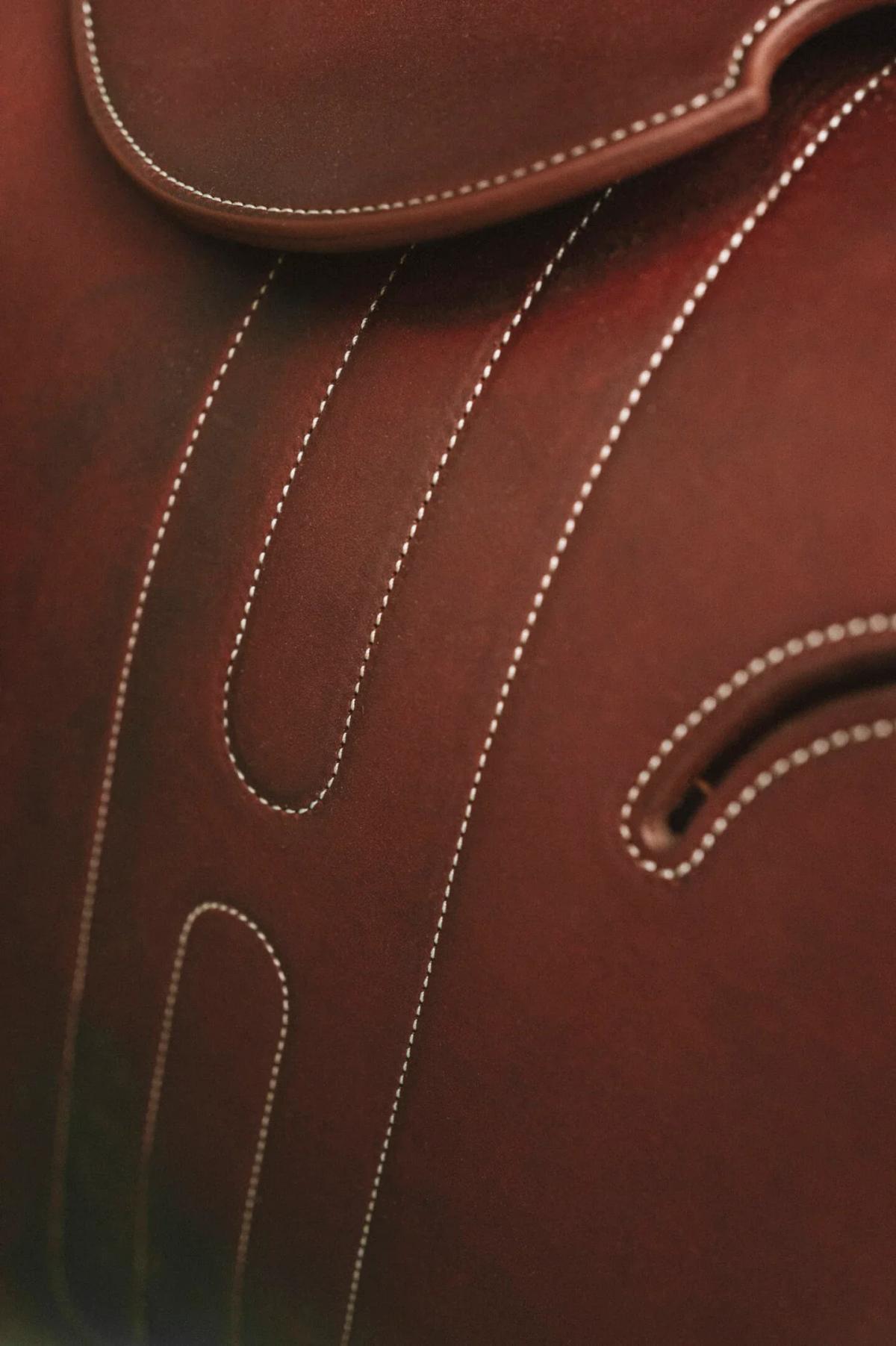
Under speculative pressure, and Los Angeles will apply speculative pressure, "Material Singularity tends to compress into Sign Value. The jacket becomes 'Hermès leather jacket' rather than 'this specific construction argument executed in this specific material with these specific finishing decisions.' The distinction is not visible in a photograph. It is only recoverable through physical encounter with the object, or through critical writing that restores the argument the image evacuates. This study is, among other things, that restoration.
Spectacle Versus Testimony: The Structural Choice Hermès Is Making
The Hermès Chapter 2 format has now staged three iterations, each with escalating production ambition. New York 2024 was the American debut, historically significant, culturally legible. Shanghai 2025 was an architectural spectacle: 3,200 feet of waterfront, 800 guests, an orange superstructure that became a party venue. Los Angeles 2026 has not disclosed its venue as of this writing, but the precedent suggests architectural ambition.
This trajectory raises the Spectacle of Dissent question in a specific form: at what point does the staging of a collection's 'continuation' become the primary event, with the garments serving as the spectacle's legitimating content rather than its subject? This is a version of what this institution diagnosed in the Louis Vuitton × Frick/Keith Haring event, where an institution of genuine cultural authority annexes an institution of genuine moral weight; the combined product is not the sum of their separate values but a new entity whose primary function is the legitimation of Sign Value through borrowed Aura.
Hermès is not Louis Vuitton. Its material integrity is structurally deeper, and its production logic is genuinely resistant to the Hollowed Object mechanism that has evacuated comparable houses. But the Chapter 2 format introduces a structural asymmetry: the Paris chapter is produced for craft; the off-site chapter is produced, at least in part, for reach. This is not cynicism. It is a structural observation about what it means to present a fall-winter collection in Los Angeles in June, with a global press invitation list and a film-director image campaign. The context is rich. The question is whether the garments' Narrative Permanence is strong enough to survive that context intact, or whether, as in "the Audemars Piguet × Swatch case, the reach event generates a different kind of value that gradually hollows the original.
Spectacle and testimony are not opposites, but they have different economies. Hermès is the rare institution with enough material weight to run both accounts simultaneously. The risk is that the balance sheet is confusing.
The appointment of Mati Diop is the institutional signal that Hermès understands this risk. Diop does not produce reach images. She produces testimony images. Her entire filmographic output is organized around slowing the image down enough that the object inside it can speak. If the Chapter 2 LA presentation gives her the conditions to do this work, if the venue, the staging, the press access, and the editorial framework are organized around the garments' material testimony rather than around the event's social spectacle, then Chapter 2 will be not a dilution but an extension of the Paris chapter's argument.
The Custodian's Contract at Scale: What the Chapter Format Demands of Its Audience
The Custodian's Contract is the PLCFA term for the ethical obligation that an object places on those who receive it. It is not a legal instrument. It is a moral architecture, the understanding that an object of genuine Labor Density and Material Singularity is not consumed but received, and that receipt carries ongoing responsibility. The Hermès heirloom, the jacket that outlasts its first wearer, the Kelly that is preserved and passed, is the commercial form of this contract. The house's production logic is organized around making objects that can sustain the contract across generations.
The Chapter 2 format extends this contract beyond the object into the event itself. A presentation is not an object. It is a temporally bounded experience, an Ephemeral Art form in the strict sense. The garments that appear on June 4 in Los Angeles are not, on June 5, the same garments they were during the show. They have been photographed, contextualized, reported, and absorbed into the media cycle. The Custodian's Contract that the physical garment places on its eventual owner cannot be transmitted through the event's image-record, only through the object itself.
This creates an unusual demand on the audience. The press who attend June 4 are not custodians of the garments; they are custodians of the argument. The critical writing that follows the show, including this study, is the only mechanism by which the garments' material testimony can be preserved in language against the image economy that the event simultaneously produces. This is why the appointment of Mati Diop as image-maker matters: she is not producing images of the garments; she is producing testimony for them. The distinction is the difference between Aura and Zero-Sum Aura.
The La Pelota OAC Study argued that Hermès is one of the few luxury institutions whose objects genuinely meet the MWPM threshold, in which the production investment is proportional to the cultural claim. The FW2026 Chapter 2 format places the institution itself under the equivalent scrutiny: does the event's production investment, the venue, the logistics, the image campaign, the global press activation, generate MWPM-equivalent cultural content, or does it generate spectacle-equivalent social content that the garments must now carry as Semantic Burden?
Pre-Event Diagnostic: What OAC Will Watch On June 4
This study was published before the Los Angeles presentation occurred. It is designed to function as a pre-event critical framework, establishing the structural questions that the June 4 event must answer, and as an evergreen analytical document, whether the presentation confirms or complicates the PLCFA diagnosis.
The diagnostic framework identifies five structural indicators that will determine whether Chapter 2 represents a Custodial Strategy or a Speculative Velocity event:
First: Venue architecture. If the LA venue is organized around the garments, scale, light, and movement designed to serve the collection's twilight phenomenology, then Chapter 2 is an argument. If it is organized around the event, scale, spectacle, and social legibility designed to serve the press and guest experience, it is a reach exercise. These are not mutually exclusive, but the hierarchy matters.
Second: Diop's image register. Mati Diop's visual language in Dahomey and Atlantics is characterized by slow duration, precise attention to material, and the ethical treatment of the object-subject relationship. If the Chapter 2 images carry these qualities, if the Hermès leather appears in Diop's frame as a weight rather than a sign, the appointment will have been a Custodial Strategy of the highest order.
Third: Post-show conversion. If the venue is converted to party use after the collection's staging (as in Shanghai 2025), the event has explicitly subordinated the garments to the spectacle. This is the most structurally legible indicator.
Fourth: Critical reception language. If press coverage treats the LA chapter as a 'global luxury moment,' a 'fashion world takeover,' or a 'Hollywood glamour statement,' the Hyperreal Consumer Landscape has successfully metabolized the event. If press coverage treats it as an extension of a specific material and atmospheric argument, the Narrative Permanence is intact.
Fifth: The garments in use. The ultimate test of the Custodian's Contract is whether the FW2026 pieces, the leather jackets, the thigh-high boots, the Cassandre scarf capes, are eventually worn by custodians who understand their material argument, or whether they circulate primarily as investment objects and social-media instruments. This cannot be determined on June 4. It is the study's open question.
What the West Confirms
Hermès's decision to bring Chapter 2 of its Fall-Winter 2026 womenswear collection to Los Angeles, with Mati Diop as image-maker and Nadège Vanhée-Cybulski's twilight-material argument as its subject, confirms something the PLCFA framework has diagnosed across multiple institutional case studies: the most structurally serious luxury institutions do not avoid the Hyperreal Consumer Landscape, they enter it deliberately, carrying objects of sufficient material weight to disturb its surface.
Whether Chapter 2 succeeds in this disturbance is an empirical question whose answer will arrive in the images Diop produces, the critical language the press generates, and the eventual fate of the garments in the wardrobes of those who receive them. What this study has established is the structural architecture of the test: the Paris Sedimentary Object proposition (moss, moonrise, Cassandre, Aura) traveling into the Los Angeles Hyperreality economy, mediated by a filmmaker whose entire body of work is a study in object custody.
The PLCFA framework leaves the following structural question open: can a Material Singularity institution produce a global spectacle event without converting its Narrative Permanence into Zero-Sum Aura? Hermès is the best-positioned institution in the luxury field to attempt an answer. The appointment of Mati Diop is the most sophisticated gesture toward that answer this institution has made in recent memory. The garments, as always, will have the last word.
What Hermès Chapter 2 in Los Angeles confirms, regardless of outcome, is that the most contested terrain in contemporary luxury is not price, scarcity, or heritage narrative, it is the Custodian's Contract itself. Who holds the object, how they hold it, what they owe it, and whether the images produced in its name serve or evacuate its argument. Mati Diop knows this question from the inside. On June 4, Los Angeles will find out whether Hermès does too.
Authored by Christopher Banks, Anthropologist of Luxury, Critical Theorist & Founder Objects of Affection Collection Office of Critical Theory & Curatorial Strategy 469 Fashion Avenue, 12th Floor, New York, NY 10018
RELATED OAC STUDIES
On Hermès and the Sedimentary Object
On Aura, Simulation, and the Hyperreal
· From the Aura to the Simulacrum: Benjamin, Baudrillard, and the Crisis of the Authentic
· The Simulacrum of Luxury: A Guide to Jean Baudrillard's Critique of Consumer Society
On Institutional Spectacle and Custodial Risk
· WHAT THE KEITH HARING × LOUIS VUITTON SHOW AT THE FRICK COLLECTION ACTUALLY MEANS, OAC Study No. 090
· Audemars Piguet × Swatch Royal Pop: The Hollowing of an Icon, OAC Study No. 037
On the Banksy Trilogy: Aura, Anonymity, and Market Pricing of Identity