Dua Lipa Wedding Suit: Aura Transaction or Homage?
On the conversion of personal milestones into parasocial capital, and the cost to the archive
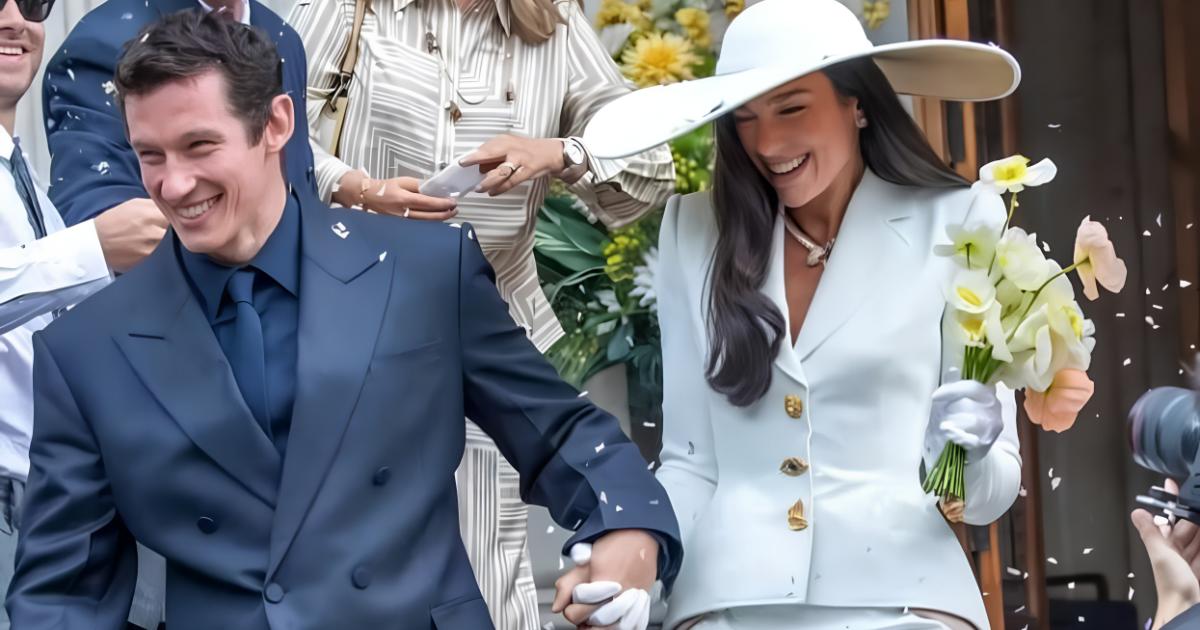
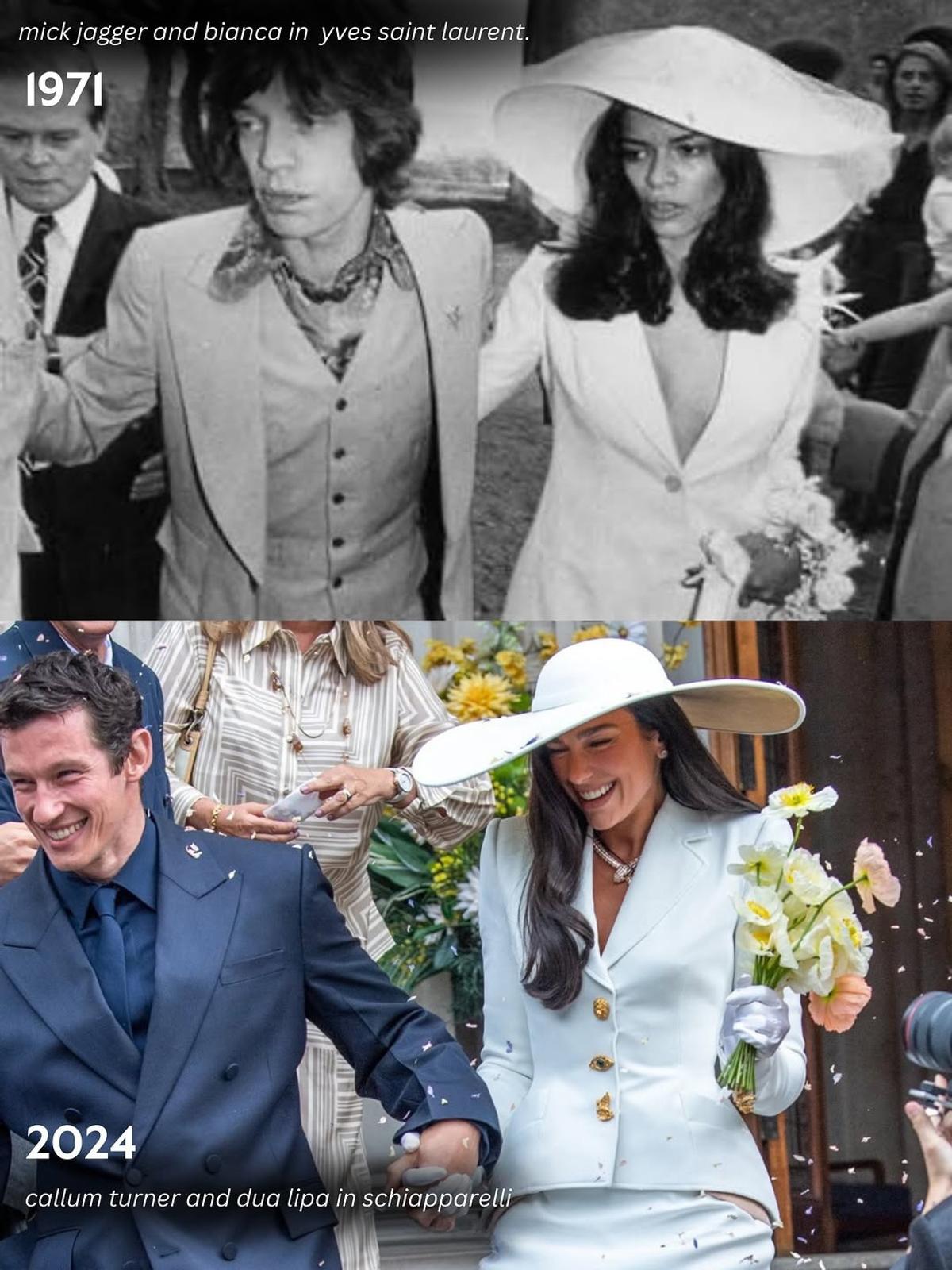
On May 31, 2026, Dua Lipa married actor Callum Turner at Old Marylebone Town Hall in London wearing a custom Schiaparelli Haute Couture suit (a sharply tailored ivory cady blazer with personalized gold bijoux buttons, a matching asymmetric skirt with a sculpted blush bustier, white gloves, a Stephen Jones wide-brimmed hat, Christian Louboutin Miss Z pumps, and Bvlgari Serpenti High Jewelry) designed by Daniel Roseberry. The fashion press responded immediately and almost unanimously: the look was a "modern homage" to Bianca Jagger's legendary 1971 Saint YSL wedding suit, worn at the Saint-Tropez Town Hall where she married Mick Jagger. This study refuses that frame. OAC does not read the suit as tribute. It reads it as Aura Transaction: a mechanism by which the Simulacrum does not copy but replaces, and, in doing so, depletes. Deploying the PLCFA framework across four operative poles: Aura, Zero-Sum Aura, Parasocial Brand, and Material Singularity, this study argues that the Dua Lipa Schiaparelli wedding suit executes a precise extraction: it captures the institutional authority of the 1971 Bianca Jagger YSL moment, recodes it as contemporary parasocial capital, and in doing so, removes from the archive something that cannot be returned. The Speculative Velocity of the five-source media convergence is not incidental to this transaction; it is the transaction itself. The suit is the occasion. The coverage is the mechanism. And Roseberry's surrealist tailoring is the apparatus that makes the theft feel like love.
The Object at Old Marylebone: A Material Inventory
The press release language is precise: a "sharply tailored ivory blazer in cady adorned with personalized gold bijoux buttons" paired with "a matching asymmetric skirt with a sculpted blush bustier trimmed in white lace." The cady fabric (a firm, smooth weave with a characteristic slight sheen) is not chosen arbitrarily. In Schiaparelli's hands, cady has historically signaled tailored authority rather than bridal softness. It resists drape. It holds structure. It does not yield to the body but disciplines it. In this, it shares DNA with Elsa Schiaparelli's own preference for materials that declared intention before a word was spoken.
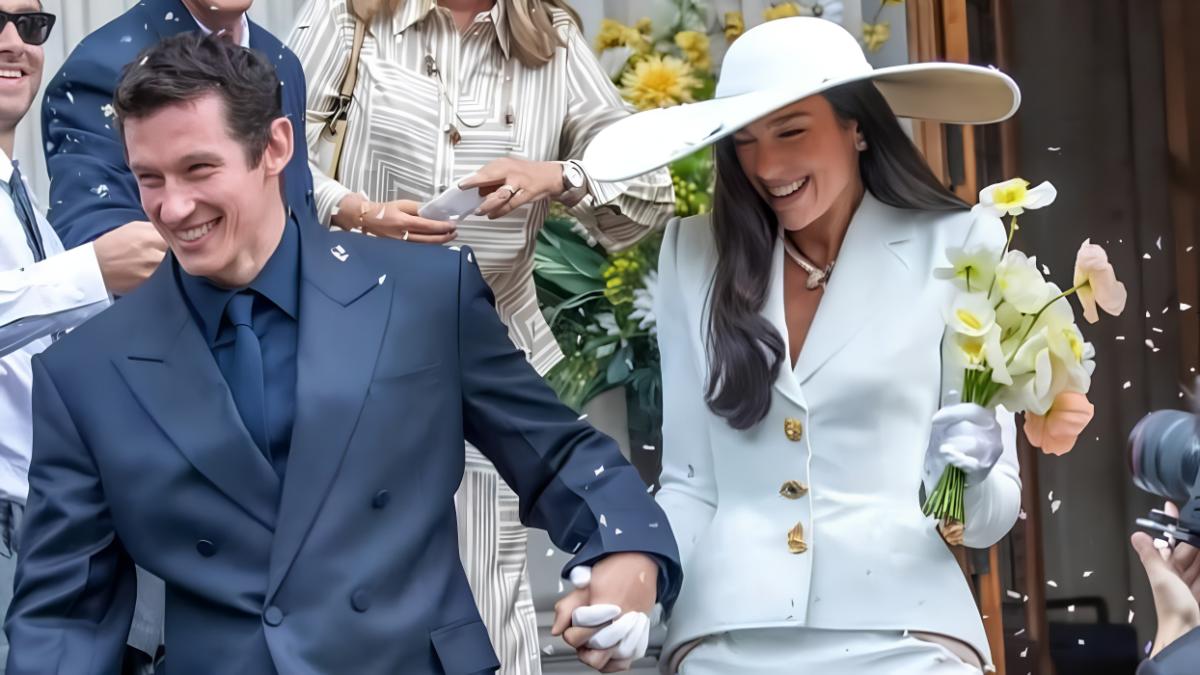
The gold bijoux buttons are Daniel Roseberry's most persistent semiotic tool. Across collections, he has used anthropomorphic gold hardware: nipples, lips, trompe-l'oeil breasts, to inject surrealist disruption into otherwise legible silhouettes. On the wedding suit, the buttons are described as "personalized": a departure from the house's standard bijoux catalog. This personalization performs a crucial function in the PLCFA analysis: it converts a Haute Couture object into what the framework identifies as a Material Singularity, a one-of-one object whose material particularity is permanently bonded to a specific subject at a specific moment. The suit cannot be remade and remain the same object. It can only be referenced, and each reference diminishes the original's singular authority.
Stephen Jones's hat with gold leaf lining completes the auratic assembly. Jones, whose millinery has graced Galliano-era Dior and Roseberry-era Schiaparelli with equal authority, understands the hat not as an accessory but as an atmosphere. The wide brim reactivates the silhouette of Bianca Jagger's 1971 veiled sun hat: not replicating it but invoking it, which is the precise operation of the simulacrum: not the copy of a thing, but the replacement of the real by its sign.
The suit does not reproduce Bianca Jagger. It absorbs her. This is the distinction the fashion press cannot make, because tribute requires an original that survives the act of homage. The simulacrum requires that it does not.
The Bvlgari Serpenti High Jewelry Necklace and stud earrings complete the semiotic assembly. Lipa became Bvlgari's Global Brand Ambassador in February 2026. The jewelry at the ceremony is therefore not private adornment; it is a contractual fixture, a brand placement at the most intimate possible event. That this goes unremarked in fashion-press coverage confirms the extent to which the Parasocial Brand model has normalized the colonization of personal milestones by endorsement architecture. The serpent motif of the Serpenti collection (coiled, devouring itself, perpetual) enacts visually what the broader suit enacts structurally: the consumption of the auratic by the commercial.
Bianca Jagger, 1971: The Original and Its Weight
On May 12, 1971, Bianca Perez-Mora Macias married Mick Jagger at the Church of Saint Anne in Saint-Tropez, following a civil ceremony at the local town hall; the structural rhyme with Old Marylebone is not lost on this analysis. She wore an ivory bias-cut column skirt, Yves Saint Laurent's Le Smoking jacket, without a blouse, and a veiled sun hat. The choice was not tactical. It was, in the language of the period, personal. Bianca Jagger came from the Nicaraguan aristocracy, moved through Parisian intellectual and bohemian circles, and, as she would later articulate, found in Saint Laurent's women's suiting the first garment that aligned with her understanding of herself: empowered, androgynous, non-domestic.
The suit's departure from bridal convention in 1971 carried genuine cost. The white wedding gown was not yet merely aesthetic tradition; it was a cultural enforcement. To appear at a civil ceremony without one was to assert something structurally subversive about the institution being entered. The Le Smoking jacket, which Saint Laurent had introduced to women's fashion in 1966 as a direct appropriation of masculine authority, made the argument legible without requiring articulation. The hat's veil, the single concession to traditional bridal iconography, made the argument precise: close enough to the convention to be read as a departure from it, not an ignorance of it.
This is what OAC's framework identifies as Semantic Burden, the accumulation of historical meaning that a specific object, image, or gesture carries into every subsequent invocation. The 1971 Bianca Jagger suit does not merely reference anti-bridal convention. It is the founding gesture of contemporary celebrity bridal subversion. Every subsequent tailored bridal suit (Carolyn Bessette Kennedy's column dress in 1996, Bianca's own daughters' stylistic inheritance, Zendaya's 2025 Met Gala homage, and now Dua Lipa's Schiaparelli) draws its authority from this ur-moment. The Semantic Burden of the 1971 suit is finite. Each time it is invoked, its weight is distributed across a wider field. Each distribution reduces the density at the source.
Bianca Jagger’s 1971 suit was an act of personal authority in a decade when women’s personal authority in marriage was structurally contested. Dua Lipa’s suit arrives in a decade when personal authority is the product being marketed. The historical conditions of the gesture are irreconcilably different. Only the silhouette is shared.
The Simulacrum Mechanism: Homage as Extraction
OAC's study From the Aura to the Simulacrum: Benjamin, Baudrillard, and the Crisis of the Authentic establishes the operational distinction that the present study applies. For Walter Benjamin, the Aura of a work is inseparable from its singular existence in time and place: its "here and now," which is what all mechanical reproduction destroys. For Jean Baudrillard, the simulacrum goes further: it does not represent an original that still exists somewhere; it replaces the original entirely, generating a "real" that never had a prior referent. The fashion press reading of the Dua Lipa suit as "homage" is the Benjaminian interpretation: the original survives, the copy acknowledges it, the aura persists. The PLCFA reading is Baudrillardian: the original does not survive the operation. It is consumed into the sign system that now circulates in its place.
What confirms the Baudrillardian diagnosis is the speed of the transaction. OAC's Intelligence Brief logged five distinct source-level publications: Yahoo, Marie Claire, NDTV, Harper's Bazaar, Vogue, within the first hours of the May 31 ceremony. Each source invoked the Bianca Jagger reference. Each source produced images of Lipa exiting Old Marylebone Town Hall that were already being circulated alongside archival images of Bianca Jagger outside the Saint-Tropez town hall in 1971. The juxtaposition was not manufactured by any single editor; it was generated by the collective semiotics of the moment. Within twelve hours of the ceremony, the image pair (Lipa/Schiaparelli alongside Jagger/YSL) had become its own cultural artifact, circulating independently of either source.
This is the Zero-Sum Aura operation, as developed in OAC's study The Zero-Sum Aura: Why Digital Immortality Requires a Material Host. The framework proposes that aura, the singular authority of a specific object or gesture in time, is not infinitely reproducible. Each reproduction draws on the same finite reservoir of historical weight. When the circulation of the Lipa/Jagger image pair reaches a global scale within hours, the 1971 moment does not become more famous; it becomes more diluted. Its specificity (the political content, the historical weight, the personal cost) is averaged out across the image circuit until what remains is the silhouette: the suit, the hat, the town hall steps. The structural argument is replaced by the aesthetic code. The political gesture is replaced by the fashion reference.
The homage frame protects the performing subject from the charge of extraction. But the archive keeps no such record of intention. It records only what was taken.
Daniel Roseberry and the Surrealist Apparatus of Transfer
Daniel Roseberry's position in this transaction is structurally important. He is not simply the craftsman who executed the object. He is the specific operator whose aesthetic grammar makes the Aura Transaction legible, and therefore more powerful, to the global fashion audience. Roseberry has built his tenure at Schiaparelli on a precisely managed paradox: he invokes Elsa Schiaparelli's surrealist archive with maximum fidelity while simultaneously updating its cultural application to contemporary celebrity. The trompe-l'oeil gold hardware on the wedding suit's blazer does not merely reference the house's history of bizarre bijoux. It activates the surrealist logic of the object-that-is-not-what-it-appears-to-be in the context of a garment that is a wedding suit but performs as something else: a historical quotation, a brand placement, a media event.
Roseberry's own articulation of his practice is illuminating here. He has described couture as "about the mastery of the moment" and the imperative to "nail the cultural moment" in ways that can, in his words, generate "$50 million worth of press in 30 minutes." This is not cynicism on his part; it is an accurate description of what couture now does in the absence of the craft economy that once justified its price point. The cultural moment is the product. The garment is the apparatus used to deliver it. In the Lipa wedding suit, the cultural moment being delivered is the Simulacrum of anti-bridal authority: the appearance of subversion without the structural conditions that make subversion meaningful.
The V&A's current exhibition Schiaparelli: Fashion Becomes Art(open March 28 to November 8, 2026) adds an institutional layer to this reading. The exhibition traces Elsa Schiaparelli's deep embedding in the surrealist art world (her collaborations with Salvador Dalí, Man Ray, Jean Cocteau) as the founding condition of the house's authority. Roseberry's revival project inherits this authority not by repeating it but by citing it, which is the same mechanism at work in the wedding suit's citation of Bianca Jagger. The institutional exhibition, the contemporary wedding, and the media event around both form a single circulation system in which the surrealist tradition is simultaneously elevated and spent.
The Parasocial Brand and the Colonization of the Personal
OAC's study, The New Luxury: How Kylie Jenner, Selena Gomez, and Jacob Elordi Perfected the "Parasocial Brand,” established the structural model now being applied here. The Parasocial Brand operates by converting a celebrity's authentic personal life into legible brand content. The celebrity does not merely endorse products; they constitute a product: the product of an intimate relationship with an audience that the audience experiences as real, even though it is structurally asymmetric and commercially mediated. Dua Lipa is among the most advanced practitioners of this model: her endorsement portfolio at the time of writing spans Bvlgari (Global Brand Ambassador, February 2026), Nespresso, YSL Beauty, Augustinus Bader, and an equity stake in Frame Fitness, among others.
The civil ceremony at Old Marylebone is the Parasocial Brand's most powerful possible activation: a private event that is structurally private (small guest list, intimate town hall, no announced photographers) but is designed to be photographed at the exit, which is public. The suit (custom Schiaparelli, with Bvlgari jewelry, by a brand-ambassador wearer) is a brand placement in the most intimate institutional setting available to a public figure. The apparent "privacy" of the civil ceremony is itself a brand gesture: it signals authenticity, restraint, and genuine emotion, which are the qualities most valuable to the Parasocial Brand at the moment when the audience is most susceptible to them. The ceremony at Old Marylebone is not a private event that accidentally became public. It is a public event that is performed privately.
The Bvlgari Serpenti necklace at the ceremony seals this analysis. Lipa's Global Brand Ambassador contract was announced less than four months before the wedding. The wedding images, circulated within hours, constitute Bvlgari's most powerful brand placement of the year, in a context where no one can describe it as advertising without appearing cynical about a wedding. This is the structural genius of the Parasocial Brand operating at full capacity: the more personal the context, the more powerful the brand placement within it, because the audience's emotional defenses are lowest at precisely the moment of maximum brand exposure.
The civil ceremony is the new press conference. The difference is that the audience arrives already invested in the subject’s happiness, which means they arrive already invested in the brands her happiness wears.
Schiaparelli and the Architecture of Institutional Absorption
OAC's study What the Keith Haring × Louis Vuitton Show at the Frick Collection Actually Means developed the framework of Artification, the process by which a luxury brand borrows the institutional authority of an art institution or artist estate to convert commercial activity into a cultural event. Schiaparelli under Roseberry performs a version of this operation in reverse: it converts the cultural authority of the original house's surrealist archive into contemporary commercial power. The V&A exhibition and the Lipa wedding suit are not separate events; they are the same operation at different scales. The exhibition legitimizes the house's claim to art-institutional authority; the wedding suit deploys that authority in a commercial-parasocial context that the exhibition alone could not reach.
This is what OAC's The Folder as Archive, the Archive as Poetics: An OAC Critical Reading of Maison Margiela Folders identified as the critical distinction between an archive that generates meaning and an archive that is consumed for meaning. Elsa Schiaparelli's archive (the Dalí Lobster Dress, the Skeleton Dress, the Shoe Hat) generates meaning because the objects retain their material singularity and their historical specificity. Roseberry's citation of this archive in the wedding suit uses the archive without adding to it: it borrows its authority while reducing its density. The house gains in commercial and parasocial reach; the archive loses in specificity.
The Atmospheric Equity of the Schiaparelli house (the ambient authority it projects as a surrealist couture institution) is simultaneously the condition that makes Roseberry's operation possible and the resource it spends. The more frequently Schiaparelli's gold bijoux buttons appear in celebrity wedding coverage, the more those buttons become celebrity-wedding iconography and the less they remain surrealist architecture. This is not a crisis for the house's commercial performance. It is a crisis for the house's institutional integrity, and the distinction matters to the PLCFA framework because institutional integrity is the condition for the next generation of genuine surrealist practice.
The Sicilian Wedding and the Architecture of Sustained Spectacle
The London civil ceremony is not the final event. Per press reports confirmed by multiple sources, a second, multi-day wedding celebration is planned in Palermo, Sicily, with Simon Porte Jacquemus rumored to be the designer for Lipa's second look and Jacquemus himself reportedly on the guest list. The structure of the two-event wedding is architecturally significant for the PLCFA analysis. The civil ceremony delivers the auratic transfer: the Schiaparelli suit, the Bianca Jagger reference, the Bvlgari jewelry. The Sicilian celebration delivers the spectacle: the Jacquemus dress, the Mediterranean setting, the constellation of guests.
Between these two events, the Speculative Velocity of the brand transaction does not pause. The coverage of the London ceremony generates search volume, social engagement, and brand impressions that accumulate until the Sicily event reactivates them. The two-event structure is the Hyperreality of the celebrity wedding at its most sophisticated: the real ceremony (civil, legal, intimate) and the spectacular ceremony (fashion, location, social) are deliberately separated so that each can perform its specific function. The legal ceremony provides authenticity; the spectacular ceremony provides the content. Between them, the audience is held in a state of anticipatory attention that is the Parasocial Brand's optimal operating condition.
Callum Turner's navy double-breasted Ferragamo suit is notable here not for what it contains but for what it refuses. Ferragamo is positioned in the luxury hierarchy below Schiaparelli on the couture register, and Turner's suit serves as a studied contrast to Lipa's: traditional, legible, and unobtrusive. This is the gendered architecture of the celebrity wedding as a brand event. The woman's look carries the cultural argument; the man's look provides the stable backdrop against which the woman's argument is legible. Turner's Ferragamo suit is not a brand placement of equal intensity to Lipa's Schiaparelli ensemble; it is the visual silence that makes her suit audible.
Two events, two looks, two designers, two audiences: one legal, one spectacular. The architecture of the sustained spectacle requires that each event perform its function without competing with the other. Old Marylebone delivers the aura. Sicily will deliver the image. Between them, the brand delivers profit.
What the Fashion Press Cannot Say
Every major outlet that covered the Dua Lipa ceremony produced the Bianca Jagger comparison. None produced an analysis of what that comparison costs. This is not a failure of intelligence; it is a structural constraint of the fashion press operating model. Fashion journalism at scale depends on access, and access depends on relationships with the brands being covered. The diagnosis that a Schiaparelli wedding suit is an Aura Transaction that depletes a cultural archive is not a story that Schiaparelli's communications office will facilitate. The claim that Bvlgari jewelry at a wedding constitutes one of the most effective brand placements of the year is not one Bvlgari's Global Brand Ambassador will endorse. The fashion press is therefore structurally prohibited from producing the argument that the PLCFA framework makes available.
This structural constraint is what OAC's Competitive Gap analysis identifies as the space that the PLCFA framework occupies in the information ecosystem. The gap between what the fashion press can say and what the PLCFA framework can say is not an accident. It is the architecture of the critical space that post-luxury theory exists to fill. The more sophisticated the brand machinery becomes (the more seamlessly it integrates personal milestones with commercial placements) the more valuable the framework's diagnostic capacity becomes.
OAC's study The Simulacrum of Luxury: A Guide to Jean Baudrillard's Critique of Consumer Society established the theoretical grounding for this structural analysis: Baudrillard's argument that the sign system of luxury has become self-referential (that luxury brands no longer refer to anything outside the circulation of their own signs) applies with particular force to the celebrity wedding as brand event. The Dua Lipa ceremony does not reference Bianca Jagger's wedding in any meaningful historical sense. It references the Simulacrum of Bianca Jagger's wedding: the image, the silhouette, the cultural shorthand. The difference is irrelevant to the fashion press. It is everything to the PLCFA analysis.
The Rei Kawakubo Counter-Argument and Its Limits
A counterargument deserves attention: that fashion has always operated through citation, that the Rei Kawakubo tradition of anti-fashion practice itself cites and subverts prior fashion systems, and that the simulacrum diagnosis misidentifies creative dialogue as extraction. OAC takes this counterargument seriously. The Maison Margiela archive, developed in The Folder as Archive, demonstrates that citation can be generative: Margiela's deconstruction of the fashion archive produced new meaning precisely by making the archive's mechanisms visible and critiquing them. Kawakubo's practice, similarly, cites the conventions of dress in order to make those conventions legible as ideology, which is a different operation from citation that makes conventions invisible while trading on their authority.
The distinction the PLCFA framework applies concerns what the citation produces. If the citation of Bianca Jagger's 1971 suit produced a critique of the institution of marriage, or a feminist structural argument, or even a visible acknowledgment of the political conditions under which Jagger's subversion was meaningful, the analysis would be different. Instead, the citation produces Speculative Velocity: the rapid conversion of historical authority into contemporary media engagement, brand value, and parasocial capital. The Kawakubo tradition uses history to generate critical friction. The Lipa/Roseberry transaction uses history to eliminate it.
The limit of the counterargument is also its most revealing feature: the claim that all citation is equivalent in its effects collapses the distinction between Artification and art, between the Parasocial Brand and the practitioner, between the simulacrum of subversion and subversion itself. The PLCFA framework holds this distinction as its first operating premise. It is the distinction that makes the analysis possible and necessary.
What the Suit Confirms
The Dua Lipa Schiaparelli wedding suit of May 31, 2026, confirms several propositions that the PLCFA framework has been building toward across the preceding studies. It confirms that the Aura Transaction is now operating at the level of the personal milestone: that the most intimate available institutional event, a civil marriage, has been fully integrated into the celebrity brand system, with no remainder. It confirms that the Zero-Sum Aura is not a theoretical proposition but a documented mechanism: in the twelve hours following the ceremony, the Bianca Jagger 1971 reference became more widely circulated and less meaningfully engaged than it had been in the preceding decade. The archive was spent.
It confirms that Speculative Velocity, the rate at which historical meaning is converted into contemporary capital, is now accelerated to the point where the conversion is essentially instantaneous. The moment the exit photographs were published, the transaction was complete. No one needed to write an analysis. The market had already priced the Bianca Jagger reference into the global Schiaparelli brand impression.
What the suit leaves structurally open, and what this study cannot resolve, is the question of restoration. Once the Semantic Burden of a foundational gesture has been distributed across a global media circuit at this velocity, is there a mechanism by which it can be reconcentrated? Can the archive be restored? OAC's framework proposes that Material Singularity is the condition for Aura, and that without the material anchor of singular, irreproducible objects operating outside the brand system, the auratic cannot be rebuilt. The question the Lipa suit poses for the next generation of couture practitioners and cultural critics alike is this: at what point does the historical archive become so thoroughly spent that the next subversive gesture has no prior moment to cite, and must, therefore, be built from nothing?
RELATED OAC STUDIES
On the Aura Transaction and Simulacrum
· From the Aura to the Simulacrum: Benjamin, Baudrillard, and the Crisis of the Authentic
· The Zero-Sum Aura: Why Digital Immortality Requires a Material Host
· The Simulacrum of Luxury: A Guide to Jean Baudrillard's Critique of Consumer Society
On the Parasocial Brand
· The New Luxury: How Kylie Jenner, Selena Gomez, and Jacob Elordi Perfected the "Parasocial Brand"
On Fashion Archives and Institutional Absorption
· The Folder as Archive, the Archive as Poetics: An OAC Critical Reading of Maison Margiela Folders
· Rei Kawakubo and the Critique of Fashion as Conceptual Art
· What the Keith Haring × Louis Vuitton Show at the Frick Collection Actually Means